

Hegseth hints at major defense spending hike, reveals new details on Trump’s anti-narco-terrorism operations
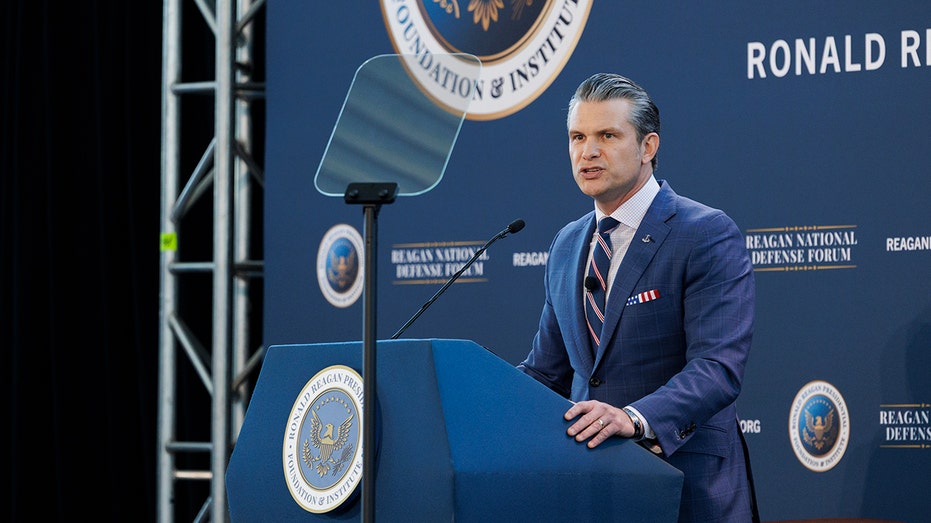
Secretary of War Pete Hegseth offered new details Saturday about how he personally authorized the Trump administration’s first strike on a suspected drug-smuggling vessel off Venezuela on Sept. 2, telling Fox News’ Lucas Tomlinson he watched the strike live in the Pentagon after giving the green light. Earlier in his keynote remarks, Hegseth declared that President Donald Trump is the true heir to Ronald Reagan’s “peace through strength” doctrine, accusing past bipartisan leaders of drifting into endless wars. After his speech, Hegseth sat down with Tomlinson for a Q&A that revealed new details about the Sept. 2 operation, which he said was the first in a series of more than 20 U.S. strikes targeting cartel-linked narco-terrorist networks across the Caribbean. He also sharply rejected reporting that he had instructed U.S. forces to kill all individuals on the boat. AS TRUMP’S STANDOFF WITH MADURO DEEPENS, EXPERTS WARN THE NEXT MOVE MAY FORCE A SHOWDOWN “(Is) anybody here from The Washington Post? I don’t know where you get your sources, but they suck,” Hegseth said when asked if he had ever issued such an order. “Of course not … you don’t walk in and say, ‘Kill them.’ It’s just patently ridiculous.” Hegseth also said it took “a couple of weeks, almost a month” to build the intelligence required for the first strike. He said the Pentagon had to reorient assets that had been focused “10,000 miles around the other side of the world for a very long time.” He kept strike authority at his level only for the initial operation due to its “strategic implications.” CAPITOL HILL REVOLT THREATENS TRUMP’S VENEZUELA PLAYBOOK AMID CARIBBEAN STRIKE OVERSIGHT “The briefing that I received before that strike was extensive, exhaustive,” he said. “Military side, on the civilian side, lawyers, intel analysts, red-teaming … all the details you need to strike a designated terrorist organization.” Hegseth said the target was part of an organization President Trump had formally designated as a terrorist group. “My job was to say execute or don’t execute,” he said. He approved the strike. HEGSETH TO HIGHLIGHT REBUILDING THE ‘ARSENAL OF FREEDOM’ IN SPEECH AT REAGAN NATIONAL DEFENSE FORUM According to Hegseth, he viewed the mission feed “for probably five minutes or so” before moving to other tasks once the strike shifted to tactical execution. Hours later, Hegseth said he was informed by commanders that a second strike was necessary. “There had to be a re-attack, because there were a couple of folks that could still be in the fight,” he said, citing access to radios, a possible link-up point with another boat and remaining drugs on board. “I fully support that strike,” he said. “I would have made the same call myself.” He added that secondary attacks are common in combat zones and fell “well within the authorities of Adm. Bradley,” who now oversees strike decisions. Hegseth said he no longer retains approval authority for subsequent missions. Addressing questions about survivor protocols, Hegseth pointed to a later incident involving a semi-submersible drug vessel. “In that particular case, the first strike didn’t take it out, and a couple of guys jumped off and swam,” he said. After the vessel was struck again and sank, U.S. forces retrieved the survivors. “We gave them back to their host countries,” he said, adding that the situation “didn’t change our protocol” but reflected different circumstances. HOUSE REPUBLICANS BACK TRUMP’S VENEZUELA MOVES FOR NOW AS ESCALATION UNCERTAINTY LOOMS Hegseth argued that the operations have already had a deterrent effect. “We’re putting them at the bottom of the Caribbean. … It will make the American people safer,” Hegseth said. Tomlinson pressed Hegseth on President Trump’s public statement that he did not oppose releasing the unredacted video of the first strike. “We’re reviewing it right now,” Hegseth said, citing concerns over “sources, methods” and ongoing operations. Hegseth said defense spending is one of the issues that “keeps [him] up,” adding he was recently in Oval Office meetings about the fiscal year 2026 and fiscal year 2027 budgets. Asked directly whether defense spending as a share of GDP will rise, he replied, “I think that number is going up,” while declining to get ahead of President Trump. “We need a revived defense industrial base,” he said. “We need those capabilities. We need them yesterday.” Tomlinson also asked whether Hegseth regretted using Signal ahead of combat operations in Yemen, referencing a recently closed inspector general review. “I don’t live with any regrets,” Hegseth said. “I know exactly where my compass is on our troops.” He argued that morale has surged under Trump. “The revival of the spirit inside our military … the desire to join and reenlist is at historic levels,” he said. Asked whether he prefers troops equipped with more AI-enabled tools or autonomous systems replacing them, Hegseth said the modern battlefield requires both. “It has to be both,” he said. “What AI is doing to ten, 100, 1,000 times the speed of sensing … is critical.” CLICK HERE TO DOWNLOAD THE FOX NEWS APP Tomlinson ended with a traditional Reagan Forum question, asking who Hegseth wants to win the Army–Navy game. “Well, I’m with Navy,” he said, before adding that the Marine Corps “stood strong” during political “nonsense” in recent years.
Dr. Oz warns Walz to address alleged Somali Medicaid fraud or lose federal funding: ‘We’ll stop paying’
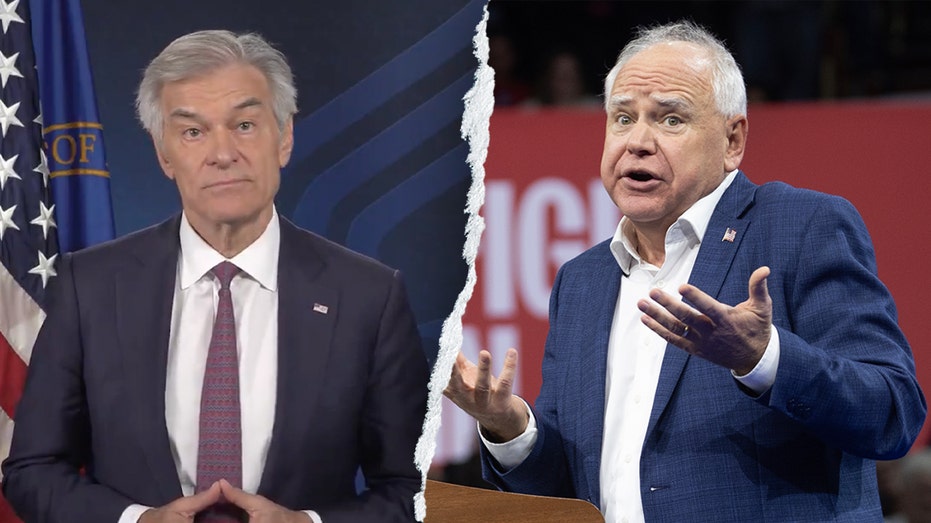
Centers for Medicare & Medicaid Services (CMS) Administrator Mehmet Oz on Friday warned Minnesota Gov. Tim Walz the state could lose federal Medicaid funding unless it restores “the integrity” of its program. In a post on X, Dr. Oz claimed more than $1 billion had been stolen through a massive Medicaid fraud scheme carried out by “bad actors” within Minnesota’s Somali community, alleging some of the funds “may have even made its way to the Somalian terrorist group (al-Shabab).” “Our staff at CMS told me they’ve never seen anything like this in Medicaid — and everyone from Gov. Tim Walz on down needs to be investigated, because they’ve been asleep at the wheel,” Oz said. COMER TARGETS WALZ IN NEW HOUSE INVESTIGATION, CITING NEARLY $1B IN ALLEGED MINNESOTA FRAUD Oz demanded Walz take the following corrective measures within 60 days: “If we’re unsatisfied with the state’s plans or cooperation, we’ll stop paying the federal share of these programs,” Oz warned. The CMS administrator pointed to two Minnesota Medicaid programs launched in recent years, noting dramatic spikes in costs. The Housing Stabilization Services program, projected at $2.6 million annually, paid out over $100 million in 2024, according to Oz. The Early Intensive Developmental and Behavioral Intervention program grew from $3 million in 2018 to nearly $400 million in 2023, he said. WALZ ‘DERELICT LEADERSHIP’ TO BLAME IN $1B FRAUD SCANDAL WITH ‘HAUNTING REMINDS OF WATERGATE’: GOP CHALLENGER “These scammers used stolen taxpayer money to buy flashy cars, purchase overseas real estate and offer kickbacks to parents who enrolled their kids at fake autism treatment centers,” Oz said. “Some of it may have even made its way to the Somalian terrorist group al-Shabab. … So why didn’t Walz stop them? That’s simple: because he went all-in on identity politics.” Minnesota officials previously reported the problem to CMS but failed to address it effectively, according to Oz. “We stepped in and shut down the worst program: housing. We also froze provider enrollment in a few of the most abused programs,” Oz said. PHOTOS EMERGE OF SOMALI ILLEGAL’S TIES TO TOP MINNESOTA DEMS AFTER ICE ARREST “The message to Walz is clear: either fix this in 60 days or start looking under your couch for spare change, because we’re done footing the bill for your incompetence.” President Donald Trump recently announced a flurry of actions to crack down and investigate fraud schemes in Minnesota, which he has assailed as a “hub of money laundering activity,” and cited it as the basis of his decision to terminate deportation protections for hundreds of Somali migrants. This week, senior Trump administration officials announced fresh investigations, including a new Treasury Department probe into how taxpayer dollars were allegedly diverted to the terrorist organization al-Shabab, according to Secretary Scott Bessent. Walz’s office did not immediately respond to Fox News Digital’s request for comment. Fox News Digital’s Breanne Deppisch contributed to this report.
Hegseth to highlight rebuilding the ‘arsenal of freedom’ in speech at Reagan National Defense Forum
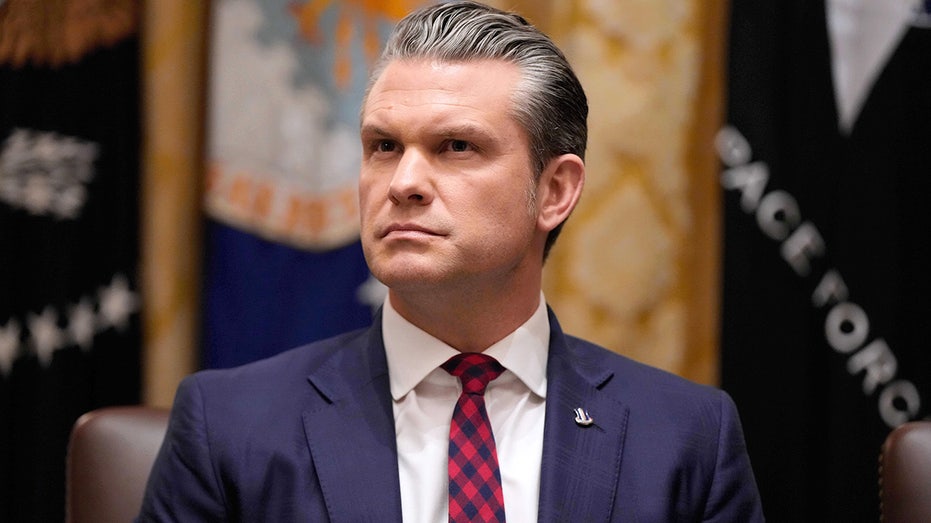
Secretary of War Pete Hegseth is preparing to deliver a speech Saturday on rebuilding the “arsenal of freedom” at the Reagan National Defense Forum in Simi Valley, California. Ahead of the keynote address, Hegseth shared a video on X touring facilities in California. “The era of vendor-locked, prime-dominated, closed architecture, cost plus is over. We’re going to compete. We’re going to move fast. We’re going to do open architecture. We’re going to innovate. We’re going to scale. We’re going to do it at cost. Because this is a commitment to a mission,” Hegseth said in the video. “Whether you’re a vet or not who served already, all of you are serving the Department of War, the American people and the arsenal of freedom,” Hegseth said. “I need you to understand that, yes, we’re here for the warfighters who are out there pulling triggers on the behalf of our nation right now. Everybody here’s touched someone who serves at some point. But they can’t succeed without you.” WAR DEPARTMENT REFOCUSES ON AI, HYPERSONICS AND DIRECTED ENERGY IN MAJOR STRATEGY OVERHAUL The secretary told those building the Department of War’s arsenal that American troops would not be able to do what’s required of them “in far-flung places, in dangerous moments, in the dead of night without the capabilities that you will underwrite for them.” “So, this arsenal of freedom is built not just with men and women in camouflage. But it’s in folks in civilian clothes all across the country who are also putting in the work 24/7, to out-compete, out-innovate and out-manufacture our opponents,” Hegseth declared. Hegseth’s speech is scheduled to begin around 2:50 p.m. ET, according to a Reagan National Defense Forum schedule. He will be joined at the event by other leaders from the U.S. military. “We are rebuilding the Arsenal of Freedom,” Hegseth wrote on X alongside the video. SAUDI ARABIA IS ALREADY AMERICA’S TOP ARMS BUYER AND NOW TRUMP WANTS TO ADD F-35S The event is being held at the Ronald Reagan Presidential Library in Simi Valley. “The Reagan National Defense Forum (RNDF) brings together leaders from across the political spectrum and key stakeholders in the defense community, including Members of Congress, current and former Administration officials, senior military leadership, industry executives, technology innovators, and thought leaders,” the Forum said on its website. “Their mission is to review and assess policies that strengthen America’s national defense in the context of the global threat environment.” Notable speakers at the event so far on Saturday included Russell Vought, the director of the United States Office of Management and Budget; Rep. Adam Smith, D-Wash., who is the ranking member of the House Armed Services Committee; Emil Michael, the U.S. under secretary of war for research and engineering; and Adm. Samuel Paparo, commander of the U.S. Indo-Pacific Command.
South Africa shooting leaves 12 dead, including young child: Police
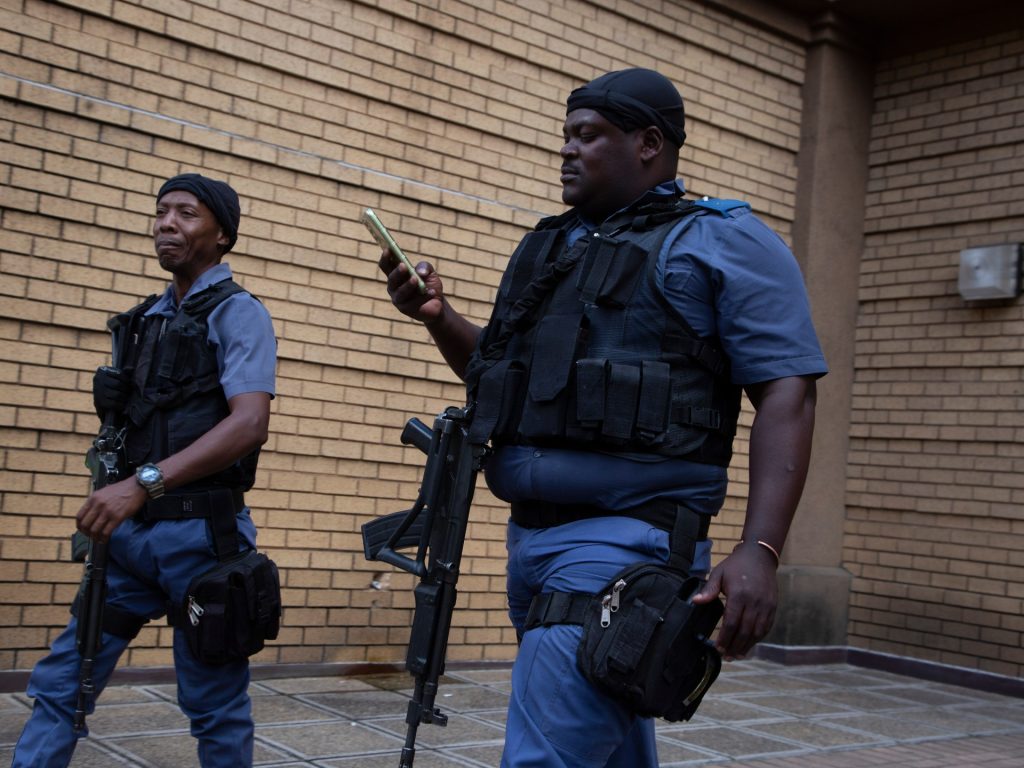
South Africa, grappling with entrenched crime and corruption, has one of the world’s highest murder rates. By News Agencies Published On 6 Dec 20256 Dec 2025 Click here to share on social media share2 Share Gunmen have killed at least 12 people, including a three-year-old boy, in a mass shooting at a bar near the South African city of Pretoria, according to police. Athlenda Mathe, spokesperson for the South African Police Service (SAPS), confirmed on Saturday that a total of 25 people were shot in the bar in Saulsville township, 18km (11 miles) west of Pretoria, adding that 14 had been taken to hospital. Recommended Stories list of 3 itemsend of list Police said three minors were among the dead in the shooting, including the three-year-old, a 12-year-old boy and a 16-year-old girl. The shooting occurred in what Mathe described as an “illegal shebeen” – or bar – within a hostel at about 4:30am (02:30 GMT), with three gunmen indiscriminately firing at a group of men who were drinking. Police were not alerted until about 6am (04:00 GMT). They said a manhunt had been launched and that the motive was as yet unknown. South Africa, the continent’s most industrialised nation, is grappling with entrenched crime and corruption driven by organised networks. The country has one of the world’s highest murder rates, spurred by robberies and gang violence, with some 63 people killed each day between April and September, according to police data. “We are having a serious challenge when it comes to these illegal and unlicensed liquor premises,” Mathe said, adding that they are where most mass shootings occur. “Innocent people also get caught up in the crossfire,” she told public broadcaster SABC. In October, two teenagers were killed and five wounded in a gang‑related shooting in Johannesburg, the country’s financial capital. Advertisement In another incident in May, gunmen killed eight customers at a tavern in the southeastern city of Durban. Last year, 18 relatives were shot dead at a rural homestead in the country’s Eastern Cape province. Many people in South Africa own licensed firearms for personal protection, but there are many more illegal guns in circulation. Adblock test (Why?)
World Cup 2026: Re-disappearing Mexico’s disappeared

The city of Guadalajara in Mexico is scheduled to host four World Cup matches next year, and labourers are working around the clock to revamp infrastructure in time for the tournament. On account of frenzied construction, the city’s roads are presently a bona fide mess, constituting a perpetual headache for those who must transit them. But Guadalajara has a much bigger problem than traffic. The metropolis is the capital of the western state of Jalisco, which happens to possess the highest number of disappeared people in all of Mexico. The official tally of Jalisco’s disappeared is close to 16,000, out of a total of more than 130,000 countrywide. However, the frequent reluctance of family members to report missing persons for fear of retribution means the true toll is undoubtedly higher. Now, with the World Cup fast approaching, Mexican authorities are also working overtime to sanitise Guadalajara’s image. For months, local officials have been threatening to remove the portraits and signs from the towering “roundabout of the disappeared” in the centre of the city, effectively re-disappearing them. I recently spent five days in Guadalajara and paid a visit to the roundabout, a few kilometres’ walk from my accommodation. The closer I got to the site, the more posters proliferated across electrical poles and sidewalk planters featuring the faces and identifying information of the disappeared. Some of these posters also appeared plastered in larger form onto the monument itself. There was, for example, 32-year-old Elda Adriana Valdez Montoya, last seen in Guadalajara on August 10, 2020. And 19-year-old Jordy Alejandro Cardenas Flores, last seen on May 19, 2022, in the nearby city of Tlaquepaque. There was 16-year-old Cristofer Aaron Leobardo Ramirez Camarena, last seen in the Jalisco municipality of Tlajomulco de Zuniga on April 21, 2024. And 67-year-old Martha Leticia Diaz Lopez, last seen in Guadalajara on June 27, 2025. Advertisement In the case of Cardenas Flores, the poster specified that the young man had been “taken” on May 19 by agents from the state prosecutor’s office, from which appointment he never returned. While there is a tendency to blame Mexico’s astronomical disappearance rates on violent drug cartels, including the notorious Jalisco New Generation Cartel, the government is thoroughly implicated in the phenomenon, as well – whether by direct action, collaboration with criminal outfits, or simply in terms of safeguarding the panorama of near-total impunity that permits such crimes to flourish. It bears underscoring, too, that the vast majority of disappearances took place following the launch in 2006 of Mexico’s so-called “war on drugs”, which not only failed to resolve the drug issue but also set the stage for more than 460,000 homicides in the country. The war effort was backed by – who else? – the United States, which rarely misses out on an opportunity for blood-soaked hemispheric meddling. But heaven forbid World Cup spectators be subjected to such a morbid reality – although it is becoming rather difficult to cover up the discovery of mass clandestine graves and hundreds of bags containing human remains in the vicinity of the Guadalajara football stadium. While in Guadalajara, I spoke with Maribel Cedeno, a representative of the Guerreros Buscadores de Jalisco (Warrior Searchers of Jalisco), one of various collectives dedicated to the search for the missing in the face of willful government inaction. Her brother, Jose Gil Cedeno Rosales, was disappeared on September 21, 2021, in Tlajomulco de Zuniga. As Cedeno commented to me, “absolutely nothing has changed” during the presidency of Claudia Sheinbaum, who assumed office last year after promising a more sympathetic approach to the issue of Mexico’s disappeared. Once in power, Sheinbaum apparently forgot her own pledge, effectively condemning countless Mexicans whose loved ones are missing to a state of continuous psychological torment. Remarking on the expansive measures the government is pursuing to provide security for the World Cup, Cedeno demanded: “But where is our security? Where is the security for our family members, or for those of us whose lives are at risk because we are searching for the missing?” They are good questions. And yet they are not ones that are keeping the authorities up at night. In March, the Guerreros Buscadores de Jalisco discovered a clandestine crematorium on a ranch outside the town of Teuchitlan, an hour from Guadalajara, which was reportedly utilised by the Jalisco New Generation Cartel as a recruitment and training centre in addition to an extermination site. Advertisement Curiously, Mexican authorities had seized the ranch months earlier, but hadn’t managed to notice any of the human bone fragments or the hundreds of shoes littering the place. On my final day in Guadalajara, I took an Uber out to the ranch, which appeared on the Uber app as “Campo de adiestramiento y exterminio” – training and extermination camp. Thinking better of it, I put the Teuchitlan town centre as my destination, and while en route proposed to the driver that I pay him in cash to swing by the ranch, as well. He made the sign of the cross, but agreed. A gregarious middle-aged man from eastern Jalisco, the driver had spent 11 years as an undocumented worker in California and Oregon; his son was studying engineering at a university in Michigan. He had personally known several people, including two sisters, who had been disappeared from his hometown, and lamented that the only time the Mexican authorities seemed inspired to seek justice for homicides was when the victims themselves had been members of the security forces. And although a die-hard football fan, the driver said he could not justify the state’s decision to pour massive quantities of money into a World Cup spectacle that would not remotely benefit the average Mexican. In Teuchitlan, we took a brief stroll around the town’s colourful central plaza and bought a few beers, then programmed our destination to “Campo de adiestramiento y exterminio”, which led us down a dusty and isolated road patrolled by an ominous black vehicle. When we found the camp blocked by the Mexican
Syria’s al-Sharaa promises peace and unity in face of Israeli aggression
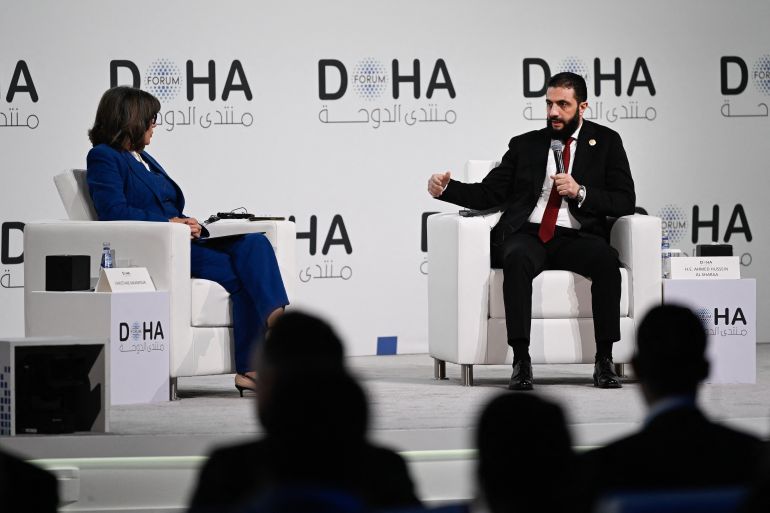
Doha, Qatar – Syria’s President Ahmed al-Sharaa accused Israel of heightening regional tensions and fabricating external threats to divert attention from the “horrifying massacres” it has committed in Gaza. Speaking to CNN’s Christiane Amanpour on Saturday during the Newsmaker Interview at the Doha Forum, al-Sharaa said Israeli leaders “often exports crises to other countries” as they increasingly invoke security pretexts to expand military action. Recommended Stories list of 3 itemsend of list “They justify everything, using their security concerns, and they take October 7 and extrapolate it to everything that is happening around them,” he said. “Israel has become a country that is in a fight against ghosts.” Since the the Bashar al-Assad regime fell in December 2024, Israel has carried out frequent air strikes across Syria, killing hundreds of people, while also conducting ground operations in the south. Last month, Israeli forces killed at least 13 people in the Damascus countryside town of Beit Jinn. In addition, it has advanced deeper into Syrian territory and established numerous checkpoints, while illegally detaining Syrian citizens and holding them inside Israel. Syrian President Ahmed al-Sharaa, right, speaks during the opening day of the Doha Forum [AFP] Al-Sharaa said his administration had worked to de-escalate tensions with Israel since he assumed office, emphasising that “we sent positive messages regarding regional peace and stability”. “We’ve said very frankly that Syria will be a country of stability, and we are not concerned with being a country that exports conflict, including to Israel,” he said. Advertisement “However, in return, Israel has met us with extreme violence, and Syria has suffered massive violations of our airspace.” ‘Syria attacked by Israel, not the opposite’ Al-Sharaa said Israel must withdraw to where they were before the fall of al-Assad, and preserve the 1974 Disengagement Accord. The accord established a ceasefire following the October 1973 Yom Kippur war, creating a United Nations-monitored buffer zone on the Israeli-occupied Golan Heights. “This agreement has held on for over 50 years,” al-Sharaa said, cautioning that efforts to replace it with new arrangements, such as a buffer or demilitarised zone, could push the region “into a serious and dangerous place”. “Who will protect that zone? Israel often says that they are afraid of coming under attack from southern Syria, so who will be protecting this buffer zone or this demilitarised zone, if the Syrian army or the Syrian forces are going to be there?” he asked. On Tuesday, Israeli Prime Minister Benjamin Netanyahu said a deal with Syria was within reach, but that he expected Syrian government forces to create a demilitarised buffer zone extending from the capital, Damascus, to Jabal al-Sheikh in the Israeli-occupied Syrian Golan Heights. “It is Syria that is being attacked by Israel and not the opposite,” he said. “Therefore, who has more right to claim a buffer zone and a pullout?” Unity in Syria On the question of unity, al-Sharaa said there was progress and ongoing challenges. “I believe Syria is living through its best days. We are talking about a country that’s aware, that’s conscious,” he said, while stressing that no country can achieve total “unanimity”. “This doesn’t occur even in advanced countries that are living through relative stability.”According to al-Sharaa, people in Syria “simply did not know each other well” due to issues inherited from the al-Assad regime. “We actually resorted to pardoning a large number of people and a large number of factions so that we can build a sustainable, safe and secure future for the Syrian people,” he added. Moreover, he rejected the notion the uprising against al-Assad was a “Sunni revolution”. “All the components of Syrian society were part of the revolution,” he said. “Even the Alawites had to pay the price of them being used by the former regime. So I do not agree with the definition or with saying that all the Alawites were supporting the regime. Some of them were living in fear.” Syria witnessed an outbreak of sectarian violence earlier this year, including in the coastal areas in March, where hundreds of people from the Alawite religious minority were killed, with members of the new government’s security forces among the perpetrators. Advertisement Fighting also broke out between government forces and their allies with Bedouin tribes in Suwayda in July, in which more than 1,400 people, mainly civilians, were killed. “We know that there are some crimes that were perpetrated … this is a negative thing,” he said. “I insist … that we do not accept what happened. But I say that Syria is a state of law, and the law rules in Syria, and the law is the only way to preserve everybody’s rights.” Many rights groups are concerned that women will be particularly at risk under the new government led by the former al-Qaeda operative, as al-Sharaa’s Hayat al-Tahrir group severely restricted women’s freedoms, including public participation and dress code, during their rule over Idlib in northwest Syria. On what the role of women looks like in Syria today, al-Sharaa said they were “empowered” under his rule. “Their rights are protected and guaranteed, and we constantly strive to ensure that women are fully participating in our government and our parliament as well,” he added. “I believe you should not fear for Syrian women, fear for Syrian men,” Sharaa joked. Elections to be held within five years Al-Sharaa stressed that Syria’s path forward lies in strengthening institutions rather than consolidating individual power, and that he was committed to conducting elections after the ongoing transition period ends. “Syria is not a tribe. Syria is a country, a country with rich ideas … I do not believe we are ready right now to undertake parliamentary elections,” he said. Nevertheless, al-Sharaa said parliamentary elections will take place within five years of when the temporary Constitutional Declaration was signed back in March, giving him the mandate to lead Syria through a five-year transition period. “The principle of people choosing their leaders is a basic principle … it is even part of our religion
IndiGo Crisis Day 5: Govt takes action, imposes limitations on air ticket prices, orders airlines to…
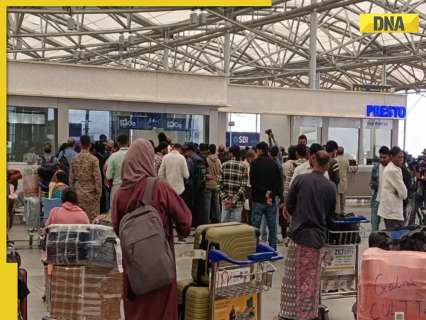
In order to protect passengers from any form of opportunistic pricing, the Ministry has invoked its regulatory powers to ensure fair and reasonable fares across all affected routes.
Govt’s BIG order to IndiGo on refunds, baggage amid mass flight cancellations; check details

The unprecedented IndiGo crisis continued to impact passengers across the country on Saturday as more than 500 flights were cancelled, with the Kempegowda International Airport, which serves Bengaluru, being the worst-affected.
Who has higher salary: Russia’s Vladimir Putin or President Droupadi Murmu? Here’s a breakdown
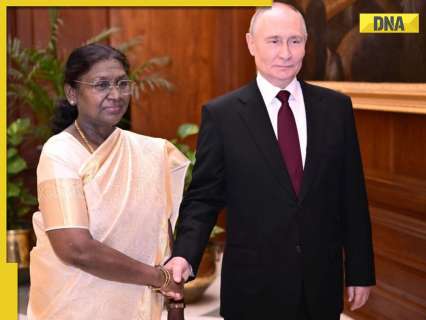
Before leaving for Russia, Putin will join President Murmu for dinner at 7.30. Amid all this, attention has shifted to a direct question about his wealth.
Amid over 1000 flights cancellations, Indigo shares BIG update on automatic refunds, rescheduling fees: ‘No questions asked…’

Amid 1000 Indigo flight cancellations that has impacted thousands of passengers, Airline has issued an update on the automatic refunds and full waivers on cancellations and reschedule requests for travel bookings between December 5 to 15.