

In Pakistan, old hopefuls jostle to turn around struggling economy
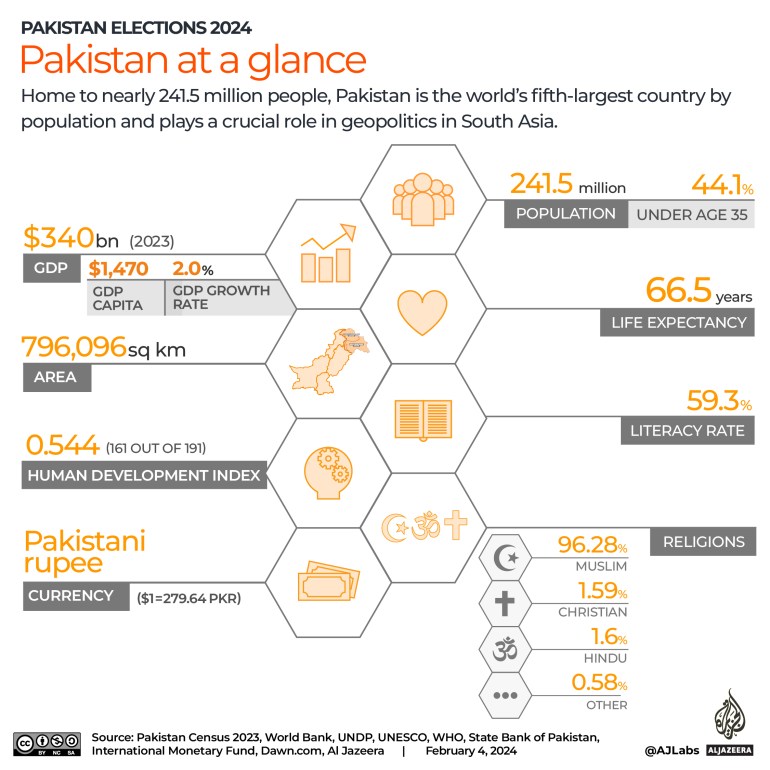
Pakistani voters head to the polls on Thursday amid a deep-seated economic crisis. Inflation is hovering at 30 percent, close to 40 percent of people live below the poverty line, and the debt-to-gross domestic product (GDP) ratio has climbed to 72 percent. Pakistan’s new government will have to contend with these and an ageing public infrastructure. “We have power outages every day for two hours,” says Muhammad Waqas, a janitor from Islamabad. “In the summer, when it’s hot, you sit idly and suffer.” As with other state-owned firms, the inability of successive governments to invest in Pakistan’s National Transmission and Despatch Company has left it prone to failure. More recently, the COVID-19 pandemic and energy supply challenges dampened Pakistan’s growth prospects and constrained efforts to diversify its export base away from low-value-added products – such as cotton and rice – to higher-value goods. In late 2022, meanwhile, monsoon floods displaced eight million people and cost the country $30bn in damage. The loss of cotton crops ravaged the country’s textile industry, a key source of exports. In all likelihood, Pakistan’s growth rate fell into negative territory in 2023. Pakistan, which imports much of its food and fuel, consistently records large trade deficits. Owing in part to elevated commodity prices, foreign exchange reserves dwindled to less than one month of imports last May, leading to shortages of vital goods. The following month, Islamabad narrowly avoided default after it secured a $3bn loan from the IMF – its 23rd fund programme since 1958. However, the lending package came with strict conditions and unpopular reforms. As part of the deal, the government agreed to impose new taxes on its faltering power sector. It also agreed to lower utility subsidies, which led to sharp hikes in electricity prices, hitting poorer households particularly hard. Inflation, which reached nearly 30 percent in December, has been climbing since the start of last year after Pakistan’s central bank agreed to liberalise its exchange rate as part of a pre-existing IMF programme. Once exchange controls were dropped, the value of the currency fell sharply. The Pakistani rupee was Asia’s worst-performing currency in 2023, depreciating by roughly 20 percent against the US dollar. “We think the rupee will continue trending down slightly,” said Krisjanis Krustins, a director at Fitch Ratings. “This will lower Pakistan’s current account deficit as goods from abroad will become more expensive, compressing import levels.” According to the State Bank of Pakistan, the country posted a balance of payments surplus of $397m last December. Krustins told Al Jazeera, “Pakistan’s goods imports fell by 27 percent in the last calendar year. As for exports, they continue to be held back by limited human capital and poor infrastructure. So, corrections in the trade account have had a depressing impact on the economy.” Recent job losses have lifted the official unemployment rate to a record high of 8.5 percent, pitching an additional 8.4 to 9.1 million people into poverty. ‘Structural issues’ Separately, Pakistan has long suffered from “structural issues”, says Tariq Banuri, professor of economics at the University of Utah. “For starters, Pakistan’s growth rate is not high enough to absorb its rapidly expanding population. It’s also one of the world’s worst performers on tax collection. Agricultural landowners are exempt from income tax, and there’s no capital gains tax on real estate.” Successive governments have stopped short of imposing robust tax legislation for fear of upsetting powerful business interests, Banuri said. “But that may change this year because of the debt situation,” he added. Islamabad’s failure to boost tax revenues and modernise state-owned enterprises has generated persistent fiscal deficits and a large debt burden. In absolute terms, external debt reached $125.7bn last year. Looking ahead, Pakistan faces $24.6bn in external debt repayments by the end of June, the bulk of which is owed to China. China is Pakistan’s largest bilateral creditor, and Beijing agreed to roll over $2.4bn in loans last year. Many economists expect the incoming government to try and secure longer-term financing from the IMF – its current deal expires in April. Given the cutbacks to public spending last year, “further fiscal consolidation is unlikely”, says Yousuf Farooq, director of research at Chase Securities. “The Fund is going to try and eke out further conditions, but probably from wealthier sections of society.” “Assuming the new government can get another IMF loan, it will struggle to repay unless it imposes new taxes on agriculture and real estate. If it can also roll over short-term contracts with longer repayment schedules, I’m hopeful that debt will fall in the near term,” he said. In the meantime, foreign investment continues to be hamstrung by security concerns along the Pakistan-Afghanistan border. Since the Taliban returned to power in Kabul in 2021, Islamabad has accused its neighbour of harbouring fighters carrying out attacks on its soil. Political crisis An unfolding political crisis is also threatening Pakistan’s economic recovery. Today, Islamabad’s fragile democracy is overseen by a caretaker government following Imran Khan’s dismissal as prime minister in April 2022. The legitimacy of the February 8 elections has been questioned as Khan is absent from the ballot sheet. He is in jail on corruption charges. And while he is disqualified from running, Khan’s approval rating stands at 57 percent, higher than any other politician. As things stand, the head of the Pakistan Muslim League-Nawaz (PMLN) – is favourite to win. Sharif’s PMLN has assumed power four times in the past three decades, under either himself or his brother Shehbaz Sharif. Earlier this month, the Supreme Court further weakened Khan’s Pakistan Tehreek-e-Insaf (PTI) campaign by banning the use of a cricket bat as its symbol – a serious setback in a country where millions of illiterate voters identify candidates by their party logos. For Banuri, the economics professor, “People are right to criticise Pakistan’s political system, which is dynastic and extractive. But for all that, I remain an optimist. I think the worst of the economic crisis is behind us.” “While I always hope tomorrow will be
In Modi’s constituency Varanasi, India’s next temple-mosque spat explodes

Varanasi/Bengaluru, India – A festive atmosphere engulfed Varanasi, one of Hinduism’s holiest cities situated on the banks of the river Ganga. It was the week Prime Minister Narendra Modi had inaugurated the new temple to the Hindu deity Ram where the 16th century Babri Masjid once stood in the city of Ayodhya, 200km (124 miles) to the north. In Varanasi, the streets and boats on the river were decked up with saffron flags bearing illustrations of Ram. Outside Varanasi’s famous and historic Kashi Vishwanath temple, the smell of burning camphor and the sound of Indian classical music drifted through the air as pilgrims flocked in large numbers to the temple to offer their prayers. But next door, towards the west of the temple, the carnival-like spirit was replaced with a strict and sombre atmosphere, with barricades and police officers greeting crowds. The officers were guarding the Gyanvapi Mosque – which is widely believed to have been built on the ruins of a 16th-century Kashi Vishwanath temple demolished by Mughal emperor Aurangzeb in 1669. While the partially ruined Kashi temple has been reconstructed and stands adjacent to the Gyanvapi Mosque, Hindu supremacist groups have been trying to reclaim the mosque for decades. Security personnel stand guard near the Gyanvapi Mosque in Varanasi [File: Niharika Kulkarni/AFP] In May 2022, some Hindu patrons went to the Varanasi local court asking for permission to worship within the mosque’s complex after a court-ordered video survey found that a ‘Shivling’ – a symbol of the Hindu deity Shiva – was found near the wuzukhana, a well used by Muslim devotees at the mosque. This case gained momentum in January this year when a survey from the Archaeological Survey of India (ASI), among other things, stated that a large Hindu temple existed on the site before the mosque and that sculptures of Hindu deities were also present in the cellars of the mosque. Within a few days, on January 31, Judge Ajaya Krishna Vishvesha from Varanasi’s local court passed an order ruling that Hindus would be allowed to pray in the mosque’s basement – a section which had been sealed due to security concerns. “District court Varanasi has created history today,” Vishnu Jain, a Supreme Court lawyer representing the Hindu side said in a post on X. A day later, videos and images began appearing on social media of a priest offering prayers to the Hindu deities inside the mosque cellar. #WATCH | A priest offers prayers at ‘Vyas Ji ka Tehkhana’ inside Gyanvapi mosque in Varanasi, after District court order. Visuals confirmed by Vishnu Shankar Jain, the lawyer for the Hindu side in the Gyanvapi case pic.twitter.com/mUB6TMGpET — ANI (@ANI) February 1, 2024 The Anjuman Intezamia Masajid, the committee managing the Gyanvapi Mosque, rejected the local court’s order and is scheduled to challenge the case at the Allahabad High Court in the city of Prayagraj, formerly known as Allahabad, on February 6. “It seems like the judicial system is against Muslims,” Rais Ahmad Ansari, an advocate in Varanasi representing the Muslim side, told Al Jazeera. Even amid a heightened momentum among India’s Hindu supremacist movement to target mosques, often facilitated by government authorities – a centuries-old mosque was razed in New Delhi last week – the case involving the Gyanyavi structure holds deep political significance. Varanasi is the electoral constituency of Modi, who leads the Hindu majoritarian Bharatiya Janata Party (BJP) that rules the country, yet has built strong relations with the presidents and ministers of Western liberal democracies. India will vote in general elections expected to be held between March and May. ‘You can feel a Hindu vibe all around you’ While the court order hasn’t stirred any violence or communal riots, a sense of anxiety is prevalent in the Muslim neighbourhoods of the city, according to advocate Ansari. “Muslim-owned shops closed after the [January 31] hearing fearing a dispute. Friday’s namaz [prayers] was also greeted with tight security presence as hundreds gathered outside the Gynavapi Mosque to offer prayers. There is a sense of anxiety in every Muslim’s mind,” he said. “It is still peaceful in Varanasi. But this peace feels uneasy,” he added. Meanwhile, some news channels in the country hailed the local court order and the onset of prayers in the mosque as “a big win for Hindus” – a sentiment shared by several Hindus in Varanasi. “We plan to go visit the site and see the priest performing rituals at the mosque as soon as our exams end,” Ayush Akash and Harshit Sharma, two 21-year-old political science students at the Banaras Hindu University (BHU), told Al Jazeera. Nita*, a Hindu devotee at the Kashi Vishwanath temple, was also keen to pray at the temple. “We feel great about it [court ruling]. If we are let to visit and pray, we will go. When Hindus pray in Varanasi, they have their own places of worship. My brother is a priest and can only worship in his temple. But if the priest allows us into Gyanvapi, we will surely go,” she told Al Jazeera. “People here have been going crazy since the inauguration of the Ayodhya temple,” Nita said. “You can feel a Hindu vibe all around you on the streets. It was never like this before, but everybody is happy about things that are happening and that the Gyanvapi is a Hindu temple,” she added. Spectators gather to watch the nightly Ganga Aarti prayer, in which several Hindu priests twirl flaming lanterns and censers over the Ganges, in Varanasi, India [Joseph Campbell/Reuters] BHU’s Akash pointed out that people from all religions in Varanasi have coexisted peacefully for years and are mature enough not to riot over the temple-mosque dispute. “It might look like Hindus are in power, and yes, some Muslim people might be unhappy about the local court’s decision on the Gyanvapi Mosque. But in this city, while ideologies do differ, it doesn’t stop Hindu-Muslim friendship. That’s how the real Varanasi is,” he said. ‘All about politics’ Since Modi came to power
Chandigarh mayor elections: AAP presents ‘proof’ of ballot paper tampering by ‘Presiding Officer of BJP’

Earlier in the day, the Supreme Court slammed the civic poll officer who held the Chandigarh Mayor elections and said that it is obvious that the returning officer has “defaced” the ballot papers.
Uniform Civil Code bill to be tabled in Uttarakhand Assembly today

The bill will be tabled during the ongoing four-day special session of the assembly, which began on Monday.
Senegal parliament delays election to December 15 after chaotic vote
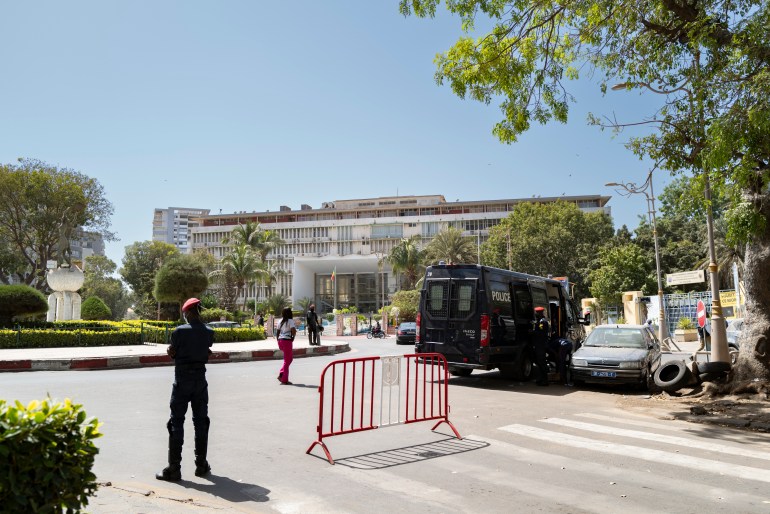
Senegal’s parliament has voted to delay the presidential election to December 15 in a chaotic vote that took place after opposition lawmakers were forcibly removed from the chamber as they debated President Macky Sall’s earlier decision to delay the crucial election. Sall announced on Saturday that the election, which was scheduled for February 25, would be postponed, pitching the West African nation into uncharted constitutional waters, and triggering violent protests. Parliamentary backing came late on Monday when 105 MPs in the 165-seat assembly voted in favour of the measure, which delays the election until December and keeps Sall in office until his successor is installed. The bill initially set an election date on August 25, and the move to delay the poll even further is likely to risk more unrest. The president, who has served the maximum two terms, was originally due to leave office on April 2. Sall has said previously he has no plans to extend his term, but protesters are sceptical. As the lawmakers debated the bill on Monday, security forces fired tear gas at protesters who had gathered outside the parliament in Dakar, burning tyres and criticising Sall. Demonstrator Malick Diouf, 37, said he had no preferred candidate and did not even have a voting card, but felt it was crucial to come out and protest. “The main thing for me is to say ‘no’ to this political agenda, this coup de force to try to stay in power,” he told the AFP news agency. Security was tight around the National Assembly in Dakar [Sylvain Cherkaoui/AP Photo] Opposition leaders had condemned the proposed delay, announced just as campaigning was due to start, as a “constitutional coup” and an assault on democracy. The mood in parliament was also tense with some deputies shoving and pushing one another, leading to a temporary recess. Security forces later stormed the building and forcibly removed several opposition lawmakers who had occupied the central dais and were trying to block the voting process. “What you are doing is not democratic, it’s not republican,” said Guy Marius Sagna, who was one of several rebel MPs wearing a sash in the colours of the Senegalese flag. Democracy at risk The postponement faced strong pushback elsewhere on Monday. At least three of the 20 presidential candidates submitted legal challenges to the delay, Constitutional Council documents showed. Two more candidates have pledged to challenge it via the courts. Authorities temporarily restricted mobile internet access from Sunday night, citing hate messages on social media and threats to public order. Several schools sent pupils home early. The private Walf television channel said it was taken off air on Sunday and had its licence revoked. “Senegal has been known as a country with a strong democracy but this is no longer the case,” one protester who only gave his first name, Dame, told Reuters. “The only thing we want is a fair election.” He said he was worried Sall would cling on to power indefinitely. The chairman of the African Union Commission, Moussa Faki Mahamat, urged Senegal to resolve its “political dispute through consultation, understanding and dialogue”. Human Rights Watch warned that Senegal risked losing its democratic credentials. “Senegal has long been considered a beacon of democracy in the region. This is now at risk,” it said in a statement. “Authorities need to act to prevent violence, rein in abusive security forces, and end their assault on opposition and media. They should respect freedom of speech, expression and assembly, and restore internet, putting Senegal back on its democratic course.” The crisis has led to fears of the kind of violent unrest that broke out in March 2021 and June 2023, which resulted in dozens of deaths and hundreds of arrests. Sall said he delayed the election due to a dispute over the candidate list and alleged corruption within the constitutional body that handled the list. The opposition Senegalese Democratic Party (PDS), whose candidate was barred from running because of dual nationality issues, supports the delay and proposed the postponement bill in parliament before Sall’s announcement. The bill passed due to backing by the ruling party and the opposition coalition, which includes PDS. Other opposition and civil society groups have angrily rejected it, with some saying Sall is trying to postpone his departure. The F24 platform, a large group of organisations behind past demonstrations, and candidate Khalifa Sall, have called it an “institutional coup”. Adblock test (Why?)
US admits it did not give Iraq notice of strikes despite earlier claims

White House National Security Council spokesman John Kirby says he regrets confusion caused by his remarks. The United States has admitted it did not notify the Iraqi government before its recent air strikes in the country after a top White House official claimed Baghdad had been informed in advance. State Department deputy spokesman Vedant Patel said on Monday that Iraqi officials were only informed after the strikes on Iranian-linked targets. “Iraq, like every country in the region, understood that there would be a response after the deaths of our soldiers. As for this specific response on Friday, there was not a pre-notification,” Patel told reporters. “We informed the Iraqis immediately after the strikes occurred.” The clarification came after White House National Security Council spokesman John Kirby on Friday said that Washington had informed the Iraqi government in advance. Kirby said on Monday that he had responded to reporters’ questions with the “information that I had been provided at the time”. “It was not as specific as it could have been, and I regret any confusion caused,” he said. “That said, we had made no secret – both to Iraqi officials and in public channels – that we would respond to the attacks on our troops. And, we did, in fact, officially notify Iraq, as appropriate with standard procedure.” US President Joe Biden on Friday ordered air strikes against 85 targets in Iraq and Syria alleged to be linked to Iran’s Islamic Revolutionary Guard Corps (IRGC) and pro-Iranian groups, following a drone attack in Jordan that killed three US troops. Iraq condemned the strikes, which officials said killed 16 people, including civilians, as a violation of its sovereignty that placed the security in the region on the “brink of the abyss”. Iraqi government spokesman Bassem al-Awadi rejected the suggestion that his country had helped to coordinate the attacks, accusing Washington of making a “false claim aimed at misleading international public opinion and disavowing legal responsibility”. Tensions between Washington and Baghdad have escalated in recent months as the Biden administration has carried out strikes inside Iraq in response to a surge in attacks on US forces since the start of the war in Gaza that it has blamed on Iran-aligned groups. About 2,500 US troops are stationed in Iraq, a legacy of the US-led coalition’s war against the ISIL (ISIS) group. Last month, US Defense Secretary Lloyd Austin said Washington would begin talks with Baghdad on the withdrawal of US-led forces in the country while maintaining security ties between the sides. Adblock test (Why?)
Noida Metro: Big update on metro rail’s entry into Noida Extension

There have been several demonstrations by locals over the years for metro rail connectivity and bus service in the region.
House committee votes to advance impeachment case against DHS Secretary Mayorkas to full chamber

The Republican-led House Rules Committee on Monday voted 8-4 to send an impeachment case against Homeland Security Secretary Alejandro Mayorkas to the full chamber for a vote. A vote on the articles of impeachment in the House – which Republicans hold by a slim margin – could come as early as Tuesday. BORDER PATROL UNION ENDORSES CONTROVERSIAL SENATE BORDER DEAL: ‘FAR BETTER THAN THE STATUS QUO’ The resolution affirms that Mayorkas “has willfully and systematically refused to comply with Federal immigration laws” by having repeatedly violated laws enacted by Congress regarding immigration and border security during his tenure. If the vote goes through, Mayorkas would be the first Cabinet official impeached in nearly 150 years. The impeachment articles charge that Mayorkas “refused to comply with Federal immigration laws” amid a record surge of migrants at the southern border and that he has “breached the public trust” in his claims to Congress that the U.S.-Mexico border is secure. The secretary and supporters have repeatedly said that what’s happening is part of a worldwide phenomenon of people on the move seeking a better way of life and that the U.S. immigration system needs more resources and legislation to meet the challenge. The secretary has called the Republican charges against him “politically motivated and completely baseless,” pointing to constitutional scholars who have weighed in with similar assessments. He said if it comes to a trial in the Senate, which generally follows an impeachment vote, he’s prepared to defend himself.
Prospects shaky for Philippines’ government and communist peace talks
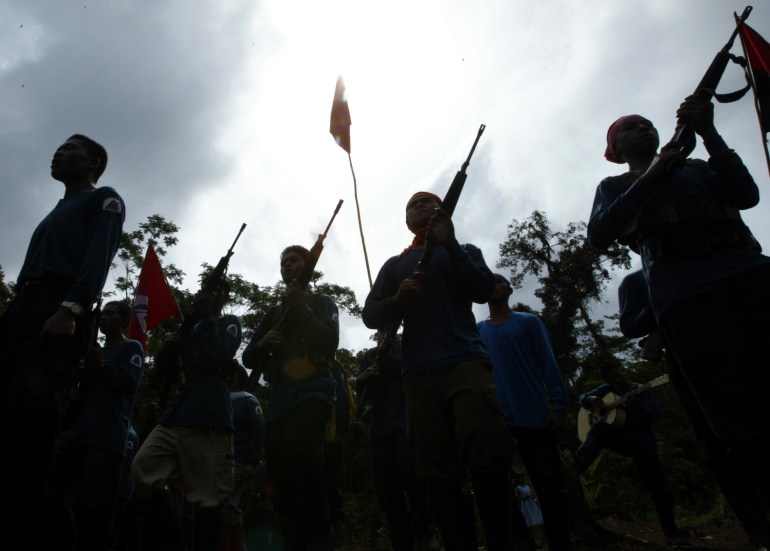
Manila, Philippines – Fighting continues between the Philippine military and communist rebels despite an agreement to resume peace talks this month in an effort to end the world’s longest-running communist armed rebellion. President Ferdinand Marcos Jr surprised many when, in November, his government announced an agreement with the National Democratic Front (NDF), the rebels’ political wing, to restart peace talks that his predecessor Rodrigo Duterte had ended shortly after taking office. In the agreement, signed in Oslo after months of secret negotiations facilitated by the Norwegian government, both parties acknowledged “the deep-rooted socioeconomic and political grievances” at the heart of the conflict and agreed to seek reforms. Since then, however, contradictory statements, public bickering and continued armed clashes between the military and the New People’s Army (NPA), the communist party’s armed wing, have tarnished hopes of an agreement. Many in the military apparatus – and especially within the government’s controversial anti-communist task force – still want to “finish off the armed conflict by physically wiping out the [NPA] forces,” Satur Ocampo, founder of the leftist Bayan Muna party-list group, told Al Jazeera. The Communist Party of the Philippines (CPP) said late last year it remained focused on “waging extensive and intensive guerrilla warfare” and rebuilding NPA forces. The NPA has been fighting the government for more than 50 years in one of the world’s longest-running insurgencies [File: Erik de Castro/Reuters] The Philippine government was “very perplexed and disappointed” by the statement, National Security Council spokesman Jonathan Malaya told reporters earlier this month. However, the military has also continued armed operations against the NPA, including December air strikes on the southern island of Mindanao that killed nine alleged rebels. Roadblocks to peace The Philippine government and NPA have been engaged for more than 50 years in a conflict that has killed more than 40,000 people. It peaked in the 1980s, during the martial law rule of Marcos’s father, the dictator Ferdinand Marcos Sr. Over the years, there have been repeated announcements of peace talks, which have then collapsed. Marcos Jr’s surprise move to reopen negotiations dovetails with the military’s stated ambition to switch its focus from domestic conflict to “external or territorial defence”, military chief Romeo Brawner Jr told reporters in November. The Philippines has shifted closer to the United States due to a series of conflicts with Chinese vessels in the disputed South China Sea, which is claimed almost in its entirety by Beijing despite an international tribunal ruling against it in 2016. Marcos initially opposed peace talks when he took office in June 2022. However, he may be growing weary after witnessing a “resurgence in armed fighting” in areas the military has claimed to have cleared, Ocampo said. “[Marcos] may be doubting the assurance of security forces that they can finish off the CPP-NPA within his term,” which ends in 2028, Ocampo said. “He’s opening up the option of seeking a negotiated settlement.” Under Philippine law, presidents can serve only one term in office. The November communique drew optimism partly because of its use of explicit language committing both parties to seek “socioeconomic and political reforms towards a just and lasting peace”. Numerous attempts at agrarian land reform in the Philippines have failed since the 1980s, leaving many rural farmers destitute and landless while families retain oligarchic control of land passed down from the colonial rule of Spain and the US. However, disagreement quickly emerged on how to institute reforms. Armed Forces of the Philippines Chief of Staff General Romeo Brawner Jr walks past honour guards during the arrival ceremony at Western Command, Puerto Princesa, Palawan, Philippines, August 10, 2023 [Eloisa Lopez/Reuters] The NDF wanted to reintroduce an agreement to distribute land forged during Duterte-era talks. But the office of presidential peace adviser Carlito Galvez Jr, which is leading negotiations, insisted the talks were “new” and a “restart”, raising concern within the NDF that he wanted to toss aside past agreements. Instead, Galvez has pitched “specific programmes that can be handled by the government and big business”, Ocampo said. “There’s nothing that touches on deep socioeconomic reforms.” National Security Adviser Eduardo Ano has also opposed removing the CPP-NPA from the country’s list of “terrorist” organisations, along with freeing currently jailed peace negotiators – positions which appear to be nonstarters for the communist side. “It is critical that Marcos rescind earlier proclamations … designating the NDF as terrorists,” a CPP spokesperson told Al Jazeera. “However, Marcos’s officials … have repeatedly expressed resistance to these measures.” Julie de Lima, interim chairperson of the NDF negotiating panel, told Al Jazeera her group was negotiating for the release of consultants needed to forge [promised] agreements on socioeconomic reforms. “It will be very difficult without that,” she said. “We still have this guarded optimism that these talks may proceed, [but] there are issues that must be resolved.” Continued conflict Last month, Marcos claimed there were no remaining active NPA fronts as of December. The government says fewer than 1,500 NPA rebels remain, although the CPP and NPA say the number is higher. The CPP spokesperson told Al Jazeera that neither side was currently seeking a joint ceasefire. De Lima, the NDF negotiator, said her panel has not been approached by the government since the November communique, and that it is “disheartening” that the peace office led by Galvez had chosen to “negotiate publicly”, referencing the secretary’s plans to collaborate with major businesses to provide socioeconomic reforms. Galvez did not respond to multiple requests for comment. “Both sides are still not trusting each other,” said Georgi Englebrecht, senior analyst at the International Crisis Group, who noted that many observers are “cautious” rather than optimistic. “But the fact we are at this stage is already progress,” he said. “Now, both sides need to show their commitment and genuine intentions.” The first step is setting an agenda, and finding realistic goals to work towards, before any talk of a ceasefire or of freeing the NDF’s negotiators, said Miriam Coronel-Ferrer, a peace negotiator who led the government’s efforts
Russia-Ukraine war: List of key events, day 713

As the war enters its 713th day, these are the main developments. Here is the situation on Tuesday, February 6, 2024. Fighting Four people were killed and at least one injured after Russia shelled the southern Ukrainian city of Kherson, local officials said. France summoned Alexey Meshkov, the Russian ambassador to France, after two French aid workers were killed in Russian artillery fire near Kherson last Thursday. Three more French citizens were also injured in the attack that Paris described as an act of “barbarism”. Russia’s FSB security service said three Russian citizens had been detained on suspicion of attempting to assassinate a high-ranking Crimean official with a car bomb. The FSB claimed Ukraine’s security service was behind the attempted attack and said the three had been charged with “terrorist” offences. It did not name the official who was allegedly the target. Politics and diplomacy The Kremlin warned Western countries that any attempt to use frozen Russian assets as collateral to raise funds for Ukraine would be illegal and lead to a Russian legal challenge. The United States and its allies banned transactions with Russia’s central bank and the Ministry of Finance, after President Vladimir Putin began his full-scale invasion of Ukraine two years ago, freezing an estimated $300bn of sovereign Russian assets. The presidential bid of antiwar candidate Boris Nadezhdin is hanging in the balance. Nadezhdin said Russia’s Central Election Commission (CEC) had informed him that 15 percent of the signatures he submitted to access the electoral race were invalid. The CEC could now block his bid to enter the election. Lawmakers from Hungary’s ruling party boycotted an emergency parliament session in which a vote on Sweden’s bid to join NATO was on the agenda. Hungary is the only member of the 31-member security alliance not to have backed Sweden’s bid. The US said it was disappointed at the move. Weapons Kajsa Ollongren, the Dutch defence minister, said The Netherlands would deliver six more F-16 fighter jets to Ukraine, taking the total number pledged to 24. “Ukraine’s aerial superiority is essential for countering Russian aggression,” Ollongren said. Georgia said it seized a clandestine shipment of explosives bound for the Russian city of Voronezh from the Ukrainian port of Odesa. It said the explosives, hidden in a cargo of car batteries, arrived in Georgia in a Ukrainian-owned minivan and were to be transported to Voronezh, about 180km (110 miles) from the Ukrainian frontier. It did not say what for. Adblock test (Why?)