

Supreme Court agrees to decide on abortion pill access, approval process

The Supreme Court decided on Wednesday to hear a case on access to the abortion bill and its approval process, which has been defended by the Biden administration. The nation’s highest court agreed to consider appeals from the Biden administration and drug manufacturer Danco defending several moves by the U.S. Food and Drug Administration intended to make it easier to access and use the mifepristone pill in the wake of the overturning of Roe v. Wade last year. This is a breaking news story. Check back for updates.
Hunter Biden will not sit for deposition by GOP, says father not ‘financially’ involved in his business

Hunter Biden arrived on Capitol Hill Wednesday, not to comply with his subpoena and be deposed at the House Oversight Committee, but to hold a press conference and again offer to testify publicly. He maintained that his father, President Biden “was not financially involved” in his business, and saying there is “no evidence because it did not happen.” Hunter Biden offer to testify publicly is a de facto rejection of the GOP demand that he appear Wednesday for the closed-door deposition he was subpoenaed for. That deposition was scheduled to take place Wednesday at 9:30 a.m. Instead, he delivered a public statement on Capitol Hill Wednesday, blasting “MAGA” Republicans who have “invaded” his privacy, “attacked” his family, and “ridiculed my struggle with addiction.” “They belittled my recovery, and they have tried to dehumanize me, all to embarrass my father, who has devoted his entire life to public service,” the president’s son said. “For six years I have been a target of the unrelenting Trump attack team. ‘Where’s Hunter?’ Well, here’s my answer. I am here.” Hunter Biden added that “my father was not financially involved in my business,” saying he was not involved in his dealings with Ukrainian natural gas firm Burisma Holdings, or his Chinese investments and others in the U.S. “No evidence to support that my father was financially involved in my business because it did not happen,” Hunter Biden said. The White House and President Biden have maintained that the president was “never in business” with his son. Biden has also said he never spoke to his son about his business dealings, but evidence–like email records and testimony from Hunter Biden’s former business partners–presented by House Republicans in their investigations seem to contradict those statements. The president’s son went on to blast House Oversight Committee Chairman James Comer, House Judiciary Committee Chairman Jim Jordan, R-Ohio, and House Ways & Means Committee Chair Jason Smith, R-Mo., who are co-leading the House impeachment inquiry against President Biden. Hunter Biden said the chairmen had manipulated evidence and misstated personal information. “Republicans have lied over and over about every aspect about my personal and professional life,” Hunter Biden said. “So much so, that the false facts are believed by too many people.” He added: “They have taken the light of my dad’s love for and presented it as darkness. They have no shame.” Hunter Biden said House Republicans have “engaged in unprecedented political interference.” “Yet here I am, Mr. Chairmen—taking up your offer…I’ve chosen,” he said. “I am here to testify at a public hearing today to answer any of the committee’s legitimate questions.” He added: “Republicans do not want an open process where Americans can see their tactics, expose their baseless inquiry, or hear what I have to say.” “What are they afraid of? I’m here. I’m ready,” Hunter Biden said. The president’s son then left Capitol Hill. Comer and Jordan last week threatened to hold Biden in contempt of Congress if he defied the subpoena and failed to appear for his deposition. Comer and Jordan had vowed to release the full transcript of Hunter’s deposition if he did participate. They also vowed to then schedule a public hearing for the president’s son to testify in a setting for the American people to hear from him directly. Hunter’s failure to appear comes as House Republicans seek to vote on a resolution that would formalize the impeachment inquiry against the president. This is a developing story. Please check back for updates.
Georgia plaintiffs criticize proposed voting district maps as ‘mockery’ of federal law
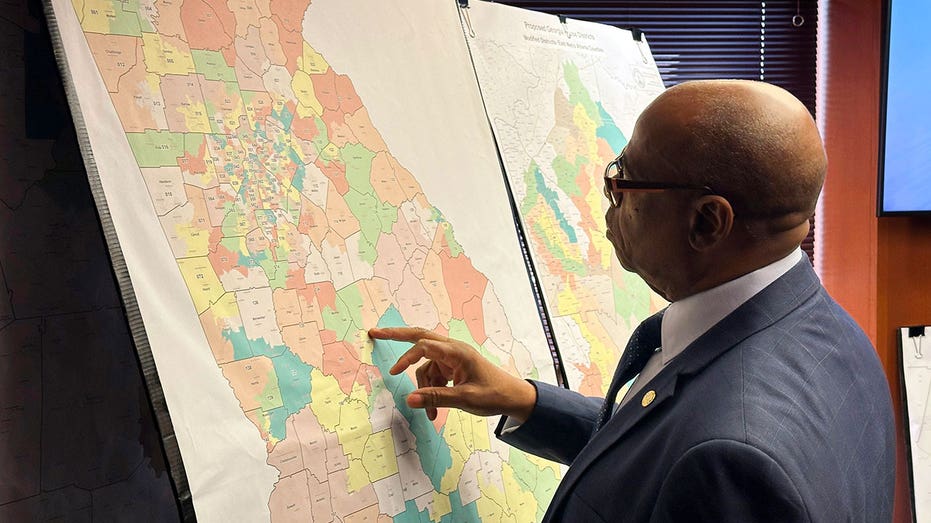
The people who sued to overturn Georgia’s congressional and state legislative districts on Tuesday attacked plans that Republican state lawmakers claim cure illegal dilution of Black votes while preserving GOP power, calling them a “mockery” of federal law and a “total failure of compliance.” The three sets of plaintiffs in the case filed briefs with the federal judge who ruled in their favor in October, urging him to reject Georgia’s proposed maps and draw new voting districts himself in time for 2024’s legislative and congressional elections. U.S. District Judge Steve Jones has scheduled a Dec. 20 hearing on whether he should accept the plans. The state is supposed to file its defense of the plans next week. GEORGIA’S REDRAWN CONGRESSIONAL MAP NEARS PASSAGE AS SPECIAL REDISTRICTING SESSION APPROACHES LIKELY END Republican legislative leaders repeatedly said during a special legislative session that ended last week that their goal was to comply with Jones’ directive. He told lawmakers they had to draw an additional Black-majority congressional district, two additional Black-majority state Senate districts and five additional Black-majority state House districts. But the plaintiffs on Tuesday, echoing arguments made by Democrats during the session, said the Republican maps don’t do enough to remedy problems in the particular districts that Jones found to be illegal under Section 2 of the Voting Rights Act, which prohibits dilution of Black votes. “The inescapable conclusion is that the proposed plans do not come close to following the court’s order,” wrote lawyers for one of two sets of plaintiffs challenging state legislative districts. “Putting eyes on the 2023 proposed plans confirms the total failure of compliance.” GEORGIA REPUBLICANS PUSH FORWARD WITH REDISTRICTING PLANS BY ADVANCING NEW LEGISLATIVE MAPS The plaintiffs also argue the plans illegally dismantle other districts that let Black and other minority voters elect their chosen candidates. Most importantly, Republicans wiped out a current district in suburban Atlanta represented by Democratic U.S. Rep. Lucy McBath at the same time they were drawing a new Black-majority district in Fulton, Douglas, Cobb and Fayette counties. “The General Assembly’s attempt to minimize and zero out minority voting opportunity in a purported ‘remedy’ to the state’s Section 2 violation is precisely the sort of gamesmanship Section 2 was meant to stamp out,” wrote lawyers for plaintiffs challenging the state’s congressional map. The plaintiffs say that the state’s plans should be rejected because they shuffled around too many Black voters from outside the districts Jones had ruled were illegal, instead of providing enough opportunities to Black voters in those areas to elect new representatives. They argue the shifts may increase the statewide number of majority-Black districts, but don’t provide opportunity for the particular voters Jones has ruled are being harmed, particularly on the southern and western sides of metropolitan Atlanta. Lawyers for the people challenging the congressional district argued that McBath’s current district in Gwinnett and Fulton counties is protected under the Voting Rights Act as a minority opportunity district, even if it isn’t majority Black. They argue that a coalition of Black, Hispanic and Asian voters in McBath’s 7th District vote cohesively as a group, and that they are opposed by white voters who vote cohesively against nonwhite-preferred candidates. GEORGIA SENATE GOP PROPOSES MAP WITH 2 BLACK-MAJORITY DISTRICTS TO ADDRESS VOTE DILUTION CONCERNS The state has signaled that it plans to argue that only districts made up of one nonwhite group, like Black voters, are legally protected, saying that earlier claims of protection for a coalition district rest on indefensible legal foundations. But the plaintiffs argue that protections for minority districts are law in Georgia, writing that “so long as different minority communities cohesively support the same candidates, they can be counted together.” All of the plaintiffs pointed to plans drawn by their own experts that they said would be less disruptive and produce fairer results for Black voters. If Jones rejects the state plans, he could accept those proposed plans, or appoint a special master to draw plans. “The General Assembly’s purported remedy makes a mockery of that process, the court’s ruling and the Voting Rights Act, and reflects the state’s continued refusal to afford minority voters equal opportunity to participate in electoral politics,” wrote those challenging congressional districts.
Parliament passes bill to repeal 76 outdated, obsolete laws

In December last year, the government introduced the Repealing and Amending Bill to cull 65 old laws. But the bill could not come up for discussion in subsequent sessions. The government later moved amendment to add 11 more laws to the list, bringing the total to 76 laws.
Hunter Biden may be held in contempt of Congress if he doesn’t show up for interview
President Biden’s son could be held in contempt of Congress if he doesn’t show up for a closed-door interview today. Hunter Biden is in Washington, but it is unclear if he will appear for the closed-door deposition the Republican committee leaders have been pushing for. COMER, JORDAN THREATEN TO HOLD HUNTER BIDEN IN CONTEMPT OF CONGRESS AFTER HE REJECTS SUBPOENA FOR DEPOSITION Last week, House Oversight and Judiciary Committees chairmen James Comer, R-Ky., and Jim Jordan, R-Ohio, threatened to hold the younger Biden in contempt if he did not show up for the deposition. Hunter Biden’s attorney Abbe Lowell and the committee leaders traded paper blows with each other as Hunter’s legal defense pushed for a public hearing. Last month, Lowell said Hunter wanted to testify publicly as opposed to the closed-door interview, but the GOP chairmen that same week said Hunter Biden must appear for a deposition first. A week later, Lowell sent a letter to Comer, saying the president’s son would only appear before the committee in public testimony. “Mr. Biden has offered to appear at a hearing on the December 13, 2023, date you have reserved, or another date this month, to answer any question pertinent and relevant to the subject matter,” Lowell wrote. “He is making this choice because the Committee has demonstrated time and time again it uses closed-door sessions to manipulate, even distort, the facts and misinform the American public — a hearing would ensure transparency and truth in these proceedings,” Lowell said. “We look forward to working out the schedule.” Comer and Jordan also pledged to release the full transcript after the closed-door deposition if it occurs. Comer and Jordan also pledged to release the full transcript after the closed-door deposition. “On November 8, 2023, we issued subpoenas to your client, Robert Hunter Biden, for a deposition on December 13, 2023,” they wrote. “Contrary to the assertions in your letter, there is no ‘choice’ for Mr. Biden to make; the subpoenas compel him to appear for a deposition on December 13,” Comer and Jordan wrote. “If Mr. Biden does not appear for his deposition on December 13, 2023, the Committees will initiate contempt of Congress proceedings,” they wrote. Fox News Digital’s Brooke Singman contributed reporting.
House tees up vote to formalize Biden impeachment inquiry tonight
The House of Representatives is taking a vote to formalize its impeachment inquiry of President Biden on Wednesday evening, a move Republicans argue will force the White House into complying with its investigation. The GOP-led committees on Oversight, Ways & Means and the Judiciary have been investigating Biden over accusations he had leveraged his office of vice president in the Obama administration to enrich his family through foreign businesses. It’s been heavily centered on the president’s brother James Biden and his son, Hunter Biden, who is under federal investigation for tax and firearm-related charges. Hunter Biden is also scheduled to appear before the House Oversight Committee for a closed-door deposition on Wednesday, though it’s unclear if he will show up. HOUSE OVERSIGHT DEMOCRAT QUIETLY MEETING WITH GOP LAWMAKERS IN EFFORT TO QUASH IMPEACHMENT INQUIRY: SOURCES The impeachment inquiry vote is scheduled to occur sometime in the 5 p.m. hour. “The impeachment inquiry is necessary now…because we’ve come to this impasse, we’re following the facts. Where they lead is hitting a stone wall because the White House is impeding that investigation,” Speaker Mike Johnson, R-La., said at a press conference on Tuesday. “We’re not going to prejudge the outcome of this. We can’t because, again, it’s not a political calculation. We’re following the law and we are the rule of law team. And I’m going to hold to that as my commitment.” But Democrats have accused the House GOP majority of playing politics with impeachment. Rep. Jamie Raskin, D-Md., the top Democrat on the House Oversight Committee, accused Republicans of moving forward with no proof of wrongdoing on Wednesday morning before the vote. “A mountain of evidence and deluge of independent reporting, including from numerous conservative outlets, have discredited every single allegation leveled by Republicans against President Biden in their painstaking and fruitless inquiry—from bogus smears about Ukraine to comical distortions about intrafamily auto payments to desperate and self-debunking cries of obstruction, all proven to be distortions, concoctions, and outright lies,” Raskin said.
Pennsylvania candidate tests AI chatbot as voter outreach tool in congressional campaign

A phone-banking tool powered entirely by artificial intelligence is getting its first real-world test in a Pennsylvania Democrat’s congressional campaign. The chatbot, named Ashley, calls voters and engages in two-way, interactive conversations about candidate Shamaine Daniels, one of seven Democrats running so far in next year’s primary. The voice tool from the startup Civox represents one of many ways AI technology is breaking into politics ahead of the 2024 campaigns, but experts say its direct contact with voters could threaten data security and has the potential to undermine voter trust. Daniels announced the partnership with Civox on Tuesday, saying the the first-of-its-kind political campaign tool had already completed more than 1,000 calls with likely Democratic primary voters in Pennsylvania’s 10th House district, which includes the state capital, Harrisburg. HOW AI WILL REVOLUTIONIZE POLITICS IN 2024, AND WHY VOTERS MUST BE VIGILANT Unlike other robocallers, Ashley doesn’t use canned responses or give call recipients a menu of options. Instead, it uses generative AI technology to devise immediate humanlike responses to voter questions. The tool was created by Civox in partnership with another new company, Conversation Labs. Civox CEO Ilya Mouzykantskii and co-founder Adam Reis, who also founded Conversation Labs, said they tested it rigorously to ensure it could accurately answer questions about Daniels’ policies and what differentiates her from other candidates in the race. The founders said they decided to give the tool a machine-like voice because in internal testing, call recipients preferred that to other, more realistic voices. “It’s often not the voice itself that influences how natural or human-feeling the conversation is,” Reis said. “It’s often the nuances of interactions and how quickly it responds and the language it uses.” In a demonstration with Ashley on Tuesday, the tool disclosed that it was powered by AI and that the call was being recorded. When prompted, it clearly and accurately shared Daniels’ positions on affordable health care and education reform. It tactfully answered pointed questions about election integrity and the Republican who holds the seat, six-term incumbent Rep. Scott Perry, pausing only a few seconds before each response. INCREASING NUMBER OF AMERICANS SAY THEY ARE MORE CONCERNED THAN EXCITED ABOUT AI: SURVEY But when asked off-topic questions, the tool sometimes got tripped up and shared false information. In a conversation about snacks, it said Cheetos were “known for being both delicious and health-conscious.” That’s an example of an AI ” hallucination ” — a problem with still-evolving generative AI technology in which large language models tend to make statements that sound convincing but are false or made up. Mouzykantskii said the mistake was fascinating but “not representative” of voters’ experiences with the tool so far. “We have tested Ashley much more extensively on political topics than on the topic of food and nutrition,” he said. Voters’ responses so far to Ashley have been mixed, said Joe Bachman of Indigo Strategies, a spokesperson for Daniels. He noted that while some call recipients engaged in thorough conversations, many stuck to one-word answers as one might in a phone conversation with a banking chatbot. “There’s not a replacement for live one-on-one conversations, either on the phone or at doors,” he said. “It’s a new technology. It’s going to take voters some time to get used to it, just as when campaigns started using SMS text messaging to communicate with voters.” He said the campaign felt the chatbot, which can speak over 20 languages, was a good opportunity to reach voters in the southern Pennsylvania district, which has a significant refugee population. Mouzykantskii and Reis said they created Ashley using a combination of over 20 AI models, including both open-source and proprietary models. They declined to share what data its AI models are trained on and would not say whether they incorporated systems from OpenAI or other high-profile AI companies that have rules against usage in political campaigning. Other entrepreneurs at the intersection of AI and politics said they were skeptical about Ashley’s direct interaction with voters and more often advise campaigns to use the rapidly advancing technology on the back end of campaigns, such as in drafting advertising copy. “The guidance I’ve offered and seen from most people is that they are steering away from AI personalities when it comes to politics and campaigns this cycle,” said Betsy Hoover, a founding partner at the progressive tech accelerator and venture capital firm Higher Ground Labs. “You don’t need people to be less trustful of politics right now. In fact, we need the opposite, and so this is not the cycle to try that.” STUDY SHOWS HOW AI CAN ACCURATELY PREDICT HOW PEOPLE VOTE IN ELECTIONS Mike Nellis, CEO of the progressive digital agency Authentic, said he was concerned about the possibility of the chatbot making mistakes in conversations and didn’t believe there was enough data to say whether its calls would be effective in motivating voters. The data the tool gathers through its phone calls is another concern, he said. “Right now, that large language model knows sensitive voter information and knows the voters’ responses to it,” Nellis said. “I don’t know how safe and secure that is.” Mouzykantskii said Civox protects voter information in line with “political campaign, technology, industry standards” and added that he encourages regulators to pay attention to these emerging tools and set stronger guidelines for them. Daniels, 45, is an immigration lawyer and member of the Harrisburg City Council making her second run for the congressional seat, which is in a Republican-leaning district. The state’s primary election is April 23. Perry beat Daniels in 2022 by 8 percentage points, easily outspending her.
It’s not shocking to see Israeli children celebrate the Gaza genocide
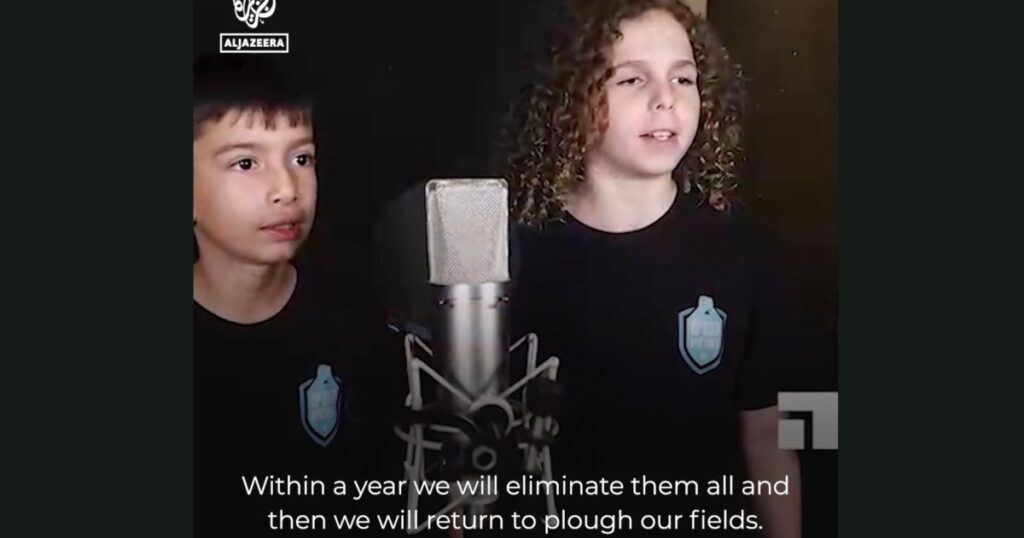
In November, Israel’s public broadcaster, Kan, uploaded on its official X page a video of Israeli children singing a song celebrating their country’s ongoing genocide of Palestinians in Gaza. The broadcaster deleted the video clip after a huge online backlash. Even after the video was silently erased from social media, however, the song remained a subject of discussion and controversy. Many across the world were shocked to see children sing happily about “eliminating” an entire people “within one year”. Yet a closer look at Israeli literature and curricula shows this open celebration of genocide was the only natural outcome of Israel’s persistent indoctrination – or brainwashing to be more blunt – of its children to ensure that they do not view Palestinians as human and fully embrace apartheid and occupation. There is myriad evidence of Israel’s brainwashing of its citizens to erase the humanity of Palestinians spanning many decades. Israeli scholar Adir Cohen, for example, analysed for his book titled “An Ugly Face in the Mirror – National Stereotypes in Hebrew Children’s Literature” some 1700 Hebrew-language children’s books published in Israel between 1967 and 1985, and found that a whopping 520 of them contained humiliating, negative descriptions of the Palestinians. He revealed that 66 percent of these 520 books refer to Arabs as violent; 52 percent as evil; 37 percent as liars; 31 percent as greedy; 28 percent as two-faced and 27 percent as traitors. Such persistent negative descriptions dehumanised Palestinians in the eyes of generations of Israelis, established them as dangerous “others”, and paved the way for children to celebrate their genocide in a video produced by the state broadcaster in 2023. Towering Palestinian academic and literary critic, Edward Said, also elaborated on the issue in his 1979 book The Question of Palestine, noting that Israeli children’s literature “is made up of valiant Jews who always end up by killing low, treacherous Arabs, with names like Mastoul (crazy), Bandura (tomato), or Bukra (tomorrow). As a writer for Haaretz said on September 20, 1974, “children’s books ‘deal with our topic: the Arab who murders Jews out of pleasure, and the pure Jewish boy who defeats ‘the coward swine!’” Israel has also used the painful memory of the Holocaust to desensitise Israeli children to the suffering of Palestinians and support without question Israel’s treatment of them. In his 1999 book, One Nation Under Israel, historian Andrew Hurley explained how Israel weaponises the Holocaust education it provides to Israeli children against the Palestinians. “The mind of a child (or of anyone else for that matter) cannot absorb the horrors of the Holocaust without finding someone to hate,” Hurley argued. “Since there are no Nazis around against whom vengeance can be sought, [Former Israeli Prime Ministers] [Menachem] Begin, [Yitzhak] Shamir and [Ariel] Sharon have solved this problem by calling the Arabs the Nazis of today and a proper target for retribution.” Israel’s current Prime Minister, Benjamin Netanyahu, appears to be eagerly continuing with this tradition and has even claimed that it was a Palestinian who gave Adolf Hitler the idea for the Holocaust. Israeli professor Meytal Nasie strongly corroborates Hurley’s view above on the ramifications of the way the Holocaust is taught. In her 2016 study, Young Children’s Experiences and Learning in Intractable Conflicts, she found that 68 percent of Israeli children suggested “beating,” “fighting,” “killing,” or “expelling” the Arabs as a solution. Nasie states that imparting these beliefs at such an early age, in a frequent and intense manner, leads to inculcation of these conflict-related narratives deep within the children’s socio-psychological repertoires. Of course, the Israeli state’s brainwashing of its citizens against the Palestinians is not limited to ridiculous lies about history told by political leaders or to children’s literature. This propaganda effort is highly systemic and at the very core of Israeli education. Just take a look at Israel’s official textbooks. For his 1998 research paper, The Rocky Road Toward Peace: Beliefs on Conflict in Israeli Textbooks, Israeli academic Daniel Bar-Tal analysed 124 Israeli textbooks on various subjects and for various age groups approved by the Israeli Ministry of Education to be used in religious and secular schools across the country. To map out the ideological content transmitted to Israeli children in the education system, he looked at which “societal beliefs (society members’ shared cognitions on topics and issues of special concern for their society)” received the most coverage in state-approved textbooks. He found that overall, the societal beliefs relating to (national) security received the most emphasis, followed by those concerning a positive self-image of Jews, and those that present Jews as the victims of the conflict. A majority of the analysed books were also found to include negative stereotypes about Arabs, portraying them as “cruel, immoral, unfair” and determined “to annihilate the State of Israel”. The widespread demonisation of the Palestinian “Other” in textbooks, coupled with the emphasis placed on the positive representations of Jews and the claim that they are the “victims” in the Israeli-Palestinian conflict, and supported by overarching narratives about the importance of national security and survival, created the perfect conditions for generations of Israelis to leave the education system convinced that any and all aggression against Palestinians – including ethnic cleansing and genocide – are at least justifiable, if not necessary. This is because when children are thought that they belong to an inherently good “chosen people” and that they are being attacked and victimised by a demonic and inhuman “Other”, they easily accept the oppression, displacement or mass killing of those who belong to this “Other” (ie, the Palestinians) without any moral qualm or hesitation. Bar-Tal’s study is from over 20 years ago, but more recent studies show that the situation is hardly any different today. For example, for her 2013 book, Palestine in Israeli School Books: Ideology and Propaganda in Education, Israeli scholar Nurit Peled-Elhanan analysed Israeli history, geography and civic studies textbooks for grades 8-12 and reached a conclusion rather similar to Bar-Tal’s: That in Israeli school books, Palestinians are still represented as
Israel-Gaza war on US campuses: Why are top university leaders under fire?
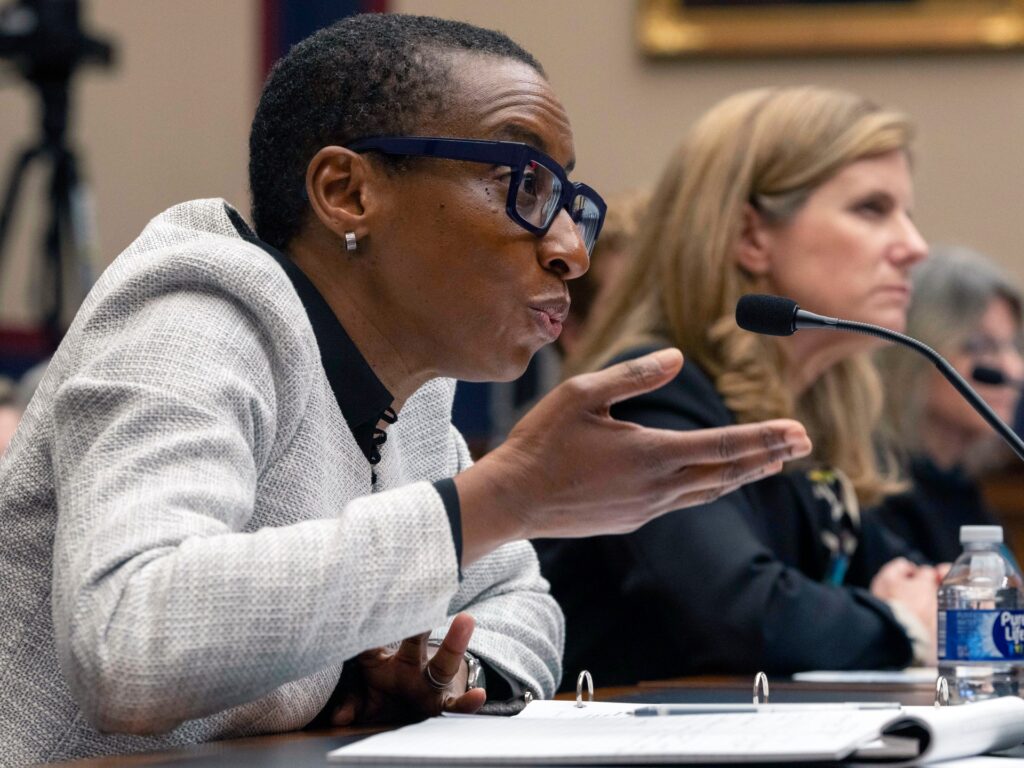
Leaders at the three top universities in the United States have faced calls to resign after their testimony before a congressional hearing on campus anti-Semitism set off a firestorm of criticism. On Tuesday, Harvard University announced it would keep political scientist Claudine Gay as its president, after her counterpart at the University of Pennsylvania, Elizabeth Magill, stepped down over the weekend. Gay, Magill and Sally Kornbluth, the president of the Massachusetts Institute of Technology (MIT), have all faced a backlash since their joint appearance before Congress on December 6, where they were asked how they would address anti-Semitism at their universities. Republican Representative Elise Stefanik grilled the academic leaders for offering evasive answers about whether calls for the “genocide of Jews” violated their schools’ codes of conduct. “Calling for the genocide of Jews is dependent on the context?” Stefanik said incredulously in response to their answers. “That is not bullying or harassment? This is the easiest question to answer yes.” Fears over anti-Semitism and other forms of hate have spiked since the start of the Israeli war in Gaza on October 7, which sparked widespread campus protests in the US. As pro-Israel and pro-Palestinian protesters clashed, university leaders faced scrutiny over what speech is protected on school grounds – and what, if anything, should be limited. Let’s take a look at the congressional hearing and why the presidents’ testimonies have drawn bipartisan backlash, including from the White House: [embedded content] Why was the hearing held? Jewish advocacy group Anti-Defamation League and some other similar groups have warned that anti-Semitism is on the rise on US campuses, particularly since the start of the Gaza war. The staunchly pro-Israel group, however, has been accused of conflating the criticism of Israel with anti-Semitism. And the Department of Education has opened investigations into more than a dozen universities since the war began, citing possible “discrimination involving shared ancestry” – an umbrella term that covers both anti-Semitism and Islamophobia. Politicians, particularly on the right, have pointed to those reports as evidence that the liberal atmosphere on college campuses has gone too far. Pro-Israel groups have deemed student chanting of the slogan, “from the river to the sea”, to be pro-Hamas, but analysts say the term has more complex roots. They say the phrase is an expression of the Palestinian desire for freedom from oppression across the historical land of Palestine. On December 6, the House Committee on Education and Labor held a hearing to address concerns about campus anti-Semitism, calling on Gay, Magill and Kornbluth to speak. “Today, each of you will have a chance to answer to and atone for the many specific instances of vitriolic, hate-filled anti-Semitism on your respective campuses,” Republican Representative Virginia Foxx told the university presidents. She added that the tense atmosphere denies students “the safe learning environment that they are due”. What happened at the hearing? The three university presidents testified at the five-hour-long hearing, addressing how they balanced free speech with concerns for campus safety. But it was their interaction with Stefanik towards the end of the hearing that fuelled viral outrage. Stefanik pressed the three leaders about whether calling for the genocide of Jews would be considered harassment, insisting on direct answers. In one such exchange, she posed a hypothetical question to Magill: “Does calling for the genocide of Jews violate Penn’s rules or code of conduct, yes or no?” Magill said it would depend on the context. “If the speech turns into conduct, it can be harassment, yes.” “I am asking, specifically, calling for the genocide of Jews, does that constitute bullying or harassment?” Stefanik said. “If it is directed and severe, pervasive, it is harassment,” Magill answered. “So the answer is yes,” Stefanik said, appearing exasperated. All three presidents refused to issue blanket statements that calling for genocide would constitute conduct violations. At one point, Gay said terms like “intifada” – the Arabic word for “uprising” – were “personally abhorrent”, but she underscored her support for “free expression, even of views that are objectionable”. [embedded content] Why did the testimonies spark controversy? Much of the outrage stemmed from the fact that the university presidents did not unequivocally condemn calls for genocide, thereby appearing tolerant of hate speech. Tom Ginsburg, a professor of law at the University of Chicago, said the presidents came across as “lawyered”, “defensive” and perhaps “out of touch”. However, he said, “in substance, it’s not clear that anything any of them said was wrong or inaccurate”. The presidents were simply reflecting the broad protections for free speech afforded under the First Amendment of the US Constitution. “We live in a country where you can call for the genocide of groups and, if you’re not imminently going to cause them harm, that’s legal,” he explained. “Go on to Twitter. It happens all the time. So [the presidents] were trying to talk about their policies, obviously, in a way which preserved their ability to say that they were applying the First Amendment.” What kind of speech is limited on US campuses? Zach Greenberg, a First Amendment lawyer with the Foundation for Individual Rights and Expression (FIRE) advocacy group, explained that the university presidents had to navigate a fine legal distinction in their testimonies. The US Constitution includes sweeping protections for “political speech”, which can comprise, in extreme cases, discussions or even the advocacy of violence. But it does not protect speech that veers into threats and harassment. The distinction is that unprotected speech represents a “serious intent to commit unlawful violence and becomes a pattern of severe, pervasive, offensive conduct that detracts a student from having an education”, Greenberg explained. But private universities, like Harvard and MIT, have the power to go further in restricting speech, he added. They have the right “to set their own policies and determine what standard of free speech they’re going to give to their students”. Still, free speech is the norm on most US campuses, which have traditionally been hotbeds for political activism, Greenberg said. “The vast majority
Argentina’s Milei starts shock therapy by devaluing peso by 50 percent

New president Milei warns of painful measures as currency value slashed, subsidies cut, public works tenders cancelled. Argentina’s government has announced it will slash the value of its currency, the peso, by more than 50 percent against the US dollar as its new far-right president seeks radical solutions to fix the country’s worst economic crisis in decades. President Javier Milei‘s economy chief announced the painful measure on Tuesday, saying it was necessary for Argentina to “avoid catastrophe”. The devaluation would drop the peso’s value from 400 to the dollar to more than 800 to the dollar, a blow to tens of millions of Argentinians already struggling to make ends meet. Economy Minister Luis Caputo announced a raft of other austerity measures, including sweeping subsidy cuts, the cancellation of tenders for public works projects, and plans to axe nine government ministries. However, the government plans to double social spending for the poorest to help them absorb the economic shock. “For a few months, we’re going to be worse than before,” Caputo said in his televised address. “If we continue as we are, we are inevitably heading toward hyperinflation,” he said. A sign outside a store reads, in Spanish, ‘We accept dollars’, in Buenos Aires, Argentina, on December 12 [Tomas Cuesta/Reuters] ‘Tough pill to swallow’ The planned measures drew praise from the International Monetary Fund (IMF), to whom Argentina owes $45bn, but sparked harsh criticism from some progressive activists. Left-wing activist Juan Grabois said that Caputo had declared “a social murder without flinching like a psychopath about to massacre his defenceless victims”. “Your salary in the private sector, in the public sector, in the popular, social and solidarity economy, in the cooperative or informal sector, for retirees and pensioners, will get you half in the supermarket,” Grabois said. “Do you really think that people are not going to protest?” Jimena Blanco, chief analyst with risk consulting firm Verisk Maplecroft, said Milei’s government was trying to temper an otherwise guaranteed economic crash landing. “He promised a very tough pill to swallow and he’s delivering that pill,” she said. “The question is how long will popular patience last in terms of waiting for the economic situation to change.” Economic shock The economic overhaul is part of the new strategy by Milei, who was sworn in on Sunday and has aggressively sought to tackle the fiscal deficit he believes is the root of Argentina’s economic woes. A self-described “anarcho-capitalist”, Milei argues harsh austerity is needed to put Argentina back on the path to prosperity and that there is no time for a gradualist approach. However, he has promised any adjustments will almost entirely affect the state rather than the private sector. Argentinians, disillusioned with skyrocketing inflation and a 40 percent poverty rate, have proven surprisingly receptive to his vision. Still, Milei’s road map is likely to encounter fierce opposition from the left-leaning Peronist movement’s lawmakers and unions it controls, whose members have said they refuse to lose wages. Adblock test (Why?)