

Sen. Tim Scott blasts Chicago mayor for ‘devastating’ students with broken campaign pledge
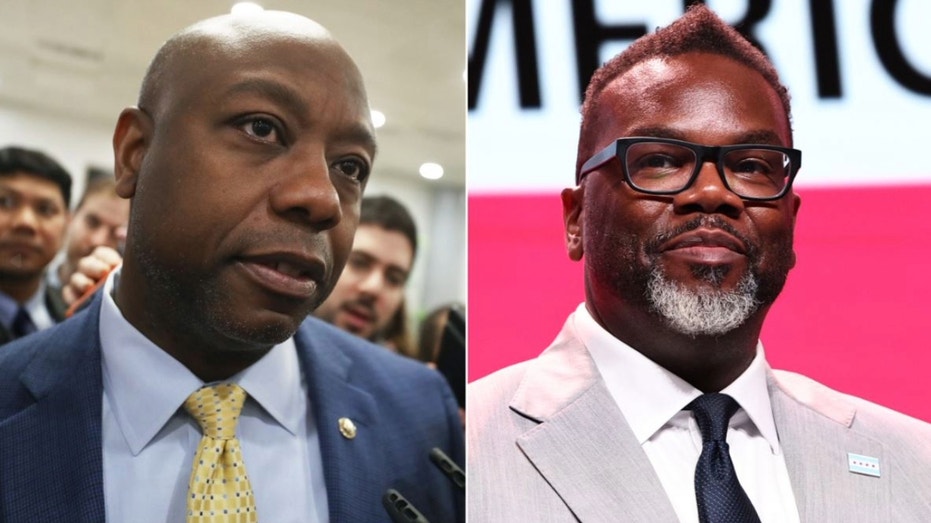
FIRST ON FOX: South Carolina Republican Sen. Tim Scott sent a letter Friday to the mayor of Chicago criticizing the Democrat over the city’s plan to shutter selective-enrollment schools, which Scott says would be “devastating” to the community while also breaking a promise the mayor made on the campaign trail. “I write to express our strong condemnation of the Chicago Board of Education’s recently passed resolution that could eliminate school choice for Chicago families, strip minority and low-income students of their preferred high schools and widen the achievement gap,” Scott wrote in a letter to Chicago Mayor Brandon Johnson and Chicago Board of Education President Jianan Shi on Friday. “As Chair of the Congressional School Choice Caucus, I believe that every parent has the right to choose the best school for their child, regardless of their zip code, and I urge you to preserve these critical options for families.” The Chicago School Board passed a resolution this week that seeks to move away from school choice and bolster the city’s neighborhood schools to address “long-standing structural racism and socio-economic inequality.” However, the move comes after Johnson reportedly told the Chicago Tribune, “A Johnson administration would not end selective enrollment at CPS schools.” CHICAGO TO MOVE AWAY FROM SCHOOL CHOICE, CENTER NEIGHBORHOOD SCHOOLS TO RECTIFY ‘STRUCTURAL RACISM’ “If enacted, this plan would be devastating to the thousands of students and families who currently benefit from attending a school of their choice,” Scott wrote. “Chicago’s 11 selective-enrollment high schools, which provide and emphasize academic rigor and achievement, enroll nearly 10,000 Black and Hispanic students. Over 7,500 of students enrolled in these schools are low-income.” According to the resolution that was passed, the board is looking to “transition away from privatization and admissions/enrollment policies and approaches that further stratification and inequity in CPS and drive student enrollment away from neighborhood schools.” CHICAGO DEMOCRAT SOUNDS ALARM AS 55 SCHOOLS REPORT NO PROFICIENCY IN MATH OR READING: ‘VERY SERIOUS’ “Schools like this are providing incredible opportunities for students, and families are clearly crying out for more choice—not less,” Scott wrote. “Six years ago, when Chicago Public Schools set up a new application system that allowed eighth graders to apply for a high school of their choosing, rather than enrolling in their assigned neighborhood school, parents jumped at the chance to give their child a better option.” “Since then, a stunning 76 percent of Chicago high school students have chosen to attend a school other than the one assigned to them.” Scott explained that as a candidate, Johnson “recognized” the importance of selective enrollment schools, but “now having secured office on that promise he’s turning his back on the families who rely on these schools and shutting out the students utilizing them to better their future.” “As Chair of the Congressional School Choice Caucus, I believe supporting neighborhood schools and schools of choice is not an either/or proposition,” Scott wrote. “I am gravely concerned that this plan will strip away public school choice for families, destroy one of the city’s best ways of helping minority and low-income children succeed, and force children into failing public schools that do not work for them.” “As you work to finalize this plan over the next several months, I urge you to preserve these crucial school choice options.” According to the Chicago Sun-Times, 76% of high school students and 45% of elementary school students do not choose to attend their assigned neighborhood schools. “Every parent has the right to choose the best school for their child, regardless of their zip code,” Scott told Fox News Digital. There’s nothing ‘equitable’ about trapping low-income kids in failing schools.” Fox News Digital reached out to Johnson’s office but did not immediately receive a response. Fox News Digital’s Bailee Hill contributed to this report.
Fox News Politics: Happy Festivus
Welcome to Fox News’ Politics newsletter with the latest political news from Washington D.C. and updates from the 2024 campaign trail. Subscribe now to get Fox News Politics newsletter in your inbox. What’s Happening? – Biden commutes sentences for 11 convicted of drug crimes – Nikki Haley closes in – Look back on 2023’s most memorable political gaffes Sen. Rand Paul, R-Ky., released his annual Christmas “Festivus” report Friday for the ninth year in a row, outlining $900 billion in government waste. Among notable instances, the National Institutes of Health allocated funds to study Russian cats on treadmills, photos of Barbies were utilized as identification to obtain COVID relief funds, the Department of Defense lost $169 million of outdoor-stored military gear, $6 million went towards tourism in Egypt by the United States Agency for International Development, and the Small Business Administration provided over $200 million to “struggling” music artists such as Post Malone, Chris Brown, and Lil Wayne. Up from $30 trillion in debt in 2022, this year’s debt amounts to $34 trillion, the report also highlights. ‘LACK OF RESPONSIVENESS’: Menendez blocks 2 Biden nominees over frustration with border negotiations …Read more ‘UNJUSTIFIED DISPARITIES’: Biden commutes sentences for 11 convicted of drug crimes …Read more ‘UNNECESSARY BURDENS’: Biden admin unveils strict hydrogen regulations in victory for environmentalists …Read more AGE VERIFICATION: Mike Lee introduces bill cracking down on commercial porn sites …Read more ‘ZERO TOLERANCE’: House leftists include antisemitism in resolution condemning Islamophobia, ‘anti-Palestinian discrimination’ …Read more ‘SMARTEST MOVE’: Experts weigh in on why it would be a ‘smart’ political move for Biden to oppose CO ruling …Read more BASHING BIDEN: Democrat Dean Phillips attacks Biden for trying to upend traditional primary election process …Read more CAMPAIGN THEME: Biden’s key 2024 message will be Trump as ‘threat to democracy’: report …Read More SURPRISE POLL: Nikki Haley closes to within 4 percentage points of Trump in New Hampshire poll …Read more STUMBLES & BUMBLES: Most memorable political gaffes and blunders of 2023 …Read more HELP ON THE WAY: ICE ramps up staffing at southern border to aid CBP with new migrant surge …Read more Get the latest updates from the 2024 campaign trail, exclusive interviews and more on FoxNews.com.
Gov. Stitt praises DeSantis’s leadership on Iowa campaign trail as caucus nears: ‘Get it done attitude’
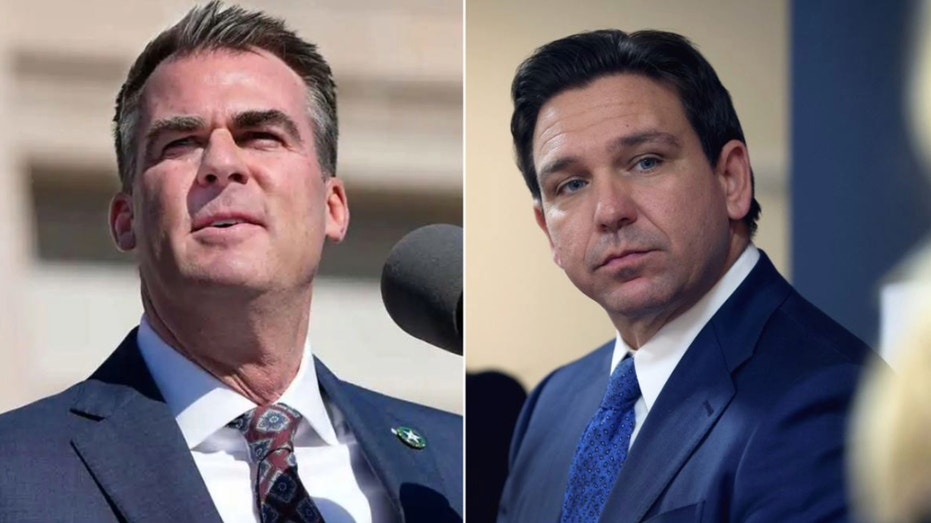
Oklahoma’s Republican Gov. Kevin Stitt called Florida Gov. Ron DeSantis the one presidential candidate with the leadership skills and experience needed for the job. “I think it’s the leadership, but it’s even more than that, It’s just the get-it-done attitude and a guy that just doesn’t back down,” Stitt told Fox News Digital on Thursday aboard a campaign bus in eastern Iowa as he stumped for DeSantis with just about three weeks to until the Iowa Caucus. “I mean, who takes on Disney, the largest corporation in your state with the most influence and power if you’re not just trying to do the right things?” he added. “No politician does that. That’s why you look at DeSantis and say this is a guy that’s going to be based on principles.” Stitt explained that he felt it was important to come to the Hawkeye State and tell Iowans face to face why he believes DeSantis is the right candidate while outlining examples of where DeSantis has led, including during the coronavirus pandemic. “COVID is a perfect example,” Stitt said. “We were having to push back against a Republican administration to just keep our schools open. I mean, Fauci was running everything at that time, and I just watched how he led and I know he’s the right guy for the job.” TRUMP KEEPS MASSIVE LEAD, HALEY TIES DESANTIS FOR SECOND IN NEW 2024 GOP PRESIDENTIAL PRIMARY POLL “We need somebody that can be there for eight years, not just four years and so I thought it was important for me to come out to Iowa and share from another governor’s perspective why I personally support him.” Stitt told Fox News Digital that the top two concerns Iowans have expressed to him during his visit are the economy, border security and spending. “The economy is really affecting everybody right now, inflation is at record highs, the spending is out of control in D.C. in both Republican and Democrat administrations. They keep spending more than we bring in,” Stitt said. “You know, if you bring in four trillion, let’s spend four trillion, we can’t keep printing money, which is going to devalue the dollar.” DESANTIS ARGUES TRUMP ‘WILL SAY IT’S STOLEN, NO MATTER WHAT’ IF FORMER PRESIDENT LOSES IN IOWA OR NH “So we need a president that’s not afraid to go up there and shake up the baseball game that’s going on in Washington, D.C., and all those counties and everybody that’s living off of the regular America.” With just about three weeks to go until the Iowa Caucus, former President Donald Trump holds a commanding lead against his Republican opponents in polls both nationally and in Iowa where the Real Clear Politics average shows him leading DeSantis by 32 points. Stitt dismissed the idea that Trump’s lead is insurmountable and pointed to recent elections where the polls have been wildly inaccurate. “Here’s the deal: national polls mean absolutely nothing,” Stitt said. “Think about this, in my re-election the polls were showing I was going to lose, or a dead heat, and I won by 15 points. I think people are just so sick of polls. In Florida, not one newspaper endorsed DeSantis and he won by 20 points. The people are going to make the decisions and it’s all going to come down to Iowa and New Hampshire, so I think it’s a new day on January 16 when DeSantis wins Iowa. It’s going to be unbelievable.” Stitt says his interactions with Iowa voters and their enthusiasm gives him confidence that DeSantis’s message is resonating. “I really do I think he’s connecting with voters, again, you know if you’re the president and you can only be in for four years, you’re basically a lame duck day one,” Stitt said. “It’s just so difficult to get the momentum, and the deep state just kind of tries to outlast you. “You have to have that threat of re-election and coming back and being there for eight years to actually move the needle and get policy done, and that’s kind of hard to explain if you’re not in this game and you don’t understand exactly how it works,” he went on. “But that’s something that you can’t discount. That’s very, very important.”
Marianne Williamson on her US presidential campaign, the economy and Gaza
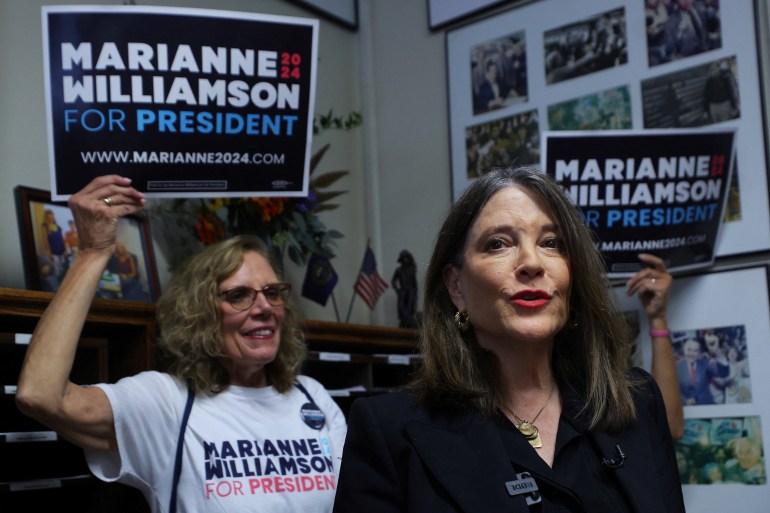
Washington, DC – Marianne Williamson says she is not merely running a protest campaign. A spiritual author who is challenging President Joe Biden for the Democratic nomination in the 2024 presidential race, Williamson believes someone needs to stand up to the growing corporate influences in the United States government. “And I’m not the kind of woman who keeps my mouth shut,” Williamson told Al Jazeera from her apartment in Washington, DC, earlier this month. Only once in US history has an elected president not received his party’s nomination for a second term. That makes Williamson’s campaign a long shot. But she remains undeterred. Her campaign is one of two Democratic challenges seeking to thwart Biden’s nomination, amid drooping poll numbers for the incumbent president. While the other Democratic contender, Dean Phillips, is running from a centrist platform, Williamson hopes to rally progressives, a growing force in the party. With her voice rising at times in indignation, Williamson decried how corporate greed was shifting the country — and the Democratic Party — away from their long-held ideals. “We are at a point now where short-term profit maximisation for huge corporate entities has become America’s bottom line,” she said. “And that corporatist perspective supersedes democratic values, humanitarian values and the safety and the health and the wellbeing of the American people.” A progressive challenger Her 2024 platform echoes many of the Democratic priorities articulated by Senator Bernie Sanders, one of the country’s most recognisable progressive voices. He ran for president twice, in the 2016 and 2020 races, facing Williamson herself in the latter. She eventually dropped out, endorsing Sanders instead. Williamson rose to fame in the early 1990s with her best-selling book A Return to Love and appearances on a TV talk show hosted by Oprah Winfrey. Later, in 2014, she unsuccessfully ran for Congress as an independent in California. But with her presidential platform, she hopes to push further than Sanders did on several policy issues. For example, Williamson backs a universal healthcare system, but her plan emphasises the need for healthier food, water and air and a less stressful lifestyle, saying that the current economic system increases “the probability of sickness”. The candidate also wants to create a Department of Peace to suppress violence and address its root causes domestically and internationally. Williamson’s almost holistic policy approach is underscored by her soft-spoken, guru-like persona. The author’s spirituality has led some to dismiss her candidacy as unserious. She went viral, for example, after saying in a 2019 primary debate that she would “harness love” to beat then-President Donald Trump and his campaign of “fear”. Williamson is not unaware of that reputation. She acknowledges that she made “silly” statements at the debate that she credits to being “nervous”. However, Williamson said there was a deliberate push to cast her aside in the 2020 race — a campaign that she said has intensified this time around. “This time, it’s a full-on assault: mischaracterisation of my personality, of what I’ve done with my life for the last 40 years. This is strategised. This is purposeful,” she told Al Jazeera. Shortly after Williamson announced her candidacy in March, Politico published an article citing anonymous former staffers who described the candidate as “abusive”. She dismissed the story at the time as a “hit piece” and refuted its details. And on Wednesday, Williamson’s campaign faced another setback when the Massachusetts Democratic Party submitted only Biden’s name for the state’s primary ballot, effectively excluding her from the list of Democratic candidates. Democratic presidential candidate and author Marianne Williamson speaks after filing to put her name on the ballot for the primary election in New Hampshire on October 12 [File: Brian Snyder/Reuters] ‘There is no wiggle room’ Still, Williamson has drawn some, albeit limited, momentum. A Quinnipiac University poll last month showed her polling at 12 percent, far behind Biden at 74 percent. The progressive monthly The Nation, however, noted last month that the polling gap between Williamson and Biden is similar to the margin between Republican rivals Trump and Nikki Haley — though less attention is being paid to the Democratic race. While the gap is nevertheless huge, Williamson argues that she deserves more media attention, especially with some polls showing Biden trailing Trump in the general elections. For his part, Biden has waved aside the polling data. “Everybody running for reelection in this time has been in the same position. There’s nothing new about that,” he said when asked about his low approval ratings earlier this year. Instead, Biden and his allies have hoped to redirect attention to the US economy, which is showing faster-than-expected growth, low unemployment and inflation slowly coming under control. But Williamson said the oft-cited economic data does not tell the whole story. For example, she pointed to a recent study showing that 62 percent of Americans live paycheck to paycheck. She also stressed the high cost of living many Americans face, which she said is due to cyclical inflation as well as corporate price-gouging. “For millions of people, it could be the difference whether or not you keep your apartment,” Williamson said. “So for the majority of Americans, there is no wiggle room.” On Gaza Democratic voters are also split over the Biden administration’s support for the war in Gaza. Biden has expressed “unwavering support” to Israel, promising to provide it with billions of dollars of additional aid despite humanitarian concerns over its military campaign. The Israeli offensive has killed more than 20,000 Palestinians, and Israel’s leaders have pledged to continue the war until Hamas is eliminated. The Palestinian group had attacked Israel on October 7, killing 1,200 Israelis and taking hundreds more captive. The White House and Pentagon have said repeatedly that they are not drawing any “red lines” to limit what Israel can do with US aid. Biden, meanwhile, continues to dismiss growing calls for a ceasefire. For her part, Williamson has called for an end to the fighting, the release of the Israeli captives and an international push for
Watching the watchdogs: Why the West misinterprets Middle East power shifts

“In Yemen, there is wisdom,” goes the medieval Arab saying. Remember that, if you’re trying to sort out how the Israel-Palestine confrontation in Gaza rattles the Middle East – because ongoing Yemeni attacks against Israel-linked ships in the Red Sea clarify one of the region’s most important political dynamics of recent times. The rocket and drone attacks on Israeli-owned or -bound ships in recent weeks are a show of support for besieged Palestinians in Gaza by Ansar Allah (Houthis), who control most of northern Yemen. Ansar Allah say they would stop these attacks only when Israel ends its genocidal siege and bombardment of the Palestinian enclave. These attacks are part of a coordinated military reaction by the three core Arab members of the Iran-led anti-Israel (and anti-West) “Axis of Resistance”, Hezbollah, Hamas and Ansar Allah, to Israel’s latest assault on the Palestinians. At one point last week, Israel and the United States simultaneously exchanged direct fire with Axis of Resistance forces in both Gaza and the West Bank in Palestine, in Lebanon, Syria, Iraq and also Yemen – which can also be seen as a peculiar low-intensity, indirect military engagement with Iran. Any assessment of how the region has evolved since October 7, and what likely lies ahead, must acknowledge three critical points relating to the Axis of Resistance’s regional network, military capabilities and trajectory. The mainstream US media and political elite tend to ignore all three points, which are: Groups within the axis can coordinate across the region and face Israel as a united front The widespread fear in the West that this latest Israel-Hamas confrontation would spark a full-fledged regional war between the US-Israel and half a dozen Arab-Iranian forces has not materialised. However, neither has the confrontation remained confined to Gaza – it has sparked the first serious coordinated battlefield action by the Axis of Resistance across the region. This reflects Hezbollah’s talk all year of the “unity of fronts”, ie, Axis members now coordinate and assist one another in battle, or between battles, in times of preparation. Ansar Allah can challenge Israel/the US militarily to deter or secure concessions from them, just like Hezbollah and Hamas For decades, Hezbollah and Hamas were the only two Arab powers that faced down Israel militarily, and forced it into ceasefires, prisoner exchanges and other concessions. Ansar Allah’s ongoing drone and missile attacks on Red Sea shipping routes will likely similarly challenge Israel. These attacks may eventually provide the Yemeni group with important leverage against its Western adversaries, especially if, as expected, the US and Israel do not send ground troops into Yemen, but rely solely on air power in their efforts to protect trade routes. All three leading Arab members of the Axis of Resistance have significantly improved their military capabilities in the past two decades Hezbollah was the first Axis member to prove its military prowess against Israel. The impasse between the Lebanon-based group and Israel in the 2006 war led to an informal truce based on mutual deterrence. Both parties realised that a fully-fledged war would inflict severe damage to national assets and result in unacceptable numbers of civilian casualties on both sides; they have since confined their confrontations to limited tit-for-tat attacks that result in limited casualties. On October 7, by attacking Israel at an unprecedented scale and then managing to defend its assets to date, Hamas has also proved that it has built significant military prowess. Ansar Allah’s capabilities are also improving – after forcing Saudi Arabia and the United Arab Emirates into ending their war on Yemen, in the past month it attacked at least 100 vessels in the Red Sea with high efficiency. A senior US military official called this a “very significant breadth of attacks” not seen in at least “two generations.” We cannot yet predict what this means for the future, but this much is clear: Hamas’s new prowess in attacking Israel and defending its own assets brings it close to Hezbollah’s qualitative capabilities; and Ansar Allah’s proven competence in drone and missile attacks against Saudi Arabia, the UAE and Red Sea shipping heightens its military proficiency. The emerging reality is that the Axis of Resistance that unites Iran with half a dozen big and small Arab non-state, armed actors is growing stronger, and will likely continue to do so if the issues that drive the partnership remain unresolved – especially the Palestine conflict, and Israeli-American aggression, threats or sanctions against Arab parties. Former American diplomat in Yemen Dr Nabeel Khoury, now a senior fellow at the Arab Center Washington, also explained to me in an interview that after the end of the war in Yemen, Ansar Allah now seem ready to act on a regional level. Yet you would be ignorant of this if your knowledge about the region comes from the mainstream US media. For the American media largely follow the American political elite, and both tend to ignore Middle East realities that do not comply with Western preconceptions of “weak” Arabs who only respond to the use of force by “righteous” Israeli-American armies” – despite the recent events in Palestine, Lebanon, and Yemen that have shattered such racist visions for good. The increasing power, integration, and influence of the Axis of Resistance rank among the most significant geo-strategic developments in the Middle East in the last half century. The combination of state-anchored Arab militancy by Hezbollah (Lebanon), Hamas (Palestine) and Ansar Allah (Yemen) alongside Iran’s resistance to American and Israeli provocations are best understood through their common underlying values of “resistance” and “defiance”. The American media and political class, and most of the West, still refuse to see or acknowledge this, because Israel, the US and their Arab allies are the ones being resisted and defied. They prefer to assess developments in the region through their imagined prism of Islamist extremism that is blindly anti-American and anti-Israeli. And they assume they can handle any Middle Eastern challenge through Israeli-American military attacks, sanctions or threats. Not surprisingly, scholars routinely
UK police probe alleged abduction of teen found in France after six years
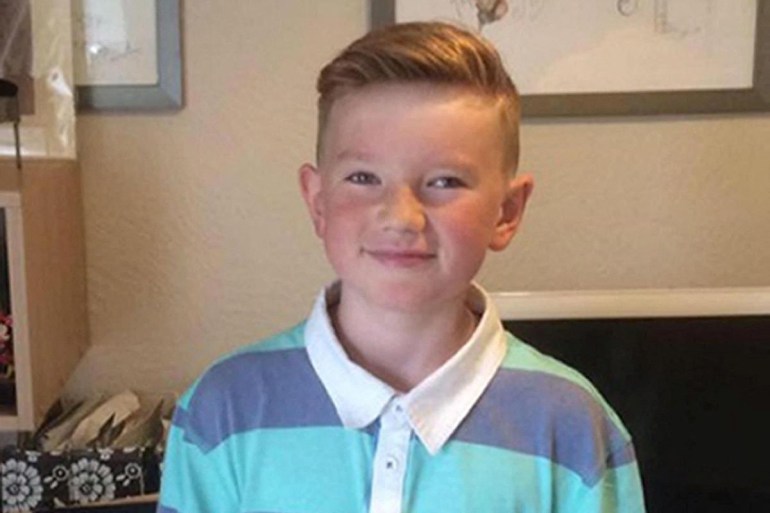
Alex Batty disappeared while on holiday with his mother and grandfather, living an off-grid life before he was found last week. Police in the United Kingdom have launched a criminal investigation into the alleged abduction of a British teen found in France after going missing abroad for six years. Greater Manchester Police said on Friday that the force has opened the inquiry after interviewing 17-year-old Alex Batty following his return to the UK last week. Batty disappeared in October 2017 while on a holiday in Spain with his mother and grandfather. He resurfaced in a mountainous area of southern France last week. The two-week family holiday turned out to be a six-year odyssey through Morocco, Spain and southwest France as he and his mother lived an off-the-grid life. The teenager told French investigators he had spent the past two years living in “spiritual communities” in France with his mother, never staying more than several months in the same place. An undated picture of Alex Batty [File: Greater Manchester Police/Handout via Reuters] The teenager says he decided to return to Britain because he wanted a better future. Batty told the Sun tabloid in an interview published on Friday that he had grown tired of drifting around Europe. “I realised it wasn’t a great way to live for my future,” said the teenager, who is back under the legal guardianship of his maternal grandmother in Oldham, northern England. “Moving around, no friends, no social life, working, working, work and not studying – that’s the life I imagined I would be leading if I were to stay with my mum.” Batty was found walking near Toulouse by a delivery driver last week. He was in good health. “She’s a great person, and I love her, but she’s just not a great mum,” Batty told the Sun, referring to his mother, Melanie Batty. He added that she was “anti-government, anti-vax” and her catchphrase was “becoming a slave to the system”. “I had an argument with my mum, and I just thought I’m gonna leave because I can’t live with her,” Batty said. He told the newspaper that his grandfather David Batty was still alive after French investigators reported that he had died six months ago. Batty also said he had been walking for two days when he was found, not the four that he had told French police. He said he lied to investigators to try to protect his grandfather and mother, who he believes is planning to go to Finland. Batty added that he was going to be “busy studying and catching up” and that he hopes to eventually work in the technology sector. Adblock test (Why?)
COVID-19: India reports 22 cases of Covid’s JN.1 variant till December 21

Kerala was the first state to report the JN.1 Covid variant reported 265 fresh Covid-19 infections and one death in the last 24 hours, according to data from the Ministry of Health and Family Welfare.
Karnataka govt withdraws hijab ban, announces CM Siddaramaiah

He also accused the BJP of dividing people and dividing society on the basis of clothes, dress and caste.
Nikki Haley closes to within four percentage points of Trump in surprise New Hampshire poll
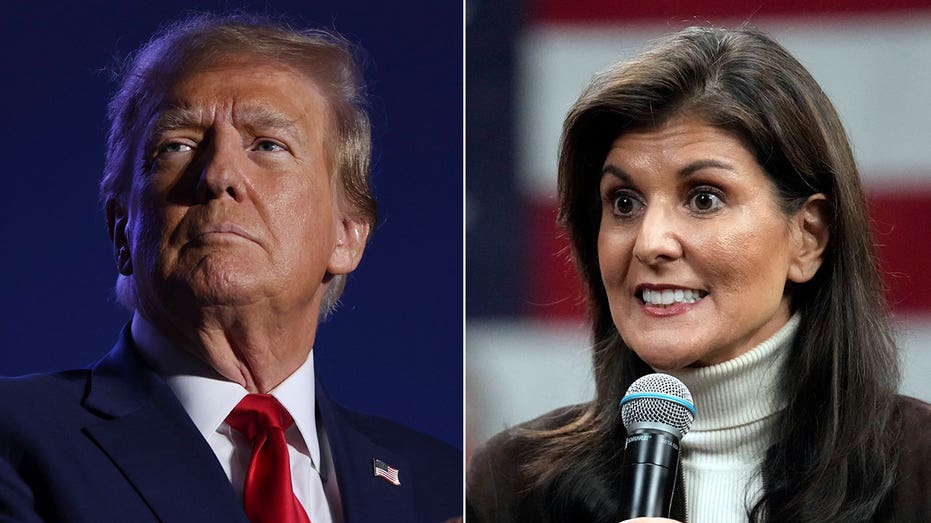
GOP presidential candidate Nikki Haley is edging within four percentage points of longtime Republican frontrunner former President Trump in a new New Hampshire poll. Haley, who served in the Trump administration as U.S. ambassador to the United Nations, was supported by 29% of likely New Hampshire Republican primary voters, according to a recent poll by American Research Group conducted by telephone, December 14-20. The poll showed that 33% of likely New Hampshire Republican voters said they would support Trump. Former New Jersey Gov. Chris Christie ranked third among likely New Hampshire Republican primary voters, garnering 13% support, while Florida Gov. Ron DeSantis had just 6% support. Vivek Ramaswamy received 5% support, while 1% of likely New Hampshire Republican primary voters responded that they would support former Arkansas Gov. Asa Hutchinson. TRUMP KEEPS MASSIVE LEAD, HALEY TIES DESANTIS FOR SECOND IN NEW 2024 GOP PRESIDENTIAL PRIMARY POLL The poll showed that 12% of respondents said they were undecided ahead of the primary. Just 1% said they would support a candidate other than those mainstream GOP contenders. The poll was conducted through 600 completed telephone interviews among a random sample of likely Republican primary voters living in New Hampshire. The sample size included 361 Republicans and 239 undeclared voters or independents, American Research Group said. AD WARS: AS TRUMP SUPER PAC TARGETS HALEY IN NEW HAMPSHIRE AD, HER SUPER PAC FIRES BACK When looking at party affiliation, 39% of registered New Hampshire Republicans interviewed said they would support Trump ahead of the primary, while 27% of registered GOP voters said they’d support Haley. Trump received 24% among undeclared voters interviewed in the poll, compared to 33% of undeclared voters interviewed saying they would support Haley. With less than a month to go before voting begins in the January 15 Iowa caucuses, Haley is mainly competing against DeSantis as the best Trump alternative for Republican voters. She has received a recent surge in polling in New Hampshire, which has its primary contest set for January 23. Earlier this month, Haley received the coveted endorsement of New Hampshire Gov. Chris Sununu. Meanwhile, the DeSantis campaign has focused heavily on Iowa, where Gov. Kim Reynolds endorsed him in November. Nationwide, a Fox News Poll released Sunday showed Trump widening his commanding lead over his GOP rivals, receiving the support of 69% of Republican primary voters. DeSantis and Haley trailed with 12% and 9% support, respectively.
French President Emmanuel Macron to be chief guest at Republic Day 2024 celebrations

Earlier, there were reports that US President Joe Biden was invited to be the chief guest for the Republic Day celebrations.