

The Silent Threat: The Growing Heart Health Crises in India

WARNING…. India has witnessed an increased number of heart related deaths.
PM Modi to flag off 5 Vande Bharat, 2 Amrit Bharat trains on December 30, check details here

The Amrit Bharat train is based on Push and Pull technology, which will help in reducing travel time and increasing the average speed of the train.
Republic Day 2024: French President Emmanuel Macron invited as Chief Guest

This is, notably the 6th time, a French leader will be the Chief guest at Republic Day celebrations here in the national capital.
India logs 328 new COVID-19 cases, 2,606 active cases in Kerala; states on high alert

With one death reported in the state, the total number of people who have died due to coronavirus in Kerala since its outbreak three years ago reached 72,060.
A Biden-Netanyahu rift? ‘Distraction’, Palestinian rights advocates say
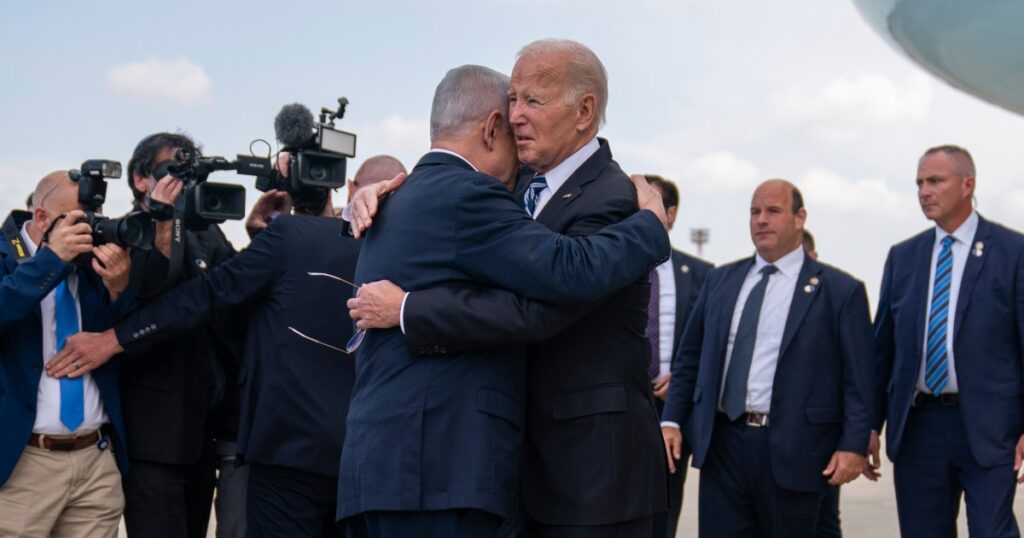
Washington, DC – Rock-solid. Unwavering. Unshakeable. After months of describing his commitment to Israel in fervent terms, United States President Joe Biden shifted his rhetoric this month — and issued his most firmly worded criticism of the country since the start of the war in Gaza. At a December 12 fundraiser, Biden warned that Israel is losing international support because of its “indiscriminate bombing” in the Palestinian territory. Those two words launched hundreds of headlines. The “rifts” between Biden and Israeli Prime Minister Benjamin Netanyahu had finally “spilled into public view”, CNN wrote. The Washington Post signalled the two leaders were headed for a “collision”. But Palestinian rights advocates have questioned how much of a “rift” exists — or whether Biden’s words were merely a means of allaying criticism without taking substantial action. Biden has faced intense scrutiny for his support of Israel’s military offensive in Gaza, which has killed more than 20,000 Palestinians since October 7. And the US remains one of the last countries in the world to oppose ending the war. The president’s statement on December 12, however, did not signal a shift in policy. Rather, his administration has reasserted that it will draw “no red lines” to restrict Israel’s actions or what it does with US military aid. Some advocates, therefore, argue that the reported disagreements between Biden and Netanyahu are inconsequential so long as the US continues to back Israel. “It doesn’t matter whether Biden and Bibi [Netanyahu] like each other or not because, at the end of the day, American money is still being transferred to fund the Israeli army. Weapons are still being sent with or without Congress’s approval,” said Laura Albast, a Palestinian American organiser in the Washington, DC, area. “Biden did not come out and call for a ceasefire.” Advocates denounce political ‘theatre’ Albast said the Biden administration is engaging in occasional criticism of Israel to address growing domestic concerns about the atrocities in Gaza. She noted that Biden’s popularity in the US has plunged during the war, particularly among young people. A Monmouth University poll this week showed Biden’s approval rating at a record low of 34 percent. Among voters under 34, that number tumbled to 23 percent. “They think that average voters in the United States are not critical thinkers, so they’re putting together this theatre,” Albast said. Hours after Biden made his comments about Israel’s “indiscriminate bombing” of Gaza, the US voted against a United Nations General Assembly resolution calling for a ceasefire in Gaza. Days earlier, Washington had also vetoed a similar measure in the UN Security Council. Still, US officials have said on several occasions that they are raising concerns with their Israeli counterpart over civilian harm in Gaza. “It’s clear that the conflict will move and needs to move to a lower-intensity phase, and we expect to see and want to see a shift to more targeted operations,” Secretary of State Antony Blinken told reporters on Wednesday. But the bombing nevertheless appears to be intensifying despite Washington’s demand. More than 5,000 Palestinians have been killed since the fighting resumed on December 1 after a brief truce. An Israeli air strike hit an area near the Kuwaiti Hospital in Rafah in southern Gaza while Al Jazeera correspondent Hani Mahmoud was live on air. pic.twitter.com/LKszfK4pQK — Al Jazeera English (@AJEnglish) December 20, 2023 Amer Zahr, a Palestinian American comedian and activist, said Biden is trying to avoid responsibility for the carnage in Gaza, even as his administration seeks billions of dollars in additional assistance to Israel. He called reports of a feud between Biden and Netanyahu a “distraction”. “This is an attempt by the Biden administration to distance themselves from the genocidal policies of Netanyahu, which they have supported from the beginning,” Zahr told Al Jazeera. ‘Clown show of foreign policy’ Adam Shapiro, the director of advocacy for Israel-Palestine at Democracy for the Arab World Now (DAWN), said the Biden administration was fully committed to the Israeli war in Gaza since its earliest days. But as the “horrific” reality of the Israeli offensive becomes more apparent, the Biden administration does not know how to disengage from it, he added. “It’s a ship without any kind of direction at this point. It’s like a drowning man, in a way, who’s just flailing,” Shapiro said. “That’s how I interpret all these random statements that come out from the administration. Meanwhile, the reality continues: Israel does what it wants. The weapons continue to flow.” Since the war broke out on October 7, some points of contention have emerged between the Israeli and US governments. They have, for example, articulated different visions for post-war Gaza. The US wants the Palestinian Authority to eventually govern the territory, but Israel wants Gaza to remain under its security control. Disagreements about the future, however, have not shaken Washington’s support for the ongoing war, the scale and intensity of which puts Palestinians at “risk of genocide“, according to UN experts. US officials, including Biden, have also emphasised the need for a two-state solution to the conflict, putting them again at odds with Netanyahu’s government, which opposes the establishment of a Palestinian state. But on Tuesday, the US was one of four countries, along with Israel, to vote against a UN General Assembly resolution reasserting Palestinians’ right to self-determination. The measure was backed by 172 other nations. To Zahr, the vote is yet another example of how US policy remains behind Israel even when Biden’s rhetoric appears to diverge from that of Israeli leaders. “How can you dare to say that you want to be an honest broker, that you want to create ‘peace’ between Palestinians and Israelis when you say you believe in the right to self-determination of one party and not the right to self-determination of the other?” Zahr said. “This is a clown show of foreign policy.” Shapiro, meanwhile, said the Biden administration was committing “unforced errors”. Its position towards the bloodshed in Gaza undermines its credibility and the principles it claims
US, China top military officials hold first talks in more than a year
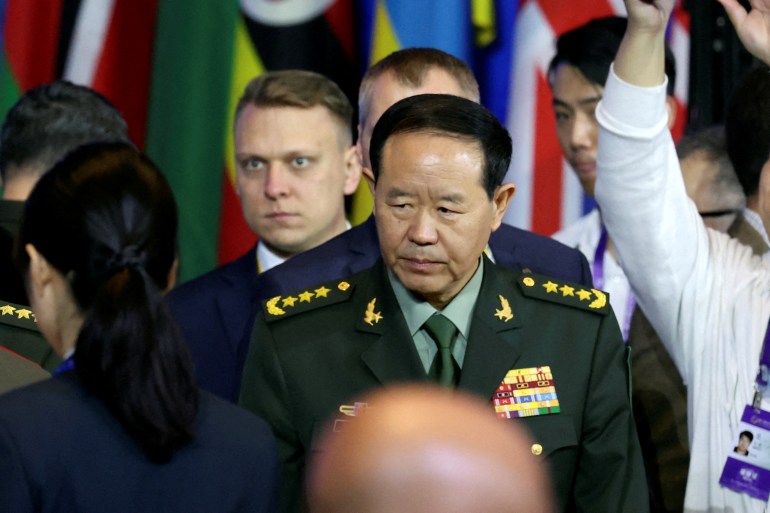
General Charles Q Brown, Chairman of the US Joint Chiefs of Staff, stresses need for dialogue to avoid miscalculations in talks with PLA’s General Liu Zhenli. The top military officer from the United States has held a virtual meeting with his Chinese counterpart, the Pentagon said, in the first such conversation in more than a year. Beijing stopped such high-level talks after then-US House Speaker Nancy Pelosi visited self-ruled Taiwan in August 2022. The two countries’ leaders finally agreed to resume them when they met last month. US Air Force General Charles Q Brown, chairman of the Joint Chiefs of Staff, and General Liu Zhenli of China’s People’s Liberation Army (PLA) touched on “a number of global and regional security issues” during their online discussion, Brown’s office said in a statement. Liu is the chief of the Joint Staff Department of the Central Military Commission (CMC), the military body responsible for China’s combat operations and planning. Brown “discussed the importance of working together to responsibly manage competition, avoid miscalculations and maintain open and direct lines of communication,” spokesman Captain Jereal Dorsey said in a statement. “General Brown reiterated the importance of the People’s Liberation Army engaging in substantive dialogue to reduce the likelihood of misunderstandings.” Brown said last month he had sent an introductory letter to Liu saying he was open to meeting. Liu said the key for the US and China to develop a healthy, stable and sustainable military-to-military relationship was for the US to have a “correct understanding of China”, according to a Chinese defence ministry statement that was released late on Thursday. US officials have cautioned that even with some restoration of military communications, it was likely to take some time to develop a functional dialogue between the two sides who remain at odds over a range of issues from Taiwan to the South China Sea and trade. China claims Taiwan as its own territory and has said it is willing to use force in order to achieve its aims. US President Joe Biden met his Chinese counterpart Xi Jinping in California in November with the two men agreeing to restore military-to-military communications as part of an effort to ease tensions. Liu has emerged as the top contender to replace China’s national defence minister, General Li Shangfu, who was dismissed in October [File: Florence Lo/Pool via Reuters] Pentagon spokesman Major General Pat Ryder described Thursday’s call between Brown and Liu as a “positive development”, saying that the two sides were working to implement what had been announced by Xi and Biden. “When you have two large militaries, it’s imperative that we keep lines of communication open in order to prevent miscalculation,” Ryder said. During the talks, Liu also asked for the US to respect China’s territorial sovereignty, and expansive maritime rights and interests in the South China Sea. China claims almost the entire sea under its so-called nine-dash line and has ignored a 2016 arbitral ruling that found it was without legal merit. Tensions have risen this year, particularly with the Philippines, which has accused the Chinese coast guard and other Chinese vessels of dangerous actions at Second Thomas Shoal and Scarborough Shoal. Liu has emerged as the top contender to replace China’s national defence minister, General Li Shangfu, who was fired in October two months after disappearing from public view. Li was placed under US sanctions in 2018 and had snubbed Washington’s efforts to resume contact. While high-level military-to-military ties between the US and China had been cut off, other top US officials were still in communication with Beijing, and lower-level military talks continued. Adblock test (Why?)
Sanctions threat looms over Bangladesh’s garment sector ahead of elections
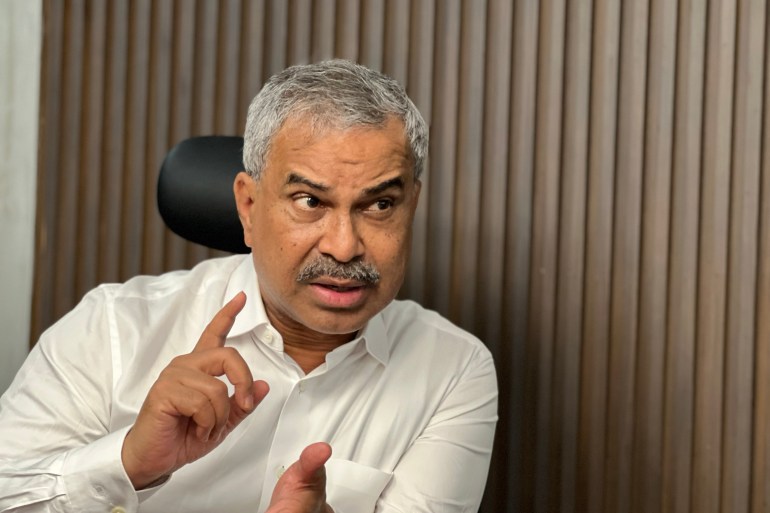
Dhaka, Bangladesh — Weeks after turbulent wage-hike protests and subsequent factory closures, Bangladesh’s ready-made garment (RMG) industry, a key revenue earner for the nation, is dealing with a new phase of anxiety: “possible” economic sanctions by the country’s Western partners. The United States and European Union collectively account for more than 80 percent of Bangladesh’s multibillion-dollar apparel sales, and any sanction on the RMG industry would put a severe dent in its already beleaguered economy, said analysts. The threat of sanctions from the US arose once Dhaka announced January 7 for national elections in what is likely to be another seemingly one-sided vote. Those concerns were further boosted in early December when a key garment supplier to the US was warned of sanctions in a letter of credit (LC) from a foreign garment buyer. An LC is issued by financial institutions or similar parties to guarantee payment to sellers of goods and services after appropriate documentations are presented. It essentially helps in avoiding risk by having intermediate buyer and seller banks that ensure proper payment. According to the LC, a copy of which was obtained by Al Jazeera, the Western buyer stated: “We will not process transactions involving any country, region or party sanctioned by the UN, US, EU, UK. We are not liable for any delay, non-performance or/ disclosure of information for sanction-based causes.” Should the clause kick in, the garment manufacturer in Bangladesh would likely incur massive losses as the buyer wouldn’t be liable to make any payment for the orders placed with that apparel producer. Both industry leaders and government officials have dismissed the threat as a “rumour” and “antigovernment” propaganda and say no such economic sanction can be imposed, especially on the garment sector, as it is a fully compliant industry and abides by all the international labour laws. Faruqe Hassan, President of Bangladesh Garments Manufacturers and Exporters Association (BGMEA) said that the LC came from a particular buyer, and was not a statutory order or notice by “any specific country or countries”. “From BGMEA, we have already contacted the buyer and the issue was sorted out. It was just a cautionary clause inserted by the bank who prepared the LC on behalf of the buyers,” Hassan told Al Jazeera, “It doesn’t mean that any country is planning to impose some sanctions on our industry.” Behind the uneasiness BGMEA President Faruque Hassan said manufacturers are concerned about the potential of economic sanctions [Faisal Mahmud/Al Jazeera] Hassan however admitted that many factory owners had expressed their concerns in a recent BGMEA meeting over that LC clause and the “ongoing political turmoil of Bangladesh has given birth to all sorts of speculations”. Bangladesh’s national election is due in less than three weeks but several political unrests have disrupted the country’s business and economy. Bangladesh Nationalist Party (BNP), the main opposition party, has boycotted the election amidst concerns of severe poll rigging. That sets up the elections as a repeat of one-sided polls held in 2014, in which Sheikh Hasina-led Awami League won 153 out of 300 parliamentary seats uncontested. BNP says no free and fair election is possible under a partisan government and gave an example of the 2018 poll, in which it took part. Independent observers termed it a severely “rigged” election which saw Awami League securing 288 out of 300 seats, a result that The Washington Post said could only be expected in a country like North Korea. For the last few months, opposition parties have been staging protests on the streets to press home the demand of installing a neutral election-time caretaker government. The government has, since late October, used brute force and court cases to suppress the protests. In November alone, more than 10,000 BNP leaders and activists were thrown in jail. None have received bail so far. Khondokar Golam Moazzem, research director of Bangladeshi think tank Center for Policy Dialogue (CPD) told Al Jazeera that the current political upheaval has obviously played its role in propagating the widespread notion that Bangladesh’s RMG industry might face an economic sanction. The United States has already taken a tough stance with a new visa policy for Bangladesh in September in which it said it would impose a visa sanction on “individuals undermining the democratic election process in Bangladesh”. The warning note in the LC also came at a time of severe unrest in the RMG sector over minimum wage hikes in which four workers died. Bangladesh has witnessed severe unrest over wage issues for garment workers [Faisal Mahmud/Al Jazeera] It also coincided with the introduction by the US, Bangladesh’s single largest garment buyer, of the Presidential Memorandum on Advancing Worker Empowerment, Rights, and High Labor Standards Globally. The memorandum is the Biden administration’s effort “to pursue a whole-of-government approach to advancing worker empowerment and organizing, workers’ rights, and labor standards globally”. While introducing the bill, the US Secretary of State specifically mentioned a firebrand garment labour activist in Bangladesh and said: “We want to be there for people like Kalpona Akter, a Bangladeshi garment worker and activist, who says that she is alive today because the US embassy advocated on her behalf.” After the new US bill, the Ministry of Commerce in Bangladesh received a letter from the Bangladesh embassy in Washington, DC in which the embassy speculated that “Bangladesh could be among the countries targeted by the new US Memorandum”. Al Jazeera has seen the letter and Commerce Secretary Tapan Kanti Ghosh acknowledged its receipt and told Al Jazeera that the Bangladesh government had already informed the US about the recent steps they had taken to protect labour rights in Bangladesh. “We are very serious about labour rights and we are the signatory of all the ILO conventions.” How serious are the sanction concerns? Labour rights activist Kalpona Akter says anger is still bubbling in the sector [Faisal Mahmud/Al Jazeera] Germany-based Bangladeshi financial analyst Zia Hassan told Al Jazeera that the prospect of US sanctions on Bangladesh’s garment industry cannot be ruled out. “Historical
Covid-19 surge in India: Hyderabad on high alert as cases rise, wearing mask becomes mandatory

Apart from wearing masks, maintaining a distance of more than 6ft between people is important.
Nine MLAs to take oath as Chhattisgarh Cabinet Minister today

Chhattisgarh Chief Minister Vishnu Deo Sai announced the names of the nine cabinet ministers who will be sworn in at 11:45 a.m. in the Governor House.
4 soldiers martyred, 2 injured after terrorists attack army vehicles in Jammu and Kashmir’s Rajouri

The operation has been underway in the general area of DKG (Dera ki Gali) since the night of December 20.