

Top Republican talks AI arms race: ‘You’ll have machines competing with each other’

EXCLUSIVE: A top House Republican is warning that the U.S. needs to stay ahead of China, Russia and other adversaries in the race to dominate the artificial intelligence (AI) space, particularly with regard to the military. “We’ve got to develop it. It’s got to be managed,” Rep. Gary Palmer, R-Ala., chairman of the House Republican Policy Committee, told Fox News Digital when asked how the U.S. military could lead the AI sphere. Palmer suggested the integration of AI with quantum computing would be a significant part of military development going forward. “What that does just by itself – the ability to analyze a situation on the ground or in the air and have an almost instantaneous countermeasure or attack. That’s what quantum computing does,” Palmer said. EUROPE SEALS WORLD’S FIRST SET OF RULES REGULATING ARTIFICIAL INTELLIGENCE “If you combine that with AI, you’re basically – you will have machines competing with each other, making decisions in nanoseconds.” Asked if that kind of future concerned him, Palmer said, “Well yeah, that’s what our enemies are trying to develop.” “Just a couple of decades ago, we didn’t think artificial intelligence was on the horizon like it is now. It’s not only a concept now, it is being implemented,” he continued. “I don’t want to start trying to figure out what to do after it’s done. I’d rather be thinking about it before it’s actually a reality.” WHAT IS ARTIFICIAL INTELLIGENCE (AI)? He raised those same concerns at an Energy and Commerce Committee hearing on AI last week, stating, “Whoever controls artificial intelligence and quantum computing will control the battlefield.” Palmer criticized President Biden for declaring at a September U.N. meeting that countries must work together to use AI as “tools of opportunity,” arguing that China would “only be more aggressive” on AI as time went on. AI DEVELOPMENT BOOM COULD PIT US VS CHINA WITH ANOTHER CHIP SHORTAGE: EXPERTS Biden said at the time, “We will push back on aggression and intimidation and defend the rules of the road, from freedom of navigation to overflight to a level economic playing field that have helped safeguard security and prosperity for decades. But we also stand ready to work together with China on issues where progress hinges on our common efforts.” “I think most Americans are coming to the realization that China is more than just an adversary, they’re the enemy,” Palmer said at the hearing. “China’s already utilizing artificial intelligence on some of their unmanned surface vessels… intended for patrols in the disputed South China Sea.” “I think China’s only going to be more aggressive in that regard. And I hope at some point we can get a briefing, maybe in a classified setting.” The White House has made AI a cornerstone of its policy goals this year, rolling out proposed guardrails for its safe and ethical use this fall.
China Committee Chair Gallagher proposes Taiwan deterrence strategy, demands Pentagon classified briefing

EXCLUSIVE: House China Committee Chairman Mike Gallagher is requesting a classified briefing from the Pentagon to discuss ways the United States can work to aid Taiwan in deterrence efforts amid heightened aggression in the region. Gallagher, R-Wis., penned a letter to Deputy Defense Secretary Kathleen Hicks, obtained exclusively by Fox News Digital, in which he says the United States needs to build an “arsenal of deterrence.” TOP REPUBLICAN SOUNDS ALARM ON US TERRITORY BEING ‘HIGHLY VULNERABLE’ TO CHINESE MISSILES “In December 1940, while we were still at peace, President Franklin D. Roosevelt famously called on the United States to be the ‘great arsenal of democracy,’” he writes. “He said it was the ‘purpose of the nation’ to build ‘with all possible speed, every machine, every arsenal, every factory that we need to manufacture our defense material.’” Gallagher said Roosevelt’s call to provide a “lifeline” to allies also helped to “arm our own military in advance of and through the years of heavy conflict and ultimately win the war.” “Today, the United States finds itself needing to rebuild a different kind of arsenal – an arsenal of deterrence,” he wrote. Gallagher warns that Chinese President Xi Jinping has “ordered the Chinese military to be ready to invade Taiwan by 2027.” Now, Gallagher is warning that in order to “prevent war,” the United States must “quickly remake an arsenal of deterrence that can arm Taiwan as well as our own forces to allow us to prevail in any conflict in the Indo-Pacific.” Gallagher, however, said the United States’ current “struggles” to meet the significant demand for U.S. munitions in Ukraine, and now even in Israel, have revealed “the fragility of our munitions industrial base.” REPUBLICANS DEMAND ANSWERS AFTER TOP BIDEN OFFICIAL INVITED CCP LEADERS TO SENSITIVE NATIONAL SECURITY SITE The committee has engaged in war games simulating a conflict with China over Taiwan, which revealed that the United States “would run out of long-range, precision-guided munitions in less than one week.” Gallagher warned that the simulation also revealed that the United States would need to fight closer to Chinese defensive fire, and would increase the risk to air and naval assets – as well as the service members who would operate them. “With no guarantees that a war in the Indo-Pacific would be limited to weeks or even months, the possibility that we may have to fight for an extended period without the most effective assets in our arsenal is deeply alarming,” he writes. “In addition, significant delays in the deliveries of critical missiles to Taiwan, including anti-ship Harpoon missiles, make it unclear whether Taiwan itself will have sufficient weapons to defend itself and repel a Chinese invasion.” Gallagher added that “rearming Taiwan after hostilities have commenced, as we did with Ukraine, would be significantly more difficult, if not infeasible.” “Today’s challenges must force us to adapt and think outside the box. If delays are preventing vital weapons from being delivered to Taiwan, we must be creative in putting together capabilities – using weapons and assets already in our inventory – that we can promptly deliver to Taiwan,” he said. Gallagher said if cost and production times are limiting U.S. supplies, he would propose cheaper alternatives that could, instead, be produced quickly, and would complement the more expensive missiles. JOINT CHIEFS CHAIRMAN SAYS ‘WE ALL SHOULD BE’ WORRIED ABOUT CHINA POSSIBLY INVADING TAIWAN “Two innovative ideas – the ‘MacGyver’ Harpoons and Powered JDAMs – may offer potential solutions to our problems and help strengthen the arsenal of deterrence at this urgent moment,” Gallagher proposed. The Harpoon missiles, which Gallagher calls “inventive,” have been used in Ukraine’s fight against Russia. Gallagher said a “MacGyver” solution, which is using existing components and older Harpoon missiles already in our inventory, may help get much-needed weapons to Taiwan at a “significantly lower cost per round.” “The United States currently has hundreds of Harpoon missiles that are being considered for demilitarization, destruction, or long-term stowage. Taiwan may be able to use these missiles with a land-based launch system with only minor modifications,” Gallagher proposed. “Missile launch support structures and Harpoon Ship Command-Launch Control Systems could be taken off decommissioned Navy ships. Communications systems and data links could come from existing Taiwanese systems. Power generators and ground platforms, such as steel plates or Heavy Expanded Mobility Tactical Trucks, could come from either American or Taiwanese stocks,” he explained. Gallagher also pointed to Joint Direct Attack Munitions, or JDAMs, which he said were used extensively by the United States in both Iraq and Afghanistan. “The ‘Powered’ JDAM – an innovative concept that would allow a standard 500-pound bomb to travel several hundred miles as a cruise missile – could provide a cheaper, near-term solution to complement the more expensive PGMs that take years to build,” he said, adding that they may be able to attack targets at both land and sea. Gallagher stressed that “reviving and rebuilding an arsenal of deterrence will require a generational investment and mobilization.” “At the same time, we must be realistic about how quickly the munitions industrial base will be able to produce our most essential weapons. We must be creative and think outside the box to come up with solutions,” he said. “The urgency of the moment requires nothing less.” Gallagher requested a classified briefing from the Pentagon next month regarding the agency’s plans it has to pursue the weapons systems he has proposed.
Israel-Hamas war: List of key events, day 73
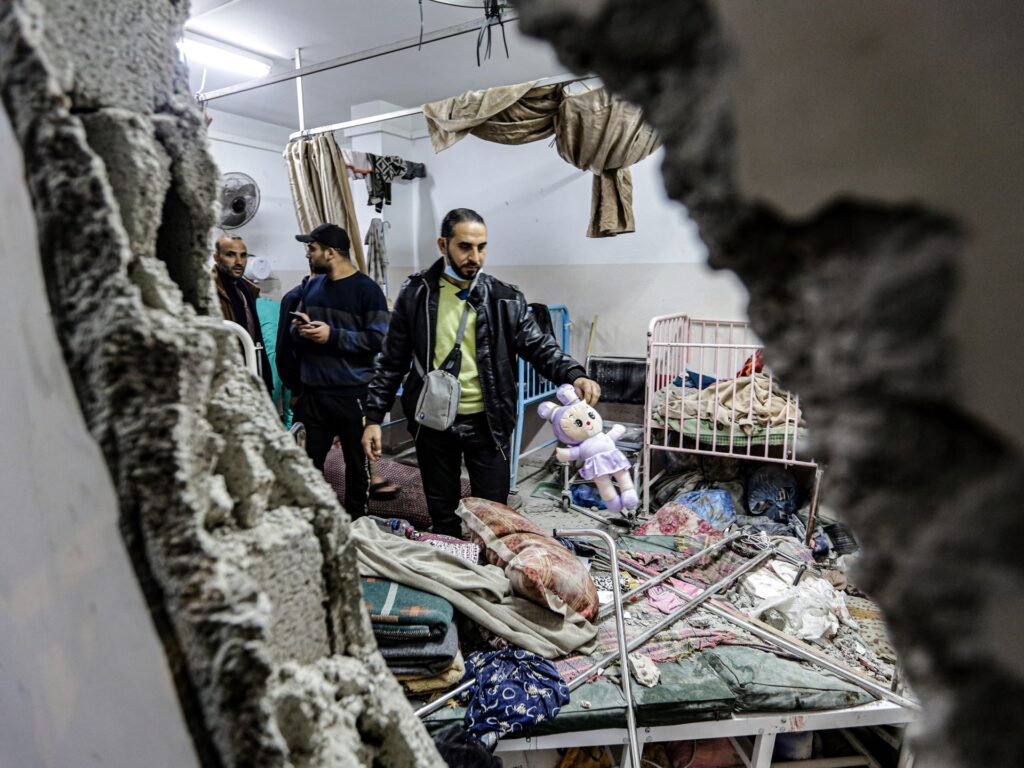
Efforts to combat Houthi attacks and de-escalate the Gaza war are under way – here’s the latest updates. Here’s how things stand on Monday, December 18, 2023: Latest developments Oil prices rose nearly 1 percent in Asian trade as Houthi attacks on ships in the Red Sea and lower exports from Russia stoke supply fears. The Israeli army has been detaining Ahmed Muhanna, the director of Gaza’s al-Awda Hospital, in an unknown location, Gaza’s Ministry of Health spokesperson Ashraf al-Qudra said on Sunday night. The Freedom Theatre in Jenin continues to demand the immediate release of its director, Mustafa Sheta, and acting teacher Jamal Abu Joas. On Sunday, Israel’s military rejected claims that its forces “murdered” two women who were sheltering in a Catholic church in Gaza. Israel’s military said on Sunday that it had discovered the largest Hamas tunnel near what was once a busy crossing into Israel, reported The Associated Press news agency. Human impact and fighting Israeli air attacks on Jabalia refugee camp killed at least 90 people and wounded more than 100 others, the Palestinian Wafa news agency reported on Sunday. An Israeli attack on Nuseirat refugee camp in central Gaza overnight Sunday killed 25 people, with 10 being from the same family, reported Al Jazeera Arabic. Palestinian journalist Haneen Ali al-Qutshan was killed in an Israeli attack on Nuseirat, according to the Palestinian media office. She was the 95th Palestinian journalist or media worker to be killed since the October 7 conflict between Israel and Hamas broke out. As Palestinians in the enclave face hunger and increased cold, they rummaged through aid trucks in large crowds on Sunday. Israeli forces raided at least six areas across the occupied West Bank overnight, including near Ramallah and Bethlehem, according to Wafa and Al Jazeera Arabic. A young Palestinian in Nablus and two young men in Qalqilya were injured in firing. Diplomacy United States Secretary of Defense Lloyd Austin will arrive in Israel today where he is expected to discuss de-escalating the Israel-Gaza war and announce an initiative for security in the Red Sea. French Ministry for Europe and Foreign Affairs condemned on Sunday the Israeli bombing of a residential building in Rafah that killed one of its staff. In a statement released on Sunday, the Palestinian Foreign Ministry called the visit by the “racist extremist” Israeli Finance Minister Bezalel Smotrich to the Psagot settlement an “act of organised state terrorism”. Adblock test (Why?)
Huge fire after explosion at Guinea fuel depot

NewsFeed A huge fire has broken out in Guinea’s capital Conakry after an explosion at a fuel depot. There are reports that dozens of injured people have been taken to two of the city’s main hospitals. Published On 18 Dec 202318 Dec 2023 Adblock test (Why?)
Iraq heads to the polls to vote for powerful provincial councils

The first council elections in a decade are expected to strengthen the grip of pro-Iran groups. Iraqis are headed to the polls to elect provincial councils for the first time in 10 years, with thousands vying for seats in the powerful assemblies. Ballots will be cast in 15 of Iraq’s 18 provinces on Monday. The elections are a prelude to a parliamentary vote in 2025, which will test the strength of pro-Iran groups that have been raising their profile in recent years. Overall, 285 candidates will be elected to the councils, whose duties include appointing regional governors and allocating health, transport and education budgets. Iraq’s semi-autonomous Kurdistan region, which includes three provinces, will decide their provincial councils next year. Turnout the ‘ultimate gage’ Monday’s vote is seen as a key test for the government of Prime Minister Mohammed Shia al-Sudani, who rose to power a year ago on the back of a parliamentary coalition of pro-Tehran parties. Since taking office, al-Sudani has struggled to develop public services and infrastructure ravaged by decades of conflict. He is hoping for a high turnout, which would give his administration a boost. “Turnout is the ultimate gage of satisfaction,” said Renad Mansour, a senior research fellow at Chatham House. It will show, he said, “whether the Sudani government’s economic populism – the policy of giving out [public sector] jobs – can be successful and can capture the young population”. Voting started at 7am (04:00 GMT) on Monday under tight security and was set to continue until 6pm (15:00 GMT). Some 17 million of Iraq’s 43 million people are eligible to vote, with 6,000 candidates in the race. However, voter apathy has been on the rise among a mostly young population who feel that they have not seen the benefits of Iraq’s massive oil wealth, much of which is misdirected or stolen in a country ranked among the world’s most corrupt. Hassan Qabas, a member of Iraq’s Independent High Electoral Commission (IHEC), told Al Jazeera that around 1,800 international observers had been invited to participate. Boycott The vote is expected to consolidate the position of the ruling Coordination Framework coalition. The Iran-aligned bloc features Shia Islamist parties with factions of Hashed al-Shaabi, a network of former paramilitary units integrated into the regular army. However, critics say the councils are sure to be nests of corruption and enable clientelism. Influential Shia scholar and political kingmaker Muqtada al-Sadr, whose rivals blocked his bid to form a government after he emerged as a winner in the 2021 parliamentary polls, is boycotting the election. Manaf Almusawi, a member of his Sadrist movement, told Al Jazeera the boycott is intended to “voice rejection of the government’s policies” and “deprive the government of legitimacy”. A supporter of Shia scholar Muqtada al-Sadr marches with an Iraqi national flag with others during a protest calling for a boycott of provincial council elections, Najaf, Iraq, December 14 [Qassem al-Kaabi/AFP] Iraq’s provincial councils were established after the 2003 US-led invasion of Iraq that toppled Saddam Hussein. The councils were initially abolished in late 2019 as a concession to massive antigovernment protests, but al-Sudani’s government later re-established them. To reflect Iraq’s multi-confessional and multiethnic population, 10 seats are reserved for minorities, namely Christians, Yazidis and Sabians. A 25 percent quota also ensures that 1,600 of the candidates are female. Adblock test (Why?)
Dawood Ibrahim dead? Media reports from Pakistan on underworld don say…

There are a lot of rumours circulating on social media that Dawood Ibrahim, the wanted criminal, has been poisoned. Here’s what we know so far.
Meet visually impaired IAS officer, who lost father at 10, mother sold pickles, took loan, cleared UPSC without coaching

A resident of Beed, Mankale studied mechanical engineering at Amrutvahini College of Engineering, Sangamner, worked as a maintenance engineer in a private firm before cracking the UPSC examination in 2020.
PM Modi inaugurates World’s largest meditation centre Swarved Mahamandir in Varanasi | 10 facts

PM Modi inaugurates the world’s largest meditation centre in Varanasi. Here’s everything you need to know about Swarved Mahamandir.
Meet couple, who built Surat Diamond Bourse, world’s largest office worth Rs 34000 crore

The architects behind this masterpiece are the Indian couple- Manit Rastogi & Sonali Rastogi, founding Partners at Morphogenesis and Principal Architects of the building, which were responsible for conceptualising and establishing this structure.
Who is Instagram influencer Priya Singh, who was allegedly run over by Maharashtra bureaucrat’s son’s car?

The victim was allegedly assaulted, bitten and then run over by a car near a hotel in Thane by her boyfriend