

Hegseth vows crackdown on military obesity after shocking Reserve, Guard report

More than two-thirds of Reserve and Guard troops are overweight, a potential threat to readiness and their ability to deploy at a moment’s notice, a new report by the American Security Project (ASP) found. Some 68% of the nation’s reserve forces are overweight, ASP researchers estimate. “With the diminished size of the [active-duty] force and increasing demands on the National Guard and reserves, service members separated due to obesity and its comorbidities are vital personnel the Armed Forces cannot afford to lose,” researchers concluded in the report. The study calls for new policies to ensure troops’ health and better access to obesity-related healthcare. NAVY TORPEDOES BIDEN-ERA CLIMATE AGENDA TO FOCUS ON LETHALITY “Completely unacceptable. This is what happens when standards are IGNORED — and this is what we are changing. REAL fitness & weight standards are here. We will be FIT, not FAT,” Defense Secretary Pete Hegseth declared in a post on X. An ASP report from October 2023 found that two-thirds of active duty service members fell into the overweight to obese category based on body mass index. “These service members experience heightened risk for a wide variety of serious health conditions, such as type 2 diabetes, cardiovascular disease, chronic kidney disease, and osteoarthritis, which may lead to life-threatening health events such as stroke and heart failure,” the report warned. Past studies from ASP have found a similar rate of obesity among active duty forces, based on the controversial BMI scale that does not account for muscle mass. However, the report warned, for reserve forces who hold day jobs and often live far away from military bases, ”commanders and policy makers will not be able to combat these trends with a uniform approach.” PENTAGON CALLS MARK MILLEY ‘CORPULENT’ AS IT KICKS OFF REVIEW OF PHYSICAL FITNESS AND GROOMING STANDARDS The report recommended further tracking and research of obesity rates within reserve forces, noting the Defense Department’s most recent data is from 2018. Hegseth launched a review of grooming and physical fitness standards last month after voicing concerns that fitness standards have eroded and questioning whether mismatched standards for men and women are affecting readiness. It directed the undersecretary of Defense for Personnel and Readiness to look at “existing standards set by the Military Departments pertaining to physical fitness, body composition, and grooming, which includes but is not limited to beards.” The memo also called for a review to examine how standards have changed since 2015. CLICK HERE TO GET THE FOX NEWS APP The service branches began making accommodations for recruits who do not meet physical fitness standards in recent years as a way to address the recruiting crisis. The Army and Navy offered pre-boot camp training for those who did not meet physical fitness or testing scores. However, those recruits had to meet the same standards in order to graduate from training courses and serve. “When I was in the Army, we kicked out good soldiers for having naked women tattooed on their arms, and today we are relaxing the standards on shaving, dreadlocks, man buns, and straight-up obesity,” Hegseth wrote in his book “The War on Warriors.”
US Treasury targets Houthi-linked vessels to disrupt efforts to fund ‘dangerous and destabilizing attacks’

The Trump administration sanctioned three vessels and their owners for providing support to the Houthis – the Iranian regime’s network of terrorist proxies and partners, Fox News Digital has learned. The Treasury Department’s Office of Foreign Assets Control announced the sanctions Monday, following the Houthis’ efforts to deploy missiles, unmanned aerial vehicles and naval mines to attack commercial shipping interests in the Red Sea – activities that “threaten global freedom of navigation and the integrity of international commerce.” TRUMP TELLS DOD TO MOVE MORE FORCES EQUIPPED FOR COMBAT INTO MIDDLE EAST AS US UPS PRESSURE ON HOUTHIS “Today’s action underscores our commitment to disrupt the Houthis’ efforts to fund their dangerous and destabilizing attacks in the region,” Treasury Deputy Secretary Michael Faulkender said Monday, adding that the department will “continue to leverage” its tools and authorities “to target those who seek to enable the Houthis’ ability to exploit the people of Yemen and continue their campaign of violence.” The State Department designated the Houthis as a specially designated global terrorist in February 2024 and redesignated the group as a foreign terrorist organization in March. “Providing material support to the Houthis not only carries acute sanctions risk, but also exposes vessels and crew members to serious safety risk from potential Houthi attacks,” a Treasury Department official told Fox News Digital. TRUMP ADMIN IMPOSES SANCTIONS AGAINST BANK OF YEMEN FOR SUPPORTING HOUTHIS A Treasury official told Fox News Digital that the Houthis control the strategic Yemen Red Sea ports of Hudaydah, Ras Isa and Al-Salif, and are funneling millions of dollars derived from port revenues and the seizure of refined petroleum products to fund a “reckless attack campaign against U.S. interests and those of our allies in the region.” The official said the group sells refined petroleum products at “exorbitant prices” on Yemen’s black market, which enables the Houthi operatives to “purchase military materials, create an artificial shortage of essential goods for average Yemenis, and fuels rampant corruption among Houthi leaders.” Marshall Islands-registered Zaas Shipping & Trading Co. used one of the vessels targeted, the Tulip BZ, to facilitate the delivery of liquid petroleum gas to the Houthi-controlled port of Ras Isa, the Treasury said. It also has been used to transport petroleum products on behalf of Iran. Mauritius-registered Bagsak Shipping Inc. is also targeted, and facilitated the delivery of gas oil to Ras Isa using the Panama-flagged vessel, the Maisan. The Maisan also has been involved in the export of Russian crude oil and petroleum products from Russian ports since February 2023, according to a Treasury official. AFTER DEBILITATING STRIKES, TRUMP TELLS HOUTHIS: STOP SHOOTING AT US AND ‘WE WILL STOP SHOOTING AT YOU’ And Marshall Islands-registered Great Success Shipping Co. facilitated the delivery of gas oil to Ras Isa using the Panama-flagged vessel, the White Whale. The move comes after President Donald Trump officially informed Congress in March that he had directed the Department of Defense to move additional combat forces into the Middle East, as U.S. forces carry out military strikes against Houthi militants in Yemen. Those strikes have been conducted in an effort to stop attacks on American forces and commercial ships in the Red Sea. “I will no longer allow this band of pirates to threaten and attack United States forces and commercial vessels in one of the most important shipping lanes in the world,” Trump wrote March 28. “We will act to keep Americans safe.” He said the U.S. will continue striking until the group no longer poses a threat to navigation or U.S. personnel. CLICK HERE TO GET THE FOX NEWS APP The strikes have been from Navy ships, Air Force bombers and drones targeting Houthi weapons, leadership and command centers. The airstrikes began after renewed Houthi threats against Israeli ships and attacks on U.S. forces, including seven Reaper drones brought down since March 3. The Houthis began ramping up attacks in the Red Sea after the October 2023 Hamas terror attack on Israel. They’ve claimed responsibility for targeting U.S. warships and have so far avoided hitting Chinese and Saudi ships, raising questions among defense officials about their strategic aims. Earlier in April, the Trump administration sanctioned the International Bank of Yemen Y.S.C. (IBY) for its financial support of Houthi terrorists. Fox News’ Greg Wehner, Jasmine Baehr, Brie Stimson, Caitlin McFall and Liz Friedan contributed to this report.
Fires continue to rage at key Iran port as explosion death toll rises to 65

Interior Minister Eskandar Momeni says the ‘culprits have been identified’ and the explosion was caused by ‘negligence’. Firefighters continue to battle raging fires at Iran’s largest commercial port, Bandar Abbas, two days after a massive explosion killed at least 65 people and injured more than 1,000, Iranian state media has reported, as questions linger as to the blast’s cause. Only “120 wounded are still in hospital”, Interior Minister Eskandar Momeni, who is visiting the affected area, told state TV on Monday. The blast took place on Saturday at Shahid Rajaei Port in Iran’s south near the strategic Strait of Hormuz, a waterway through which one-fifth of global oil output passes. Iran’s state TV showed images of firefighters dousing the flames, saying the damage would be assessed after the fire is fully brought under control. Heavy charcoal-black smoke continued to billow over low flames at part of the site, above which a firefighting helicopter flew, pictures from the Iranian Red Crescent showed. What caused the blast? It was not immediately clear what caused the explosion, but the port’s customs office said it likely resulted from a fire that broke out at a depot storing hazardous chemical materials. Advertisement Momeni said on Monday that “culprits have been identified and summoned”, and that the blast was caused by “shortcomings, including noncompliance with safety precautions and negligence”. Iran’s Supreme Leader Ayatollah Ali Khamenei has ordered a thorough investigation into the incident. In the face of external and expert speculation, Iran has denied reports that the blast was caused by a shipment of missile fuel. National day of mourning declared On Sunday, President Masoud Pezeshkian visited hospitals treating the wounded in Bandar Abbas. Since the explosion, authorities have ordered all schools and offices in the area closed and urged residents to avoid going outside “until further notice” and use protective masks when doing so. Authorities declared Monday a national day of mourning, while three days of mourning began on Sunday in Hormozgan province. The explosion took place as Iranian and US delegations met in Oman for high-level talks on Tehran’s nuclear programme, with both sides reporting progress. While Iranian authorities so far appear to be treating the explosion as an accident, it also comes against a backdrop of years of shadow war with regional enemy Israel. Iran has in the past accused Israel of being behind such attacks. According to The Washington Post, Israel launched a cyberattack targeting the Shahid Rajaei Port in 2020. Adblock test (Why?)
Trump-China tariff war: Who’s winning so far?

After United States President Donald Trump suspended his “reciprocal tariffs” on major US trading partners on April 9, he ramped them up on China’s goods. US trade levies on most imports from China have climbed to 145 percent. Beijing retaliated with duties of its own, at 125 percent on US goods. Trump has long accused China of exploiting the US on trade, casting his tariffs as necessary to revive domestic manufacturing and reshore jobs back to the US. He also wants to use tariffs to finance tax cuts. Most economists remain sceptical Trump will achieve his aims. For now, the US and China are locked in a high-stakes game of chicken. The world is waiting to see which country will yield and which will stay the course. As Trump nears his first 100 days in office for the second time, here’s where the tariff war with China stands: What’s happening with negotiations? Trump recently played up the possibility of securing a trade deal with China. Last week, the US president said his tariffs on China will “come down substantially” in the near future. Advertisement “We’re going to have a fair deal with China,” Trump told reporters on April 23, stirring hopes of a de-escalation. He also said his administration was “actively” negotiating with the Chinese side without elaborating. On April 24, however, China’s Ministry of Commerce rebuffed president Trump’s remarks, saying there were no talks taking place between the two countries. “Any claims about the progress of China-US economic and trade negotiations are groundless and have no factual basis,” ministry spokesman He Yadong said. While he insisted that Beijing won’t duck any economic blows from Washington, he also said the door was “wide open” for talks. Last week, the Reuters news agency reported that China was evaluating exemptions for select US imports – a list of up to 131 products. Beijing has not made any public statement on the issue. Has the tariff war impacted US exports? Trump introduced his sweeping tariffs on China less than three weeks ago. The fallout for US businesses won’t be fully felt until later this year. Still, the warning signals are already flashing red. Data from the US Department of Agriculture shows that exports of soya beans – the biggest US farm export – fell dramatically for the period April 11-17, the first full week of reporting since Trump’s China tariff announcement. By April 17, net sales of US soya beans dropped by 50 percent compared with the previous week. That was driven by a 67 percent fall in weekly soya bean exports to China, which, until recently, was America’s biggest export destination for the legume. Advertisement According to Piergiuseppe Fortunato, an adjunct professor of economics at the University of Neuchatel in Switzerland, “China’s retaliatory tariffs will hit US farmers hard. Some may go out of business.” He added that all sectors with exposure to China would come under strain. In 2023, the US exported roughly $15bn of oil, gas and coal to China. Losing that market would hit US energy firms. Are imports to the US going to take a hit? Since the start of Trump’s tariff war, cargo shipments have plummeted. According to Linerlytica, a shipping data provider, Chinese freight bookings bound for the US fell by 30 to 60 percent in April. The drastic reduction in shipping from America’s third largest trading partner – after Canada and Mexico – has not yet been felt. In May, however, thousands of companies will need to restock their inventories. According to Bloomberg News, retail giants Walmart and Target told Trump in a meeting last week that shoppers are likely to see empty shelves and higher prices from next month. They also warned that supply shocks could roll out to Christmas. Electronic appliances, such as TV sets and washing machines, made up 46.4 percent of US imports from China in 2022. The US also imports a lot of its clothing and pharmaceutical product ingredients from China. The price of these goods will begin to rise from next month. On April 22, the International Monetary Fund raised its US inflation forecast to 3 percent in 2025, owing to tariffs – a full 1 percentage point higher than in January. The lender also lowered its US economic growth forecast and raised its expectation that the US will tip into recession this year. Advertisement How will China’s economy be affected? Despite growing tensions between the US and China, Washington and Beijing remain major trading partners. According to the Office of the US Trade Representative, the US imported $438.9bn in Chinese goods last year. That amounts to roughly 3 percent of China’s total economic output, which remains heavily reliant on exports. In a report shared with its clients this month, Goldman Sachs said it expects Trump’s tariffs to drag down China’s gross domestic product (GDP) by as much as 2.4 percentage points. For their part, China’s top officials said the country can do without American farm and energy imports and promised to achieve a 5 percent GDP growth target for this year. Zhao Chenxin, vice chairman of the National Development and Reform Commission, said that together with non-US imports, domestic farm and energy production would be enough to satisfy demand. “Even if we do not purchase feed grains and oilseeds from the United States, it will not have much impact on our country’s grain supply,” Zhao said on Monday. He also noted there would be limited impact on China’s energy supplies if companies stopped importing US fossil fuels. In some ways, experts said, China has been preparing for this crisis. Fortunato told Al Jazeera: “The US is one of China’s biggest export markets, so tariffs will slow GDP growth. But Beijing has played this smartly as it began diversifying its imports away from the US during the first Trump trade war” in 2018. He also pointed out that “the US depends on China for up to 60 percent of its critical mineral imports, used in everything from clean energy to military technology. The opposite flow simply isn’t there,
Sudan’s RSF accused of ‘war crime’ after 31 people ‘executed’
[unable to retrieve full-text content] At least 31 people, including children, have been ‘executed’ by the paramilitary Rapid Support Forces (RSF).
Join us May 6 for a conversation on how Texas can attract, prepare and retain the best teachers

Our two-part conversation will focus on the critical challenges and opportunities surrounding teacher recruitment, training and retention in Texas.
Trump’s executive order surge: The unprecedented use of presidential authority
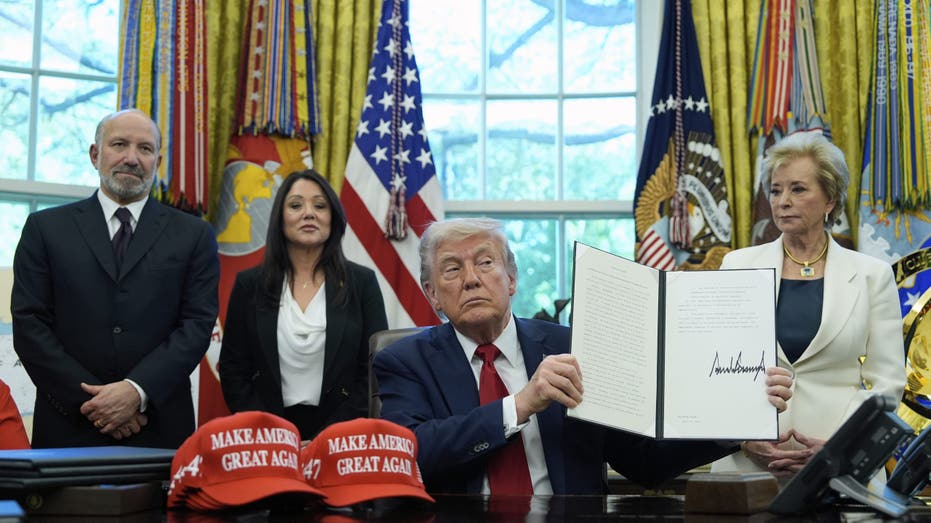
President Donald Trump made history during his first 100 days in office, surpassing former President Franklin Delano Roosevelt’s record for the number of executive orders issued during that same window. To date, Trump has signed more than 135 executive orders during his first 100 days in office during his second term — up from the 33 he signed during the first 100 days of his first term, and up from the 99 Roosevelt signed during that period too. The slew of executive orders indicates a shift in power away from the legislative branches and also indicates that Trump has a clear set of priorities he wants to accomplish during this term, according to experts. Trump’s approach signals that power has been diverted away from Congress and that the executive branch is assuming increased lawmaking authority — a trend that will likely continue into future administrations, James Broughel, a senior fellow at the regulatory reform-focused Competitive Enterprise Institute, told Fox News Digital. THESE ARE THE JUDGES GOING TOE TO TOE AGAINST TRUMP’S AGENDA “So much of the power in the federal government is now housed in the executive branch, and so this is really a sign that the president can implement a very vast and sweeping agenda through executive actions,” Broughel said. “And so I would expect future presidents to probably follow Trump’s lead on this.” These first 100 days are critical to setting the president’s agenda and driving media coverage of these initiatives — and that becomes more and more challenging as the term progresses, Broughel said. “These initial directions coming early are very important, because you’ll run out of time in your presidency if they’re not, if it’s not set out early,” Broughel said. Additionally, the Trump administration has advanced this plethora of executive orders because it had four years out of office to prepare and plan administrative priorities, according to Thomas Berry, the director of the libertarian think tank Cato Institute’s Center for Constitutional Studies. Berry said it is evident that the Trump administration has thought about what issues it wanted to target in the executive orders for a long time and that many of them are focused on dismantling hurdles he faced during his first term. That includes executive orders that ease restrictions on firing federal employees, Berry said. JUDGES BLOCKING TRUMP’S EXECUTIVE ORDERS ARE ACTING ‘ERRONEOUSLY,’ WHITE HOUSE SAYS “It seems clear that a lot of these executive orders are really aimed at trying to push past what they viewed as the obstacles to his agenda in his first administration,” Berry said. “The weakness of executive orders is they can simply be reversed by the subsequent president. It’s not set in stone in statute,” Berry said. “The one possible exception for that is if you weaken an agency so much that it’s hard for it to be built back up under the next administration.” For example, Berry said that massive staff reductions at agencies like the United States Agency for International Development could take several administrations to replenish. The Trump administration unveiled plans in March to cut thousands of staffers at the agency — which historically has functioned as an independent agency that works to deliver aid to impoverished countries and development assistance — and move its remaining functions to the State Department. Likewise, Trump signed an executive order in March to dismantle the Education Department and said that functions of the agency that oversee student loans and financial aid would move to separate agencies. Berry said the onslaught of executive orders is placing strain on the judicial branch, as there have been more than 150 lawsuits filed challenging Trump’s executive orders. Among these cases are high-profile ones, including ending birthright citizenship and banning transgender individuals from serving in the military, which are temporarily blocked. DEPARTMENT OF EDUCATION SIGNIFICANTLY DISMANTLED IN NEW TRUMP EXECUTIVE ORDER “It’s making it hard for the judicial branch to keep up,” Berry said. “It’s taxing courts to the limit, and it’s forcing courts to act fast, and the judicial branch doesn’t act as functionally when it’s forced to act really fast.” “To some extent, it’s a self-fulfilling prophecy when Trump complains about judges ruling without much law or deliberation,” Berry said. “It’s because the administration is kind of forcing them to by taking all these actions with immediate effect and not doing the normal time for deliberation.” Berry anticipates that the pace of the executive orders will slow in the near future though since the majority of the ones that emerged during the first 100 days appeared to be pre-planned. “They will, they will run out, I expect, certainly by the end of his first year, if not in the next few months, and then any remaining ones would be reactive,” Berry said.
Dems stage 12-hour ‘moral moment’ at US Capitol, rejecting Trump’s ‘big, beautiful bill’
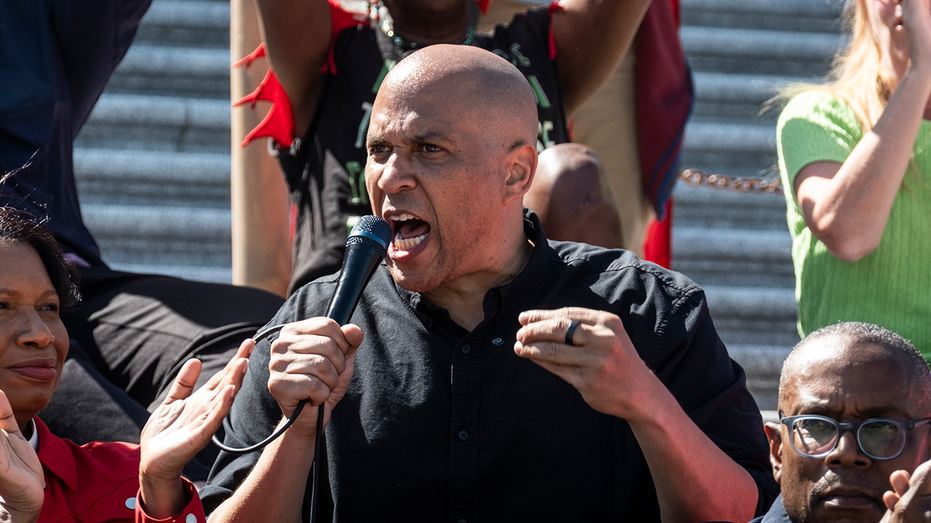
Sen. Cory Booker, D-N.J., and House Minority Leader Hakeem Jeffries, D-N.Y., staged a sit-in on the steps of the U.S. Capitol on Sunday, taking a “moral moment” to reject President Donald Trump’s agenda as Congress returns to Washington to negotiate the “big, beautiful bill.” On the final day of the two-week congressional recess, Booker and Jeffries discussed their relationship with faith, invited Americans to share their experience of Trump’s first 100 days and sounded off on “what’s at stake with Trump’s budget.” The sit-in’s hours-long livestream had amassed hundreds of thousands of views on X and YouTube. Instead of church on Sunday, the Democratic leaders opted for a “sacred civic space” outside the Capitol for more than 12 hours. Activists and politicians joined the Democrats throughout the day, including American Federation of Teachers President Randi Weingarten, Sen. Amy Klobuchar, D-Minn., and Sen. Raphael Warnock, D-Ga. “This is how we will stop cuts to Medicaid, this is how we will stop Trump and congressional Republicans’ devastating agenda, this is how we will rise,” Booker said on X at the end of the sit-in. TRUMP KICKS OFF WHIRLWIND WEEK MARKING HIS 100TH DAY BACK IN THE OVAL OFFICE Democrats have been warning Americans about Trump’s ambitious budget bill since he was elected in November, claiming his budget cuts will threaten funding for entitlement programs like Social Security, Medicaid and Medicare. The Trump administration has maintained that no cuts will be made to those services, despite the anticipated $1.5 trillion in spending reductions and extension of Trump’s 2017 tax cuts. WHAT TO KNOW ABOUT SENATOR BOOKER’S OVERNIGHT SPEECH As Congress returns to session this week, committees begin mark-ups on the budget framework passed by both the House and Senate before recess, with plans to finalize legislation by Memorial Day. Trump added pressure to the negotiations on Sunday, posting on Truth Social that it is a crucial week for the budget bill, “which will contain Massive Tax Cuts, Strong Border Security Measures, Major Military Advancements, Dramatic Deregulation, Powerful Spending Reforms, and more!” “IT MUST BE DONE. We will unleash Economic Prosperity, and accelerate into the Golden Age of America,” Trump said of his “big, beautiful bill.” However, Democrats have a drastically different depiction of Trump’s vision for the country, and the 12-hour livestream on the Capitol steps covered their laundry list of concerns – everything from Department of Education cuts, Planned Parenthood funding and protecting Supplemental Nutrition Assistance Program benefits. “This is a moment of moral urgency. We are in this moment where Congress is going to come back tomorrow from a two-week recess, and the Republican leaders on your side of the Capitol are saying that they’re going to force a bill through. They want to get it done during this work period and back over to the Senate to be voted on and put on the president’s desk,” Booker said to Jeffries. “This bill, we believe, presents one of the greatest moral threats to our country that we’ve seen in terms of what it will do to providing food for the hungry, care for the elderly, services for the disabled, health care for the sick,” he added. Booker said the goal of the protest was to “center the stories of people who will be affected by this bill that will cut Medicaid so savagely and so many other things, to give tax cuts to the wealthiest Americans.” Booker, who celebrated his 56th birthday on Sunday, has been mocked by critics for similar stunts rejecting Trump’s second-term agenda. The New Jersey senator broke the record for the longest-ever speech on the Senate floor last month, speaking out against Trump’s executive orders, tax cuts and Elon Musk’s Department of Government Efficiency for 25 hours. He also joined his Democratic colleagues ahead of Trump’s joint address to Congress earlier this year in a social media campaign with identical scripts describing “S— That Ain’t True” about the Trump administration. Sen. Bernie Sanders, I-Vt., who has drawn tens of thousands of supporters to his “Fighting Oligarchy” tour rallies across the United States, told NBC on Sunday that “what Democrats lack right now is a vision for the future,” as the party struggles to find a consistent message and clear party leader in the aftermath of big November losses. Booker’s office did not respond to Fox News Digital’s request for comment by deadline.
Virginia congressman to retire after cancer returns

Rep. Gerry Connolly, D-Va., says he is stepping back from his leadership rolls in Congress and will not run for re-election after announcing that his cancer has returned on Monday. Connolly will step down from his role as ranking member on the House Oversight Committee in the coming days, he says. The lawmaker announced his initial diagnosis with esophageal cancer roughly six months ago. “After grueling treatments, we’ve learned that my cancer, while initially beaten back, has now returned,” Connolly said in a statement to constituents. “I’ll do everything possible to continue to represent you and thank you for your grace.” “The sun is setting on my time in public service, and this will be my last term in Congress. I will be stepping back as Ranking Member of the Oversight Committee soon. With no rancor and a full heart, I move into this final chapter full of pride in what we’ve accomplished together over 30 years,” he added. HOUSE DEMS DEMAND ‘PROOF OF LIFE’ OF ABREGO GARCIA AFTER BEING DENIED MEETING IN EL SALVADOR Well-wishes for Connolly quickly began to flow in following his announcement. “Throughout his career, Gerry Connolly has exemplified the very best of public service — fiercely intelligent, deeply principled, and relentlessly committed to the people of Northern Virginia and our nation,” said Sen. Mark Warner, D-Va. “Whether it’s standing up for federal workers, advocating for good governance, or now confronting cancer with the same resilience and grit that have defined his life of public service, Gerry is one of the toughest fighters I know.” Connolly is currently serving his ninth term in the U.S. House of Representatives from Virginia’s 11th District, according to his online biography. His district is centered in Fairfax County and includes the wealthy suburbs outside the nation’s capital. DEMS FUME OVER ‘DUE PROCESS’ FOR ABREGO GARCIA DESPITE LONG HISTORY OF PARTY BUCKING THE LEGAL PRINCIPLE The 75-year-old won his current term by defeating Republican Mike Van Meter, a Navy veteran and former FBI agent. Connolly has been a fixture in northern Virginia politics for roughly 30 years. He was first elected as a Fairfax County supervisor in 1995. In Congress, he has played a leading role in oversight investigations. Fox News’ Pilar Arias contributed to this report.
Poll position: Where Donald Trump stands with Americans 100 days into his second presidency
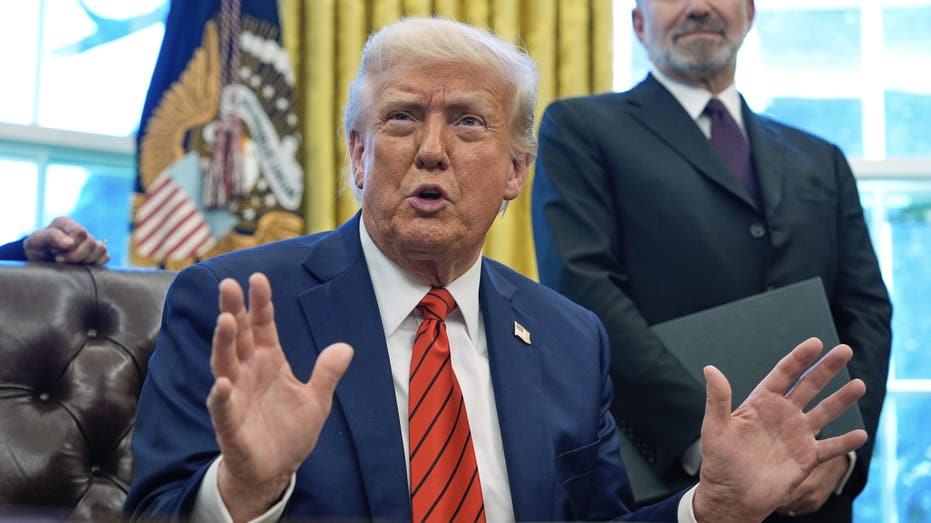
President Donald Trump is giving himself a big thumbs-up when it comes to his job performance during his second tour of duty in the White House. “I think we’re doing really well,” Trump told reporters last week. The president, as he neared the 100-day mark into his second administration, predicted that “we’re going to be the strongest that we’ve ever been as a nation.” Trump has aggressively asserted executive authority in his second term, overturning long-standing government policy and making major cuts to the federal workforce through an avalanche of sweeping and controversial executive orders and actions – with some aimed at addressing grievances he has held since his first term. HEAD HERE FOR THE LATEST FOX NEWS REPORTING AND ANALYSIS ON TRUMP’S FIRST 100 DAYS BACK IN OFFICE However, the latest poll numbers suggest that Americans are not overly thrilled with the job Trump’s doing steering the nation. The president stands at 44% approval and 55% disapproval in the most recent Fox News national poll, which was conducted April 18-21. The president’s numbers are also underwater in polls released the past few days by ABC News/Washington Post (42% approval-55% disapproval), New York Times/Siena College (42%-54%), CNN (43%-57%), Reuters/Ipsos (42%-53%), Pew Research (40%-59%), and AP/NORC (39%-59%) Most, but not all, of the most recent national public opinion surveys indicate Trump’s approval ratings in negative territory, which is a slide from the president’s poll position when he started his second tour of duty in the White House. CLICK HERE TO SEE WHERE TRUMP STANDS IN THE LATEST FOX NEWS NATIONAL POLL Contributing to the drop are increasing concerns over the economy and inflation, which were pressing issues that kept former President Joe Biden’s approval ratings well below water for most of his presidency. Additionally, Trump’s blockbuster tariff announcement earlier this month, which sparked a trade war with some of the nation’s top trading partners, triggered a massive sell-off in the financial markets and increased concerns about a recession. Trump’s approval rating on the economy stands at 38% in the Fox News poll, with just a third of respondents approving of the job he is doing handling inflation and tariffs. The Fox News poll is the latest to indicate a massive partisan divide over Trump. Nearly nine-in-10 Republicans questioned gave the president a thumbs-up, with 90% of Democrats disapproving of the job Trump’s doing. Nearly three-quarters of Independents also disapprove of the president’s performance in office. Daron Shaw, who serves as a member of the Fox News Decision Team and is the Republican partner on the Fox News poll, noted “the consolidation of the Republican base.” TRUMP’S THIRD-TERM TRIAL BALLOON GETS RESOUNDING RESPONSE IN NEW POLL “The party’s completely solidified behind him,” added Shaw, a politics professor and chair at the University of Texas, who pointed out that Trump’s current solid GOP support was not the case at the start of the first term, when he had trouble with some Republicans. However, Trump’s overall approval rating is close to where he stood 100 days into his first term in office, in 2017, when he stood at 45% approval in Fox News polling. So how does Trump stack up against his presidential predecessors? “John F. Kennedy and Dwight Eisenhower had the highest first-quarter average ratings, with both registering above 70%, while Jimmy Carter, Barack Obama and Ronald Reagan averaged between 60% and 69%. George W. Bush, George H.W. Bush, Joe Biden and Bill Clinton had similar average ratings of 55% to 58% in their first quarters,” Gallup noted in a poll released two weeks ago on presidential approval ratings. Gallup highlighted that “Trump is the only president to have sub-50% average approval ratings during a first quarter in office.” However, enjoying promising approval ratings out of the gate does not guarantee a positive and productive presidency. Carter’s poll numbers sank into negative territory less than two years into his presidency, and he was resoundingly defeated in his bid for re-election in 1980. Biden stood at 54% approval in Fox News polling 100 days into office, with his numbers hovering in the low-to-mid-50s during the first six months of his single term as president. However, Biden’s numbers sank into negative territory in the late summer and autumn of 2021, in the wake of his much-criticized handling of the turbulent U.S. exit from Afghanistan and amid soaring inflation and a surge of migrants crossing into the U.S. along the nation’s southern border with Mexico. Biden’s approval ratings stayed underwater throughout the rest of his presidency, and he dropped his bid for re-election last summer. “He just got crippled and never recovered,” Shaw said of Biden.