

53 international students’ immigration statuses revoked at four more Texas universities

Nineteen students at the University of Texas at Dallas, 27 at the University of North Texas and others now face uncertainty about their ability to stay in the U.S.
The Speaker’s Lobby: ‘Whose throat do I get to choke?’
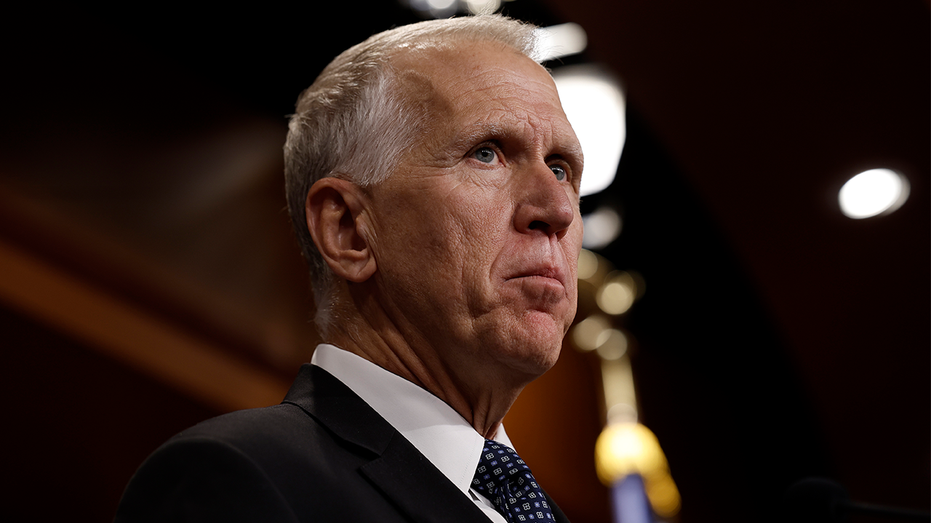
It was a split screen Tuesday morning on Capitol Hill. One eye on the markets. The other eye on the Senate testimony of U.S. Trade Representative Jamieson Greer. “Do you think your remarks will alter the markets in any way?” yours truly asked Greer as he walked to the hearing room in the Dirksen Senate Office Building. “I’m just going to respond to the senators. Be candid as I can be,” replied Greer. TRUMP TRADE REP TAKES BIPARTISAN FIRE OVER TARIFFS AS DEM LAUNCHES BID TO HALT THEM The public has heard a lot about tariffs from Commerce Secretary Howard Lutnick. They’ve heard a lot about tariffs from Treasury Secretary Scott Bessent. They’ve heard even more about tariffs from White House advisor Peter Navarro. But until Tuesday morning, there was little said about tariffs from the man in charge of the administration’s trade policy: Jamieson Greer. “The president’s strategy is already bearing fruit,” Greer testified. “Nearly 50 countries have approached me personally to discuss the president’s new policy and explore how to achieve reciprocity.” Democrats were dubious about Greer’s suggestion. Yes, nations may be willing to negotiate. But carving out sophisticated trade agreements with nations just sanctioned by the U.S. takes time. “You’re telling us you have nearly 50 countries coming to you, approaching you to enter into negotiation, and you think that you can do that overnight?” asked Sen. Catherine Cortez Masto, D-Nev. “You’re pretty superhuman here, if that’s the case.” TRUMP TRADE CHIEF FACES HOUSE GRILLING ON TARIFFS Greer tangled with Sen. Maggie Hassan, D-N.H. “Even if inflation hits Americans’ pocketbooks at 10% because of these tariffs, then the Trump administration is still going to go charging ahead?” asked Hassan. “Senator, your hypotheticals are not consistent with the history we have seen with tariffs,” Greer replied. “My hypotheticals are based on the fact that a lot of Americans are looking at their 401(k)’s today and wondering how much of a lifestyle change they are going to have to have or whether they’re going to be able to retire when they plan to,” Hassan shot back. “This has been a haphazard, incompetent effort. And it’s showing.” After rough showings, the markets actually shot up at the opening bell Tuesday before Greer spoke. It didn’t appear that anything Greer told senators resonated positively or negatively on Wall Street. But lawmakers were well attuned to the market fluctuations. Especially as they started to hear from constituents. TRUMP SAYS HE’LL ‘TAKE A LOOK’ AT EXEMPTING SOME LARGER US COMPANIES HIT ESPECIALLY HARD BY TARIFFS Outside the hearing room, Sen. John Kennedy, R-La., offered one of his signature Bayou homilies to characterize the unfolding trade war. “God created the world. But everything else is made in China,” said Kennedy. “But senator, isn’t the bigger issue here the question of the uncertainty in the markets and rattling around?” I asked Kennedy. “Well, there’s always uncertainty,” answered Kennedy. “But this is a different type of uncertainty, though, Senator,” I countered. “Is it going to have to have an impact on your capital markets? Well, yes. Duh. And it’s not fun. It’s very, very painful. Whether this will have a happy ending or a sad ending depends in large part what President Trump does next,” said Kennedy. And that’s the key to the entire enterprise. It doesn’t matter what Lutnick does. Or Bessent. Or Navarro. And not Greer. For better or worse, this is President Trump’s baby. Only he can move markets. And potentially trade deals. And that’s certainly what unfolded in recent days. Democrats — and some Republicans — excoriated the president for unilaterally imposing the tariffs. Lawmakers asked the reasoning for imposing the tariffs. And they argued that the tariffs should have been an issue which came to Capitol Hill. “Where was the consultation with Congress about this? Where is the homework? You know, Greek and Roman letters thrown on a plaque doesn’t mean a strategy that you’ve informed Congress on,” Sen. Maria Cantwell, D-Wash., the top Democrat on the Senate Commerce Committee, asked. “And part of the question is, where’s the homework done by the administration to not misconstrue the authority that was given?” SCHUMER SAYS TRUMP ‘FEELING THE HEAT’ AFTER RECIPROCAL TARIFF PAUSE Cantwell may not have received a sufficient answer from the Trump administration on the rationale. But Sen. Josh Hawley, R-Mo., answered the other part of the question about why the President cut Congress out of the loop. “Let’s not pretend that this is anything other than the president exercising the statutory authority Congress has given him for decades,” said Hawley. “Because Congress didn’t want to do tariffs, they didn’t want to do trade, it was too hot. They wanted the president to hold the hot potato. So now you’ve got a President who’s happy to do that.” Article I, Section 8 of the Constitution declares that Congress has the “Power To lay and collect Taxes, Duties, Imposts and Excises to pay the Debts and provide for the common Defence and general Welfare of the United States.” The Office of the U.S. Trade Representative says the U.S. is a signatory to more than 14 total trade pacts. Congress has ratified several of those in recent years. That includes the USMCA. That’s a trade pact President Trump pushed – alongside former House Speaker Nancy Pelosi, D-Calif., in 2020 for the U.S., Mexico and Canada. That deal replaced NAFTA, the North American Free Trade Agreement, approved by Congress in 1993. Congress also greenlighted “CAFTA, the Central American Free Trade Agreement, in 2005. So, Congress has engaged in trade somewhat in recent decades. But maybe not as much as it should have. Greer appeared for a second time on Capitol Hill Wednesday, testifying before the House Ways and Means Committee. TRUMP PUSHES BACK ON ‘REBEL’ REPUBLICANS OVER TARIFFS: ‘YOU DON’T NEGOTIATE LIKE I NEGOTIATE’ “Any deal that you do, are you going to bring that to Congress for a vote?” asked Rep. Suzan DelBene, D-Wash., “We’ll do what the law requires. Some
Treasury Secretary Scott Bessent denies that tariff pause is due to market declines
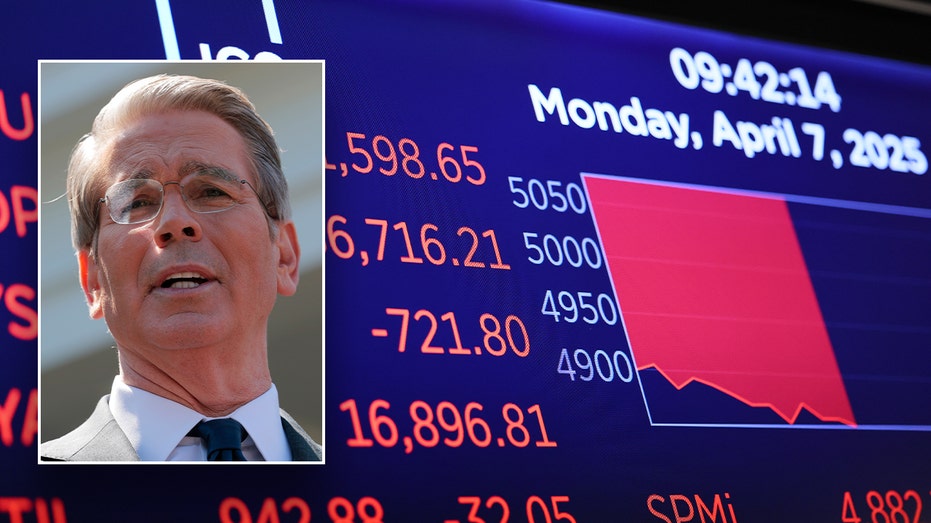
Treasury Secretary Scott Bessent denied the president’s move to implement a pause on his tariffs was the result of declines in the financial markets, which have been causing great concern for investors. The comments came after the president issued a pause Wednesday for 75 different countries, which, according to the Trump administration, have shown a willingness to negotiate trade deals in good faith with the United States. Simultaneously, the Trump administration increased its tariff rates on Chinese goods to 125%, which came after China imposed tariffs of its own in response to Donald Trump’s “Liberation Day” tariff increase last week. “This was driven by the president’s strategy. He and I had a long talk on Saturday and this was his strategy all along,” Bessent responded when asked if the tariff pause was the result of market declines. The Treasury Secretary also cited an “imbalance” in the responses from various countries, particularly China, in regard to their willingness to negotiate new trade deals. TRUMP URGES AMERICANS TO ‘HANG TOUGH’ ON TARIFFS PLAN AS MARKETS TUMBLE “It is just a processing problem,” Bessent said when asked if the market whiplash was a catalyst for the pause. “Each one of these solutions is going to be bespoke. It is going to take some time, and President Trump wants to be personally involved, so that’s why we are hitting the 90-day pause.” Meanwhile, Bessent questioned claims from reporters that the bond market was “cratering” and said the information in front of him did not indicate as much. Trump, who also fielded questions Wednesday about the market volatility following his tariffs, similarly described the current bond market as “beautiful.” “I saw last night where people were getting a little queasy,” Trump told reporters Wednesday about his view on the market declines in relation to his tariffs. “[Markets] went from, you know, pretty moderate today, but over the last few days, it looked pretty glum, to, I guess, they say it was the biggest day in financial history. That’s a pretty big change.” “I think the word would be flexible,” Trump added. “You have to be flexible.” WHITE HOUSE ADDRESSES RECESSION FEARS, CALLS MARKET VOLATILITY A ‘PERIOD OF TRANSITION’ Stocks did jump back up on Tuesday before sliding back down once again before the markets closed that evening. However, on Wednesday, as Trump made his announcement about the tariff pauses, stocks rallied again, with the S&P 500 seeing its best day since 2008, according to Market Watch. Over the weekend, the president told Americans concerned about the ongoing market volatility to “hang tough,” adding that his plan is already working with trillions of dollars already being poured into the U.S. economy. “HANG TOUGH, it won’t be easy, but the end result will be historic,” Trump wrote Saturday in a post on his social media platform Truth Social. “We will, MAKE AMERICA GREAT AGAIN!!!” The White House declined to comment for this story.
State offers specific measles guidance for 10 West Texas “outbreak” counties

State health officials added four more counties to what they consider “outbreak areas” and advise those visiting or living in those counties to consult measles vaccination guidance for those areas.
Federal public health cuts could cost Texas $700 million

State and local health agencies are having to cut programs and staff to make up the loss and more cuts could be coming.
Mike Johnson punts House vote on Trump tax agenda after GOP rebellion threatened defeat
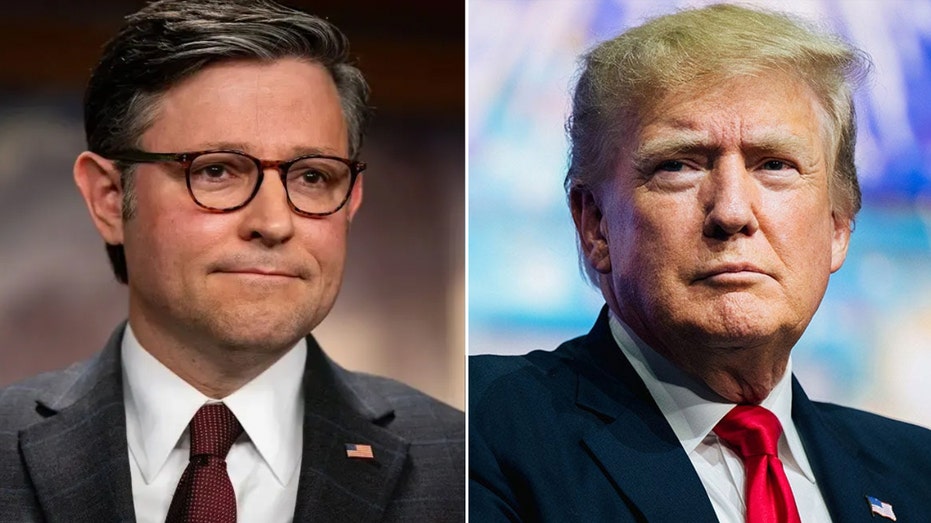
Speaker Mike Johnson, R-La., is delaying a key vote on legislation aimed at advancing President Donald Trump’s agenda in the face of a likely rebellion on Wednesday evening. It comes as fiscal hawks in the lower chamber have raised alarms at the Senate’s version of the plan, which guarantees far fewer spending cuts than the House’s initial offering. Johnson told reporters the vote will now take place on Thursday, the last scheduled day in session for House lawmakers before a two-week recess. The speaker has not ruled out keeping lawmakers in Washington until Friday, Fox News Digital was told, or until the matter is sorted. The gap between the two versions is significant; the House version that passed in late February calls for at least $1.5 trillion in spending cuts, while the Senate’s plan mandates at least $4 billion. HOUSE FREEDOM CAUCUS CHAIR URGES JOHNSON TO CHANGE COURSE ON SENATE VERSION OF TRUMP BUDGET BILL Some conservatives are also wary of congressional leaders looking to use the current policy baseline to factor the total amount of dollars the bill will add to the federal deficit. The current policy baseline allows lawmakers to essentially zero out the cost of extending Trump’s 2017 Tax Cuts and Jobs Act (TCJA) because they are already in effect. “We’ve got to have something more substantive out of the Senate. If you were going to sell your house, and I offered you a third of the price, you would laugh,” Rep. Andy Ogles, R-Tenn., one of the earliest holdouts, told reporters on Wednesday. Trump has directed Republicans to work on “one big, beautiful bill” to advance his agenda on border security, defense, energy and taxes. Such a measure is largely only possible via the budget reconciliation process. Traditionally used when one party controls all three branches of government, reconciliation lowers the Senate’s threshold for passage of certain fiscal measures from 60 votes to 51. As a result, it has been used to pass broad policy changes in one or two massive pieces of legislation. MEET THE TRUMP-PICKED LAWMAKERS GIVING SPEAKER JOHNSON A FULL HOUSE GOP CONFERENCE The first step traditionally involves both chambers of Congress passing an identical “framework” with instructions for relevant committees to hash out policy priorities in line with the spending levels in the initial legislation. The House passed its own version of the reconciliation framework earlier this year, while the Senate passed an amended version last week. House GOP leaders now believe that voting on the Senate’s plan will allow Republicans to enter the next step of crafting policy. “Why does President Trump call it one big, beautiful bill? Because it does a lot of critically important things, all in one bill, that help get this country back on a strong footing. And what else it does is it produces incredibly needed savings,” House Majority Leader Steve Scalise, R-La., said during debate on the bill. The legislation as laid out would add more money for border security including Immigration and Customs Enforcement (ICE), as well as some new funding for defense. Republicans are also looking to repeal significant portions of former President Joe Biden’s green energy policies, and institute new Trump policies like eliminating taxes on tipped and overtime wages. But House conservatives had demanded added assurances from the Senate to show they are serious about cutting spending. The House and Senate must pass identical versions of the final bill before it can get to Trump’s desk to be signed into law. They must do so before the end of this year, when Trump’s TCJA tax cuts expire – potentially raising taxes on millions of Americans. Trump himself worked to persuade holdouts both in a smaller-scale White House meeting on Tuesday and in public remarks at the National Republican Congressional Committee. He also fired off multiple Truth Social posts pushing House Republicans to support the measure, even as conservatives argued it would not go far enough in fulfilling his own agenda. “Republicans, it is more important now, than ever, that we pass THE ONE, BIG, BEAUTIFUL BILL. The USA will Soar like never before!!!” one of the posts read.
Trump-backed bill to stop ‘rogue’ judges passes House
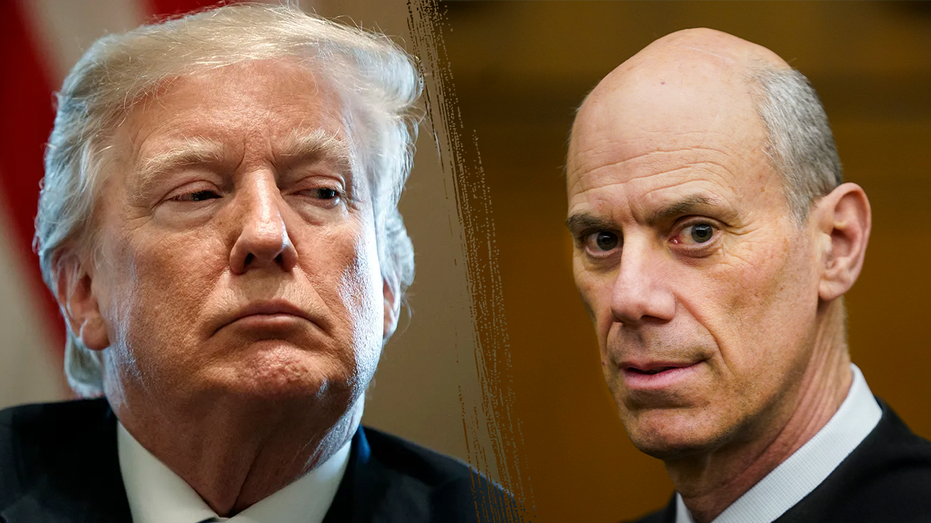
The House of Representatives passed a bill Wednesday to limit federal district judges’ ability to affect Trump administration policies on a national scale. The No Rogue Rulings Act, led by Rep. Darrell Issa, R-Calif., passed the House and limits district courts’ power to issue U.S.-wide injunctions, instead forcing them to focus their scope on the parties directly affected in most cases. All but one Republican lawmaker voted for the bill, which passed 219 to 213. No Democrats voted in favor. The Trump administration has faced more than 15 nationwide injunctions since the Republican commander-in-chief took office, targeting a wide range of President Donald Trump’s policies, from birthright citizenship reform to anti-diversity, equity and inclusion (DEI) efforts. Issa himself was confident the bill would pass, telling Fox News Digital on Tuesday morning, “We’ve got the votes.” SENATE GOP PUSHES TRUMP BUDGET FRAMEWORK THROUGH AFTER MARATHON VOTE SERIES He was less certain of the bill getting Democratic support, though he noted former Biden administration solicitor general Elizabeth Prelogar made her own complaints about district judges’ powers during the previous White House term. “We’re hoping some people look at it on its merits rather than its politics,” Issa said. Rep. Derek Schmidt, R-Kan., who has an amendment on the bill aimed at limiting plaintiffs’ ability to “judge shop” cases to favorable districts, told Fox News Digital before the vote, “A lot of things get called commonsense around here, but this one genuinely is.” “The basic policy of trying to rein in the overuse of nationwide injunctions was supported by Democrats before. It’s supported by Republicans now, and I’m hoping [this vote will] be supported by both,” he said. Rep. Lance Gooden, R-Texas, who, like Schmidt and Issa, is a House Judiciary Committee member, told Fox News Digital after the bill’s passage, “Many Democrat-appointed lower court judges have conducted themselves like activist liberal lawyers in robes while attempting to stop President Trump’s nationwide reforms. The No Rogue Rulings Act limits this unchecked power.” Another GOP lawmaker, Rep. Randy Feenstra, R-Iowa, told Fox News Digital, “More than 77 million Americans voted for [Trump’s] pro-American policies and want to see them implemented quickly. There is no reason that activist judges whose authority does not extend nationally should be allowed to completely stop [his] agenda.” Republicans’ unity on the issue comes despite some early divisions over how to hit back at what they have called “rogue” and “activist” judges. MEET THE TRUMP-PICKED LAWMAKERS GIVING SPEAKER JOHNSON A FULL HOUSE GOP CONFERENCE Rep. Marlin Stutzman, R-Ind., who supported impeachment and Issa’s bill, told Fox News Digital, “The judicial vendetta against President Trump’s agenda needs to be checked. Nationwide injunctions by activists judges have stood in the way of the American people’s will and in come cases their safety, since the President was sworn into office.” Stutzman said Issa’s bill “will stop individual judge’s political beliefs from preventing the wants and needs of our citizens from being implemented.” A group of conservatives had pushed to impeach specific judges who have blocked Trump’s agenda, but House GOP leaders quickly quashed the effort in favor of what they see as a more effective route to take on the issue. Despite its success in the House, however, the legislation does face uncertain odds in the Senate, where it needs at least several Democrats to hit the chamber’s 60-vote threshold.
Trump has a timeline in mind for Iran nuke deal, taps Israel to lead any potential military action
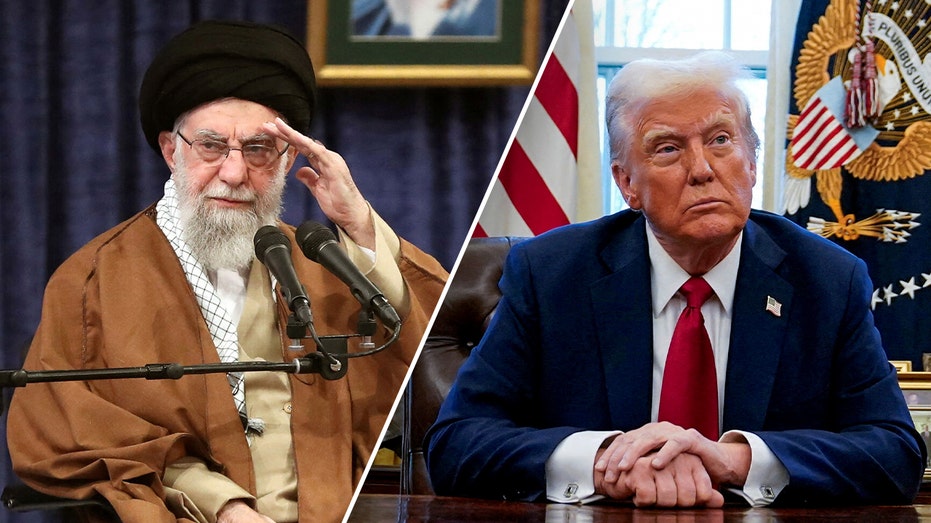
President Donald Trump told reporters that if Iran does not give up its nuclear weapons program, military action led by Israel is a real possibility, adding he has a deadline in mind for when the two countries must come to an agreement. The U.S. and Iran are expected to hold negotiations Saturday in Oman as the Trump administration continues to try to rein in the country’s nuclear program, threatening “great danger” if the two sides fail to come to an agreement. Trump told reporters from the Oval Office Wednesday he did have a deadline in mind for when the talks must culminate in an agreed-upon solution, but the president did not go into details about the nature of the timeline. TIMELINE IS RUNNING OUT TO STOP IRAN FROM MAKING NUCLEAR BOMB: ‘DANGEROUS TERRITORY’ “We have a little time, but we don’t have much time, because we’re not going to let them have a nuclear weapon. We can’t let them have a nuclear weapon.” Trump said when pressed on details about his potential timeline. “I’m not asking for much. I just — I don’t — they can’t have a nuclear weapon.” When asked about the potential for military action if Iran does not make a deal on their nuclear weapons, Trump said “Absolutely.” “If it requires military, we’re going to have military,” the president told reporters. “Israel will obviously be very much involved in that. They’ll be the leader of that. But nobody leads us. We do what we want to do.” TRUMP SAYS US WILL DEAL ‘DIRECTLY’ WITH IRAN IN HIGH-LEVEL MEETING ON SATURDAY Israeli Prime Minister Benjamin Netanyahu has expressed support for Iran’s complete denuclearization. During a visit to the White House, he expressed support for a deal similar to the one Libya sealed with the international community in 2003. The country gave up its entire nuclear arsenal. “Whatever happens, we have to make sure that Iran does not have nuclear weapons,” Netanyahu said during the meeting. The talks with Iran scheduled for Saturday in Oman have been characterized as “direct” talks by Trump, but Iran’s foreign leaders have disputed that assertion, describing the talks as “indirect.” Iran’s leaders have said if the talks go well Saturday, they would be open to further direct negotiations with the U.S.
Trump says he’ll ‘take a look’ at exempting some larger US companies hit especially hard by tariffs
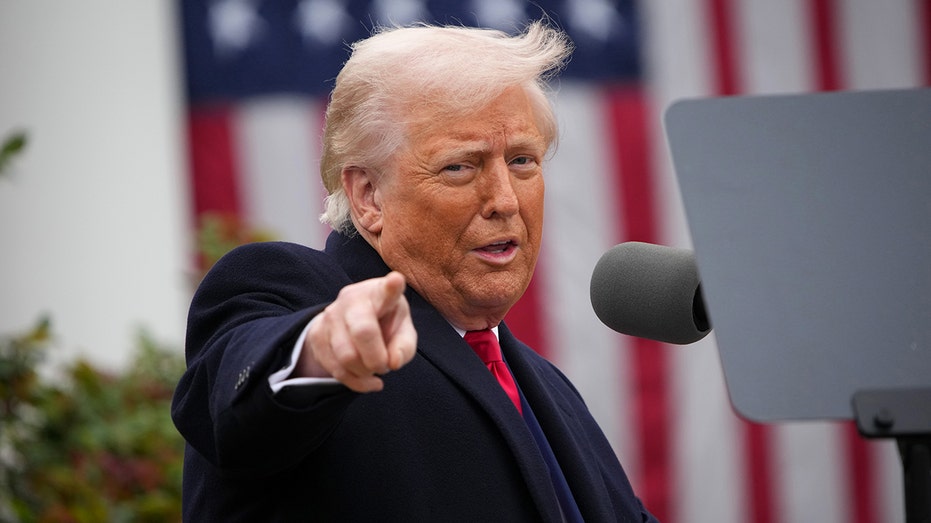
President Donald Trump said Wednesday he was open to providing exemptions for certain U.S. companies hit especially hard by tariffs through no fault of their own. The president and Treasury Secretary Scott Bessent spoke to reporters Wednesday afternoon and were asked repeatedly about the effect their tariff moves have had on financial markets and whether they will let their recent declines affect future trade decisions. Trump was asked specifically if he would consider “exempting” some larger U.S. companies that have been hit especially hard by the new tariffs, and the president said he would consider it. “I’ll take a look at it as time goes by. We’re going to take a look at it,” Trump responded. “There are some that have been hard — there are some that, by the nature of the company, get hit a little bit harder, and we’ll take a look at that.” DONALD TRUMP’S ALLIES, SUPPORTERS AND DONORS, LED BY ELON MUSK, PUSH TO END TARIFF WAR When asked how he would determine which companies might receive such an exemption, Trump responded, “Instinctively.” “You almost can’t take a pencil to paper. It’s really more of an instinct than anything else,” Trump added. “Some companies, through no fault of their own, they happen to be in an industry that is more affected by these things than others. You have to be able to show a little flexibility, and I’m able to do that. CHARLIE GASPARINO BREAKS DOWN TRUMP’S TARIFF PAUSE: ‘THIS IS WHAT FORCED THE HAND’ “You have to have flexibility,” Trump said Wednesday. “I could say, ‘Here’s a wall, and I’m going to go through that wall. I’m going to go through it, no matter what. Keep going, and you can’t go through the wall. Sometimes you have to be able to go under the wall, around the wall or over the wall.” After the president’s “Liberation Day” tariff announcements, which included a 10% universal tariff on all imported goods and higher “reciprocal” tariffs targeting other countries like China and the European Union, the Trump administration did release a list of carve-outs related to roughly $644 billion in imports, according to a report from The Wall Street Journal. The exemptions include $185 billion in goods from Canada and Mexico, but the countries remain subject to other tariffs, according to the report. WHITE HOUSE WARNS AGAINST TARIFF RETALIATION, SAYS TRUMP ‘HAS SPINE OF STEEL AND HE WILL NOT BREAK’ Additionally, the Trump administration has exempted certain industries, such as the pharmaceutical and semiconductor industries, from new tariffs, but the president has signaled that could change. These sectors and others are facing an ongoing probe, called a Section 232 investigation, according to Market Watch, to assess the need for imposing tariffs. No matter the outcome of the investigation, it appears Trump has his sights set on placing higher tariffs on the pharmaceutical industry. He told an audience at a dinner hosted by the National Republican Congressional Committee Tuesday night that “a major tariff on pharmaceuticals” would be announced very soon. The White House declined to comment for this article.
Verifying hand-counted ballots in Texas elections may be easier under GOP bill

The proposal would require counties who opt for hand counts to use ballots that can be scanned and tabulated by a voting machine.