

Woman, 27, dies by suicide, leaves behind suicide note: ‘Chhodna mat usko’

A 27-year-old woman allegedly died by suicide at her residence in Delhi’s Uttam Nagar last week, reported Hindustan Times.
Ohio teacher attempted to pay student $2K to kill estranged husband in failed murder-for-hire plot

An Ohio substitute teacher is accused of offering a student $2,000 to kill her estranged husband before the teenager’s mother caught wind of the murder-for-hire plot and alerted authorities. Stephanie Demetrius, 44, was arrested Wednesday and charged with first-degree conspiracy for the offer to a boy at The Academy For Urban Scholars High School in Columbus, WSYX reported. Demetrius approached a student at the school on March 26 and offered $2,000 to carry out the murder of her soon-to-be ex-husband. The student was initially paid $250 in cash as a down payment. “This particular teacher was attempting to groom this young person into committing murder,” Columbus Division of Police Sgt. James Fuqua told WSYX. OHIO TEACHER PLACED ON LEAVE AFTER ALLEGEDLY VISITING STUDENT’S HOME TO DEMAND MISSING HOMEWORK The plan was foiled when the student’s mom discovered texts on her son’s phone between him and Demetrius. The teenager’s mother then reported the incident to the police. “Without their help, some of this might not have come to light,” Fuqua said. “This was a situation where a parent was able to capture things inside this young person’s phone and contact authorities.” In a recorded phone call between the student and Demetrius, the substitute teacher told the student that he would receive the remainder of the payment, saying she owed an additional “15.” The substitute teacher also gave the student information about when her children would be out of the home, so he could kill her estranged husband, who worked from home, court records show, according to The Columbus Dispatch. SCHOOL BUS CAUGHT ON CAMERA ENGULFED IN FLAMES AFTER DRIVER’S ‘QUICK RESPONSE’ SAVES STUDENTS FROM INFERNO “When asked if the neighbors would hear the gunfire, she advised that they don’t care about the neighbors,” court records state, the outlet reported. Demetrius and her husband have been married since 2004 but were going through divorce proceedings, court records show. She appeared in Franklin County Municipal Court on Thursday morning, with her public defender denying the allegations and criticizing them as fabrication. Prosecutor Parker Schwartz said Demetrius’s estranged husband had received a protection order against her. Schwartz also noted that Demetrius had exhibited “possessive and controlling behavior,” had mental health issues and had previously made homicidal threats. Court filings show she has previously been accused of assaulting her estranged husband and some of her children, setting a fire in her home’s basement, smashing garage doors and damaging other property while the children were present and other threatening behavior, according to The Columbus Dispatch. Demetrius was released on a $150,000 bond and is barred from having any contact with her estranged husband or the student. She is due back in court on April 11.
Russia-Ukraine war: List of key events, day 1,136

These are the key events on day 1,136 of Russia’s war on Ukraine. These are the key events from Saturday, April 5: Fighting A Russian missile attack has killed at least 18 people, including nine children, in a residential area of the Ukrainian city of Kryvyi Rih, local officials said, but Russia’s Ministry of Defence said it targeted a military gathering there. Ukrainian President Volodymyr Zelenskyy says European military planners could be ready within a month with details of a foreign troop contingent in Ukraine seen as critical to ending the war with Russia. Russia launched a drone attack at a thermal power plant in Ukraine’s city of Kherson, accusing Moscow of violating a United States-brokered energy ceasefire. Russia claimed its forces captured two more villages in Ukraine’s eastern Donetsk region in the past 24 hours. According to a statement from the Russian Defence Ministry, Russian forces now control the settlements of Panteleimonivka and Rozivka in Donetsk. Ukraine said an official in the central city of Dnipro died in hospital after a blast rocked his car. Russian commander Apti Alaudinov was quoted by the state RIA news agency as saying the situation in Russia’s Belgorod region is “under control” after the Ukrainian army tried to break through the border. Germany has been paying for Ukraine’s access to a satellite internet network operated by France’s Eutelsat, as Europe seeks alternatives to Elon Musk’s Starlink. Advertisement Ceasefire Zelenskyy said the deadly strike on his home city of Kryvyi Rih showed that Russia did not want a ceasefire. The Kremlin said Russian President Vladimir Putin and United States President Donald Trump had no plans to talk after a visit to Washington by Putin’s investment envoy. US Secretary of State Marco Rubio said “there is a lot that has to happen” in the coming weeks to reach a ceasefire in Ukraine and that negotiations will not continue forever. NATO Secretary General Mark Rutte said the ball regarding a Ukraine ceasefire is in the Russian court, after meeting with NATO foreign ministers in Brussels. The United Kingdom and French foreign ministers accused Putin of dragging his feet in ceasefire talks and demanded a swift response from Russia after weeks of US efforts to secure a truce. Turkish Foreign Minister Hakan Fidan told Reuters news agency any potential peace agreement between Ukraine and Russia would be “difficult to digest” but would still be better than the alternative of more death and destruction. Politics and diplomacy European NATO allies and Canada said they are willing to ramp up defence spending but are cool on American demands for the size of their military budgets. US allies have spent billions of dollars more on defence but almost a third still don’t meet NATO’s target of at least 2 percent of their gross domestic product. The Ukrainian team will head to the US in the near future for discussions on a new framework on the minerals deal, public broadcaster Suspilne reported, citing Foreign Minister Andrii Sybiha. A former Russian defence official was convicted of taking bribes and sentenced to seven years in a penal colony, as Putin continues a drive to punish corruption in the armed forces, leading to a rash of prosecutions. The EU proclaimed a “new era” in ties with Central Asia at a major summit in Uzbekistan, as Russia’s invasion of Ukraine accelerates the region’s drift from Moscow’s orbit and Brussels presses its influence in the region in the face of Russian and Chinese competition. NATO members Poland, Finland and all three Baltic states have queued up over the past few weeks to withdraw from the Ottawa Convention banning antipersonnel landmines, in the face of what they say are growing military threats from Russia. The Vatican’s Foreign Minister Archbishop Paul Gallagher held a phone call on Friday with Russian counterpart Sergey Lavrov to discuss the war in Ukraine and plans to stop the fighting. Germany said it would buy explosive drones for the first time as Berlin boosts investments in its armed forces to counter the threat from Russia. Advertisement Adblock test (Why?)
Trump’s 10 percent tariff takes effect, raising fears of global trade war
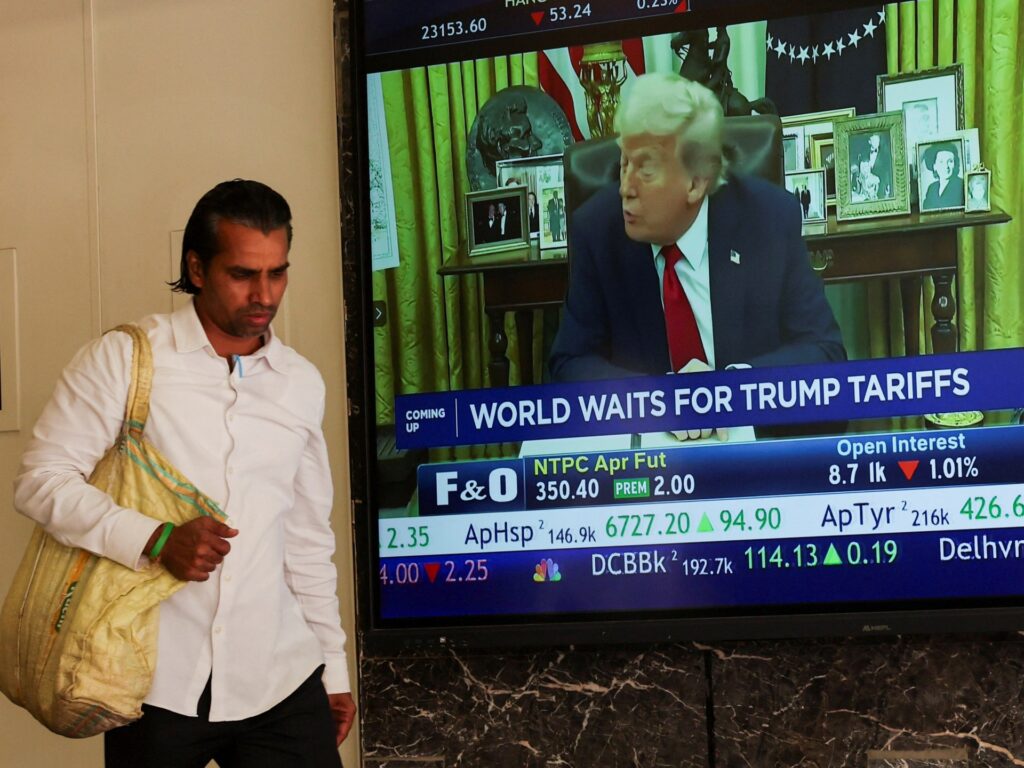
US President Donald Trump’s widest-ranging tariffs to date have come into effect – a move that may trigger retaliation and escalate trade tensions, upsetting the global economy. The initial 10 percent “baseline” tariff took effect at United States seaports, airports and customs warehouses at 12:01am ET (04:01am GMT) on Saturday, ushering in Trump’s full rejection of the post-World War II system of mutually agreed tariff rates. Among countries first hit with the 10 percent tariff are Australia, Britain, Colombia, Argentina, Egypt and Saudi Arabia. The trade gaps, said the White House, were driven by an “absence of reciprocity” in relationships and other policies like “exorbitant value-added taxes.” A US Customs and Border Protection bulletin to shippers indicates no grace period for cargoes on the water at midnight on Saturday. But a US Customs and Border Protection bulletin did provide a 51-day grace period for cargoes loaded onto vessels or planes and in transit to the US before 12:01am ET on Saturday. These cargoes need to arrive by 12:01 am ET (4:01am GMT) on May 27 to avoid the 10 percent duty. Advertisement Moreover, on April 9, Trump’s higher “reciprocal” tariff rates of 11 percent to 50 percent are due to take effect. European Union imports will be hit with a 20 percent tariff, while Chinese goods will be hit with a 34 percent tariff, bringing Trump’s total new levies on China to 54 percent. Vietnam, which benefitted from the shift of US supply chains away from China after Trump’s first-term trade war with Beijing, will be hit with a 46 percent tariff. The country, however, agreed on Friday to discuss a deal with Trump. Canada and Mexico are both exempt from Trump’s latest duties because they are still subject to a 25 percent tariff related to the US fentanyl crisis for goods that do not comply with the US-Mexico-Canada rules of origin. ‘Pretty seismic’ Michael Strain, director of Economic Policy Studies at the American Enterprise Institute, told Al Jazeera that the US tariffs have been greeted quite poorly by the investors. “This would have a really bad effect on the economic outcome of workers and households and businesses,” he said, adding that the move “would constitute a tax increase of 400-500 billion dollars this year on American households and on businesses”. “The combination of big increase in taxes and the tariffs would increase the prices of these imported goods that households face [and] would mean that households would very likely see negative income growth… That alone would risk a recession in the US,” he said. On Friday, China announced that it will impose its own 34 percent tariff on US products from April 10. Beijing also said it would sue the US at the World Trade Organization (WTO) and restrict exports of rare earth elements used in high-end medical and electronics technology. Advertisement Trump warned on Friday on social media that “China played it wrong,” saying this was something “they cannot afford to do”. Other major trading partners have held back as they continue to digest the unfolding international standoff and fears of a recession. Trump’s Wednesday tariff announcement shook global stock markets to their core, wiping out $5 trillion in stock market value for S&P 500 companies by Friday’s close, a record two-day decline. Prices for oil and commodities plunged, while investors fled to the safety of government bonds. Economists have also warned that the tariffs could dampen growth and fuel inflation. Kelly Ann Shaw, a trade lawyer at Hogan Lovells and former White House trade adviser during Trump’s first term told a Brookings Institution event on Thursday that she expected the tariffs to evolve over time as countries seek to negotiate lower rates. “This is the single biggest trade action of our lifetime,” she said. “But this is huge. This is a pretty seismic and significant shift in the way that we trade with every country on earth.” Trump said on his Truth Social platform that his “policies will never change”. However, his latest tariffs have notable exclusions. They do not stack on recently imposed 25 percent tariffs hitting imports of steel, aluminium and automobiles. Also temporarily spared are copper, pharmaceuticals, semiconductors and lumber, alongside “certain critical minerals” and energy products, the White House said. But Trump has ordered investigations into copper and lumber, which could lead to further duties soon. Advertisement He has threatened to hit other industries like pharmaceuticals and semiconductors as well, meaning any reprieve might be limited. Adblock test (Why?)
India’s Modi visits Sri Lanka to shore up defence and energy ties
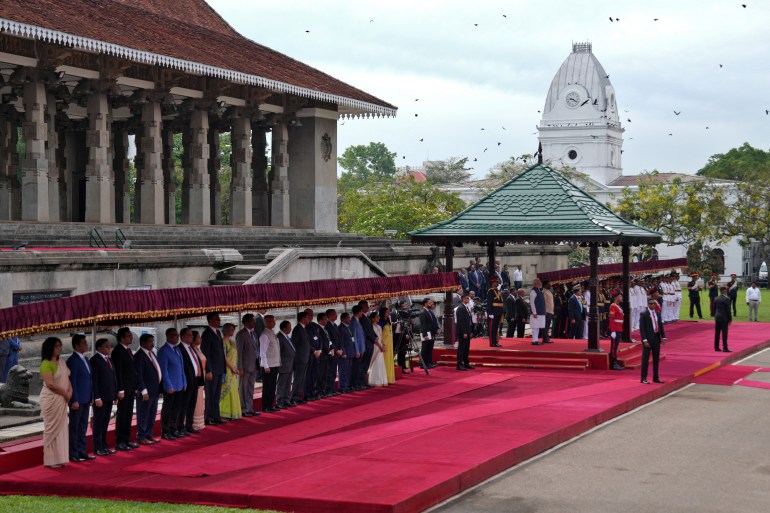
The Indian leader is the first foreign dignitary to visit the island nation since the leftist Dissanayake swept elections last year. Indian Prime Minister Narendra Modi is in Sri Lanka to strengthen historical defence and energy ties as Colombo balances ties with its powerful neighbour and biggest lender, China. Sri Lankan President Anura Kumara Dissanayake rolled out the red carpet for Modi and welcomed him with a 19-gun salute in the capital’s Independence Square on Saturday. The Indian leader is the first foreign dignitary to visit the island since the leftist Dissanayake swept elections last year. Modi was also conferred with Mithra Vibhushan, Sri Lanka’s highest civilian honour, by Dissanayake. The Indian leader thanked the Sri Lankan president and said the honour was “not just mine but it belongs to the 140 crore [1.4 billion] people of India.” Modi and Dissanayake listen to the national anthems of their countries during a ceremony at Colombo’s Independence Square, April 5, 2025 [Thilina Kaluthotage/Reuters] “We believe that our security interests are aligned,” Modi said during a televised ceremony from Dissanayake’s office in Colombo. “Our security is interdependent and interconnected.” Advertisement The two nations signed a five-year defence cooperation agreement for the training of Sri Lankan military personnel in India as well as information and technology sharing. Dissanayake applauded what he called “India’s rise as a world power, not just a regional power”. “I have reiterated our position to Prime Minister Modi that Sri Lankan territory will not be allowed to be used by anyone to undermine India’s security,” he added. India has previously objected to Chinese submarines and research vessels which have called at the main seaport in Colombo. Sri Lanka has not allowed Chinese submarines to dock since 2014, after India raised concerns over two such visits. Last year, Colombo imposed a ban on foreign research vessels following New Delhi’s accusations that Chinese ships were being used to spy on India. But the visit’s highlight was the launch of a 120-megawatt solar power plant in Sampur in the island’s northeastern Trincomalee district. The plant had been stalled for years but was reinvigorated with New Delhi’s backing as a joint project. Reporting from Colombo, Al Jazeera’s Minelle Fernandez said Dissanayake was also expected to discuss the issue of fishermen from the southern Indian state of Tamil Nadu allegedly encroaching into Sri Lankan territorial waters. “Hundreds of Indian trawlers are carrying away fish using a mechanised system called bottom trawling, which is also destroying the environment,” she said. Balancing act Modi’s visit came as Colombo grapples with the competing interests of New Delhi and Beijing. Advertisement India has been concerned about China’s growing sway in Sri Lanka, which it considers to be within its sphere of geopolitical influence. Dissanayake’s first foreign visit as president was to New Delhi in December, but he followed that with a visit to Beijing in January, underscoring Sri Lanka’s delicate balancing act. China has emerged as Sri Lanka’s largest single bilateral creditor, accounting for more than half of its $14bn bilateral debt at the time the island defaulted on its sovereign debt in 2022. Beijing was the first to restructure its loans to Sri Lanka, a move that cleared the way for the island to emerge from that year’s worst-ever economic meltdown. Colombo also signed an agreement in January with a Chinese state-owned company that will invest $3.7bn in an oil refinery in the island’s south. It would be Sri Lanka’s largest single foreign investment and is seen as crucial for the island’s economy. Modi arrived in Sri Lanka late on Friday from a summit in Thailand and a string of meetings with leaders of regional nations as he sought to shore up India’s relations with neighbours. On the sidelines of the Bangkok BIMSTEC meeting – the grouping of the seven nations on the Bay of Bengal – Modi held a rare face-to-face meeting with Myanmar’s military government chief Min Aung Hlaing. Modi also held talks with Muhammad Yunus, the interim leader of neighbouring Bangladesh – the first such meeting since a revolution in Dhaka removed New Delhi’s long-term ally Sheikh Hasina. Advertisement India was the biggest benefactor of Hasina’s government and her overthrow sent cross-border relations into a tailspin, culminating in Yunus choosing to make his first state visit last month to China. Modi also met on Friday in Bangkok with his Nepali counterpart KP Sharma Oli, the first since Kathmandu’s leader returned to power last year, as well as Tshering Tobgay of Bhutan. Adblock test (Why?)
India, Sri Lanka ink defence partnership pact after PM Modi, President Dissanayake’s meet: Here’s all you need to know
The two sides also signed a pact to develop Trincomalee as an energy hub. Another agreement was inked to facilitate New Delhi’s multi-sectoral grant assistance to Sri Lanka’s eastern region.
Amid Trump’s immigration crackdown, students from THESE two Indian states see highest US visa rejection rate in 20 years

Discouraged by these trends, students are now looking at alternative destinations for higher studies — including the United Kingdom and Germany — according to study abroad consultants based in Hyderabad.
IMD weather update: Severe heatwave alert in Delhi-NCR, Uttar Pradesh, Rajasthan, Haryana and other states, maximum temperature to go up to…

The India Meteorological Department (IMD) predicted strong surface winds during the day. The maximum temperature is expected to reach 39 degrees Celsius, according to the IMD.
Senate GOP pushes Trump budget framework through after marathon vote series
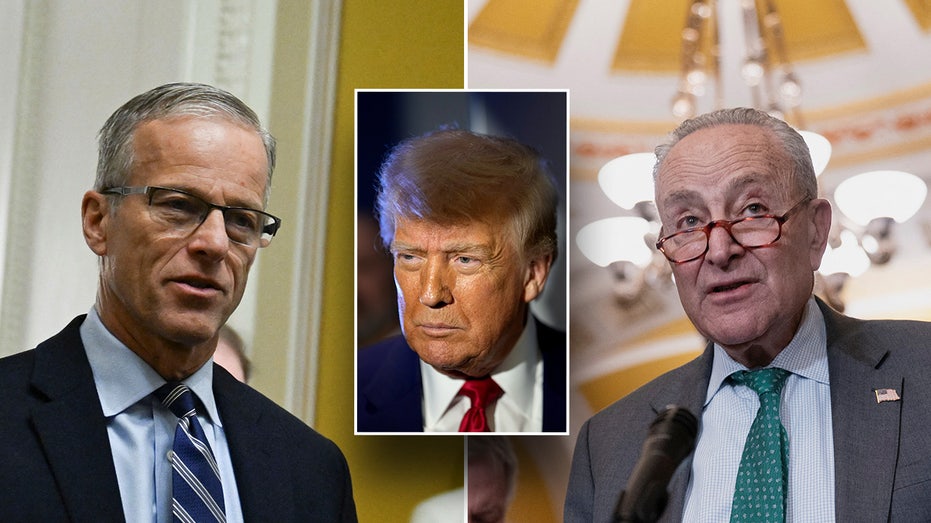
The Senate passed a framework for a sweeping bill promoting President Donald Trump’s agenda after an hourslong series of amendment votes during which Democrats sought to put Republicans on record on issues like tariffs and the Department of Government Efficiency (DOGE). It passed mostly along party lines in a 51 to 48 vote around 2:30 a.m. ET on Saturday morning. Sens. Susan Collins, R-Maine, and Rand Paul, R-Ky., were the only two Republicans to join Democrats in opposing the measure. The amended framework would raise the debt ceiling by up to $5 trillion within the reconciliation process, taking future leverage away from Senate Democrats. It would also make Trump’s 2017 tax cuts permanent by using what’s called a current policy baseline that Budget Committee Chairman Lindsey Graham, R-S.C., decides. DEM SENATOR LOOKS TO HIJACK KEY TRUMP BUDGET PROCESS WITH TARIFF CHALLENGE The scoring tool essentially means the cost of making Trump’s tax cuts permanent would be factored at $0 because it extends current policy, rather than counting it as new dollars being added to the federal deficit. Some conservatives have signaled they’re wary of using that method, however. Sen. Bill Cassidy, R-La., said on the Senate floor ahead of the vote series, “I have been assured that there is a commitment and other ways to pay for the eventual reconciliation bill.” “Now, I am not saying that I think that it is better that we use current policy as baseline. It’s never been done before in a setting like this. I think it establishes a dangerous precedent. It might be within the rules to do so, but it doesn’t mean it’s wise to do so,” he said. Some House conservatives have gone so far as to call it a “gimmick.” Senate GOP leaders made clear they were in lock-step behind the framework, however. “This resolution is the first step toward a final bill to make permanent the tax relief we implemented in 2017 and deliver a transformational investment in our border, national, and energy security – all accompanied by substantial savings measures and commonsense reforms to our government,” Senate Majority Leader John Thune, R-S.D., said on Friday evening. Senate Majority Whip John Barrasso, R-Wyo., said, “The American people gave us a mission and a mandate: secure borders, lower taxes, affordable energy, peace through strength, and, of course, efficient, effective government. Senate Republicans’ bold budget blueprint delivers.” REPUBLICANS CHARGE AHEAD ON TRUMP BUDGET, SETTING UP MARATHON SENATE VOTES Budget reconciliation lowers the vote threshold in the Senate from 60 to 51, which lets Republicans approve certain priorities with no Democrat support. Washington’s Republican trifecta thus sees reconciliation as a key tool for delivering on Trump agenda items. The Senate’s Friday night “vote-a-rama” was triggered by the chamber agreeing to a motion to proceed to the budget resolution amendment on Thursday night. Nearly a day of debate followed before the vote series was initiated. During this type of voting series, senators of both parties can introduce an unlimited number of amendments, and many get floor votes. No amendments were adopted during the roughly six hours-long vote series. Some notable measures, however, included an amendment by Sen. Bernie Sanders, I-Vt., to raise the federal minimum wage to $17 over a period of five years, an amendment by Senate Minority Leader Chuck Schumer, D-N.Y., to limit many of Trump’s tariffs, and a bipartisan amendment aimed at blocking the reconciliation bill from making cuts to Medicaid. TED CRUZ CLASHES WITH KEY DEMOCRAT OVER ‘SECOND PHASE OF LAWFARE’ THROUGH FEDERAL JUDGES’ ORDERS “Tonight, Senate Democrats gave Senate Republicans the chance to hit the kill switch on Donald Trump’s tariffs on DOGE, on the attacks against Social Security and Medicare and Medicaid,” Schumer said after the vote. “And at each opportunity, Republicans refused.” Graham said in a statement on X after the vote, “Tonight, the Senate took one small step toward reconciliation and one giant leap toward making the tax cuts permanent, securing the border, providing much-needed help for the military and finally cutting wasteful Washington spending.” The budget would address border funding for the Trump administration as well as extend the hallmark tax cuts Trump passed in 2017. Initially, there was stark disagreement between Republicans in the House and Senate on how to organize a budget reconciliation resolution. The House GOP leaders preferred one bill with both the border and taxes included, while those in the Senate wanted to have two separate resolutions for them. House Republicans passed a framework that closely resembles the current Senate-passed version last month. But it’s still not clear that House conservatives will accept the Senate plan, despite its similarities to the lower chamber’s framework, with the Senate’s bid to permanently extend Trump’s tax cuts likely to be one of the biggest points of contention. The House Budget Committee’s Republican majority wrote on X just before the Senate kicked off its vote series, “Cutting taxes without cutting spending doesn’t reduce taxes, it merely shifts the tax burden to our children. We have a generational opportunity – and maybe our last – to get our fiscal house in order.” After matching frameworks pass the House and Senate, the relevant congressional committees will begin filling it out with policy and spending changes under their jurisdictions. Trump expressed support for the Senate framework earlier this week, saying at an unrelated event, “If we get this done, it’ll be the most incredible bill ever passed in the history of our Congress.”
India caught in crosswinds of US aerospace tariffs

With the Trump Administration announcing sweeping new tariffs 10% on all imports starting on April 5, 2025, followed by additional ‘reciprocal tariffs’ from April 9 on countries with which the US runs the largest trade deficits-the sector fears rising costs and long-term damage to its supply chain.