

Texas counties are looking into “potential noncitizens” on voter rolls. Here’s what they’re finding.
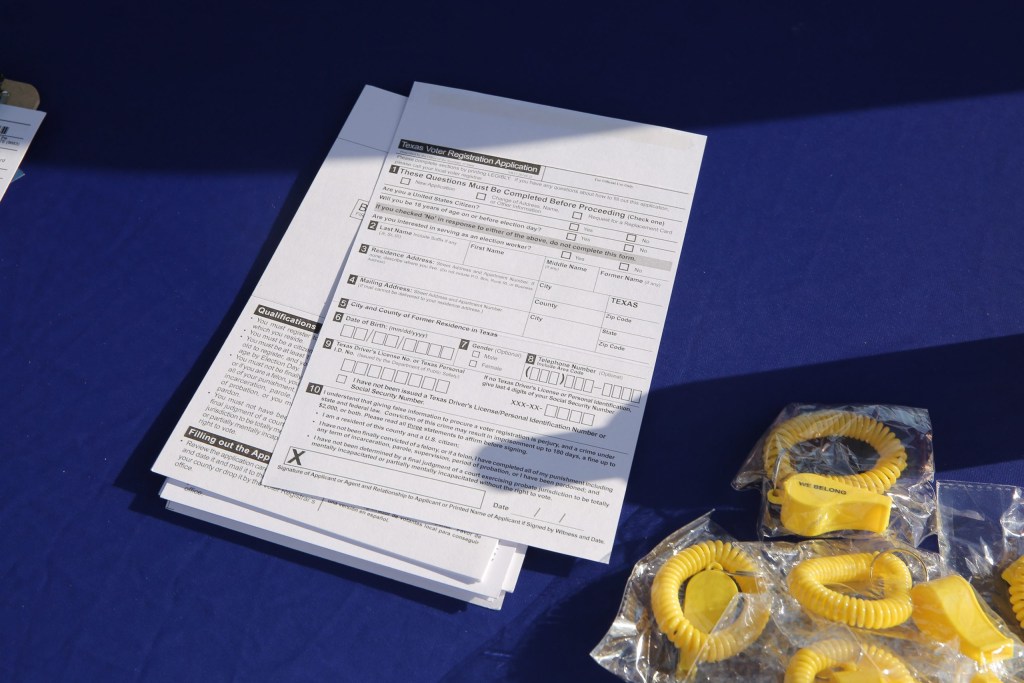
The voters were flagged after being checked against a federal database. Some officials question its reliability.
Texas DACA recipients ponder leaving the state amid push to revoke their work permits

A Trump administration proposal would strip Texas’ more than 86,000 DACA recipients of their work permits — including two nurses who say they’ll move to other states if that happens.
In Waco, food banks are already feeling the heat ahead of SNAP freeze

Charities are seeing a wave of clients seeking groceries ahead of the Saturday suspension of federal food benefits. Waco has a high food insecurity rate already.
DHS asked Texas to hand over driver’s license data for citizenship checks

It’s the latest step to pool confidential data that the Trump administration claims will help identify noncitizens on voter rolls and tighten immigration enforcement.
Republican Texas secretary of state fights GOP’s closed primary lawsuit, calls Paxton filing “brazen”
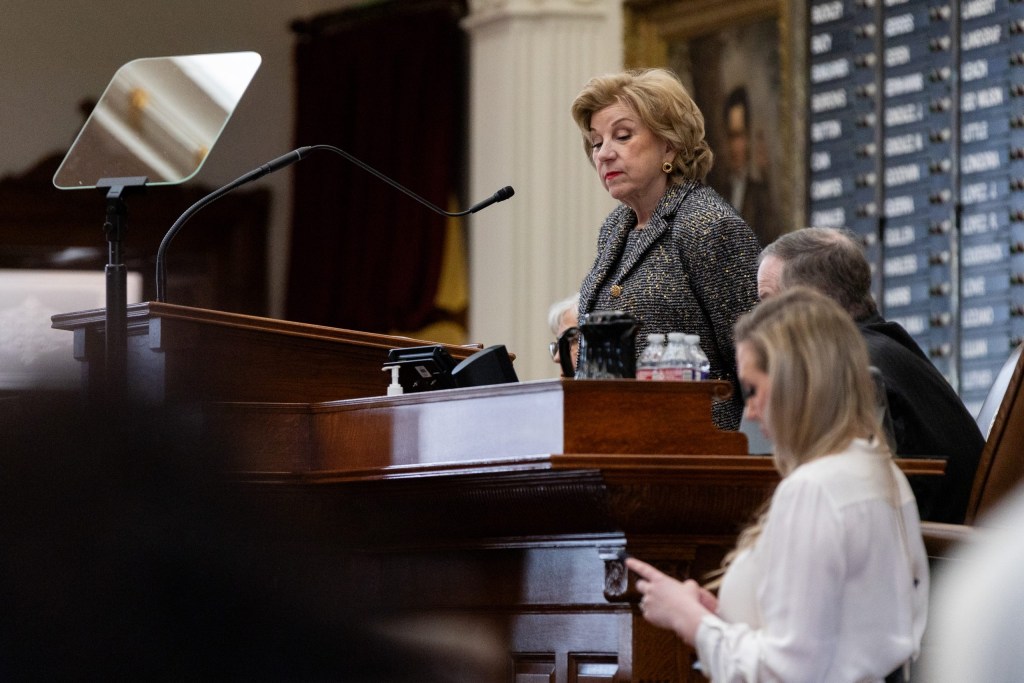
Jane Nelson is fighting a lawsuit from Republicans who say Democrats and independents are voting in GOP primaries, boosting more moderate candidates.
Texas ACA insurers hike monthly premiums by 35% on average

The amount Texans will pay toward their ACA premiums will likely rise more steeply, with enhanced subsidies set to expire.
New York judge dismisses Ken Paxton’s legal challenge in abortion pills case
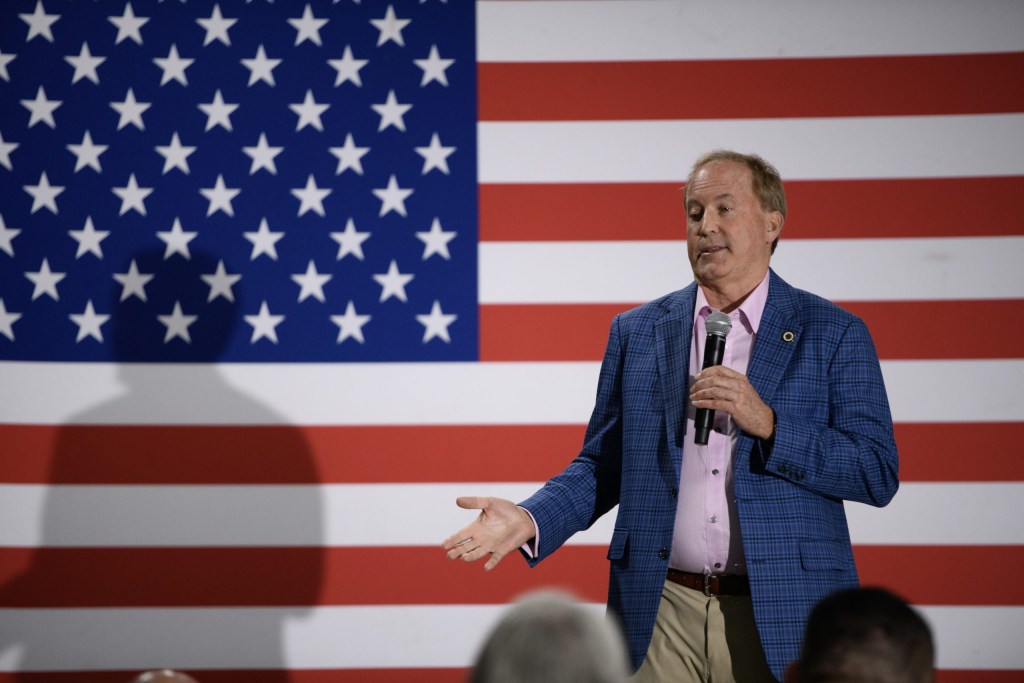
The Texas attorney general wanted a New York court to enforce a civil judgment against a doctor accused of prescribing abortion pills. The suit was a test of New York’s “shield law.”
Feds ordered to pay for SNAP as millions of Texans face cuts during government shutdown

It’s not clear how soon assistance could reach people and the rulings could be appealed, The Associated Press reported.
Trump touts ‘12 out of 10’ meeting with Xi, downplays reports of Venezuela strikes
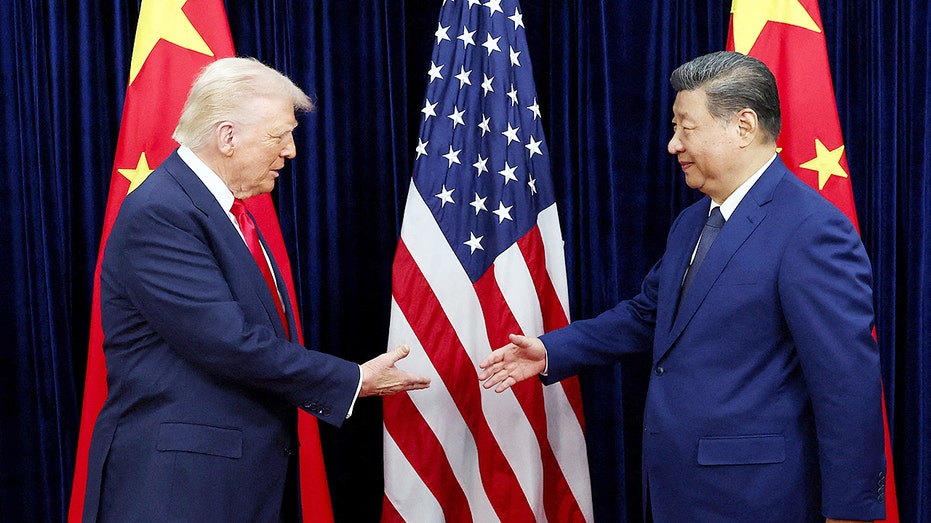
President Donald Trump spent the week in Asia meeting with other global leaders, including Chinese President Xi Jinping, while his administration ramped up its attacks against alleged drug boats in Latin America. Trump met with Xi Thursday in South Korea, where the two hashed out a series of agreements concerning trade. Specifically, Trump said he agreed to cut tariffs on Chinese imports by 10% — reducing the rate to from 57% to 47% — because China said it would cooperate with the U.S. on addressing the fentanyl crisis. Additionally, Trump said that he would not move forward with imposing an additional 100% tariff on Chinese goods that were expected to kick in Saturday. Trump threatened the steep hike after China announced in October it would impose export controls on rare earth magnets, which he said China had agreed to postpone by a year. Afterward, Trump described the meeting as a massive success, and signaled that a broader trade deal between the two countries would be signed shortly. TRUMP, XI MEET IN EFFORT TO RESOLVE TRADE TENSIONS SPARKED BY US TARIFFS “Zero, to 10, with 10 being the best, I’d say the meeting was a 12,” Trump told reporters after meeting with Xi. “A lot of decisions were made … and we’ve come to a conclusion on very many important points.” From China’s point of view, Xi said afterward the two countries should work together and complete outstanding tasks from the summit for the “peace of mind” of China, the U.S., and the rest of the world. “Both sides should take the long-term perspective into account, focusing on the benefits of cooperation rather than falling into a vicious cycle of mutual retaliation,” Xi said, according to a state media report on the meeting. TRUMP ANNOUNCES MEETING WITH XI JINPING AT SOUTH KOREA APEC SUMMIT SCHEDULED FOR NEXT MONTH Additionally, Trump announced on the Asia trip, which also included stops in Malaysia and Japan, that he would instruct the U.S. to revive nuclear weapons testing —upending decades of precedent on nuclear policy, as the U.S. has not conducted nuclear weapons testing since 1992. The announcement also left lawmakers, experts and military personnel wondering what he meant since no other country has conducted a known nuclear test since North Korea in 2017. China’s and Russia’s last known tests go back to the 1990s, when Russia was still the Soviet Union. The White House did not provide comment to Fox News Digital. The Pentagon did not respond to a request for comment. TRUMP CLAIMS ASIA TOUR RETURNED ‘TRILLIONS’ TO US AHEAD OF CRITICAL MEETING WITH CHINA’S XI However, experts are aligned that Trump likely meant he would instruct the U.S. to either increase its testing of nuclear-powered weapons systems or conduct tests of low-yield nuclear weapons. Vice President JD Vance told reporters Thursday that Trump would continue to work on nuclear proliferation, but said testing would be done to guarantee weapons are working at optimal capability. “It’s an important part of American national security to make sure that this nuclear arsenal we have actually functions properly,” Vance said. “And that’s part of a testing regime. To be clear, we know that it does work properly, but you got to keep on top of it over time. And the president just wants to make sure that we do that with his nation.” TRUMP THREATENS ‘MASSIVE’ CHINA TARIFFS, SEES ‘NO REASON’ TO MEET WITH XI The Trump administration also stepped up its campaign against drug cartels in Latin America, totaling at least 14 strikes against alleged drug boats in the region. Secretary of War Pete Hegseth announced Tuesday that the U.S. had conducted three strikes against four vessels in the Eastern Pacific, and Hegseth announced Wednesday another strike had also been conducted in those waters. But the White House dismissed reports Friday that the Trump administration had identified and was poised to strike military targets within Venezuela imminently. Trump later told reporters that he hadn’t determined whether he would conduct strikes within Venezuela. Lawmakers — including some Republicans — have pressed for more answers on the strikes, and have questioned if they are even legal. For example, Sens. Adam Schiff, D-Calif., Tim Kaine, D-Va., and Rand Paul, R-Ky., spearheaded a war powers resolution that would prohibit U.S. armed forces from engaging in “hostilities” against Venezuela. “The Trump administration has made it clear they may launch military action inside Venezuela’s borders and won’t stop at boat strikes in the Caribbean,” Schiff said in an Oct. 17 statement. The Associated Press contributed to this report.
Trump’s ‘nuclear’ demand not landing for Senate Republicans amid shutdown
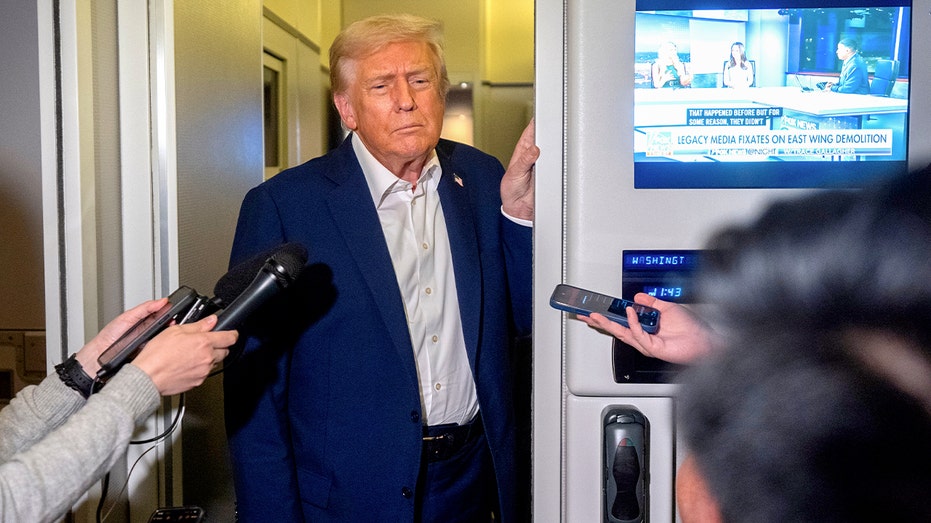
President Donald Trump wants Senate Republicans to gut the Senate filibuster, but it’s a request that puts his quick-fix desire to end the shutdown at odds with the GOP’s long-held defense of the filibuster. The Senate filibuster is the 60-vote threshold that applies to most bills in the upper chamber, and given the nature of the thin majorities that either party has commanded in recent years, that means that legislation typically has to be bipartisan to advance. It has also proven to be the main roadblock in reopening the government. Despite Republicans controlling the upper chamber, they have routinely come up a handful of votes short in their 13 attempts to end the shutdown. JOHNSON WARNS AGAINST TRUMP’S DEMAND FOR SENATE TO GO ‘NUCLEAR’ TO END SHUTDOWN Three members of the Democratic caucus have broken from Senate Minority Leader Chuck Schumer, D-N.Y., and their colleagues to reopen the government, but Senate Majority Leader John Thune, R-S.D., needs five more to hit the magic number. Trump, in a late-night Truth Social post, said that on his return trip from Asia, he ruminated heavily over why the government had shut down despite Republicans being in control. His solution was for Senate Republicans “to play their ‘TRUMP CARD,’ and go for what is called the Nuclear Option.” “Get rid of the Filibuster, and get rid of it, NOW,” Trump said. Senate Republicans have already gone nuclear this year to unilaterally change the rules to blast through Schumer’s and Democrats’ blockade of Trump’s nominees. But for many Senate Republicans, including Thune and his leadership team, nuking the filibuster is a proverbial third rail. TRUMP URGES GOP TO ‘END THE SHUTDOWN’ BY GOING NUCLEAR ON SENATE FILIBUSTER “There’s always a lot of swirl out there, as you know from, you know, social media, etc., but no, we’re not having that conversation,” Thune said earlier this month when asked about pressure to go nuclear on the filibuster. And there isn’t much daylight between his sentiments from earlier in October to now. “Leader Thune’s position on the importance of the legislative filibuster is unchanged,” Thune’s spokesperson Ryan Wrasse said in a statement. Earlier this month during an appearance on Fox & Friends, Senate Majority Whip John Barrasso, R-Wyo., shared a similar outlook as Thune when asked if the filibuster was under consideration to be on the chopping block. “No, that’s not going to be the case,” he said. “There aren’t the Republicans that would want to support it.” SENATE GOP RESISTS ‘NUCLEAR OPTION’ AS DEM SHUTDOWN STANDOFF DEEPENS The filibuster has come under fire in the last decade from Senate Democrats, a point that Trump noted in his lengthy post. The last time the filibuster was put to the test was when Democrats controlled the Senate in 2022. Schumer, who was majority leader at the time, tried to change the rules for a “talking filibuster” in order to pass voting rights legislation. But the effort was thwarted when then-Sens. Joe Manchin, D-W.Va., and Kyrsten Sinema, D-Ariz., joined Republicans to block the change. Both have since retired from the Senate and become independents. Still, the stalemate in the Senate has shown no signs of shattering as the shutdown heads into November, though bipartisan talks among rank-and-file members have been on the rise as federal food benefits career toward a weekend funding cliff. Across the building, House Speaker Mike Johnson, R-La., also warned against turning to the nuclear option for the filibuster, even as a handful of House Republicans have demanded that the safeguard be erased. “Look, I’ll just say this in general, as I’ve said many times about the filibuster, it’s not my call. I don’t have a say in this. It’s a Senate chamber issue,” Johnson said. “But the filibuster has traditionally been viewed as a very important safeguard. If the shoe was on the other foot, I don’t think our team would like it.”