

Democrats plan luxury Napa retreat as government shutdown threat looms over Congress

Democrats have come under fire for planning a luxury jaunt to California’s wine country while Washington heads toward a possible government shutdown. The Democratic Senatorial Campaign Committee (DSCC), chaired by Sen. Kirsten Gillibrand, allegedly invited lawmakers to an expensive two-day Napa Retreat from Oct. 13–14 at Hotel Yountville, a five-star resort with hot tubs and vineyard views, according to an invitation obtained by Politico Playbook. If Congress fails to pass funding legislation before the end of September, the government may still be shut down when some Democrats gather for wine tours and dinners, the outlet reported Saturday. THUNE SLAMS DEMOCRATS’ ‘COLD-BLOODED PARTISAN’ TACTICS AS FUNDING DEADLINE NEARS The retreat, was also said to include dinner at the expensive Staglin Family Vineyards, an organic estate known to be one of Napa’s premier winemakers. Attendees will include Gillibrand, Sen. Angela Alsobrooks and other Democrats. Rep. Haley Stevens, D-Mich, is also expected to attend, a Democrat briefed on the plans told Politico. In a statement to the Daily Caller, Alyssa Brouillet, spokesperson for GOP Senate candidate Mike Rogers, criticized Stevens for “running off to wine and dine in California” while Michiganders brace for potential paycheck disruptions. TRUMP-APPROVED PLAN TO AVERT GOVERNMENT SHUTDOWN SCUTTLED BY SENATE “If it was outrageous for Trump, it’s hypocritical for Senate Democrats,” the GOP strategist told the outlet after Democrats had criticized Trump for heading to the Ryder Cup Friday at Bethpage. Sen. John Cornyn, R-Texas also shared news of the “invitation obtained by Playbook for a Napa Retreat” on X. So far, the DSCC has not disclosed the retreat’s costs, nor clarified whether the event would be canceled if a shutdown persists. Fox News Digital has reached out to Sen. Kirsten Gillibrand and Rep. Haley Stevens of Michigan for comment.
Reporter’s Notebook: Democrats’ shutdown gamble reveals party divisions, Schumer’s weak spot with the left
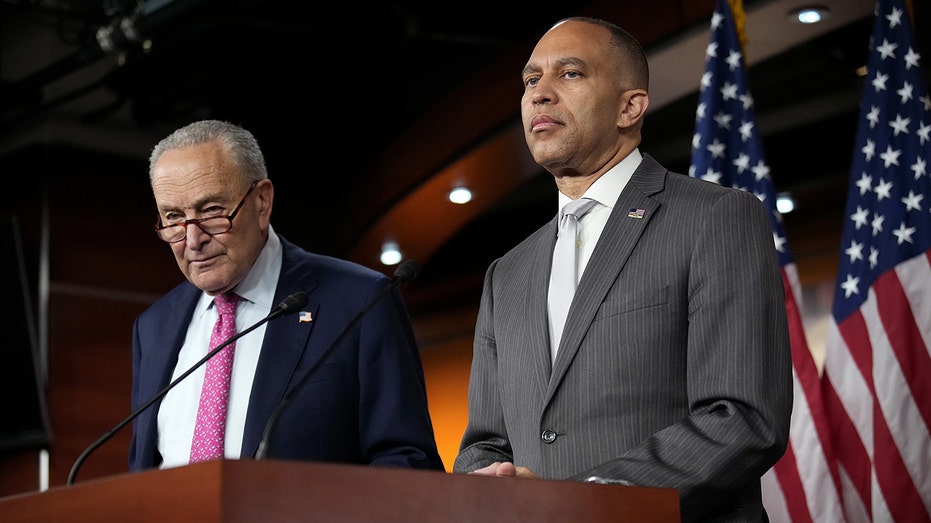
It’s often hard to separate the noise from the signal in politics. The noise is that congressional Democrats are fighting President Donald Trump and Republicans over a prospective government shutdown and healthcare spending. The signal is scratchy. But if you turn the squelch knob, you may detect the signal. We won’t know who “wins” or is “blamed” for a government shutdown for weeks. But the government shutdown will likely tell us a great deal about the future of the Democratic Party. REPORTER’S NOTEBOOK: TRUMP HOLDS BIPARTISAN MEETING WITH CONGRESSIONAL LEADERS AS WEDNESDAY SHUTDOWN LOOMS Progressives excoriated Senate Minority Leader Chuck Schumer, D-N.Y., in March when he reluctantly provided Democratic votes to break a filibuster to avoid a government shutdown. Democrats on both sides of Capitol Hill were apoplectic. They felt betrayed by Schumer. The New York Democrat caved to Republicans to avert the shutdown without pocketing any political concessions in return. At the time, Schumer said a shutdown under those conditions would be worse. Elon Musk was busy filleting the federal government. To hear Schumer tell it, Musk may try to block parts of the federal government from ever opening again. Progressives fumed at Schumer. Some called for new leadership. “There was a disappointment because Schumer had said that he was going to vote against it, and then he voted for it,” said Rep. Suhas Subramanyam, D-Va., to Fox. “So there was some confusion about why he would do that.” REPORTER’S NOTEBOOK: GOVERNMENT SHUTDOWN CHANCES ASTRONOMICAL AS CONGRESS BARRELS TOWARD DEADLINE House Minority Leader Hakeem Jeffries, D-N.Y., and other top Democrats seethed about Schumer’s March move. A senior House Republican source told Fox recently that they were stunned the government didn’t close earlier this year — surprised at Schumer’s decision to cave. And so liberals thought that Schumer may have overstayed his welcome, and it was time to move on. Schumer didn’t provide the necessary votes to avoid a shutdown when the Senate took a test vote to clear the way for the House-approved interim spending bill a week-and-a-half ago. So that made Schumer an easy target of the right. Plus, calling it the “Schumer Shutdown” is alliterative. It rolls off the tongue and easy for the GOP to characterize what’s going on. That’s why lots of Republicans — and some Democrats — hope Schumer faces a challenge from Rep. Alexandria Ocasio-Cortez, D-N.Y. This explains how Republicans are trying to always flag a potential challenge to Schumer by Ocasio-Cortez. They portray Schumer as finding himself in a tight spot, having to appeal to the left-leaning base of the Democratic Party. If Democrats fold, they face an avalanche of criticism from progressives. “That’s why Jeffries and Schumer are betwixt in between,” said Rep. Mike Lawler, R-N.Y., on Fox. “Jeffries has to worry about a primary next year and Schumer’s got to worry about AOC in 2028.” The star of Ocasio-Cortez could shine as Schumer’s may dim. She’s deploying rhetoric which appeals to liberals when speaking of Trump at a recent town hall meeting. “Authoritarians rely on the perception of power,” said Ocasio-Cortez. “They need people to believe that they are more powerful than they actually are.” How Schumer handles a possible shutdown could dictate the political future of Ocasio-Cortez. That’s to say nothing of his own. Political observers consistently mention Ocasio-Cortez among the top four potential Democratic presidential candidates were she to run in 2028. No one in the Democratic Party can churn out a crowd like Ocasio-Cortez. The same with raising money. This is why Republicans believe Schumer’s resistance hinges on self-preservation. GARBAGE COLLECTION, TOURS TO BE SUSPENDED ON CAPITOL HILL IF THERE’S A GOVERNMENT SHUTDOWN “You’ve seen Sen. Schumer’s poll numbers. He’s got AOC nipping at his heels,” said Treasury Secretary Scott Bessent on Fox. Not everyone is buying the GOP line that Schumer is trying to finesse government funding around his own political fortunes. “Do you think that Leader Schumer feels kind of footsteps from the left with Ocasio-Cortez?” asked yours truly of Jeffries. “Leader Schumer is not even up for reelection in 2026,” replied Jeffries. Either way, Democrats have struggled since the election about how to connect with their voters and combat Trump. “They just want to be perceived as fighting Trump,” said Sen. Eric Schmitt, R-Mo., on Fox. “Chuck Schumer is afraid of his own shadow at this point. They want to be perceived as the resistance more than a party that’s willing to govern.” And since many Democrats aren’t pleased with how their party has fought back at Trump… There are few inflection points over the course of a two-year Congress. A skirmish over government funding is one of them. So Democrats must seize the opportunity. But there is something crafty in the Democrats’ strategy, which isn’t necessarily apparent to the casual observer. Fights over “government funding” and “avoiding a government shutdown” aren’t terribly compelling to most voters. Yes, Democrats will talk about the possibility of a shutdown impacting federal workers and thrusting the economy into uncertainty. And Democrats always seem to pepper their arguments about Trump with concerns about “instability” and “chaos,” be it government funding or say, tariffs. However, it’s no surprise that Democrats are attempting to convert the shutdown into something more tangible for millions of Americans: The high cost of healthcare coverage. “Republicans have refused to extend the Affordable Care Act tax credits, and as a result of that, millions of working-class Americans are going to experience skyrocketing premiums, co-pays and deductibles at a time when America is already too expensive,” said Jeffries. First, Democrats are pushing for a restoration of what they say are cuts to federal health care benefits under the One, Big, Beautiful Bill. On its face, government funding has nothing to do with what congressional Republicans approved under the hallmark of Trump’s legislative agenda. But, as we said, this is one of those inflection points. So it’s an opportunity for Democrats to emphasize what Republicans passed and portray it as a negative ahead of the 2026
Trump finds new leverage in Ukraine fight with Tomahawk threat and long-range strike authorization
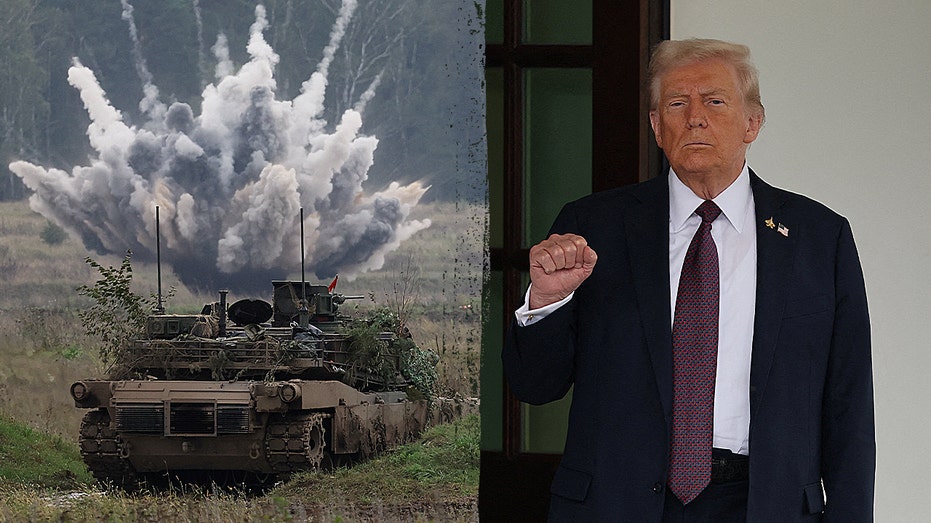
President Donald Trump is flexing new leverage in the war in Ukraine — allowing the nation to use U.S. weapons to strike deep into Russia, weighing whether to provide Kyiv with Tomahawk cruise missiles and vowing Ukraine can take back all its land — while pressing China and India to slash purchases of Russian oil. Ukraine supporters are cheering the shift, noting that after months of frustration over the grinding conflict, Trump appears to be changing tactics. From a combative February meeting with President Volodymyr Zelenskyy to his declaration last week that Ukraine could reclaim all of its original territory, the president is signaling a harder line on Moscow. On Fox News’ The Sunday Briefing, Ukraine envoy Keith Kellogg revealed that Trump had authorized long-range Ukrainian strikes inside Russia. Vice President JD Vance added that the administration is weighing whether to send Tomahawk missiles, a capability the Biden White House had denied. The weapons would be funded by European partners. “We’re certainly looking at a number of requests from the Europeans,” Vance said. “It’s something the president’s going to make the final determination on.” ‘PUTIN IS PUSHING THE LIMITS’: EASTERN ALLIES WARN TRUMP NOT TO PULL US TROOPS The U.S.-made Tomahawk has a range of about 1,500 miles, meaning Kyiv could theoretically target Moscow if Trump approves the transfer. Russia quickly issued warnings, with Kremlin spokesman Dmitry Peskov questioning whether Ukrainians could operate such systems without American assistance. “Who can launch these missiles, even if they end up on the territory of the Kyiv regime?” Peskov asked. “Can they be launched only by Ukrainians, or must it still be done by American personnel? Who provides the targeting? A very deep analysis is needed here.” He dismissed the weapons as strategically meaningless. “There is no panacea that can change the situation on the fronts. There are no magic weapons, whether Tomahawk or others, that can alter the dynamics,” Peskov said. Still, Trump’s stance marks one of his most striking reversals. Last week, he suggested Ukraine could not only hold its ground but also return to its original borders, calling that “very much an option,” while urging NATO nations to shoot down Russian drones and jets that cross into their airspace. He added that Russia has been “fighting aimlessly for three and a half years in a war that should have taken a Real Military Power less than a week to win. This is not distinguishing Russia.” BALTIC LEADERS RIP UN SECURITY COUNCIL AS POWERLESS WHILE RUSSIA HOLDS VETO SEAT This month, Russian drones entered Polish and Romanian territory. Missile-carrying MiG-29 jets crossed into Estonian territory. Eastern European officials say Moscow’s provocations are meant to test NATO unity. “Part of these provocations are to see: will there be solidarity? Will there be a clear decision within NATO to increase defense?” Romanian foreign minister Oana Țoiu told Fox News Digital. The tougher tone follows Trump’s August summit with Vladimir Putin in Alaska, which produced few breakthroughs. Since then, Trump has ratcheted up pressure, urging Europe to accelerate its energy break with Moscow and coordinating a new sanctions package with U.S. allies. “Inexcusably, even NATO countries have not cut off much Russian energy and Russian energy products,” Trump told the United Nations General Assembly. “China and India are the primary funders of the ongoing war by continuing to purchase Russian oil.” The president has already imposed a 50% tariff on Indian goods, citing New Delhi’s reliance on Russian fuel. Officials suggest additional measures are under consideration if India and China do not curb their energy ties with Moscow.
Moldova election results: Who won and did the diaspora play a role?
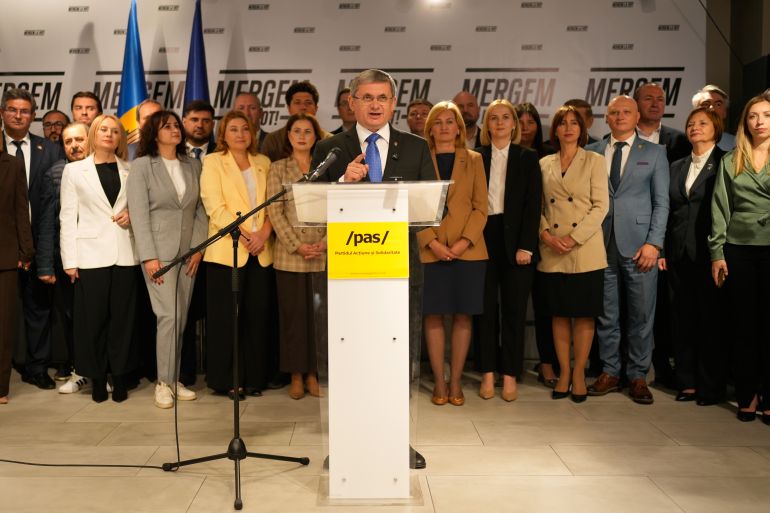
Moldova’s ruling pro-West governing party won a majority in the country’s tense Sunday elections, beating pro-Russian parties by a wide margin amid reported attempts to violently disrupt the vote and allegations of interference by Russia. Results from more than 99 percent of the polling stations counted by Monday noon showed the Party of Action and Solidarity (PAS) clearly in the lead, despite analysis and opinion polls before the vote suggesting that pro-Russian parties would come close and possibly upset the ruling party’s parliamentary majority. Recommended Stories list of 4 itemsend of list The small country is located between Ukraine and Romania. One of Europe’s poorest states, it was part of the Soviet Republic until 1991. The breakaway, semi-autonomous region of Transnistria, which lies along the border with Ukraine, has traditionally supported ties with Russia. As a result, in recent years, Moldova has emerged as a battleground for influence between Russia and the West. In a September 9 speech at the European Parliament, Moldovan President Maia Sandu, founder of PAS, declared that this election would be “the most consequential” in the country’s history. For Moldovans, the elections represented a crucial turning point. The small country with Russia’s war in Ukraine on its doorstep could either continue on its current path towards European Union membership, or it could fall back into the old fold of Russian influence. Ultimately, despite reports of pro-Russian groups threatening violence, with at least three people arrested in Moldova, and several bomb scares reported at polling booths abroad, the Moldovan diaspora played a key role in delivering a pro-EU victory. Igor Grosu, president of Moldova’s parliament and leader of the pro-EU Party of Action and Solidarity, speaks to the media after the parliamentary election, in Chisinau, Moldova, Monday, September 29, 2025 [Vadim Ghirda/AP] What was the outcome of Moldova’s election? Nearly all votes cast at polling stations had been counted by Monday. Some 1.6 million people cast their votes, making about 52.2 percent of eligible voters, which is higher than in previous elections. Advertisement The ruling pro-EU PAS, led by parliament president and PAS cofounder, Igor Grosu, won 50.16 percent of the vote and about 55 of the 101 seats in parliament, translating to a comfortable majority government, according to the country’s election agency. The current prime minister, Dorin Recean, appointed by Sandu in February 2023, is expected to retain his position. The pro-Russian Patriotic Electoral Bloc (BEP), an alliance of four parties led by former president and Russian ally Igor Dodon, came in a far second with 24.19 percent of the vote. The party won 26 seats in parliament. Two parties within the bloc, Heart of Moldova and Moldova Mare, were banned from participating in the election amid allegations they had received illicit funding from Russia. In third place was the Alternative Party, which is also pro-EU with 7.97 percent of the vote, securing eight parliamentary seats. Our Party, a populist group, and the conservative Democracy at Home party, respectively, won just more than 6 percent and 5 percent of the vote. That allowed them entry into parliament for the first time with 6 seats each. What had polls predicted? Opinion polls had suggested a much tighter race between the ruling PAS and the BEP, which was predicted to come a close second. That scenario would have disrupted PAS’s present control of parliament, potentially forcing it into an uncomfortable coalition with the BEP, and slowing down pro-EU reforms. Before the Sunday polls, politicians and their supporters on both sides of the debate campaigned intensely on the streets and on TV, but also on online platforms such as TikTok, in an attempt to reach young people who make up about a quarter of the population. What were the key issues? EU accession was the single most important issue on the ballot this election. Under President Sandu, Moldova applied to join the EU in early 2022, just after Russia’s February invasion of Ukraine. Chisinau’s goal, alongside a better economy, has been to obtain security guarantees like its neighbour, Romania, which is a member of the EU and of the North Atlantic Treaty Alliance (NATO). In July 2022, the EU granted Moldova – as well as Ukraine – candidate status, on the condition that democracy, human and minority rights, and rule of law reforms are made. European Commission President Ursula von der Leyen at the time declared that the future of Moldova was in the EU. However, while President Sandu’s PAS is eager to achieve Moldova’s EU membership by 2028 when her term expires, she has accused Moscow of attempting to scupper this plan in order to continue wielding influence over a country it once controlled. Advertisement Russia has considerable support in Moldova, and backs a breakaway, autonomous enclave – Transnistria, located along its border with Ukraine. About 1,500 Russian troops are present there, and the enclave’s government has requested Russian annexation several times. In a referendum vote last October, just more than 50 percent of Moldovans voted “yes” to joining the EU, a tight margin of victory that was seen as a predictor of this week’s parliamentary elections. At the time, President Sandu blamed “dirty interference” from Russia for her camp’s thin victory. A woman holds Moldovan and EU flags during a pro-EU rally in Chisinau, Moldova, Monday, September 29, 2025, after the parliamentary election [Vadim Ghirda/AP] Did Russia interfere in these elections? During the run-up to Moldova’s election, the authorities have repeatedly accused Moscow of conducting a “hybrid war” – offline and online – to help pro-Russian parties to win the vote. Moscow denies meddling in Moldovan politics. Russia is specifically accused of being behind a widespread “voter-buying” operation – through which voters are bribed to vote for particular parties – and of launching cyberattacks on Moldovan government networks throughout the year. The authorities have also claimed that Moscow illicitly funds pro-Russia political parties. Two pro-Russia parties – Heart of Moldova and Moldova Mare – were barred from the vote on Friday over allegations of illegal financing
ICC Women’s World Cup 2025: Teams, schedule, tickets, India vs Pakistan

EXPLAINER From tournament format to venues and top players to watch, here’s Al Jazeera’s guide to the Women’s Cricket World Cup. Published On 29 Sep 202529 Sep 2025 Click here to share on social media share2 Share Women’s cricket will take centre stage when eight nations compete in the International Cricket Council’s (ICC) Women’s World Cup 2025 in India and Sri Lanka from Tuesday. Australia are the defending champions and record seven-time winners of the one-day international (ODI) competition , but in-form India are favourites to break their World Cup drought at home. Recommended Stories list of 4 itemsend of list Here’s everything you need to know about the tournament: When are the first match and final of the Women’s World Cup? The World Cup begins when India host Sri Lanka in Guwahati on Tuesday and will conclude with the final on Sunday, November 2. Why will some World Cup games be played in Sri Lanka if India is the official host? While India was confirmed as the tournament’s official host earlier this year, Sri Lanka was added as a neutral venue for games involving Pakistan. It came as a result of an ICC-brokered agreement between India and Pakistan that allows both countries the option of playing their games at a neutral venue for a tournament hosted by either South Asian nation. The neighbours have not visited each other for a bilateral cricket competition in 13 years and shared an intense four-day military and aerial conflict in May. Guwahati is set to host the first semifinal but the venue will change to Colombo if Pakistan qualify for the last four. Navi Mumbai will host the second semifinal, which will be India’s designated last-four clash if they qualify. The venue for the final can also be moved to Colombo should Pakistan enter their first Women’s World Cup final. Advertisement Where are the venues of the Women’s World Cup? Dr DY Patil Sports Academy, Navi Mumbai, India Barsapara Cricket Stadium, Guwahati, India Holkar Stadium, Indore, India Dr YS Rajasekhara Reddy ACA-VDCA Cricket Stadium, Visakhapatnam, India R Premadasa Stadium, Colombo, Sri Lanka Which teams are in the Women’s World Cup, and how did they qualify? Australia Bangladesh England India New Zealand Pakistan South Africa Sri Lanka India qualified on the basis of their hosting rights, while Australia, England, New Zealand, South Africa and Sri Lanka qualified as the top five teams in the ICC Women’s Championship 2022-25. Bangladesh and Pakistan entered the tournament by finishing first and second in the World Cup qualifiers. Chamari Athapaththu will have her eyes on the prize when she leads Sri Lanka at the World Cup at home [Ishara S Kodikara/AFP] When and where is the India vs Pakistan match in the Women’s World Cup? The archrivals will face-off on Sunday at the R Premadasa Stadium in Colombo. India have beaten Pakistan in all ODI matches played between the two nations since 2005, with their last win coming at the ICC World Cup 2022 in South Africa. What’s the format and schedule of the Women’s World Cup? The tournament’s main round will be played in the round-robin format between September 30 and October 26. The top four teams at the end of the group stage will qualify for the semifinals on 29 and 30 October. The final will be played on November 2. The updated match schedule for #CWC25 is out now 🏆 All the action starts on 30 September! 🗓️ ✍️: https://t.co/EArFubvvlg pic.twitter.com/yqYfPbHzbM — ICC Cricket World Cup (@cricketworldcup) August 22, 2025 Which teams are favourites to win the Women’s World Cup? Australia: The Southern Stars’ supremacy in women’s cricket is undeniable, with their record seven titles in the ODI World Cup and six in the T20 World Cup proof of their status as the world’s best team. Alyssa Healy’s team is packed with the world’s top batters, bowlers and all-rounders and will be the favourite to defend the title they won in South Africa. India: The hosts came very close to lifting their first World Cup trophy in 2017, when they lost the final to England, and will look to go one better on home turf. India enjoy the services of arguably the world’s best batter in Smriti Mandhana, as well as some in-form bowlers and all-rounders. They have won 10 of their last 14 ODIs, including three against higher-ranked opponents. Who are the players to watch at the Women’s World Cup? Advertisement Smriti Mandhana (India) Deepti Sharma (India) Chamari Athapaththu (Sri Lanka) Sophie Ecclestone (England) Megan Schutt (Australia) Ellyse Perry (Australia) Laura Wolvaardt (South Africa) Amelia Kerr (New Zealand) Sidra Amin (Pakistan) Nahida Akter (Bangladesh) Smriti Mandhana has scored four ODI hundreds in 2025 [File: Pankaj Nangia/Getty Images] Which are the five best group-stage matches of the World Cup? India vs Pakistan on October 5 at 09:30 GMT India vs Australia on October 12 at 09:30 GMT India vs England on October 19 at 09:30 GMT Australia vs England on October 22 at 09:30 GMT Australia vs South Africa on October 25 at 09:30 GMT Who are the past champions of the Women’s World Cup? 1973: England 1978: Australia 1982: Australia 1988: Australia 1993: England 1997: Australia 2000: New Zealand 2005: Australia 2009: England 2013: Australia 2017: England 2022: Australia What’s the prize money for the Women’s World Cup? Total prize money for the tournament: $13.88m Champions: $4.48m Runners-up: $2.24m Losing semifinalists: $1.12m each Fifth and sixth place finishers: $700,000 each Seventh and eighth place finishers: $280,000 each. How can I buy tickets for the Women’s World Cup? Tickets for all group-stage games are available on the ICC’s ticketing website, and prices start at $1. Schoolchildren gather around the ICC Women’s Cricket World Cup 2025 Trophy in Colombo [Ishara S Kodikara/AFP] Adblock test (Why?)
Video: Moldova’s president says election results show ‘Russia failed’
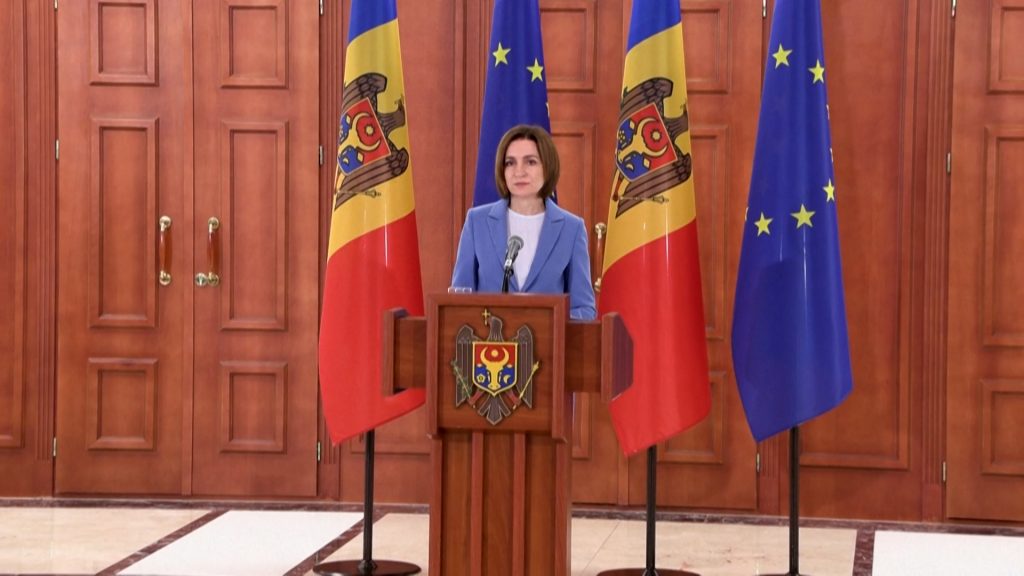
NewsFeed Moldova’s President Maia Sandu hailed her pro-EU party’s victory in parliamentary elections despite allegations of widespread Russian interference, saying the results showed Russia had ‘failed’. Published On 29 Sep 202529 Sep 2025 Click here to share on social media share2 Share Adblock test (Why?)
Kolkata Durga Puja Pandal 2025: From time travel to Byomkesh Bakshi theme, 7 pandals every devotee should visit

Kolkata Durga Puja 2025 features seven must-visit pandals with themes ranging from time travel and Byomkesh Bakshi to patriotism.
Rajasthan to get two new Vande Bharat Express trains: Delhi-Jodhpur in 8 hours, check route, timings and stoppages

The inauguration is planned for Thursday, 25 September, with Prime Minister Narendra Modi likely to flag off the trains. Although Vande Bharat trains are designed to reach speeds of up to 180 kmph, track conditions currently limit their operation to around 160 kmph.
Her ‘Mann Ki Baat’: PM Modi pens foreword to Georgia Meloni’s book

Prime Minister Modi describes the book, which is scheduled to be launched on October 7, 2025 as Meloni’s ‘Mann Ki Baat’, taking a cue from his own monthly radio broadcast of the same name.
What is Sahyog Portal? Reason behind Elon Musk’s X fight against Karnataka HC order

Elon Musk’s social media platform X said it would file an appeal against the Karnataka High Court’s move to reject its petition against the Central government’s Sahyog portal.