

Trump administration sues Maryland court system over deportation rulings

The administration of United States President Donald Trump has filed an extraordinary lawsuit against the Maryland district court system and its federal judges, accusing them of having “used and abused” their powers to stymie deportations. The complaint was lodged late on Tuesday. In its 22 pages, the administration accuses Maryland’s federal courts of “unlawful, anti-democratic” behaviour for placing limits on Trump’s deportation policies. Fifteen district judges are named among the defendants, as is a clerk of court, one of the administrative officials in the court system. The complaint advances an argument that Trump and his allies have long made publicly: that the president has a mandate from voters to carry out his campaign of mass deportation — and that the courts are standing in the way. “Injunctions against the Executive Branch are particularly extraordinary because they interfere with that democratically accountable branch’s exercise of its constitutional powers,” the lawsuit reads. It seeks an immediate injunction against a recent ruling from Chief Judge George Russell III, who was appointed by former President Barack Obama. Russell had issued a standing order that would automatically take effect each time an immigrant files a petition for habeas corpus — in other words, a petition contesting their detention. The chief judge’s order prevents the Trump administration from deporting the immigrant in question for a period of two business days after the petition is filed. That time frame, Russell added, can be extended at the discretion of the court. Advertisement The idea is to protect an immigrant’s right to due process — their right to a fair hearing in the legal system — so that they have the time to appeal their deportation if necessary. But the Trump administration said that Russell’s order, and other orders from federal judges in Maryland, do little more than subvert the president’s power to exercise his authority over immigration policy. “Every unlawful order entered by the district courts robs the Executive Branch of its most scarce resource: time to put its policies into effect,” the lawsuit argued. Trump’s immigration policies have faced hundreds of legal challenges since the president took office for his second term in January. Tuesday’s lawsuit admits as much, citing that fact as evidence of judicial bias against Trump’s immigration agenda. “In the first 100 days of President Trump’s current term, district courts have entered more nationwide injunctions than in the 100 years from 1900 to 2000, requiring the Supreme Court to intervene again and again in recent weeks,” the lawsuit said. The Supreme Court has upheld the right to due process, writing in recent cases like JGG v Trump that immigrants must be able to seek judicial review for their cases. But critics have argued that other recent decisions have undermined that commitment. Earlier this week, for instance, the Supreme Court lifted a lower court’s ruling that barred the US government from deporting immigrants to third-party countries without prior notice. Tuesday’s lawsuit against the Maryland federal court system appears poised to test whether the judicial branch can continue to serve as a check against the executive branch’s powers, at least as far as immigration is concerned. The lawsuit attacks Maryland’s immigration-related court orders on several fronts. For example, it questions whether “immediate and irreparable injury” is likely in the deportation cases. It also asserts that the federal courts are impeding immigration courts — which fall under the authority of the executive branch — from greenlighting deportations. But the complaint also emphasises the need for speed in executing the removals of immigrants from the US. “Removals can take months of sensitive diplomacy to arrange and often do not completely come together until the last minute,” the Trump administration’s lawsuit said. “A delay can undo all of those arrangements and require months of additional work before removal can be attempted again.” Maryland is a reliably Democratic-leaning state, and the Trump administration has been dealt some significant setbacks in its federal courts. Advertisement That, in turn, has led the president and his allies to denounce the courts for “judicial overreach”, a theme reprised in Tuesday’s court filing. One of the most prominent immigration cases unfolding in the US is that of Kilmar Abrego Garcia, a Salvadoran immigrant and resident of Maryland who was deported despite a protection order allowing him to remain in the country. His lawyers have maintained he fled El Salvador to escape gang violence. His deportation was challenged before District Judge Paula Xinis, one of the judges named in Tuesday’s complaint. Xinis ruled in early April that the US must “facilitate and effectuate” Abrego Garcia’s return from the El Salvador prison where he was being held, and the Supreme Court upheld that decision — though it struck the word “effectuate” for being unclear. The Maryland judge then ordered the Trump administration to provide updates about the steps it was taking to return Abrego Garcia to the US. She has since indicated the administration could be held in contempt of court for failing to do so. Abrego Garcia was abruptly returned to the US on June 6, after more than two and a half months imprisoned in El Salvador. The Trump administration said it brought him back to face criminal charges for human trafficking in Tennessee. That case is currently ongoing, and Abrego Garcia has denied the charges against him. That legal proceeding, and Xinis’s orders, were not explicitly named in Tuesday’s lawsuit. But the complaint offered a broad critique of orders like hers. “Defendants’ lawless standing orders are nothing more than a particularly egregious example of judicial overreach interfering with Executive Branch prerogatives,” the lawsuit argued, “and thus undermining the democratic process.” Adblock test (Why?)
NATO countries’ budgets compared: Defence vs healthcare and education
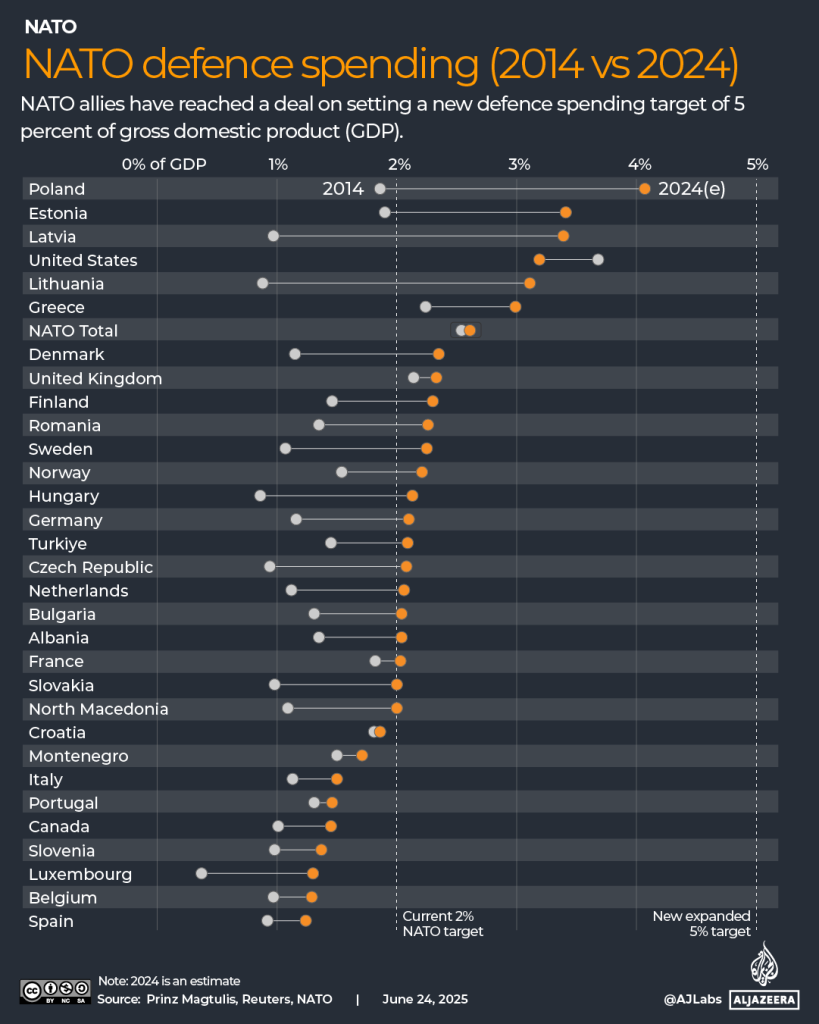
NATO leaders signed a deal to increase defence spending as the annual alliance summit in The Hague drew to a close after two days of meetings on Tuesday and Wednesday. At the top of the agenda was a big new defence spending target demanded by US President Donald Trump, which will see NATO members spend 5 percent of their economic output on core defence and security. The new spending target, which is to be achieved over the next 10 years, is a jump worth hundreds of billions of dollars a year from the current goal of 2 percent of gross domestic product (GDP). Which countries meet the current target of two percent? In 2006, NATO defence ministers agreed to commit at least 2 percent of their GDP to defence spending. However, few did. It wasn’t until Russia’s annexation of Crimea in 2014 that member states agreed to spend 2 percent of GDP on defence by 2024 at the NATO summit in Wales in 2014. Currently, 23 of the 32 member countries have met this target, with the alliance as a whole spending 2.61 percent of its combined GDP on defence last year. Poland leads NATO countries in defence spending, committing 4.1 percent of its GDP, followed by Estonia and the United States at 3.4 percent each, Latvia at 3.2 percent, and Greece at 3.1 percent. NATO countries bordering Russia, such as Estonia and Lithuania, have significantly increased their defence spending — from less than one percent of their GDP just 10 years ago. The only NATO country whose defence spending in 2024 was less, as a percentage of its GDP, than in 2014? The United States. Advertisement How will the new target of 5 percent work? The new target of 5 percent GDP is measured in two parts: 3.5 percent of GDP on pure defence spending, such as troops and weapons 1.5 percent of GDP on broader defence and security investments, such as: upgrading infrastructure including roads, bridges, ports, airfields, military vehicles, cybersecurity and protection for energy pipelines This surge in NATO defence spending comes amid perceived threats from Russia, in the wake of the Russia-Ukraine war. Mark Rutte, NATO’s secretary general and the Netherlands’ former prime minister, described Russia as “the most significant and direct threat” to NATO. Alliance members will be expected to meet the target by 2035, but the target will be reviewed again in 2029. Where will the money come from? NATO members will have to decide on their own where they’ll find the extra cash to allocate to defence. Rutte stated it was “not a difficult thing” for members to agree to raise defence spending to 5 percent of GDP because of the rising threat from Russia. But ministers in the UK, for example, have not made it clear where they will get the extra money to spend on defence. The European Union, meanwhile, is allowing member states to raise defence spending by 1.5 percent of GDP each year for four years without any disciplinary steps that would come into effect once a national deficit is above 3 percent of GDP. Additionally, EU ministers approved the creation of a 150-billion euro ($174bn) arms fund using EU borrowing to give loans to countries for joint defence projects. When asked whether NATO members should commit to the 5 percent target, US President Donald Trump told reporters on Friday, “I think they should. We’ve been supporting NATO so long, in many cases, I believe, paying almost 100 percent of the cost.” How does defence spending compare to other areas? When a country is asked to spend more on defence, that money has to come from somewhere. Unless governments expand their budgets or raise new revenue, increased military spending can strain other sectors that people rely on every day — like healthcare and education. Currently, none of NATO’s 32 members spends more on defence than either healthcare or education. However, if the new 5 percent defence spending target is adopted, then 21 countries that currently invest less than five percent in education would end up allocating more to the military than to schooling. The table below compares NATO countries’ budgets, highlighting how defence spending measures up against healthcare and education expenditures. Advertisement Adblock test (Why?)
Majority of Texans oppose total THC ban like the one vetoed by Gov. Greg Abbott, poll finds

The statewide survey also found that Texas Republicans are closely divided on the issue.
Democratic congressman hurls profanity-laced message at Stephen Miller
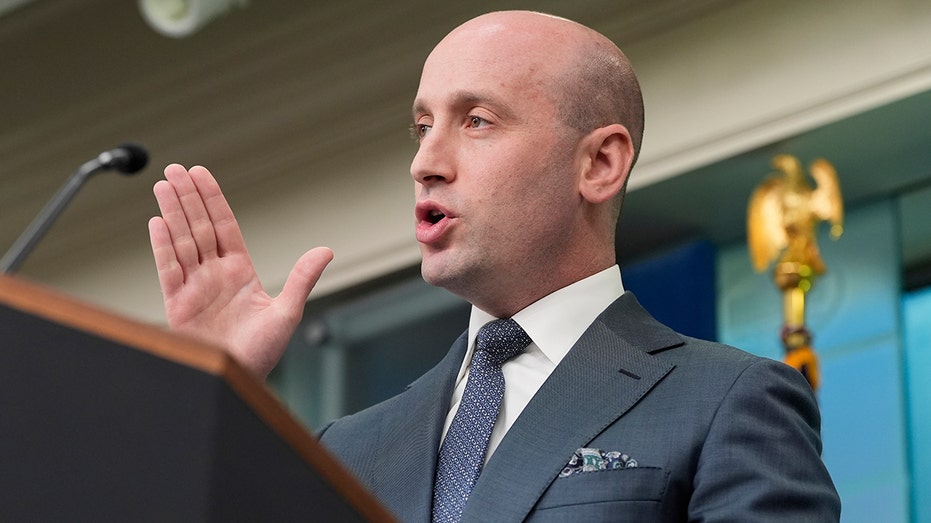
A Democratic lawmaker hurled profanity at White House deputy chief of staff Stephen Miller on Wednesday, going on to imply that Miller is a Nazi. Rep. Mark Pocan, D-Wisc., made the statement on social media in response to some of Miller’s commentary on New York City. Miller was discussing democratic socialist Zohran Mamdani’s victory in the Democratic primary for New York City’s mayoral election, saying unchecked immigration was a major contributor to the city’s leftward slide in recent years. “NYC is the clearest warning yet of what happens to a society when it fails to control migration,” Miller wrote. Pocan chimed in: “Racist ****. Go back to 1930’s Germany.” WHAT MAMDANI IS PLEDGING TO DO IF HE BECOMES NEW YORK CITY’S NEXT MAYOR Pocan weighed in on Mamdani’s win multiple times, lashing out at another user who claimed the democratic nominee, who is Muslim, supports “Sharia Law.” “I love watching MAGA nut jobs spinning total bull**** to overcome blatant racism and xenophobia,” Pocan responded to the post. “People want progressive populism that focuses on making their lives better, not redistribution of wealth from working people to the wealthiest. Trumpism is on the decline.” Republicans have capitalized on Mamdani’s victory as evidence of the extremism of the current Democratic Party. The National Republican Congressional Committee (NRCC) was among the first to make the connection. “The new face of the Democrat Party just dropped, and it’s straight out of a socialist nightmare,” they wrote in an email. Aiming to tie House Democrats to Mamdani, NRCC spokesman Mike Marinella argued that “every vulnerable House Democrat will own him, and every Democrat running in a primary will fear him.” Rep. Elise Stefanik of New York, a top ally of President Donald Trump who is seriously considering a run for Empire State governor next year, also pounced. Stefanik claimed that “a radical, Defund-the-Police, Communist, raging Antisemite will most likely win the New York City Democrat Mayoral primary.” Vice President JD Vance also weighed in, writing, “Congratulations to the new leader of the Democratic Party” in a post on Blue Sky, a social media platform frequented by progressives. Fox News’ Paul Steinhauser contributed to this report.
Texas the latest state with a law banning foreign adversaries from buying real estate
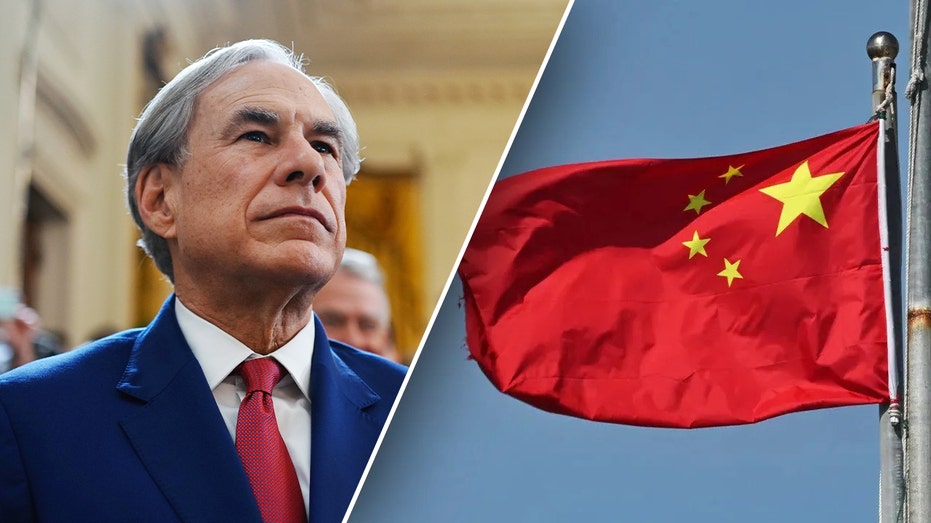
Texas has become the latest state to cement a ban on land and property purchases by individuals or entities from adversarial nations. Republican Gov. Greg Abbott signed Senate Bill 17 into law over the weekend, prohibiting countries identified as security threats in the intelligence community’s 2025 Annual Threat Assessment, from acquiring “real property” in the state. The countries include China, Russia, Iran and North Korea, and the bill identified “real property” as agricultural land, commercial or industrial properties, residential properties and land used for mining or water use. Amid heightened global tensions, there has been an increased appetite for protecting foreign asset acquisitions in the United States. However, these efforts have been criticized by some for being overly broad, arbitrary and potentially discriminatory. ISRAEL’S DRONE STRIKES IN IRAN SHOW WHY US MUST HALT CHINA’S LAND GRAB: EXPERTS In response to Abbott’s signing of S.B. 17, the nonprofit Asian Americans Advancing Justice said it was “outraged” at the legislation that the group said “creates an overly broad net that places innocent foreign nationals at risk of racial profiling.” A similar defense was made by Arizona Gov. Katie Hobbs after she vetoed a bill seeking to stop Chinese land and property purchases in the state, noting the bill lacked “clear implementation criteria,” which opened the door for “arbitrary enforcement.” Hobbs, following backlash over her veto, subsequently described the bill as “a watered-down, weak-on-China bill,” noting it allowed the communist country to purchase land near military bases for up to three years at a time, and followed up this month with her own version of the bill. Texas’s bill exempts U.S. citizens and lawful permanent residents. Individuals legally residing in the United States wishing to purchase a primary residence are also exempt, as well as leaseholders of less than a year. The Texas attorney general is authorized through the new legislation to investigate potential violations of the new law, which would be a felony. The law will go into effect on September 1. DEM GOVERNOR RIPPED AS ‘TOTAL DISGRACE’ AFTER VETOING BILL LIMITING CHINESE LAND OWNERSHIP NEAR MILITARY BASES Proponents of measures like the one in Texas have cited efforts by countries like China to purchase land and property near major U.S. military bases. However, it is not just land either, it is assets too. China has a strong foothold in the U.S. drone market with many law enforcement agencies using Chinese-made DJI drones. The country has also faced scrutiny for building solar converters in the U.S. that can be tapped for espionage efforts, its increasing footprint in U.S. maritime ports and penetration of other critical infrastructure. Texas’s bill follows a high-profile incident earlier this month when two Chinese nationals were arrested for attempting to smuggle a dangerous biological pathogen into the United States. “Chinese companies purchasing American land, particularly near sensitive strategic and military sites, is not a coincidence. The CCP is blatantly attempting to base espionage efforts, and potentially worse, right in our backyard, and it’s up to states act accordingly,” said Michael Lucci, the CEO and founder of State Armor Action, a conservative group with a mission to develop and enact state-level solutions to global security threats. “Governor Abbott and the Texas legislature are right to ban foreign adversaries from purchasing land in their state. More and more states should follow their lead.” RICKETTS, FETTERMAN TEAM UP FOR CRACKDOWN ON CHINA’S ATTEMPTS TO PURCHASE US FARMLAND Per the Committee of 100, which tracks state and federal bills in the United States that restrict property ownership by foreign entities, 25 states have passed bills that restrict foreign property ownership as of Monday. That is up from 22 states as recently as March, per the committee. Meanwhile, according to the committee’s tracking, 15 bills pertaining to this issue are being considered at the federal level as well. On Monday, Republicans in Congress introduced a bill aimed at increasing oversight of foreign farmland purchases, which would add the U.S. Agriculture Secretary to the Committee on Foreign Investment in the United States (CFIUS). It would also compel the U.S. Department of Agriculture to report to CFIUS any purchase of domestic agricultural land by foreign adversaries who pose risks to national security. State-level bills aimed at increasing scrutiny of foreign land and asset acquisitions from adversaries appear imminent in New Hampshire and North Carolina, if their governors grant them approval.
New York Democrat says mayoral candidate Zohran Mamdani ‘too extreme to lead’
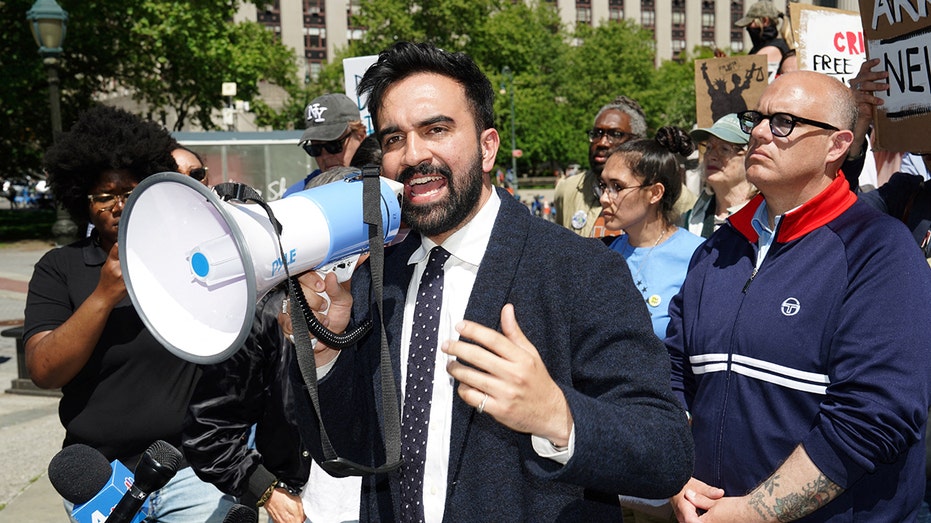
A moderate House Democrat from New York is criticizing New York City’s presumptive Democratic nominee for mayor, Assemblyman Zohran Mamdani. “Socialist Zohran Mamdani is too extreme to lead New York City. His entire campaign has been built on unachievable promises and higher taxes, which is the last thing New York needs,” Rep. Laura Gillen, D-N.Y., said in a statement Wednesday. “Beyond that, Mr. Mamdani has called to defund the police and has demonstrated a deeply disturbing pattern of unacceptable antisemitic comments, which stoke hate at a time when antisemitism is skyrocketing. He is the absolute wrong choice for New York.” It’s the first pushback from a Democratic official to Mamdani’s stunning victory in the first round of New York City’s ranked choice voting primary tally. REPUBLICANS USE MAMDANI BOMBSHELL VICTORY OVER CUOMO AS AMMUNITION TO BLAST DEMOCRATS AS EXTREMISTS Mamdani far outpaced former New York Gov. Andrew Cuomo in the first round, winning 43.5% of the vote compared to Cuomo’s 36.4%. Cuomo announced he would bow out of the primary but left it an open question whether he would join current New York City Mayor Eric Adams in running as an independent in the race. The former governor, whose own issues include accusations of sexual harassment that derailed his time in Albany, told Fox Business’ Maria Bartiromo that he is not ruling out running again in November. CUOMO CONCEDES IN NYC DEMOCRATIC PRIMARY FOR MAYOR, CONGRATULATES AOC-ENDORSED MAMDANI Gillen is a Long Island Democrat who unseated former Rep. Anthony D’Esposito, R-N.Y., in the 2024 elections. She’s been known to break from her own party on issues like law enforcement and illegal immigration during her brief time in Congress so far. Gillen is also breaking from Democratic leaders in her criticism of Mamdani, a 33-year-old self-proclaimed democratic socialist whose platform includes city-owned and operated grocery stores. Both House Minority Leader Hakeem Jeffries, D-N.Y., and Senate Minority Leader Chuck Schumer, D-N.Y., said in public statements on Wednesday that they had spoken to Mamdani since his victory. “He ran an impressive campaign that connected with New Yorkers about affordability, fairness, & opportunity,” Schumer said. Jeffries’ statement said, “Assemblyman Mamdani ran a strong campaign that relentlessly focused on the economy and bringing down the high cost of living in New York City.” Fox News Digital reached out to Mamdani’s campaign for comment on Gillen’s criticism.
Trump DHS sues entire bench of federal judges in Maryland district court over automatic injunctions
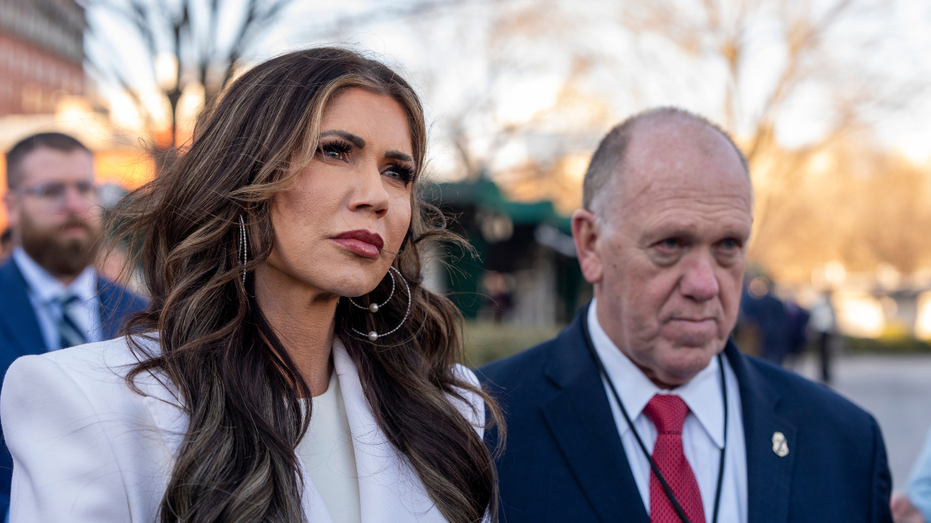
The Department of Homeland Security (DHS) is suing all 15 judges on the Maryland federal bench, arguing the court’s policy of automatically pausing certain immigration cases that come before it is unlawful. Attorneys for the Trump administration argued to the very court they are suing that the policy, imposed through an order the court issued in May, is an “egregious example of judicial overreach.” “A sense of frustration and a desire for greater convenience do not give Defendants license to flout the law,” the attorneys wrote in a filing Tuesday. “Nor does their status within the judicial branch.” The Maryland court’s standing order requires clerks to immediately enter temporary administrative injunctions in cases brought by alleged illegal immigrants who are challenging their detention. US JUDGE BLASTS TRUMP LAWYERS FOR 11TH-HOUR TACTICS IN MS-13 DEPORTATION CASE The automatic injunctions in these cases, known as habeas corpus cases, temporarily bar the DHS from deporting or changing the legal status of the immigrant in question for two business days. In its order, the court said it did this out of scheduling convenience to make sure the “status quo” is preserved when a case is filed. The order cited a higher volume than usual of cases involving detained immigrants who are attempting to prevent the government from keeping them detained or deporting them. “The recent influx of habeas petitions concerning alien detainees purportedly subject to improper and imminent removal from the United States that have been filed after normal court hours and on weekends and holidays has created scheduling difficulties and resulted in hurried and frustrating hearings in that obtaining clear and concrete information about the location and status of the petitioners is elusive,” the court order stated. The Trump administration also asked the court in a follow-up motion that all the judges-turned-defendants recuse themselves from the case and bring in an outside judge to take over or transfer the case to a different court district. JUDGE ON WARPATH PRESSES TRUMP DOJ ON ABREGO GARCIA DEPORTATION, ANSWERS LEAVE COURTROOM IN STUNNED SILENCE The unusual lawsuit comes as President Donald Trump‘s mass deportation agenda encounters roadblocks involving individual immigrants using legal avenues afforded to them through U.S. immigration laws to raise challenges and appeals to their deportations. In Maryland, Judge Paula Xinis, who is now one of the named defendants in the new case, ordered the Trump administration to return to the United States a Salvadoran national named Kilmar Abrego Garcia. Abrego Garcia was mistakenly deported to a prison in El Salvador in March before he was returned months later to face trafficking charges. The case became the first known instance of the Trump administration erroneously deporting an illegal immigrant before affording him legally-required due process.
Rubio cracks up at Trump’s reaction to NATO leader calling president ‘daddy’
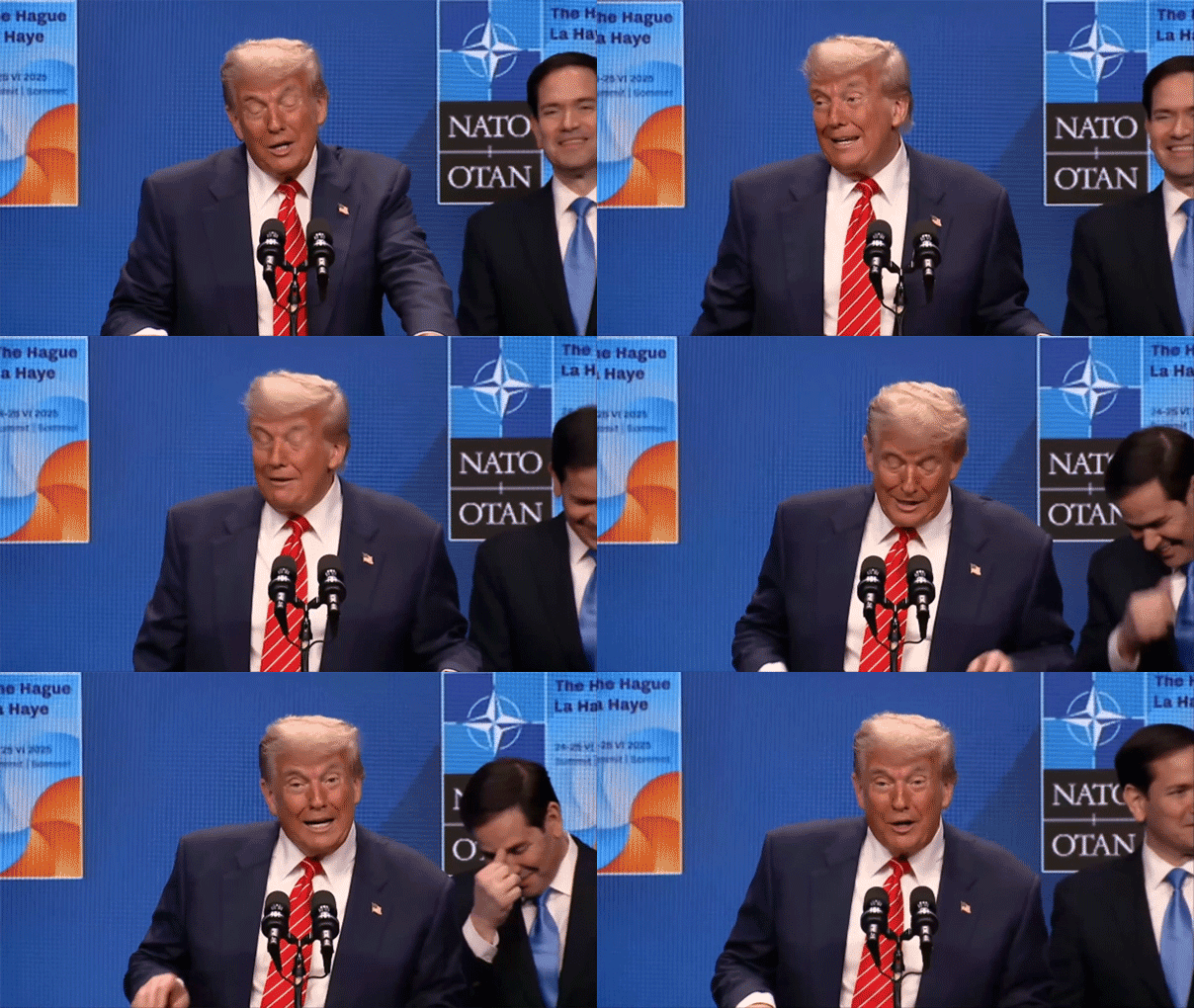
Secretary of State Marco Rubio cracked up laughing when President Donald Trump gave his reaction to NATO Secretary General Mark Rutte calling the commander in chief “daddy” earlier Wednesday. During their bilateral meeting in The Hague, Netherlands, Trump discussed the U.S.’ role in brokering a fragile ceasefire between Israel and Iran, saying both countries were like “two kids in a school yard” who “fight like hell” for a short time before “it’s easier to stop them.” Rutte interjected, “Then daddy has to sometimes use strong language.” Trump had used profanity in front of reporters outside the White House before boarding Marine One on Tuesday, saying about Israel and Iran that they “have been fighting so long and so hard that they don’t know what the f— they’re doing. ” At a subsequent press conference Wednesday, Rubio broke into hysterics when a reporter from Sky News asked Trump about the remark. TRUMP LASHES OUT AT ISRAEL AND IRAN WITH PROFANITY FOR BREAKING CEASE-FIRE The reporter reminded Trump that Rutte, “who is your friend.… He called you daddy.” “Do you regard your NATO allies as kind of children?” the reporter asked. Trump responded lightheartedly, and Rubio could be seen standing next to him starting to smile and laugh. “No, he likes me. I think he likes me. If he doesn’t, I’ll let you know. I’ll come back, and I’ll hit him hard. Okay?” Trump said jokingly. “He did. He did it. Very affectionate,” Trump added of Rutte. “‘Daddy, You’re my daddy.’” The reporter pressed on with a more serious tone, as Rubio continued to laugh. “Do you regard your NATO allies, though, as kind of like children?” she said. TRUMP THRASHES CNN AS ‘GUTLESS LOSERS’ FOR COVERAGE OF US STRIKES ON IRAN NATO leaders on Wednesday committed that the member states would contribute 5% of GDP annually to defense and security obligations by 2035. “You’re obviously appreciative of that,” the reporter said. “But do you hope that actually they’re going to be able to defend themselves, defend Europe on their own?” “I think they’ll need help a little bit at the beginning, and I think they’ll be able to,” Trump said. “I think they’re going to remember this day and this is a big day for NATO. You know, this was a very big day.” “It’s been sort of an amazing day for a lot of reasons, but also for that,” Trump added, referencing how the greater contributions were decades in the making. Trump claimed it was not possible until he came along. The reporter pressed, “Do you think they can do it without you, though in the future? Can they do more states?” “I mean, you have to ask Mark,” Trump said, concluding the press conference. The president had noted earlier that the only NATO member that did not agree to hike its defense contribution was Spain.
Zelenskyy pointedly thanks Trump, America for Ukraine support months after Vance’s jab about lack of gratitude

Ukrainian President Volodymyr Zelenskyy thanked President Donald Trump after they had a talk Wednesday at the NATO summit in the Netherlands — months after Vice President JD Vance called out Zelenskyy for not voicing more gratitude for U.S. support for Kyiv as it battles Moscow. When Zelenskyy visited the White House in February he sparred openly with Trump and Vance in the Oval Office over engaging in diplomacy with Russia to end the conflict, prompting Vance to ask the Ukrainian leader if he’d “said thank you once this entire meeting.” But on Wednesday Zelenskyy made sure to thank Trump and the U.S. in a post on X following their meeting in The Hague. “We covered all the truly important issues. I thank Mr. President, I thank the United States. We discussed how to achieve a ceasefire and a real peace,” Zelenskyy said in a post on X on Wednesday. “We spoke about how to protect our people. We appreciate the attention and the readiness to help bring peace closer. Details will follow.” JD VANCE STEPS INTO THE SPOTLIGHT DEFENDING TRUMP’S FOREIGN POLICY IN OVAL OFFICE DUSTUP WITH ZELENSKYY Trump, Vance and Zelenskyy’s infamous Oval Office meeting in February started after Zelenskyy challenged Vance’s statements that diplomacy was the correct avenue to end the conflict. Zelenskyy questioned the value of diplomacy, noting that Russian President Vladimir Putin has broken other agreements in the past. “What kind of diplomacy, JD, you are speaking about?” Zelenskyy said. “What do you mean?” Vance said, “I’m talking about the kind of diplomacy that’s going to end the destruction of your country.” “Mr. President, with respect, I think it’s disrespectful for you to come into the Oval Office to try to litigate this in front of the American media,” Vance said. “Right now, you guys are going around and forcing conscripts to the front lines because you have manpower problems. You should be thanking the president for bringing it, to bring it into this country.” TRUMP SAYS ZELENSKYY CAN ‘COME BACK WHEN HE IS READY FOR PEACE’ AFTER FIERY WHITE HOUSE EXCHANGE Following the tense exchange, Trump announced a halt to peace negotiations and said that Zelenskyy could return to the White House when he was “ready” for peace. Just after leaving the White House, Zelenskyy issued a post on X thanking the U.S., Trump, Congress and the American people for backing Ukraine. Although Zelenskyy and Trump continued to exchange harsh barbs at one another following the Oval Office visit, they’ve subsequently spoken over the phone and met in person at St. Peter’s Basilica in Vatican City during Pope Francis’ April funeral. WHERE ZELENSKYY IS HEADED FOLLOWING TENSE WHITE HOUSE EXCHANGE WITH TRUMP, VANCE Meanwhile, Trump said Wednesday that his administration has not been able to finalize a peace deal with Ukraine and Russia, claiming that both leaders have been more challenging to work with than expected. “Vladimir Putin has been more difficult,” Trump told reporters Wednesday. “Frankly, I had some problems with Zelenskyy. You may have read about him, and it’s been more difficult than other wars.” Still, Trump said that his meeting with Zelenskyy went smoothly, and that he would be speaking to Putin as well. “He’s very nice, actually,” Trump said of Zelenskyy. “A little rough at times. He couldn’t have been nicer. I think he’d like to see an end to this.”
Zelenskyy meets Trump on NATO sidelines; Putin will skip BRICS in Brazil

Ukrainian leader steps up diplomatic push, while his Russian counterpart will skip a summit due to ICC arrest warrant. Ukrainian President Volodymyr Zelenskyy and United States President Donald Trump have held talks on the sidelines of the NATO summit in The Hague, with sanctions on Russia over its war in Ukraine, now in its fourth year, and arms procurement for Kyiv on the agenda. Zelenskyy said he discussed how to achieve a “real peace” and “protect our people” with Trump on Wednesday. The meeting, which reportedly lasted 50 minutes, was a second attempt after Zelenskyy failed to meet Trump earlier this month in Canada when the US president abruptly left a G7 summit as the Israel-Iran conflict raged, just days before the US militarily intervened with strikes on Iran’s nuclear sites. Speaking at news conference ending his participation at the NATO summit, Trump said it is possible that Russian President Vladimir Putin has territorial ambitions beyond Ukraine, adding that he plans to speak to Putin soon about ending the war. Zelenskyy noted earlier that Moscow and Kyiv have not moved any closer to a ceasefire, saying, “The Russians once again openly and absolutely cynically declared they are ‘not in the mood’ for a ceasefire. Russia wants to wage war. This means the pressure the world is applying isn’t hurting them enough yet, or they are trying very hard to keep up appearances.” NATO Secretary-General Mark Rutte said the security bloc’s “military edge is being aggressively challenged by a rapidly rearming Russia, backed by Chinese technology and armed with Iranian and North Korean weapons” before the summit. Advertisement On Putin, Rutte was blunt, “I don’t trust the guy,” he said, adding that the Russian leader wouldn’t be happy with the outcome of the NATO summit. NATO endorsed a higher defence spending goal of five percent of gross domestic product (GDP) by 2035 – a response to a demand by Trump and to Europeans’ fears that Russia poses a growing threat to their security. Putin to stay at home In the meantime, Putin will not travel to next week’s BRICS summit in Brazil as an arrest warrant issued against him by the International Criminal Court (ICC) still hangs over him, Kremlin foreign policy aide Yuri Ushakov said on Wednesday. The ICC issued the warrant in 2023, just over a year after Russia launched its full-scale invasion and war against Ukraine. Putin is accused of deporting hundreds of children from Ukraine to Russia, a war crime. Moscow vehemently denies allegations of war crimes, and the Kremlin, which did not sign the ICC’s founding treaty, has dismissed the warrant as null and void. But weighing the risk that he might be arrested if he travels to another country that is a signatory to the ICC treaty, Putin has always erred on the side of caution, only travelling where he is safe from being apprehended. Putin concluded an official visit to Mongolia last September undisturbed as his hosts ignored the arrest warrant, despite Mongolia being an ICC member. The Kremlin on Wednesday also said the US was not yet ready to dismantle obstacles to the work of their respective embassies, as efforts to normalise relations between the two have stalled after initial signs that Trump’s second term as US president would lead to a major thaw after tensions during the administration of former US President Joe Biden. The war grinds on In the latest developments on the ground in the war, Russian missile strikes on southeastern Ukraine killed 17 people in the city of Dnipro and injured more than 200, damaging dozens of buildings and infrastructure facilities on Tuesday. Two people were killed in a Russian attack on the city of Samara. Russia says it intercepted dozens of drones overnight across its territory, including the Voronezh region on the border of eastern Ukraine. Russian forces say they captured the village of Dyliivka in Ukraine’s eastern Donetsk region, a key battleground dating back to the first eruption of conflict in 2014. Adblock test (Why?)