

Nashville mayor stands behind doxing ICE agents even after officials said his actions put them in danger
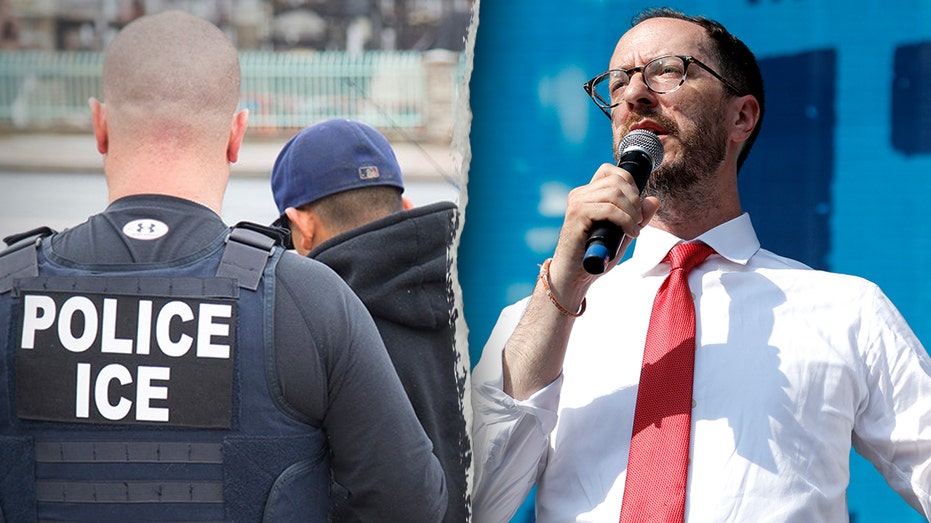
The Democratic mayor of Tennessee’s largest city, who has been accused of obstructing federal immigration efforts, defended his office’s decision to publicly dox the names of immigration officers. Nashville Mayor Freddie O’Connell’s defense came even after the names of federal immigration officials were removed from a public immigration report detailing a month’s worth of immigration-related interactions between local police and federal immigration authorities. Initially, the public report detailed immigration officers’ names, but following backlash over the move the names were taken down. “I wouldn’t say it was an endangerment process, I would say they may have some concerns – I’m far more concerned about the overall dynamic we have about unmarked, unidentifiable masked people whisking people into vehicles – i think that’s a bigger concern,” O’Connell, who is currently under investigation by GOP House lawmakers for potentially interfering with federal immigration efforts, said during a press conference with reporters. DHS ISSUES NEW GUIDANCE FOR MEMBERS OF CONGRESS WHO WANT TO VISIT ICE DETENTION FACILITIES O’Connell did add the move was not “intentional,” but then quickly followed up that he wouldn’t have described what happened as “doxing” in the first place. “It’s not a process that I would characterize as doxing. It was an unintentional release of names that were already part of a public record,” he told reporters. “They were already part of a public record by being in Department of Emergency Communication’s calls, so I don’t think it puts them at additional risk. But it’s also not an intention of the executive order under which those names are released.” Fox News Digital reached out to O’Connell’s office for comment but did not hear back in time for publication. Larry Adams, an Immigrations and Customs Enforcement (ICE) Assistant Field Office Director, told local Fox affiliate in Nashville WZTV that ICE agents disagree that making their names public is not a risk, noting their faces can easily be matched to photos on social media. DHS FIRES BACK AT BLUE-CITY MAYOR UNHAPPY ABOUT ICE OPERATION, PROVIDES RAP SHEETS FOR THOSE CHARGED “It has gotten more and more difficult,” Adams said of his job under the new administration’s aggressive deportation tactics, during a ride along with WZTV that occurred last week. “What affects me the most, is we understand the job we are doing, we understand what we sign up for, it’s mostly the attacks or threats against our families.” After Tennessee Republican Congressman Rep. Andy Ogles requested the Department of Homeland Security (DHS) investigate the Nashville mayor over allegedly obstructing federal officials, the agency followed through and opened an investigation. Meanwhile, two congressional committees are also investigating him, including requesting documents related to O’Connell’s Executive Order 30, which has required city departments to report federal immigration communications to the city of Nashville’s Office of New Americans. In an interview with Fox News’ Laura Ingraham, Assistant DHS Secretary Tricia McLaughlin remarked at the danger associated with doxing federal immigration officers, noting that the act effectively handed cartels intelligence “on a silver platter.” “These are the tip of the spear, these are the people on the front lines trying to make our communities safer,” McLaughlin said. “So, when Democrats and the media show us who they are, we’ll believe them, and it’s the fact that they’re fighting for people like MS-13 and child rapists to be on American streets.” According to local news outlet, the Tennessee Lookout, McLaughlin has also clapped back at O’Connell’s claims that the release of immigration officials’ names was a mistake. “They claimed it was a mistake. There’s zero chance it was a mistake, and there will be repercussions,” she said, according to the outlet.
Dem lawmaker sparks social media firestorm with ‘cringe’ anti-Trump guitar performance: ‘Talk about tone-deaf’
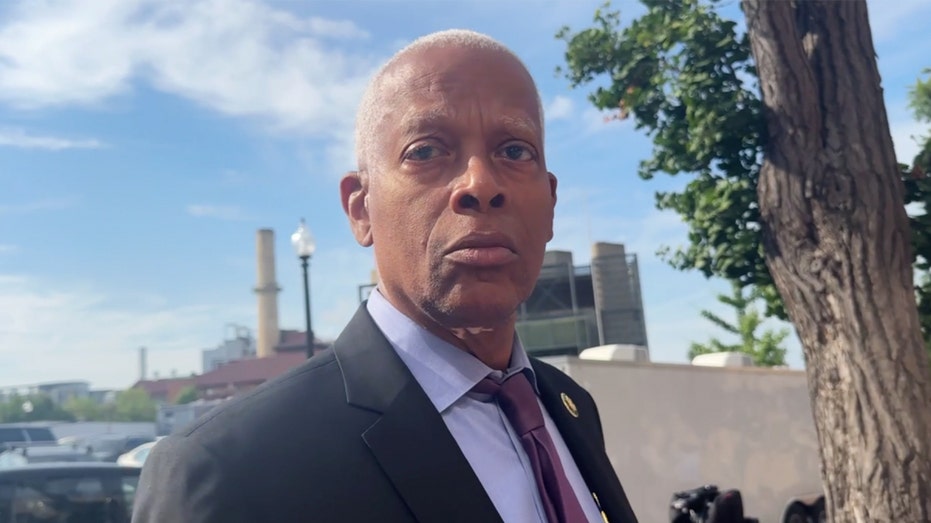
Rep. Hank Johnson, D-Georgia, garnered some backlash from conservatives on social for a rendition of “Hey Joe,” which was made popular by Jimi Hendrix and other artists in the ’60s, which he retooled as a criticism of President Donald Trump. “I hate to hurt your ears and everything, but I’m just learning to play guitar,” he said in a video posted to X on Wednesday, adding that he was inspired by Black Music Month to provide political commentary through song. He noted that he was “just learning to play guitar,” then proceeded to sing an anti-Trump parody of the famous song. “Hey Trump, where you goin’ with that gun in your hand?” Johnson sang. “I’m goin’ down the street to shoot democracy. You know I wanna be a king someday.” BRUCE SPRINGSTEEN RELEASES DIGITAL DOWNLOADS OF HIS LIVE ANTI-TRUMP SPEECHES As of Friday afternoon, the video had received over 800 comments on the platform, most of which were criticisms from conservatives. “Talk about Tone-Deaf messaging!” Media Research Center posted on X. “Democrat Rep. Hank Johnson releases hilariously bad anti-Trump song, and you just have to hear this.” “This would make Jimi Hendrix advocate for a ground war with Iran,” Josh Holmes, co-host of the Ruthless Podcast, posted on X. “Democrat Rep. Hank Johnson sings an Anti-Trump song on his guitar about Trump shooting down Democracy with a gun to be a king,” conservative influencer account LibsofTikTok posted on X. “Yes, this is real….” RAGE AGAINST THE MACHINE GUITARIST RIPS TRUMP OVER PRESIDENT’S FEUD WITH BRUCE SPRINGSTEEN IN FIERY RANT Another user simply quipped, “I love the internet.” “Heyyy Hank, Please tune that dang guitar if you can,” another one wrote, directly pulling from the lyrics of the song. Hendrix most notably played “Hey Joe” at the notorious Woodstock Festival in 1969. “Democrats are doing another one of their cringe sing-a-longs,” Ben Petersen, National War Room Director of the National Republican Congressional Committee, posted on X. “This horribly sounding performance is yet another waste of our tax dollars and proof of the uselessness of the Democrat Party,” conservative influencer Paul A. Szypula posted on X. KID ROCK TURNS HEADS IN TRUMP OVAL OFFICE MEETING WITH BEDAZZLED, PATRIOTIC OUTFIT “Ok. A few things. If you’re going to do a song like this, it’s best to tune your guitar beforehand,” Jeff Charles, news editor at Townhall, posted on X. “Also, covering Jimi Hendrix when you don’t know how to tune a guitar is cringe AF. The lyrics are something I could have come up with when I was five years old. I’m almost embarassed for him.” “Hank Johnson – Thinks Guam can capsize… Also Hank Johnson – Thinks he can play guitar,” comedian Tim Young posted on X. “He’s dumber than AOC. Fox News Digital reached out to Johnson’s office for comment. The video comes as Democrats continue to experiment with different social media strategies during Trump’s second term and have consistently faced criticism from conservatives for doing so, including earlier this year when Alexandria Ocasio-Cortez and other House Democrats were lambasted online over “choose your fighter” TikTok video.
Iran, Israel trade air attacks as conflict enters second week

Israel has launched strikes on dozens of targets in Iran, including missile production sites, and Iran fired a barrage of missiles that hit near industrial facilities in the southern Israeli city of Beersheba, as the conflict between the two sides entered its second week. An Iranian nuclear scientist was killed on Friday morning following an Israeli strike in Tehran, according to the Israeli public broadcaster Kan. The news followed reports from the Iranian media saying that a residential building in the capital’s central Gisha district was hit by a drone strike. The identity of the scientist was not immediately clear. Israel has killed several nuclear scientists since it started attacking Iran on June 13. A hospital in Tehran was hit in a separate Israeli missile strike, the third such medical facility damaged in the past eight days, Iran’s health ministry was quoted by the Islamic Republic News Agency (IRNA) as saying. There were no immediate reports of casualties from the hospital strike, but six ambulances were damaged, the ministry said. Despite the attacks, thousands of Iranians took to the streets of Tehran following Friday prayers to denounce Israel and the US for the deadly attacks in the country. In the northwestern province of Kermanshah, a medical clinic was also hit, leaving it completely damaged, according to Press TV. Both Iran and Israel have been exchanging allegations of targeting medical facilities, which is prohibited by international humanitarian law. In a statement, Israel’s Defence Minister Israeli Katz said he has instructed the military to intensify attacks on “symbols of the regime” in Tehran, aiming to destabilise it. Advertisement “We must strike at all the symbols of the regime and the mechanisms of oppression of the population, such as the Basij [militia], and the regime’s power base, such as the Revolutionary Guard,” Katz said. Earlier on Friday, at least seven people were lightly injured after Iranian missile strikes hit Beersheba, the largest city in the Negev desert in southern Israel, according to Israeli media. The attack temporarily shut the city’s central rail station and damaged several buildings including the Microsoft office located inside a technology park, which is also near an Israeli army military telecommunications branch. After air raid sirens sounded later on Friday, Israeli media reported there were potential impacts in Tel Aviv, Beersheba and Haifa. At least two wounded people were in a serious condition after they were hit with shrapnel in Haifa, according to local media. “The south of Israel is more sparsely populated, and the one missile that we could see landed before the beginning of business hours, so there were no people in the offices, presumably,” Al Jazeera’s Nour Odeh, reporting from Amman, Jordan said. Iran-Europe meeting Against the backdrop of deadly exchanges, Iranian Foreign Minister Abbas Araghchi arrived in the Swiss capital, Geneva, ahead of a meeting with his French, German, British and European Union counterparts. Ahead of the talks, Iranian President Masoud Pezeshkian said the only way to end the conflict is for Israel to stop its air attacks. “We have always pursued peace and stability,” he said in a statement cited in Iranian media on Friday. Foad Izadi, professor of international relations at the University of Tehran, told Al Jazeera that it was clear that Araghchi was not prepared to hold any negotiations while Israeli strikes were continuing. “When you negotiate, it’s give and take,” he said. “Iran cannot engage in that style of give and take when we have bombs falling” on Tehran and other parts of the country. Still, Araghchi’s presence in Geneva also sends out a message “that they’re not closing the door to the possibility of diplomacy,” said Al Jazeera’s Tohid Asadi, who is reporting from Tehran. Meanwhile, Iran’s Tasnim news agency reported that Ali Shamkhani, a close adviser to Iran’s Supreme Leader Ayatollah Ali Khamenei, who was seriously wounded in an Israeli attack a week ago, was now in stable condition after round-the-clock efforts of doctors. “I am alive and ready to sacrifice myself,” Tasnim quoted Shamkani as saying in a message. Advertisement Adblock test (Why?)
Armenian PM in Turkiye for ‘historic’ visit aimed at normalising ties

Nikol Pashinyan’s visit marks Ankara and Yerevan’s second attempt at reconciliation. Armenian Prime Minister Nikol Pashinyan is on a rare visit to Istanbul to hold talks with Turkish President Recep Tayyip Erdogan, in what Yerevan has described as a “historic” step towards regional peace. The visit forms part of the two countries’ efforts to normalise ties strained over historical disputes and Ankara’s alliance with Azerbaijan, which has been in a long-simmering conflict with Armenia. “This is a historic visit, as it will be the first time a head of the Republic of Armenia visits Turkiye at this level. All regional issues will be discussed,” Armenian parliament speaker Alen Simonyan told reporters on Friday. “The risks of war [with Azerbaijan] are currently minimal, and we must work to neutralise them. Pashinyan’s visit to Turkiye is a step in that direction.” Pashinyan’s visit comes a day after Azerbaijani President Ilham Aliyev held talks in Turkiye with Erdogan, during which he praised the Turkish-Azerbaijani alliance as “a significant factor, not only regionally but also globally”, and Erdogan reiterated his support for “the establishment of peace between Azerbaijan and Armenia”. Baku and Yerevan agreed on the text of a peace deal in March, but Baku has since outlined a host of demands, including changes to Armenia’s constitution, that it wants met before it will sign the document. Pashinyan is scheduled to meet Erdogan at Istanbul’s Dolmabahce Palace at 15:00 GMT, Erdogan’s office said. An Armenian Ministry of Foreign Affairs official told the AFP news agency that the pair will discuss efforts to sign a comprehensive peace treaty. Advertisement The regional fallout from the Israel-Iran conflict, which began last Friday when Israel launched several waves of air strikes targeting Iran’s nuclear facilities and military sites, will also be discussed. Armenia and Turkiye have never established formal diplomatic ties, and their shared border has been closed since 1993. Attempts at normalisation Relations between the two nations have been historically strained over the World War I-era mass killings of Armenians in the Ottoman Empire – atrocities historians and Yerevan say amount to genocide. Turkiye rejects the label, contending that while many people died in that era, the death toll is inflated and the deaths resulted from civil unrest. Ankara has also backed its close ally, Turkic-speaking Azerbaijan, in the long-running Nagorno-Karabakh conflict with Armenia. This region, which had a mostly ethnic Armenian population at the time, broke away from Azerbaijan with support from Armenia in the late 1980s. In 2020, Turkiye backed Azerbaijan in its second war with Armenia, which ended after six weeks with a Russia-brokered peace deal that saw Azerbaijan gain control of a significant part of the region. Pashinyan has actively sought to normalise relations with both Baku and Ankara. Ankara and Yerevan appointed special envoys in late 2021 to lead a normalisation process, and resumed commercial flights in 2022 after a two-year pause. Earlier this year, Pashinyan announced Armenia would halt its campaign for international recognition of the 1915 mass killings of Armenians as genocide – a major concession to Turkiye that sparked widespread criticism at home. Pashinyan’s first visit to Turkiye was to attend Erdogan’s inauguration in 2023. This is Ankara and Yerevan’s second attempt at reconciliation. Turkiye and Armenia reached an agreement in 2009 to establish formal relations and open their shared border, but the deal was never ratified because of strong opposition from Azerbaijan. Adblock test (Why?)
A simple visual guide to Iran and its people
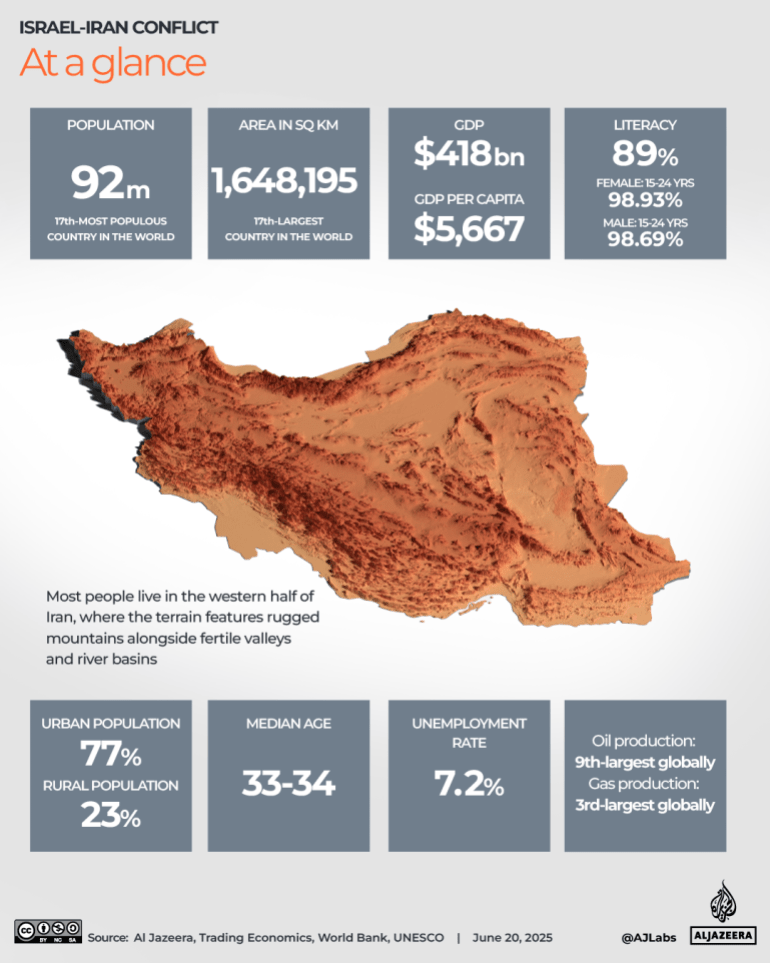
Iran has re-emerged at the centre of international attention, following Israeli attacks on the Middle East’s second-largest country on June 13. Stretching from the Caspian Sea in the north to the Gulf of Oman in the south, Iran’s landscape is as varied as its history, with key access to critical waterways, including the Strait of Hormuz, through which 20 percent of the world’s oil flows. Iran’s history spans millennia, making it one of the world’s most ancient and culturally rich nations, continuously inhabited and influential throughout history. In this visual explainer, Al Jazeera provides a snapshot of Iran’s geography, key cities, population makeup, and ethnic diversity. Iran at a glance With a population of 92 million, Iran is the 17th-largest country in the world by population and land area. Iran’s nominal gross domestic product (GDP) is $418bn, ranking it 36th in terms of the economy size. It has an unemployment rate of about 7.2 percent. The country’s adult literacy rate is 89 percent, with youth literacy nearing 99 percent, though these rates vary between rural and urban areas. The country is rich in oil and gas, ranking as the world’s ninth-largest oil producer and third-largest natural gas producer. How big is Iran? Located in Western Asia, Iran is the second-largest country in the Middle East after Saudi Arabia and the 17th-largest in the world, covering approximately 1.65 million square kilometres (636,000 square miles). Iran shares land borders with seven countries, the longest being Iraq, followed by Turkmenistan, Afghanistan, Pakistan, Azerbaijan, Turkiye and Armenia. Advertisement Iran covers about one-sixth the equivalent land area of the United States, nearly as large as the state of Alaska. It is about one-sixth the size of Europe, about one-fifth the size of Australia, roughly half the size of India and about 80 times larger than Israel. Where are Iran’s main population centres? Most of Iran’s 92 million people live in the western half of the country, where the terrain features rugged mountains alongside fertile valleys and river basins that sustain much of the population. With 9.6 million inhabitants, Tehran has been the capital since 1795 and is the country’s largest city. Situated beneath the Alborz Mountains, Tehran’s history dates back more than 6,000 years. Mashhad, in the northeast, is Iran’s second-largest city with 3.4 million people and a history spanning more than 1,200 years. It is a major religious and cultural centre and is home to the Imam Reza Shrine, which brings in millions of pilgrims from around the world. Isfahan, the third-largest city, is home to some 2.3 million people. More than 2,500 years old, the city was once the capital of the Safavid Empire, which lasted from 1501 to 1722. Isfahan hosts major educational institutions and is a centre for textiles, steel and manufacturing, along with nuclear and aerospace industries. Other populous cities across Iran include: Shiraz (1.7 million), Tabriz (1.7 million), Karaj (1.6 million), Qom (1.4 million) and Ahvaz (1.3 million). Demographic breakdown Nearly 60 percent of Iran’s population is below the age of 39, according to figures from the United Nations Statistics Division. The country’s median age is 33-34 years, and about 77 percent of Iranians live in urban areas. The largest age groups in Iran are those aged 30-34 and 35-39, meaning most of the population was born after the 1979 Islamic Revolution that toppled the Pahlavi Shah regime. However, there has been a significant emigration of Iranian professionals in recent years, largely driven by economic hardship. What are Iran’s ethnicities? Iran is a highly diverse country, both ethnically and culturally. Persians make up approximately 61 percent of the population, while significant minority groups include Azerbaijanis (16 percent), Kurds (10 percent) and others, such as Lurs (6 percent), Arabs (2 percent), Baloch (2 percent) and Turkic groups (2 percent). Iran is predominantly Shia Muslim, making up about 90 percent of the population, while Sunni Muslims and other Muslim sects account for roughly 9 percent. The remaining 1 percent includes roughly 300,000 Baha’i, 300,000 Christians, 35,000 Zoroastrians, 20,000 Jews, and 10,000 Sabean Mandeans according to the Minority Rights Group. Advertisement In border regions such as Kurdistan, Khuzestan and Sistan-Baluchestan, ethnic groups play a key role in shaping the country’s ethnic and religious diversity as well as its regional politics. While Persian (Farsi) is the official national language, many regions across the country speak a variety of other languages. Adblock test (Why?)
Iran, European officials to hold first meeting since Israel conflict began
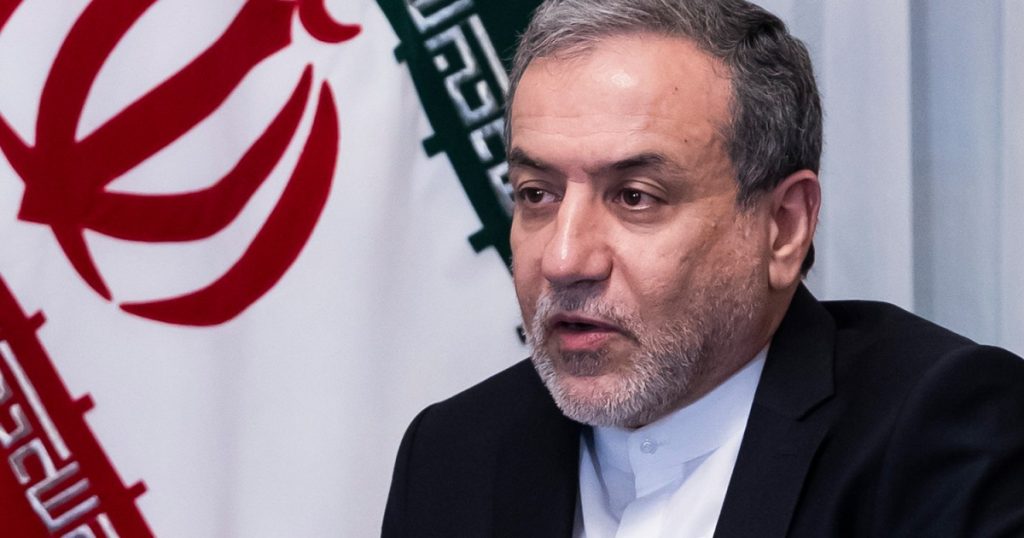
Iran, UK, Germany, France and EU foreign ministers to meet in bid to avoid further escalation between Israel and Iran. Iran will hold talks with the United Kingdom, France and Germany in Geneva on Friday in an attempt to prevent an escalation in its conflict with Israel, after United States President Donald Trump said he would decide within two weeks whether to join the assault on Tehran. “We will meet with the European delegation in Geneva on Friday,” Iran’s Foreign Minister Abbas Araghchi said in a statement, carried by state news agency IRNA. European diplomats confirmed the planned talks in Switzerland, set to involve French Foreign Minister Jean-Noel Barrot, British Foreign Secretary David Lammy, German Foreign Minister Johann Wadephul, and European Union foreign policy chief Kaja Kallas. Kallas and the ministers from the three European countries – known as the E3 – spoke to Araghchi earlier this week and discussed the need to return to the negotiating table and avoid further escalation. At Iran’s suggestion, the two sides agreed to meet face-to-face. French President Emmanuel Macron said European nations were planning to suggest a negotiated solution to end the conflict. On Wednesday, he asked his foreign minister to draw up an initiative with “close partners” to that end. Speaking in Paris after talks on the crisis with the Jordanian Foreign Minister Ayman Safadi on Thursday, Barrot said the three nations “stand ready to bring our competence and experience on this matter”. “We are ready to take part in negotiations aimed at obtaining from Iran a lasting rollback of its nuclear and ballistic missile programmes,” he added. Advertisement The UK’s Lammy was scheduled to travel to Switzerland following his visit to Washington, DC, where he met US Secretary of State Marco Rubio and White House Special Envoy to the Middle East Steve Witkoff. “We are determined that Iran must never have a nuclear weapon … A window now exists within the next two weeks to achieve a diplomatic solution,” Lammy said in a statement. Kallas, in coordination with European countries, has insisted that diplomacy remains the best path towards ensuring that Iran does not develop a nuclear bomb. Israel has repeatedly said its series of strikes is a preemptive move to stop Iran from obtaining nuclear weapons. Iran denies it is building nuclear weapons and insists that its nuclear programme is peaceful. The International Atomic Energy Agency (IAEA) said it has found no evidence that Iran was building such weapons. Trump weighs intervention The ramping up of diplomatic efforts comes as Trump said he is weighing military action against Iran’s nuclear facilities. Trump said on Thursday he would make up his mind within two weeks on whether Washington will get directly involved militarily in the conflict, given the “substantial chance” for renewed diplomatic negotiations over Tehran’s nuclear programme. Iran’s well-defended Fordow uranium enrichment facility, which is buried under a mountain, is widely considered to be out of reach of all but the US’s so-called “bunker-buster” bombs. Israeli Prime Minister Benjamin Netanyahu said he trusted that Trump would “do what’s best for America”. “I can tell you that they’re already helping a lot,” he told reporters in Beersheba. The talks will be held in Geneva, where an initial accord between Iran and world powers to curb its nuclear programme in return for lifting sanctions was struck in 2013, before a comprehensive deal in 2015. Trump left the Iran nuclear deal during his first term as president in 2018, defying last-ditch diplomatic efforts by his European allies to convince him otherwise. Negotiations between Iran and the US had been taking place when Israel launched what it called Operation Rising Lion against Iran’s nuclear facilities and ballistic capabilities on June 12. The conflict erupted with a surprise wave of Israeli attacks targeting Iranian nuclear and military sites and killing top generals and nuclear scientists. At least 639 people, including 263 civilians, have been killed in Iran and more than 1,300 wounded since Israel launched a surprise wave of air raids against Iran a week ago, according to the US-based rights group Human Rights Activists. Advertisement In Israel, at least 24 people have been killed and hundreds of others wounded in Iranian attacks, according to Israeli health authorities. Adblock test (Why?)
Botafogo upset UCL champs PSG at FIFA Club World Cup

Igor Jesus’ 36th minute goal was enough for Botafago to defeat the Europeans champions PSG at the Rose Bowl in Los Angeles. Paris Saint-Germain (PSG) suffered a shock 1-0 Club World Cup defeat against Brazilian side Botafogo in a hard-fought battle between the reigning champions of Europe and South America. A first-half goal from Brazilian international Igor Jesus proved the difference on Thursday as Botafogo all but sealed a place in the knockout rounds in front of a 53,699 crowd at the Pasadena Rose Bowl. French champions PSG are widely regarded as one of the favourites for FIFA’s 32-team tournament after a dazzling season which culminated with a scintillating 5-0 demolition of Inter Milan in the UEFA Champions League final last month. But their hopes of securing a victory, which would have seen them become the first side to reach the last 16, were stymied by a resilient performance from their opponents from Rio de Janeiro. “A lot of people wondered, but we showed how strong Botafogo is,” goal scorer Jesus said after the win. “It was a difficult game, and we had to defend well, and we did our job and scored a goal. “We’re really happy – we knew how important this game was. One team was the champion of the Champions League, the other team was the champion of South America,” added Jesus, who had been strongly linked with a move to English Premier League side Nottingham Forest earlier this year before opting to stay with the Brazilians to play in the Club World Cup. “I think I made the right choice to stay in Botafogo,” Jesus quipped. Jesus scores the game-winning goal in the 36th minute against PSG at the Rose Bowl in Los Angeles on June 19, 2025 [Yuri Cortez/AFP] Setback for PSG PSG coach Luis Enrique said his team had expected a tough battle. Advertisement “We knew it was going to be a very difficult match – they defended very well,” the Spaniard said. “This Club World Cup is very intense and difficult, and all the teams are highly motivated, especially when they’re playing against us.” The PSG manager, though, was adamant that the European champions still had plenty of time to resurrect their campaign. “If there’s a team that can turn it around, it’s our team,” he said. “We’ve got to analyse this and there’s things we can improve. But I think our performance was good.” PSG picked up where they had left off in Sunday’s 4-0 Group B rout of Atletico Madrid, with Khvicha Kvaratskhelia testing Botafogo goalkeeper John with an early curling effort after just two minutes. But that early effort was as close as PSG came to scoring in a scrappy first half punctuated by a series of niggling fouls that prevented the European champions from settling into their passing game. Botafogo’s midfield trio of Marlon Freitas, Gregore and Allan worked tirelessly to close down Vitinha, denying the skilful PSG playmaker time and space to launch attacks despite dominating possession. Instead, it was Botafogo who took the lead with a goal against the run of play on 36 minutes. Jefferson Savarino’s perfectly weighted through ball split the PSG defence and sent Jesus racing through on goal. The Botafogo striker did brilliantly to wrongfoot the covering Willian Pacho before sweeping a shot that took a slight deflection past PSG goalkeeper Gianluigi Donnarumma on its way into the net. PSG continued to dominate possession through the second half, and spent long periods camped in the final third. But Botafogo’s defence held firm and the result leaves the Brazilians firmly on course for the last 16, with a final group game against Atletico Madrid to come in Pasadena on Monday. Botafogo players celebrate after winning the match 1-0 against PSG [Frederic J Brown/AFP] Adblock test (Why?)
Air India takes BIG step, to cut services on … international routes, suspend operations to these 3 cities

The Tata Group-owned airline, grappling with disruptions following the fatal plane crash on June 12 in Ahmedabad, said the objective is to restore schedule stability and minimise last-minute inconvenience to passengers.
PM Modi to flag off Gorakhpur-Patna Vande Bharat Express today, check travel time, ticket price, full schedule, top speed to be…

Gorakhpur Patna Vande Bharat Express: The Gorakhpur to Patna Vande Bharat Express will run via Bettiah, departing Gorakhpur at around 5:40 AM to reach Patna at 12:45 PM.
Air India cancels multiple domestic, international flights due to… Here’s the full list

The airline has offered full refunds or free rescheduling and is helping passengers with alternate travel plans.