

Trump calls on all future candidates to take cognitive exam, noting perfect score during latest physical
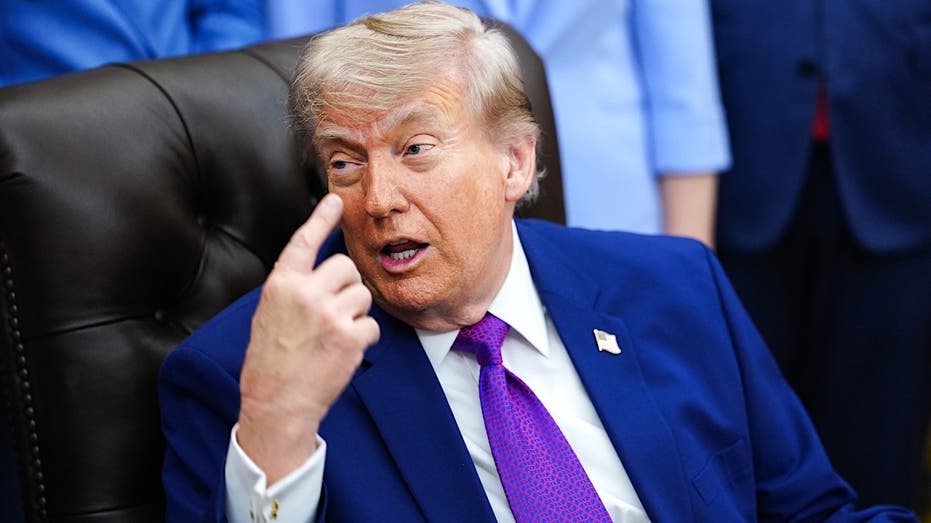
President Donald Trump fired back at critics of his health and cognitive abilities just two weeks before his 80th birthday, repeating his new favorite moniker for his Democrat critics, calling out the “Dumocrats.” “All people running for President and Vice President should be forced to take high difficulty Cognitive Tests,” Trump wrote in an overnight Truth Social post. “Congress, and the Dumocrats, should demand it!” Trump is set to become only the second president to serve at the advanced age of 80 after former President Joe Biden. TRUMP LASHES OUT AT CROCKETT, RENEWS CALL FOR COGNITIVE TEST “The results of my Physical Examination, taken at Walter Reed Military Medical Center, and just released, were extremely good,” Trump’s post began. “Unlike other U.S. Presidents, none of whom have ever taken an approved, high difficulty, Cognitive Test, I scored a perfect 30 out of 30, considered ‘extreme intelligence.’ “Are the Dumocrats really surprised?” Trump has long touted his cognitive test scores, using it as one of his campaign rally staples in contrast to his predecessor Biden, who was the oldest U.S. president in history at 82 when he left office in January 2025. TRUMP DECLARED IN ‘EXCELLENT OVERALL HEALTH’ BY DOCTOR AFTER WALTER REED VISIT The White House released a memorandum Friday night from Capt. Sean P. Barbabella, the physician to the president, detailing Trump’s May 26 annual medical examination. The memo said the evaluation included diagnostic studies, laboratory testing conducted over the past year and consultations with 22 specialty providers. The physician’s summary said Trump “remains in excellent health,” with “strong cardiac, pulmonary, neurological, and overall physical function.” It also said his cognitive and physical performance were “excellent” and that he is “fully fit to carry out all duties of the Commander-in-Chief and Head of State.” “His demanding daily schedule, including multiple high-level meetings, public engagements, and regular physical activity, continues to support his overall well-being,” Barbabella wrote. TRUMP CLAIMS WHITE HOUSE DOCTORS REPORT HIM IN ‘PERFECT HEALTH,’ SAYS HE ‘ACED’ THIRD STRAIGHT COGNITIVE EXAM The memo said Trump’s neurological exam showed normal mental status, cranial nerves, motor strength, sensation, reflexes, gait and balance. It said he completed the Montreal Cognitive Assessment, known as the MoCA, and scored 30 out of 30. “In fact, this is my fourth such test, all PERFECT or, 120 correct answers out of 120 questions asked!” Trump added in his post. “It is very rare that anyone gets a Perfect Score, especially when achieved four times in a row.” Screenings for depression and anxiety were also listed as normal, but the report noted slight lower leg swelling, improved from last year, and bruising on the backs of his hands, which the physician attributed to minor soft tissue irritation from “frequent handshaking” while taking aspirin for cardiovascular prevention. The bruising is “common and benign,” according to the physician. Trump’s lab results were listed largely within normal ranges. His total cholesterol was 143, LDL cholesterol was 53, HDL cholesterol was 70 and triglycerides were 104. His fasting glucose was 83.2, hemoglobin A1c was 5.3 and PSA was 1.0. The memo also listed normal kidney, liver, thyroid and cardiac-related markers. Trump’s current medications include rosuvastatin and ezetimibe for cholesterol control and aspirin for cardiac prevention.
America’s next economic powerhouse may be rising in red-state territory

DALLAS — Texas has emerged as the biggest winner in corporate America’s flight from high-tax blue states, attracting a wave of headquarters relocations as companies increasingly abandon costly coastal hubs for lower-tax Republican strongholds. The relocation wave is reshaping the balance of economic power in America, boosting red-state economies while raising fresh questions about whether high taxes and regulation are driving companies out of blue-state strongholds. Dallas-Fort Worth led the nation with 111 headquarters relocations between 2018 and 2025, according to a CBRE report, while Austin added 88 and Houston gained 31. Together, the three Texas hubs have became one of the nation’s biggest magnets for corporate relocations. THE RED STATES RACING AHEAD IN AMERICA’S POWERFUL WEALTH BOOM — AND THE STATES FALLING BEHIND CBRE found 725 companies relocated headquarters during that seven-year period, with many citing growth opportunities, lower operating costs and lighter regulation as key reasons for moving. Florida, particularly Miami, also emerged as a major beneficiary. Over the past year alone, six companies moved operations to Miami from costly hubs like Los Angeles, the Bay Area and Boston, drawn by Florida’s lower taxes, growing tech sector and access to East Coast markets. Companies told CBRE that Miami’s expanding startup scene and growing pool of finance and tech talent are making the city increasingly attractive. International firms are also flocking to South Florida for its strong tourism, travel and beauty industries. Meanwhile, California suffered the nation’s steepest corporate losses. CALIFORNIA’S LOOMING CAPITAL FLIGHT PROBLEM COULD RESHAPE STATE IN 3 KEY AREAS The San Francisco Bay Area posted a net loss of 163 headquarters during the same period Texas posted gains. Companies leaving California frequently cited taxes, labor rules and soaring living costs as reasons for relocating elsewhere, CBRE found. The migration is also becoming increasingly political. Economic performance often shapes midterm messaging, and corporate relocations are poised to play a larger role in debates over taxes, regulation and the broader business climate. THIS STATE ISN’T JUST GROWING — ITS ECONOMY IS GETTING RICHER PER RESIDENT The issue is drawing even more attention as Democrats in several blue states push billionaire taxes and other progressive policies that critics warn could accelerate the exodus of companies and wealthy residents. Whether the trend endures remains unclear. But for now, the corporate migration is reinforcing a growing reality: Taxes, regulation and cost of living are increasingly determining where businesses invest, where jobs move and which states gain or lose economic power.
Karen Bass appears to liken Spencer Pratt to Trump amid tightening LA mayoral race

Los Angeles Mayor Karen Bass and her challengers spent the final weekend before Election Day crisscrossing the city as a surprisingly competitive mayoral race heads toward a likely runoff. Bass, who is seeking a second term, is up against former reality star Spencer Pratt and city council member Nithya Raman in Tuesday’s primary election. Recent polling has shown a competitive race as no candidate is expected to receive more than 50% of the vote. The top two finishers would then advance to a November runoff. On Saturday, Bass — who is backed by high-profile Democrats, including former Vice President Kamala Harris and California Gov. Gavin Newsom — stopped at Yosemite Recreation Center in Eagle Rock. WATCH: LEFT-WING LA MAYOR FACES REALITY TV CHALLENGER’S BLUNT TAKEDOWNS IN HEATED MAYORAL DEBATE She was seen serving tacos while wearing an apron bearing the slogan “Common Sense and Carne Asada.” During an Instagram livestream Saturday, Bass also took aim at Pratt. “You have a failed reality TV star who wants to be famous,” she said while speaking with two actresses before appearing to reference President Donald Trump. “We know what it means if you put somebody who is a reality TV star in a seat of power.” BAN ON BACKYARD BARBECUES ON CERTAIN DAYS IN CALIFORNIA FLOATED AS OTHERS PUSH BACK HARD Pratt spent part of Saturday criticizing Raman on X, including attacking her recent campaign advertisements. In a video posted to Instagram, Raman pointed to a recent poll and urged supporters to vote. “After millions of dollars of spending against us, we are still here and we are still competitive,” she said. KAREN BASS GRILLED OVER BROKEN HOMELESSNESS PROMISE, BLAMES BUREAUCRACY FOR SLOWED PROGRESS Pratt, who is best known for his role on “The Hills,” has gained attention in the race by criticizing Bass over the response to the January 2025 wildfires that destroyed thousands of structures, including his Pacific Palisades home. He has also sharply criticized Bass over homelessness, drug addiction and crime. Pratt has gained momentum in recent weeks and secured endorsements from fellow reality television personalities, actors, musicians and media figures. Still, Pratt — a registered Republican — faces significant challenges in a city where Democratic candidates have historically dominated local elections. Fox News Digital’s Adam Pack, Kiera McDonald and Andrew Mark Miller, along with The Associated Press, contributed to this report.
Hasan Piker defends pro-communist, anti-ICE Singham network activists as ‘wonderful people’

As he navigated the crowds in an impromptu appearance at a protest outside the Delaney Hall ICE detention facility, Marxist political influencer Hasan Piker defended figures in the pro-China activist network funded by American Marxist tech millionaire Neville Roy Singham as “wonderful people,” while dismissing scrutiny surrounding his Cuba trip. Asked about reporting on Singham’s network and its connections to far-left activism, Piker said there is “this environment of suspicion” surrounding Singham and his activities, taking a “sinister shape,” but they are “totally above board and totally legal.” In recent months, many agitators from the Singham network have fueled, coordinated and organized fiery protests against U.S. Immigration and Customs Enforcement (ICE) in Minneapolis, New York City, Los Angeles, New Jersey and elsewhere. HASAN PIKER NAMES PRO-CCP TYCOON SINGHAM AS FINANCIER OF ‘POLITICAL MOVEMENTS’ DESPITE NONPROFIT VENEER The remarks by Piker are noteworthy because the online influencer isn’t just a livestreamer on the Twitch platform. With millions of mostly young followers across Twitch, YouTube and social media platforms, he has emerged as one of the most influential — and polarizing — figures on the American left, regularly mobilizing support for candidates and causes aligned with the Democratic Socialists of America. Piker wore a baseball cap emblazoned with the group’s logo. Piker has used his platforms to interview, promote and campaign alongside candidates backed by Democratic Socialists of America, helping introduce them to younger voters who consume political content online. His audience reach has made him a significant force in Democratic politics, giving him the ability to shape narratives and drive grassroots enthusiasm for candidates running on socialist and anti-establishment platforms. As reported, Singham is an American Marxist tech tycoon who has pumped $285 million since 2017 into a network of nonprofits that have organized and coordinated divisive anti-American street protests, such as the one unfolding in New Jersey. “I don’t have any personal contact with Roy Singham or any of these other people,” Piker said, in response to questions from Fox News Digital. “I mean, I know some of these people. They’re wonderful people in general. They’re activists….None of it is actually hidden or illegal in any way, shape or form.” The remarks come as federal investigators have expanded scrutiny of activists involved in travel to communist Cuba, including organizations and individuals linked to the broader network of nonprofits and advocacy groups that have received funding from Singham and his wife, Code Pink co-founder Jodie Evans. GOP LAWMAKERS URGE TREASURY TO PRESS AHEAD WITH PROBE OF HASAN PIKER OVER CUBA TRIP As reported exclusively by Fox News Digital last Saturday, the Treasury Department’s Office of Foreign Assets Control (OFAC) sent Piker and CodePink an administrative subpoena as part of an investigation into a March convoy to Cuba. Piker claimed he hadn’t personally received any legal notice. “Fox News Digital says I have a subpoena, but I have yet to be served one,” Piker said. “So I don’t even know what’s going on. It kind of feels like you guys have more insight into what the federal government’s doing than I do, and I’m supposed to be subpoenaed.” Piker’s comments follow disclosures by CodePink co-founder Medea Benjamin that Evans received the query via an email that initially landed in a spam folder. “We heard this on Fox News, that there was this subpoena out,” Benjamin said in an interview shared publicly by BreakThrough News, another nonprofit that Singham has funded. “I was going outside my front door looking around for somebody to serve me. And it turns out that it was an email that was sent to Code Pink co-founder Jodie Evans, and it was so unofficial that it landed in our spam box.” As reported, the Treasury Department’s Office of Foreign Assets Control sent investigative letters seeking financial, logistical and communications documents about the March convoy. The Office of Foreign Assets Control administers and enforces U.S. sanctions programs, including restrictions governing financial transactions and certain travel-related activities involving Cuba. Fox News Digital has reported that the March 2026 convoy to Cuba involved a transnational network of activists organized by another Singham-funded group, the People’s Forum, and a nonprofit, Progressive International, both with close ties to the communist regime in Cuba. DAVID MARCUS: HASAN PIKER, USEFUL IDIOT FASHIONISTAS WANT TO MAKE AMERICA INTO COMMIE CUBA The activists are protesting U.S. sanctions on the communist island. Piker participated in the trip alongside members of Code Pink and a network of 145 organizations, according to a Fox News Digital investigation. Piker framed the investigation as part of a broader effort by the Trump administration to target political activists and protesters, arguing that scrutiny of Cuba travel conflicted with Trump’s campaign promises to defend free speech. “I feel like there are a lot of people who believed in that message, and now he’s betrayed that message,” Piker said. Piker told Fox News Digital that he welcomed a debate with Fox News host Sean Hannity. Piker, who was born in New Brunswick, New Jersey, was visiting his home state from his $2 million home in West Hollywood, California, canvassing at a Saturday rally in Trenton for a controversial candidate, Adam Hamamy, endorsed by Democratic Socialists of America in his race for the U.S. Congress. The New York Times published a profile on Saturday, noting the candidate’s “ties to a militant cleric.” Piker defended Hamamy. Last week, on a livestream on the Twitch platform where he talked for about six hours nonstop, the influencer dismissed concerns about his connections to organizations involved in the Cuba convoy, while acknowledging that Singham finances a network of left-wing nonprofits engaged in “political advocacy” and “a lot of political movements.” Critics have argued the network functions as a coordinated activist infrastructure advancing pro-communist causes, including support for Cuba, China and other authoritarian governments opposed to U.S. foreign policy. As Fox News Digital asked Piker about concerns related to malign foreign influence from China, including at far-left activist events such as the anti-ICE protest unfolding around him, an activist shouted, “Get
Iran war live: Lebanon slams Israel’s invasion; US-Tehran deal in limbo

blinking-dotLive updatesLive updates, Lebanese prime minister describes Israel’s attacks as collective punishment as US warns Iran of strikes if no deal is reached. Published On 31 May 202631 May 2026 Click here to share on social media share-nodes Share googleAdd Al Jazeera on Googleinfo Adblock test (Why?)
Rescues in eastern Syria after the Euphrates River bursts its banks

NewsFeed Rescue workers have pulled stranded farmers from flood waters in eastern Syria after the Euphrates burst its banks. Among the worst-affected areas was Deir Az Zor, where the flooding caused a bridge collapse and cut-off communities. Published On 31 May 202631 May 2026 Click here to share on social media share-nodes Share googleAdd Al Jazeera on Googleinfo Adblock test (Why?)
Emotional scenes as more survivors pulled from flooded Laos cave

NewsFeed Divers in Laos have rescued four more villagers trapped in a flooded cave. The first survivor was pulled out on Friday. Two more men remain missing. They entered the cave to look for gold before flash floods blocked their escape 10 days ago. Published On 31 May 202631 May 2026 Click here to share on social media share-nodes Share googleAdd Al Jazeera on Googleinfo Adblock test (Why?)
Abhishek Banerjee hospitalised after attack during Sonarpur visit, TMC chief Mamata visits nephew in hospital | WATCH

After getting attacked by people during his visit to Sonarpur, TMC leader Abhishek Banerjee was admitted to a Kolkata hospital. TMC chief Mamata Banerjee visited him at the hospital and reacted strongly in front of the media.
DK Shivakumar to take oath as Karnataka CM on June 3 after being elected leader of Congress Legislature Party

The swearing-in ceremony is scheduled to take place on June 3 at 4:05 pm at the Lok Bhavan in Bengaluru. The Governor’s invitation came after Shivakumar submitted a letter earlier in the day staking claim to form the government following his election as the Leader of the Congress Legislature Party.
‘Rulers became killers’: Mamata Banerjee slams BJP after attack on TMC MP Abhishek Banerjee

The TMC has alleged that party leader Abhishek Banerjee was “attacked by a few BJP supporters” when he had gone to meet the family of “a person murdered by BJP.”