

Arizona Gov. Hobbs asks federal government for $752M to pay for migrant services, shelters

Democratic Arizona Gov. Kaite Hobbs is asking the federal government for $752 million to pay for migrant shelters and services in an effort to alleviate the financial strain on local governments and charity groups. In a letter dated Tuesday to leaders of the Senate and House Appropriations Committees, Hobbs expressed the need for action as local law enforcement and charities “find themselves on the brink of operational limitations.” The funds would go toward the U.S. Customs and Border Protection (CBP) Shelter and Services Program in the upcoming Homeland Security Appropriations bill. The CBP program gives money to groups that assist immigrants. JOHNSON CHASTISES BIDEN FOR ‘REGRET’ ON CALLING LAKEN RILEY MURDER SUSPECT ‘ILLEGAL’: ‘WHAT AN EMBARRASSMENT’ “Arizona’s border is more than a convenient location for politicians to take photo ops and stage press conferences,” Hobbs wrote. “It’s where my constituents live, work, and raise their families. My state has done everything possible to deliver safety and security to those communities, but we need Congress to step up and do its job.” “It is unacceptable that the security of everyday Arizonans has taken a backseat to political games in Washington, D.C., forcing working families in my state to bear the burden of congressional inaction. It’s time to prioritize practical solutions over political maneuvers,” she added. DHS WARNS HAITIAN ILLEGAL IMMIGRANTS ARRIVING BY BOAT FACE ‘IMMEDIATE REPATRIATION’ The governor also urged lawmakers to pass bipartisan border legislation that has failed to gain traction despite record numbers of migrants at the southern border. Her request echoes a similar letter to lawmakers by Arizona Senators Mark Kelly and Kyrsten Sinema. CLICK HERE TO GET THE FOX NEWS APP Without the federal funding, migrants would likely be released without shelter or support onto the streets of local Arizona communities, the pair said in a Feb. 27 letter to appropriation committees in both chambers of Congress. Officials in Arizona told Fox 10 they hope lawmakers listen to their pleas for help in managing the crisis. “I hope that Washington just listens to what we here on the border need. Sometimes we’re forgotten. You hear about San Diego, you hear about Tucson, you hear about Eagle Pass, but they forget about that here in Yuma. We face this every day,” Yuma Police Chief Thomas Garrity said.
Georgia school voucher bill narrowly clears longtime obstacle with state House passage

ATLANTA (AP) — Georgia Republicans powered a voucher plan funding private school tuition and homeschooling through the state House on Thursday, nearing a goal that has long eluded the state’s school choice advocates as GOP leaders overcame longstanding skepticism from some rural members of their party The House voted 91-82 for Senate Bill 233, passing it with one vote to spare. The same bill failed last year when 16 Republicans voted against it. Thursday, seven Republicans and one Democrat who opposed the measure last year flipped to support it. DEFENSE ATTORNEY TELLS MSBNC THAT JUDGE PULLING DA WILLIS FROM TRUMP CASE COULD BE ‘DEATH KNELL’ FOR CASE The vote sends the bill back to the Senate for what could be a single up-or-down vote on final passage. Republican Gov. Brian Kemp backs the voucher plan, including devoting a substantial portion of his State of the State speech to advocating for it. And Republican House Speaker Jon Burns of Newington began to forcefully advocate for the bill after spending the summer on the sidelines. “We are going to empower our parents to make the best educational decisions for their children and give them the tools to succeed for generations to come!” Burns said in a statement after Thursday’s vote. The bill would provide $6,500 education savings accounts to students attending public schools that rank in Georgia’s bottom 25% for academic achievement. That money could be spent on private school tuition, home schooling supplies, therapy, tutoring or even early college courses for high school students. It differs from last year’s failed measure, having been combined with a number of other education initiatives. But opponents argue it would subtract resources from public schools, with school districts losing state aid as children depart, even as other students will remain behind. Rep Vance Smith of Pine Mountain, one of eight House Republicans who continued to oppose the bill, said lawmakers should instead seek to solve dysfunction in schools. “When the dust settles, you’ve still got children in the classroom,” Smith said. “What are we doing for those children that are left in the classroom?” The new program would be limited to spending 1% of the $14.1 billion that Georgia spends on its school funding formula, or $141 million. Lawmakers would appropriate money for the voucher separately, and not take it directly out of the formula. That could provide more than 21,000 scholarships. Students who could accept them are supposed to have attended an eligible public school for at least two consecutive semesters, or be about to enter kindergarten at an eligible public school. Students from households with incomes of less than four times the federal poverty level would prioritized for the scholarships. Four times the federal poverty level is about $100,000 for a family of three. Parents would have to provide proof of allowed expenditures to a new Georgia Education Savings Authority to claim the money. All of a family’s eligible children could qualify for the program Democrats argue the money isn’t enough to pay tuition at most private schools, and that private schools aren’t available in some rural areas. They also say private schools don’t have to accept all applicants and could discriminate against people with differing social and religious views. Rep. Karlton Howard, an Augusta Democrat, said the plan increases inequality, favoring people with the resources to make up the difference. “It is leaving the least and the less behind to fend for themselves,” Howard said. Republicans see it differently, though. Mesha Mainor, an Atlanta Republican, switched from the Democratic Party in part because of her support for vouchers. She said the bill would help at least some people, claiming members of her former party don’t want to help any students in poorly performing schools. “They are growing up in a cycle of poverty and a cycle of desperation,” Mainor said “Today, you can make a change for them.” The Georgia effort is part of a nationwide GOP wave favoring education savings accounts following the pandemic and fights over what children should learn in public schools. Other parts of the revamped bill include writing current teacher pay raises into Georgia’s K-12 school funding formula, letting public school prekindergarten programs qualify for state aid to construct and furnish buildings, letting students enroll in other public school districts that will accept them and increasing tax credits for donations to public schools. The language on teacher raises is partly symbolic — lawmakers have been increasing pay using budget bills in recent years. Georgia already gives vouchers for special education students in private schools and $120 million a year in income tax credits for donors to private school scholarship funds.
Manhattan DA Bragg asks for delay to Trump’s hush money trial

Manhattan District Attorney Alvin Bragg is pushing for a delay to the start of former President Trump’s New York hush-money criminal trial. In a Thursday court filing, the DA’s office said it was not opposed to adjourning the start of the trial for up to 30 days to give Trump’s legal team time to review evidence that was recently turned over. Trump’s lawyers are seeking a 90-day delay or the dismissal of charges against Trump, alleging violations of the “discovery process,” whereby both sides exchange evidence. TRUMP FLORIDA JUDGE CANNON SEEMS TO HINT DISMISSAL UNLIKELY The new records came from the U.S. attorney’s office in Manhattan, which previously investigated the hush-money arrangement at the heart of Trump’s New York criminal case. Trump’s legal team has also sought a delay to the trial until after the Supreme Court rules on Trump’s presidential immunity claim. Oral arguments in that case are slated to begin in late April. The judge in the hush-money case, Juan Manual Merchan, has yet to rule on either request. Jury selection in the trial is scheduled to begin March 25. Since March 4, Trump’s lawyers have received at least 84,000 pages of records from the federal prosecutor’s office in Manhattan, including a batch of 31,000 pages on Wednesday, according to a court filing. TRUMP HOLDS SLIGHT EDGE OVER BIDEN IN CRUCIAL BATTLEGROUND STATE: POLL The records pertain to a federal investigation that touched on the hush-money matter and led to prison time for former Trump lawyer Michael Cohen. Federal prosecutors in 2018 charged Cohen with campaign finance violations related to the hush-money payments, with evading taxes related to his investments in the taxi industry and with lying to Congress. Cohen, who blamed Trump for his legal problems, pleaded guilty and served about a year in prison before being released to home confinement because of the COVID-19 pandemic. He is now a key prosecution witness in the Manhattan district attorney’s case. Trump and his lawyers have portrayed Cohen as completely untrustworthy.
Trump Florida Judge Cannon seems to hint dismissal unlikely

Defense attorney Todd Blanche argued the Trump position is that the Presidential Records Act gives the president the authority to retain documents he sees fit, and essentially take them home or out of the White House, and if that’s accurate, that alone is “fatal” to Special Counsel Jack Smith’s indictment. “Presidents since George Washington have taken material out of the White House,” said Blanche, adding that the PRA was passed in the late 70s and nothing in the statute says anything about documents with markings or anything that gives the National Archives (NARA) the ability to challenge a president’s decision about which documents are personal versus presidential. Team Trump also points out often that then-President Trump caused these boxes to be moved while he was still president and that this is the first time NARA has challenged a decision made by a president about which documents are personal versus presidential. They claim NARA only took this action because the president in question was Donald Trump. TRUMP HOLDS SLIGHT EDGE OVER BIDEN IN CRUCIAL BATTLEGROUND STATE: POLL US District Court Judge Aileen Cannon told Mr. Blanche, “All that might be right. But I don’t see how it leads to a dismissal of the indictment…Maybe a defense at trial…” Blanche replied that this was a “proper” avenue for a dismissal because the government must prove that the possession of the documents was unauthorized. However, Judge Cannon seemed to double down, saying the arguments might have, “some force at trial, but it’s hard to see how it gets you to a dismissal.” Judge Cannon at one point remarked that the Trump defense team’s view of the Presidential Records Act would essentially, “Gut the PRA,” giving presidents the unfettered ability to classify clearly presidential records as personal. TRUMP ATTENDS FLORIDA HEARING ON POSSIBLE DISMISSAL OF CLASSIFIED DOCS CASE Mr. Blanche replied that it is up to Congress to change the law. “That’s what’s supposed to happen. DOJ can’t just decide…” [what is personal versus presidential]. “We don’t have a lot of case law on this because this has never been done before,” added Blanche. “While he was the president he took records, like many presidents… For the first time ever NARA took a different path and made a criminal referral,” instead of negotiating with the president as had been done in the past. Judge Cannon at one point said, “Correct… the seizure of a president’s records was seen to be an extraordinary act.” Blanche pointed out that in the aftermath of the Clinton presidency, “President Clinton hid tapes in his socks and NARA said there’s nothing we can do about that.” Judge Cannon asked if those tapes contained any classified information. Blanche said no one knows because the tapes were never recovered from President Clinton. “They can’t have it both ways,” said Blanche. “No effort to investigate whether there was national defense information in President Clinton’s socks,” but still referring the Trump matter to the DOJ for a potential criminal prosecution. DOJ prosecutor David Harbach told Judge Cannon that the documents seized at Mar-a-Lago, “were not personal, nowhere close to that.. The only inference is that they were presidential, not personal.” Harbach also went back to one of Judge Cannon’s questions to the defense, “Our view is that President Trump’s position would completely gut the PRA.” CLICK HERE TO GET THE FOX NEWS APP Mr. Harbach also took pains to stress the independence of Special Counsel Jack Smith’s team, “We are not appendages or puppets of the Biden Administration.”
Maryland Senate nearing vote on $63B budget legislation for next fiscal year

ANNAPOLIS, Md. (AP) — Despite recent fiscal challenges, Gov. Wes Moore‘s $63 billion budget plan remains largely intact under legislation heading to a vote Thursday in the Maryland Senate. The measure makes reserves available if needed to cover a miscalculation in Medicaid costs that was discovered after the governor submitted his budget to the General Assembly in January. MARYLAND GOV. MOORE UNVEILS $90M ‘DOWN PAYMENT’ FOR CLIMATE INITIATIVES The legislation will still need to go to the Maryland House, where majority Democrats haven’t been shy in voicing support to raise significant revenues this year to help address deficits in future years, pay for a major K-12 education funding overhaul and fund ambitious plans to fight climate change. But leaders in the Senate, which also is controlled by Democrats, have said major tax increases are a nonstarter this session. And the governor — who highlighted the lack of tax increases in his budget — has said there would be “a very high bar” for any tax hikes. It’s a revenue debate playing out in an election year for an open U.S. Senate seat and congressional races, featuring the surprise U.S. Senate candidacy of former Republican Gov. Larry Hogan, who campaigned against tax increases to win his first term in 2014 in the heavily Democratic state and won re-election in 2018. Moore‘s proposed budget is more than $1 billion smaller than the last one, due to the absence of federal aid that Maryland, like other states, had received during the COVID-19 pandemic. Still, a large amount of reserves that lawmakers set aside can be tapped to address future holes. In its work on the spending plan, the Senate had to address a drop in forecasted revenues announced last week for the current fiscal year as well as the next, totaling $255 million. The mistake in the state’s Medicaid calculations presented another $236 million challenge. The Senate decided to authorize the governor to withdraw money from the rainy day fund to ensure Medicaid and foster care are adequately funded. The budget fully funds the state’s ambitious K-12 spending plan known as the Blueprint for Maryland’s Future, while challenges remain on how to pay for rising future costs as it is phased in. Senators also kept Moore’s down payment of $90 million to help reach the state’s ambitious goal to reduce greenhouse gas emissions, though it’s only a one-time expenditure. The money would be used to lease electric school buses, install electric vehicle charging infrastructure and electrify schools and multifamily homes. The Senate also restored some funding Moore proposed reducing for community and private colleges, a move that brought students to Annapolis to lobby lawmakers. While the Senate hasn’t entertained the kind of revenue increases under consideration in the House, it is considering measures to help raise money for the state’s medical trauma system. For example, the Senate is advancing a bill to increase the annual surcharge on vehicle registration fees that support emergency medical services. Senators also are moving forward with a new tax on firearms and ammunition and are considering a surcharge for electric vehicle registration fees to help make up for gas taxes that their owners don’t pay. Meanwhile, the House appears poised to advance legislation to allow internet gambling, an expansion beyond the state’s brick-and-mortar casinos. There’s a similar bill in the Senate, but it’s unclear how much support exists for more gambling, which would need to go on the ballot for voter approval if a bill clears the General Assembly. The budget, as modified by the Senate, preserves about $1.3 billion in the rainy day fund, which is about 9.4% of general fund revenues. That’s well above the 5% that the state routinely kept in the fund before the pandemic. The House will work on the budget legislation with less than a month to go in the 90-day legislative session. Differences between the two chambers will have to be resolved before the General Assembly adjourns at midnight April 8.
Pornhub shuts down website in Texas after getting sued under age verification law

Pornhub, a pornographic website, disabled users in Texas from accessing the site on Thursday after the state attorney general and lawmakers sought to require adult websites to verify the age of visiting users. Last month, Attorney General Ken Paxton filed a lawsuit against Aylo Global Entertainment and Aylo USA, Incorporated — the conglomerate that owns Pornhub — for failing to verify users’ ages before granting access to its pornographic websites. In a message to users who visit the site, Pornhub called the age verification legislation “the least effective and most restrictive means” to protect minors. “While safety and compliance are at the forefront of our mission, providing identification every time you want to visit an adult platform is not effective for protecting users online, and in fact, will put minors and your privacy at risk,” the company wrote. PORNHUB PARENT COMPANY SUED BY TEXAS AG FOR FAILING TO VERIFY USERS’ AGES Pornhub also encouraged users to contact their local representatives to demand “device-based age verification.” “Until the real solution is offered, we have made the difficult decision to completely disable access to our website in Texas,” the company continued. “In doing so, we are complying with the law, as we always do, but hope that governments around the world will implement laws that actually protect the safety and security of users.” House Bill 1181 became law in Texas last June, requiring adult websites to “use reasonable age verification measures to ensure those viewing their pornography are 18 years of age or older.” The passage of the legislation made Texas the seventh state to implement age verification laws on pornography sites. TEXAS AG KEN PAXTON SUES 5 CITIES OVER MARIJUANA AMNESTY POLICIES, CITES DRUG’S REPORTED LINKS TO ‘PSYCHOSIS’ CLICK HERE TO GET THE FOX NEWS APP Companies that violate the state law are subject to up to $10,000 a day for failing to verify age, an additional $10,000 per day if the sites retain user information, and an additional $250,000 if a child is exposed to pornographic material due to failures in verification. “AYLO GLOBAL ENTERTAINMENT, INC.’s and AYLO USA, INCORPORATED’s publication or distribution of sexual material harmful to minors on the internet without implementing the reasonable age verification methods required by Chapter 129B harms, and continues to harm, Texas children and adolescents,” Paxton’s office alleged in the lawsuit. Fox News’ Timothy H.J. Nerozzi contributed to this report.
Speaker Johnson floats stand-alone Israel aid plan after Schumer’s comments made situation ‘even more urgent’

EXCLUSIVE: WEST VIRGINIA — Speaker Mike Johnson, R-La., said the House could soon consider a new standalone bill to aid Israel. In an interview with Fox News Digital, the Louisiana Republican cited “the urgency of the moment” for needing a new funding package for the Middle East ally, though he said it’s in the “early” stages. It comes hours after Senate Majority Leader Chuck Schumer, D-N.Y., stirred outrage among Israel supporters by calling for new elections in the country to replace Prime Minister Benjamin Netanyahu and equated his right-wing Israeli government to Hamas. “There’s discussion in the last two hours about running Israel as a separate standalone because of the events of today,” Johnson said. “Frankly, Leader Schumer and his comments made the situation even more urgent.” “There’s enough members now saying let’s just get Israel done,” he added. WORLD, UN SIGNAL NO EXIT FOR CIVILIANS CAUGHT UP IN GAZA WAR: ‘POLITICALLY TOXIC’ Democrats have been urging Johnson to take up the Senate’s $95 billion supplemental foreign aid package with funds for Ukraine, Israel, Taiwan and humanitarian support in Gaza. Johnson signaled in the past that there wasn’t enough GOP support in the House to take up the measure, but he told Fox News Digital he was “actively considering all the options with regard to the supplemental issues.” “We will be turning our attention to it as soon as the government funding is— as soon as the text is filed, we’ll get that done,” Johnson said. One of his first acts as speaker was putting a standalone $14 billion Israel aid bill on the floor, which passed along bipartisan lines. However, Schumer panned the bill as a nonstarter because it would have required the funding to be offset by cuts to IRS dollars. Citing those concerns, Johnson passed a bill last month to give Israel $17.6 billion with no offsets, but Schumer has not taken up that bill either. US ARMY BOATS DEPART FOR GAZA ON MISSION TO BUILD FLOATING PIER FOR FOOD DELIVERIES “The second time we did…more, and to my great surprise, I think 166 House Democrats voted against it, because the president issued a veto threat – which was just stunning, a stunning development to me,” Johnson said. “Their stated reason was, I guess, that they wanted to make sure that it remained as part of the supplemental package…some time has passed since then and the circumstances have changed markedly. And my guess is that they might be more open to consideration of that, given where we are right now, and the urgency of the moment.” He made the comments to Fox News Digital on the sidelines of the House GOP’s annual retreat, held this year at the Greenbrier resort in West Virginia. URBAN WARFARE EXPERT SAYS ISRAELI MILITARY TAKING UNPRECEDENTED STEPS TO PROTECT GAZA CIVILIANS Back in Washington, Schumer took to the Senate floor on Thursday morning, where he condemned both Hamas and Israel for the high death toll of Palestinians and the humanitarian catastrophe in Gaza as Israel responds to the Oct. 7 attack. He called on Palestinians to throw off their leader, President Mahmoud Abbas, and for Israelis to demand a new election to elect a less “radical” government. “Hamas and the Palestinians who support and tolerate their evil ways, radical right-wing Israelis in government and society, President Abbas, Prime Minister Netanyahu – these are the four obstacles to peace, and if we fail to overcome them, then Israel and the West Bank and Gaza will be trapped in the same violent state of affairs they’ve experienced for the last 75 years,” Schumer said. “These obstacles are not the same in their culpability for the present state of affairs. But arguing over which is the worst stymies our ability to achieve peace.” During a press conference addressing that earlier, Johnson called it “inappropriate” for “an American leader to play such a divisive role in Israeli politics, while our closest ally in the region is in an existential battle for its very survival.”
DHS warns Haitian illegal immigrants arriving by boat face ‘immediate repatriation’

The Department of Homeland Security says that any illegal immigrants arriving by boat, including from Haiti, face “immediate repatriation” – amid brewing concerns about a potential migrant wave coming from the conflict-plagued country. In a statement to Fox News Digital, DHS said it is “monitoring the situation in Haiti and coordinating closely with the State Department and international partners.” The Caribbean nation has seen a significant escalation in violence as gangs have overrun the capital, burning police stations and attacking the main airport. Gangs have also raided some of the largest prisons, releasing thousands of inmates. DESANTIS SENDS SOLDIERS, AIRCRAFT TO ‘PROTECT’ FLORIDA FROM ILLEGAL IMMIGRANTS BOATS AMID HAITI UNREST The increased violence raises the possibility of a new wave of migrants coming from the country, both at the southern land border, where migrants surged into Del Rio in 2021 in the thousands, and by boat. On Wednesday, Florida Gov. Ron DeSantis announced he is sending soldiers and officers, as well as aircraft and boats to “protect” the state from vessels carrying illegal immigrants. “Given the circumstances in Haiti, I have directed the Division of Emergency Management, the Florida State Guard, and state law enforcement agencies to deploy over 250 additional officers and soldiers and over a dozen air and seacraft to the southern coast of Florida to protect our state,” he said. In its statement, DHS stressed that migration flows through the Caribbean “remain low.” “All irregular migration journeys, especially maritime routes, are extremely dangerous, unforgiving, and often result in loss of life. DHS will continue to enforce U.S. laws and policy throughout the Florida Straits and the Caribbean region,” a spokesperson said. The spokesperson also stressed that those caught at sea would be immediately returned. HAITIAN PRIME MINISTER ARIEL HENRY TO RESIGN AMID LOW-SCALE CIVIL WAR, BOWING TO INTERNATIONAL PRESSURE “U.S. policy is to return noncitizens who do not have a fear of persecution or torture or a legal basis to enter the United States. Those interdicted at sea are subject to immediate repatriation pursuant to our longstanding policy and procedures. The United States returns or repatriates migrants interdicted at sea to The Bahamas, Cuba, the Dominican Republic, and Haiti.” According to the U.S. Coast Guard, 65 migrants were repatriated on Tuesday after the agency stopped a boat near the Bahamas. So far, the Coast Guard has repatriated 131 migrants this fiscal year. The administration has said it is implementing “consequences” for illegal entry while expanding what it says are lawful migrant pathways. Haitians are also eligible for a controversial parole program that allows up to 30,000 nationals from Haiti, as well as Cuba, Venezuela and Nicaragua, to fly into the U.S. each month. On Tuesday, Rebecca Zimmerman, assistant secretary of defense for Homeland Defense and Hemispheric Affairs, told lawmakers that the Pentagon is “alert” to the possibility of a mass migration event, but it has also not yet seen large numbers. “I think you’re right that the driving conditions in Haiti could very well press more people,” she told Rep. Matt Gaetz, R-Fla. “We recently approved some additional assistance we could provide to the Coast Guard.” Fox News’ Bradford Betz and Danielle Wallace contributed to this report.
Trump holds slight edge over Biden in crucial battleground state: poll

A new poll in Michigan – one of the key states that may decide November’s presidential election – indicates that former President Donald Trump holds a three-point advantage over President Biden. According to a survey released Thursday by Quinnipiac University, Trump stands at 48% among registered voters in Michigan, with Biden at 45%, and eight percent undecided. In the head-to-head match up, independents favored Trump by a narrow 46%-42% margin. The poll was conducted March 8-12 (last Friday through Tuesday). When third-party and independent candidates are included, the survey indicates Trump at 41%, Biden at 36%, Democrat-turned-independent Robert F. Kennedy Jr. at 10%, Green Party candidate Jill Stein at 4%, and progressive independent Cornell West at 3%. Five percent were undecided. CLICK HERE FOR THE LATEST FOX NEWS 2024 ELECTION POLLING The Quinnipiac poll was released as the president campaigned in the crucial Midwestern general election battleground state. Since delivering a vigorous State of the Union address last week, Biden has stopped in Pennsylvania, Georgia, Wisconsin, and now Michigan. He plans a trip to Nevada and Arizona next week. Biden narrowly edged Trump in all six of those states in the 2020 presidential election to win the White House. BIDEN-TRUMP SEQUEL UNDERWAY IN HISTORY MAKING PRESIDENTIAL ELECTION REMATCH Biden and Trump clinched the Democratic and Republican presidential nominations, as they swept primaries in Georgia, Mississippi and Washington State on Tuesday, becoming the major party 2024 presumptive nominees. With over seven and a half months to go until Election Day on November 5, Trump currently enjoys the early edge in public opinion polling – in most national surveys and in many in the key battleground states. A Fox News poll in Arizona that was released on Wednesday indicated Trump topping Biden by four points, both in a two-way matchup and a five-way showdown that also includes Kennedy Jr., Stein and West. Trump edges Biden by two points, which is within the survey’s sampling error, in a Fox News poll in Pennsylvania that was also released on Wednesday. The survey indicates that the two are deadlocked in a five-way matchup including Kennedy Jr., Stein, and West. While third-party and independent candidates didn’t play much of a role in the 2020 presidential election, they did in the 2016 showdown between Trump and Democratic nominee Hillary Clinton. And they may again in 2024. The Biden-Trump rematch offers up stark contrasts when it comes to their styles and demeanors, and on where they stand on key issues, such as the economy, health care and entitlements, immigration, abortion, foreign policy, the war in Ukraine and America’s overseas role going forward. The 81-year-old Biden, who four years ago made history as the oldest American ever elected president, will continue to face questions about his mental and physical durability, even after last week’s vigorous State of the Union address. The president needs to show that he can energize younger voters, progressives, and Black and Latino Americans, who are all key parts of the Democratic base. Biden is also facing primary ballot box protests – materializing in “uncommitted” votes – over his support for Israel in its war in Gaza against Hamas. The former president is also dealing with plenty of problems. Trump, who last year made history as the first president or former president to face criminal charges, now faces four major trials and a total of 91 indictments – including federal cases on his efforts to overturn the 2020 presidential election and on handling classified documents. There’s also a $355 million civil fraud judgment that Trump is appealing. He will have to juggle his appearances in court with his time on the campaign trail. The 77-year-old Trump will also need to court the sizable block of Republican voters who backed Nikki Haley in the GOP nomination race. The former U.N. ambassador and former South Carolina governor was Trump’s last remaining rival before she ended her White House campaign last week. Haley’s support is shining a spotlight on Trump’s weakness with suburban and highly educated voters. Get the latest updates from the 2024 campaign trail, exclusive interviews and more at our Fox News Digital election hub.
Indiana Gov. Holcomb greenlights bills addressing child care, tenure reform and more
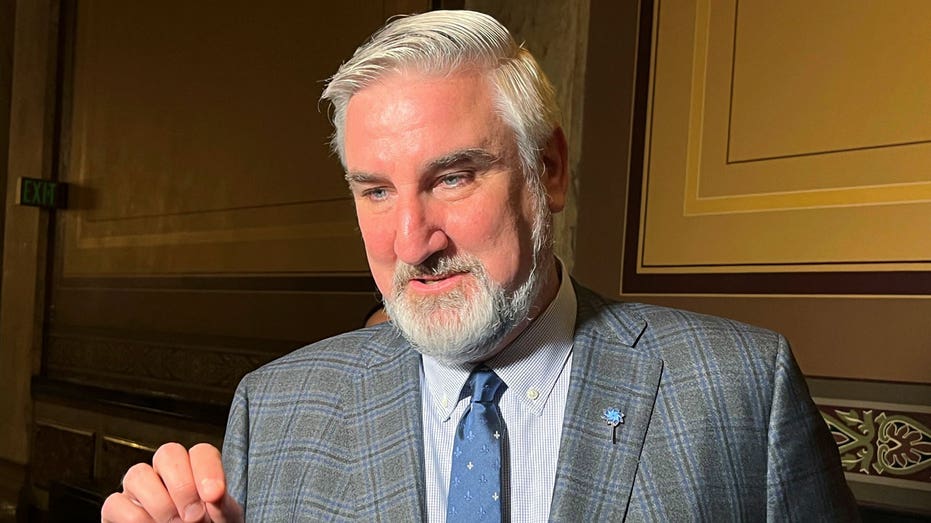
Indiana Gov. Eric Holcomb has signed a bipartisan bill to support child care in the state on top of 74 other measures, according to his office. The signings on Wednesday included several contested proposals, such as an overhaul of faculty tenure at state colleges and universities, the repeal of a state statute letting Ukrainian refugees get driver’s licenses and broader gun rights for some state officials at the Capitol in Indianapolis. Addressing the affordability of child care was a priority for both Republican and Democratic leaders this year, but lawmakers were limited in their action due to the nonbudget cycle. Indiana creates a biannual budget during odd numbered years. INDIANA GOV. HOLCOMB SIGNS ELEMENTARY LITERACY BILL INTO LAW Holcomb signed the state Senate agenda bill on Wednesday, expanding eligibility for a child care subsidy program for employees in the field with children of their own. The legislation also lowers the minimum age of child care workers to 18 and, in some instances, to 16. The governor also put his signature to a Republican-backed bill that undoes some regulations on child care facilities. The legislation would make a facility license good for three years, up from two, and allow certain child care programs in schools to be exempt from licensure. It also would let child care centers in residential homes increase their hours and serve up to eight children, instead of six. Republicans have said undoing regulations eases the burden of opening and operating facilities. Many Democrats vehemently opposed the measure, saying it endangers children. Holcomb signed another closely watched bill dealing with higher education on Wednesday, creating new regulations on tenure for faculty at public colleges and universities. Tenured professors will be reviewed every five years and schools must create a policy preventing faculty from gaining tenure or promotions if they are “unlikely to foster a culture of free inquiry, free expression and intellectual diversity within the institution.” Backers argued it will address a hostile academic environment for conservative students and professors. “Universities that fail to foster intellectually diverse communities that challenge both teachers and learners fail to reach their potential,” the bill’s author, state Sen. Spencer Deery, said in a statement Wednesday. “This measured bill makes it significantly less likely that any university will shortchange our students in that way.” Opponents said it will make it harder for Indiana schools to compete with other states for talent. “This is a dark day for higher education in Indiana,” Moira Marsh, president of the Indiana State Conference of the American Association of University Professors, said in a statement Thursday. Holcomb also put his signature to a bill allowing certain statewide officials to carry guns in the statehouse and to legislation that repeals a law allowing Ukrainian refugees to obtain driver’s licenses. The repeal jeopardizes a discrimination lawsuit against the state brought by a group of Haitian immigrants in the same immigration class. The second term Republican governor has signed 166 bills this year, his last in office under state term limits. Once bills reach the governor’s desk, he has seven days to either sign or veto them. If no action is taken, the bill automatically becomes law. Most laws in Indiana go into effect July 1, unless otherwise stipulated.