

Centre notifies implementation of CAA weeks before Lok Sabha polls 2024

CAA notification: The Modi government on Monday notified the implementation of the Citizenship Amendment Act weeks before the upcoming Lok Sabha elections.
What is the full form of CAA?

The CAA was passed in December 2019 and subsequently got the President’s assent.
Centre notifies CAA rules: Here’s a timeline of Citizenship Amendment Act

The Citizenship (Amendment) Act (CAA) has been a subject of contention and debate in India since its inception in December 2019.
Review finds ‘broken’ processes for resolving public record disputes in most states

Dana Holladay-Hollifield has worked as a nurse in Alabama for years, but never was her pay as low as it was at Huntsville Hospital. She wondered what executives at the not-for-profit facility were making, so she filed a public records request to find out. The hospital is governed by a public board, she said, and therefore subject to the state’s open records law. Many months and roadblocks later, Holladay-Hollifield faced a decision: File a costly lawsuit to get the information, or give up. ENFORCEMENT OF GOVERNMENT TRANSPARENCY RULES IS POOR IN MOST STATES, REPORT FINDS “This is supposed to be easy to access,” she said. “I’ve got three kids; I’m taking care of my mother-in-law and my husband. I mean, I don’t have a spare $10,000.” Holladay-Hollifield’s predicament represents what experts say is a fundamental breakdown of American democracy: the fact that, in most states, the most effective — and often only — option for residents to resolve open government disputes is to sue. “Unfortunately, in the United States, almost everywhere, you have to go to court to enforce these laws. And that’s just wrong,” said David Cuillier, director of the Joseph L. Brechner Freedom of Information Project at the University of Florida. “If the system requires the average person to hire an attorney to make democracy work, then it’s really broken.” A nationwide review of procedures by The Associated Press and CNHI News, timed to Sunshine Week, found that fewer than a third of states have offices that can resolve residents’ complaints by forcing agencies to turn over documents or comply with open meetings requirements. In most states, residents have just one meaningful option when they believe an agency is illegally withholding public information: to wage a legal battle. This system has a chilling effect, discouraging private citizens from finding out about everything from police investigations to how elected officials make decisions and spend taxpayer money. Alabama is one of these states. Holladay-Hollifield began seeking records from Huntsville Hospital, which is overseen by the Health Care Authority of the City of Huntsville, a public corporation, in early 2023. She petitioned its governing board, where an attorney repeatedly rebuffed her request. She then contacted numerous local public officials, but none could help. Finally she consulted a lawyer, who told her a lawsuit would likely cost thousands of dollars. Joe Campbell, general counsel for the Huntsville Hospital system, said the facility’s administration and board have tried to provide Holladay-Hollifield with appropriate responses without “compromising their fiduciary obligations to protect the hospital.” “We have notified her in writing that we contend executive salaries are confidential and not subject to an open record request,” Campbell said in an email. However, J. Evans Bailey, a media law attorney in Montgomery, says significant Alabama Supreme Court rulings have held that all health care authorities in the state are subject to its public records law. “If you are subject to the open records law, and you have a document that shows what the salaries are of various executives or higher level people in your government entity, that should be an open record,” Bailey said. The AP and CNHI’s 50-state review uncovered a patchwork of systems for resolving open government disputes. Some states, like Arizona and Indiana, have offices that can review residents’ complaints but can’t compel agencies to comply with their findings. Others give their attorneys general authority to issue opinions or take matters to court, though experts say they rarely pursue litigation or prosecution. “That’s one of the real challenges with any of these laws is that even when they have enforcement tools built in, civil liability or criminal liability, that they are so rarely enforced,” said Chip Stewart, a media law professor at Texas Christian University. Beyond private citizens, these systems can cost taxpayers. When LaPorte County, Indiana, Prosecutor Sean Fagan took office in January 2023, one of his first requests was to access emails from the office’s prior administration to review details about ongoing cases. The problem? Those emails are on servers controlled by county commissioners, who refused to hand them over. EX-FBI OFFICIAL SENTENCED TO OVER 2 YEARS IN PRISON FOR CONCEALING PAYMENT FROM ALBANIAN BUSINESSMAN The Indiana Attorney General, the state public access counselor and the Indiana Prosecuting Attorneys Council all agreed the state’s Access to Public Records Act gave Fagan the legal right to obtain the emails. Commissioners still refused to provide them. The county attorney warned a lawsuit was likely. So did Indiana Public Access Counselor Luke Britt, whose job is to oversee compliance with public access laws. “LaPorte County seemingly thumbed its nose at the position of this office and other state officials on this matter before, which may ultimately leave its resolution to the courts in what will likely result in expensive litigation,” Britt wrote in an opinion calling on the board to release the emails. The warnings became reality in June when Fagan sued commissioners. But because Fagan is a LaPorte County employee, taxpayers there and around the state are on the hook to pay for the litigation. The attorney general’s office has contracted outside representation for Fagan, and commissioners have used public dollars to hire an attorney. Pennsylvania is one of few states with a robust office for resolving open records disputes. The Office of Open Records reviews appeals and issues binding decisions. which can be appealed in court. Some experts describe the office as one of the better systems for handling such complaints. Still, there can be costly and time-consuming hurdles. Simon Campbell, a prolific records requester from the Philadelphia suburbs, saw a request of his challenged at the Pennsylvania Supreme Court, a rare venue for open records appeals. He won. A Feb. 21 opinion affirmed that the Pennsylvania Interscholastic Athletic Association — a nonprofit regulating athletics for 350,000 middle school and high school students — is a public entity subject to the state’s Right to Know Law. The ruling facilitated the pending release of thousands of financial documents and correspondence. Campbell’s involvement
Protesters boo Israeli president at opening of new Holocaust museum

NewsFeed Pro-Palestinian protesters targeted the Israeli President Isaac Herzog’s visit to the opening of a new Holocaust museum in Amsterdam. Herzog has been an outspoken supporter of the Gaza war. Published On 11 Mar 202411 Mar 2024 Adblock test (Why?)
Climate change threatens EU with mass deaths and huge costs: Report

Hundreds of thousands of lives and more than $1 trillion in losses are threatened unless urgent action is taken. Europe urgently needs stronger measures to respond to climate change risks, a new report has warned. The 32-paged assessment, published on Monday by the European Environment Agency (EEA), asserted that the bloc is not prepared to respond to the increasingly severe risks that climate change poses. The policy adviser’s first-ever report on the threats faced by the world’s fastest-warming continent warns of “catastrophic” consequences. “Hundreds of thousands of people would die from heat waves, and economic losses from coastal floods alone could exceed 1 trillion euros ($1.1 trillion) per year,” the report read. Urgent policies targeting healthcare systems, farming and critical infrastructure are needed, it continued, noting that extreme heat and drought events, once rare, are becoming more common. “If decisive action is not taken now, most climate risks identified [in the report] could reach critical or catastrophic levels by the end of this century,” the analysis said, urging the EU to integrate climate risk into budgets and policies across sectors. 🆕The EEA’s first #EUCRA – European #ClimateRisk assessment is out. It identifies 36 major climate risks for Europe within 5 broad clusters: ecosystems, food, health, infrastructure, and economy & finance.Find out more:https://t.co/m4CJoLBOb0 pic.twitter.com/rPCfSKhbiD — EU EnvironmentAgency (@EUEnvironment) March 11, 2024 Those risks likely will not diminish even if the world meets the 2015 Paris Agreement goal of keeping average temperatures no more than 1.5 degrees Celsius (2.7 degrees Fahrenheit) above pre-industrial levels, the researchers, who analysed five sectors ranging from business to health, noted. An EU monitor recently noted that the world had crossed the 1.5C warming threshold last year, as 2023 broke records. However, the target has not been permanently breached because it depends on measurements taken over decades. Climate-related hazards on food production are especially set to hit southern Europe hard, the report said, noting that less than 2 percent of EU farming subsidies are spent on helping farmers manage risks. The report also recommended that the EU set requirements to protect outdoor workers in agriculture, construction and other industries from extreme heat or floods. New “Eurocodes” for building infrastructure are also needed, because of mounting risks to critical infrastructure, such as floods damaging roads or extreme heat warping train tracks. The report also called for the EU to design funding instruments to help countries prepare their healthcare systems to cope with climate change, which hits vulnerable and elderly people particularly hard. Climate-related events accounted for 85,000 to 145,000 human fatalities across Europe over the past 40 years, according to the EEA. Extreme heatwaves in 2022 caused more than 60,000 deaths on the continent, researchers found separately. Europe has faced a wave of severe climate events in recent years. In 2021, unprecedented floods swept across Belgium, Germany and the Netherlands, leading to costs of 44 billion euros ($48bn). The same year, Italy saw more than 150,000 acres (60,700 hectares) of forest burned in severe wildfires, the largest number in at least a decade. In 2023, flash floods in Slovenia caused damage estimated at more than 10 percent of the country’s GDP. Combined, economic losses from weather and climate-related extremes in EU countries exceeded 650 billion euros ($711bn) from 1980 to 2022. Adblock test (Why?)
Fear of China, Russia and Iran is driving weapons sales: Report

The aggressive postures of disruptive states drove arms sales in Europe, the Middle East and Asia during the past five years, according to a new report by the Stockholm International Peace Research Institute (SIPRI). Russia’s war in Ukraine contributed to a doubling of arms purchases in Europe in 2019-23 relative to 2014-18, the think tank said on Monday, with Ukraine becoming the largest regional importer and fourth-largest in the world. Arms exports to Asia made up the largest single chunk globally – 37 percent – with United States allies Japan, Australia and India leading the buying spree. These were “largely driven by one key factor: concern over China’s ambitions”, said Pieter Wezeman, a senior researcher at SIPRI’s arms transfers programme. Japan, for example, raised its imports two-and-a-half times over, ordering, among other things, 400 long-range missiles capable of reaching North Korea and China. US allies Qatar, Egypt and Saudi Arabia also led purchases in the Middle East, which accounted for 30 percent of global imports. “It is not just a fear of Iran. It is actually warfare,” Wezeman told Al Jazeera. “In the past 10 years, Saudi Arabia has actually used those arms in operations which it is leading by itself, including in Yemen. That is considered in Saudi Arabia a direct confrontation with Iran through proxies.” Regional rivalry also played a role. Qatar, for instance, quadrupled its arms imports after Saudi Arabia and the United Arab Emirates imposed a blockade on the Gulf country in 2017, ordering combat aircraft from the US, France and the United Kingdom. “We live in a transitional world. It is fluid and unstable. The UN has a decorative role. There is a whole class of revisionist powers,” professor of history at the American College of Greece Konstantinos Filis told Al Jazeera. “There is insecurity from Western-friendly states about whether US power can deter an attack on them,” Filis said. “They’re saying, ‘If I don’t rearm, there is no one to protect me, there aren’t multilateral strong mechanisms as in previous years, so I have to prepare for a future attack’.” US widens lead as top exporter Western allies are the biggest exporters, too. The surge in spending by allies helped the US widen its lead as a top arms exporter, reaching 42 percent of the global market, up from 34 percent in 2013-18. That is partly because the US is the only country with an exportable fifth-generation combat aircraft, the F-35 Lightning II, and many of its allies are now transitioning their air forces to adopt the aircraft’s stealth technology. Europe has almost 800 next-generation fighter planes on order, including the F-35, the Eurofighter Typhoon and France’s Rafale. But the pattern of upticks in sales to key Western allies, comprising eight of the top 10 arms importers, suggests the bigger reasons are political. Other Western arms producers have also benefitted. France raised exports almost by half to beat Russia to second place, and Italy nearly doubled them. Fighter planes have swollen France’s orderbook, with Dassault going from selling 23 Rafale 4.5th generation aircraft in the 2013-18 period to 94 in the past five years. It currently has 193 on order. In fact, Europe, including the UK and Switzerland, exported 31 percent of the world’s weapons in 2019-23. South Korea has emerged as a major exporter too, signing big deals with Poland for tanks, artillery, aircraft, and rocket artillery. China, in contrast, sold 5.8 percent, with 60 percent of its exports going to Pakistan, and most of the rest to Bangladesh and Thailand. Russia, once the US’s great rival in arms sales, halved its exports to 11 percent of the global share – partly due to husbanding its resources to fight Ukraine, but also due to a longer decline predating its full-scale invasion. Russian exports have been falling partly because China, a major client since the 1990s, has increasingly been building its own weapons, and India, a long-term buyer of Russian weapons, is beginning to question Russia’s technologies and ability to deliver. “India seems to be moving away from Russian equipment,” said Wezeman. “There have been some orders that haven’t led to deliveries yet, for example, the nuclear powered submarine which Russia is supposed to deliver this year or next, some frigates, a few aircraft.” “We also see what seems to be a disappointment on the Indian side about the technical level of the Russian equipment which they have acquired, and therefore a shift to other suppliers such as France and Israel in the past 20 years, and the US.” A hopeful sign for Europe It is a hopeful sign, say experts, that Europe has begun to rekindle the forges of its own defence industry, giving it greater agency to supply Ukraine – especially given delays in US military aid. “It is very clear that Europe is putting in an enormous effort to scale up its production of ammunition and a whole range of other products,” said Wezeman. “It turns out, there is capacity, but of course it is scattered throughout Europe. Much of it has been standing still. There is expertise, there are production lines lying dormant,” he said. “It’s only when things get really bad that people mobilise,” Suzanne Raine, a former UK diplomat and lecturer at Cambridge University’s Centre for Geopolitics, told Al Jazeera. “There was a moment at the beginning when Russia invaded and it looked terrible and there was an immediate response,” she said, referring to the first rush of weapons pledges for Ukraine in early 2022. She believed that Ukrainian success was misinterpreted in the West. “That moment when it became clear that Ukraine was actually going to be able to hold the Russians back was a dangerous turning point, because it allowed for the first little bit of complacency,” she said. French President Emmanuel Macron last May called for greater European defence autonomy. Not everyone agrees with that framing of the debate. “The defence industrial partnerships that protect European nations and support Ukraine cross European boundaries,” Cambridge University
CAA likely to get notified today

Following the passage of the CAA by Parliament in December 2019 and its subsequent Presidential assent, significant protests erupted in various parts of the country.
5 killed, 11 injured as bus touches live wire in Uttar Pradesh’s Ghazipur
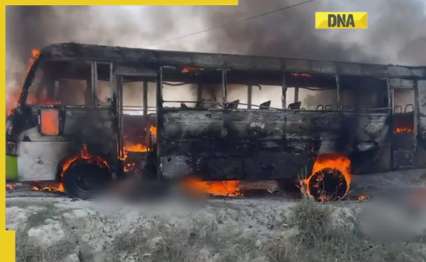
The accident took place when members of a marriage party from Mau were on its way to Mahahar temple in the Mardah police station area, SHO Dharmendra Kumar Pandey stated.
PM Modi to address nation soon, to make important announcement

PM Modi to address nation soon, to make an important announcement