

China-linked US pot farms spark raids, calls for stronger crackdowns

Law enforcement agencies from Maine to California say wealthy Chinese investors – and, many suspect, Communist party officials – are teaming up with Asian criminal organizations to take over the illicit marijuana trade in the U.S., generating enormous profits. Some of the money is traced back to China, but it is also plowed back into U.S. real estate, generating cash flow for years to come. Case in point: Friday in Los Angeles, where the LA County Sheriff’s Department raided three marijuana grow warehouses they identified as Chinese-operated-and-controlled. “We’ve seen quite an influence or increase in the amount of Chinese, Asian-owned, Asian-operated marijuana cultivation sites in L.A. County since about 2021,” said an undercover narcotics detective leading Friday’s operation. “Several million dollars in profits of what’s here today and the criminal penalties are very minor.” 4 CHINESE CITIZENS, 1 IN US ILLEGALLY, ALLEGEDLY FOUND WITH $22.5M WORTH OF MARIJUANA PLANTS IN GEORGIA Reinforced steel doors protecting each warehouse required massive rotary cutting saws to breach the buildings. Inside the first location, the entry team found some 4,000 marijuana plants growing under bright lights. Plants in each room varied by age and height, allowing for multiple harvests year-round. The THC content measured 27%, making it a highly potent brand of cannabis that would command a premium on the street – especially in large cities on the East Coast. “We’ve tracked millions of dollars a month coming out of some of these small shops going to overseas,” said the detective, referring to the grow house operating behind a pottery outlet on a busy street in the LA suburb of El Monte. “This site had a little over 4,000 marijuana plants. At today’s yield, that’s somewhere around $2 million to $3 million at wholesale value.” Officials at the state Bureau of Cannabis Control said large Chinese grow operations have been dominating California – from suburban Riverside and San Bernardino Counties to homes in the Bay Area, up to the so-called Emerald Triangle near the Oregon border, the hub of state cannabis production. “We’ve seen just tremendous explosion of Chinese folks coming in and buying land and then growing illegal marijuana,” Siskiyou County Sheriff Jeremiah LaRue told Fox News. “This scale that we’re talking, I mean, we’re talking thousands of different illegal grows within our community, and it’s just perpetuated a lot of violence.” Arial images showed how marijuana cultivation in Siskiyou County has exploded since 2017, with as many as 8,000 grow houses now dotting the rural landscape. Each grow has averaged around a dozen acres with four to five plastic-covered “hoop houses” on site, each containing several hundred marijuana plants inside. “Because it’s so profitable and there’s really hardly any consequences, the growth just continues,” LaRue said. “In some instances, the money is going directly back to China. As for the workers, essentially, they’re trafficking in labor, to do the cultivation. Seventy-five percent or more are undocumented individuals that we’re running into, and in the last few years, those numbers have increased dramatically.” CHINESE NATIONAL ACCUSED OF MURDERING 4 AT ILLEGAL OKLAHOMA MEDICAL MARIJUANA FARM SENTENCED TO LIFE IN PRISON A federal official who asked not to be named said the Chinese operations have been “highly sophisticted, multi-layer operations and very hard to crack. Most of the labor is trafficked and they won’t give us any meaningful information. The person on the deed is a nobody and the cases have very little prosecutorial appeal. Growing marijuana without a license is a misdemeanor and [subject to a] $500 fine. The owners flip the house and move on.” Officials say the Chinese are active not just in California. In Oklahoma, the state Bureau of Narcotics has estimated 2,000 marijuana farms with a Chinese connection. Last Thursday, the bureau shut down a massive grow, seizing 82,979 plants and 1,955 pounds of processed marijuana, putting the street value at $300 million. Agents detained several Asian warehouse workers and arrested a 36-year-old Chinese woman for her alleged involvement in the operation. The Department of Homeland Security also identified 270 grow operations in Maine connected to the Chinese. The agency last year began a “national intelligence-gathering initiative” to assess Chinese involvement, asking local law enforcement to alert the department if they’ve encountered Asian and Chinese trans-national criminal organizations in their investigations. EX-COP TURNED LEGAL POT FARMER CLAIMS HE’S BIGGER DEALER THAN ‘ANYONE SITTING IN PRISON’ Last week, 50 members of Congress asked the Justice Department for a briefing on illegal marijuana farms linked to Chinese nationals, citing the DHS effort. “There is substantial evidence implicating the [Chinese Communist Party] in directly supporting illicit marijuana grow operations across the United States,” the lawmakers wrote. “Further, the same DHS document indicated 270 suspected illicit marijuana operations in rural Maine generated an estimated $4.37 billion in revenue, far outpacing the $158 million from the state’s legal marijuana market last year… This issue is not limited to the illegal cultivation and distribution of marijuana. Allowing illicit marijuana farms tied to the CCP is a continued threat to national security, public safety, and human rights.” “We know that this money is being funneled back to China,” Rep. Jay Obernolte, R-Calif., one of the lawkmakers who signed the letter, told Fox News, “so the Chinese are using this as a moneymaking operation and also as an operation to destabilize life in the United States. The wide-open southern border is catalyzing this problem because the cartels are trafficking people across the border, and they’re establishing these camps and they lock them in. It’s a human catastrophe for everybody. “Recently we’ve become concerned about some findings that the Chinese Communist Party is behind this newest wave of illegal grows. That’s certainly happened. In my district, we’ve had some identified activity that’s tied to the CCP, and so, that’s why we are asking the DOJ to share with us the information that it’s gathered, and to give us a briefing on what it is doing and what can be done to try and rectify this problem.”
Appeals court to allow Texas immigration law that criminalizes illegal migrant crossings

An appeals court on Saturday reversed a lower court’s decision to block Texas from enforcing a new state law that would make illegal immigration a state crime. The 5th Circuit Court of Appeals went against U.S. District Judge David A. Ezra’s order to block Texas’ Senate Bill 4 but also put its own ruling on hold for seven days should the Biden administration want to appeal to the Supreme Court. The new law allows state authorities to arrest and jail illegal immigrants and would give state judges the power to order deportations. The law was initially set to go into effect on March 5 but will now be put on hold until March 9 unless the Supreme Court intervenes. MIGRANT ENCOUNTERS AT SOUTHERN BORDER SURPASS 21,000 IN 72 HOURS, CBP SOURCES SAY Ezra, who presides in the Western District of Texas, ruled last week that states “may not exercise immigration enforcement power except as authorized by the federal government.” Texas Gov. Greg Abbott, however, maintained that the state “has the right to defend itself” from the invasion at our southern border.” TEXAS HAS SPENT NEARLY $150M BUSSING MIGRANTS TO ‘SANCTUARY’ CITIES: REPORT “Texas will immediately appeal this decision, and we will not back down in our fight to protect our state – and our nation – from President Biden’s border crisis,” Abbott said in a statement at the time. The law was one of several moves by Texas to curb the flow of migrants into the state. Abbott has repeatedly accused the Biden administration of failing to enforce immigration laws amid record numbers of migrant entries and encounters at the southern border. Fox News’ Louis Casiano contributed to this report.
Kentucky House passes school bus behavior bill after student misconduct prompts bus driver sickout

The Kentucky House passed a bill Friday aimed at curbing unruliness on school buses by requiring student and parental buy-in to transportation policies and setting clear consequences for misbehavior. The measure sailed through the House on a 93-1 vote to advance to the Senate. Supporters said the goal is to offer relief to beleaguered bus drivers by setting expectations for students and parents. Misbehavior on school buses was termed a statewide issue, but the House discussion focused on Kentucky’s largest school system, in Louisville. In November, the district was forced to cancel nearly 100 routes after bus drivers organized a sickout and 143 called off work, with student behavior cited as among their biggest concerns, the Courier Journal of Louisville reported. UPDATED KENTUCKY BUDGET WITH INCREASED SCHOOL BUS FUNDING ADVANCES TO HOUSE Setting accountability is crucial to getting the problem under control, Republican Rep. Kevin Bratcher said. “Accountability — what happens when you get so far out of line that you’re stopping a school bus from operating,” he said. “You’re causing the school bus driver to quit their job.” The bill would require local school boards statewide to adopt a policy outlining what’s expected of students riding school buses and the consequences for failing to meet those standards. “Drivers have a huge responsibility, and we should respect and address concerns thoroughly,” said Republican Rep. Emily Callaway, the bill’s lead sponsor. In setting guidelines, boards would work off a model policy developed by the state education department. Students and parents would have to sign a document acknowledging the policy each school year, and failure to do so could be grounds for revoking bus-riding privileges. Each district’s policy would also establish procedures for investigating complaints and protecting those who bring them from retaliation. Severe or repeated misconduct could also lead to a loss of bus-riding privileges. “We must be sure that if a student puts him or herself, other riders or the driver in danger, the driver can act appropriately, swiftly and effectively,” Callaway said. “This policy allows for that discretion.” District policies would provide for expeditious reviews of driver complaints about student misbehavior, and drivers would be allowed to be heard during disciplinary procedures. They must also be notified of the outcome of disciplinary actions. If a driver continues to feel unsafe transporting a student, the driver would be allowed to opt out of transporting that student.
Medvedev says ‘Ukraine is definitely Russia’, rules out peace talks

The former Russian president says parts of Ukraine should ‘return home’ as he rules out peace talks with Zelenskyy. Dmitry Medvedev, deputy chairman of Russia’s Security Council, says Ukraine is part of Russia as he rules out peace talks with the current Ukrainian leadership. In a bellicose speech on Monday at a youth festival in the southern city of Sochi, Medvedev said Russia would prosecute what it calls its “special military operation” until the other side capitulated. The former president and prime minister said what he called historical parts of Russia should “return home”. Medvedev spoke in front of a map of Ukraine, which showed the country as a much smaller landlocked slice of territory squeezed up against Poland with Russia in complete control of its east, south and Black Sea coast. “One of Ukraine’s former leaders said at some point that Ukraine is not Russia,” Medvedev said. “That concept needs to disappear forever. Ukraine is definitely Russia,” he said to applause from the audience. Medvedev said peace talks would not be possible with the current Ukrainian leadership, led by President Volodymyr Zelenskyy. He said any future Ukrainian government that wants talks would need to recognise what he called the new reality on the ground. Commenting on East-West relations, Medvedev, who accused US special forces and military advisers of waging war against Russia, said ties between Moscow and Washington were worse than during the 1962 Cuban missile crisis. Alexander Graf Lambsdorff, Germany’s ambassador to Russia, leaves the Russian Ministry of Foreign Affairs in Moscow on March 4, 2024 [Maxim Shemetov/Reuters] Accusations against Germany On Sunday, Medvedev joined a chorus of Kremlin voices accusing Western countries of participating in the war in Ukraine after a wiretap recording of German military officials was published on Russian social media. The discussion revolved around the potential impact of Ukraine’s use of German-made Taurus missiles. The conversation included remarks about aiming the missiles at targets such as the Kerch Bridge, which links the Russian mainland to occupied Crimea, which was annexed by Russia in 2014. German Chancellor Olaf Scholz has so far refused to send the missiles to Ukraine, fearing it would escalate the conflict. In a Telegram post on Sunday, Medvedev criticised the German military and claimed the country was preparing to attack Russia. Adblock test (Why?)
What lies behind the Biden administration’s changing ‘ceasefire’ language

A week ago, US President Joe Biden claimed that a “ceasefire” deal in Gaza was imminent and could take effect as soon as March 4. “My national security adviser tells me we are close,” he told reporters while eating ice cream in New York City. But ice cream or not, Biden’s actual position was not nearly that sweet. A subsequent statement by a senior Biden administration official claimed Israel had “basically accepted” a proposal for a temporary pause in fighting. But as of March 4, Israeli Prime Minister Benjamin Netanyahu and his Mossad director were still refusing to send a delegation to Cairo, where talks with Hamas were under way. The Biden administration’s eagerness to claim victory in its search for some kind of temporary truce indicates how much it is feeling the heat of the rising global and domestic pressure demanding an immediate ceasefire, an end to the Israeli genocide, an end to the threat of a new escalation against refugee-packed Rafah, and an end to the siege of Gaza and immediate unhindered provision of massive levels of humanitarian aid. Despite Washington’s vain hopes for March 4 and the unofficial goal of a ceasefire by the beginning of the Muslim holy month of Ramadan on March 10, the deal remains elusive. Media reports indicate Biden is telling the Qatari and Egyptian leaders that he is putting pressure on Israel to agree to a truce and a captives swap. But his claim of pressuring Israel is undermined by the continuing US vetoes of ceasefire resolutions at the United Nations Security Council, most recently on February 20, as well as the continuing flow of United States weapons and money to Israel to enable its assault. The vetoed resolution, introduced by Algeria on behalf of the Arab Group, demanded an immediate humanitarian ceasefire and deplored all attacks against civilians. It specifically rejected the “forced displacement of the Palestinian civilian population, including women and children” and called unconditionally for unhindered humanitarian access to Gaza and the “urgent, continuous and sufficient provision of humanitarian assistance at scale”. Significantly, the text referenced the January order of the International Court of Justice (ICJ) that found Israel to be plausibly committing or preparing to commit genocide in Gaza, and imposed a set of provisional measures requiring Israel to stop its practices. Linda Thomas-Greenfield, Biden’s ambassador to the UN, cast the sole veto against the Algerian resolution, and instead put forward an alternative US text, claiming it also supported a ceasefire. But the proposed US language does not call for an immediate or permanent ceasefire or an end to Israeli genocide; it does not prevent an attack on Rafah or end the Israeli siege. The proposed US resolution is not designed to end the murderous Israeli war against Gaza – nor is the deal that is currently being negotiated in Cairo. To the contrary, the provisions of the US draft resolution reflect the true intentions of the Biden administration vis-a-vis its continuing support of Israel, and reveal the limitations of the truce it is trying to orchestrate. While the US draft resolution does use the dreaded word “ceasefire” – which had been prohibited in the White House for months – it does not call for an immediate halt in the bombing, only “as soon as practicable”, with no indication of when that might be. It does not call for a permanent ceasefire either, leaving Israel free to resume its genocidal bombing – presumably with continuing US support. Virtually everything the US draft calls for is undercut by what is left out. The demand for “lifting all barriers to the provision of humanitarian assistance at scale” in Gaza certainly sounds appropriately robust. But that’s only until you realise that the text’s failure to challenge or even name the principal barrier to aid getting in – Israel’s bombardment – means that this is not a serious plan to end Israel’s deadly siege. It should not surprise anyone that “the Biden administration is not planning to punish Israel if it launches a military campaign in Rafah without ensuring civilian safety” – as Politico reported – despite claiming it wants a credible plan to ensure Palestinian safety. No one in the Biden administration has even hinted at imposing consequences for Israel’s constant rejection of the insipid appeals for restraint – such as conditioning aid on human rights standards (as required by US law) or cutting US military aid altogether. That’s what real pressure would look like. A more accurate picture of Washington’s approach to Israel’s war against Gaza is the continuing US pipeline of weapons to make Israel’s murderous assault on Gaza more effective, more efficient, and more deadly. According to the Wall Street Journal, the “Biden administration is preparing to send bombs and other weapons to Israel that would add to its military arsenal even as the US pushes for a ceasefire in Gaza.” The arms the US intends to hand over to the Israeli army include MK-82 bombs, KMU-572 Joint Direct Attack Munitions and FMU-139 bomb fuses, worth tens of millions of dollars. It is more than likely that the administration will do another end run around US Congress to send the weapons without relying on congressional approval, as it did on at least two occasions last December. Whatever the language of Washington’s proposed UN Security Council resolution and likely the possible temporary truce deal as well, the words of National Security Council spokesperson John Kirby continue to resonate as a better reflection of the Biden administration’s policy: “We’re going to continue to support Israel… and we’re going to continue to make sure they have the tools and the capabilities to do that.” The views expressed in this article are the author’s own and do not necessarily reflect Al Jazeera’s editorial stance. Adblock test (Why?)
In Texas’s Super Tuesday races, a litmus test for Trump’s Republican Party
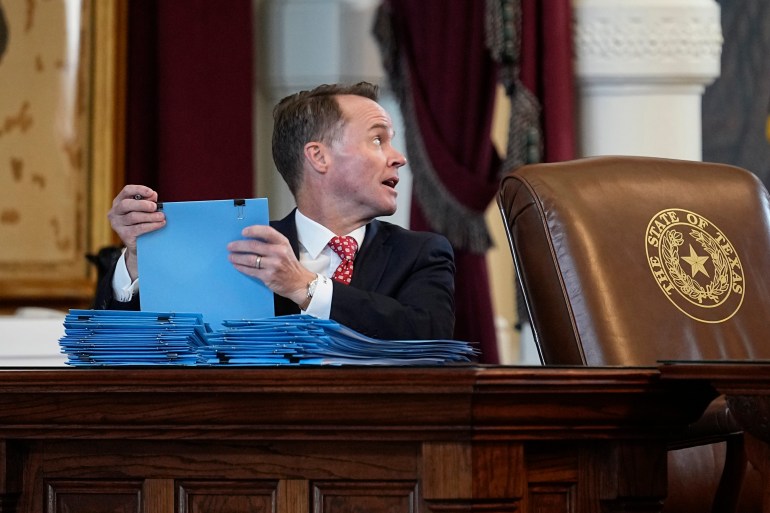
Everything’s bigger in Texas — and that includes this year’s political primary races. The second largest state in the United States — both in terms of population and land mass — Texas is set to hold votes this week for Super Tuesday, a pivotal juncture on the electoral calendar. Fifteen states and one territory take to the polls on that day, which can be a make-or-break moment for presidential candidates. But Texas looms particularly large as a window into the key issues facing candidates. Situated on the southern border, Texas has, in recent years, made headlines for grappling with immigration, gun violence and abortion access. Both Democratic incumbent Joe Biden and Republican frontrunner Donald Trump will be on the ballot for Texas’s presidential primaries. But with their party nominations all but assured, experts are pointing to the down-ballot races as the most interesting of all. Politicians will be vying for seats on the state’s Board of Education and in its legislature. Party nods for high-profile federal positions will be up for grabs, too. And in each case, the victors are expected to serve as weathervanes for the general elections. With a strong tradition of Republican leadership, Texas is also set to be a litmus test for how loudly Trump’s influence over the party resonates. “It’s important to always keep in mind that among the most influential and important red states is Texas,” said Mark Jones, a political science fellow at the Baker Institute for Public Policy in Houston. “No one else really comes close in terms of the number of the Republican House members provided, in terms of electors in the Electoral College, and in terms of leading the opposition to the Biden administration.” ‘Principal official opposition’ With just under 30 million residents, Texas is seen as where the American South meets the West. Spread across 695,660 square kilometres (268,597 square miles), the state stretches from the humid coast of the Gulf of Mexico to the arid grasslands of its panhandle. Its formidable economy is buoyed by fossil fuels, agriculture and aerospace: The state advertises itself as the eighth largest economy in the world. And it has also come to be known as a Republican stronghold. Since the late 1970s, Republicans have dominated the governor’s mansion, only losing twice to single-term Democrats. No Democrat has represented the state in the US Senate since 1993, and the last Democratic presidential candidate to win the state was Jimmy Carter in 1976. Needless to say, Republicans have a tight grip on Texas power. And whenever a Democrat is in the White House, Texas “essentially assumes the role of principal official opposition”, Jones explained. Governor Greg Abbott, for example, has long criticised Biden for his lack of action on immigration. Texas’s Attorney General Ken Paxton has sued the Biden administration for everything from its federal spending package to its policy of removing razor wire at the border. The state, along with Republican-led Florida, has also set the pace in the so-called “culture wars”, with right-wing policies aimed at constricting certain types of education programmes and gender expression. Over the last two years, for example, the Texas legislature has prohibited higher education from establishing diversity, equity and inclusion (DEI) offices; sought to restrict drag performances; and banned puberty blockers and hormone therapy for transgender children. Texas state Speaker of the House Dade Phelan is among the elected officials whose positions are up for grabs this Super Tuesday [Eric Gay/AP Photo] Could Texas turn ‘purple’? But just how far to the right Texas lands has long been a subject of debate. For years, Democrats have eyed Texas’s shifting demographics as evidence that the state could tilt left. In 2022, Texas officially became a minority-majority state, with Hispanic residents surpassing whites. They account for more than 40 percent of the state’s population. Still, Democrats have struggled to land victories in major statewide contests. In 2020’s presidential race, for instance, Biden lost Texas to Trump by five percentage points, in part because Hispanic residents near the border leaned towards the Republican candidate. J Matthew Wilson, a political science professor at Southern Methodist University, said the belief that Texas could imminently become not red or blue but rather a purple swing state has dominated recent political discourse but has yet to fully materialise. “Democrats have been talking about this for over a decade — this ‘purple Texas’ idea,” Wilson said. “And every election cycle, once again, Lucy yanks the football away from Charlie Brown.” That reality, along with a history of drawing electoral maps to separate voters by political predilection, means the primary on Super Tuesday will hold disproportionate sway, according to Jones at the Baker Institute. “Power and politics in Texas are decided in the primary,” Jones said, “especially the Republican primary.” Democrats are eyeing the seat of Republican Senator Ted Cruz as a possible point of weakness in November [Mark Schiefelbein/AP Photo] Choosing a Senate contender Still, Democrats have largely zeroed in on one statewide election they consider vulnerable: the race for the US Senate seat. This year, Senator Ted Cruz is up for re-election, and the Super Tuesday ballot will decide who he faces as his Democratic rival. Cruz, a polarising Republican with a national profile, nearly lost his last re-election bid in 2018 to dark-horse Democrat Beto O’Rourke. A January poll from Emerson College and Nexstar Media put him in a statistical tie with either of this year’s Democratic contenders: Colin Allred and Roland Gutierrez. The Super Tuesday primary will decide whether Allred or Gutierrez advances to the final match-up. Allred, a US representative from north Texas, represents a more centrist strain of Democrat. He has criticised Biden as being too soft on the border and staunchly supports Israel in its war in Gaza. Gutierrez, meanwhile, has hewed progressive. A state senator, he has foregrounded gun control and humane border policies in his campaign. He also supports a ceasefire in Gaza. Whichever candidate emerges as the champion in Super Tuesday’s primary will indicate the
Trump speaks after Supreme Court ruling, tells Biden to ‘fight your fight yourself’
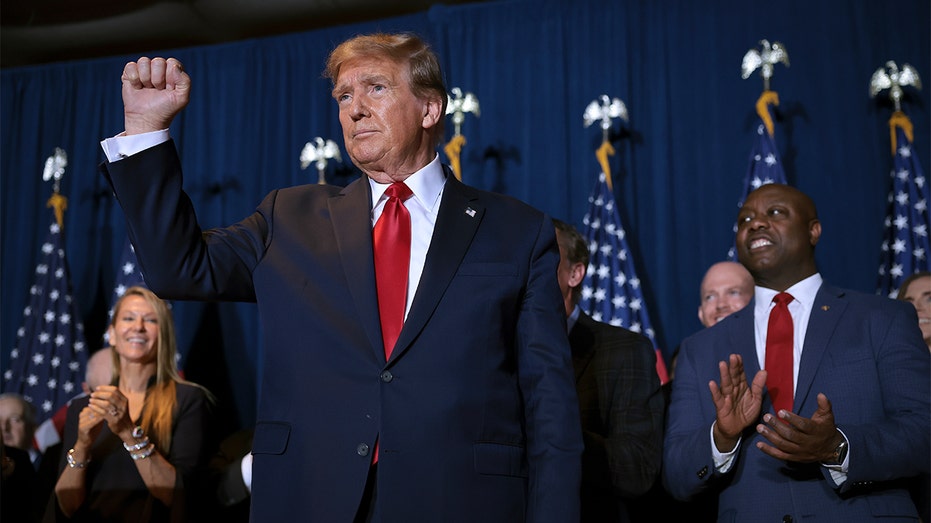
Former President Trump spoke from Mar-a-Lago just hours after the Supreme Court unanimously ruled in his favor, keeping him on the 2024 primary ballot in Colorado, thanking the high court for its unifying decision and looking ahead to its pending ruling on his presidential immunity appeal. The 2024 GOP frontrunner also blamed President Biden for his legal challenges, and claimed he is using judges and prosecutors to influence the election. The Supreme Court sided unanimously with the 2024 GOP frontrunner in his challenge to Colorado’s attempt to kick him off the 2024 primary ballot. The high court ruled in favor of Trump’s arguments in the case, which will impact the status of efforts in several other states to remove the likely GOP nominee from their respective ballots. “I want to start by thanking the Supreme Court for its unanimous decision today. It was a very important decision, were very well crafted, and I think it will go a long way toward bringing our country together, which our country needs,” Trump said from Mar-a-Lago. “And they worked long, they worked hard, and frankly, they worked very quickly on something that will be spoken about 100 years from now and 200 years from now. Extremely important.” Trump said, “essentially, you cannot take somebody out of a race because an opponent would like to have it that way. And it has nothing to do with the fact that it’s the leading candidate, whether it was the leading candidate or a candidate that was well down on the totem pole. You cannot take somebody out of a race.” “The voters can take the person out of the race very quickly. But a court shouldn’t be doing that. And the Supreme Court saw that very well,” Trump said. “And I really do believe that will be a unifying factor because while most states were thrilled to have me know, there were some that didn’t and they didn’t want that for political reasons.” Trump touted his poll numbers, saying he is “beating President Biden in almost every poll.” Meanwhile, the Supreme Court last week agreed to hear arguments on presidential immunity, after Trump and his legal team brought the appeal to the high court. Those arguments will be heard beginning on April 22. A Supreme Court decision is expected in mid-to-late June. Special Counsel Jack Smith’s election interference case is on hold pending that ruling. “If a president doesn’t have full immunity, you really don’t have a president because nobody that is serving in that office will have the courage to make, in many cases what would be the right decision, or it could be the wrong decision,” Trump said, adding that a president should not be prosecuted for doing something that is “for the good of the country and actually for the good of the world.” “A president shouldn’t have that on his mind, and he has to have a free and clear mind when he makes very big decisions or it’s going to be nothing more than a ceremonial post,” he explained. “You’ll be president. That’ll be a wonderful thing. And you won’t do anything because you don’t want to be hit by your opponent or hit by somebody else because who wants to leave office and go through what I’ve gone through?” Trump went on to reflect on the legal challenges he is fighting during an election year, saying he is “being prosecuted by Biden,” saying every case is “in total coordination with the White House.” The 2024 GOP frontrunner issued a message to Biden. “I will say that President Biden, number one, stop weaponization. Fight your fight yourself. Don’t use prosecutors and judges to go after your opponent to try and damage your opponent so you can win an election,” he said. “Our country is much bigger than that.” Trump is facing a number of legal challenges in multiple jurisdictions. The former president has pleaded not guilty to all charges across all jurisdictions. Trump, on Monday, said “the whole thing is a rigged deal and the public understands it.” “I’m lucky that I’m able explain it to the public because if you weren’t able to explain it, the public wouldn’t know. They believe what they see,” Trump said. But the former president stressed: “I don’t want to win this way.” “Look, I want to win based on my policies,” he said. “We’re going to cut taxes. We’re going to get interest rates down. You’re going to be able to buy homes again. I mean, you can’t buy a home today. The interest rates are so high. I want to win those supporters.” Trump added: “I want to stop wars. I want to stop the war in Ukraine with Russia. I want to stop what’s happening in Israel would have never been attacked if I were president. Ukraine would have never, ever been attacked. If I was president, you wouldn’t have had inflation. Inflation was caused by high energy prices. I had low energy prices. I would have kept them there very easily. And it probably maybe caused the war with Ukraine because Putin became rich. All of a sudden it went up so much.” Trump said Russian President Vladimir Putin “became very rich because at $100 a barrel, he’s got so much money to fight a war at $40 a barrel.” “He doesn’t have the money to fight a war, but he wouldn’t have done it anyway because I told him not to,” Trump said. Meanwhile, Trump went on to demand that Biden “close the borders now.” “This is not sustainable for our country. It’s not sustainable for our cities. Our country is under siege,” he said. “This is a violent thing that you’ve done. And many people are dying. Many, many people are dying. They die on the trip up, they die going through the border, and they die in our country.” Trump warned about the people entering the country, saying they are entering from “some of the roughest countries in the world, in some
Appeals court reverses order blocking Texas immigration law, setting up Supreme Court showdown

If the U.S. Supreme Court doesn’t intervene in the coming days, the law making illegal entry a state crime could go into effect this weekend.
Washington lawmakers advance bill to address opioid crisis among Native tribes
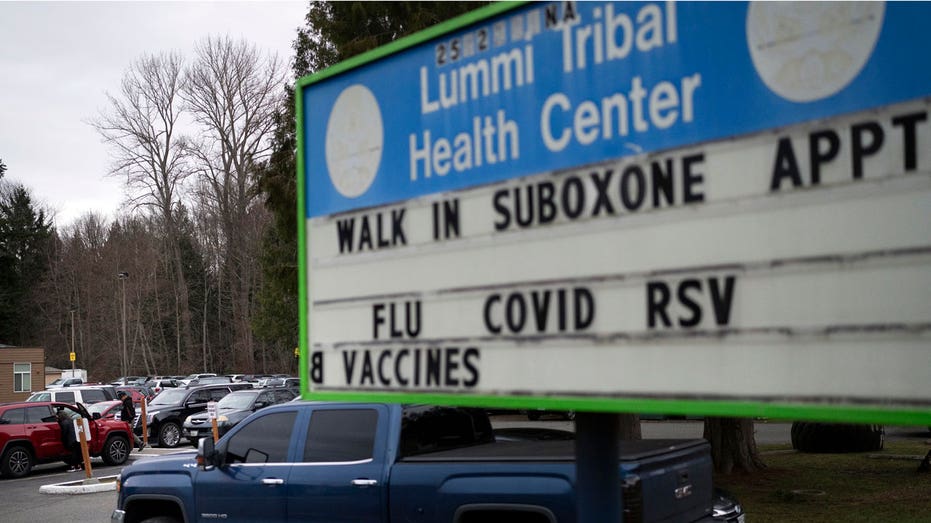
A bill that would bring millions of dollars to tribes in Washington state to address the opioid crisis received unanimous support in the House on Friday, opening the door for state funding to address a scourge that some say is claiming a generation. “This bill invests in Indian country. It invests in the Native Americans of Washington state. It invests in the preservation of generations of Native Americans whose land we stand on today,” Democratic Rep. Debra Lekanoff, who is Tlingit and Aleut, said during the vote. The proposed measure is expected to provide nearly $8 million each year for the 29 federally recognized tribes in Washington, funds drawn in part from a roughly half-billion-dollar settlement between the state and major opioid distributors. BIDEN ADMIN MARKS $366M TO BRING GREEN ENERGY TO UNDERSERVED NATIVE AMERICAN TRIBES, RURAL COMMUNITIES The approach comes as Native Americans and Alaska Natives in Washington die of opioid overdoses at five times the state average, according to 2021-2022 Centers for Disease Control and Prevention data that includes provisional numbers. The rate in Washington is one of the highest in the U.S. and more than three times the rate nationwide — but many of the Indigenous nations in the state lack the funding or medical resources to fully address it. The state Senate previously unanimously approved the bill, but it will need to go back to the body for concurrence before going on to Democratic Gov. Jay Inslee’s desk. Jaime Smith, a spokesperson for the governor’s office, said in an email that Inslee “has been very supportive of this effort and appreciates the work of legislators to bolster our state’s opioid response on multiple fronts, including support for Tribes.” But some tribes say the proposed funding, while appreciated, would barely scratch the surface in the face of such a deadly crisis. Opioid overdose deaths for Native Americans and Alaska Natives have increased dramatically during the past few years in Washington, with at least 100 in 2022 — 75 more than in 2019, according to the most recent numbers available from the Washington State Department of Health. Republican state Sen. John Braun, the bill’s prime sponsor, has said this is just a first step. “This is just going to get us started, and make sure we’re not sitting on our hands, waiting for the problem to solve itself,” he said. The bill would earmark funds deposited into an opioid settlement account, which includes money from the state’s $518 million settlement in 2022 with the nation’s three largest opioid distributors, for tribes battling addiction. Tribes are expected to receive $7.75 million or 20% of the funds deposited into the account the previous fiscal year — whichever is greater — annually. The money provided through the legislation does not come with a specific end date. But starting in 2031, there would no longer be a minimum required dollar amount, according to an amendment approved Friday. The state would provide 20% of the money deposited in an opioid settlement account during the prior fiscal year. And if the average amount deposited into that account gets too low, no funding would be required to go to the tribes.
Trump-aligned lawmakers celebrate unanimous Supreme Court ballot ruling

Former President Trump-supporting lawmakers celebrated the Supreme Court’s unanimous decision Monday to reject the state of Colorado’s attempt to keep the former president off their presidential ballot, citing the 14th Amendment. All nine justices, appointed by Democratic and Republican presidents, agreed that states lack the authority “under the Constitution to enforce Section 3 with respect to federal offices, especially the Presidency.” However, they may do so in regard to state office. “The right decision. Glad to see the Supreme Court stand up to the extreme left’s attempts to undermine our democracy,” said Sen. Steve Daines, R-Mont., in a post to X. SUPREME COURT RULES UNANIMOUSLY FOR TRUMP IN COLORADO BALLOT DISQUALIFICATION DISPUTE House Judiciary Chairman Jim Jordan, R-Ohio, called the decision a “Big win for common sense and democracy!” Sen. Marsha Blackburn, R-Tenn., also cheered the decision, writing on X, “Grateful that SCOTUS blocked Democrats from unconstitutionally attempting to remove @realDonaldTrump from the ballot. President Trump is the choice of the American people!” “9-0. The commies will have to find other ways to “defend democracy”. #MAGA,” Sen. Tommy Tuberville, R-Ala., added, noting the decision’s unanimity. Rep. Byron Donalds, R-Fla., said he was “glad” to see the court choose “the side of freedom.” BIDEN PREDICTS 2024 WIN IN RARE INTERVIEW, TAUNTS MEDIA, CALLS TRUMP ‘LOSER’ “BREAKING: The Supreme Court defends democracy against radical leftist low-tier judges. Despite the Far Left’s never-ending political witch-hunt against Donald Trump, the Constitution and our democracy prevailed,” wrote Sen. Roger Marshall, R-Kan., on X. Democrats had largely been quiet on the Supreme Court’s ruling. Calls placed seeking comment from President Biden, Senate Majority Leader Chuck Schumer and House Minority Leader Hakeem Jeffries were not immediately returned. Get the latest updates from the 2024 campaign trail, exclusive interviews and more at our Fox News Digital election hub.