

Last minute Kentucky bill would add exceptions to state abortion ban

Legislation aimed at easing Kentucky’s near-total abortion ban by creating limited exceptions for pregnancies caused by rape or incest was introduced Monday in the GOP-dominated House, as lawmakers wrangle with an issue at the forefront of last year’s campaign for governor. Republican state Rep. Ken Fleming filed the measure on the last day that new House bills could be introduced in this year’s 60-day session. The bill’s prospects are uncertain, with House Speaker David Osborne saying the chamber’s GOP supermajority has not discussed any particular abortion bill. Kentucky’s near-total abortion ban has been in place since the U.S. Supreme Court overturned Roe v. Wade in 2022. The state’s so-called trigger law took effect, banning abortions except when carried out to save the mother’s life or to prevent a disabling injury. It does not include exceptions for cases of rape or incest. KENTUCKY HOUSE VOTES TO CHANGE CHILD LABOR LAWS, FOOD STAMP RECIPIENT REQUIREMENTS Fleming’s proposal would change that by making abortions legal in cases of rape and incest if done no later than six weeks after the first day of the woman’s last menstrual period, according to a statement describing the bill. The measure also would allow an abortion to remove a dead fetus and in cases of a lethal fetal anomaly, meaning the fetus wouldn’t survive after birth. “We all encounter difficult heart-wrenching decisions in life,” Fleming said in the statement. “As a father of two daughters, I have always supported them financially, emotionally, and especially spiritually. With them on my mind and in my heart, exceptions for life-saving measures for the mother and in cases involving rape or incest should be included in our state’s abortion law.” Current exceptions to save the mother’s life or prevent disabling injuries would remain under his bill. The measure also includes a provision creating a process for physicians to document the circumstances surrounding an abortion performed under state law. The last-minute bill filing mirrors another GOP lawmaker’s attempt last year to relax the state’s abortion ban. That measure, also filed on the last day for bill introductions in the House, made no headway as the abortion issue was skipped over in 2023 by the legislature’s Republican supermajorities. The issue rose to the forefront of Kentucky’s hotly contested governor’s race last year. Democratic Gov. Andy Beshear, an abortion-rights supporter who won reelection to a second term, hammered away at his Republican challenger’s support of the state’s sweeping abortion ban. Kentucky’s Supreme Court refused to strike down the ban last year. The justices, however, ruled on narrow legal issues but left unanswered the larger constitutional questions about whether access to abortion should be legal in the Bluegrass State. In late 2023, a Kentucky woman sued to demand the right to an abortion, but her attorneys later withdrew the lawsuit after she learned her embryo no longer had cardiac activity. In 2022, Kentucky voters rejected a ballot measure aimed at denying any constitutional protections for abortion. Kentucky is one of 14 states with a ban on abortions at all stages of pregnancy currently in effect. Since the U.S. Supreme Court overturned Roe v. Wade and the nationwide right to abortion, bans of some kind have kicked in in most Republican-controlled states. Two — Georgia and South Carolina — ban abortion once cardiac activity can be detected, around six weeks into pregnancy and before women often realize they’re pregnant. Utah and Wyoming have bans on abortion throughout pregnancy, but enforcement has been paused by courts while they weigh whether the laws comply with the state constitutions.
NY Democrats reject bipartisan congressional map, prompting legislative redrawing

Democrats in the New York Legislature on Monday rejected a congressional map drawn by the state’s bipartisan redistricting commission, setting the stage for the party to craft lines that help Democrats in battleground House races that could determine control of Congress. The Democrat-dominated state Legislature will now have to submit and approve a new set of congressional lines, which is expected in the coming days. Republicans are already threatening a legal challenge. Congressional races in New York, particularly suburban contests, are expected determine which party controls the House after the November elections, adding major significance to even the slightest tweaks in how districts are drawn. NEW YORK REDISTRICTING COMMISSION APPROVES NEW CONGRESSIONAL MAP The move came about two weeks after the state’s Independent Redistricting Commission approved a map that would have helped Democrats in two districts and a Republican in one, but left most of the current lines in place. Democrats had panned the commission’s map, arguing it split up so-called communities of interest, among other issues. Many expected Democrats to kill the proposal so they could draft maps that were more advantageous for the party’s congressional candidates. It is unclear exactly how Democrats will move to reshape districts, as lawmakers try to balance the national party’s ambitions to win races on Long Island and north of New York City with the state’s prohibition against partisan gerrymandering. Voters established the redistricting commission through a constitutional amendment. It was supposed to draw the state’s congressional map before the 2022 elections, but failed to reach a consensus. Democrats then stepped in and drew a map that packed Republican voters into a few super districts, weakening GOP voting power. Republicans sued to block the map, arguing it would give Democrats an unfair advantage, and the lawsuit delayed congressional primaries. The case reached the state’s highest court, which sided with Republicans and appointed an outside expert to draft a new map for 2022. Under those lines, Republicans were able to flip congressional seats in the New York City suburbs and win a narrow House majority. After the losses, Democrat sued to throw out the 2022 maps and convinced the courts to allow the redistricting commission to redraw the lines. NY ELECTION LAW THAT ‘NATIONALIZES’ LOCAL POLITICS FLIES UNDER THE RADAR DESPITE BEING ‘MONUMENTAL’: EXPERT Earlier this month, the commission compromised on a map that left most of the court’s 2022 lines in place, except for modest changes to three competitive districts. U.S. Rep. Hakeem Jeffries, who is leading Democrats’ effort to recapture House seats in New York, has criticized the commission’s proposal. Jeffries’ spokesman Andy Eichar said the commission’s map ignored concerns about dividing communities and that one change helping an incumbent Republican “would be a clear violation of the New York State Constitution.” The statement did not mention that the map would also help an incumbent Democrat. State Senate Republican Leader Rob Ortt said Democrats were “poised to create their own gerrymandered maps in another shameful power grab.” “It is once again painfully obvious that Albany Democrats don’t care about the millions of New Yorkers who demanded a fair and transparent redistricting process – they only care about their own political self-interests,” he said.
Israeli police break up ultra-Orthodox Jews’ military service protest

NewsFeed Israeli police moved in to break up a protest by ultra-Orthodox Jews who want their exemption from compulsory military service to be extended. Published On 27 Feb 202427 Feb 2024 Adblock test (Why?)
Biden says Israel-Hamas ‘ceasefire’ imminent: What could a deal look like?

On Monday, US President Joe Biden told reporters that he hopes for a ceasefire in Israel’s war on Gaza by Monday, March 4. “My national security adviser tells me that we’re close. We’re close. We’re not done yet. My hope is by next Monday we’ll have a ceasefire,” said Biden amid talks mediated by Egypt, Qatar and the United States since January. How are the Gaza truce talks progressing? Israeli officials met mediators from Qatar, Egypt and the US in Paris on Friday. Hamas, the Palestinian armed group, was not represented in those talks. The talks resulted in a framework for a potential truce along with captive-prisoner exchanges which Israel agreed to, sources have told Al Jazeera. US national security adviser, Jake Sullivan, said Israel and the mediators “came to an understanding” on the basic terms of a deal. An Israeli military delegation is expected to fly to Qatar for more intensive talks in the coming days. Qatar has been at the forefront of mediation efforts including Israel, Hamas, and other nations — including the US — to help secure more aid for Gaza amid the war, and to bring about a ceasefire. What’s at stake? Israeli Prime Minister Benjamin Netanyahu has declared plans to launch a military assault on Rafah, the southernmost urban area of the strip, where 1.4 million Palestinians are sheltering and on the brink of famine. Most of them are internally displaced, having fled their homes to escape Israel’s bombardment and ground invasions throughout the rest of Gaza. While a ground incursion on Rafah looms, air strikes began on February 8 and have hit residential areas, killing civilians in the city that shares a border with Egypt. On February 21, al-Faruq mosque in Rafah was flattened by Israeli air strikes. Israeli attacks have killed roughly 3,523 Palestinians in Gaza in the past month, according to the Palestinian Ministry of Health. Nearly 30,000 Palestinians have been killed since the war began on October 7 last year, with thousands more buried under the rubble and presumed dead. Humanitarian agencies and Western allies of Israel are pressing Israel to hold back on a full-blown invasion of Rafah for fear of a humanitarian catastrophe. Israel is facing further pressure from two legal cases mounted at the International Court of Justice (ICJ). One of these, filed by South Africa, directly accuses Israel of committing genocide in Gaza, while the other is seeking legal clarification on the status of Israel’s occupation of the Palestinian territories. South Africa’s genocide case against Israel resulted in the ICJ issuing a set of provisional measures last month, including orders for Israel to cease all genocidal acts and to take all possible actions to ensure no genocidal acts are committed. Human Rights Watch released a statement on Monday saying Israel is not complying with the measures, however. Ramadan, the holy month during which Muslims observe fast during the day, will likely begin on March 10. Arab countries have voiced fears that a continuation of fighting during Ramadan will lead to further conflict in the region. “Ramadan’s coming up, and there’s been an agreement by the Israelis that they would not engage in activities during Ramadan as well, in order to give us time to get all the hostages out,” said Biden. What is each side demanding? Hamas wants all displaced Palestinians to be able to return to their homes across Gaza. Additionally, Hamas wants more humanitarian aid to be allowed into Gaza alongside a reconstruction plan to build or repair infrastructure destroyed or damaged by the Israeli bombardment. A source told Al Jazeera that Israel has said it will allow the gradual return of displaced people to the northern Gaza Strip, with the exception of “those of military service age”. Israel has also accepted Hamas’s request that more aid be allowed into the strip. Israel is demanding the total demilitarisation of the Gaza Strip. This means Hamas would have to disarm itself, a condition the group would be highly unlikely to accept. Would an agreement entail a full ceasefire? Israel and Hamas fundamentally disagree on the conditions required for a ceasefire. Hamas wants a permanent ceasefire under which Israel will withdraw its forces from Gaza. However, Netanyahu has stated that he does not want to end Israel’s military campaign until a “total victory” has been secured over Hamas to which an invasion of Rafah is deemed key. The Israeli prime minister is demanding that Israel maintain an open-ended control over Gaza’s security and civilian affairs after the war. He also wants to hand-pick Palestinian officials to govern the Strip. Palestinian officials have rejected Netanyahu’s post-war vision for Gaza. Unlike Hamas, which wants a permanent ceasefire, Israel is ready to accept a “temporary halt” to fighting during a captive-prisoner swap. Israeli media have quoted officials talking about a six-week truce during Ramadan. What about another captive-prisoner swap? Israel has offered to release 400 Palestinian prisoners, including a number of those with lengthy sentences, in exchange for the release of 40 Israeli captives. Hamas had initially demanded a large-scale release of Palestinian prisoners. About 130 captives, taken by Hamas on October 7 during its assault on southern Israel, remain in Gaza. What happened during the truce in November? A truce deal in November led to a weeklong pause in fighting during which Hamas released 105 captives and Israel released 240 Palestinian prisoners. While the agreement was originally for a four-day pause, it was extended twice. The UN humanitarian office, OCHA, reported that despite the pause in fighting at that time, Israeli forces shot at Palestinians in northern Gaza on November 29, killing two people. They also shelled people in Gaza City and towards the Gaza shore in the south on November 30. As soon as the truce ended on December 1, Israel resumed air strikes on Gaza and ordered the residents of Khan Younis in central Gaza to evacuate further south. Adblock test (Why?)
Gaza faces starvation as Israel continues to block aid

Two human rights groups have accused Israel of further limiting humanitarian aid to Gaza despite an order from the United Nations’ top court. Exactly one month ago, The International Court of Justice in The Hague said Israel must do everything to prevent genocidal acts in the besieged territory. Tel Aviv must also take “immediate and effective measures” for aid provision, the ICJ added. But Israeli authorities have “failed to take even the bare minimum steps to comply” with the ICJ ruling issued on January 26, Amnesty International has claimed. Both Amnesty and Human Rights Watch (HRW) said on Monday that the number of aid trucks entering Gaza had actually decreased by roughly one-third since the ruling, which came in a case brought by South Africa accusing Israel of breaching the UN Genocide Convention. “The Israeli government is starving” Gaza’s 2.4 million Palestinians, “putting them in even more peril than before the World Court’s binding order,” said Omar Shakir, HRW’s Israel and Palestine director. “The Israeli government has simply ignored the court’s ruling, and in some ways even intensified its repression, including further blocking lifesaving aid.” ICJ rulings are legally binding but the court has no enforcement mechanism. The United Nations agency for Palestinian refugees, UNRWA, said there was a “50 percent reduction” in humanitarian aid entering Gaza during February compared with January. The comments from the NGOs came as Israel prepares for a ground invasion of Rafah in southern Gaza, which UN Secretary-General Antonio Guterres said on Monday would “put the final nail in the coffin” of aid operations. The war in Gaza began after Hamas fighters staged an unprecedented attack on southern Israel on October 7. Israel’s retaliatory military offensive in Gaza has killed almost 30,000 people, most of them women and children, according to the health ministry in the Hamas-run territory. Israel dismissed the case brought by South Africa as a “grossly distorted story” and said that if any genocidal acts had been carried out, they had been executed against Israel during the October 7 Hamas attack. In a separate, non-binding, case, the UN has asked the ICJ to hand down an “advisory opinion” on the “legal consequences arising from the policies and practices of Israel in the Occupied Palestinian Territory, including East Jerusalem”. Adblock test (Why?)
Rajya Sabha polls: Karnataka BJP MLA cross-votes for Congress

The party will look into the matter and strict action will be taken against the BJP MLA, BJP Chief Whip in Karnataka Assembly said.
Lok Sabha Elections 2024: AAP announces candidates for Delhi, Haryana; check list here

AAP has joined hands with INDIA bloc ally Congress for the Lok Sabha elections 2024.
Nilesh Kulkarni’s Playbook for Enterprise Architecture Success

Nilesh Kulkarni’s strategy offers a unique approach to establishing an effective EA framework within medium to large organizations.
In leaked audio, Supreme Court Justice John Devine railed against “brainwashed” GOP colleagues
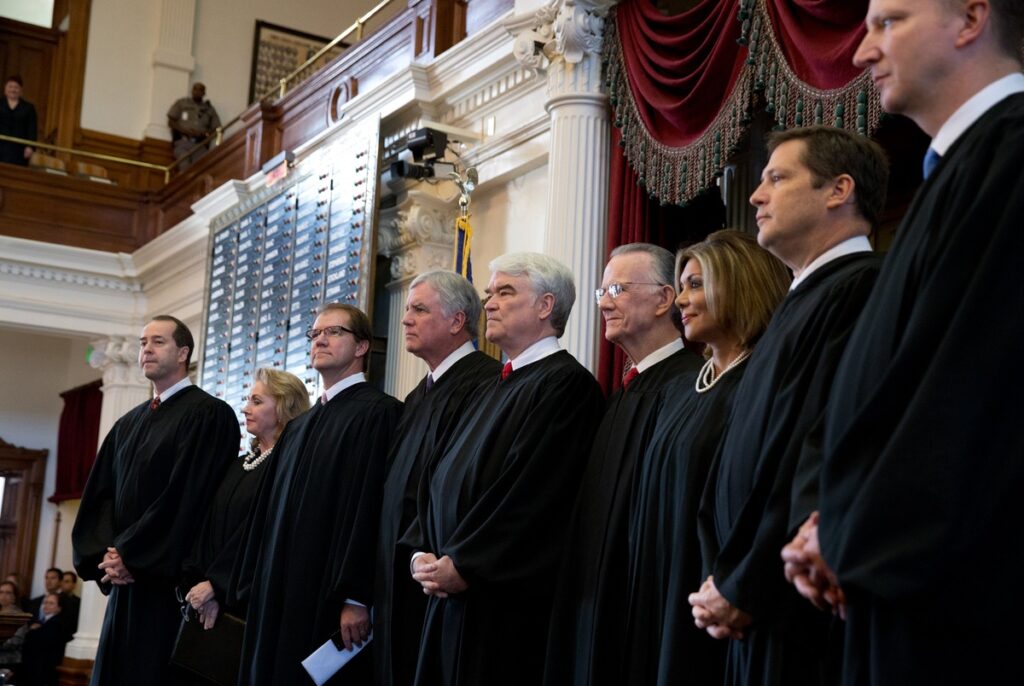
Devine, a former anti-abortion activist, faces a heated primary challenge that has focused on questions about his ethics.
Rural housing programs serve Texas’ elderly and disabled. This federal bill could make the process easier.

Texas Congresswoman Jasmine Crockett introduced House Bill 7412 to fix administrative issues that have created hurdles for some in rural communities.