

CBI summons BRS leader K Kavitha next week in Delhi excise policy case

The central agency had earlier recorded her statement in December 2022 at her residence in Hyderabad.
Texas has spent more than $148 million busing migrants to other parts of the country

Since Gov. Greg Abbott announced the program in 2022, Texas has paid to bus more than 102,000 migrants to cities around the country.
Frustration boils as Gov. Greg Abbott, AG Ken Paxton target GOP incumbents

Big spending and anger surround reelection bids for state House members like Glenn Rogers, who’s facing heat for votes on vouchers and Ken Paxton’s impeachment.
James Biden says his brother ‘has never had any involvement’ or any ‘financial interest’ in business ventures

FIRST ON FOX: James Biden testified Wednesday that his brother, President Biden, “has never had any involvement or any direct or indirect financial interest” in his business ventures, Fox News Digital has learned. The president’s brother arrived on Capitol Hill Wednesday morning for a closed-door deposition before the House Oversight and Judiciary Committees. Fox News Digital obtained the first brother’s opening statement. “I have had a 50-year career in a variety of business ventures,” James Biden said in his opening statement. “Joe Biden has never had any involvement or any direct or indirect financial interest in those activities. None.” James Biden went on to defend his brother, the president, saying that because of his “intimate knowledge of my brother’s personal integrity and character, as well as my own strong ethics, I have always kept my professional life separate from our close personal relationship.” “I never asked my brother to take any official action on behalf of me, my business associates, or anyone else,” James Biden said. “In every business venture in which I have been involved, I have relied on my own talent, judgment, skill, and personal relationships—and never my status as Joe Biden’s brother.” He added: “Those who have said or thought otherwise were either mistaken, ill informed, or flat-out lying.” James Biden stressed that Joe Biden “played no role, was not involved with, and received no benefits” from his work with Chinese energy company CEFC, or the healthcare company Americore. “With my appearance here today, the Committees will have the information to conclude that the negative and destructive assumptions about me and my relationship with my brother Joe are wrong,” James Biden said. So far in the investigation into Biden family businesses, House Oversight Committee Chairman James Comer said he has found that Biden family members, their business associates and their “related companies” received “significant payments from individuals and companies in China, Russia, Ukraine, Kazakhstan and Romania.” Comer said the committee has learned throughout its investigation that the Biden family and their business associates brought in more than $24 million between 2014 and 2019 by “selling Joe Biden as ‘the brand’ around the world.” Republicans have also focused on a “$200,000 direct payment” in the form of a “personal check” from James Biden and Sara Biden. That check was labeled “loan repayment.” “On March 1, 2018, Americore wired a $200,000 loan into James and Sara Biden’s personal bank account — not their business bank account,” Comer continued. “And then, on the very same day, James Biden wrote a $200,000 check from this same personal bank account to Joe Biden.” “Americore — a distressed company — loaned money to James Biden, who then sent it to Joe Biden,” Comer said. This is a developing story. Please check back for updates.
Georgia proposal for parental oversight of library books advances, critics cry censorship

A proposal that would require school libraries to notify parents of every book their child checks out was advanced by Georgia senators Tuesday, while a proposal to subject school librarians to criminal charges for distributing material containing obscenity waits in the wings. The measures are part of a broad and continuing push by Republicans in many states to root out what they see as inappropriate material from schools and libraries, saying books and electronic materials are corrupting children. Opponents say it’s a campaign of censorship meant to block children’s freedom to learn, while scaring teachers and librarians into silence for fear of losing their jobs or worse. CALIFORNIA TEACHER SUING NEWSOM SAYS GENDER POLICY FORCED HER TO TEACH STUDENTS TO ‘LIVE A DOUBLE LIFE’ Georgia senators are also considering bills to force all public and school libraries in the state to cut ties with the American Library Association and to restrict school libraries’ ability to hold or acquire any works that depict sexual intercourse or sexual arousal. Neither measure has advanced out of committee ahead of a deadline next week for bills to pass out of their originating chamber. The state Senate Education and Youth Committee voted 5-4 Tuesday to advance Senate Bill 365 to the full Senate for more debate. The proposal would let parents choose to receive an email any time their child obtains library material. Sen. Greg Dolezal, the Republican from Cumming sponsoring the bill, said the Forsyth County school district, which has seen years of public fighting over what books students should be able to access, is already sending the emails. Other supporters said it was important to make sure to guarantee the rights of parents to raise their children as they want. “I can’t understand the resistance of allowing parents to know what their children are seeing, doing and participating in while they’re at school, especially in a public school system,” said Senate Majority Leader Steve Gooch, a Dahlonega Republican. Opponents said it’s important for students to be able to explore their interests and that the bill could violate students’ First Amendment rights. “This is part of a larger national and Georgia trend to try to limit access,” said Nora Benavidez, a board member of the Georgia First Amendment Foundation and lawyer for Free Press, a group that seeks to democratize the media. “The logical endpoint of where this bill, as well as others, are taking us is for children to have less exposure to ideas.” The proposal to make school librarians subject to criminal penalties if they violate state obscenity laws, Senate Bill 154, is even more controversial. Current law exempts public librarians, as well as those who work for public schools, colleges and universities, from penalties for distributing material that meets Georgia’s legal definition of “harmful to minors.” Dolezal argues that school librarians should be subject to such penalties, although he offered an amendment Tuesday that makes librarians subject to penalties only if they “knowingly” give out such material. He argues that Georgia shouldn’t have a double standard where teachers can be prosecuted for obscenity while librarians down the hall cannot. He said his real aim is to drive any such material out of school libraries. “The goal of this bill is to go upstream of the procurement process and to ensure that we are not allowing things in our libraries that cause anyone to ever have to face any sort of criminal prosecution,” Dolezal said. Supporters of the bill hope to use the threat of criminal penalties to drive most sexual content out of libraries, even though much sexual content doesn’t meet Georgia’s obscenity standard. “If you are exploiting children, you should be held accountable,” said Rhonda Thomas, a conservative education activist who helped form a new group, Georgians for Responsible Libraries. “You’re going to find that our students are falling behind in reading, math, science, but they’re definitely going to know how to masturbate.” Robert “Buddy” Costley, of the Georgia Association of Educational Leaders, said the bill won’t solve the content problems that activists are agitated about. “My fear is is that if we tell parents that this is the solution — your media specialists, the people that have been working for 200 years in our country to loan books, they’re the problem — we will have people pressing charges on media specialists instead of dealing with the real problem,” Costley said.
Indiana lawmakers vote to lift nearly 40-year ban on restaurant happy hours
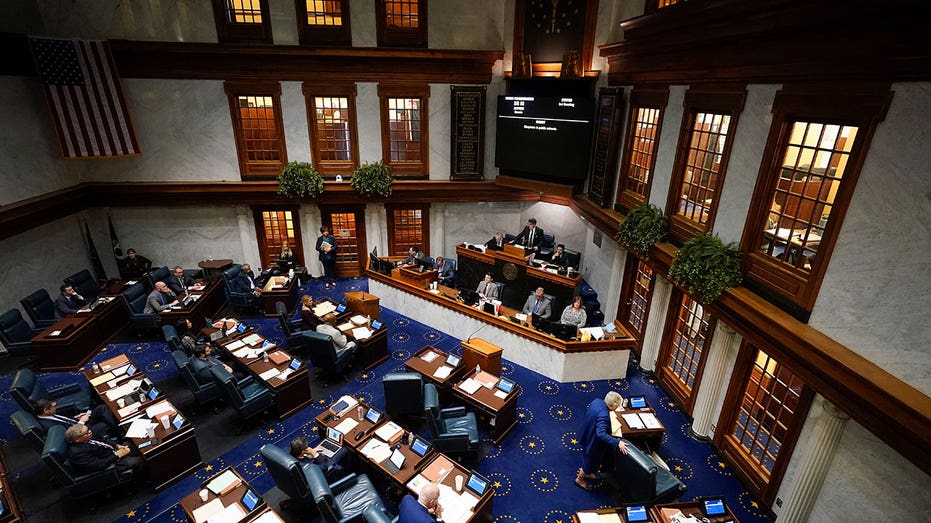
Indiana lawmakers voted to lift a nearly 40-year ban on happy hours Tuesday. State senators approved House Bill 1086 with bipartisan support in a 38-10 vote. The bill would allow restaurants to sell alcoholic beverages at a reduced price for portions of the day. State Sen. Kyle Walker, the bill’s sponsor, told lawmakers Tuesday that the tourism and restaurant industries want the legislation in order to attract more patrons and increase food sales. INDIANA COUNTY JUDGE STRIKES DOWN ‘UNCONSTITUTIONAL’ VOTING LAW IN FAVOR OF GOP SENATE HOPEFUL He said the bill would “generally assist an industry that is still fighting its way back after severe losses due to the pandemic.” Some restrictions accompany the times businesses can reduce prices, or in other words, host a happy hour. The time may not exceed four hours in one day and 15 hours in one week. The proposal also says discounts could not be offered between 9 p.m. and 3 a.m. INDIANA GOV. ERIC HOLCOMB SIGNS LAW ALLOWING WOMEN TO OBTAIN BIRTH CONTROL WITHOUT DOCTOR’S PRESCRIPTION Happy hours were banned in the state in 1985, according to IndyStar archives, aiming to reduce drunk driving. Individuals who knowingly or intentionally violate the current ban could face a Class B misdemeanor, according to state code. The proposal now goes back to the House for review. If the bill becomes law, the change would take effect July 1.
Medicaid expansion in Georgia looks unlikely this year, but advocates want lawmakers to keep trying

Georgia’s house speaker cracked open the door to Medicaid expansion in the state, but now that door appears to be closing for 2024. A bill introduced Tuesday by a top lieutenant to Republican House Speaker Jon Burns proposes to create a Comprehensive Health Care Commission that could clear the way for more health coverage in the future, but not this year. Supporters of Medicaid expansion had already concluded that the odds were growing long for 2024, with more than half the legislative session having elapsed without a proposal being introduced by Rep. Butch Parrish, the Swainsboro Republican that Burns appointed to lead the discussions. GEORGIA REPUBLICANS CONSIDERING MEDICAID EXPANSION RISK BACKLASH FROM PRIMARY VOTERS Republican Gov. Brian Kemp’s decision this month to sue the federal government to try to extend the life of his Georgia Pathways program was widely seen as a sign that he opposed an expansion of health care coverage. Georgia Pathways offers coverage to able-bodied adults earning up to the poverty line — $14,580 for an individual or $24,860 for a family of three. But people must document 80 monthly hours of work, study, rehabilitation or volunteering to be eligible. Only 2,350 people enrolled in the program from July 1 to mid-December, far fewer than the 100,000 that the Kemp administration projected the program might cover. It would expire in 2025, but Kemp sued to extend it to 2028. After North Carolina began offering Medicaid to uninsured adults on Dec. 1, there are 10 remaining states that don’t cover people with incomes up to 138% of the federal poverty line. More than 430,000 uninsured Georgia adults could gain coverage if Medicaid is broadened, health research group KFF has projected. “The governor’s getting entrenched,” said House Minority Leader James Beverly, a Macon Democrat. “In suing the federal government and in his continuing to say Pathways is the way, 500,000 Georgians are being left without health care for another year. And that’s a tragedy.” Burns, a Newington Republican, said in a statement that he continues “to be 100% supportive” of Pathways but that Georgia should explore other options in case Kemp doesn’t win his court case. Burns has voiced support for using Medicaid money to buy private coverage for residents, as Arkansas does, a route that could boost payments to hospitals, doctors and other medical providers. The speaker said that because Pathways could expire in 2025, “we also want to take the time to gather the facts, hear from policy experts and stakeholders, and craft the best policy possible to support our low-income, uninsured population across the state, which will help patients and providers alike,” Burns said. Advocates called on lawmakers to keep working on expansion this year. “There are people being diagnosed with cancer today who can’t wait for treatment,” Julie Vojtech, government relations director for the American Cancer Society Cancer Action Network, said in a statement. “It’s important we keep all options open and on the table during the 2024 legislative session.” The group brought dozens of cancer patients, survivors and their family members to the state Capitol earlier this month to rally for Medicaid expansion, called on lawmakers to keep working expansion this year. Supporters had hoped the state Senate might explore Medicaid expansion in exchange for reducing or eliminate permitting requirements for hospitals and health services. That’s been a top priority for Lt. Gov. Burt Jones, the Republican who presides over Georgia’s Senate, while the House has balked at loosening certificate of need rules. Parrish’s bill proposes an incremental loosening of certificate of need standards. Most importantly, it removes dollar caps on how much existing hospitals can spend on new or remodeled buildings or new equipment, as long as they’re not offering new services. It also loosens rules on hospitals adding new beds, and lets them relocate up to 5 miles (8 kilometers) away without a new permit, up from the current 3 miles. The bill would let new hospitals be built in counties with less than 50,000 residents, as long as they agree to provide a certain amount of charity care, join the statewide trauma system, provide “comprehensive behavioral health services” and agree to serve as teaching hospitals for medical students. A standoff between Jones and Burns last year partly revolved around a plan to build a new hospital in Butts County, where Jones lives. The existing hospital there opposes the plan. But Parrish’s measure would still require a state permit to offer new service, a safeguard many hospitals say is needed to prevent new operators from skimming off the most profitable services. Jones said in a Tuesday statement he was “glad to see the House take up this effort to increase competition in the health care marketplace and reduce costs for Georgia families.
Speaker Johnson highlights 100 stories of ‘dangers and destruction’ of ‘Biden Border Catastrophe’

FIRST ON FOX: House Speaker Mike Johnson is highlighting 100 news stories that he says show the “dangers and destruction” of the “Biden Border Catastrophe,” including crime, violence, fentanyl smuggling and national security threats, which he blames on the actions and policies of the Biden administration – as Republicans and the administration feud over who is responsible for the crisis. “The mass release of illegal immigrants into our country is wreaking havoc on families, communities, and law enforcement. These 100 stories show how the Biden administration’s open door to illegal immigration is flooding America with fentanyl, human trafficking, and increased violence, bankrupting municipalities, and killing our citizens,” Johnson said in a statement to Fox News Digital. The stories include dozens of instances of migrant-committed crime, including recent instances of Venezuelan and other migrants committing crime in New York City, where tens of thousands have traveled since being released into the U.S. CHINESE ILLEGAL IMMIGRATION ON PACE TO BREAK RECORDS AT US SOUTHERN BORDER It also highlights reports of migrants draining resources at the state and city level, including in Denver, New York City and Chicago, as well as reports of the enormous impact the crisis has had on housing, hospitals, schools and state budgets. Other stories include the impact of the fentanyl crisis, which has afflicted the U.S. for years but has surged in recent years. The illicit drug, which is primarily smuggled across the U.S. border after its production in Mexico, can be fatal in small doses. Other stories include how the border crisis has fueled smuggling across the border, making it a multibillion-dollar industry for cartels, and the impact it has had on Border Patrol agents on the frontlines. Separately, the 100 stories include national security threats and those on the terror watch list who have been encountered coming across the border. Republicans have sought to pin the blame on the crisis on the policies of the administration, including increased “catch-and-release,” reduced interior enforcement and deportations, the halting of border wall construction and the reversal of a number of Trump-era policies, including the Remain-in-Mexico policy. Last week, the House voted to impeach DHS Secretary Alejandro Mayorkas on articles accusing him of having “refused to comply with federal immigration laws” and of having violated “public trust.” The matter now goes to the Senate for a trial. “President Biden and Homeland Security Secretary Mayorkas have inflicted a colossal failure of leadership and refused to defend our homeland. They have the power to stop the catastrophe and secure the border right now, but they simply will not do so,” Johnson said in the statement to Fox News Digital. HOUSE SPEAKER SAYS SENATE BORDER BILL ‘DEAD ON ARRIVAL’ IF IT REACHES CHAMBER: ‘EVEN WORSE THAN WE EXPECTED’ The Biden administration has pushed back, arguing that it needs funding and comprehensive immigration reform from Congress and calling for the Senate and House to pass a bipartisan deal that would have provided $20 billion in funding for the border while limiting asylum as part of a broad sweep of immigration measures. The White House said that the increased staffing and other measures would help secure the border and protect against fentanyl smuggling, arguing a vote against it was a vote “for fentanyl.” Conservatives have said that it did not go far enough and would have normalized high levels of illegal immigration. They called for the House GOP’s border bill to be passed as part of a supplemental spending agreement instead. The administration has denied claims it has opened the door to illegal immigration and has pointed to statistics that show total removals and returns of illegal immigrants since May have exceeded every full fiscal year since 2015, and that DHS has seized more fentanyl and arrested more smugglers for fentanyl-related crimes than in the last five years combined. It has also said that its apprehension rate of illegal immigrants has remained broadly the same as the Trump administration’s. Biden himself took aim at Republicans for impeaching Mayorkas, which he called “baseless,” while renewing calls for them to pass the border legislation. “We will continue pursuing real solutions to the challenges Americans face, and House Republicans have to decide whether to join us to solve the problem or keep playing politics with the border,” he said in a statement last week. Fox News Digital reached out to the White House for comment.
Nikki Haley’s campaign against Trump has siphoned thousands of ‘large dollar’ donors away from Biden

Nikki Haley’s Republican presidential campaign has succeeded in siphoning thousands of donors away from President Biden. The Haley campaign’s Tuesday fundraising report, first obtained by Politico, showed that more than 5,200 donors who gave to Biden’s 2020 campaign have donated to Haley this election cycle. That number includes over 1,600 who gave more than $500,000 to Biden, the outlet reported. Haley’s report says the campaign received “large dollar” donations of $200 or more from 55,000 individuals in the month of January. Haley has also siphoned some donors away from Trump. More than 10,000 donors who previously supported Trump in 2020 have donated to her campaign this election cycle, and 3,000 in January alone, according to Politico. TRUMP HOLDS LARGE DOUBLE-DIGIT LEAD OVER HALEY AHEAD OF CRUCIAL SHOWDOWN Haley has indicated she is determined to stay in the GOP primary race as long as she can. Trump remains dominant in polling, and he is expected to secure a commanding victory over Haley in her home state of South Carolina this weekend. LAST RIVAL STANDING: HALEY FACES BIG CHALLENGE IN HER HOME STATE AGAINST TRUMP “I refuse to quit. South Carolina will vote on Saturday. But on Sunday, I’ll still be running for president. I’m not going anywhere,” Haley said during a Tuesday campaign event. “I have no fear of Trump’s retribution,” she stated. Haley seems intent on holding her ground through at least Super Tuesday on March 5, when 15 states will hold their primaries and award some 800 delegates. Meanwhile, Florida, Illinois and Ohio will hold winner-take-all primaries on March 19, likely to be major victories for Trump. HALEY SPOTLIGHTS TRUMP CHAOS’ AS JUDGE SETS FORMER PRESIDENT’S HUSH MONEY TRIAL DATE While South Carolina is home for Haley, the former president enjoys the backing of the state’s governor, nearly the entire congressional delegation, and scores of state lawmakers and local officials. Fox News’ Paul Steinhauser contributed to this report.
California lawmakers introduce reparations package with formal apology for slavery

California lawmakers introduced a reparations package to their state house on Wednesday, including 14 bills they claim will help support Black communities across the state following historical mistreatment. Members of California’s Legislative Black Caucus said the 14 reparations bills seek a formal apology for slavery and other human rights violations from the governor and legislature, and the return of property taken in race-based cases of eminent domain, among other restitution. The bills are intended to be just the first legislative actions in an effort that will likely span years. “While many only associate direct cash payments with reparations, the true meaning of the word, to repair, involves much more,” Assemblywoman Lori D. Wilson, chair of the California Legislative Black Caucus, said per Reuters. CALIFORNIA VOTERS ISSUE STRONG REBUKE TO DEM PLAN TO OFFER CASH REPARATIONS: POLL The 14 bills follow an extensive 1,100-page report written in June by the California Reparations Task Force, a group of lawmakers created by a state bill in 2020. The task force includes Wilson as chair, Assembly members Steven Bradford as vice chair, Isaac Bryan, Dr. Akilah Weber, Mia Bonta, Christopher Holden, Dr. Corey Jackson, Kevin McCarty, Tina McKinnor, Lola Smallwood-Cuevas, Mike Gipson and Reggie Byron Jones-Sawyer, Sr. Their work on the report spanned two years and they ultimately made over 100 recommendations to legislators in the state. Among the above issues, the other recommendations include compensating people and funding community-based programs to decrease violence in Black communities. CALIFORNIA REPARATIONS TASK FORCE CALLS FOR ELIMINATING CHILD SUPPORT DEBT FOR BLACK RESIDENTS Wednesday’s 14 bills — The items were initially announced in January. None of the initial 14 bills proposed on Wednesday call for cash reparations, a subject which has garnered criticism from both sides of the proverbial aisle. Assemblymember Jones-Sawyer argued the bills would address decades of laws and policies designed to ostracize Black Americans. “These atrocities are found in education, access to homeownership, and to capital for small business startups, all of which contributed to the denial of generational wealth over hundreds of years,” Jones-Sawyer said, Reuters reported. Reuters contributed to this report.