

GOP senator fumes over ‘wacko’ Democrats’ lack of ‘common sense’ on trans sports: ‘Going to get hurt’
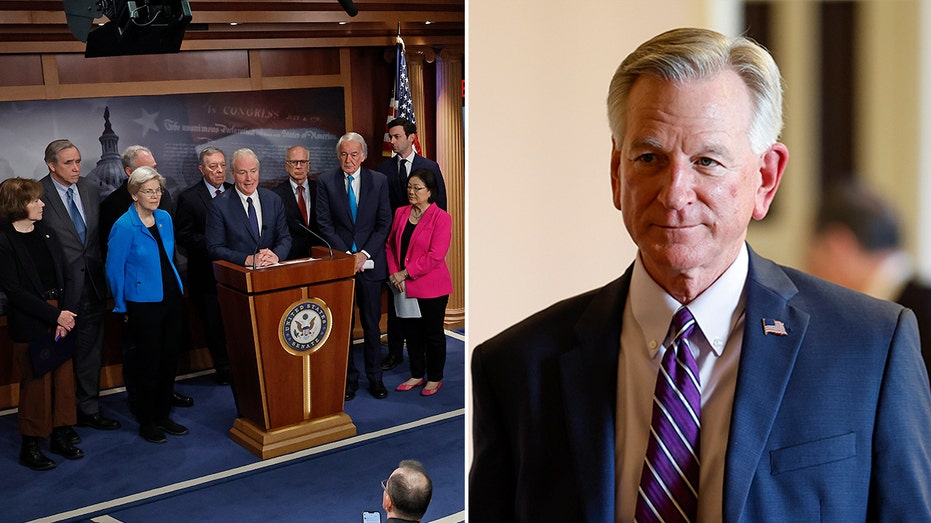
FIRST ON FOX: One Republican senator is taking aim across the aisle at “wacko” Democrats who he says lack “common sense” when it comes to the issue of biological men participating in women’s sports. In an interview with Fox News Digital, Sen. Tommy Tuberville, R-Ala., touted his and Florida Rep. Greg Steube’s recently introduced Protection of Women in Olympic and Amateur Sports Act, which would prevent men and women being forced to compete against each other, and something he lamented was even a topic of conversation. “Can you believe we’re even talking about this? I mean, the insanity of what the Democrats are pushing on the American people,” Tuberville said. “They hate gender. They hate the nuclear family. They’re trying to destroy that. They’re trying to make it very, very tough for women, and I don’t understand it.” GOP SENATOR FUMES OVER BIDEN ADMIN PROVIDING VETERAN MEDICAL RESOURCES TO ILLEGAL IMMIGRANTS As a former college football coach, Tuberville said Title IX, a federal civil rights law enacted in 1972 prohibiting sex-based discrimination, was “probably the best thing to ever come out of Washington, D.C., because of how it evened the playing field concerning sports.” However, he warned people were “going to get hurt” by mixing genders in certain sports, such as boxing, because “Democrats couldn’t care less” about protecting the opportunity for girls to safely participate. Tuberville reintroduced the Protection of Women and Girls in Sport Act, an earlier version of his legislation, last year, but it failed in the Senate after passing the House with no support from Democrats. Sen. Mazie Hirono, D-Hawaii, blocked the bill when Tuberville tried to have it passed by unanimous consent. VULNERABLE HOUSE DEM BACKPEDALS AFTER REFUSING TO CONDEMN PHRASE SEEN AS CALLING FOR ‘EXTERMINATION’ OF JEWS This time, Tuberville says the bill might still end up being more about educating people on the issue of protecting women’s sports than actually winning over any Democrats to support it. “Hey, folks, this is what’s happening. I mean, open your eyes to what these wackos are doing to our country, what they’re doing to women, what they’re doing to gender,” Tuberville said. “We’re going to lose little girls playing sports growing up.” He said that there was still going to be a push to win over some Democratic support, but that the pending departure of retiring Sen. Joe Manchin, D-W.Va., would make that job a lot harder, unless Sen. Jon Tester, D-Mont., another moderate Democrat up for re-election this year, decided to support it. WATCH: SUPER BOWL AD FEATURES MARINE DRILL INSTRUCTOR RUNNING MEMBERS OF CONGRESS THROUGH BOOT CAMP “We’re just looking for some common sense from Democrats. They fall in line like a bunch of ducks. They don’t look out for the American people. They don’t look out for their constituents. They vote as a group,” Tuberville said. “One thing about our Republican group, we’ve got people that actually use their minds and common sense to vote for their people in their state. Sometimes I don’t agree with it, but, hey, that’s what you’re supposed to do. I vote for the people of Alabama, and I’m going to stand up for them because they need a voice,” he added.
House recesses with just 2 days to solve government shutdown standoff

The House of Representatives has just two more days in session before the first of Congress’ two government shutdown deadlines, putting lawmakers on a critically short timeline to reach a bipartisan deal. House lawmakers ended their week on Thursday afternoon after leaders called off votes scheduled for Friday. Unless members have caucus or committee work to attend to, they are largely not expected back on Capitol Hill until Feb. 28 – two days before the March 1 deadline to fund some government agencies. JOHNSON CAUGHT BETWEEN WARRING HOUSE GOP FACTIONS: ‘DRIFTING TOWARD MOB RULE’ The remaining agencies must be funded by March 8. “We think we’re going to meet the deadlines,” House Speaker Mike Johnson told reporters on Wednesday when asked about the appropriations process. He previously passed two short-term extensions of the previous year’s government funding agreement, known as continuing resolutions. Congress has passed three overall to keep the government open past the original Sept. 30 fiscal year deadline. HOUSE VOTES TO AVOID GOVERNMENT SHUTDOWN AFTER SPEAKER JOHNSON BUCKS GOP REBELS However, the spending fight has been a particularly divisive battle for Johnson’s thin House GOP majority, and it likely will not get easier. Last month, he and Senate Majority Leader Chuck Schumer, D-N.Y., announced an agreement to set a discretionary spending topline of $1.59 trillion for the next fiscal year but would also honor an earlier side-deal of an added $69 billion. GOP REBELS ADMIT DEFEAT IN SHORT-TERM SPENDING FIGHT AS JOHNSON STICKS BY BIPARTISAN DEAL Johnson said he secured an extra $16 billion in cuts for this fiscal year to offset some of that. However, GOP hardliners, including those in the House Freedom Caucus, have said they will not support anything above a total topline funding amount of $1.59 trillion. They have forced House floor proceedings to a grinding halt on multiple occasions by deliberately sinking their own party’s measures in protest of the bipartisan agreement. The division, and his three-seat majority, will mean Johnson almost certainly needs to seek Democratic support in the House, even before reckoning with the liberal-held Senate. Meanwhile, President Biden blasted House members on Friday for taking a two-week recess without bringing a $95 billion national security supplemental package to assist Ukraine, Israel and the Indo-Pacific to a vote, after it recently passed in the Senate.
Last rival standing: Haley faces steep uphill climb against Trump with one week until South Carolina primary

Nikki Haley was the first of more than a dozen White House contenders to challenge former President Donald Trump for the 2024 GOP nomination. One year after she launched her campaign, the former two-term South Carolina governor who later served as U.N. ambassador in the Trump administration is the last major rival standing against the former president in the race for Republican standard-bearer. “One year ago, there were 13 fellas in the race, and we were polling at 2%. But we knew what we were fighting for: a strong and proud America. And now, one year later, we’re back in my sweet state of South Carolina and we’re ready to bring it home!,” Haley said Thursday on social media. But with one week to go until the South Carolina Republican presidential primary, Haley faces a steep uphill climb for the nomination against Trump, the frontrunner, as he makes his third straight bid for the White House. HALEY SPOTLIGHTS TRUMP CHAOS’ AS JUDGE SETS FORMER PRESIDENT’S HUSH MONEY TRIAL DATE Trump grabbed a majority of the votes last month in Iowa caucus and New Hampshire primary victories and won by a landslide a week and a half ago in the Nevada and U.S. Virgin Island caucuses. And with the Feb. 24 South Carolina primary fast approaching, the latest public opinion surveys suggest the former president holds a double-digit lead over Haley in her home state. “She’s getting clobbered,” Trump emphasized Wednesday night at a rally in North Charleston, South Carolina. “She’s finished.” Haley has been campaigning vigorously in her home state and kicked off a bus tour last weekend as early voting in the Republican primary got underway. Haley’s campaign and an aligned super PAC have also been spending millions to flood South Carolina’s airwaves with ads touting her and targeting Trump. TRUMP TO JOIN FOX NEWS’ LAURA INGRAHAM FOR SOUTH CAROLINA TOWN HALL Trump, by comparison, didn’t set foot in South Carolina for two months, until he held two rallies in the Palmetto State over the past week. The former president will return to South Carolina Tuesday for a Fox News town hall hosted by Laura Ingraham. And Trump and an aligned super PAC were dark in the state until the former president’s campaign went up this week with a low six-figure ad buy. While South Carolina is home for Haley, the former president enjoys the backing of the state’s governor, nearly the entire congressional delegation and scores of state lawmakers and local officials. Veteran South Carolina-based Republican consultant Dave Wilson pointed to Trump’s “groundswell” in the state and highlighted the former president’s “ground forces.” THE NEXT STOP IN THE HALEY-TRUMP 2024 GOP PRIMARY SHOWDOWN Wilson also noted that “Nikki Haley is reintroducing herself to South Carolina” because “almost a million people have moved into the statae since she was governor.” But pointing to her undefeated electoral record, Wilson said, “Never underestimate Nikki Haley. Never count Nikki Haley out.” Haley has repeatedly said she doesn’t need to win her home state. FIRST ON FOX: HALEY HAULS IN BIG BUCKS DURING WEST COAST SWING “Success means being competitive. Closing the gap. Making sure we can continue to go forward as we go into Super Tuesday,” Haley stressed in a Fox News Digital interview earlier this month in Columbia, South Carolina. “It’s just about keeping that momentum going. We got 20% in Iowa. We got 43% in New Hampshire. Let’s bring it a little bit closer so that we can get closer in to him [Trump] and make it more competitive going into Super Tuesday.” Haley took a short break from her South Carolina stumping to raise cash and campaign Thursday and Friday in Texas, one of the 15 states holding Republican nominating contests on Super Tuesday in early March. She hauled in over $1 million during her first day in Texas. And Haley raked in $1.7 million in fundraising, as Fox News first reported, during a two-day campaign swing a week and a half ago in California, another large Super Tuesday state. The stops in Texas and California appear in part to be a marker for Haley as she pushes back against calls by some Republicans to drop out of the race and allow Trump to focus on facing off with Biden in November. “I’m in this for the long haul,” Haley emphasized at a campaign rally last week in Los Angeles. And Haley reiterated to Fox News Digital that “our focus is on South Carolina, Michigan, Super Tuesday.” Michigan holds its primary Tuesday, Feb. 27, three days after South Carolina. Longtime Republican consultant David Carney, a veteran of numerous GOP presidential campaigns, noted that “people support Haley. No question about it. And she’ll raise money. No question about it.” But Carney, who remains neutral in the 2024 GOP nomination race, emphasized, “I don’t see any pathway” for Haley. Pointing to rules in many of the March 5 GOP contests that award the candidate who tops 50% either statewide or in congressional districts the lion’s share of delegates, Carney predicted that, for Haley, “Super Tuesday will be really painful.” Get the latest updates from the 2024 campaign trail, exclusive interviews and more at our Fox News Digital election hub.
Australian MPs vote overwhelmingly to demand US, UK free Assange; US lawyers pressure DOJ to drop charges

The Australian Parliament voted overwhelmingly to call on the U.S. and U.K. Governments to end the prosecution of Wikileaks founder Julian Assange, and a group of more than 35 U.S. lawyers wrote a letter urging the U.S. Justice Department to drop the charges against the Australian journalist. This comes ahead of a hearing about Assange’s possible final legal appeal challenging his extradition from the U.K. to the U.S. to face charges for publishing classified U.S. military documents. The hearing will be held at the High Court in London on Tuesday and Wednesday. If he is extradited to the U.S. after exhausting all his legal appeals, Assange, 52, would face trial in Alexandria, Virginia, and could be sentenced to up to 175 years in an American maximum-security prison. The motion from the Australian Parliament, which was brought by Independent member Andrew Wilkie, passed on Wednesday by a vote of 86 to 42. Prime Minister Anthony Albanese of the Labor Party voted in favor of the motion, while most members of the conservative opposition coalition opposed it. UK HIGH COURT SETS DATE FOR JULIAN ASSANGE’S FINAL APPEAL CHALLENGING US EXTRADITION The parliamentary motion emphasized “the importance of the UK and USA bringing the matter to a close so that Mr. Assange can return home to his family in Australia.” The Australian publisher is facing 17 charges for allegedly receiving, possessing and communicating classified information to the public under the Espionage Act, and one charge alleging a conspiracy to commit computer intrusion. The charges were brought by the Trump administration’s Justice Department over WikiLeaks’ 2010 publication of cables leaked by U.S. Army intelligence analyst Chelsea Manning detailing war crimes committed by the U.S. government in Iraq, Afghanistan and the Guantánamo Bay, Cuba, detention camp. The materials also exposed instances of the CIA engaging in torture and rendition. WikiLeaks’ “Collateral Murder” video showing the U.S. military gunning down civilians in Iraq, including two Reuters journalists, was also published 14 years ago. Wilkie told the Parliament ahead of the vote that the motion “will send a powerful political signal to the British government and to the U.S. government.” UN TORTURE EXPERT URGES UK TO HALT JULIAN ASSANGE’S US EXTRADITION OVER FEARS OF TORTURE, HUMAN RIGHTS ABUSES During the debate, Wilkie urged fellow members of Parliament to support the motion because it was “time for all of us to take a stand” and “We’ve just about run out of time to save Julian Assange.” Labor Party member Josh Wilson told Parliament that the same material that prompted the charges against Assange had been “published without legal consequence by media organizations in the United States.” In 2022, the editors and publishers of U.S. and European outlets that worked with Assange on the publication of excerpts from the more than 250,000 documents he obtained in the Cablegate leak – The Guardian, The New York Times, Le Monde, Der Spiegel and El País – wrote an open letter calling for the U.S. to drop the charges against Assange. The Obama administration in 2013 decided not to indict Assange over WikiLeaks’ 2010 publication of the classified cables because it would have had to also indict journalists from major news outlets who published the same materials, which has been described as “The New York Times problem.” Former President Obama also commuted Manning’s 35-year sentence for violations of the Espionage Act and other offenses to seven years in January 2017, and Manning, who had been imprisoned since 2010, was released later that year. But the Justice Department under former President Trump later moved to indict Assange under the Espionage Act, and the Biden administration has continued to pursue his prosecution. AUSTRALIAN MPS PEN LETTER URGING UK GOVERNMENT TO STOP JULIAN ASSANGE’S US EXTRADITION, CITING HEALTH CONCERNS Albanese has repeatedly said in the last year that the U.S. should halt its extradition requests and that it is time to bring Assange’s case to a conclusion. Last year, a cross-party delegation of Australian lawmakers visited Washington, D.C., and met with U.S. officials, members of Congress and civil rights groups to demand the charges against Assange be dropped. Multiple bipartisan efforts were also made last year by U.S. lawmakers who called for Assange’s release. Assange has been held at London’s high-security Belmarsh Prison since he was removed from the Ecuadorian Embassy on April 11, 2019, for breaching bail conditions. He had sought asylum at the embassy since 2012 to avoid being sent to Sweden over allegations he raped two women because Sweden would not provide assurances it would protect him from extradition to the U.S. The investigations into the sexual assault allegations were eventually dropped. Australia’s Attorney General Mark Dreyfus said Assange’s extradition case was raised when he met with U.S. Attorney General Merrick Garland in Washington, D.C., last month. “This was a private discussion, however, this government’s position on Assange is very clear, and has not changed,” Dreyfus said in a statement. “It is time this matter is brought to an end.” In the U.S., lawyers from various academic institutions across the country wrote a letter to Garland saying they “strongly urge the Department of Justice to end its efforts to extradite Wikileaks founder Julian Assange to the United States and to drop the charges against him under the Espionage Act.” “Our personal views on Assange and WikiLeaks vary, and we are not writing to defend them in the court of public opinion. But when it comes to courts of law, we are united in our concern about the constitutional implications of prosecuting Assange,” the lawyers wrote in the letter dated Wednesday, adding that they “believe the Espionage Act charges against him pose an existential threat to the First Amendment.” The letter cites the U.S. Supreme Court ruling in numerous instances that journalists may publish true and newsworthy information even if their sources obtained the information unlawfully. The lawyers also note that the indictment against Assange accuses him of “recruit[ing] sources” and “soliciting” confidential documents by maintaining a website indicating that it accepts
US to send weapons to Israel amid invasion threat in Gaza’s Rafah: Report

Planned delivery of bombs and other munitions comes as President Biden pushes for truce in Israel’s war on Gaza. The United States is preparing to send more bombs and other weapons to Israel even as it pushes for a ceasefire in the war on Gaza and has said it opposes Tel Aviv’s plans for a ground invasion in southern Rafah where more than half the enclave’s displaced population is trapped. The proposed arms delivery includes about a thousand each of MK-82 500-pound (227kg) bombs and KMU-572 Joint Direct Attack Munitions (JDAMs) that turn unguided munitions into precision-guided bombs, The Wall Street Journal reported on Friday, citing unnamed US officials. The US is further considering sending FMU-139 bomb fuses, with the total shipment estimated to be worth tens of millions of dollars, which will be paid from US military aid to Israel. The report cited an assessment of the proposed arms transfer drafted by the US embassy in Jerusalem as saying the Israeli government has requested “rapid acquisition of these items for the defence of Israel against continued and emerging regional threats”. The assessment also dismisses potential human rights concerns, saying “Israel takes effective action to prevent gross violations of human rights and to hold security forces responsible that violate those rights”. The administration of US President Joe Biden has so far twice bypassed Congress to urgently send bombs and other munitions to Israel amid the war that has killed more than 28,000 Palestinians, mostly children and women, and left tens of thousands more injured or missing. According to the WSJ, the US has provided roughly 21,000 precision-guided munitions to Israel since the start of the war last October. It said the remaining weapons are enough to sustain 19 weeks of bombing Gaza, but that would shrink to days if Israel also launches a full assault on Lebanon, where it has been engaged in border fighting with Hezbollah. On Friday, Biden said he has repeatedly told Israeli Prime Minister Benjamin Netanyahu there “has to be a temporary ceasefire” in Gaza during “extensive” conversations this week. In the face of widespread international condemnation, Israel has insisted it will soon launch a ground invasion of Rafah, the southernmost city in the Gaza Strip that borders Egypt. It is where an estimated 1.4 million of the enclave’s 2.3 million population has been forcibly displaced in Israeli attacks across Gaza in the four-month conflict. While the Biden administration maintains that an Israeli incursion into the densely packed city would be a “disaster”, it has said that such an operation would not result in tangible consequences, such as a freeze in US weapons transfers. Biden said he cautioned Netanyahu against moving forward with a military operation into Rafah without a “credible and executable plan” to protect Palestinians sheltering there. “I anticipate, I’m hoping, that the Israelis will not make any massive land invasion [of Rafah] in the meantime. So, my expectation, that’s not gonna happen,” Biden said. Washington, some of Israel’s other allies, in addition to the United Nations and a slew of rights groups, have said an assault on Rafah given the dire humanitarian situation suffered by Palestinians in Gaza would prove catastrophic. Netanyahu has ordered the military to draw up plans that would evacuate civilians, but top UN officials have said there is no feasible way of moving people from the area and that there is no safe place left in Gaza. Israeli defence minister Yoav Gallant said the country is “thoroughly planning” its ground invasion of Rafah, and Netanyahu promised early on Friday to reject “international dictates” on a long-term resolution of Israel’s conflict with the Palestinians. Adblock test (Why?)
Butter chicken battle: How the dish brought two Indian restaurants to court

Butter chicken has long been a national and global crowd-pleaser. Golden, succulent pieces of chicken cooked in a bright, tangy and silky tomato and cream sauce, the dish is often served with naan or steaming white rice. Now, the decadent dish is at the centre of a bitter legal spat between two restaurants in the Indian capital, New Delhi. Owners of the eateries are now in court, debating the history of this curry which dates back to before the subcontinent was partitioned into India and Pakistan. Both restaurants claim to be the original home of the beloved victual. The (contested) history of butter chicken Kundan Lal Gujral first learned how to cook in a sweets and sherbet shop in Peshawar, which is now in Pakistan. The moustachioed founder of Moti Mahal restaurant, Kundan Lal Gujral [File: Wikimedia Commons] In 1947, amid the chaotic split of the subcontinent into India and Pakistan, Gujral moved to Delhi, where he opened the first Moti Mahal restaurant. The opening team of the Moti Mahal restaurant in 1947 [File: Wikimedia Commons] The eatery was frequented by quite a notable cohort, with guests including India’s first prime minister, Jawaharlal Nehru; first education minister Maulana Azad as well as former United States President Richard Nixon and former First Lady Jacqueline Kennedy. Gujral later appointed his cousin, Kundan Lal Jaggi, as a partner – a decision that, decades later, would lead to the butter chicken brawl. Jaggi’s heirs opened their own restaurant, Daryaganj, in Delhi in 2019 to celebrate Jaggi’s culinary legacy. Gujral’s relative and partner, Kundan Lal Jaggi, whose legacy led to the opening of Daryaganj restaurant, also in Delhi [File: Wikimedia Commons] Moti Mahal vs Daryaganj – the battle of the Kundan Lals There is now bitterness between the two restaurants and the furious feud between the two families has materialised into a 2,752-page lawsuit filed by Moti Mahal, accusing its rival eatery, Daryaganj, of falsely taking credit for inventing butter chicken. The case had its first hearing on January 16. Moti Mahal has also accused Daryaganj of claiming credit for conceptualising the creamy, slow-cooked black lentil dish, dal makhani. Daryaganj used “By the inventors of butter chicken and dal makhani” as its slogan, which was trademarked in 2018, local media reported. But the current owner of Moti Mahal, Manish Gujral, claims he has submitted documentary evidence that his grandfather, Kundan Lal Gujral, was the true inventor of the dishes. According to Gujral, his grandfather first created butter chicken by adding a rich tomato-based gravy to leftover chicken to keep the pieces moist. Jaggi’s grandson, Raghav Jaggi, tells a similar story, except his version features the other Kundan Lal. Raghav Jaggi narrates that his grandfather only had a few pieces of tandoori chicken left and he quickly whipped up a gravy in order to produce a more hearty meal. The Daryaganj family additionally argues that the late Jaggi had partnered with Gujral to open Moti Mahal in 1947, where the dish was invented. Daryaganj argues that this gives it the right to lay claim to the creation of the dish. Moti Mahal is seeking 20 million rupees ($240,000) in damages for copyright infringement and unfair competition. Additionally, the restaurant wants the court to bar Daryaganj from claiming that butter chicken and daal makhani were invented by its forebears. Tulasi Srinivas, an anthropology professor at Emerson College in Boston, who writes about South Asian food cultures and gastronomy, speculated Moti Mahal’s move to be a result of food production becoming “a very entrepreneurial space”. She spoke about the value of originality in a space where tremendous profits can be made with quick-service restaurants. “If you want to lay claim that you’re the original creator of something, it translates into real money. “Not all sparkling wines are champagne, right?” Srinivas inherited her interest in food from her mother, a famous cookbook author and academic. Srinivas grew up in Delhi and visited Moti Mahal occasionally when her parents took guests there. Srinivas described Moti Mahal to be a “middle-class luxury restaurant, famous for its smokey tandoori flavours”. Srinivas added that it is common for feuds over food to occur when it comes to inherited knowledge within the same families. “It is frequently true in restaurant families, there are shared recipes so each arm of the family claims ownership”. Food – delectable and divisive This is not the first dispute over who invented a dish within South Asia or beyond. Delhi High Court heard a food fight in 2018 when two kebab shops were vying for the brand name, “Tunday Kababi”. The states of Odisha and West Bengal both lay claim to the iconic rasgulla, which is a confection made with curdled milk and dipped in sugar syrup. In 2020, China laid claim to kimchi, a fermented cabbage dish that has long been a staple of Korean cuisine, leading to a social media row among users from China and South Korea. Senegal, Ghana and Nigeria all lay claim to jollof rice, a West African staple consisting of long rice cooked with tomatoes, onions and spices. What will happen next? The owners of Daryaganj are studying the petition before filing their reply. The next court hearing is on May 29. In India, court proceedings can take months, even years to resolve. Until then, the case will marinate. Srinivas said that the results of the court proceedings are unpredictable and depend on the lawyers employed and the nature of evidence produced. While Moti Mahal has claimed they have documentary evidence, it is unclear how strong the proof is. However, she looks ahead and postulates: “As Indian restaurants go global, we will see more litigation around family recipes.” Questions of who owns a recipe or method of food production will become more pervasive. Srinivas said that this becomes an even greater issue with the rise of social media influencers, who reveal family recipes in brief videos on platforms such as TikTok. “If content is disseminated so quickly and so broadly on that
‘The tourists have gone’: Jerusalem restaurateur struggles amid Gaza war

What’s your money worth? A series from the front lines of the cost of living crisis, where people who have been hit hard share their monthly expenses. Name: Mo Sarwa Age: 50 Occupation: Owner of Sarwa Street Kitchen in East Jerusalem Lives with: His wife, Ilona, and their three children – one son, Ruslan, 20, and two young daughters, Anastasia, 10, and Ulana, 5. The newest addition to their family is Yokie, a brown-and-white rabbit from the pet store across the street. Lives in: One of seven apartments in a building that has been in Mo’s family since 1954 in Ras al-Amud, a Palestinian neighbourhood in East Jerusalem. Mo himself was born and raised there alongside his six brothers and two sisters. In the 90-square-metre (nearly 1,000-square-feet), two-bedroom, three bath home, Mo, Ilona and the girls share the larger bedroom, while Ruslan has the smaller one to himself. Monthly household income: Before the war, Mo earned 10,000 Israeli shekels ($2,697) each month. This compares with the average monthly gross salary in Israel of 12,009 shekels ($3,238) as of May 2023. This month, Mo made 500 shekels ($137). He is currently relying on his savings to support his family as their sole source of income, which he only expects to last for another six months. Total expenses for the month: 23,173 shekels ($6,286.70). Adblock test (Why?)
‘Even BJP, RSS people…’: Rahul Gandhi in Varanasi during Bharat Jodo Nyay Yatra

Rahul Gandhi emphasized unity and working together during the Bharat Jodo Nyay Yatra in Varanasi, Uttar Pradesh.
After gains against Modi, India’s Congress party slips before election

New Delhi, India — A little more than two months ago, the Congress party, India’s biggest opposition force, seemed to be on a roll. Rahul Gandhi, the leader of what is the country’s oldest political movement, the party of Mahatma Gandhi, had attracted large crowds on a nationwide march, rekindling hopes in the Congress that had been struggling for relevance after a series of political setbacks. In May, the party won legislative elections in the southern state of Karnataka that is home to startup capital Bengaluru, unseating Prime Minister Narendra Modi’s Bharatiya Janata Party. And it was projected, in opinion polls, to win four out of five states – Madhya Pradesh, Rajasthan, Telangana, Chattisgarh and Mizoram – that voted for their state assemblies in November. Those predicted wins, party veterans said, would have provided the ballast for the Congress to take Modi on in the general elections that are now weeks away. Just the opposite happened. The opinion polls were wrong. The Congress won only Telangana. “All opinion polls showed Congress was ahead by 2 percent votes in Madhya Pradesh elections, but we lost by 8 percent of votes. How did the final results go contrary to these opinion polls?” asks senior party leader, Digvijay Singh, former chief minister of the central Indian state. Answering that question and similar ones tied to the gulf between the party’s hopes and recent results, quickly could be central to the chances of the 138-year-old party as it prepares to lock horns with Modi in the coming national vote, say analysts and Congress leaders. A strong showing in those state elections would have validated Rahul Gandhi’s Bharat Jodo Yatra (Uniting India March), which had seen him walk more than 4,000km (2,485 miles) over 150 days, from the country’s southern tip, Kanyakumari, to Indian-administered Kashmir in the north. In most of the states that voted in November, the Congress was in a direct one-on-one contest with the BJP and was in the opposition, hoping to reap the benefits of anti-incumbency voter sentiment against the ruling government. What went wrong? One Congress leader in Madhya Pradesh, who requested anonymity, claimed that he had warned the party leadership that it needed to concentrate mobilisation efforts around the state’s 21 percent tribal vote, but that his attempts at persuasion failed. “Congress was very complacent,” the leader said. The BJP, he said, gained, focusing on tribal communities, and securing their votes. Many of the seats that the Congress had won in the 2018 assembly elections flipped to the BJP. The same script played out in Rajasthan and Chattisgarh where the BJP also won the bulk of seats where tribal votes dominate, reversing what had happened in 2018. Party insiders also accuse leaders of arrogance, in spurning the offers of smaller regional parties like the Samajwadi Party, which is primarily based in Uttar Pradesh, India’s most populous state, but also has a small presence in Madhya Pradesh. Some, like former chief minister Singh, see a more nefarious plot unfolding: he alleged that the rigging of electronic voting machines and a mechanism to keep a paper trail of voting had allowed the BJP to buck opinion polls in the recent elections. But there is little hard evidence of systematic rigging in those elections, and critics of the Congress point out that it is quick to accept results when it wins using the same processes that it criticises while losing. Many Congress leaders do not agree with Singh’s assertion. One of them said that in Madhya Pradesh, it was clear that the party was losing – not because of any foul play but because of poor “both management”, a reference to the practice of party workers ensuring that their voters come and vote at every polling station. The Congress has tried to revive its fortunes by embracing regional parties in a national coalition called the INDIA alliance. That move forced the BJP to rethink its own strategy. But since then, the BJP has successfully chipped away at the INDIA alliance: Nitish Kumar, the chief minister of the northern state of Bihar has broken away and joined the BJP-led NDA coalition. West Bengal Chief Minister Mamata Banerjee has also walked out of INDIA, though it is unclear whether she will join the NDA that she was once a part of two decades ago. Many Congress allies have faced the wrath of law enforcement agencies controlled by the Modi government in New Delhi, such as the former chief minister of the central state of Jharkhand, Hemant Soren, who was arrested in January on corruption-linked charges that he denies. Yet, the Congress itself is also to blame for parties breaking away from its alliance, admit party insiders. One reason? Its refusal, they say, to adequately accommodate partners in seat-sharing, a concern that Bihar’s Kumar raised, too. At the heart of that failure is a challenge that the Congress faces, said Sanjay Kumar, political analyst and professor at the Centre for the Study of Developing Societies in New Delhi. It wants to collaborate with smaller parties at the moment, but in the long run wants to compete from all parliamentary seats on its own. “The Congress party is suffering from a dilemma between the short and the long term,” said Kumar. In a bid to shift public opinion in favour of the Congress party, Rahul Gandhi has tried a repeat of his earlier long march. The Bharat Jodo Nyay Yatra (Uniting India Through Justice March), the latest iteration, promises to cover 6,500km (4,000 miles) from the country’s east to the west. However, experts have questioned whether it makes sense for the party to be focusing on grand philosophical questions when the country is in the throes of winner-takes-it-all election campaigning. “The yatra is oddly timed. When the party’s attention and imagination should be fully geared for the Lok Sabha poll, it has become a distraction,” said political analyst Harish Khare, referring to the lower house of the Indian parliament. “Neither has Rahul managed to snatch
Pro-Gaza feeling runs high in Lebanon, but Hamas presence is controlled

Beirut/Tripoli, Lebanon — The entrance to the Burj Barajneh refugee camp is covered in the small yellow flags of the Palestinian group Fatah displaying the faces of the late Yasser Arafat and his successor, current Palestinian Authority leader Mahmoud Abbas. But these are not the men of the hour. That honour is for a man whose face is unknown because he covers it with a red keffiyeh: Abu Obaida, the spokesman for Hamas’s armed wing, the Qassam Brigades. Fatah and Hamas are opponents with presences in Lebanon, although they often have competing agendas politically or even militarily, but that does not filter down to the Palestinians there. “I’m not with any party, not Fatah or Hamas,” Hassan, a Palestinian refugee in his mid-20s, told Al Jazeera from under the sea of yellow. But, Hassan adds, he likes Abu Obaida because: “We’re with anyone who helps the Palestinian cause.” On October 7, Qassam Brigades and other armed Palestinian factions launched Operation Al-Aqsa Flood, an attack on Israel during which 1,139 civilians and Israeli security personnel died and another 240 or so were taken into Gaza. Israel responded with a vicious campaign of retribution that has now killed more than 28,000 people and displaced more than two million people, or 90 percent of Gaza’s population, to the horror of Palestinians and their supporters all over the world. Israel has also intensified attacks on southern Lebanon in recent days, amid heightened tension with the Hezbollah armed group that dominates the region. On Wednesday, Israeli strikes in Lebanon killed 10 civilians. Amid the destruction and death, Palestinians in Lebanon and many Lebanese have formed an affinity to movements they feel are standing up to Israel effectively. Palestinians speak as they sit next to a poster of the late Palestinian leader Yasser Arafat, left, and Palestinian Authority President Mahmoud Abbas, right, at the Burj Barajneh Palestinian refugee camp, in Beirut, Lebanon, on Friday, October 21, 2022 [FILE: Bilal Hussein/AP Photo] A Palestinian presence in Lebanon for 75 years After the 1948 Nakba, many Palestinian refugee camps were established in Lebanon and 12 remain today across the country, according to the United Nations Relief and Works Agency (UNRWA), with a handful in the capital, Beirut. Each camp has its political dynamics but, historically, Fatah has been the strongest political and social force. The group firmly established itself in the camps in the 1960s and 1970s, thanks in part to the Cairo Accord, which transferred control over the camps from the Lebanese army to the Palestinian Armed Struggle Command. By the time the Lebanese Civil War broke out in 1975, Fatah had established what many considered a state within a state, with checkpoints and roadblocks that earned parts of south Lebanon the label “Fatahland”. But that ability to mobilise has faded a bit over time, with many Palestinians in Lebanon now disillusioned with the status quo and looking to emigrate rather than stay in camps with few political or economic rights or opportunities. “Many are with neither [Fatah nor Hamas],” said Marie Kortam, associate researcher at the French Institute of the Near East specialising in Palestinian groups. Palestinians walk under a poster that shows Yahya Sinwar, head of Hamas in Gaza, on a street inside the Burj Barajneh Palestinian refugee camp, south of Beirut, Lebanon, on Monday, February 5, 2024 [Bilal Hussein/AP Photo] Is Hamas making inroads? Analysts say Hamas is trying to use its moment in the spotlight and the unhappy conditions in the refugee camps to recruit and grow its influence in Lebanon. In early December, Hamas announced “Vanguards of Al-Aqsa Flood”, a recruitment drive it said was to find new political and social cadres. “[They] are trying to form a cadre of politicians and supporters in order to instil in them morals, values and a political formation,” Kortam said. While the Palestinian camps support Abu Obaida, Hamas’s Yahya Sinwar and Qassam Brigades head Mohammed Deif, it is for the resistance they represent, not their party, Kortam maintains. “Hamas is not rooted in the camps like Fatah,” Kortam said. While it is perhaps not as historically strong as Fatah, Hamas “has gained popularity specifically among Sunnis in Lebanon” since October 7, Mohanad Hage Ali, an expert on Islamist groups at the Carnegie Middle East Center, said. In late October, Hamas organised a large protest in downtown Beirut. Thousands of people were bussed in from around the country to take part as green Hamas flags filled Martyr’s Square. While much of the crowd was Palestinian, many Lebanese were also present and some had travelled for hours to get there. On a cold evening in February, Abu Iyad, a 38-year-old Lebanese man, sat at a table in the corner of a cafe off Azmi Street in Tripoli. “We’re with the people of Gaza and if the border was open, maybe people would go,” Abu Iyad, who works as a sports teacher, told Al Jazeera. “Look at Syria and Iraq.” During the Syrian civil war, many young men from north Lebanon, including Tripoli, joined groups fighting against Bashar al-Assad’s regime. Yet, while many in Lebanon’s north are moved or outraged by the violence in Gaza and support the Palestinian cause, they have not mobilised politically or militarily. While there has been gossip about at least one Lebanese father naming his newborn son Obaida, so he can be called Abu Obaida, support for Hamas or the Palestinian resistance here is less steadfast than in the Palestinian camps. Smoking a cigarette outside his cafe near the Tripoli fairgrounds, Hajj Kamal said young people in Tripoli could offer little to the people of Gaza aside from solidarity. “What are we supposed to do, send them an OMT?” he asked mockingly, referring to a Lebanese money transfer service. In November, two men from Tripoli, Lebanon’s second city, were killed when the car they were in was hit by an Israeli strike in south Lebanon. Also in the car was a Hamas operative and two Turkish citizens who had recently landed in the country. Tripoli