

‘CAA to be implemented before Lok Sabha polls’: Union Home Minister Amit Shah

The CAA, introduced by the Narendra Modi government, aims to confer Indian citizenship to persecuted non-Muslim migrants, including Hindus, Sikhs, Jains, Buddhists, Parsis, and Christians, who migrated from Bangladesh, Pakistan, and Afghanistan and arrived in India before December 31, 2014.
Parliament session: BJP MP Satyapal Singh initiates discussion on Ram Mandir, says ‘Lord Ram is..’

Today is the last session of the ongoing budget session of Parliament.
UN torture expert urges UK to halt Julian Assange’s US extradition over fears of torture, human rights abuses

A United Nations expert on torture is calling on the U.K. government to halt the possible extradition of Wikileaks founder Julian Assange to the U.S., citing concerns that he would be at risk of treatment amounting to torture or other forms of ill-treatment or punishment. The U.N. Special Rapporteur on Torture, Alice Jill Edwards, said in a press release that Assange “suffers from a long-standing and recurrent depressive disorder” and that he “is assessed as being at risk of committing suicide.” The hearing for Assange’s possible final legal appeal challenging his extradition to the U.S. to face charges for publishing classified U.S. military documents will be held at the High Court in London on Feb. 20 and 21. If he is extradited to the U.S. after exhausting all his legal appeals, Assange would face trial in Alexandria, Virginia, and could be sentenced to up to 175 years in an American maximum-security prison. “If extradited, he could be detained in prolonged isolation while awaiting trial, or as an inmate. If convicted, he could be sentenced to up to 175 years in prison,” Edwards said. UK HIGH COURT SETS DATE FOR JULIAN ASSANGE’S FINAL APPEAL CHALLENGING US EXTRADITION Assange, 52, is facing 17 charges for allegedly receiving, possessing and communicating classified information to the public under the Espionage Act, and one charge alleging a conspiracy to commit computer intrusion. The charges were brought by the Trump administration’s Justice Department over WikiLeaks’ 2010 publication of cables leaked by U.S. Army intelligence analyst Chelsea Manning detailing war crimes committed by the U.S. government in the Guantánamo Bay, Cuba, detention camp, Iraq and Afghanistan. The materials also exposed instances of the CIA engaging in torture and rendition. WikiLeaks’ “Collateral Murder” video showing the U.S. military gunning down civilians in Iraq, including two Reuters journalists, was also published 14 years ago. “The risk of being placed in prolonged solitary confinement, despite his precarious mental health status, and to receive a potentially disproportionate sentence raises questions as to whether Mr. Assange’s extradition to the United States would be compatible with the United Kingdom’s international human rights obligations, particularly under article 7 of the International Covenant on Civil and Political Rights, as well as respective articles 3 of the U.N. Convention against Torture and the European Convention on Human Rights,” Edwards said. “Diplomatic assurances of humane treatment provided by the Government of the United States are not a sufficient guarantee to protect Mr. Assange against such risk,” Edwards said. “They are not legally binding, are limited in their scope, and the person the assurances aim to protect may have no recourse if they are violated.” Assange, an Australian journalist and publisher, has been held at London’s high-security Belmarsh Prison since he was removed from the Ecuadorian Embassy on April 11, 2019, for breaching bail conditions. He had sought asylum at the embassy since 2012 to avoid being sent to Sweden over allegations he raped two women because Sweden would not provide assurances it would protect him from extradition to the U.S. The investigations into the sexual assault allegations were eventually dropped. Last month, a group of Australian lawmakers wrote a letter to U.K. Home Secretary James Cleverly demanding Assange’s U.S. extradition be halted over concerns about his safety and well-being. The letter asked the U.K. government to make an independent assessment of Assange’s risk of persecution. AUSTRALIAN MPS PEN LETTER URGING UK GOVERNMENT TO STOP JULIAN ASSANGE’S US EXTRADITION, CITING HEALTH CONCERNS A cross-party delegation of Australian lawmakers also visited Washington, D.C., last year and met with U.S. officials, members of Congress and civil rights groups to demand the charges against Assange be dropped. Multiple bipartisan efforts were also made last year by U.S. lawmakers who demanded Assange’s release. Australian Prime Minister Anthony Albanese has also repeatedly called on the U.S. in the last year to end the prosecution of Assange. No publisher had been charged under the Espionage Act until Assange, and many press freedom groups have said his prosecution sets a dangerous precedent intended to criminalize journalism. U.S. prosecutors and critics of Assange have argued WikiLeaks’ publication of classified material put the lives of U.S. allies at risk, but there is no evidence that anyone was put in danger as a result of the documents being published. The editors and publishers of the U.S. and European outlets that worked with Assange on the publication of excerpts from more than 250,000 documents he obtained in the Cablegate leak — The Guardian, The New York Times, Le Monde, Der Spiegel and El País — wrote an open letter in 2022 calling for the U.S. to drop the charges against Assange. The Obama administration elected not to indict Assange in 2013 over WikiLeaks’ 2010 publication of the classified cables because it would have had to also indict journalists from major news outlets who published the same materials. Former President Obama also commuted Manning’s 35-year sentence for violations of the Espionage Act and other offenses to seven years in January 2017, and Manning, who had been imprisoned since 2010, was released later that year. But the Justice Department under former President Trump later moved to indict Assange under the Espionage Act, and the Biden administration has continued to pursue his prosecution. “I call on the Government of the United Kingdom to carefully review Mr. Assange’s extradition order with a view to ensuring full compliance with the absolute and non-derogable prohibition of refoulement to torture and other cruel, inhuman or degrading treatment or punishment and to take all the necessary measures to safeguard Mr. Assange’s physical and mental health,” Edwards said. Assange’s lawyer in the U.K., Jennifer Robinson, has previously said she fears he “would not survive if extradited to the U.S.” Under the Trump administration, the CIA allegedly had plans to kill Assange over the publication of sensitive agency hacking tools known as “Vault 7,” which were leaked to Wikileaks, Yahoo reported in 2021. The agency said the leak represented “the largest data loss in CIA history.” The CIA was
Policeman on security duty at Chhattisgarh minister’s bungalow shoots self, investigation underway

The incident took place shortly after 2 am at the official residence of the state’s Food and Civil Supply Minister Dayaldas Baghel on station road in the Ganj police station limits, a police official said.
Weather update: Delhi-NCR likely to receive rainfall in coming days; check IMD’s complete forecast

Amid changing temperatures in February, people have been baffled, as warm noons and chilly nights are causing variations of temperatures throughout the day.
How Taiwan’s elections challenge the power of China’s Communist Party

If free and fair national elections are considered the hallmark of a democratic state, Taiwan has much to boast about. In January, the self-ruled island held its eighth presidential election concurrently with a parliamentary vote. Just 160km (100 miles) away on the other side of the narrow Taiwan Strait, the Communist Party of China (CPC) has ruled China since 1949, and though the party often claims that it governs a democratic state, there is no electoral process comparable with Taiwan’s. China’s President Xi Jinping has referred to “whole-process people’s democracy” to describe the Chinese political system where the “people are the masters” but the party-state apparatus runs the people’s affairs on their behalf. Ken Cai*, a 35-year-old entrepreneur from Shanghai, does not subscribe to Xi’s definition of democracy. “The truth is that [mainland] Chinese people have never been allowed to choose their own leaders,” Ken told Al Jazeera. “That is just propaganda.” Ken’s critical assessment stands in sharp contrast to an assertion often presented by the CPC that their one-party rule is considered satisfactory by Chinese people. President Xi has long said that China is following a unique development path under the guidance of its distinctive system of governance. Chinese officials have also presented criticism of Beijing’s record on human rights and democracy as being based on a lack of understanding of China and the Chinese people. President Xi takes his oath during the third plenary session of the National People’s Congress at the Great Hall of the People, in Beijing in March 2023 [File: Mark R Cristino/Pool via Reuters] That is why Taiwan’s hosting of successful multiparty elections challenges Beijing’s argument that liberal democracy is incompatible with Chinese culture. At the same time, Taiwan’s liberal democratic system clashes with Xi’s vision of a rejuvenated Chinese nation firmly under the CPC’s control and a wayward Taiwan eventually unified with the Chinese mainland. “The Taiwanese experience is a clear affront to the CPC narrative,” said Chong Ja Ian, associate professor of China’s foreign policy at the National University of Singapore. Taiwanese elections are a far more sensitive topic for Beijing than elections in other democracies as the democratic example being set by Taipei can be a more direct source of inspiration for people in mainland China, said Yaqiu Wang, research director for China, Hong Kong and Taiwan at the United States-based advocacy group Freedom House. “When you see that people from your own in-group have democracy and can elect their leaders, it can cause particular frustration with your own non-elected leaders,” Wang said. “That makes Taiwanese elections a threat to the CPC,” she added. China censoring Taiwanese elections It was perhaps not surprising that while leaders from countries such as Japan, the Philippines and the US congratulated Taiwan on the successful conclusion of its elections, the Chinese government did not. Relations between China and Taiwan have been in a downward spiral ever since the outgoing president, Tsai Ing-wen, was elected in 2016. The CPC views Tsai, her replacement President-elect William Lai Ching-te, and other members of the Democratic Progressive Party (DPP) as foreign-backed separatists and has not ruled out the use of force in its future plans to unify Taiwan with China. Chen Binhua, spokesperson for Beijing’s Taiwan Affairs Office (TAO), reacted to the election results by saying that Lai’s 40 percent vote share and the DPP’s loss of its parliamentary majority revealed that the party “cannot represent mainstream public opinion on the island”, and the outcome “will not impede the inevitable trend of China’s reunification”. On social media in China, many reacted to Chen’s comments by focusing on Beijing’s own democratic credentials. “Enough, already – how can you criticise others’ elections when you don’t even allow elections at home,” one user wrote on the Chinese social media platform Weibo. “So a general election doesn’t represent mainstream public opinion? What new sort of understanding is this?” read another comment, while a third even attacked Beijing’s Taiwan Affairs Office directly: “[TAO is] the most shameless, useless, piece-of-trash government department.” All three comments have since been removed by censors. Ailene Long*, a 31-year-old translator from the Chinese city of Shenzhen, told Al Jazeera that she found comments criticising Taiwan’s election ridiculous when measured against the shortcomings in China’s political system. “You can’t ask questions about public opinion in Taiwan when people in China have never been allowed to choose anything other than the Communist Party,” Ailene said. Freedom House’s Wang observed a lot of similar Chinese responses popping up across Chinese social media platforms as the Taiwanese election results came in. “But a lot of them were quickly removed – even within a couple of minutes many were gone,” she told Al Jazeera. Hashtags, comments and news about the Taiwanese election were repeatedly removed from Chinese social media by the state’s vast censorship network. Along with the tight censorship, there were also signs that the Chinese authorities on Taiwan’s election day had tried to drown the interest on Chinese social media by inflating other hashtags. Such actions were a way for the authorities to remove displays of public criticism, according to Wang, but the underlying sentiment remained one of discontent with the Beijing government. China’s democratic deficit in tough economic times Ken Cai from Shanghai thinks that a lot of the online commentary about Taiwan’s election was really about airing dissatisfaction with the situation in China. “The economy is not good for a lot of people, many are struggling so they take the opportunity to release their frustration with the government,” he explained. For Ken, Taiwan’s elections also demonstrate how far Beijing and Taipei have diverged. Ken recounted how his grandparents told him how they used to be afraid of Taiwan’s Nationalists attacking China, and that they heard stories from Taiwan about crackdowns on Taiwanese people. After the Kuomintang (KMT), known as the Chinese Nationalists, were defeated by the Communists in the Chinese Civil War, they fled to Taiwan in 1949 where they initially held ambitions about reconquering mainland China. To cement
‘He needs our votes’: In Karachi, Pakistan election tests old loyalties
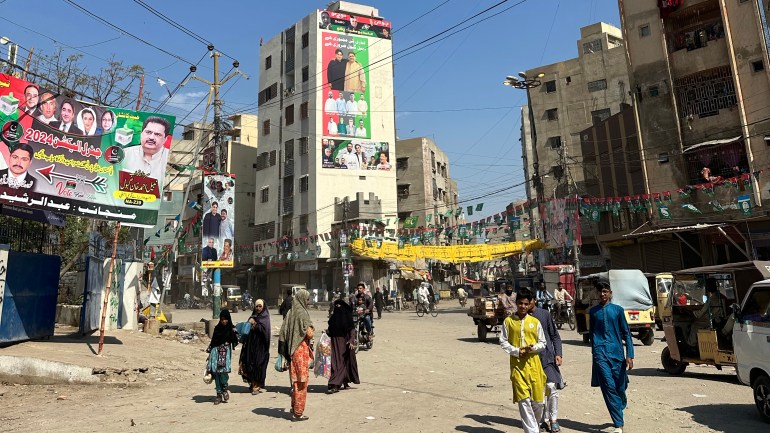
Karachi, Pakistan – These are the fourth general elections I’m covering in Pakistan over the past 16 years. In a city where colours, music and ethnicities change from neighbourhood to neighbourhood, every one of those previous elections has been confusing. This one has been the same: chaotic and confusing. I started the day by voting at my neighbourhood polling station. It’s something I’ve always struggled with: Should journalists vote? Then, as I reported from Pakistan’s largest city – home to 22 seats, more than the entire province of Balochistan – on Thursday, I realised that not only was Pakistan’s democracy on trial but so too were the city’s loyalties. Former Prime Minister Imran Khan’s Pakistan Tehreek-e-Insaf (PTI) party had won 14 National Assembly seats in the 2018 election from Karachi, breaking voters away from the Muttahida Qaumi Movement (MQM), which has traditionally dominated the city’s political landscape. With the MQM split into multiple factions since 2016, its disenchanted voters found solace in Khan’s party, from the affluent southern areas of Karachi all the way to the city’s north. I was standing outside my polling station in Clifton, barely 1km (0.6 miles) away from Bilawal House, which is the Karachi home of the Bhutto-Zardari family, which leads the Pakistan People’s Party. The PPP has historically been the most dominant political force in the province of Sindh, whose capital is Karachi. Yet, on Thursday, most people streaming out to vote in this upscale part of Karachi were PTI supporters, many of them women who had stepped out at 8am to be among the first to cast their ballot. N Tariq, a 50-year-old who did not want to share her full name, said she came first in the morning to ensure she caught the polling staff in a good mood and in the hope the voting process would be smooth and without long queues. “I’m voting for the person who is in trouble right now. He needs our votes”, said Tariq. She laughed as she said this, referring to Khan, who received multiple sentences in a range of cases last week. My next stop was one of the largest polling stations in Defence Phase 4, a cantonment housing area, run by Pakistan’s powerful military, which Khan’s supporters blame for derailing the party – its leaders are in jail, and candidates can’t even use the party symbol. An upscale neighbourhood, the polling station was already getting busy – but it was missing the celebratory atmosphere of the 2018 election, when I had spent a few hours outside this venue. By this time, my cellular and data connection had been cut and I could no longer contact anyone. As a native Karachite, losing cellular connectivity isn’t new to me but this was a day when law and order could be compromised and it was very unnerving. Lyari, a stronghold of the Pakistan People’s Party, was eerily quiet on Thursday, February 8, 2024 [Alia Chughtai/Al Jazeera] I headed towards Lyari, a PPP stronghold. As I drove through Lyari’s Cheel Chowk – the usually very noisy and congested area, home to decades-long gang wars, was eerily calm. It was so quiet that it made me uncomfortable. The flags and banners were up but there was no music, no dancing, no blaring of Dilan Teer Bija – the PPP’s viral anthem. As I began going through different polling stations, I came across many elderly women voters. Rehmat, 75, and Kulsom, 60, came together to the polling station – where I wasn’t allowed in despite having accreditation. Kulsom said she was only voting for the PPP because it was the party of former Prime Minister Benazir Bhutto, who was assassinated in 2007. Left: Kulsom, right, Rehmat, residents of Lyari [Alia Chughtai/Al Jazeera] “Bilawal is her son and they have given us everything. Water, gas, and brought peace to this area, PPP has given us everything. What else do we need? I will always stand by PPP till my last breath,” said Kulsom. She was referring to Bilawal Bhutto-Zardari, the 36-year-old leader of the PPP. Rehmat said her children don’t have jobs but the PPP is her choice too. She voted for Bilawal’s grandfather – former Prime Minister Zulfikar Ali Bhutto – in 1970, and then for Benazir, and now she is determined to vote for Bilawal. “They work for us and they take care of us – how can we not love the Bhuttos?”, she said. This wasn’t the sentiment shared by everyone in Lyari. A first-time voter, 18-year-old Mohammed Yazdan said promises are made before elections but never fulfilled. First-time voter Mohammed Yazdan [Alia Chughtai/Al Jazeera] “I’m voting for Imran Khan, PTI, because those who do work are always pulled down by them. Look at what they’ve done to him. I will continue supporting him.” I went into the heart of the city, in the old Golimar area, a working-class neighbourhood. There were small pockets of Tehreek-e-Labbaik, MQM and Jamaat-e-Islami supporters in the streets helping voters. Tehreek-e-Labbaik, a far-right party formed in 2017, rallies support by focusing its politics around religion. Jamaat-e-Islami, also a religious right-wing party, is among Pakistan’s most organised political forces, with a charity wing, the Al Khidmat Foundation. I found that voters were hesitant to admit they were going to be voting for PTI-affiliated candidates who have had to contest as independents. One female voter who wished to remain anonymous said: “I’m sitting in the MQM tent to get my polling numbers sorted but my vote is always for the leader of the nation I can’t name. I wanted to come today to be a polling agent but we were told there would be security issues for those affiliated with PTI candidates.” In the Pakistan Employees Cooperative Housing Society, an old neighbourhood known locally by its acronym PECHS, one of the larger polling stations is a college campus that has an unpaved dirt entrance and steps that go down into the main courtyard. After crossing it, voters had to climb up to the first
Budget session: ‘Motion of Thanks’ on Ayodhya Ram Mandir in Parliament today, PM Modi likely to speak

There will be a “Motion of Thanks” regarding the building of the magnificent Ram Temple in Ayodhya on Saturday.
Trump takes familiar dig at justice system after Biden documents report: ‘sick’

HARRISBURG, PENNSYLVANIA – Former President Donald Trump railed against the “two-tiered system of justice” during his address at the NRA’s Great American Outdoor Show in Pennsylvania, citing Special Counsel Richard Hur deciding against criminally charging President Biden. “We have a sick and corrupt, two-tiered system of justice in our country,” Trump said from a packed arena in Harrisburg, Pennsylvania, Friday evening. “Do I know better than anybody.” “As an example, it was just announced that Joe Biden’s department of injustice will bring zero charges against crooked Joe, despite the fact that he willfully retained, willfully retained and disclosed drawers of ultra classified national security documents.” FOREIGN OUTLETS PULL NO PUNCHES OVER BIDEN ‘CONFUSION’ AND ‘RAGE’ AFTER SURPRISE PRESS CONFERENCE Hur had carried out a months-long investigation into Biden’s possession of classified documents, ultimately deciding against criminally charging the president. “We conclude that no criminal charges are warranted in this matter,” the report, released Thursday, states. “We would reach the same conclusion even if the Department of Justice policy did not foreclose criminal charges against a sitting president.” CONSERVATIVES RIP BIDEN AFTER CLASSIFIED DOCS PROBE DOESN’T CHARGE HIM, CITING ‘POOR MEMORY’: ’25TH AMENDMENT’ The special counsel also described Biden as “a sympathetic, well-meaning, elderly man with a poor memory,” with the president later that day holding a press conference to address concerns surrounding his mental clarity. Trump said that Biden is not protected by the Presidential Records Act as he was not president at the time of the documents, and argued the Democratic Party is trying to “spin the Biden document disaster into, an ‘Oh, but wasn’t Trump worse?” ‘BIDEN SEEMS LIKE THE DANGER,’ SAYS LIBERAL PROTESTER OUTSIDE PRESIDENT’S ELITE NYC FUNDRAISER “No, no no, Trump was peanuts in comparison. It was 50 years and he did a lot of it when he was a very young age. He was mentally a little bit better than he’s right now,” Trump said. BIDEN LASHES OUT AT REPORTERS ASKING ABOUT AGE CONCERNS AFTER SPECIAL COUNSEL REPORT: ‘THAT IS YOUR JUDGMENT!’ In Florida, Trump was charged with allegedly mishandling classified documents following his presidency, and he is scheduled to face trial on May 20. Trump said during the NRA event that he is covered “by the very important Presidential Records Act and, therefore, I did absolutely nothing wrong. Nothing.” Trump, the 2024 Republican frontrunner, was in Harrisburg to double down on his support of the Second Amendment, warning that if Biden wins re-election, “your gun rights will be gone.” “They’ll be totally gone. And the sad part of that is, the bad guys aren’t giving up their guns. The bad guys aren’t. But the good people aren’t giving up their guns either, because there’s never going to be anybody that’s going to be asking. And when I’m re-elected, every single Biden attack on gun owners and manufacturers will be terminated my very first week back in office. Perhaps by the first day.”
Louisiana plans to deploy 150 National Guard troops to southern border amid surge in illegal immigrants

Louisiana plans to deploy 150 National Guard troops to the southern border in Texas amid a failure in Congress to secure a border deal. Louisiana Gov. Jeff Landry announced the move Thursday in Baton Rouge, adding himself to a growing list of Republican governors offering to assist Texas with resources amid that state’s battle with the Biden administration over border security. “Because the federal government will not act, because the president will not do his job, because Congress refuses to put into place a solid immigration plan that protects this country and allows people to come in and out of this country the way it has been done since the beginning, then the states are going to act,” Landry said. NEW YORK’S ‘CATCH AND RELEASE’ POLICIES FAIL TO HOLD CRIMINALS ACCOUNTABLE: POLICE REP He said the federal government has essentially, “dog-whistled those who are trying to come into the country illegally by saying, ’Listen, if you swim across the Rio Grande we will let you in that way.’” The deployment of Louisiana Guard troops would likely occur in March at an estimated cost of $3 million. The move still needs to be approved by the state’s Republican-controlled Legislature. Troops at the border would not have authority to detain migrants, Brig. Gen. Michael Greer the director of the Louisiana Military Department, said Thursday. Besides Louisiana, Florida has sent around 1,000 members of its National Guard to the border. Texas Gov. Abbott has been busy in a legal battle with the Biden administration over its measures to curb the flow of illegal immigrants into the U.S. Meanwhile, Republicans have heavily criticized Biden over a surge of migrants coming into the U.S. Fox News Digital has reached out to Abbott’s office. The Associated Press contributed to this report.