

Lubbock group pushes forward with marijuana ballot question despite Paxton lawsuit

The Texas attorney general has sued five other cities that have passed similar policies decriminalizing marijuana.
Despite mounting doubts about his guilt, Ivan Cantu running out of time to avoid Texas’ death chamber

Convicted of killing his cousin and his cousin’s fiancée, the death row inmate hopes recanted testimony and other new details spur a review of his case .
Active shooter training: State-specific requirements for schools and law enforcement

No states mandate annual active shooter training for police officers, according to an analysis by The Texas Tribune, ProPublica and FRONTLINE. In comparison, at least 37 states require such training in schools, typically on a yearly basis.
Kansas lawmakers approve 93% pay raise for themselves starting next year

Kansas is set to nearly double state legislators’ pay at the start of next year, making their compensation better than it is for their counterparts in a majority of states, including more populous ones like Georgia and Texas. The increase is nearly $28,000 a year for rank-and-file legislators, boosting their total compensation from $30,000 to nearly $58,000, an increase of 93%. Legislative leaders get additional payments because of their duties, and the House speaker and Senate president are set to make more than $85,000 a year, up from $44,000. The pay increase appeared to have bipartisan support, though lawmakers never voted directly on it. Instead, they set up a bipartisan pay commission last year, with its proposal taking effect unless both legislative chambers passed a resolution rejecting it by Wednesday. An effort to force a debate in the Senate failed last week, and there was no such move in the House. KANSAS GOP FACES DEMOCRATIC RESISTANCE IN RENEWED BATTLE OVER CONTROVERSIAL INCOME TAX CUTS Some Kansas legislators have complained for years that their annual compensation of $30,000 isn’t enough to live on year-round, while their duties as lawmakers cut into outside work or even prevent them from holding down other jobs. Supporters of the pay increase say it is likely to make the Legislature more diverse when it’s in danger of becoming mostly retirees and wealthy people. “You might get a few more females,” said state Sen. Cindy Holscher, a Kansas City-area Democrat. “You might get a few more minorities. You might get a few more younger people.” Alaska lawmakers’ salaries rose by 67% at the start of this year, from $50,400 to $84,000, also because legislators let a proposal from a pay commission stand. New Jersey legislators will see their pay increase in 2026, also by 67%, from $49,000 to $82,000. New York lawmakers received a 29% raise at the start of 2023, making their pay the highest in the nation at $142,000 a year. Most states pay a salary and give their lawmakers extra money each day to cover expenses in session, according to National Conference of State Legislatures data. New Hampshire’s salary is $100 a year — the same as it was in 1889, while New Mexico pays $202 to cover lawmakers’ expenses in session but no salary. When Kansas became a state in 1861, its constitution said lawmakers were to receive $3 a day in session, up to $150. They didn’t get a raise for nearly 90 years, with voters rejecting five proposals before approving pay of $12 a day in 1948. In 1962, voters said lawmakers’ pay could be set by state law. The new figure, nearly $58,000, includes both a salary and daily, in-session payments to cover expenses such as meals and housing. “I think it’s fair,” said House Speaker Dan Hawkins, a Wichita Republican. “I think that the commission did, really, a pretty good job.” Commission members argued that their sizeable pay increase represented catching lawmakers’ compensation up to several decades’ worth of inflation. However, the proposal did draw at least a few objections. Sen. Rob Olson, a conservative Kansas City-area Republican, tried and failed last week to pull an anti-pay raise resolution out of the Senate budget committee so senators could debate it on the floor. The effort fell short because a dozen of the 40 senators passed. Senate President Ty Masterson, a Wichita-area Republican, saw opposition to the pay raise as political grandstanding. “It’s just kind of political theater,” he said after last week’s vote. The Senate budget committee did review the pay proposal Tuesday during a short hearing. Nicholas Reinecker, a central Kansas restaurant owner who makes seven to 10 trips to Topeka a year to advocate for legalizing cannabis, had to interrupt the its adjournment — after no action — to get his opposition on record. KANSAS GOP LOOKS TO OVERHAUL ETHICS COMMISSION AMID ONGOING INVESTIGATION He said he wants Kansas to keep its “citizen” Legislature, adding that when lawmakers take their oaths of office, they promise to “sacrifice for God, family and country.” “I’m sorry, it’s not supposed to be a job,” he told the committee, predicting that the big pay raise could lead to “entanglements” with professional lobbyists. Olson said he doubts lawmakers’ constituents support such a big pay raise and said they should have the courage to debate it and vote on it. And Rep. Ken Corbet, a Topeka Republican who operates a hunting lodge, said that in most businesses, the boss sets the pay, not the employees. And his boss — the taxpayers — haven’t told him a pay raise is OK with them, he said. He had considered proposing his own anti-raise resolution, but, “Apparently, there was not an appetite for that.”
Panic in hemmed-in Rafah as Israel PM orders troops to prepare ground entry

UN chief says ground invasion of city would widen the ‘humanitarian nightmare with untold regional consequences’. Panic is growing in Rafah over an imminent ground invasion after Israel’s prime minister ordered his military to prepare to enter the city in the southern Gaza Strip that is sheltering 1.2 million people with nowhere else to go as he rejected Hamas’s truce plan and rebuffed US efforts to reach a deal. A new round of talks aimed at securing a truce with Hamas were set to open on Thursday in Egypt after Prime Minister Benjamin Netanyahu said Israel will not end the war and will push on until “total victory” over the Palestinian group. Visiting United States Secretary of State Antony Blinken insisted on Wednesday that he still saw “space for agreement to be reached” and was meeting on Thursday in Tel Aviv with Israel’s war cabinet members Benny Gantz and Gadi Eisenkot to discuss the release of captives being held in Gaza. “We are on the way to an absolute victory,” Netanyahu said on Wednesday, adding that the operation would last months, not years. “There is no other solution.” Israeli air strikes overnight on Rafah – which Israel had once declared a safe zone for displaced Palestinians – killed 14 people, including five children. Al Jazeera’s Hani Mahmoud, reporting from Rafah, said: “What people are experiencing in the southern part of the Gaza Strip is a surge in attacks from air, land and sea.” Safia Marouf, a displaced Palestinian who sought refuge in Rafah with her family after being uprooted from their home farther north, said she is afraid of what’s to come. “The children are scared all the time, and if we want to leave Rafah, we don’t know where to go. What will be our destiny and that of our children?” United Nations Secretary-General Antonio Guterres said a ground invasion of Rafah would “exponentially increase what is already a humanitarian nightmare with untold regional consequences”. ‘Critical phase’ Al Jazeera’s Hashem Ahelbarra said the meeting in Egypt indicated that “we’re moving towards a critical phase of any potential agreement between Israel and Hamas” after senior Hamas leader Osama Hamdan said a delegation was going to Cairo. “I think we have reached a point where we’re really talking about operational aspects of the agreement, and what is happening behind closed doors is a real, genuine push towards that,” Ahelbarra said. The Muslim fasting month of Ramadan in March puts “political pressure on leaders in this part of the world”, he said, adding that if Israeli attacks continue then “I wouldn’t see a chance of any deal in the near future.” Hamas had laid out a three-phase plan to unfold over four and a half months that would see the release of all captives in exchange for hundreds of Palestinians imprisoned by Israel, including senior fighters, and an end to the war. “While there are some clear non-starters in Hamas’s response, we do think it creates space for agreement to be reached, and we will work at that relentlessly,” Blinken told reporters after meeting Netanyahu to discuss the Hamas counterproposal to a truce plan drawn up by US and Israeli spy chiefs and delivered to the Palestinian group last week by Qatari and Egyptian mediators. Reporting from occupied East Jerusalem, Al Jazeera’s Rory Challands said Blinken “came to get a deal and he didn’t get it”. “He’s still going to try to bridge the huge gap between Israel and Hamas. He might be right – there might be a chance. But at the moment, he’s going back to Washington, DC, empty-handed,” Challands said on Thursday. Adblock test (Why?)
Five killed in clashes with police as protests rock Haiti

Five armed environmental protection agents were killed in clashes with police near Haiti’s capital, Port-au-Prince, as violent protests seeking the removal of Prime Minister Ariel Henry paralysed the country. Haiti has been engulfed in unrest since Monday, with thousands of people in the city and the rest of the country demanding that Henry step down in line with a political agreement forged in 2022. A police source said the five agents of the National Agency for Protected Areas (BSAP), an armed government bureau now in open rebellion, had been shot on Wednesday after refusing to drop their weapons and firing in the direction of police. Three other members of the agency were arrested. According to an agreement concluded in December 2022 following the assassination of President Jovenel Moise a year earlier, Henry was supposed to hold elections and then cede power to newly elected officials on February 7, 2024. But Henry has remained in power, with an aide saying the prime minister intends to form a government of national unity. The Western hemisphere’s poorest nation has been in turmoil for years, with armed gangs taking over parts of Haiti and unleashing brutal violence, leaving the economy and public health system in tatters. The 2021 assassination of Moise plunged the country further into chaos. No elections have taken place since 2016 and the presidency remains vacant. The protests have been called by several opposition parties and joined by employees of the environmental agency. On Tuesday evening, a police station in the northeastern province of Ouanaminthe came under attack, local media reported. Major roads and schools have been closed across the country since Monday. The Dominican Republic, which shares the island of Hispaniola with Haiti, said on Wednesday that it was reinforcing its borders due to the violence. Adblock test (Why?)
A new chapter in the Baloch struggle for justice in Pakistan

November 23, 2023 marked the beginning of a new chapter in the Baloch struggle for justice and accountability in Pakistan. On that day, the country’s Counter Terrorism Department (CTD) claimed that Balach Mola Bakhsh, a 24-year-old Baloch man who had been forcibly disappeared in October, was “killed in an encounter” with security forces in the city of Turbat in Balochistan. His family knew this could not be true, as Bakhsh had been presented to a “anti-terrorism” court by the same department just two days earlier and charged with possessing five kilogrammes of explosives. He was in state custody when he was killed. The killing of Bakhsh, and the attempts by security forces to lie about what happened to him, was not only a mockery of Pakistan’s justice system, but also a perfect example of the injustices and gaslighting our community has been facing in this country for many decades. After receiving the young man’s dead body, his family organised a sit-in protest in Turbat attended by thousands. At the protest where Bakhsh’s corpse was also present, they demanded the state investigate his death and punish those responsible. On November 25, a local court called for a First Information Report (FIR) to be registered against counterterrorism department officials, but the police defied the order. Eventually, the High Court had to intervene and get the FIR registered. Yet, the culprits who had custody of Bakhsh at the time of his death remained free (in fact, they did not face any accountability to this day). After our week-long sit-in alongside Bakhsh’s dead body in Turbat achieved no results, in the first week of December we decided to move our women-led protest to Quetta, the provincial capital. Our aim was to find justice for Bakhsh and prevent other young Baloch men like him from being forcibly disappeared and extrajudicially killed. We protested in Quetta for three days, but our cries for help once again fell on deaf ears. So we decided to move to the national capital, Islamabad. But reaching the political heart of the country proved much more difficult than we imagined. We were not breaking any regional or national laws with our peaceful march towards the capital, but the police used force to stop us anyway. At least 20 participants of our peaceful march were arrested in Dera Ghazi Khan. As the march progressed, sedition cases were lodged against many of us, including me, in many different parts of the province. However, these intimidation attempts were not successful. We continued our march, and calls for justice and accountability, because we know that inaction is no longer an option for our community. Because we know that the extrajudicial killing of Balach Mola Bakhsh was not an anomaly, a one-off tragedy, but part of a devastating pattern. Indeed, unlawful arrests, forceful disappearances and extrajudicial killings have become a routine part of life for Baloch people in Pakistan in the past 20 years. Since a flare-up in the decades-old ethno-nationalist insurgency in the early 2000s, thousands of Baloch have been forcefully disappeared, and hundreds have been brutally murdered and their bodies dumped on desolate mountains or deserted roads. Many of these corpses bore signs of torture, with limbs snapped, faces bruised, and flesh sliced or punctured with drills; some even had slogans like “Pakistan Zindabad (Long Live Pakistan)” written on their backs. My own family also suffered the consequences of these systematic attacks on the Baloch community. My father, Abdul Ghaffar Lango, who was a political activist for the ethno-nationalist Balochistan National Party (BNP), was forcefully disappeared from outside a hospital in Karachi, Sindh Province, in December 2009. At the age of 16, as the eldest among my six siblings, I embarked on a desperate struggle to find my father. My family asked the police to register an FIR, but they refused. We then turned for help to the Sindh High Court, which summoned top officials, including the chief of Pakistan’s intelligence agency ISI, the inspector-general of the Sindh Police, and the Sindh province home secretary, among others. But they all defied the court’s orders and refused even to register an FIR on my father’s disappearance. Nearly two years after his disappearance, in July 2011, my father’s bullet-riddled body – which bore apparent signs of torture – was recovered in an abandoned hotel in the Lasbela district of Balochistan. Despite everything my family had been through, I chose to remain silent and focus on my education. However, in December 2017, my brother, Nasir Baloch, was also forcefully disappeared. Terrified that my only brother would share the fate of my father, I decided not to stay quiet any longer. I began to campaign for justice for my father, brother and countless other Baloch men sharing the same fate with them. My decision to speak up triggered a campaign of harassment against me and my family. My brother was thankfully released and returned to us in March 2018, but the organised campaign of intimidation against me and my family continued unabated. I, alongside others in our movement, faced many baseless charges, threats and attacks over the years. And yet, I continued to talk about forced disappearances and extrajudicial killings of Baloch men because I knew the experiences of my family mirrored the experiences of hundreds of other families in our community. With the killing of Balach Mola Bakhsh in November, our principled struggle for justice entered a new phase. Now, the Baloch people are more determined than ever before to put an end to these blatant attacks on our community. Our women-led protest march reached Islamabad on December 20. Three days later, we initiated a sit-in in front of the National Press Club in Islamabad. From that day on, we faced the worst harassment at the hands of the Islamabad police. Officers attacked us with batons and tried to disperse our protest using water cannons in freezing temperatures. Some 290 protesters, including myself, were arrested, and released only after the intervention of the Islamabad High Court. The
‘PM Modi not OBC by birth, belongs to general caste’: Rahul Gandhi
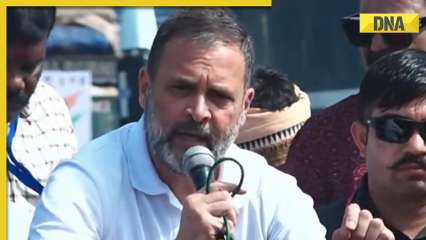
Rahul Gandhi also alleged that the prime minister will never conduct a caste census in the country, without which social justice cannot be achieved.
Ohio GOP Senate hopeful makes campaign trail pitch as candidate Dems ‘most afraid of’ in tight race
XENIA, OHIO – Ohio Secretary of State Frank LaRose, currently running in the GOP Primary for U.S. Senate, spoke to Fox News Digital on the campaign trail in Ohio this week and explained why he believes he’s the candidate Democrats fear most and why his conservative message will shine through a crowded primary field in a hotly contested race. “When I say that we’ve got a country to save that’s not exaggeration at this point, the left is trying to take this country in a fundamentally dangerous direction,” LaRose, a 44-year-old father of three who has served as Ohio’s Secretary of State since 2019, told Fox News Digital on Monday evening inside a Coffee Hub location in Xenia, Ohio, about 15 miles east of Dayton and 50 miles northeast of Cincinnati. “I’ve long had this belief that each generation is responsible for leaving this country better than we found it, right? A little bit stronger, a little bit freer, a little bit more prosperous. I think if we don’t act soon, our generation will be the first in American history to leave this country weaker, poorer and less secure.” The Ohio Senate race is expected to be one of the tightest and most contentious in the country and is one of only 3 Senate races listed as a “toss up” by the Cook Political Report, along with Arizona and Montana. 2024 SENATE SHOWDOWN: NEW ENDORSEMENT IN OHIO’S GOP PRIMARY BATTLE IN RACE TO FLIP BLUE SEAT A recent Emerson College poll shows LaRose, businessman Bernie Moreno, and State. Sen. Matt Dolan, in a neck and neck race with all 3 polling within a point or two of incumbent Democratic Senator Sherrod Brown and 22% of GOP primary voters supporting Moreno, 21% LaRose and 15% Dolan with 42% of voters still undecided. The poll represents a dramatic shift from November when Emerson College had Brown, the only Democrat to win statewide in Ohio in the past decade, beating Dolan by three points, LaRose by five, and Moreno by 11. After speaking with Fox News Digital, LaRose walked down Main Street to the Greene County GOP headquarters where he took questions from a group of engaged conservatives in a county where Trump won by 20 points in 2020. Voters wanted to hear about LaRose’s allegiance to the former president and although Trump endorsed Moreno in the primary, LaRose made it clear that he’s a firm supporter of Trump. “100%,” LaRose, who has faced scrutiny from some conservatives over past criticisms of Trump, told an audience member when asked if he fully supports the former president. “Listen, I’ll give you an example, I told you that I was hired by President Trump to help run his inaugural committee. I literally buckled his grandchildren into their motorcade vehicles for the ride down Pennsylvania Avenue. I am a loyal Trump supporter. I’ve endorsed him. I was one of the first to endorse him. I can tell you this, I will stand with President Trump to accomplish his agenda. I will work for the people of Ohio, that’s who my first loyalty is to, but I will work with President Trump to accomplish his agenda when he’s in the White House and I’m in the U.S. Senate.” OHIO SENATE CANDIDATE SAYS GOP IMPEACHING ‘TRAITOR’ MAYORKAS A ‘NO BRAINER’: ‘GROTESQUELY UNQUALIFIED’ “I’m a proud supporter of his,” LaRose told Fox News Digital. “I believe he’s going to be in the White House in 2025, but we need to take back the Senate if we’re going to get his policies done, get his appointees through the process. And so in that sense, making sure that we have the strongest candidate to beat Sherrod Brown needs to be what Ohio Republicans are focused on.” In terms of beating Brown, who has represented Ohio as a Democrat in the Senate since 2007, LaRose has consistently made the case on the campaign trail that he is best positioned to beat Brown, who he referred to as a “fraud”, in November. “I’m the one that Sherrod is the most afraid of. It’s pretty clear and the old saying is they only try to tackle you when you have the ball,” LaRose told Fox News Digital. “The Democrats have been attacking me because they know I’m the most dangerous weapon against Sherrod Brown.” OHIO POLITICIANS REACT TO BIDEN VISITING EAST PALESTINE AFTER 1 YEAR: ‘TOO LITTLE TOO LATE’ “I think it’s pretty clear that I’m the one that has the wherewithal to defeat this tough federal Democrat incumbent, but it’s not good enough to just beat him with another sort of go along, get along Republican,” LaRose added, outlining his pitch that he has the most conservative record in the race. “The two guys that are also running in this race are part of that kind of corporate establishment. I think it’s important that we send somebody to D.C. who’s a proven conservative. Everybody’s going to call themselves a conservative in the Republican primary. We need somebody who we know is going to fight for our values. I’m proven on it. I’m the only candidate in this race who’s a lifelong Republican. I’ve never been a registered Democrat.” The three GOP Senate candidates faced off in their first of three debates last month and in addition to jockeying for the position as the most conservative, immigration was the most hotly contested topic in the debate and is an issue LaRose told Fox News Digital where his resume is the strongest. “I was on the border over 20 years ago in uniform as a member of the United States Army,” LaRose, a former Green Beret who earned a Bronze Star serving in Iraq, explained. “Securing the border is absolutely fundamental, I actually served out there and so that’s a unique life experience that I’ve had. I was part of a counter-narcotics task force as a soldier with the 101st Airborne Division down on the U.S. Mexican border. We know what it takes. I’m the one
North Korea ends all economic cooperation with South as ties hit new low

Relations have deteriorated as Pyongyang ramps up weapons development and Seoul bolsters ties with US, Japan. North Korea’s parliament has voted to abolish all economic cooperation agreements with South Korea as ties between the two neighbours sharply deteriorate. The latest decision comes after Pyongyang last month declared Seoul its main enemy, jettisoned agencies dedicated to reunification, and threatened to occupy the South during war. The Supreme People’s Assembly, which takes formal steps to adopt policy allegedly dictated by the ruling Workers’ Party, on Wednesday voted to scrap the law on inter-Korean economic cooperation, the official Korean Central News Agency (KCNA) reported on Thursday. Relations between the two Koreas have been in a deadlock, with key projects suspended for years, as Pyongyang ramps up its weapons development programmes and Seoul bolsters its military cooperation with the United States and Japan. The assembly also abolished laws on the operation of the Mount Kumgang tourism project, which offered tours and was a symbol of economic cooperation between the two sides that began in the early 2000s, drawing nearly two million South Korean visitors. The resort was built by South Korea’s Hyundai Asan. The project was suspended in 2008 when a South Korean tourist was shot dead by North Korean guards for straying into a restricted zone. The Mount Kumgang resort was once one of the two largest inter-Korean projects, along with the now-shuttered Kaesong industrial zone. During its peak, it housed the factories of 125 South Korean companies employing 55,000 North Korean workers. Seoul pulled out of the venture – launched in the wake of a 2000 inter-Korean summit – in 2016 in response to a nuclear test and missile launches by the North, saying Kaesong profits were helping fund the provocations. ‘Not rational’ North Korea last year ended a military pact signed in 2018 to de-escalate tensions near the military border which was drawn up under a truce ending the 1950-53 Korean War. South Korean President Yoon Suk Yeol on Wednesday called Pyongyang’s move “an extraordinary change” but said it was hard to understand their logic. “What hasn’t changed is that the North has tried for more than 70 years to turn us into Communists, and while doing that, it realized its conventional weapons were insufficient so they went onto nuclear development to threaten us,” he said in an interview with state TV KBS. Yoon said he was still open to engaging the North and would provide aid if needed, but added that the North Korean leadership is “not a rational group”. After years of border closures because of the COVID-19 pandemic, restarting its lucrative tourism business would offer the North a means of generating hard cash, but could now violate international sanctions imposed on Pyongyang over its nuclear and ballistic weapons programmes. Adblock test (Why?)