

Russia’s Putin says ‘obvious’ Ukraine shot down plane over Belgorod

Moscow and Kyiv trade blame after Ilyushin Il-76 plane crashed, reportedly killing 65 Ukrainian POWs said to be on board. Russian President Vladimir Putin has said that Ukrainian air defences shot down the Russian military plane that crashed near its border with Ukraine this week. In his first comments about Wednesday’s crash, Putin said that the results of Moscow’s investigation would be published in two to three days, but preliminary results suggested that the missiles that hit the plane were either American or French. Putin also accused Ukraine of knowing that the Ilyushin Il-76 plane was carrying 65 Ukrainian prisoners of war. “I don’t know if they did it on purpose or by mistake, but it is obvious that they did it,” Putin said in televised comments on Friday. “In any case, what happened is a crime. Either through negligence or on purpose, but in any case, it is a crime.” The Russian defence ministry said six Russian crew members and three Russian soldiers were also on board the flight to undertake the latest prisoner swap with Ukraine. Ukraine has not confirmed nor denied whether it shot down the plane and has challenged Moscow’s account of who was on board and what occurred. Kyiv has refuted Moscow’s claim that it was warned that a plane carrying Ukrainian POWs would be flying over Russia’s Belgorod region at that time. It also said there were discrepancies in a list of names published by Russian media of the 65 Ukrainians who were reportedly on board. However, Putin said the plane could not have been brought down by Russian “friendly fire” since its air defence systems have safeguards in place to prevent them from attacking their aircraft. “There are ‘friend or foe’ systems there, and no matter how much the operator presses the button, our air defence systems would not work,” he said. Trading blame On Thursday, Ukraine called for an international investigation into the blast. “Regarding an international investigation, I believe that we will do our part to make it happen. But I am convinced that … the Russians will make loud statements but will not allow anyone in,” Dmytro Lubinets, the Ukrainian parliament commissioner for human rights, told national television, adding he would send letters to the United Nations and the International Committee of the Red Cross. “They will not hand over any materials for analysis and will simply blame Ukraine,” he added. Russian Foreign Minister Sergey Lavrov also called for an emergency session of the UN Security Council to discuss the downed plane on Thursday. At the session, Moscow and Kyiv both sought to pin the blame on the other. “All of the information that we have today shows that we are dealing with a premeditated, thought-through crime,” said Russia’s deputy ambassador to the UN, Dmitry Polyanskiy, adding that Ukraine’s leaders “knew the route very well, knew about the way the soldiers were going to be transported to the place of exchange”. He accused Kyiv of sacrificing its own troops “to Western geopolitical interests”. Ukraine’s Deputy Ambassador Khrystyna Hayovyshyn in turn rejected the accusation, saying that “Ukraine was not informed about the number of vehicles, roads and means of transportation of the captives”. “This alone may constitute intentional actions by Russia to endanger the lives and safety of the prisoners,” she said. Adblock test (Why?)
Displaced people in Khan Younis told to move further south

NewsFeed “You must immediately move“ Israel tells hundreds of people in Khan Younis, including those already displaced, to move further south as the military continues to expand its offensive in the area. Published On 26 Jan 202426 Jan 2024 Adblock test (Why?)
Meet Priyanka Panwar, single woman applicant who is now first woman SPOT commando of Uttar Pradesh

Priyanka Panwar became a member of the Uttar Pradesh Police in 2011 and in 2017 she was assigned to the SPOT unit.
Filipinos in Hong Kong were promised a new life in Poland. It never came

This is the second article in a two-part series about the alleged exploitation of Filipino migrant workers. You can read part one here. Hong Kong, China – It only took a few minutes of searching online for Divina*, a domestic worker in Hong Kong, to find a recruiter offering the tempting opportunity to work in Poland. Before long, Divina found herself attending a two-hour orientation session on the 17th floor of a building in the city’s bustling Mong Kok district. There, she listened as agents listed opportunities in workplaces ranging from hotels to a chicken processing plant and a car parts factory. “So you would really be convinced that [they] had many contacts in Poland,” she told Al Jazeera. Divina paid the recruiters 10,000 Hong Kong dollars ($1,279) to initiate her application to work in Europe. But more than 14 months later, Divina is still waiting for her application to be finalised and has all but given up hope of ever reaching Poland. Divina is one of at least dozens of domestic workers in Hong Kong who feel cheated after paying thousands of dollars in fees for jobs in Poland that haven’t materialised. Labour advocates in the financial hub say that the victims of an international network of recruiters and agencies have lost at least 600,000 Hong Kong dollars ($76,785) – but that is likely to only be the tip of the iceberg. Al Jazeera spoke with five Filipino domestic workers in Hong Kong and read written statements from 20 others who claim to have been deceived by online recruiters and at least two agencies in Hong Kong that worked with a Poland-based agency. Many said they were unable to support their families for months after taking out loans to cover the recruitment fees. Labour advocates in Hong Kong say domestic workers have been targeted by an international network of recruiters and agencies that has cost them at least 600,000 Hong Kong dollars [Dan Archer/Al Jazeera] Such cases are far from unique in Hong Kong, which has become a “hotbed for illegal recruitment schemes” due to its 340,000-strong population of foreign domestic workers and the growing demand for migrant workers from Asia to Eastern Europe, according to David Bishop, a university professor and co-founder of the migration-focused social enterprise Migrasia. Bishop said his team has identified a large number of agencies that engage in third-country recruitment strategies prohibited by Philippine labour authorities. “These agencies target Filipino workers in Asia with the alleged intention of placing them in jobs in Europe,” he told Al Jazeera, adding that recruiters play on the despair of people hoping to find work opportunities. A few weeks after her application, Divina was informed that a Warsaw-based agency would be solely responsible for handling her application. The partner agency in Hong Kong that she dealt with directly told her it was no longer involved. Ultimately, the Polish agency claimed it had not received her payment. Divina, who is legally required to live with her employer in Hong Kong and often works 16-hour shifts without overtime, was at a loss for what to do next. “I keep praying, I keep begging [to get back] all our hard-earned money,” she said, adding that while she hopes to get a refund, she still dreams of going to Poland. Recruitment agents have sold Poland to domestic workers as a country that offers higher salaries – sometimes more than double – better working conditions, and the opportunity to live together with their families in Europe. After the Philippines, Hong Kong was the top source of visa applications by Filipinos hoping to work in Poland from 2021 to November 2023. Polish authorities in Hong Kong processed 2,980 visas for Filipino workers over the period, according to a spokesman for Poland’s Ministry of Foreign Affairs. Searching for answers Maria*, another Filipina migrant worker who applied for a job in Poland with the Mong Kok-based agency, has also been left searching for answers. “I don’t know where my 10,000 Hong Kong dollars went,” she told Al Jazeera, referring to the first cash instalment she made in May 2022. Maria said she was told her full application would cost 30,000 Hong Kong dollars (US$3,839) – more than six times the monthly minimum wage of a domestic worker in Hong Kong. “I thought that because we were using an actual agency in Hong Kong, we would be more protected,” she said. Maria cannot understand why she remains in the city, while another worker she knows who applied with the same agency at the same time was offered a job and successfully reached the Eastern European country. In WhatsApp messages seen by Al Jazeera, Maria asked the Hong Kong agency for proof that her money had indeed been sent to Poland, but was told that was “confidential [information] between companies”. In November 2022, the agency – which currently holds a licence to operate in the city – sent a letter to applicants, claiming that “all the problems” were “from the Poland side”. When Al Jazeera accompanied Maria on two visits to her agency in Mong Kok last month, the office was closed each time. A person who answered a number posted on the door questioned why Maria had decided to go there in person, insisting queries be sent over WhatsApp. Despite repeated efforts, Maria has been unable to meet with anyone from the agency in person. Philippine authorities have received dozens of complaints against the Poland-based agency CIS Group Manpower [Dan Archer/Al Jazeera] The Philippine Consulate in Hong Kong had recorded 24 formal complaints against a Poland-based agency, CIS Group Manpower, as of the end of November – 18 of which named Son Employment as its Hong Kong partner. “Almost all stated they have paid significant amounts [ranging from] 10,000 to 30,000 Hong Kong dollars to the recruiter, only ending up not being able to leave for Poland,” Raly Tejada, who served as Consul General until last month, told Al Jazeera. The owner of the CIS Group Manpower, Imran
Stories of ‘beating the odds’ in China draw dark responses from wary public

A honeymoon in Western Tibet came to a tragic end in October when the newlyweds crashed their car on a mountain road after suffering altitude sickness. Sitting in the passenger seat, 27-year-old Yu Yanyan from Shanghai was badly injured. Despite being transferred to a local hospital, rapid haemorrhaging and a lack of adequate blood stocks meant that she was unlikely to make it. But drawing on the couple’s network and connections, Yu’s husband was able to secure blood donations from local civil servants and members of the public in that area of Tibet that helped to stabilise his bride. Yu’s father then arranged a chartered plane to fly her to a larger hospital for more advanced surgery. The operation to save Yu’s life was a remarkable effort in China – where many lack access to quality healthcare – especially in remote regions, such as Tibet. Some also said it was unbelievable. Success stories meet a sceptical Chinese public Bai Xinhui, who is also from Shanghai like Yu, began to follow the story after a now-recovering Yu posted a video about her near-death experience. “It was really beautiful to hear how so many people worked together and contributed to saving her life,” Bai, a 26-year-old UX designer, told Al Jazeera. At the same time though, Bai was left wondering whether ”a regular person could get so much help”. “Maybe her husband and her have very good connections or come from very rich families,” Bai said. “Maybe it’s all true, maybe it’s only half true,” she said, suspicious that some of the details of the rescue might have been altered to make public officials appear in a more positive light. “It is sometimes difficult to know what to believe and who to believe in China these days,” she added. Bai is not the only one who has pondered the circumstances and details of Yu’s ordeal. When the story gained national media attention and went viral on Chinese social media in November and December, people started to ask questions. “How were they able to involve so many people to help her and how were they able to do it so fast?” asked Li Xueqing, a 31-year-old marketing specialist from Suzhou. “Chinese healthcare is very bad in many places, so I don’t think Yu’s story shows how patients in her situation are normally treated,” Li said to Al Jazeera. Yu’s survival has shifted from the story of a dramatic rescue to symbolising entitlement and privilege in contemporary China, with some referring to her as the “Shanghai princess” in Tibet. Lhasa in the Tibet Autonomous Region, China, in 2020 [File: Thomas Peter/Reuters] The story became so prominent that it resulted in Chinese authorities and media looking into signs of wrongdoing regarding the resources mobilised to save Yu. So far, there is little evidence suggesting that any abuse of positions or power played a role. Around the same time that Yu’s rescue was being dissected by a sceptical online community in China, another story about overcoming incredible odds began trending on Chinese social media. It too was met by equally cheerless responses. A lottery player in the central Chinese city of Nanchang won the equivalent of almost $31m from the state-run Welfare Lottery in early December. The winner had reportedly spent a sum of $14,000 on nearly 50,000 sets of identical lottery numbers that each won him approximately $625. Additionally, his total winnings were tax-free due to the relatively small prize money on each individual bet. The circumstances instantly raised suspicions. “He probably had help from someone on the inside,” one user on the Chinese social media platform, Weibo, speculated. Both China’s healthcare sector and the state lottery have previously been plagued by stories of embezzlement and corruption. “There is a lot of money taken and bribes given in many sectors in China, so of course we are suspicious,” Li from Suzhou said about the incredulous effort to rescue Yu in Tibet and the unprecedented lottery win in Nanchang. The outpouring of public scepticism also suggests a lack of alignment between successes in life and the experiences of everyday Chinese people, said Jodie Peng, a high school teacher from Shenzhen. “Most people haven’t won big in the lottery or experienced a whole community helping them during a medical emergency,” she told Al Jazeera. People buy scratch cards at an outlet of the China Welfare Lottery in Beijing, China [File Adrian Bradshaw/EPA] Peng also had her own faith in China’s healthcare system tested in recent years. Her grandfather died last year from COVID-19 in a crowded public hospital before overworked medical staff had a chance to properly tend to him. Peng also fell victim to medical fraud in connection with post-surgery treatment she received a few years back. “So, of course, it was nice to hear about the lottery winner in Nanchang and the successful rescue of the Shanghai woman in Tibet. But those things don’t happen in the Chinese world that I live in,” she said. China’s party-approved ‘positive energy’ stories According to associate professor Yao-Yuan Yeh, who teaches Chinese studies at the University of St Thomas in the United States, stories that circulate in China’s media and online often reflect the desired narratives of the ruling Chinese Communist Party (CCP) more so than the lived experiences of the public. “The Chinese internet is filled with stories backed by the Chinese state,” Yeh told Al Jazeera. China’s leaders have repeatedly called for the media to disseminate stories with “positive energy” to lift up and inspire people. With the internet heavily surveilled and regulated in China, stories and commentary that do not support the mandates of the government can be quickly removed by censors without warning or explanation. So, when public data showed that Chinese youth unemployment was hitting a record 21.3 percent in June, China’s censors shut down critical discussions about the figures online and removed negative comments about the state of the Chinese economy. The following month, the publication of China’s youth jobless data was suspended. Combatting ”negativity” has also resulted
Boeing woes spark painful memories for families of Indonesian crash victims
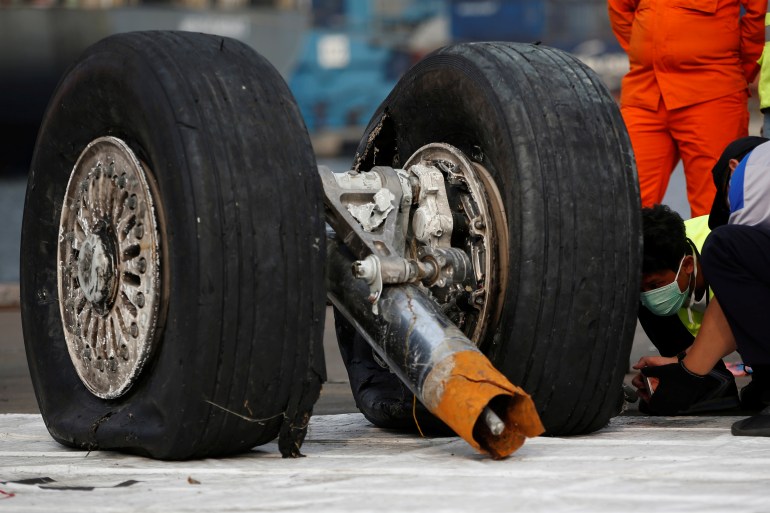
Medan, Indonesia – For Neuis Marfuah, the recent near-catastrophe involving a 737 Max plane flown by Alaska Airlines brought back painful memories and anger. Her daughter, 23-year-old Vivian Hasna Afifa, was killed when Lion Air Flight 610 crashed into the Java Sea in Indonesia on October 29, 2018, killing all 189 people on board. “How could this have happened? I can’t stop thinking about it,” Marfuah told Al Jazeera. On Thursday, the US Federal Aviation Administration (FAA) said that it had approved the Boeing 737 Max 9 to return to service after more than 170 of the aircraft were grounded on January 6, the day after a panel on Alaska Airlines Flight 1282 blew out at 14,000 feet with 177 people on board. The FAA’s “exhaustive” review gave the watchdog the confidence to “proceed to the inspection and maintenance phase”, FAA administrator Mike Whitaker said in a statement that outlined “unacceptable” quality assurance issues. No one was killed or injured in the incident, but for Marfuah, the news of the near-disaster was hard to bear. “It should have been enough after the events in Indonesia and Ethiopia to decide to stop operating the Max 737 aircraft once and for all,” Marfuah said. Less than five months after the Lion Air crash in Indonesia, Ethiopian Airlines Flight 302 crashed six minutes after takeoff from Addis Ababa Airport en route to Kenya, killing all 157 people on board. Following the Lion Air and Ethiopian Airlines crashes, a US congressional report found that Boeing operated a “culture of concealment” and that the 737 Max planes were “marred by technical design failures”, including issues with the Maneuvering Characteristics Augmentation System (MCAS). MCAS is a flight-stabilisation programme on newer 737 Max models that is designed to automatically stop a plane from going into a stall, although this was not clearly communicated to pilots flying the planes. On Lion Air Flight 610, a sensor on the outside of the plane malfunctioned and indicated that the nose of the plane was too high and that the aircraft was at risk of stalling, causing the MCAS to automatically force the plane down to avoid a potential stall and crash into the sea. MCAS also malfunctioned on Ethiopian Airlines Flight 302, prompting Boeing to make changes so that it now “operates in unusual flight conditions only and now relies on two sensors, activates only once and never overrides pilots’ ability to control the airplane”. 189 people died on Lion Air Flight 610 [File: Willy Kurniawan?Reuters] After an investigation into the near-miss involving Alaska Airlines Flight 1282, the airline found that the panel that blew off had been removed, repaired and reattached by Boeing mechanics. Alaska Airlines CEO Ben Minicucci said in an interview aired by NBC News on Wednesday that an in-house inspection found that “many” of the 737 Max 9 aircraft had loose bolts. “Really, an airplane exploded in mid-air in one section,” Dennis Tajer, spokesperson for the Allied Pilots Association union and a 737 Max 8 pilot with more than three decades of experience, told Al Jazeera. “It was an explosive depressurisation of the plane, which is all-encompassing and terrifying. This has taken trust in Boeing and absolutely crushed it again.” In the three weeks since the Alaska Airlines incident, Boeing has lost nearly one-fifth of its market capitalisation. After a meeting with US senators on Wednesday, Boeing CEO Dave Calhoun told reporters that the company does not “put airplanes in the air that we don’t have 100 percent confidence in”. Anton Sahadi, whose wife lost her two 24-year-old cousins, Riyan Aryandi and Ravi Andrian, on Lion Air Flight 610, described the latest incident involving the Boeing 737 Max incident as “saddening”. “As a family member of and spokesperson for the victims of the Lion Air plane crash, I was very concerned to hear the Alaska Airlines news, remembering that 189 people were victims of the Lion Air crash in Indonesia,” Sahadi told Al Jazeera. The Boeing 737 Max 8 was involved in fatal crashes in 2018 and 2019 [File: Tiksa Negeri/Reuters] Like Tajer, Sahadi said the latest incident had shaken his trust in Boeing’s planes. “I am increasingly doubtful about the 737 Max planes and I think there must be serious action taken by the aircraft certifier before they are ready to be sold and used commercially,” he said. “It is playing with people’s lives and safety. It should be a serious concern for operators and Boeing passengers.” In a statement provided to Al Jazeera on Tuesday, Stan Deal, president and CEO of Boeing Commercial Airplanes, said: “We have let down our airline customers and are deeply sorry for the significant disruption to them, their employees and their passengers.” On Wednesday, Boeing released another statement in which it said it would “continue to cooperate fully and transparently with the FAA and follow their direction as we take action to strengthen safety and quality at Boeing”. But Tajer, the Allied Pilots Association spokesperson, said that “trust in Boeing continues to erode” despite the planes being cleared to fly. “This is not just a case of everyone waking up, people have been watching Boeing closely for some time and they built an airplane based on executive excuses and exemptions,” he said. It is not just the 737 Max that has been in the spotlight following the Alaska Airlines incident. On January 18, a Boeing cargo plane made an emergency landing in Florida after the engine caught fire and, on January 20, a nose wheel fell off a Delta Air Lines Boeing 757 flight that was about to take off from Atlanta’s international airport. “If I had made as many mistakes as Boeing, I would not have a pilot’s licence,” Tajer said. “We are watching closely and we are not happy. We are going to get through this and we will keep people safe, but we are being asked to cover for Boeing’s failures. Enough is enough. Engineer your planes like lives depend on it, because they do.” Adblock
‘Votes against BJP must not get split’: Tamil Nadu CM Stalin urges INDIA bloc leaders amid turmoil

The reports of CM Nitish Kumar severing his ties with the Mahagathbandhan (Grand Alliance) and reuniting with the BJP have triggered concerns about the stability of the 17-month-old, six-party Grand Alliance government.
UP recording highest number of colleges to increased female enrolment: Key takeaways from AISHE 2021-22 report

The survey released by the Ministry of Education on Thursday night pointed out that the overall female enrolment has increased to 2.07 crore in 2021-22 from 2.01 crore in 2020-21.
Biden touts potential border deal with Senate as Speaker Mike Johnson says bill ‘dead on arrival’ in House

President Biden on Friday appeared to tout negotiations between his administration with the Senate to address the crisis on the southern border despite House Speaker Mike Johnson saying such legislation would be “dead on arrival” in his chamber. In a statement released by the White House, Biden urged Congress to support a bipartisan package that would tie border security measures with aid to Ukraine. He said the terms negotiated with senators would be the “toughest and fairest” set of reforms ever to secure the border. “It would give me, as President, a new emergency authority to shut down the border when it becomes overwhelmed,” he said. “And if given that authority, I would use it the day I sign the bill into law.” ILLEGAL MIGRANTS ARE SLEEPING IN TERMINALS OF BOSTON AIRPORT ON ‘DAILY BASIS’ AS CRISIS OVERWHELMS SHELTERS Hours earlier, Johnson wrote a letter to his colleagues in the Senate signaling the legislation addressing the border and aid to Ukraine has no future in the House if Republicans there feel it doesn’t do enough to address the records numbers of illegal immigrants crossing into the United States. “I wanted to provide a brief update regarding the supplemental and the border, since the Senate appears unable to reach any agreement. If rumors about the contents of the draft proposal are true, it would have been dead on arrival in the House anyway,” Johnson wrote. “I am emphasizing again today that House Republicans will vigorously oppose any new policy proposal from the White House or Senate that would further incentivize illegal aliens to break our laws,” he added. A bipartisan group of lawmakers has been trying to secure a deal for months with White House officials to unlock $60 billion of aid to assist Ukraine’s war with Russia that’s included in the national security supplemental bill. The Department of Defense has already depleted its available funds earmarked for Ukraine without needing approval from Congress. The Biden administration is seeking over $100 billion in funding, including $14 billion for the border. But Republicans have demanded limits on migrant releases into the interior, including the use of parole, and negotiators have been attempting to find a compromise. CLICK HERE TO GET THE FOX NEWS APP In the White House statement, Biden urged lawmakers to provide funding to aid Ukraine that was requested in October, which would include funds for an additional 1,300 U.S. Border Patrol agents, 375 immigration judges, 1,600 asylum officers and more than 100 inspection machines to help prevent the smuggling of fentanyl into the United States. “For everyone demanding tougher border control, this is the way to do it,” Biden said. “If you’re serious about the border crisis, pass a bipartisan bill and I will sign it.” Fox News Digital’s Jamie Joseph, Tyler Olson and Aishah Hasnie contributed to this report.
‘Will launch protests if…’: West Bengal CM Mamata Banerjee gives seven-day ultimatum to Centre, check details

In November, TMC MLAs led by the party chief had staged a protest within the state assembly premises against the alleged delay in the release of central funds by the Modi government.