

Gavin Newsom blasts effort to block Trump from California ballot: ‘We defeat candidates at the polls’
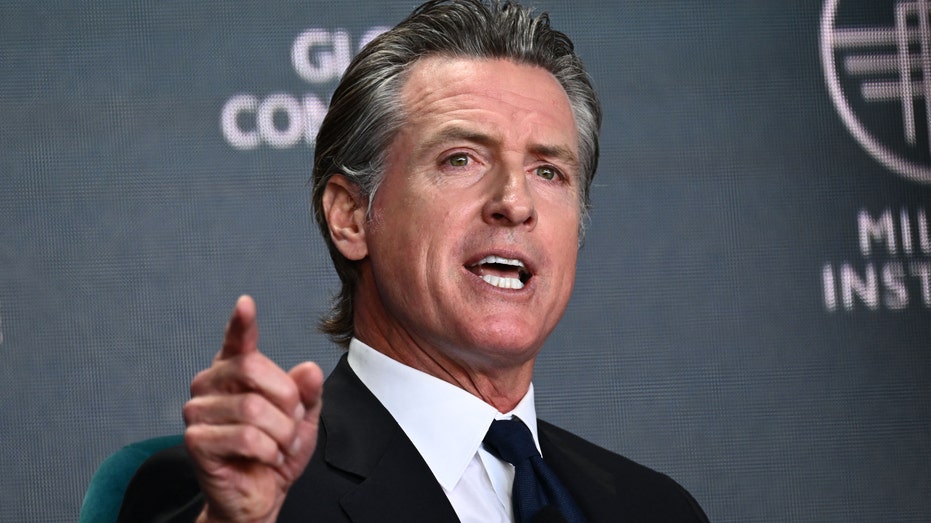
Gov. Gavin Newsom critized fellow Democrats for considering blocking former president Donald Trump from California’s 2024 presidential primary ballot, saying that, “we defeat candidates at the polls.” “There is no doubt that Donald Trump is a threat to our liberties and even to our democracy,” Newsom said in a statement. “But in California, we defeat candidates at the polls.” “Everything else is a political distraction,” Newsom said. RFK JR SLAMS CALIFORNIA LT GOV FOR EYEING BID TO REMOVE TRUMP FROM BALLOT The effort to boot Trump off the ballot has been gaining momentum after Lieutenant Governor Eleni Kounalakis sent a letter to California Secretary of State, Dr. Shirley Weber, and urged her to “explore” all legal options of removing the former President from the state’s ballot. “Based on the Colorado Supreme Court’s ruling in Anderson v. Griswold (2023 CO 63), I urge you to explore every legal option to remove former President Donald Trump from California’s 2024 presidential primary ballot,” the letter to Weber said. In the letter, Kounalakis argued that persuing legal options for removing Trump is about “protecting the fundamental pillars of our democracy.” CALIFORNIA LT. GOV CALLS FOR STATE TO ‘EXPLORE EVERY LEGAL OPTION’ TO REMOVE TRUMP FROM ’24 BALLOT “This decision is about honoring the rule of law in our country and protecting the fundamental pillars of our democracy,” Kounalakis wrote. Newsom’s comments come in the wake of this week’s ruling by the Colorado Supreme Court to remove Trump from the state’s 2024 ballot. The divided court ruled that Trump is ineligible to run for the presidency under the U.S. Constitution’s insurrection clause, arguing that his actions fueled the deadly Jan. 6, 2021, attack on the U.S. Capitol by right-wing protesters aiming to disrupt congressional certification of President Biden’s 2020 election victory. The blockbuster development was immediately condemned from nearly all corners of the GOP. Additionally, Trump’s Republican rivals for their party’s presidential nomination – who are aiming to defeat him at the ballot box – quickly rallied around the former president. Gov. Gavin Newsom and Lt. Governor Eleni Kounalakis did not immediately respond to Fox News Digital’s request for comment. Fox News’ Paul Steinhauser contributed to this report.
House committee to launch investigation into UN agency for alleged ‘troubling connection’ to Hamas

A House Committee is expected to launch an investigation into a United Nations agency that provides aid to Palestinians for alleged ties to Hamas, according to a report. The House Foreign Affairs Committee is planning to investigate the United Nations Relief and Works Agency for Palestinian refugees in the Near East, which is also known as UNRWA, according to the New York Post. Rep. Darrell Issa, R-Calif., told the outlet that there’s evidence of a connection between the UN agency and Hamas. “There is extensive evidence of a troubling connection between UNRWA and Hamas, and it is far deeper than was known,” Issa said. “Congress must now investigate and uncover the extent of what UNRWA knew, what it did, and what it may be hiding from the world.” LIVE UPDATES: ISRAEL AT WAR WITH HAMAS Since the Oct. 7 terrorist attack in Israel carried out by Hamas, troubling reports regarding the UNRWA have emerged. One Israeli citizen taken hostage by the Hamas terrorist group said they were held for 50 days inside an attic belonging to a UNRWA teacher, according to the Jerusalem Post. HAMAS SAYS ‘NO TALK ABOUT PRISONERS OR EXCHANGE DEALS’ UNTIL ISRAEL STOPS MILITARY CAMPAIGN: REPORT The State Department under former President Trump cut ties with UNRWA in 2018, with the agency calling the organization an “irredeemably flawed operation.” However, President Biden reestablished the relationship in June 2021. A spokesperson for Rep. Brian Mast, R-Fla., who chairs the body’s oversight subcommittee, told the Post that “He is also supportive of a probe, to put it mildly.”
‘Did not ask for ceasefire’ in Gaza: Biden after phone call with Netanyahu

White House says the two leaders discussed Israel’s military campaign in Gaza, including its ‘objectives and phasing’. United States President Joe Biden says he did not ask Israeli Prime Minister Benjamin Netanyahu for a ceasefire in the war between Israel and Hamas in Gaza in a telephone call between the two leaders. “I had a long talk with Netanyahu today [Saturday] and it was a private conversation,” Biden told reporters on Saturday. “I did not ask for a ceasefire,” he said, in response to a shouted question. In a statement later, the White House said Biden and Netanyahu discussed Israel’s military campaign in Gaza, including its “objectives and phasing”. Biden “emphasised the critical need to protect the civilian population including those supporting the humanitarian aid operation, and the importance of allowing civilians to move safely away from areas of ongoing fighting,” said the statement. “The leaders discussed the importance of securing the release of all remaining hostages.” The call between the two leaders came a day after the United Nations Security Council (UNSC) passed a resolution calling for the scaling up of aid for Gaza but fell short of calling for a ceasefire or a pause in weeks-long fighting. The resolution, which demanded “immediate, safe and unhindered” deliveries of life-saving aid to Gaza “at scale”, was passed after UNSC members wrangled for days over its wording and toned down some provisions at Washington’s insistence. The US and Russia abstained from the vote, whose impact on the ground, aid groups fear, will be close to nil. “This resolution has been watered down to the point that its impact on the lives of civilians in Gaza will be nearly meaningless,” Avril Benoit, the executive director of Doctors Without Borders, said in a statement. “The way Israel is prosecuting this war, with US support, is causing massive death and suffering among Palestinian civilians and is inconsistent with international norms and laws,” Benoit added. The US also opposed the demand to create a UN monitoring mechanism for aid, assuring Israel would continue to have a role in inspecting deliveries. Netanyahu on Saturday “expressed his appreciation” for the stance taken by the US at the UN, his office said. He also “made it clear that Israel will continue the war until all its goals are completed”. More than 200 killed in 24 hours Israel has continued to bomb Gaza for nearly 80 days, with more than 200 people killed in the past 24 hours. Gaza’s Health Ministry said the death toll since the start of the attacks rose to 20,258 on Saturday, most of them being women and children. According to UN estimates, the war has displaced 1.9 million of Gaza’s 2.3 million population. The UN has described the situation in Gaza as “beyond catastrophic”, with residents struggling to find food, fuel and water, while living in crowded shelters or tents. In a post on X, the UN relief agency for Palestinian refugees (UNRWA) said it “cannot deliver meaningful aid” while the Israeli bombardment of Gaza continues. “It is extremely tragic that politics stand in the way of 2.2 million people’s survival in Gaza,” UNRWA spokesperson Tamara al-Rifai said at a news conference on Saturday. Adblock test (Why?)
Biden admin’s top officials attempted to ‘conceal’ Chinese spy balloon from public, Congress exposed: report

Despite Biden administration officials assuring the American public that the Chinese spy balloon did not collect and transmit data, a previously unreported phone call paints a different picture of top officials hiding information about the balloon. According to NBC News, a previously unreported Jan. 27 phone call between President Joe Biden’s top military adviser, Gen. Mark Milley and NORAD chief Gen. Glen VanHerck sheds lights about China’s surveillance balloon. The administration initially hoped to keep the balloon’s existence a secret from Congress and the public, the outlet reported, citing multiple former and current administration and congressional officials. “Before it was spotted publicly, there was the intention to study it and let it pass over and not ever tell anyone about it,” one former senior U.S. official told NBC. AIR FORCE WARNS CHINESE COMPANY’S NORTH DAKOTA MILL WOULD BE ‘SIGNIFICANT’ NATIONAL SECURITY THREAT A senior Biden administration official denied allegations that they attempt to conceal the incident, saying decisions were made to protect sensitive intelligence capabilities. CHINA SPY BALLOON SHOWS COUNTRY IS PREPARING CITIZENS FOR WAR THAT COULD COME ‘AT ANY POINT’ “To the extent any of this was kept quiet at all, that was in large part to protect intel equities related to finding and tracking them,” the official told NBC. “There was no intention to keep this from Congress at any point.” During the Jan. 27 phone call, Milley called VanHerck, and said the Pentagon planned to send up F-22 jets and other aircraft alongside the object and attempt to gauge its characteristics. US NAVY RECOVERS ‘SIGNIFICANT’ PORTION OF CHINESE SPY BALLOON OFF SOUTH CAROLINA, DEFENSE OFFICIAL SAYS Soon after that call, U.S. military jets used targeting pods to determine the object was a balloon the size of three school buses and equipped with a massive surveillance payload but no offensive capabilities, NBC reported. Biden was not briefed on the balloon until Feb. 1, NBC reported. The public did not hear about the Chinese spy balloon until Feb. 2, when NBC News broke the story. VanHerck warned that the Chinese balloon program remains active and that the U.S. has failed to develop systems to detect and track the craft. “It exposed significant gaps, long range gaps, for us to be able to see potential threats to the homeland.” VanHerck said. “I think that opened the eyes of a lot of people.” The top military official said that the U.S. is “not where it needs to be” in the development of “deterrence options.” “Time is the opportunity to create deterrence options or, if required, defeat options,” he said, adding that the U.S. is still “not where we need to be.” According to the outlet, Biden officials privately lamented the public outcry and consequences of the spy balloon’s reveal in early 2023. Officials, in their view, claimed that the spy balloon’s reputational consequences for China and U.S. relations posed a far graver threat than the balloon entering U.S. airspace. “It caused so many problems,” one senior administration official said. President Biden’s White House has stated the delay in shooting down the surveillance craft was due to safety precautions as the balloon was carrying several thousand pounds of equipment. The U.S. eventually shot down the craft over open water off the coast of South Carolina, leading to questions about why that wasn’t done as it crossed water near Alaska.
Gaza media office says 100 journalists killed since Israeli attacks began

Palestinian journalist Muhammed Abu Hweidy latest to be killed in Israeli attack on his home in the east of Gaza City. At least 100 journalists have been killed since Israel’s war on Gaza began on October 7, according to new figures released by the government media office in Gaza. Palestinian journalist Muhammed Abu Hweidy was the latest to be killed in an Israeli air raid on his home in the east of Gaza City on Saturday, the media office said. “The number of journalists killed has risen to 100, men and women, since the start of the brutal war on the Gaza Strip, after the martyrdom of journalist Mohammed Abu Hweidy in an Israeli airstrike in the Shujaiya neighborhood,” the office said on Telegram social media. Palestinian officials in Gaza say the number could be much higher. However, according to a tally by the Committee to Protect Journalists, at least 69 journalists have been killed in the conflict, including Al Jazeera Arabic’s cameraman Samer Abudaqa. More than 50 media premises or offices in Gaza have been completely or partially destroyed by Israeli attacks. Hundreds of Palestinian journalists and their families have been forcibly displaced to the south. The media workers were also forced to abandon their reporting equipment in offices in the north to live and report under difficult conditions amid frequent communication blackouts. Journalists working in areas of armed conflict are protected under international humanitarian laws, which Israel is accused of violating repeatedly. Palestinian journalists have said Israel is deliberately targeting them to silence their stories. Tim Dawson, deputy general secretary at the International Federation of Journalists, told Al Jazeera it is becoming “impossible to ignore such a terribly, terribly high toll” of journalists. “I don’t think we have seen a death toll of journalists to this concentration in any conflict that I can think of. There were about 1,000 journalists in Gaza at the beginning of this conflict. And while there are slightly different counts of precisely how many have died, if between seven-and-a-half and 10 percent have died, that is an extraordinarily high number,” he said. Dawson said the journalists in Gaza “only have cameras, microphones and notebooks and continue doing their work despite this absolutely mind-blowing death toll”. When asked by Al Jazeera if Israel is targeting journalists, he said some Palestinian journalists have told him they “received threatening calls from people” purporting to be from the Israeli military, “warning them that they are going to be targeted or that their families are going to be targeted in the coming days”. Adblock test (Why?)
Will motion passed by UN Security Council on Gaza have any impact?
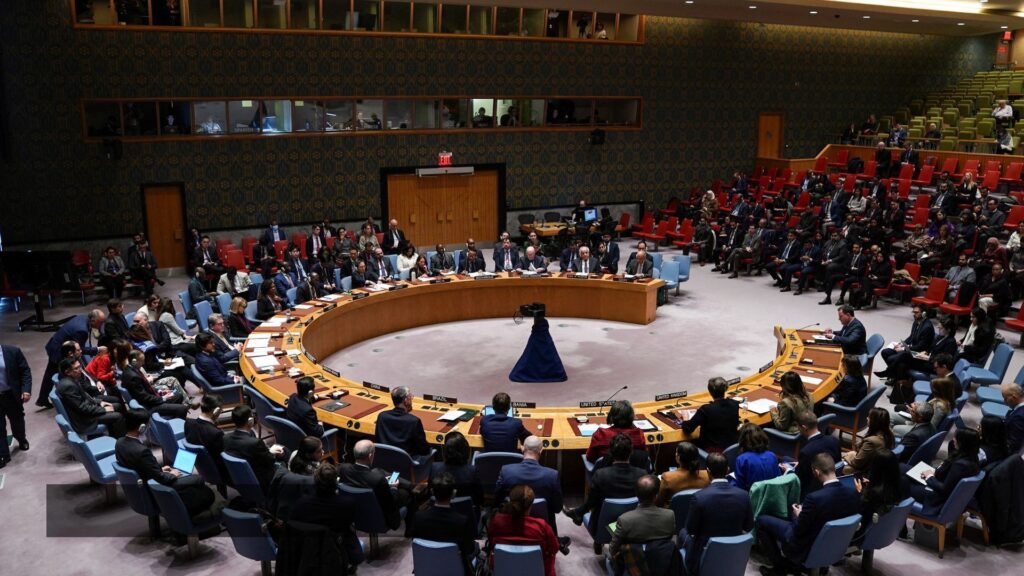
Resolution on aid has been watered down to avoid a US veto and omits call for an end to hostilities. The United Nations Security Council has passed a motion on the war on Gaza. It comes after two months of Israeli attacks that have killed more than 20,000 Palestinians. The resolution – weakened by pressure from the United States – calls for more aid but not for Israel to stop its bombardment. So, will it have any impact? Presenter: Dareen Abughaida Guests: Scott Lucas – professor of US and international relations at University College Dublin and founder and editor of online news site EA Worldview Dmitry Babich – political analyst at the InoSMI internet media project in Moscow Maleeha Lodhi – former Pakistan permanent representative and ambassador to the UN Adblock test (Why?)
Rebel attack in western Burundi kills at least 20
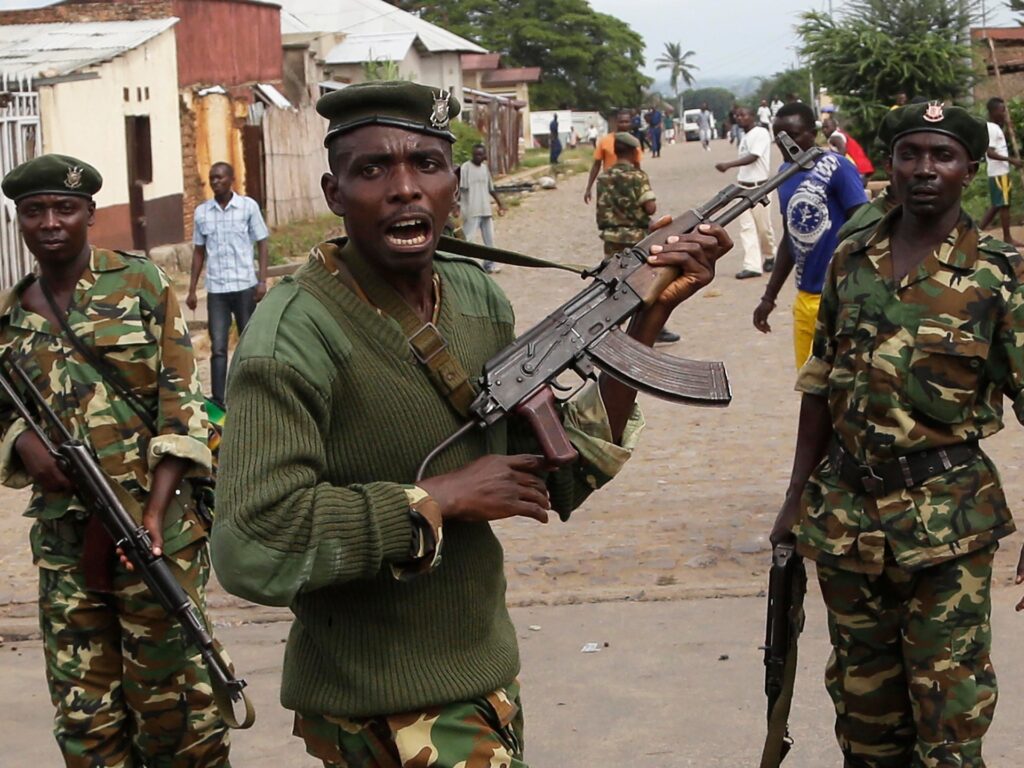
It is the second attack in two weeks by the RED-Tabara rebels, who have been largely inactive inside Burundi since 2021. Gunmen have killed at least 20 people and wounded nine others near Burundi’s western border with the Democratic Republic of the Congo (DRC), an official has told reporters. Those killed in the Friday evening raid on the town of Vugizo included 12 children, two pregnant women and a police officer, government spokesperson Jérôme Niyonzima said on Saturday. The attack was claimed by the RED-Tabara rebel group, considered a “terrorist” group by the Burundian authorities. The attack targeted nine homes in the town, close to the Lake Tanganyika border with the DRC. At least nine others wounded in the attack have been hospitalised. The RED-Tabara rebel group, which has been battling Burundi’s government from bases in the eastern DRC since 2015, claimed on the social media platform X to have killed nine soldiers and one police officer. The group denied having targeted civilians. Local residents said they heard sounds of gunfire and explosions during the attack. Witnesses who spoke to the Associated Press said the rebels appeared to be wearing Burundian Army uniforms and civilians were “left to their own devices” after the military and police fled. “We realised they were attackers when they attacked the police position guarding the border,” said Priscille Kanyange, a farmer. “Many people here were injured by bullets [as they were] trying to flee.” Another farmer, Innocent Hajayandi, who witnessed the attack, said security forces fled, “leaving the residents to their own devices”. André Kabura, a grocery shop owner who was wounded in both legs in the gunfire, said the military and police were slow to regroup and fend off the attackers. Two military and security sources told the AFP news agency the attack targeted “a military position”. “The civilians were caught in the crossfire and were killed, and then the assailants retreated to DRC,” a senior military official told the AFP on condition of anonymity, confirming the toll of 20. The attack was the second in as many weeks inside Burundi by the rebels, who have not been active inside the country since September 2021, when they carried out a series of attacks, including on the Bujumbura airport. Since then, their activities have been taking place in the DRC’s South Kivu province. But on December 11, they exchanged fire with the military in northwestern Burundi. On Friday, Burundian President Évariste Ndayishimiye told army, police and intelligence officers to remain vigilant, warning that “the enemy never sleeps even if we have security”. Adblock test (Why?)
‘Pseudeo-legitimate’ travel agencies in Senegal offering ‘complete packages’ to get migrants to US border
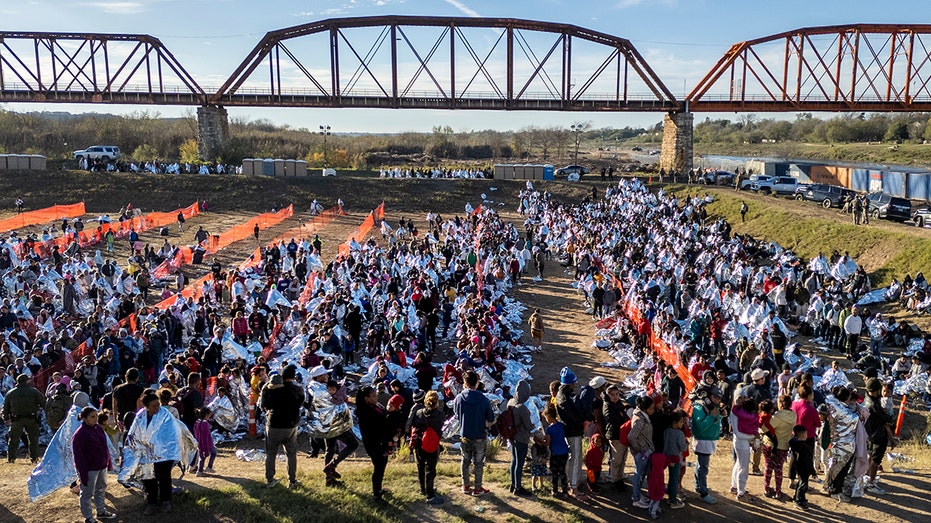
“Pseudo-legitimate” travel agencies are emerging in Senegal and offering migrants a “complete package” to get to the United States‘ southern border, where millions have tried to get into the U.S. illegally, officials said this week. A Customs and Border Protection (CBP) official told Fox News that the agencies are emerging in cities like Dakar, Senegal’s capital, and offer free travel to Europe to Senegalese nationals. Those agencies offer visa-free travel to Europe, which then allows them to move from there to the Western Hemisphere, where they can travel to the U.S. and either try to get in at a port of entry using the CBP One app – where 1,600 are let in each day – or enter illegally between ports of entry in hope of being released into the U.S. with a court date in the distant future. MIGRANT CRISIS INCREASING STRAIN ON BORDER OFFICIALS, IMMIGRATION COURTS WITH MASSIVE NUMBERS “They sell complete packages to connect them to a smuggling organization that will then facilitate their movement up to the border,” the official said. CBP said it is working with partners throughout the hemisphere and across the globe to make sure they are encouraging people’s ability to access protections, while also taking action to prevent those seeking to exploit different travel mechanisms. The Senegalese travel agencies offer a glimpse of the global nature of the migrant crisis and how migrants from across the globe are being pulled to the U.S.-Mexico border. Beyond countries in the Western Hemisphere, U.S authorities have encountered migrants from over 150 countries coming to the border hoping to be processed and released into the interior. Meanwhile, the traffic at the border is not slowing down. On Friday CBP announced that there were 242,418 migrant encounters at the southern border in November, including migrant encounters at ports of entry and illegal immigrant encounters by Border Patrol between ports of entry. That is the highest November on record and the third-highest month of the crisis so far. NOVEMBER SAW NEARLY QUARTER OF A MILLION MIGRANT ENCOUNTERS AMID NEW BORDER SURGE Announcing the November numbers, acting CBP Commissioner Troy Miller said that the agency is facing a “serious challenge” and that it and federal partners need more resources from Congress as requested in the supplemental funding request. Meanwhile, new data released this week from the Transactional Records Access Clearinghouse (TRAC) at Syracuse University showed that the immigration court backlog now stands at over three million. Sources have also told Fox News that Border Patrol has released more than 386,000 illegal immigrants into the U.S. with Notices to Appear since October. MIGRANT ENCOUNTERS AT BORDER SOAR PAST THE 200K MARK IN DECEMBER, WITH OVER A WEEK STILL TO GO Republicans have criticized the administration for releasing migrants into the interior and have called for greater restrictions on asylum and the use of humanitarian parole by the administration. The administration has said it is dealing with a hemisphere-wide crisis and needs more funding and comprehensive immigration reform to reduce backlogs and fix a “broken” system. There are ongoing negotiations in Washington about the Biden administration’s request for supplemental funding – including $14 billion for border funding. But Republicans have demanded more asylum restrictions, something that some Democrats have called on the Biden administration to reject. While there had been hope of securing a deal before the end of the year, lawmakers have said this week that there won’t be a deal until January at the earliest. Fox News’ Griff Jenkins contributed to this report.
China considers revising gaming rules after tech giants lose billions

Draft document outlining restrictions caused major stir as tech stocks tumbled, sent investors into a panic. Chinese authorities have said they may revise newly drafted online gaming rules shortly after the planned restrictions caused major tech companies to lose billions of dollars. State broadcaster CCTV reported on Saturday that the authorities have heard the “concerns and opinions raised by all parties”, adding that “the State Press and Publication Administration will study them carefully and further revise and improve them”, referring to the media regulator. The authorities released a draft on Friday with a wide range of rules and regulations aimed at curbing online spending and rewards in video games. Its impact was immediate, dealing a massive blow to the world’s biggest games market. Investors went into a tailspin, leading to as much as $80bn in market value being wiped off from China’s two biggest companies, industry leader Tencent Holdings and Netease. According to the new rules, online games would be banned from giving players rewards if they log in every day, if they spend on a game for the first time, or if they spend several times on a game consecutively. All are common incentive mechanisms in online games. CCTV reported that regulators may now change the wording of sections of the draft rules that limit the ability to encourage daily logins and wallet top-ups. China has become increasingly tough on video games over the years. Its first major move against the gaming sector came in 2021, when Beijing set strict playtime limits for under-18s and suspended approvals of new video games for about eight months, citing gaming addiction concerns. As a result of the crackdown, 2021 and 2022 were the most difficult years on record for the Chinese gaming industry as total revenue shrank for the first time. China revised its position last year and started approving new games again, but regulators have continued to set their sights on curbing the time children play in-game and the amount of money they spend. As part of Friday’s draft, which signifies the strictest limits yet, games are also banned from offering probability-based draw features to minors, and from enabling the auction of virtual gaming items. The new rules reflected Beijing’s concerns about user data, requiring game publishers to store their servers within China. The draft comes as China’s video game market has returned to growth this year as domestic revenue rose 13 percent to 303 billion yuan ($42.6bn), according to the industry association CGIGC. Due to the sheer size and impact of Chinese gaming giants, the global video games market could also be affected in the long run. Several United States and European video games developers saw shares take a hit after Friday’s announcement, but the losses were small when compared with Tencent’s 16 percent tumble. Friday’s news wiped about $54bn off the company’s share value, according to Bloomberg News. The administration is seeking public comment on the rules by January 22. [embedded content] Adblock test (Why?)
The US is no country for old men
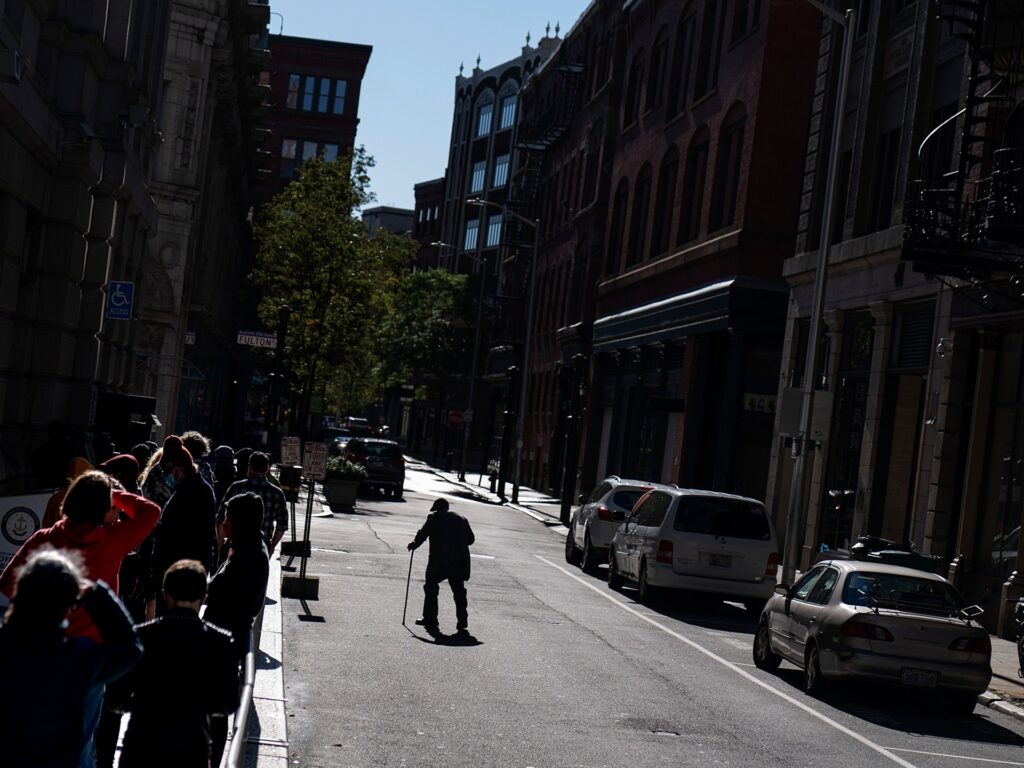
Shortly prior to his death from prostate cancer in August of this year at the age of 72, my father emerged from a state of muteness to recite, with a burst of energy, the 1927 poem, Sailing to Byzantium, by William Butler Yeats, which begins: “That is no country for old men.” My mother, my uncle, and I were present for the impromptu performance, which took place in my father’s bed in Washington, DC, where he had commenced in-home hospice care after the chemotherapy treatments that had been forced upon him by profit-oriented doctors had accelerated his demise. This was but one of many poems my father had memorised as a young man intent on honing his intellectual credentials; my mother and uncle – who in their youth had also fallen under the influence of my dad’s cerebral pursuits – joined in on the lines they remembered. Having completed his vehement recitation, my father resumed his generally mute state, which was thereafter punctuated only by intermittent outbursts about wanting to die. I have no way of knowing what was going through my dad’s mind during that final poetic eruption, but the first line of the Yeats poem did seem to be a fitting commentary on the country in which we found ourselves – the one where we had all been born and the one my parents and I had spent years avoiding. My mom and dad had only relatively recently returned to reside in the homeland after nearly eight years in Barcelona; I had flown into Washington in August from Turkey, which was one of my regular stops in a 20-year self-imposed exile. Indeed, my father’s final months had merely confirmed that the US is “no country for old men”. Counterproductive chemotherapy treatments were but one of the ways he had been milked for all he was worth, before being turned over as prey to the lucrative realm of funeral and cremation services. For example, for a one-month prescription of the prostate cancer drug Xtandi, a medication developed with none other than US taxpayer money, my father had been charged $14,579.01 – ie, more than many people in the United States earn in several months. For folks lacking the means to pursue healthcare and other basic needs, US capitalism can be deadly, too. And while US society specialises in oppressing a wide range of demographics – minus, of course, the elite minority that thrives on acute inequality – the treatment of the elderly is particularly cynical. Having outlived their labour-based exploitability as cogs in the capitalist machine, older people become decaying objects from which profit must continue to be extracted until the very last minute. According to the results of a West Health-Gallup survey published in 2022, approximately one in four Americans aged 65 and older and three in 10 Americans between the ages of 50 and 64 said they had sacrificed basic needs, such as food, to pay for healthcare. The study found that older women and Black Americans were disproportionately affected and that punitive health care costs constituted a significant source of stress in the daily lives of older Americans, with stress naturally only exacerbating existing medical issues. Add vampire-like insurance companies to the mix, and the panorama becomes ever more morbid. The prohibitive fees associated with many programmes – coupled with insurance outfits’ frequent refusal to cover lifesaving treatments – means that life itself continues to be a privilege and not a right in the United States. Then there’s the $34bn assisted-living industry, which a recent Washington Post investigation revealed to be plagued by wanton neglect despite charging an average of $6,000 a month per resident. Since 2018, the Post reported, more than 2,000 residents have wandered off unnoticed from such facilities, and nearly 100 of them have died after doing so. So much for “assisted living”. To be sure, the loneliness and isolation that so often attends old age in the US does nothing to increase life expectancy; nor does the unique stigma that US “culture” attaches to ageing. As the American Psychological Association (APA) has noted, institutionalised ageism in the United States entails a “host of negative effects, for people’s physical and mental wellbeing and society as a whole”. Granted, loneliness and isolation are often lifelong afflictions for inhabitants of the so-called “land of the free”, where the collective mental wellbeing is hardly helped by a dog-eat-dog insistence on individual success at the expense of communal and family bonds and the conversion of human beings into consumerist automatons. And the cutthroat, transactional nature of existence in the US culminates, appropriately, with elderly bodies being put up for grabs by pharmaceutical companies, nursing homes, and the corporate racket known as the US healthcare system. That said, the US is, in fact, a fine country for some old men – such as former warmongering diplomat Henry Kissinger, who perished at home in Connecticut in November at the ripe old age of 100 after spending a good part of his life causing the deaths of countless people worldwide. Not long after my father’s death in August, I fell into conversation with a Bolivian man in his 50s who had resided in Washington for more than two decades and who expanded on the “no country” theme. He planned to stick it out for another 10 to 15 years before returning to his home city of Cochabamba, he told me, because he couldn’t afford to be old in the US. And while the US may be “no country for old men”, it’s not much of a country for anyone else, either. The views expressed in this article are the author’s own and do not necessarily reflect Al Jazeera’s editorial stance. Adblock test (Why?)