

Australia PM Albanese launches gun ‘buyback’ plan after Bondi Beach attack
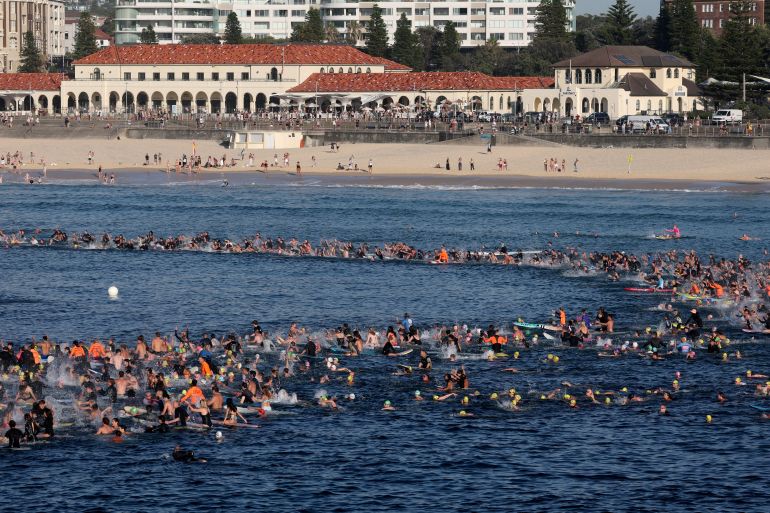
Albanese said Australia has more guns now than 30 years ago, when the country’s deadliest-ever mass shooting took place. Australia will launch a national gun buyback scheme, Prime Minister Anthony Albanese has announced, as the country continues to come to terms with the deadly attack on a Jewish holiday event at Sydney’s Bondi Beach that left 15 people dead. Albanese called the plan the country’s biggest gun buyback since 1996 – the year of Australia’s deadliest mass shooting in modern history, the Port Arthur massacre in the island state of Tasmania – and said authorities will purchase surplus, newly-banned and illegal firearms. Recommended Stories list of 3 itemsend of list “Right now, there are more guns in Australia than there were during Port Arthur. We can’t allow that to continue,” Albanese told a news conference on Friday, adding that there are currently more than four million firearms in the country. “Non-citizens have no need to own a gun. And someone in suburban Sydney has no need to own six … The terrible events of Bondi show we need to get more guns off our streets,” he said. Albanese added that authorities in Australia’s states and territories will be tasked with collecting the weapons and processing payments for surrendered firearms under the scheme. Federal police will then be responsible for destroying them. “We expect hundreds of thousands of firearms will be collected and destroyed through this scheme,” Albanese added. Aided by some of the toughest gun restrictions globally, Australia has one of the lowest gun homicide rates in the world. Restrictions were tightened after a lone gunman, armed with semiautomatic weapons, killed 35 people at the Port Arthur tourist site almost 30 years ago. Advertisement The massacre shocked the country, with authorities soon after launching a major gun amnesty and buyback scheme that removed more than 650,000 newly-prohibited firearms from circulation. ‘We need to do more to combat this evil scourge’ Sunday’s shooting in Sydney’s Bondi Beach area – in which two attackers, named as father and son Sajid Akram and Naveed Akram, went on a shooting spree and killed 15 people – has had a similarly jolting impact on Australian society as the Port Arthur massacre and prompted self-reflection. Albanese said 50-year-old Sajid – who was shot dead at the scene – and 24-year-old Naveed – who was charged with “terrorism” and murder offences after he awoke from a coma on Tuesday – were inspired by “Islamic State ideology”. On Thursday, Albanese announced tougher hate speech laws as he acknowledged the country had experienced a rising tide of anti-Jewish hate since the Hamas-led October 7, 2023, attacks on Israel, and Israel’s genocidal war on Gaza. Albanese said rising anti-Semitism in Australia “culminated on Sunday in one of the worst acts of mass murder that this country has ever seen”. “It was an attack on our Jewish community – but it was also an attack on the Australian way of life,” he said. “Australians are shocked and angry. I am angry. It is clear we need to do more to combat this evil scourge, much more,” he added. The prime minister also announced on Friday that Australia will hold a national day of reflection this Sunday – one week after the mass shooting. Albanese urged Australians to light candles at 6:47pm (07:47 GMT) on Sunday, December 21 – “exactly one week since the attack unfolded”. “It is a moment to pause, reflect, and affirm that hatred and violence will never define who we are as Australians,” he told reporters. Earlier on Friday, hundreds of people plunged into the ocean off Bondi Beach in another gesture to honour the dead. Swimmers and surfers paddled into a circle as they bobbed in the gentle morning swell, splashing water and roaring with emotion. “They slaughtered innocent victims, and today I’m swimming out there and being part of my community again to bring back the light,” security consultant Jason Carr told the AFP news agency. “We’re still burying bodies. But I just felt it was important,” the 53-year-old said. “I’m not going to let someone so evil, someone so dark, stop me from doing what I do and what I enjoy doing,” he said. Surfers and swimmers congregate in the surf at Bondi Beach as they participate in a tribute for the victims of Sunday’s Bondi Beach attack, in Sydney, on December 19, 2025 [David Gray/AFP] Adblock test (Why?)
EU delays trade deal with South America’s Mercosur bloc as farmers protest
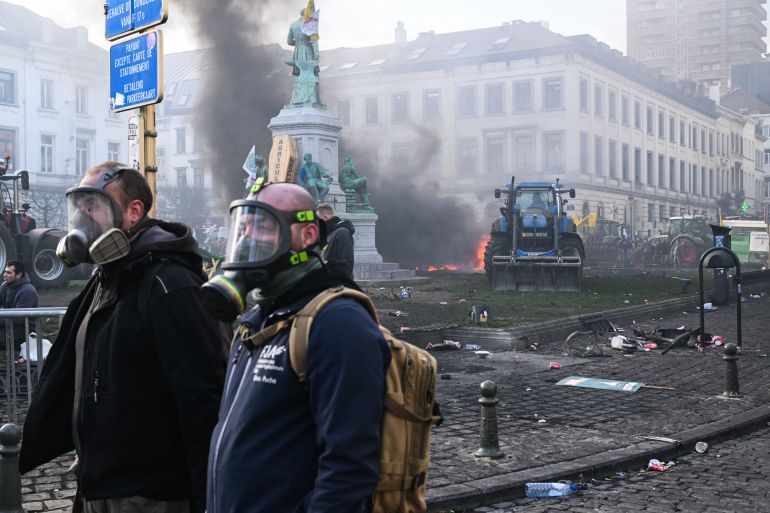
EU delays Mercosur trade deal until January amid farmer protests and opposition from France and Italy. The European Union has delayed a massive free-trade deal with South American countries amid protests by EU farmers and as last-minute opposition by France and Italy threatened to derail the agreement. European Commission chief spokesperson Paula Pinho confirmed on Thursday that the signing of the trade pact between the EU and South American bloc Mercosur will be postponed until January, further delaying a deal that had taken some 25 years to negotiate. Recommended Stories list of 4 itemsend of list Commission President Ursula von der Leyen was expected to travel to Brazil on Saturday to sign the deal, but needed the backing of a broad majority of EU members to do so. The Associated Press news agency reported that an agreement to delay was reached between von der Leyen, European Council President Antonio Costa and Italian Prime Minister Giorgia Meloni – who spoke at an EU summit on Thursday – on the condition that Italy would vote in favour of the agreement in January. French President Emmanuel Macron had also pushed back against the deal as he arrived for Thursday’s summit in Brussels, calling for further concessions and more discussions in January. Macron said he has been in discussions with Italian, Polish, Belgian, Austrian and Irish colleagues, among others, about delaying the signing. “Farmers already face an enormous amount of challenges,″ the French leader said. The trade pact with Argentina, Brazil, Bolivia, Paraguay and Uruguay would be the EU’s largest in terms of tariff cuts. But critics of the deal, notably France and Italy, fear an influx of cheap commodities that could hurt European farmers, while Germany, Spain and Nordic countries say it will boost exports hit by United States tariffs and reduce reliance on China by securing access to key minerals. Brazil’s President Lula says Italy’s PM Meloni asked for ‘patience’ The EU-Mercosur agreement would create the world’s biggest free-trade area and help the 27-nation European bloc to export more vehicles, machinery, wines and spirits to Latin America at a time of global trade tensions. Advertisement Al Jazeera’s Dominic Kane, reporting from Berlin, said Germany, Spain and the Nordic countries were “all lobbying hard in favour of this deal”. But ranged against them were the French and Italian governments because of concerns in their powerful farming sectors. “Their worry being that their products, such as poultry and beef, could be undercut by far cheaper imports from the Mercosur countries,” Kane said. “So no signing in December. The suggestion being maybe there will be a signing in mid-January,” he added. “But there must now be a question about what might happen between now and mid-January, given the powerful forces ranged against each other in this debate,” he added. Farmers wear gas masks at the Place du Luxembourg near the European Parliament, during a farmers’ protest on December 18, 2025 [Nicolas Tucat/AFP] Mercosur nations were notified of the move, a European Commission spokeswoman said, and while initially reacting with a now-or-never ultimatum to its EU partners, Brazil opened the door on Thursday to delaying the deal’s signature to allow time to win over the holdouts. Brazil’s President Luiz Inacio Lula da Silva said Italy’s Meloni had asked him for “patience” and had indicated that Italy would eventually be ready for the agreement. The decision to delay also came hours after farmers in tractors blocked roads and set off fireworks in Brussels to protest the deal, prompting police to respond with tear gas and water cannon. Protesting farmers – some travelling to the Belgian capital from as far away as Spain and Poland – brought potatoes and eggs to throw and waged a furious back-and-forth with police while demonstrators burned tyres and a faux wooden coffin bearing the word “agriculture”. The European Parliament evacuated some staff due to damage caused by protesters. Adblock test (Why?)
‘Jahannum main jaye’: Giriraj Singh’s shocking statement to woman defending Nitish Kumar over Hijab row lands him in trouble, what happened?
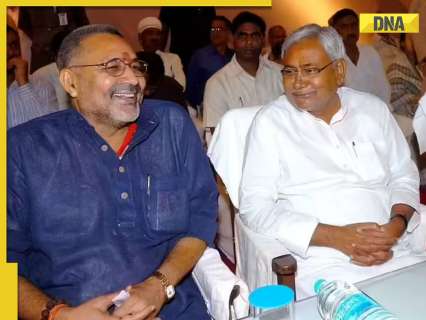
Bihar Chief Minister Nitish Kumar was under scrutiny due to the Hijab controversy for the fourth day on Thursday. However, Union minister and BJP leader Giriraj Singh came to his defence after he pulled down a Muslim woman’s veil in public.
School Holiday December 19: Schools to remain closed in THESE states today due to…; Check state-wise list here

Extreme cold waves, rising pollution, and local holidays are causing school closures and schedule changes across India on December 19, 2025. Delhi, Uttar Pradesh, Goa, Jammu & Kashmir and Tamil Nadu are among the states affected, with some schools shifting to online or hybrid modes.
Good news for commuters: Gurugram to get metro services on THESE 2 new routes, preparations underway; Here’s what we know so far
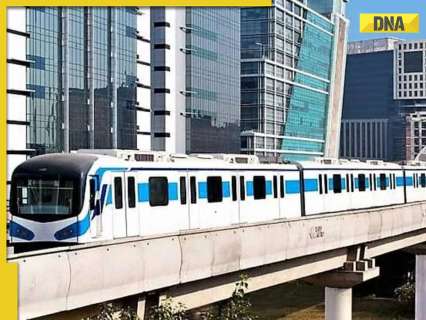
Gurugram is set to expand its metro network as HMRTC approves DPRs for two new corridors connecting Bhondsi, the railway station, Golf Course Extension Road and Sector 5. Traffic studies will begin soon, with reports expected in six months.
Delhi-NCR pollution: Air quality remains ‘very poor’, hits ‘severe’ in THESE areas; over 61,000 PUCCs issued in 24 hrs

According to the Central Pollution Control Board, the Air Quality Index in Delhi is at 387 as of 6 am, falling into the ‘very poor’ category. Several other areas reeled under ‘severe’ levels, with Anand Vihar recording an AQI of 437, ITO at 409 and Jahangirpuri at 400.
One year after a deadly train wreck, a West Texas town awaits help to avoid more tragedy

As oil and gas industry traffic continues to speed through Pecos, TxDOT said it is working to find $194 million to build an alternative route away from the heart of the city.
Texas tracks the long-term outcomes of public school students. See how your school district compares here.

Newly-released state data tracked the long-term outcomes of public school students who enrolled a decade ago.
Texas is approving money for flood warning systems, but will it be enough to build Kerr County’s?

The county where more than 100 died in July floods wants to quickly build a $5 million flood warning system.
More Texas students complete journey through college, but low-income students still left behind

Economically disadvantaged students are much less likely to go on and attain degrees, according to new state data that tracks long-term outcomes.