

LIVE: Barcelona vs PSG – UEFA Champions League

blinking-dotLive MatchLive Match, Follow our live build-up with full team news before our text commentary stream of the league phase encounter. Published On 1 Oct 20251 Oct 2025 Click here to share on social media share2 Share Adblock test (Why?)
Mysterious, majestic; Sudan’s Nuba Mountains

Published On 1 Oct 20251 Oct 2025 Click here to share on social media share2 Share The skyline of the vast and rugged Nuba Mountains in Sudan, stretching across the south of the country’s South Kordofan region, is defined by rocky hills and scattered huts. Constant war has put pressure on the region’s Nuba people for decades, as the government in Khartoum starved and bombed them for decades after the Sudan People’s Liberation Movement-North (SPLM-N), the rebel group in control, fought for autonomy in the mountains. More recently, ethnic cleansing campaigns by the paramilitary Rapid Support Forces (RSF) have further haunted the local population. Then, at the start of this year, the SPLM-N picked a side in the war, allying with the RSF, a group accused of genocide, war crimes and ethnic cleansing, which has battled the Sudanese Armed Forces (SAF) for control of the country since 2023. The pact stirred deep uncertainty and mixed emotions among residents of the Nuba Mountains. Some residents, scarred by past RSF abuses, regard the move with suspicion, but many are too afraid to speak openly, choosing instead to trust that their leaders’ decision will bring peace to the region. Despite lingering fear, many hope the alliance could open a path to stability and peace – something desperately needed after decades of continual wars. Conflict has brought hunger to the Nuba Mountains more than once, its spectre looming larger now that the new alliance might bring more fighting. In 2024, a year into the war, famine was declared in parts of the mountains, driven by aid blockages by the warring parties, failed harvests and locust swarms. Advertisement The local communities and the more than one million internally displaced people who have arrived in the region since the war began in 2023 survived on leaves and scraps, and continue to be food insecure. Doctors across the region report a surge in malnutrition, especially among children and pregnant women, and warn of a silent mental health crisis among the displaced. And yet, amid this devastation, a powerful spirit of solidarity endures. Communities reach across lines of faith and geography to support one another. Local communities have welcomed the internally displaced into their homes, and those who settled in camps have formed tight-knit communities that help each other. Adblock test (Why?)
A history of US government shutdowns: Every closure and how long it lasted
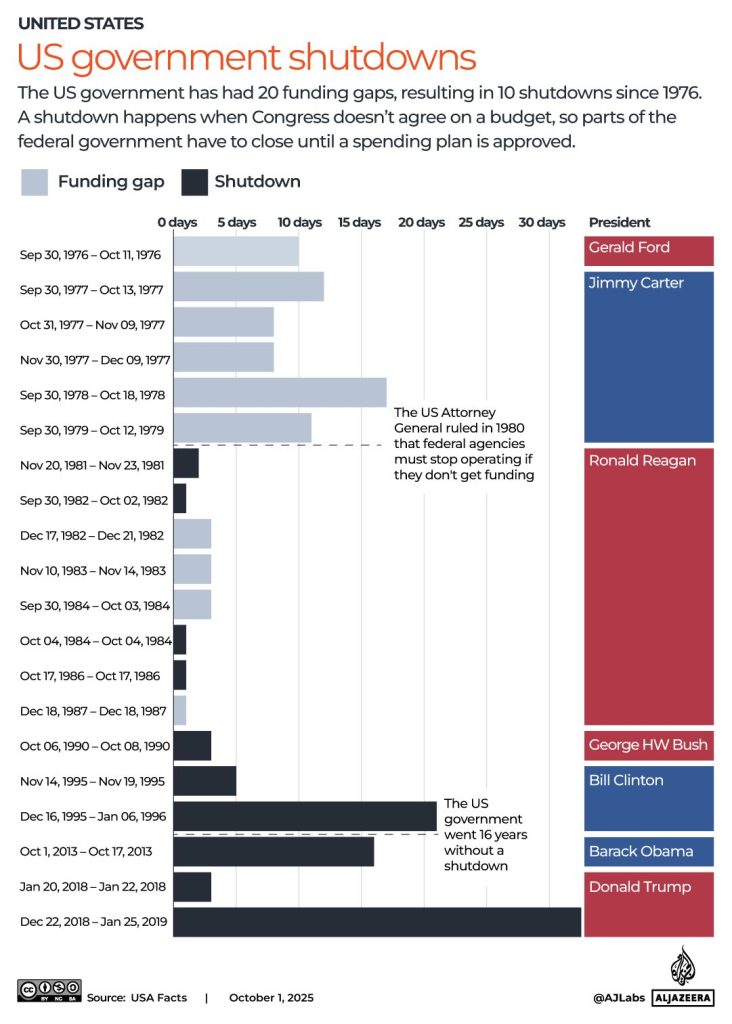
The United States federal government shut down at 12:01am East Coast time (04:01 GMT) on Wednesday after Congress failed to pass a new spending bill, forcing operations considered inessential to close. President Donald Trump has threatened to use the budget deadlock to push through mass layoffs of federal employees. Democrats and Republicans remain divided over spending priorities as Democrats push to protect healthcare, social programmes and foreign aid while Republicans demand cuts. This is not the first time Washington has faced such a standoff. The graphic below shows every US funding gap and government shutdown since 1976, including how long each lasted and under which administration it occurred. (Al Jazeera) What is a government shutdown? A government shutdown happens when Congress does not agree on a budget, so parts of the federal government have to close until a spending plan is approved. Shutdowns tend to happen in October because the government’s fiscal year runs from October 1 to September 30. How many times has the government shut down? The current budget process was established in 1976. Since then, the government has had 20 funding gaps, resulting in 10 shutdowns. A funding gap occurs whenever Congress misses the deadline to pass a budget or a stopgap spending bill (also called a continuing resolution), leaving the government without legal authority to spend money. A single shutdown can involve multiple funding gaps if temporary funding measures expire before a long-term agreement is reached. A shutdown happens only if government operations actually stop because of that funding gap. Advertisement Before the 1980s, funding gaps did not usually lead to shutdowns, and agencies kept operating, assuming funding would be restored soon. After 1980, Attorney General Benjamin Civiletti issued legal opinions stating that, under federal law, agencies may not spend money without congressional approval. Only essential services – such as national security, air traffic control and law enforcement – could continue. Since 1982, with this new legal basis in place, funding gaps have more often resulted in full or partial government shutdowns until Congress resolves the standoff. When was the last government shutdown? The last government shutdown occurred in December 2018 and January 2019 after President Donald Trump, then in his first term, and Democratic politicians hit an impasse over the president’s request for $5bn in funding for a wall on the US-Mexico border, a demand the Democrats opposed. When was the longest shutdown? The last shutdown was also the longest in US history, lasting 35 days from December 22, 2018, to January 25, 2019, when Trump announced he had reached a tentative deal with congressional leaders to reopen the government for three weeks while negotiations on the border wall continued. What happens during a shutdown? During a government shutdown, nonessential federal services are halted or reduced, and many government employees are furloughed, or placed on unpaid leave. Meanwhile, essential personnel – such as military service members, law enforcement officers and air traffic controllers – are required to keep working, often without pay until funding is restored. How are government shutdowns resolved? Shutdowns are typically resolved when Congress passes a continuing resolution, which provides short-term funding while negotiations for a longer-term budget continue. Since 1990, every shutdown has ended through the passage of a continuing resolution. Which services are halted? A shutdown primarily affects nonessential federal employees as well as people and businesses that rely on government services. The federal government is the nation’s largest employer. As of November, it had a little more than 3 million workers – about 1.9 percent of the civilian workforce – according to Bureau of Labor Statistics data reported by the Pew Research Centre. The Congressional Budget Office estimated that if funding lapses in fiscal year 2026, about 750,000 federal employees could be furloughed each day, and their lost pay would add up to about $400m daily. The exact number of furloughed workers could change over time because some agencies might increase layoffs the longer a shutdown continues while others could bring some employees back. Advertisement Past shutdowns have affected numerous services and agencies, including: National parks and monuments Federal museums Federal research projects Processing of certain government benefits IRS taxpayer services Which services are still in operation? Even during a shutdown, many core government functions remain in operation. Some continue because they are classified as essential for public safety and welfare while others are funded separately from the annual budget process through mandatory or self-sustaining programmes. Examples include: Social Security and Medicare benefits The military and federal law enforcement US Postal Service Air traffic control US Passport Agency Adblock test (Why?)
Engineer dies by suicide in Chhattisgarh’s Bilaspur after rape allegations by girlfriend, leaves note behind, ‘Betrayed in…’

A 29-year-old engineer, Gaurav Savanni, died by suicide in Bilaspur by jumping in front of a train on Saturday, September 27. Gaurav Savanni left a suicide note behind on his mobile phone.
Modi government on HIGH alert after Ladakh violence, Pahalgam attack; Set to activate this 45-year-old plan to counter China, Pakistan, it is…
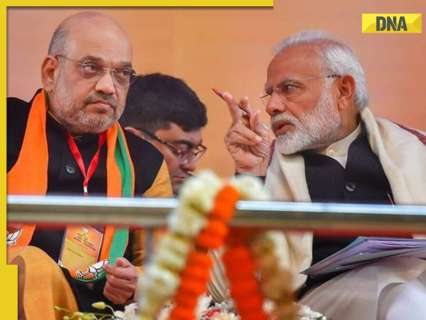
In the wake of unrest in Ladakh and Pahalgam terror attack in recent few moths, India has been on high alert. The recent development in neighbouring countries like Nepal and Bangladesh has been a major concern. The government has now decided to take a big step. What has Modi government decided?
Commercial LPG cylinder prices hiked by Rs…, no change in domestic rates
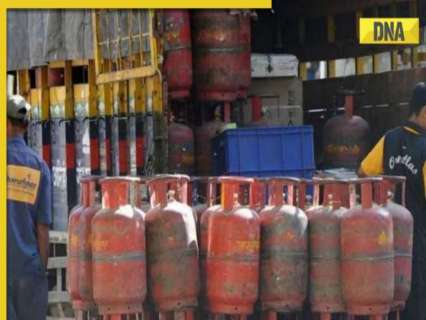
There has been no change in the prices of 14.2 kg domestic LPG cylinders, which are used widely by households for cooking purposes.
Navi Mumbai International Airport set to be inaugurated by PM Modi on…; Gautam Adani visits ahead of opening

After multiple delays, the much-awaited inauguration of the Navi Mumbai International Airport is scheduled on October 8. As per reports, the airport is to be inaugurated by Prime Minister Narendra Modi. Gautam Adani on his X, video of his visit to the airport for the review.
RBI keeps repo rate unchanged at 5.5%, revises growth projection upwards to 6.8% from 6.5% for FY 26

The gross domestic product (GDP) growth forecast for FY26 has been revised upward to 6.8 per cent, with quarterly estimates of 7 per cent in Q2 as against 6.7 per cent announced earlier, 6.4 per cent in Q3 as compared to 6.6 per cent earlier, and 6.2 per cent in Q4 as against 6.3 per cent projected
BIG Diwali gift for central govt employees as cabinet approves 3% DA hike; check details

The Union Cabinet on Wednesday, i.e., October 1, approved a 3 percent dearness allowance hike ahead of Diwali.
Taslima Nasreen’s Durga Puja post sparks row; Javed Akhtar counters with Ganga-Jamni culture, details here

As Bengalis celebrate Durga Puja, Taslima Nasreen’s claim that all Bengalis have roots in Hindu culture has sparked a debate. Javed Akhtar countered, highlighting India’s Ganga-Jamni Awadh culture and regional diversity in traditions.