

Trump tariffs push India closer to America’s strategic rivals China and Russia
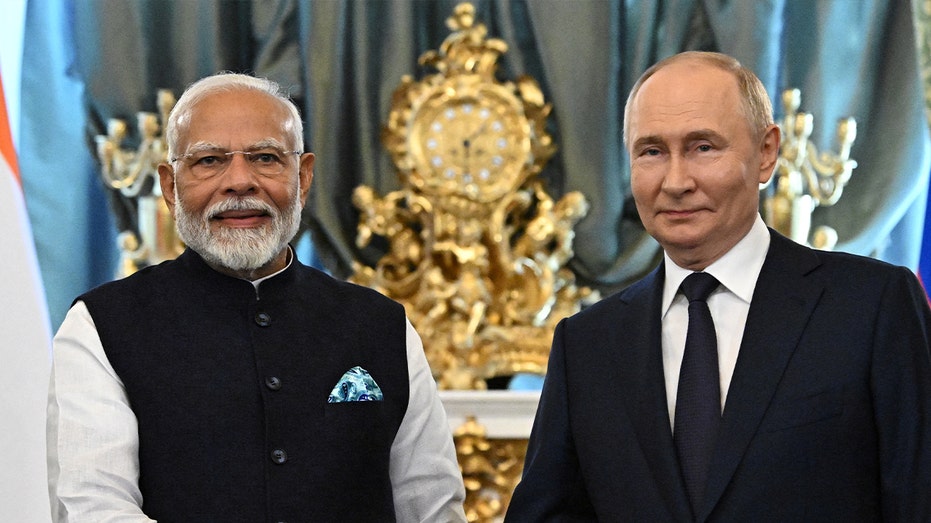
For more than two decades, Washington and New Delhi built a strategic partnership that was hailed as one of the great success stories of post–Cold War diplomacy. Today, that relationship is facing its most serious test in years — and India is signaling it has other options. “We’re in a situation in the U.S.-India relationship where the premises and assumptions of the last 25 years — that everybody worked very hard to build, including the president in his first term — have just come completely unraveled,” said Evan Feigenbaum, a South Asia expert at the Carnegie Endowment for International Peace. “The trust is gone.” Since President Trump imposed sweeping tariffs on Indian imports, New Delhi has turned visibly eastward. India’s national security adviser traveled to Moscow in recent weeks, its foreign minister is visiting this week and Chinese Foreign Minister Wang Yi just concluded talks in Delhi. Prime Minister Narendra Modi is preparing for his first trip to China in more than seven years, while Russian President Vladimir Putin is expected to host him in Moscow before the end of the year. The pivot underscores how tariffs meant to punish India for its continued purchases of Russian oil may instead be pushing New Delhi closer to America’s rivals. TRUMP AND PUTIN’S RELATIONSHIP TURNS SOUR AS PRESIDENT PUSHES FOR RESOLUTION WITH UKRAINE Trump slapped a 25% tariff on Indian imports earlier this year, citing India’s willingness to keep buying Russian crude. On August 27, that tariff is set to double to 50%. Indian public opinion has bristled at what many see as U.S. interference in sovereign decision-making. “They’re signaling very clearly that they view that as interference in India’s foreign policy, and they are not going to put up with it,” Feigenbaum said. Despite initial hesitation, state-run refiners resumed Russian oil purchases, lured by discounts of 6% to 7%. Russian oil now accounts for 35% of India’s imports, up from a negligible 0.2% before the Ukraine war. Moscow, for its part, has seized the opening. “We continue to ship fuel, including crude oil and oil products, thermal and coking coal,” said Russian First Deputy Prime Minister Denis Manturov. “We see potential for the export of Russian LNG.” TRUMP’S DEADLINE ON SECONDARY TARIFFS ARRIVES; US-RUSSIAN RELATIONS HANG IN THE BALANCE Russia is using the rift to promote its vision of a “great Eurasian partnership” linking Moscow, Beijing and Delhi. “All of this engagement we’re seeing between India and China now is not exclusively coming because of Trump and his tariffs,” said Michael Kugelman, a Washington-based South Asia analyst. “We’ve actually seen indications for almost a year of India wanting to ease tensions with China and strengthen relations, mainly for economic reasons. But the Trump administration’s policies have made India want to move even more quickly.” Some of India’s moves are diplomatic theater meant to signal anger at Washington. But others are more durable. “India is going to double down on some aspects of its economic and defense relationship with Russia,” Feigenbaum said. “And those parts are not performative.” Kugelman noted that before the Ukraine war, India had already begun reducing its reliance on Russian arms imports in favor of U.S., French and Israeli systems. “But as soon as the invasion happened, India very quickly started buying more from Russia, particularly energy,” he said. “This is essentially validation of a view in India that the U.S. can’t be trusted, whereas Russia can — because Russia is always going to be there for India no matter what.” Modi has used the standoff to reinforce his image at home as a defender of sovereignty. “India actually made a fair number of concessions to the Trump administration early on in its second term,” Kugelman said, citing tariff reductions and agreements to repatriate undocumented workers. “Because of those concessions, India needs to be careful about signaling further willingness to bend. This is one reason there was no trade deal — Modi put his foot down.” While not directly criticizing Trump, Modi has emphasized that his priority is protecting the livelihoods of farmers, small businesses and young workers. That defiant tone, Kugelman added, has “real political mileage” in India’s domestic debate. The Trump administration has shown no signs of backing down. Former White House trade advisor Peter Navarro blasted India’s oil purchases as “opportunistic” and “deeply corrosive” in a Financial Times op-ed this week. “This two-pronged policy will hit India where it hurts — its access to U.S. markets — even as it seeks to cut off the financial lifeline it has extended to Russia’s war effort,” Navarro wrote. “If India wants to be treated as a strategic partner of the U.S., it needs to start acting like one.” INDIAN PRIME MINISTER MODI TAKES PAGE FROM TRUMP, SAYS ‘MAKE INDIA GREAT AGAIN,’ OR ‘MIGA’ The contrast with the U.S.–India relationship of two decades ago could not be starker. In 2008, the two countries struck a landmark civil nuclear deal that gave India access to American technology and fuel despite not being a signatory to the Non-Proliferation Treaty. “India put the entire government on the line for the deal,” Feigenbaum recalled. “Bush really went to the mat and provided a lot of assurances to Congress that were politically not easy, but he was willing to take risks for the relationship.” At that time, Washington and Delhi managed to work around their disagreements. “The U.S. objected to many aspects of India’s relationships with Iran, Burma and Russia,” Feigenbaum said. “India objected to aspects of the U.S. relationships with China and Pakistan. But neither side let that bleed back into the bilateral relationship in a completely debilitating way.” For years, the U.S. has viewed India as a democratic counterweight to China’s authoritarian model — central to its Indo-Pacific strategy under Obama, Trump and Biden. But now the question is whether that glue still holds. “Both sides agree that countering China is the main glue that has really bound this relationship together over this 20-year period,” Kugelman said. “But the tensions,
‘There are 50 swamps’: State Freedom Caucus Network helps conservatives fight the ‘uniparty’
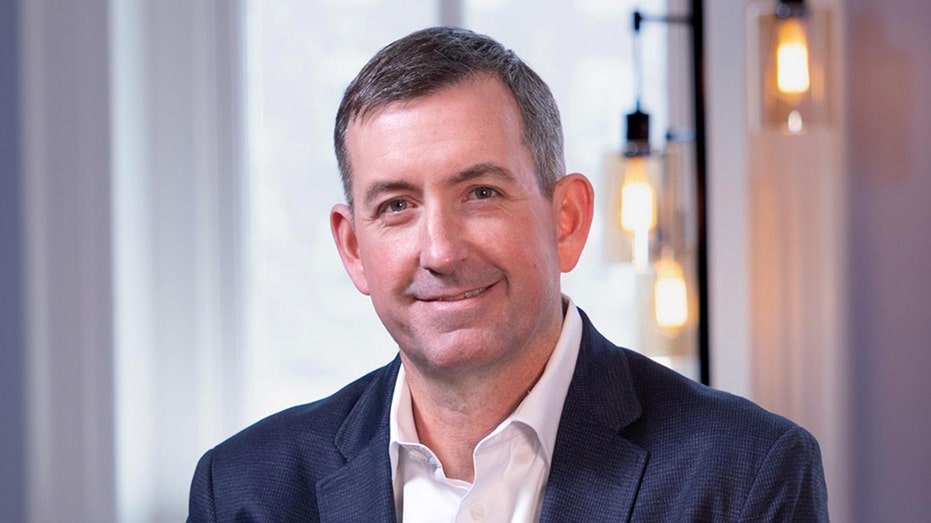
Andrew Roth, president of the State Freedom Caucus Network, helms an organization fighting to help conservatives win and wield control of state governments across the nation. “There is a swamp in all 50 states. There are 50 swamps,” Roth told Fox News Digital during a Tuesday interview, noting that “liberal Republicans” join with Democrats to expand government. This “uniparty” phenomenon exists in the U.S. Congress and in every state, Roth indicated, asserting that in red states many Democrats cannot win elections unless they don the Republican label. “They say they’re good on guns, and babies, and a few other things, but then they get in there, and they vote like liberals, growing government[.] ” Roth noted. He said that while the goal of state freedom caucuses is to slash taxes and government, the first step is exposing “deceitful lawmakers for who they are. And then once you can do that, then you can hopefully start getting good people elected and then cut the budget, cut taxes, cut spending,” he explained. COWBOY STATE REPUBLICAN WHO MOUNTED GUBERNATORIAL BID ‘ISN’T CONSERVATIVE ENOUGH,’ FREEDOM CAUCUS CHAIR SAYS So far, the organization boasts freedom caucuses in 13 of the 50 states, including Pennsylvania, Maryland, South Carolina, Georgia, Louisiana, Oklahoma, Illinois, Missouri, South Dakota, Wyoming, Montana, Arizona and Idaho – but deep red states like Texas and Florida are conspicuously absent from the list. Asked whether this is because there are not enough conservative legislators in those states to form a freedom caucus, Roth replied, “That’s absolutely correct,” explaining, “In Texas I could probably say there’s only one or two House members, and in Florida I’m not even sure I can say two.” There are “zero” conservative state lawmakers in the Alabama, Tennessee and Mississippi state legislatures, he said. FORMER FREEDOM CAUCUS CHAIR BOB GOOD CALLS OUT ‘THE BIG GLARING WEAKNESS FOR ALL OF REPUBLICAN GOVERNMENT’ “This is a big, big problem” he noted, “and I don’t think enough people realize how bad it is.” Roth indicated that the organization provides a state director in each freedom caucus state – those directors help read legislation, offer vote recommendations, work with other groups, and help with organizing and strategizing, he explained. GOP LOUISIANA STATE SENATOR SAYS HE’S RUNNING FOR US SENATE BECAUSE INCUMBENT REPUBLICAN ‘SUCKS’ Roth noted that Louisiana state Sen. Blake Miguez, a Republican who belongs to that state’s freedom caucus, is challenging incumbent GOP U.S. Sen. Bill Cassidy.
Texas Democrat who rails against billionaire cash takes $59K from Trump-backing megadonor
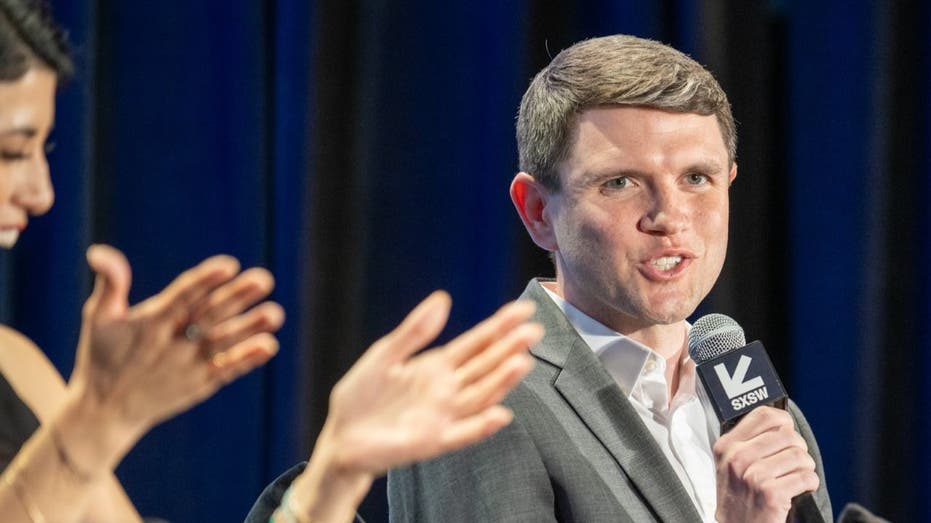
Texas Democrat James Talarico has campaigned on getting megadonor cash out of elections, but records show he has been cashing checks from an unlikely source: a Republican, Trump-backing billionaire. Talarico’s single largest donation last year came from a PAC backed by casino mogul Miriam Adelson, the widow of longtime Republican megadonor Sheldon Adelson. Records show Talarico received $59,000 from Adelson’s Texas Sands PAC in 2024, making the group his largest donor for that year. A representative for Talarico’s office defended his accepting the funds, telling Politico that while he opposes big-donor cash influencing elections, “he will not unilaterally disarm and let Texas Republicans play by different rules. “Rep. Talarico believes our campaign finance system is deeply broken,” spokesman Antonio Esparza told the outlet. “That’s why he filed legislation to cap campaign contribution limits in the state of Texas.” ABBOTT SCORES BIG WIN IN REDISTRICTING BATTLE AS TEXAS DEMOCRATS’ BLOCKADE COLLAPSES Talarico proposed legislation last year that would have capped donations to state-level lawmakers at $10,000. There is no cap on such donations under current law. Reports on the donations come after Talarico appeared on the “Joe Rogan Experience” podcast in July, during which he blasted Republicans for accepting billionaire dollars. “Basically every single Republican state senator in Texas has taken their money. Every single one. A majority of the Republicans in the State House have taken their money,” he told Rogan, referring to oil-based billionaires in the state. “They increasingly run this whole government here in Texas.” NEWSOM-STYLE REDISTRICTING EFFORTS CRITIQUED BY CALIFORNIA DEMOCRATS AS RECENTLY AS JULY, STATEMENTS SHOW Meanwhile, Adelson’s PAC has routinely supported both Democrats and Republicans on the state level in Texas, pushing for the state to legalize casino gambling. In 2023, Talarico voted in favor of a measure that would have given voters the chance to approve casino legalization through a constitutional amendment. Talarico was among the roughly 50 Texas Democrats who fled the state earlier this month in an attempt to block Republicans from adopting a new congressional map. ‘TIRED OF DEMOCRACY DYING’: NEWSOM REDISTRICTING PUSH FACES GOP BACKLASH OVER VOTER RIGHTS CLICK HERE TO GET THE FOX NEWS APP Talarico and his fellow Democrats returned to Austin this week, saying they achieved their goal of galvanizing Democratic opposition across the country. Several Democratic states are now threatening to carry out their own redistricting plans, as parties battle for control over the House of Representatives in the 2026 midterm elections.
US senators urge Rubio to press Israel over journalist killings
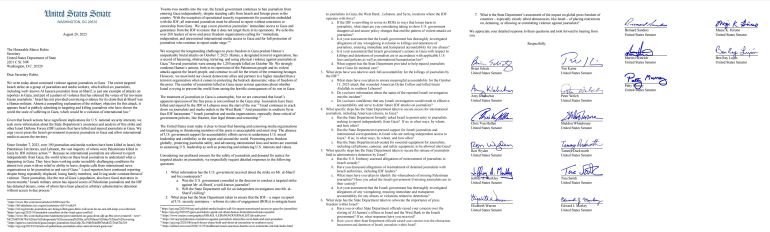
The senators urged for the protection of journalists in Gaza and international media access to the territory. A group of 17 US senators has written to US Secretary of State Marco Rubio, condemning an Israeli attack last week that killed several Al Jazeera journalists, and urging the US to pressure Israel to grant foreign media access to Gaza and protect journalists there. The letter [pdf] published on Wednesday was led by Hawaii Senator Brian Schatz and signed by 16 other senators, including Massachusetts Senator Elizabeth Warren, Virginia Senator Tim Kaine and Vermont Senator Bernie Sanders, a registered independent who caucuses with the Democrats. It comes a week after an Israeli strike killed several Palestinian journalists in the besieged territory, including Al Jazeera correspondents Anas al-Sharif and Mohammed Qreiqeh, and Al Jazeera cameramen Ibrahim Zaher and Mohammed Noufal. The attack was met with international outcry and brought the number of journalists killed by Israel in Gaza since October 7, 2023, to 238, according to the Gaza Government Media Office. “Israel has not provided convincing evidence for its claim that al-Sharif was a Hamas militant,” the senators wrote. “Absent a compelling explanation of the military objective for this attack, it appears Israel is publicly admitting to targeting and killing journalists who have shown the world the scale of suffering in Gaza, which would be a violation of international law.” The group urged President Donald Trump’s administration to provide more information about the State Department’s “awareness and analysis” of the strike. State Department spokesperson Tammy Bruce told reporters last week that the department discussed al-Sharif’s killing with Israel, and reiterated Israel’s unverified claim that he may have had ties to Hamas, the Palestinian group that governs Gaza. Advertisement Al Jazeera has accused Israeli authorities of fabricating evidence to link its staff to Hamas, and denounced Israel’s military for waging a “campaign of incitement” against its journalists in the Gaza Strip, including al-Sharif. The senators called for the US to “make it clear to Israel that banning and censoring media organizations and targeting or threatening members of the press is unacceptable and must stop.” “We urge you to press the Israeli government to protect journalists in Gaza and allow international media to access the territory.” The senators’ letter also called for unrestricted and immediate access for foreign journalists to cover Israel’s ongoing assault on Gaza. While Palestinian journalists in Gaza cover Israel’s devastating war, Israel has barred international journalists from entering the Strip. The letter also voiced concern for Israel’s attacks on press freedom elsewhere. The group condemned the killings of journalists in Lebanon, Israel’s crackdown on journalists and media outlets in the occupied West Bank, harassment by Israeli soldiers of journalists in southern Syria, and the legal threats and censorship faced by Israeli journalists and media organisations. The Washington Post on Wednesday night also reported that a member of the press office for the US State Department’s Bureau of Near East Affairs, Shahed Ghoreishi, was fired after suggesting Washington offer condolences for the journalists killed in Gaza. Adblock test (Why?)
US college declines to oppose Trump travel ban after Iranian students’ plea
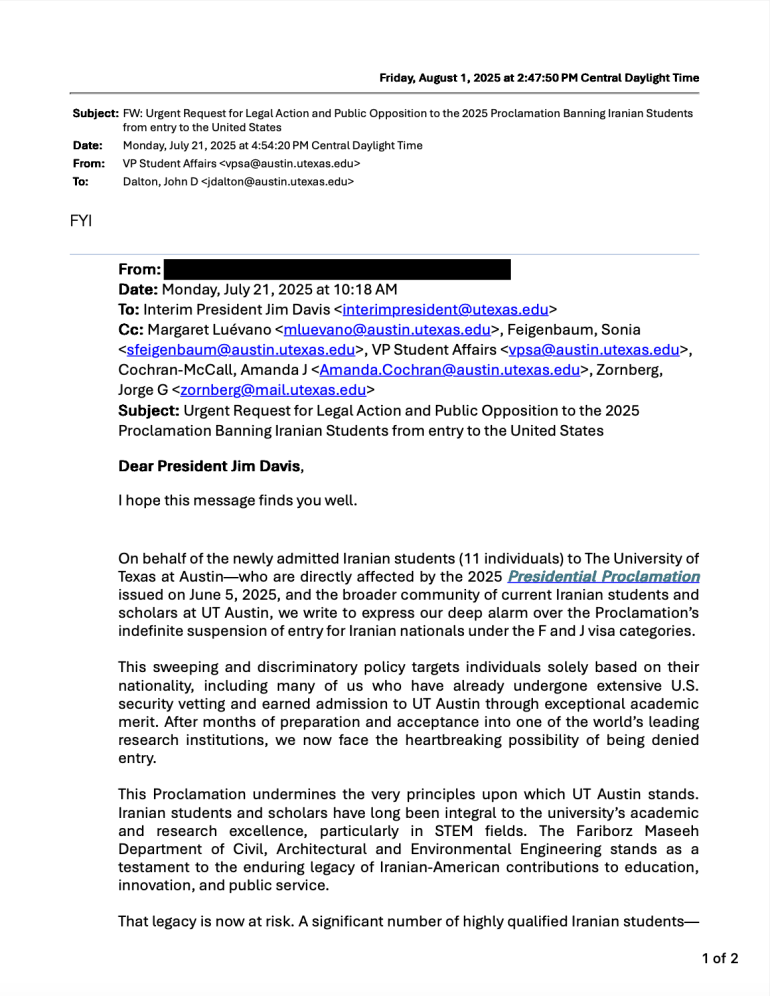
A top university in the United States has declined to oppose President Donald Trump’s travel ban on Iran after a call to action by its Iranian students. In a letter last month, the group of students called on the University of Texas at Austin to denounce Trump’s “sweeping and discriminatory” ban, take “immediate legal action” against the measure, and reaffirm support for Iranian students and scholars. The letter, authored “on behalf of the newly admitted Iranian students”, was sent to interim university President Jim Davis on July 21, weeks after Trump signed an executive order banning citizens from 12 countries, including Iran. “This Proclamation undermines the very principles upon which UT Austin stands. Iranian students and scholars have long been integral to the university’s academic and research excellence, particularly in STEM fields,” the letter said. In the letter, the group noted that the university’s department of civil, architectural and environmental engineering was named after Fariborz Maseeh, an Iranian-American entrepreneur and philanthropist, in a “testament to the enduring legacy of Iranian American contributions to education, innovation, and public service”. “This is a moment that calls for bold and principled action,” the letter said. “UT Austin has long benefited from Iranian students’ academic contributions. It must now stand in their defense. Failing to act not only jeopardizes the futures of individual students – it risks diminishing the ethical and intellectual standing of the institution itself.” Al Jazeera obtained the letter through a public records request. Advertisement Despite the students’ plea, neither the university nor Davis have made any public comment on the ban. Davis’s office did not respond to a request for comment. Last year, 81 Iranians studied at the University of Texas at Austin, according to the university’s website, almost all of whom were graduate students. The University of Texas at Austin is considered among the most prestigious tertiary institutions in the US, placing 30th in US News and World Report’s 2025 university rankings. “After months of preparation and acceptance into the world’s leading research institutions, we now face the heartbreaking possibility of being denied entry for a long time,” an Iranian student, who was involved in the letter, told Al Jazeera, requesting anonymity. The student said many members of a 1,500-person Telegram group of Iranian students that they belong to have reported being stuck in prolonged post-interview administrative processing. A few of them have been refused visas, while others have chosen to skip visa interviews on the understanding that they would be denied a visa, the student said. Prior to the ban, many of them would have already undergone extensive security vetting to obtain a student visa. Apart from Iran, Trump’s travel ban also applies to Afghanistan, Myanmar, Chad, Republic of Congo, Equatorial Guinea, Eritrea, Haiti, Libya, Somalia, Sudan, and Yemen. The student said Iranians were facing “collective punishment” by the Trump administration. “People must not be equated with their governments,” the student said. “Such blanket measures are neither reasonable nor fair, and they undermine the very principles of justice, academic freedom, and equal opportunity that the United States has long stood for.” More than 12,300 Iranian students studied in the US during the 2023-2024 academic year, up from 10,812 a year earlier, according to the US State Department. Adblock test (Why?)
What’s causing Pakistan’s deadly floods?
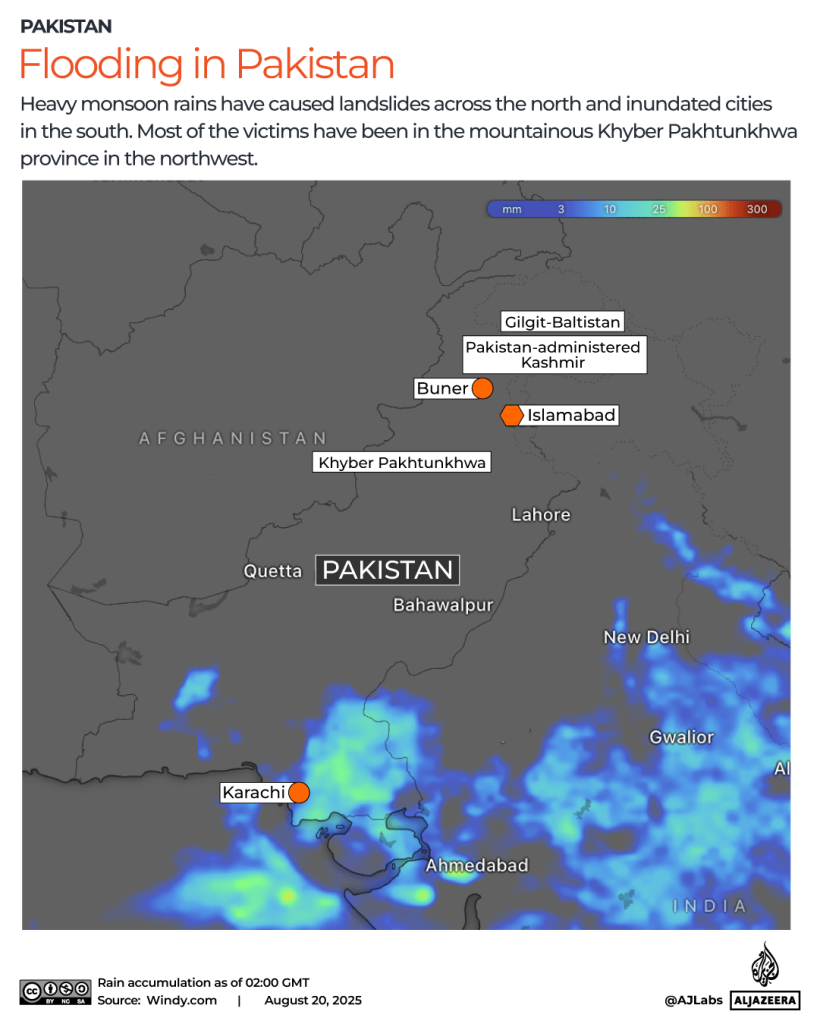
Pakistan has been reeling from flooding triggered by torrential rains, with nearly 400 people killed since August 14. On Wednesday, Karachi was inundated following a heavy downpour, paralysing the southern port city of 20 million people less than a week after deadly flash floods swept away villages in the northwestern province of Khyber Pakhtunkhwa. More than 700 people have been killed in the flooding and landslides across the South Asian nation since June, with forecasters warning of further downpours until Saturday. So why have floods in Pakistan been so intense, and what is the solution to the South Asian country’s flooding problem? Where did it flood in Pakistan? The Buner district in the Khyber Pakhtunkhwa province has been the worst hit, with more than 200 people killed and extensive damage to homes and public infrastructure across the northwestern mountainous province since August 14. The Himalayan region of Gilgit-Baltistan, as well as Pakistan-administered Kashmir, was also affected. Karachi, the capital of the southern Sindh province, was hit by floods after rainfall on Tuesday. Videos circulating on social media showed cars and motorbikes submerged in water. How many people have died in the floods? On Thursday, nine people died and 15 were injured across the country, according to the National Disaster Management Authority (NDMA). Seven of these deaths were in Khyber Pakhtunkhwa, while two were in Sindh. On Wednesday, 41 people died and 11 people were injured across the country. At least 19 of these deaths were in Khyber Pakhtunkhwa, 11 deaths were in Sindh, and 11 deaths were reported in Gilgit-Baltistan. Advertisement Some 759 people have died, including 186 children, and 993 have been injured since the onset of the monsoon season in June. More than 4,000 houses have been damaged due to flooding in the same period. What do rescue efforts look like? The head of the NDMA, Lieutenant General Inam Haider Malik, said that more than 25,000 people had been rescued from flood-hit areas, Reuters reported on Wednesday. The army and air force have also been pressed into action in rescue efforts. On Wednesday, 2,300 people were treated in 14 active medical camps in Khyber Pakhtunkhwa, according to the NDMA. Relief items have also been distributed among those affected by the floods. What is causing the floods in Pakistan? While the exact cause of the floods is yet to be determined, several factors could have contributed to the deluge. “While climate change plays a critical role in intensifying flooding events in Pakistan, other factors such as urbanisation, deforestation, inadequate infrastructure, and poor river management also contribute significantly,” Ayyoob Sharifi, a professor at Hiroshima University in Japan, told Al Jazeera. Climate change Sharifi told Al Jazeera that climate change is causing monsoon rainfall to intensify, resulting in more frequent extreme precipitation events. A study co-authored by Sharifi and published in February this year, indicates that cities such as Lahore and Faisalabad could experience increased rainfall under certain scenarios, heightening the risk of urban flooding. He added that rising temperatures allow the atmosphere to hold more moisture, leading to heavier downpours during storms. In northern Pakistan, these higher temperatures are also accelerating glacial melting, which increases the likelihood of glacial lake outburst floods (GLOFs). These are floods that occur when water is suddenly released from a glacial lake. Earlier this month, a GLOF occurred in Pakistan’s northern region of Hunza, when the Shisper Glacier swelled the Hassanabad nullah, damaging infrastructure and destroying cultivable land, Dawn reported on August 8. While Pakistan is responsible for less than 1 percent of global greenhouse gas emissions according to European Union data, the country bears the brunt of climate disaster, the country’s former Finance Minister Miftah Ismail told CNBC in 2022. Heavy rain over a short period Fahad Saeed, a climate scientist at the Berlin-based think tank, Climate Analytics, told Al Jazeera that the flooding was caused by higher-intensity rainfall. This means that there was a large amount of rain over a short period. Advertisement In Buner, more than 150mm (6 inches) of rain fell in just one hour on Friday morning. In 2022, Pakistan endured its most severe monsoon season ever recorded, resulting in at least 1,700 deaths and causing an estimated $40bn in damage. Saeed said the 2022 floods were unexpected because of the areas they hit, ravaging arid or semiarid parts of northern Sindh that usually do not experience heavy rainfall. However, rainfall this year has occurred within or around the region that normally experiences monsoon rain, he said. What is unusual this time is the sheer intensity of the rain. Soil unable to absorb the rain in rural areas Saeed explained that when there is rapid rainfall in a rural area over a short time, the soil does not get enough time to absorb the rainwater. “The rain doesn’t infiltrate into the soil, rather, it flows off the surface. It results in mudslides and soil erosion.” This applies to rural areas in the northern parts of Khyber Pakhtunkhwa and parts of Gilgit-Baltistan. “What happens is that normally, if you are living next to the rivers, your house is prone to get destroyed or inundated. But this time, what happened is that even if you are on the slopes of the mountain, the rainfall is so intense that because of the mudslide and the landslides, it destroyed the homes at the elevations,” Saeed explained. Issues with the drainage system in urban areas Karachi primarily relies on natural stormwater drains, or nullahs, for rainwater to be drained off. Research shows that Karachi generates more than 20,000 tonnes of solid waste per day, and the nullahs are clogged by this rubbish. During an event on urban flooding last year, hydrologist Sana Adnan pointed out that cleaning nullahs only before the monsoon season significantly contributes to flooded roads, emphasising that heavy rains can happen at any time of the year, not just during the monsoon, local outlet Dawn News reported. Architect and planner Arif Hasan told Dawn in 2020 that due to the absence of a sustainable
Delhi CM Rekha Gupta Security Update: Gets Z-category CRPF cover after attack

The CRPF personnel reached the Chief Minister’s residence on Thursday morning to take charge of her security from the Delhi police. Additional deployment has also been made in and around the CM’s residence and office to ensure round-the-clock protection.
Ahmedabad murder case: Junior student confesses of killing senior in new CHILLING chats, says, ‘Ab jo hogaya, vo hogaya…’

A class 10 student Nayan, of Seventh Day School in the Khokhra area of Gujarat’s Ahmedabad was stabbed to death by a Class 8 student after an altercation between the two students. the chilling chats between the accused and his friend have been revealed. What did the friend of accused asked?
School Holidays: Students to enjoy 9-Day lengthy break, educational institution to remain closed in THESE states – Check dates

School Holiday: Due to Dussehra, one of the most highly celebrated festivals in the state, Telangana will have even longer holidays, with schools and colleges closed from September 21 to October 3.
When is Ganesh Chaturthi? in 2025? Auspicious sthapana date, puja vidhi, rituals and visarjan details

Ganesh Chaturthi commemorates the birth of Lord Ganesha, a 10-day festival that begins on the Chaturthi of Shukla Paksha in Bhadrapada month.