

Russia-Ukraine war: List of key events, day 1,322

Here are the key events from day 1,322 of Russia’s war on Ukraine. Published On 8 Oct 20258 Oct 2025 Click here to share on social media share2 Share Here is how things stand on Wednesday, October 8, 2025: Fighting Russian President Vladimir Putin said his forces have captured almost 5,000 square kilometres (1,930sq miles) of Ukrainian territory so far this year, and Moscow retains the strategic initiative on the battlefield. Russian troops have captured the Ukrainian villages of Novovasylivka in the southeastern Zaporizhia region and Fedorivka in the eastern Donetsk region, Russia’s defence ministry said. Russian air defence units destroyed 184 Ukrainian drones in recent attacks, the RIA Novosti state-owned news agency reports. Russia’s air defence units also intercepted and destroyed a drone flying towards Moscow city, said Sergei Sobyanin, mayor of the Russian capital. Russia’s President Vladimir Putin shakes hands with Defence Minister Andrei Belousov, right, as Chief of Staff Valery Gerasimov, centre, stands nearby during a visit to the Peter and Paul Cathedral in Saint Petersburg on October 7, 2025 [Mikhail Metzel/AFP] Ukraine’s Energy Minister Svitlana Hrynchuk said Russian air strikes have caused “significant” damage to Ukrainian gas production capacity due to the targeting of regional gas infrastructure and power transmission facilities in front-line regions. Hrynchuk said Ukraine wants to increase imports of natural gas by 30 percent after Russian attacks on its gas infrastructure, telling reporters she had discussed additional gas imports with Group of Seven (G7) member states. Ukrainian President Volodymyr Zelenskyy accused Russia of using oil tankers for intelligence gathering and sabotage operations, and he added that Ukraine was cooperating with its allies on the matter. Russia’s state nuclear energy company has claimed that a Ukrainian drone attempted to strike a nuclear plant in Russia’s Voronezh region bordering Ukraine, but the unmanned aerial vehicle crashed into a cooling tower and caused no damage at the site. Advertisement Military aid Kremlin spokesperson Dmitry Peskov said Russia was waiting for clarity from the United States about the possible supply of Tomahawk missiles to Ukraine, saying such weapons could theoretically carry nuclear warheads and reiterated that Moscow would see the provision of such weapons as a serious escalation. The Kremlin also said it assumed for now that US President Donald Trump still sought a peace settlement in Ukraine. Peace talks Turkish President Recep Tayyip Erdogan spoke by phone with President Putin and said diplomatic initiatives need to gain momentum to achieve a just and lasting peace in the Russia-Ukraine war, Erdogan’s office said. The statement cited Erdogan as saying Turkiye will continue to work for peace and said bilateral relations and regional and global issues were also discussed with Putin. Italian Prime Minister Giorgia Meloni said she believed Trump had come to the conclusion that Russia was not interested in a peace deal with Ukraine, and that the only way forward was to apply pressure, continue to support Ukraine, and impose sanctions on Russia. Politics and diplomacy Polish Prime Minister Donald Tusk said it is not in Poland’s interest to hand over a Ukrainian man wanted by Germany for suspected involvement in explosions which damaged the Nord Stream gas pipelines three years ago. Tusk said the problem with Nord Stream 2 was not that it was blown up but that it was built. He added that Russia built the pipelines “against the vital interests not only of our countries, but of all of Europe”. A Polish court ruled on Monday that the Ukrainian diver wanted by Germany over his alleged involvement in the explosions, which damaged the Nord Stream gas pipeline, must remain in custody for another 40 days, his lawyer said. European Union governments have agreed to impose limits on the travel of Russian diplomats within the bloc, the Financial Times reported. Economy Ukraine’s foreign currency reserves totalled $46.5bn as of October 1, the National Bank of Ukraine reported on its website. Adblock test (Why?)
Muslims in India’s poll-bound Bihar battle ‘Bangladeshi infiltrator’ tag
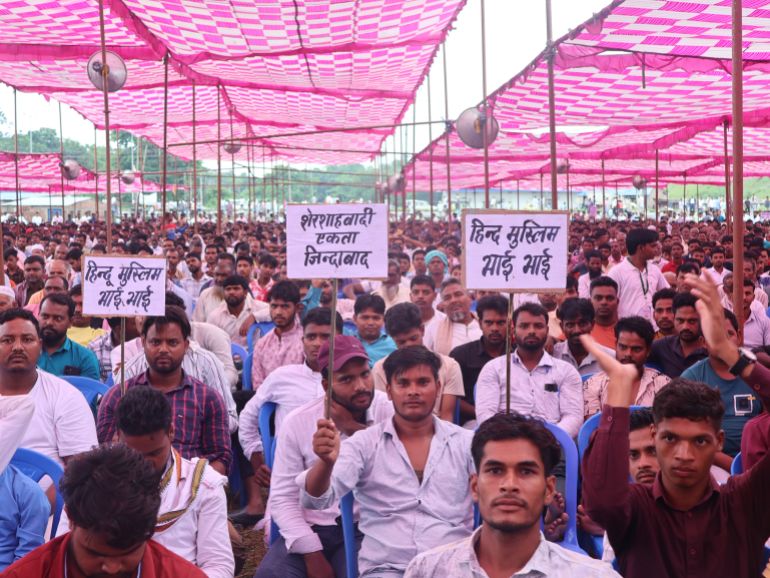
Kishanganj/Katihar, India – More than a decade ago, when Mukhtar Alam* studied at a government school in Kishanganj, the only Muslim-majority district in eastern India’s Bihar state, he had Hindu friends. Alam was especially close to one of them. The two would do their studies and school projects together. Alam would avoid meat when they ate together so as not to make his vegetarian friend uncomfortable. But an incident two years ago created a rift in their friendship, which has not been bridged since. Addressing a rally in Kishanganj, Jitanram Manjhi, a former chief minister of Bihar and a prominent ally of Prime Minister Narendra Modi’s Bharatiya Janata Party (BJP), said the Shershahbadi community of Muslims were “infiltrators” from Bangladesh, India’s neighbour in the east, where more than 91 percent of the population is Muslim and mainly speaks Bangla. The term Shershahbadi is derived from the historical Shershahbad region, which includes areas in the neighbouring West Bengal state. The name Shershahbad, in turn, is believed to be derived from Sher Shah Suri, an Afghan king who defeated the mighty Mughals and briefly ruled over the modern regions of Bihar and Bengal (including Bangladesh) in the 16th century. Shershahbadi Muslims hold placards that read ‘Long live Shershahbadi unity’ and ‘Hindus-Muslims are brothers’ at a rally in Kishanganj, Bihar [Shah Faisal/Al Jazeera] Unlike Hindi and its dialects, as well as Urdu, spoken widely across Bihar, the Shershahbadi Muslims speak a dialect of Bangla mixed with Urdu and Hindi words. They are often referred to as “Badia” (a likely short form of Shershahbadi) or “Bhatia”, which derives its origin from the local dialect “Bhato”, meaning going against the river’s stream, since the Shershahbadi Muslims are said to have migrated upstream of the Ganges River from Malda to Murshidabad in West Bengal state, and finally to the Seemanchal region in Bihar, India’s most impoverished state. Advertisement “We felt threatened [by Manjhi’s speech],” Alam, a Shershahbadi Muslim and graduate in business administration, told Al Jazeera. Refusing to stay silent, he posted his condemnation on Facebook. Within minutes, a comment in Hindi popped up under his post: “You people are Bangladeshi infiltrators.” It was his best friend. “Reading that comment sent a shiver down my spine,” recalled the 30-year-old Alam, sitting under the thatched roof of a primary school he runs. “The comment created a rift between us. We developed trust issues and lost our brotherhood, our friendship.” Alam is one of 1.3 million Shershahbadi Muslims in Bihar, according to a “caste census” published by the state government in 2023, and most of them live in Kishanganj and Katihar districts. As Bihar, India’s third-most populous state, heads towards crucial elections to its legislature that could impact national politics, it is these districts that have emerged as the focus of a high-pitched BJP campaign against supposed “Bangladeshi infiltrators”. Why Shershahbadi Muslims? As India celebrated its Independence Day on August 15 last month, Prime Minister Modi addressed the nation from the ramparts of the Mughal-era Red Fort in New Delhi, in which he announced the formation of a “high-powered demography mission” to find the infiltrators. “No country can hand itself over to infiltrators. No nation in the world does so – how then can we allow India to do so?” Modi said, without specifying who those infiltrators were. He added that through the mission, “the severe crisis now looming” over the country will be addressed in a “deliberate and time-bound manner”. His government has not yet provided details on the workings of the mission. Hindu right-wing groups in India often use the term “Bangladeshi infiltrator” to target Bangla-speaking Muslims mainly in the states of Bihar, West Bengal and Assam. In Assam, where Modi’s BJP has been in power since 2016, the state government has been running a campaign against Bangla-speaking Muslims, labelling them “outsiders” and accusing them of trying to alter the regional demography. Nearly a third of Assam’s population is Muslim – the highest among Indian states. Only the federally run territories of Indian-administered Kashmir in the north and the Lakshadweep islands in the Arabian Sea have a higher Muslim percentage than Assam. In Bihar, the Muslim population stands at 17 million, or nearly 17 percent of its total population of 104 million, according to India’s last census conducted in 2011. About 28.3 percent of those Muslims are concentrated in what is commonly referred to as Seemanchal (“frontier region” in Hindi), comprising Kishanganj, Katihar, Araria and Purnia districts. Katihar, Kishanganj and Purnia share their borders with West Bengal state, while the Bangladesh border is just a few kilometres from Seemanchal. Bihar will hold its state assembly election in two phases on November 6 and November 11, with the results to be announced on November 14. Advertisement The BJP has never formed a government on its own in the key northern state, ruling it for a good part of the past 20 years in coalition with a regional ally. Critics accuse it of now using the “Bangladeshi infiltrator” pitch in Seemanchal to polarise the region’s voters on religious and linguistic lines. In the last two years, Alam says his worries have increased manifold as Modi himself leads the BJP’s charge against his community. “Those indulging in vote bank politics have turned Purnia and Seemanchal into a hub of illegal infiltration, putting the security of this area at risk,” Modi had said last year while campaigning in Purnia for the general elections. He repeated his stance in the BJP’s election rallies in several districts of Bihar this year. “Today, a huge demographic crisis has happened in Seemanchal and across eastern India because of infiltrators,” Modi said in Purnia last week, promising to “throw every single infiltrator out”. That drive is already under way in other parts of India. ‘Demons have come from Bangladesh’ Authorities in several BJP-ruled states have been cracking down on allegedly “illegal” Bangladeshi nationals, with hundreds of Bengali-speaking people deported from Assam, Gujarat, Maharashtra and New Delhi – despite most of them holding valid documents
Italy’s Meloni says ICC complaint accuses her of Gaza genocide complicity
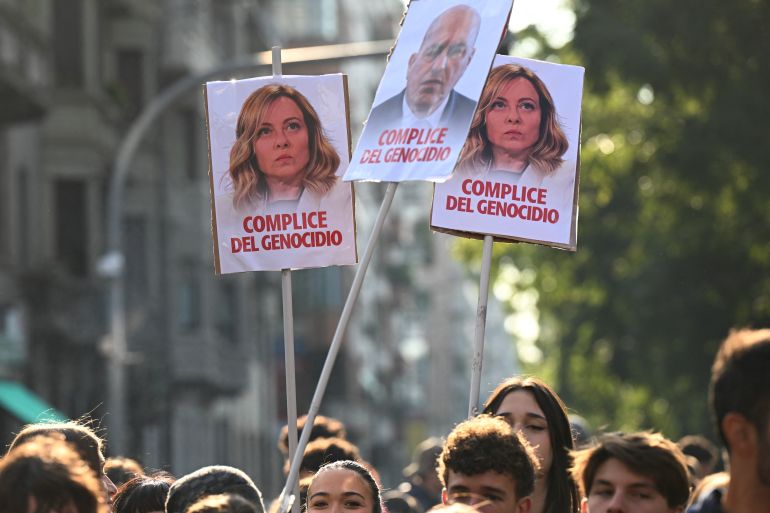
Italian Prime Minister Giorgia Meloni says she has been accused of “complicity in genocide” in a complaint lodged with the International Criminal Court (ICC) over Rome’s support for Israel as it bombards Gaza. Meloni made the statement during an interview with state television company RAI, in the first public comment on the situation, which has not been confirmed by the international court. Recommended Stories list of 4 itemsend of list Meloni said Defence Minister Guido Crosetto and Foreign Minister Antonio Tajani have also been “denounced”, referring to when the court is officially alerted to a possible crime. She said that she believes that Roberto Cingolani, head of Italian weapons and aerospace company Leonardo, might also have been named. The complaint, dated October 1, was signed by some 50 people, including law professors, lawyers, and several public figures who accused Meloni and others of complicity by supplying arms to Israel, according to the AFP news agency. “By supporting the Israeli government, particularly through the supply of lethal weapons, the Italian government has become complicit in the ongoing genocide and the extremely serious war crimes and crimes against humanity committed against the Palestinian people,” the authors of the court filing against the Italian leaders wrote. The Palestinian advocacy group behind the complaint naming Meloni is calling for the court to assess the possibility of opening a formal investigation into the charge of genocide against the Italian prime minister, AFP also reported. Advertisement Last month, a UN Independent Inquiry found that Israel’s war on Gaza is a genocide, adding to similar assessments from a broad range of experts in human rights, genocide and international law. The ICC has outstanding arrest warrants for Israeli Prime Minister Benjamin Netanyahu and former Defence Minister Yoav Gallant over charges of war crimes and crimes against humanity in Gaza, including starvation, murder and persecution. However, neither Netanyahu nor Gallant has been charged with genocide specifically. The ICC also issued arrest warrants for Hamas officials; however, those named have all since been killed in Israeli attacks. “I don’t think there is another case in the world or in history of a complaint of this kind,” Meloni said of the complaint against her in the televised comments. Pro-Palestinian demonstrators hold placards of Meloni reading ‘Accomplice to genocide’ at a protest against Israeli forces intercepting the Global Sumud Flotilla, in Milan on Friday [Stefano Rellandini/AFP] ‘Major arms’ exports According to data from the Stockholm International Peace Research Institute (SIPRI), Italy was one of only three countries to export “major conventional arms” to Israel from 2020 to 2024, although the United States and Germany were responsible for 99 percent of the exports of the larger weapons category, which include aircraft, missiles, tanks and air defence systems. The major arms that Italy provided to Israel in this period included light helicopters and naval guns, SIPRI said. It is also one of several countries involved in making parts for F-35 fighter jets, under a US-led programme, SIPRI added. “Concerns about the potential use of the F-35 by Israel to carry out violations of international humanitarian law have led to much criticism of transfers of the aircraft or its parts to Israel,” SIPRI said in a recent report. Italy’s Defence Minister Guido Crosetto has said that Italy is only sending deliveries of arms to Israel under contracts signed before October 7, 2023 and that Italy has sought assurances from Israel that the weapons would not be used against civilians in Gaza, after Deputy Prime Minister Antonio Tajani had earlier claimed Italy had stopped sending the weapons altogether. Meloni’s acknowledgement of the complaint against her comes as hundreds of thousands of people have taken to the streets in mass protests against Israel’s war on Gaza in recent weeks. Italy’s major labour unions have actively supported the protests. The country’s dockworkers have threatened strike action over Israeli forces preventing the Sumud Global Flotilla from delivering aid to Gaza. Advertisement Following earlier protests, Meloni’s government sent naval ships to accompany the fleet of international vessels, but the Italian navy pulled back before Israeli forces intercepted the boats in international waters and detained close to 500 international activists. Six crew members remained in Israeli detention as of Tuesday, according to the flotilla’s organisers. Mounting legal challenges The latest complaints against Italian leaders join a growing number of legal challenges to Israel’s actions in Gaza, alongside the ICC case against Netanyahu and Gallant. At the International Court of Justice (ICJ), South Africa has submitted a case against Israel, accusing it of breaching the 1948 UN Genocide Convention. In April this year, the ICJ ruled against pursuing a case brought by Nicaragua that accused Germany of aiding genocide in Gaza for its role in selling arms to Israel. The US, which is the largest exporter of weapons to Israel, is not a member of the ICC. It has also actively pushed back against the ICC pursuing charges against Israel. Last month, US Secretary of State Marco Rubio announced that the US was imposing sanctions on three Palestinian human rights organisations, Al-Haq, the Palestinian Centre for Human Rights (PCHR) and Al Mezan Center for Human Rights, for engaging in efforts to “investigate, arrest, detain, or prosecute Israeli nationals” at the ICC. Adblock test (Why?)
SHOCKING! New audio clip in Delhi Baba case reveals how women aide pressurised students: ‘Don’t make excuses…’

The case of self-styled godman Chaitanyananda Saraswati has turned more horrific as new audio evidence has been recovered by the investigators. During the ongoing investigations, an audio clip indicates the gruesome behaviour of the baba.
Good news for passengers! Indian Railways to allow changing travel dates on confirmed tickets from…, know benefits, new policy

the Indian Railways has come up with a new policy which will allow travellers to make changes in their plans without losing money. From January 2026, passengers will be able to change the date of travel online.
Aviation Minister Ram Mohan Naidu issues BIG statement on Air India scare: ‘We’re going to…’

Air India flight AI117, a Boeing 787 Dreamliner, landed safely in Birmingham on Saturday after the Ram Air Turbine was deployed during its final approach. The airline confirmed all electrical and hydraulic systems were functioning normally. The flight took off from Amritsar on October 4. Read more.
PM Modi to visit Maharashtra today, will inaugurate Navi Mumbai airport; know key details

According to an official release from the Prime Minister’s Office, Prime Minister Modi will reach Navi Mumbai around 3 pm and will undertake a walkthrough of the newly built Navi Mumbai International Airport. Thereafter, around 3.30 pm, he will inaugurate the airport.
PM Modi in Maharashtra today: From Navi Mumbai Airport inauguration to meeting UK PM Starmer – full itinerary, and details of projects to be inaugurated

Prime Minister Modi’s visit to Maharashtra on October 8-9 will inaugurate the Navi Mumbai International Airport, unveil new phases of the Mumbai Metro, and launch key projects like the “Mumbai One” app and the Short-Term Employability Program (STEP). His visit also includes engagements with UK PM Ke
Himachal Pradesh landslide: 15 dead after landslide hits bus in Bilaspur; search ops underway for missing child

Bilaspur SP Sandeep Dhawal said local residents assisted in saving the two children and confirmed that rescue operations are ongoing to locate an eight-year-old boy.
Who is IAS Amanit P Kumar, wife of IPS Y Puran Kumar who died by suicide? Everything to know about her

Amanit P. Kumar is a 2001-batch IAS officer, while her late husband, Y. Puran Kumar, belonged to the same batch of the IPS.