

Why did Israel bomb Syria? A look at the Druze and the violence in Suwayda
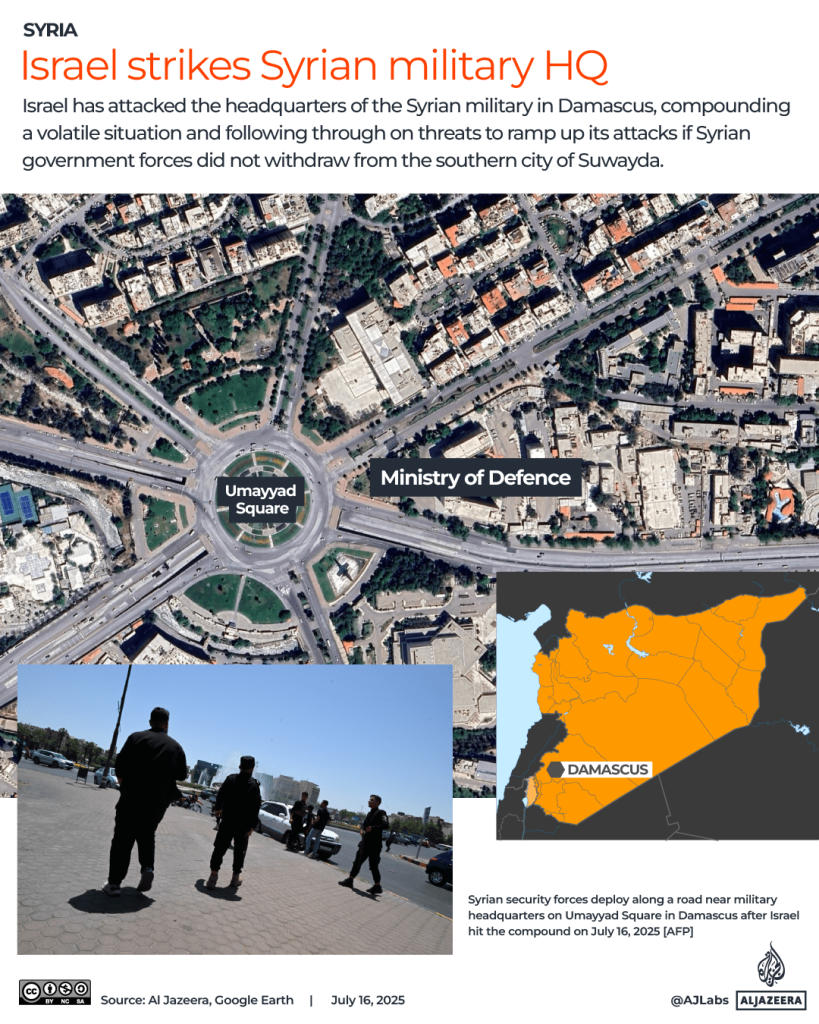
Israel has launched a series of intense strikes on Damascus, Syria’s capital, intensifying a campaign it says is in support of an Arab minority group. Syria, on Wednesday, strongly condemned Israeli attacks, denouncing the strikes as a “dangerous escalation.” The Ministry of Foreign Affairs accused Israel of pursuing a “deliberate policy” to “inflame tensions, spread chaos and undermine security and stability in Syria”. The strikes killed three people and injured 34, according to Syrian officials. Here is what we know: What happened in Syria on Wednesday? Israel carried out a series of air strikes on central Damascus, hitting a compound that houses the Ministry of Defence and areas near the presidential palace. The Israeli military also struck targets in southern Syria, where fighting between Druze groups, Bedouin tribes, and Syrian security forces has continued for more than four days. According to the Syrian Observatory for Human Rights, more than 250 people have been killed in Suwayda province during the clashes. Israel, which already occupies the Syrian Golan Heights, says its operations aim to protect the Druze minority – whom it considers potential allies – and to strike pro-government forces accused of attacking them. Syria rejected this and called the attack a “flagrant assault”. Where did the attacks happen? The main attacks focused on central Damascus: the Defence Ministry, military headquarters and areas surrounding the presidential palace. Additional strikes were carried out further south. Advertisement Syria’s Defence Ministry headquarters: The compound was struck several times, with two large strikes about 3pm (12:00pmGMT), including its entrance, causing structural damage and smoke rising visibly over the city. “Israeli warplanes [were] circling the skies over the Syrian capital,” Al Jazeera’s Zeina Khodr said, reporting from Damascus. “There was panic in the city,” she added. Near the presidential palace (Umayyad Square): Strikes also hit areas immediately around the presidential palace in central Damascus. Another air strike landed near the presidential palace in Damascus. In a post on social media, Israel said “a military target was struck in the area of the Syrian regime’s Presidential Palace in the Damascus area”. In the south: Israeli drones also targeted Syria’s city of Suwayda, a mainly Druze city close to the border with Jordan. (Al Jazeera) Why did Israel bomb Syria? Israel’s air strikes followed days of deadly clashes in Suwayda between Syrian government forces and local Druze fighters. The violence began with tit-for-tat kidnappings and attacks between Druze fighters and local Bedouin tribes. When government troops intervened to restore order, they ended up clashing with Druze groups – and, in some cases, reportedly targeted civilians. The Druze, a small but influential minority in both Syria and Israel, are seen in Israel as loyal allies, with many serving in the Israeli military. A ceasefire declared on Tuesday quickly collapsed, and fighting resumed the next day. Suwayda’s Druze appear divided. One leader, Yasser Jarbou, declared that a ceasefire had been agreed with the Syrian government. Another, Hikmat al-Hijri, rejected any ceasefire. And many Druze in Syria do not want Israel to intervene on their behalf. Israel has its own considerations and has been attempting to expand its control in southern Syria since the fall of President Bashar al-Assad in December. Israel has shunned any attempts to come to a security agreement with Syria and has instead repeatedly bombed the country this year. Many analysts believe that Israel would prefer a weak Syria over a country it believes could potentially threaten it should it grow strong. Intensifying attacks Israel, citing a commitment to protect the Druze and prevent hostile forces from gaining ground near its borders, warned Wednesday it would escalate its operations unless Syrian troops withdrew from Suwayda. The province sits near both the Israeli and Jordanian borders, making it a key strategic zone. Advertisement “This is a significant escalation,” Khodr, Al Jazeera’s correspondent, said. “This is the Israeli leadership giving a very, very direct message to Syria’s new authorities that they will intensify such strikes … if the government does not withdraw its troops from southern Syria.” As part of its campaign, Israeli forces struck the General Staff compound in Damascus, which it said was being used by senior commanders to direct operations against Druze forces in Suwayda. Israeli officials said the strikes were also aimed at blocking the buildup of hostile forces near Israel’s frontier. Shortly after the Damascus attacks, Syria’s Ministry of Interior announced a new ceasefire in Suwayda. According to state media, government troops began withdrawing from the area. Syrian response Syria condemned the Israeli strikes as a violation of international law, a stance echoed by several Arab governments. Syria’s new government has been trying to assert control, but it has struggled to do so in Suwayda, in part due to repeated Israeli threats against any government military presence in the province. “The Israelis are not going to allow the Syrian government to spread its authority all over the territory,” said Ammar Kahf, executive director of Omran Center for Strategic Studies, who is based in Damascus. With the fall of al-Assad’s government and the infancy of a new one, Israel is trying to impose its will on the new leadership, he said. “We are still in the early stages, but this requires all Syrians to come together. For a foreign government to come in and destroy public property and destroy safety and security is something that’s unexplainable,” Kahf told Al Jazeera. The Syrian government has now announced that army forces will begin withdrawing from the city of Suwayda as part of a ceasefire agreement. It did not mention any pullout of other government security forces. Adblock test (Why?)
‘It’s just better!’ Trump says he has convinced Coca-Cola to use cane sugar
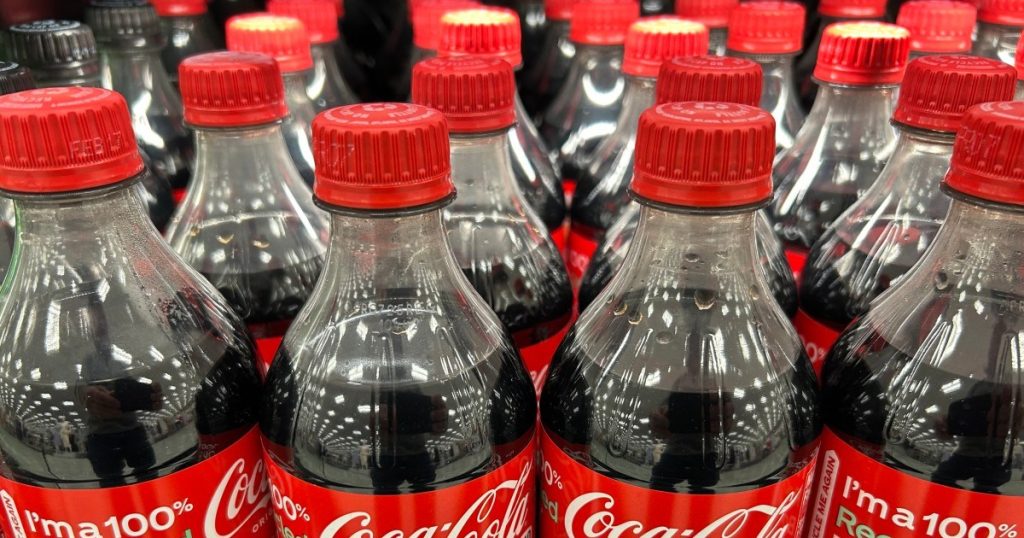
Beverage giant declines to either confirm or deny change to ingredients in its signature soft drink. United States President Donald Trump has announced that Coca-Cola will start using cane sugar instead of high-fructose corn syrup in its US-made soft drink at his urging. “I have been speaking to Coca-Cola about using REAL Cane Sugar in Coke in the United States, and they have agreed to do so,” Trump said in a post on Truth Social on Wednesday. “I’d like to thank all of those in authority at Coca-Cola.” Trump said the switch would be a “very good move”, adding: “You’ll see. It’s just better!” Coca-Cola neither confirmed nor denied Trump’s announcement, but said it appreciated the president’s “enthusiasm for our iconic Coca-Cola brand”. “More details on new innovative offerings within our Coca-Cola product range will be shared soon,” the Atlanta, Georgia-based company said in a brief statement. “I have been speaking to @CocaCola about using REAL Cane Sugar in Coke in the United States, and they have agreed to do so. I’d like to thank all of those in authority at Coca-Cola. This will be a very good move by them — You’ll see. It’s just better!” –President Donald J. Trump pic.twitter.com/9L27oxlYUj — The White House (@WhiteHouse) July 16, 2025 Trump, who is known for his love of Diet Coke, did not explain his push to change the original version of the soft drink’s ingredients, but his health secretary, Robert F Kennedy Jr, has harshly criticised the prevalence of high-fructose corn syrup in the American diet. Kennedy, who has pledged to wage war on ultra-processed foods containing ingredients rarely found in kitchen cabinets, has called the sweetener “just a formula for making you obese and diabetic”. Advertisement High-fructose corn syrup, which is derived from corn starch, is favoured by many US manufacturers because it is cheaper than sugar, in part due to government subsidies for corn and tariffs on sugar imports. Coca-Cola began using high-fructose corn syrup in its US production in the 1980s, but still uses cane sugar in many versions of its signature beverage made overseas, including Mexico, whose version of the drink has developed a cult-like following for its supposedly superior taste. While Americans’ high sugar intake is a major contributor to nearly three-quarters of the population being overweight or obese, there is currently no scientific consensus to suggest high-fructose corn syrup is less healthy than cane sugar or other sweeteners. In a 2018 fact sheet, the US Food and Drug Administration said it was “not aware of any evidence” of a “difference in safety” between foods containing high-fructose corn syrup and those with other sweeteners, such as sugar and honey. Adblock test (Why?)
Who is Aditya Saurabh? Cracked UPSC with impressive AIR, became IRS officer, now arrested for…
In a big crackdown on officers accepting bribes, the CBI has arrested IRS officer Aditya Saurabh in case of bribery. He cracked UPSC with impressive AIR but is now facing legal action.
Delhi-Goa IndiGo flight makes emergency landing due to a mid-air engine failure
A Goa-bound IndiGo flight from Delhi made an emergency landing here after it was diverted to the city due to a mid-air engine failure, according to a source.
UIDAI deactivates Aadhar of deceased persons, disables over 1 crore numbers, starts new service for…

The UIDAI has started deactivating Aadhaar of deceased persons to prevent misuse of their identity proof, and disabled over 1.17 crore such unique 12-digit numbers till date. UIDAI has launched a new service, ‘Reporting of Death of a Family Member’, on the myAadhaar Portal.
What is ‘PAN-PAN’ call that Delhi-Goa IndiGo flight pilot made before diverting flight to Mumbai?

The flight, 6E 6271, was scheduled to land at the Manohar International Airport in Goa but was instead rerouted to Chhatrapati Shivaji Maharaj International Airport in Mumbai as a precautionary measure.
Meet woman, first IAS officer to officially appoint a female driver, she is from…, her name is..

In Sandhya Rani’s story, we see not only the breaking of gender stereotypes but also the recognition of drivers as individuals with aspirations, capabilities, and the courage to lead.
Bengaluru small vendors are saying ‘NO’ to UPI, demands ‘Only’ cash, are in fear due to…

Bengaluru’s small vendors, including street food sellers, corner shop owners, pushcart vendors, are now refusing to accept UPI payments, removing QR codes and are opting for cash transactions. But why?
Bihar Elections: CM Nitish Kumar announces 125 units of ‘free electricity’ from…, check details here

Nitish Kumar said that the government has also decided to install solar power plants on the rooftops or in the nearby public places of domestic consumers in the next three years.
Big money shaping GOP primaries for Texas attorney general, comptroller
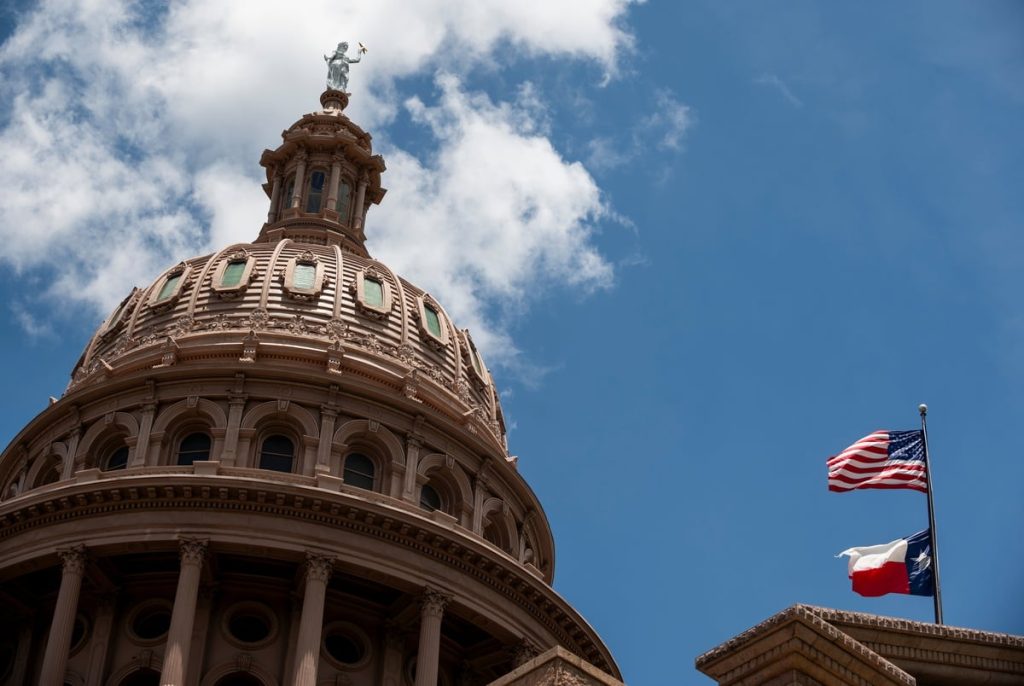
New campaign finance filings provide the first glimpse of the financial and political fault lines emerging in the open primaries for key statewide offices.