

Thousands in Sudan’s besieged el-Fasher at ‘risk of starvation’, UN warns
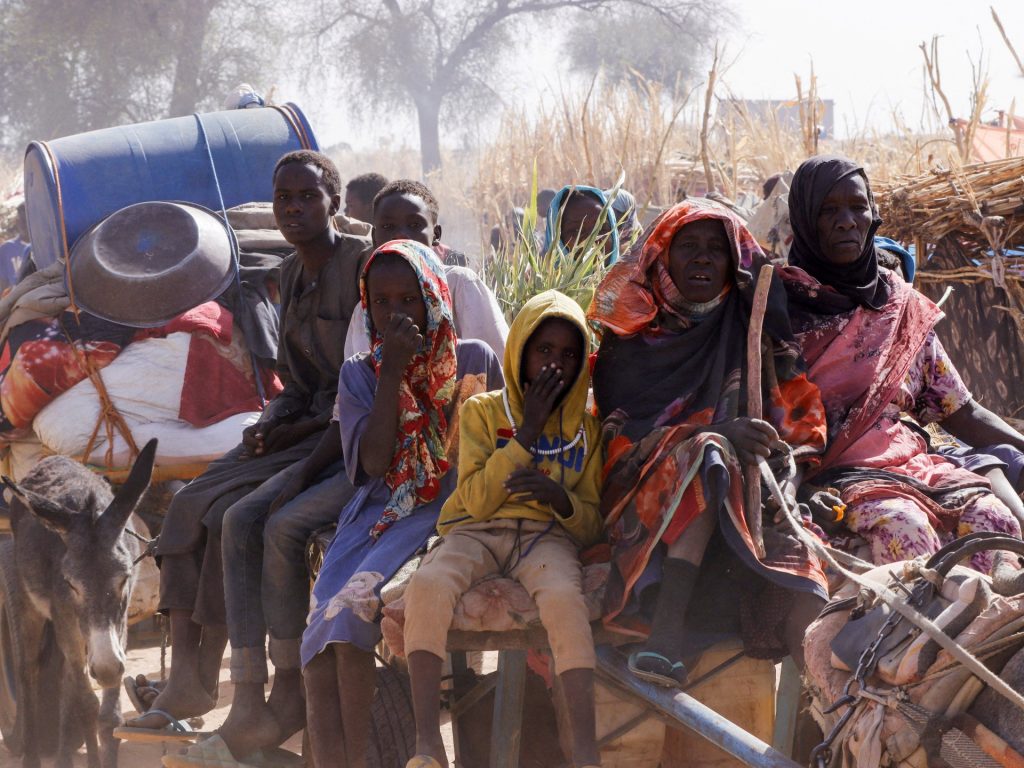
Thousands of families trapped in the besieged city of el-Fasher in western Sudan are at “risk of starvation”, the World Food Programme (WFP) warns as the country’s brutal civil war rages well into its third year. Since May last year, el-Fasher, the capital of North Darfur state, has been under siege by the paramilitary Rapid Support Forces (RSF), which has been at war with the government-aligned Sudanese armed forces (SAF) since April 2023. The RSF has encircled the city, blocking all major roads and trapping hundreds of thousands of civilians, who have dwindling food supplies and limited humanitarian access. “Everyone in el-Fasher is facing a daily struggle to survive,” said Eric Perdison, the WFP’s regional director for East and Southern Africa. “People’s coping mechanisms have been completely exhausted by over two years of war. Without immediate and sustained access, lives will be lost.” El-Fasher is the last major city in the Darfur region still held by the SAF. It has come under renewed attack by RSF fighters this year since the paramilitary was ousted from Sudan’s capital, Khartoum. A major RSF assault on the Zamzam displacement camp near el-Fasher in April forced hundreds of thousands of civilians to flee. Many have sought shelter in the state capital. According to the WFP, prices for staple foods like sorghum and wheat, used to make traditional flatbreads and porridge, are as much as 460 percent higher in el-Fasher than in other parts of Sudan. Markets and clinics have been attacked while community kitchens that once fed displaced families have largely shut down due to a lack of supplies, the United Nations agency added. Advertisement Desperate families are reportedly surviving on animal fodder and food waste while acute malnutrition is soaring, especially among children. According to the UN, nearly 40 percent of children under five in el-Fasher are now acutely malnourished, and 11 percent are suffering from severe acute malnutrition. The rainy season, which peaks in August, is further hampering efforts to reach the city as roads rapidly deteriorate. Last year, famine was first declared in Zamzam and later spread to two other nearby camps – al-Salam and Abu Shouk – and some parts of southern Sudan, according to the UN. ‘Irreversible damage’ The war has killed tens of thousands of people, displaced millions and created what the UN describes as the world’s largest displacement and hunger crises. The country in effect is split in two with the army controlling the north, east and centre of Sudan and the RSF dominating nearly all of Darfur and parts of the south. Last month, a Sudanese coalition led by the RSF announced it was establishing an alternative government in a challenge to the military-led authorities in Khartoum. The new self-proclaimed government could deepen divisions, worsen the humanitarian crisis and lead to competing institutions as the war rages. The crises are happening as UN agencies face one of their worst funding cuts in decades, compounded by decisions by the United States and other donor states to slash their foreign aid funding. Funding cuts are now driving an entire generation of children in Sudan to the brink of irreversible harm amid a scaling-back in support, UNICEF warned on Tuesday. “Children have limited access to safe water, food, healthcare. Malnutrition is rife, and many good children are reduced to just skin, bones,” Sheldon Yett, UNICEF’s representative in Sudan, said, speaking via videolink from Port Sudan. Children were being cut off from life-saving services due to funding cuts while the scale of need is staggering, UNICEF said. “With recent funding cuts, many of our partners in Khartoum and elsewhere have been forced to scale back. … We are being stretched to the limit across Sudan with children dying of hunger,” Yett said. “We are on the verge of irreversible damage being done to an entire generation of children in Sudan.” Only 23 percent of the $4.16bn global humanitarian response plan for Sudan has been funded, according to the UN Office for the Coordination of Humanitarian Affairs (OCHA). “It has been one year since famine was confirmed in Zamzam camp, and no food has reached this area. El-Fasher remains under siege. We need that access now,” Jens Laerke of OCHA said. Advertisement Meanwhile, a cholera outbreak in North Darfur has further added to the desperation of families there. Deaths due to the water-borne disease have risen to 191 in the region, according to Adam Rijal, spokesman for the General Coordination for Displaced Persons and Refugees in Darfur. At least 62 people have died from the disease in Tawila in North Darfur, Rijal said in a statement. Nearly 100 people have also died in the Kalma and Otash camps, both displacement camps located in the city of Nyala in South Darfur state. About 4,000 cases of cholera have been reported in the region, according to the statement. Adblock test (Why?)
The airdrops on Gaza are a PR stunt, not a humanitarian operation
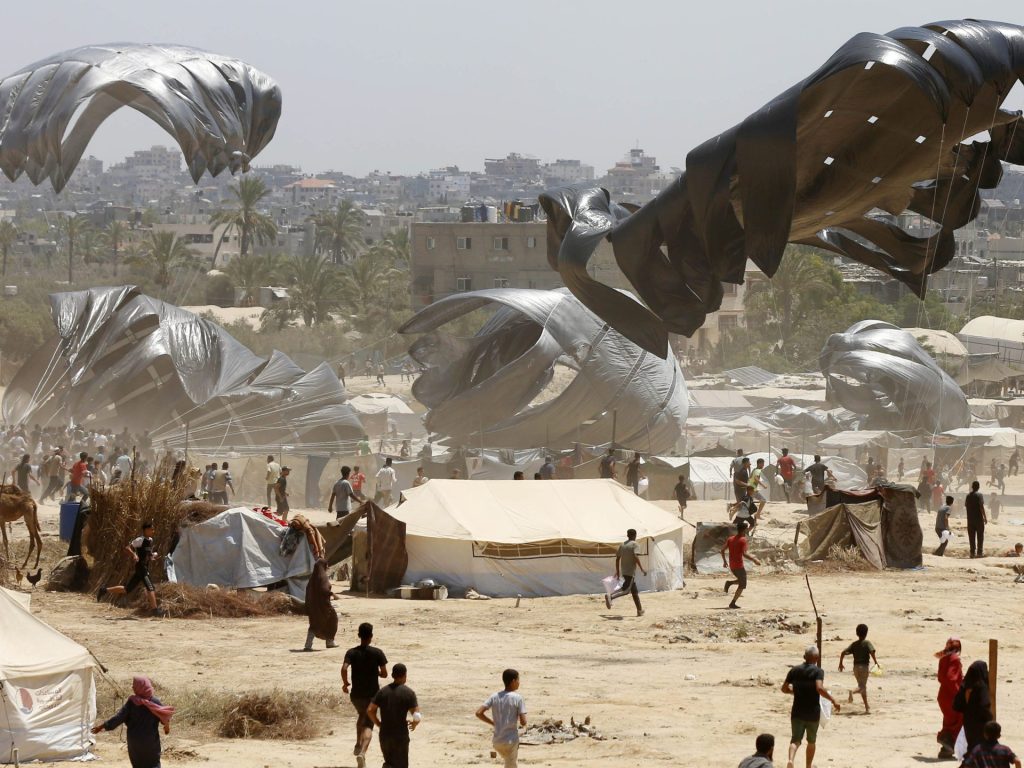
Last week, I saw aid dropping from the sky near my central Gaza neighbourhood of az-Zawayda. Neither I nor any of my neighbours had the courage to chase after it because we knew that the moment it hit the ground, a battle would erupt. If the aid survived the air, it wouldn’t survive the looters. It is almost always the same scene. Gunfire breaks out the second the plane drops the boxes. Armed gangs are already waiting on the ground, ready to take the goods by force. Whoever gets there first, whoever shoots first, also walks away with the food. It is never those who need it the most. Later, we would see those same “aid boxes” in the market in Deir el-Balah, their contents up for sale at exorbitant prices. Recently, my little brother was craving a biscuit. I saw biscuits from an aid package at the market and asked for the price. It was 20 shekels ($5) for a biscuit, something we could not afford. The aid dropped from the sky not only fails to feed the hungry, but it also kills them. On Monday, an airdropped pallet hit a tent for the displaced and killed Uday al-Quraan, a medic working at Al-Aqsa Martyrs Hospital. A week ago, 11 people were injured when another airdropped pallet hit tents in northern Gaza. Last year, in other failed airdrops, people also died. Five were killed in the Shati refugee camp in Gaza City when the parachute of a pallet did not open; 12 drowned trying to reach boxes that dropped into the sea; six were killed in a stampede after a crowd of people rushed to an airdrop location. Advertisement The idea for these latest airdrops came from Israeli Prime Minister Benjamin Netanyahu, who called on the world to help with the process. Many governments welcomed the idea and some joined the effort, including Jordan, the United Arab Emirates and European countries. But Netanyahu knows very well that the airdrops will not stop the starvation of Palestinians, which is why he called for them instead of opening the land crossings into Gaza and allowing United Nations agencies to distribute aid in a fair and orderly fashion, just like they have always done. While, the global public may be deceived that something is being done about the hunger, inside Gaza, these airdrops aren’t seen as a real solution or a humanitarian gesture. We see them as nothing more than a PR show – a way to cover up a crime that hasn’t stopped: starving an entire population under tight siege by preventing thousands of trucks from entering while a few boxes fall from the sky for the cameras. It’s all part of a strategy to extend the starvation and ease international pressure on Israel. And so the famine proceeds at full speed. According to Gaza’s Ministry of Health, more than 180 people have died from hunger, including 92 children. It is not just in Gaza that airdrops are seen as inefficient and dangerous. In Afghanistan in 2001, airdropped aid was packaged in the same way as cluster bombs. The latter would get mistaken for food boxes by children who would get killed running after them. In Syria, aid airdropped into a besieged area did not reach the starving civilians because it was either damaged or fell into ISIL (ISIS)-held territory. It is well known that airdrops do not work and when other options are available, there is no reason to use them. The UN has repeatedly said this method is ineffective and ground delivery is safer and far better. A truck can carry four to 10 times more aid than a parachute. It is also much cheaper. Thousands of trucks are waiting on the Egyptian side of the border, enough to feed people and prevent more deaths from starvation. And yet, we see this futile spectacle once again in Gaza. Here we know not to look to the sky with hope. The same sky that drops bombs can’t be trusted to drop food. This “humanity with parachutes” is a fig leaf deployed to try to cover the world’s shame and its decision to silently watch starvation. Gaza is not only under siege by bombs but also by lies, by complicity, by soft language covering bloody massacres. Everyone who stays silent, who justifies, who treats the killer and victim as equal is a partner in this crime. Advertisement And we, the Palestinians, are not just victims – we are witnesses. We see the world refuse to act, we see countries continue to arm Israel, to trade with it, to give it diplomatic cover. We see governments think of pitiful excuses not to impose embargoes – as they are obliged to do under international law – on a nation committing genocide. And tomorrow, when history is written, it won’t be in the language of diplomacy with euphemisms and excuses. It will be in the language of facts with the names of those complicit in the mass killing and starvation of Palestinians written in clear letters. The views expressed in this article are the author’s own and do not necessarily reflect Al Jazeera’s editorial stance. Adblock test (Why?)
Man Utd and Newcastle make Sesko bids as Leipzig admit ‘concrete’ interest

Benjamin Sesko tops the summer’s transfer targets, with striker’s club Leipzig revealing ‘concrete interest’. Premier League sides Manchester United and Newcastle have both placed competing bids for in-demand RB Leipzig striker Benjamin Sesko, German tabloid Bild reported Tuesday. Bild said the Red Devils made an initial bid of 85 million euros ($98.2) on Tuesday for the 22-year-old centre forward. Newcastle had offered a reported 80 million euros ($92.4) for the striker on Saturday, upping that to 85 million ($98.2) with bonuses on Monday. The Slovenian striker scored 13 goals and laid on five assists in a disappointing league campaign for Leipzig last season. He has scored 16 times in 41 appearances at the international level. Sesko was stood down from Saturday’s home friendly against Serie A side Atalanta, won 2-1 by the visitors, due to a potential transfer. Leipzig sporting director Marcel Schafer confirmed this, saying Sesko would not play “due to the very concrete interests from several clubs”. United are rebuilding after their worst top-flight campaign in 51 years, along with defeat to Tottenham in the Europa League final. United were toothless in attack and have already brought in forwards Matheus Cunha and Bryan Mbeumo in the summer window. Sesko’s arrival could push under-pressure striker Rasmus Hojlund towards the exit, with reports emerging that United could sell the Denmark forward for 35 million ($40.4) euros, less than half of what they paid to bring him from Atalanta in 2023. Newcastle qualified for the Champions League with a fifth-placed finish last season, but are reportedly in danger of losing striker Alexander Isak to Premier League champions Liverpool. Advertisement Adblock test (Why?)
Satyapal Malik, former J-K Governor, dies at 79 after prolonged illness

Satyapal Malik, who passed away on Tuesday, served as the Governor of J-K from August 2018 to October 2019. It was during his tenure that the historic abrogation of Article 370 happened which transformed Jammu and Kashmir into two Union Territories.
Amit Shah surpasses Lal Krishna Advani’s record, know all about his tenure as India’s longest-serving Home Minister

Who are India’s longest-serving Home Ministers? Before Amit Shah, the leaders who served the longest tenures as Home Minister include Congress leader Govind Ballabh Pant and Bharatiya Janata Party (BJP) leader Lal Krishna Advani.
‘Dost dost na raha’: Jairam Ramesh mocks ‘special bond’ between Donald Trump and PM Modi after US President threatens steeper tariffs on India

Highlighting that India was being “threatened” with additional tariff imposition and was being asked not to buy oil from Russia, Jairam Ramesh took a jibe, saying that this was a result of a “special bond” between the two leaders, asking PM Modi to respond to these decisions.
Uttarkashi cloudburst triggers flash flood in Dharali village, 4 killed

Police, SDRF and other disaster response teams rushed to rescue operations at the site.
Is Donald Trump financing Russia’s war against Ukraine? US continues to buy from Moscow, threatens India

Is the US financing Russia in its war against Ukraine, as it has accused India of doing? According to the US International Trade Commission (USITC) data, Washington imported from Russia fertilisers, palladium, uranium and aircraft engine parts in the Year 2024.
EPFO makes BIG change in new UAN generation, makes THIS thing mandatory from Aug 1

The Employees’ Provident Fund Organisation (EPFO) has introduced a major change in the way new members register. From 1 August 2025, all new Universal Account Numbers (UANs) will be created using Aadhaar-based Face Authentication Technology. This can be done directly through the UMANG app, meaning there is no need to contact your employer to get a UAN.
India to place BIG order for powerful missile used during Op Sindoor against Pakistan, it is…

Soon after they caused significant damage to Pakistani military infrastructure during Operation Sindoor, Indian forces placed mega orders for the Indo-Russian joint venture BrahMos supersonic cruise missiles. Recently, Prime Minister Narendra Modi praised the performance of the indigenous weapon