

Trump defends use of ‘shylock’ term at rally amid antisemitism claims

President Donald Trump has defended his use of the term “shylock” at a rally this week, saying he was unaware it is considered antisemitic by some people. Trump used the term in his speech in Iowa on Thursday, shortly after his signature One Big Beautiful Bill Act was passed by Congress earlier in the day. Shylock is the name of the villainous Jewish moneylender in Shakespeare’s “The Merchant of Venice,” who demands a pound of flesh from a debtor. TRUMP ADMIN CRACKS DOWN ON ANTISEMITISM AS DOJ OFFICIAL EXPOSES ‘VIOLENT RHETORIC’ OF RADICAL PROTESTERS Over time, the name came to be used more broadly to refer to a loan shark or greedy moneylender. Today, some consider it an antisemitic slur, particularly when used in reference to Jewish people. “No death tax, no estate tax, no going to the banks and borrowing some from, in some cases, a fine banker and in some cases, shylocks and bad people,” Trump said, while referring to the bill’s elimination of estate taxes and borrowing burdens. The term did not provoke any reaction from the crowd, but his remark quickly blew up online, and he later defended using it when a reporter said it is widely considered an antiemetic phrase. “No I’ve never heard it that way,” Trump responded. “To me, a shylock is somebody that’s a moneylender at high rates. I’ve never heard it that way. You view it differently than me. I’ve never heard that.” The Anti-Defamation League (ADL), which works to combat antisemitism, said the term evokes “a centuries-old antisemitic trope about Jews and greed that is extremely offensive and dangerous.” SUSPECT CHARGED WITH MURDERING ISRAELI EMBASSY STAFF COULD FACE DEATH PENALTY “President Trump’s use of the term is very troubling and irresponsible,” the ADL wrote in a statement Friday. “It underscores how lies and conspiracies about Jews remain deeply entrenched in our country. Words from our leaders matter and we expect more from the President of the United States.” Rep. Jerry Nadler, D- N.Y., who is Jewish, agreed and ripped Trump for using the term. “The term ‘Shylock’ is one of the most recognizable antisemitic slurs in the English language,” Nadler wrote on X. “It’s a centuries-old trope that has fueled discrimination, hatred and violence against Jews for generations. I condemn Donald Trump’s dangerous use of this blatantly antisemitic slur and his long history of trafficking in antisemitic tropes.” Nadler went on to say that Trump has exploited the rise of antisemitism to suppress free speech and that he isn’t serious about tackling the problem. Conservative political commentator John Podhoretz, who is also Jewish, shot back at Nadler. “I condemn your endorsement of an anti-Semitic mayoral candidate which you did because you are a pusillanimous coward,” Podhoretz wrote, in reference to Nadler endorsing Zohran Mamdani for New York City mayor. “At best Trump said Shylock the same week he destroyed Iran’s nuclear program. What have you ever done for the Jews, Jerry?” Trump has made tackling antisemitism — particularly on college campuses and through immigration enforcement — a top priority in his campaign. He signed an executive order in January mandating that all federal agencies identify and apply tools to address antisemitic harassment and violence in higher education. His administration has also launched investigations into universities including Harvard, Columbia, and UC Berkeley over allegations of antisemitism and has threatened to pull federal funding if they fail to act. His daughter Ivanka converted to Orthodox Judaism in 2009 and is married to Jared Kushner, who is also Jewish. Democrat Joe Biden, while vice president, said in 2014 that he had made a “poor choice” of words a day after he used the term in remarks to a legal aid group. The Associated Press contributed to this report.
Democrats project doom and gloom, not celebration, with July 4 messages

Prominent Democrats sent messages of doom and gloom rather than celebration on July 4, drawing ire from a multitude of critics. Many of the messages included warnings about supposed threats to the country emanating from the Trump administration. “This Fourth of July, I am taking a moment to reflect. Things are hard right now. They are probably going to get worse before they get better,” former Vice President Kamala Harris wrote in a post on X that included a photo of her and former second gentleman Doug Emhoff at the White House. “But I love our country — and when you love something, you fight for it. Together, we will continue to fight for the ideals of our nation.” Many social media users were quick to point out that Harris cropped former President Joe Biden and former first lady Jill Biden out of the photo. Others took one of Harris’ famous phrases to mock her, saying that the country was “unburdened by what has been.” THE LEFT IS CELEBRATING JULY 4 WITH PROTESTS WHILE THE RIGHT SEES A PATRIOTIC REVIVAL Harris’ old boss, former President Joe Biden, posted a more mild message, while also encouraging Americans to “fight to maintain” democracy. Meanwhile, former President Barack Obama also chimed in with a warning of his own, saying that “core democratic principles seem to be continuously under attack.” He argued that the word “we” is the “single most powerful word in our democracy,” and used his first presidential campaign slogan as one of his examples. KAMALA HARRIS COMES KNIVES OUT AGAINST TRUMP IN FIRST SPEECH SINCE LEAVING OFFICE: ‘ABSOLUTE CHAOS’ “Independence Day is a reminder that America is not the project of any one person. The single most powerful word in our democracy is the word ‘We.’ ‘We The People.’ ‘We Shall Overcome.’ ‘Yes We Can.’ America is owned by no one. It belongs to all citizens. And at this moment in history—when core democratic principles seem to be continuously under attack, when too many people around the world have become cynical and disengaged—now is precisely the time to ask ourselves tough questions about how we can build our democracies and make them work in meaningful and practical ways for ordinary people,” Obama wrote. Xi Van Fleet, a survivor of Mao’s Cultural Revolution, responded saying, “We the People are taking our country back from those like you who despise America and work tirelessly to dismantle everything it stands for.” Sen. Bernie Sanders appeared to support the anti-Trump “No Kings” movement in his July 4 post. “On July 4, 1776, Americans said: No to Kings, No to Despotism. On July 4, 2025, all across the country, Americans say again: No to Kings, No to Despotism,” Sanders wrote. In response, several social media users pointed out that, unlike a king, President Donald Trump was elected.
State-sponsored Islamophobia in France encourages violence
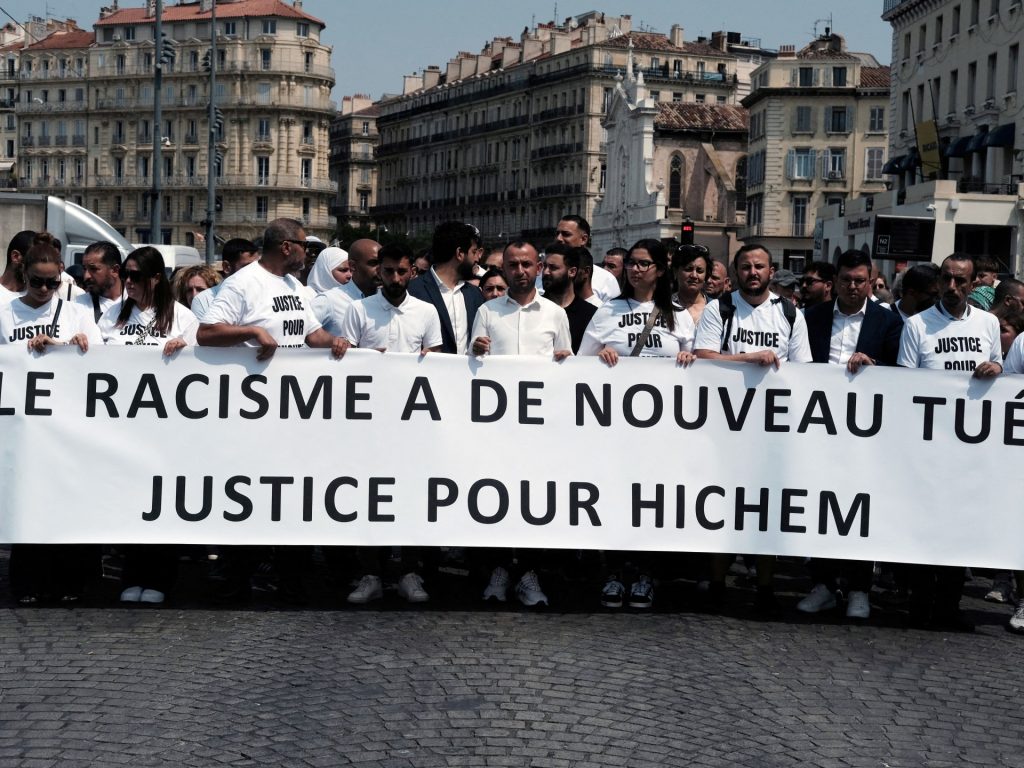
On June 27, El Hidaya Mosque in Roussillon in Southern France was attacked and vandalised. Windows were smashed and furniture overturned; the walls were plastered with racist flyers. Earlier the same month, a burned Quran was placed at the entrance of a mosque in Villeurbanne of Lyon. Unfortunately, virulent Islamophobia in France has not stopped at vandalism. On May 31, Hichem Miraoui, a Tunisian national, was shot dead by his French neighbour in a village near the French Riviera; another Muslim man was also shot but survived. A month earlier, Aboubakar Cisse, a Malian national, was stabbed to death in a mosque in the town of La Grand-Combeby by a French citizen. There has been a significant spike in Islamophobic acts in France – something the French authorities remain reluctant to publicly comment on. One report showed a 72 percent increase in such incidents between January and March 2025 compared with the same period in 2024. There are various factors that have contributed to this, but central among them is the French state’s own Islamophobic rhetoric and anti-Muslim policies. The most recent iteration of this was the release of a report titled “The Muslim Brotherhood and Political Islamism in France” by the French government. The document claims that the Muslim Brotherhood and “political Islamism” are infiltrating French institutions and threatening social cohesion and names organisations and mosques as having links to the group. The report came out just days before Miraoui was shot dead and two weeks after the French authorities raided the homes of several founding members of the Brussels-based Collective Against Islamophobia in Europe (CCIE) living in France. Advertisement With the rise of anti-Muslim attacks and discrimination in France, it is increasingly hard to believe that the obsession of the French state and government with what they call “Islamist separatism” is not, in fact, inciting violence against the French Muslim population. The idea that French Muslims are somehow threatening the French state through their identity expression has been championed by the French far right for decades. But it was in the late 2010s that it entered the mainstream by being embraced by centrist politicians and the media. In 2018, French President Emmanuel Macron, who also embraced the term “separatism”, called for the creation of a “French Islam”, a euphemism for domesticating and controlling Muslim institutions to serve the interest of the French state. At the heart of this project stood the idea of preserving “social cohesion”, which effectively meant suppressing dissent. In the following years, the French state started acting on its obsession with controlling Muslims with more and tougher policies. Between 2018 and 2020, it shut down 672 Muslim-run entities, including schools and mosques. In November 2020, the French authorities forced the Collective Against Islamophobia in France (CCIF), a nonprofit organisation documenting Islamophobia, to dissolve; the organisation then reconstituted in Brussels. In December of that year, they targeted 76 mosques, accusing them of “Islamist separatism” and threatening them with closure. In 2021, the French Parliament passed the so-called anti-separatism law, which included a variety of measures to supposedly combat “Islamist separatism”. Among them was an extension of the ban on religious symbols in the public sector, restrictions on home schooling and sports associations, new rules for organisations receiving state subsidies, more policing of places of worship, etc. By January 2022, the French government reported that it had inspected more than 24,000 Muslim organisations and businesses, shut down more than 700 and seized 46 million euros ($54m) in assets. The Muslim Brotherhood boogeyman The report released in May, like many official statements and initiatives, was not aimed to clarify policy or ensure legal precision. It was supposed to politicise Muslim identity, delegitimise political dissent and facilitate a new wave of state attacks on the Muslim civil society. The report names various Muslim organisations, accusing them of having links to the Muslim Brotherhood. It also argues that campaigning against Islamophobia is a tool of the organisation. According to the report, the Muslim Brotherhood uses anti-Islamophobia activism to discredit secular policies and portray the state as racist. Advertisement This framing is aimed to invalidate legitimate critiques of discriminatory laws and practices, and frames any public recognition of anti-Muslim racism as a covert Islamist agenda. The implication is clear: Muslim visibility and dissent are not just suspect — they are dangerous. The report also dives into the Islamo-gauchisme or Islamo-leftism conspiracy theories – the idea that “Islamists” and leftists have a strategic alliance. It claims that decolonial movement is challenneling Islamism and references the March Against Islamophobia of November 10, 2019, a mass mobilisation that drew participants from across the political spectrum, including the left. The report that was commissioned under the hardline former Interior Minister and now Justice Minister Gerald Darmanin, who back in 2021 accused far-right leader Marine Le Pen of being “too soft” on Islam. All of this – the report, the legislation, the police raids and rhetorical attacks against the French Muslim community – follows the long French colonial tradition of seeking to rule over and control Muslim populations. The French political centre has had to embrace Islamophobia to contain its falling popularity. It may help with narrow electoral victories over the rising far right, but those will be short-lived. The more lasting impact will be a sigmatised, alienated Muslim community which will increasingly face state-incited violence and hatred. The views expressed in this article are the author’s own and do not necessarily reflect Al Jazeera’s editorial stance. Adblock test (Why?)
UK re-establishing diplomatic ties with Syria as Lammy visits Damascus
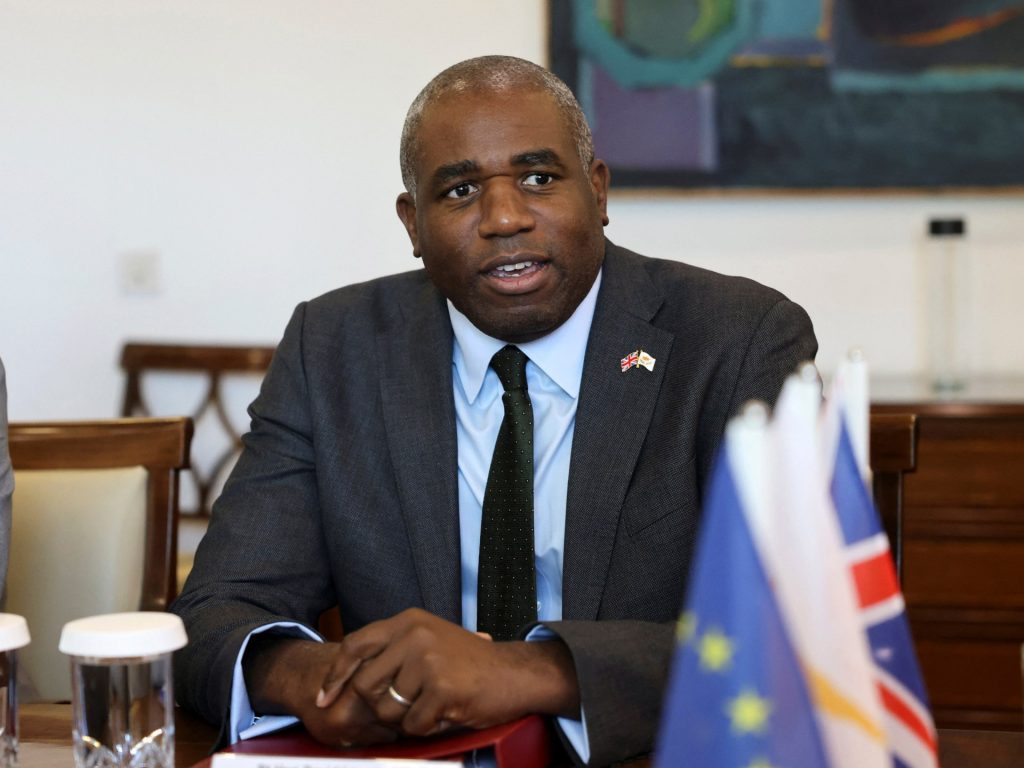
British foreign secretary pledges support for Syria’s new government after talks with interim President Ahmed al-Sharaa. The United Kingdom has announced it is formally restoring diplomatic ties with Syria as British Foreign Secretary David Lammy travelled to the capital Damascus to meet with interim Syrian President Ahmed al-Sharaa. Al-Sharaa received Lammy on Saturday alongside Syrian Foreign Minister Asaad al-Shaibani, according to photos of the meeting released by the presidency. “After over a decade of conflict, there is renewed hope for the Syrian people,” Lammy said in a statement released by his office, noting that the visit was the first by a British minister to Syria in 14 years. “The UK is re-establishing diplomatic relations because it is in our interests to support the new government to deliver their commitment to build a stable, more secure and prosperous future for all Syrians,” he said. Syria has been improving relations with Western countries after longtime President Bashar al-Assad was removed from power in December 2024 in an offensive led by al-Sharaa’s Hayat Tahrir al-Sham (HTS) armed group. In April, the British government lifted sanctions against a dozen Syrian entities, including government departments and media outlets, to help the country rebuild after al-Assad’s fall. Weeks earlier, the UK had dropped sanctions against two dozen Syrian businesses, mostly banks and oil companies. On Monday, United States President Donald Trump signed an executive order to dismantle a web of sanctions against Syria that had crippled the country’s economy under al-Assad. In a statement posted on X, al-Shaibani – the Syrian foreign minister – welcomed Trump’s decision, saying it would “open the door of long-awaited reconstruction and development”. Advertisement “It will lift the obstacle against economic recovery and open the country to the international community,” he said. Syria’s new leaders have been struggling to rebuild the country’s decimated economy and infrastructure after nearly 14 years of civil war that killed half a million people. Adblock test (Why?)
Supporters of banned Palestine Action group arrested at London protest
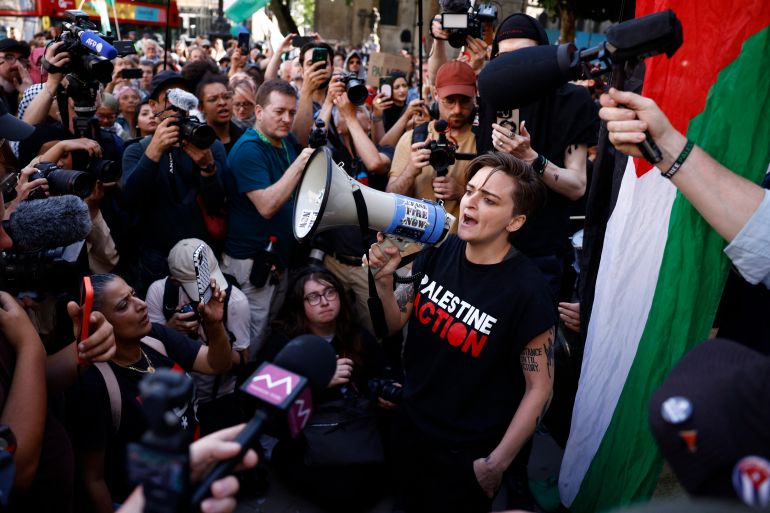
More than 25 protesters have been detained by police a day after the activist group was banned in the UK. Police have arrested protesters in London for supporting activist group Palestine Action, which was banned at midnight in the United Kingdom. “Officers have arrested more than 20 people on suspicion of offences under the Terrorism Act 2000. They have been taken into custody. Palestine Action is a proscribed group and officers will act where criminal offences are committed,” the Metropolitan Police wrote on X on Saturday. Campaign group Defend Our Juries said in a press release that 27 people, including a priest and a number of health professionals, had been arrested for offences under the Terrorism Act. They were holding cardboard signs, saying: “I oppose genocide. I support Palestine Action.” Passersby reacted to the arrests as the police intervened in the demonstration at noon. “Met Police, you are puppets of the Zionist state” and “leave them alone”, they were quoted as shouting by the Press Association, the British news agency. Other supporters, not directly involved in the Palestine Action protest, shouted: “Who do you protect? Who do you serve?” and “British police off our streets.” There were further chants of “From the river to the sea, Palestine will be free” during the incident. The ban Police warned on Friday that expressing support for Palestine Action would be a criminal offence after the ban kicked in at midnight. “This includes chanting, wearing clothing or displaying articles such as flags, signs or logos,” said the force. A spokesperson for Defend Our Juries said: “We commend the Counter Terrorism police for their decisive action in protecting the people of London from some cardboard signs opposing the genocide in Gaza and expressing support for those taking action to prevent it.” Advertisement The proscription cleared parliament on Thursday, with a court challenge to try to stop it becoming law failing on Friday. The government announced last week it would ban Palestine Action under the Terrorism Act 2000, days after activists from the group broke into an air force base in southern England. Two aircraft at the base were sprayed with red paint, causing an estimated 7 million pounds ($9.55m) in damage. Four Palestine Action activists were remanded in custody on Thursday after appearing in court over the incident. Palestine Action has condemned the proscription as an attack on free speech. The ban will make it a criminal offence to belong to or support the group, punishable by up to 14 years in prison. A Palestine Action activist speaks to supporters and members of the media on Friday [Benjamin Cremel/AFP] Adblock test (Why?)
36 pilgrims injured as 5 Amarnath Yatra buses collide in Jammu and Kashmir’s Ramban

The fourth batch of 6,979 pilgrims – 5,196 men, 1,427 women, 24 children, 331 sadhus and sadhvis, and one transgender – left the Bhagwati Nagar base camp in two separate convoys between 3.30 am and 4.05 am.
‘Maharashtra is bigger than politics’: Raj Thackeray on reunion with Uddhav Thackeray at ‘Awaz Marathicha’ joint rally

Thackeray brothers garlanded the statue of Chhatrapati Shivaji Maharaj at the joint rally of their parties, Shiv Sena (UBT) and Maharashtra Navnirman Sena (MNS) at Worli Dome in Mumbai.
Indian army set to receive first 3 Apache AH-64E helicopters in Rs 56910000000 deal with US till…

Indian Army is finally set to receive the first batch of Apache AH-64E attack helicopters from the United States. Three Boeing Apache helicopter, known as ‘tanks in the air’, are expected to be delivered by mid-July.
‘We have come together to stay together’: Uddhav Thackeray’s big statement on reunion with brother Raj Thackeray

The Maharashtra Navnirman Sena (MNS) and Shiv Sena (UBT) are holding a joint rally in Mumbai to oppose the alleged imposition of the Hindi language over Maharashtra by the state government.
Good news for Indians: This state to get first Disneyland?inspired mega theme park, its whopping area is…

India’s first Disneyland-inspired mega park is coming to Manesar, Haryana-set to transform the region with a thrilling mix of rides, entertainment and cultural attractions. A bold, game-changing project aimed at boosting tourism, jobs and economic growth, all while staying rooted in local values.