

Kim, Xi hail bond as North Korea says it will protect China’s interests
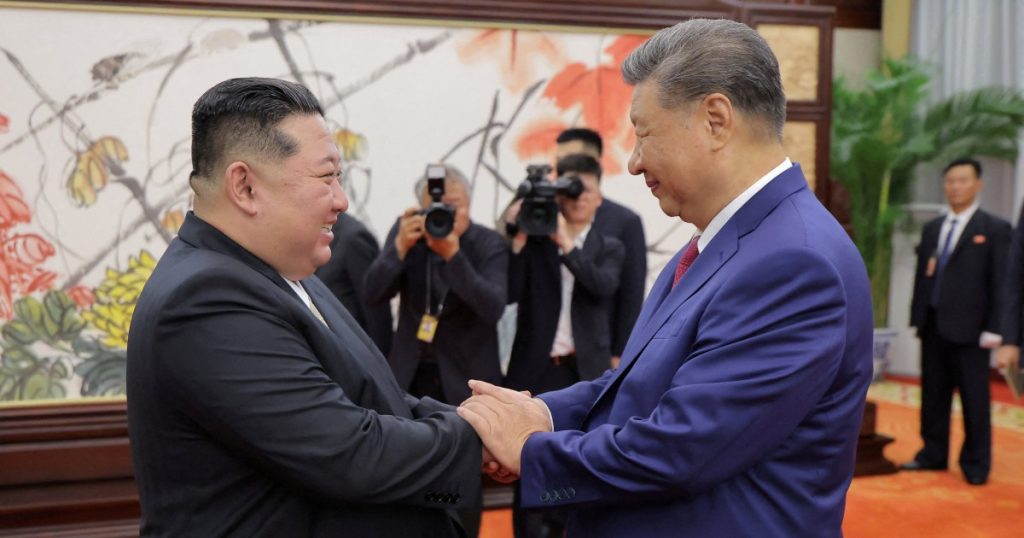
Goodwill messages continued this week’s unprecedented public display of diplomatic unity between Beijing, Pyongyang and Moscow. Published On 5 Sep 20255 Sep 2025 North Korean leader Kim Jong Un told Chinese President Xi Jinping that North Korea will support China in protecting its sovereignty, territory and development interests, as the pair met just a day after an unprecedented show of unity with Russian President Vladimir Putin in Beijing. The bilateral meeting between Xi and Kim on Thursday came as Russia also hailed North Korea’s role supporting its war in Ukraine, continuing the public display of close relations between Pyongyang, Beijing and Moscow after their meeting at Wednesday’s huge military parade in China’s capital to mark 80 years since the end of World War II. Recommended Stories list of 3 itemsend of list In an article published on Friday by North Korea’s state-run outlet, the Korean Central News Agency (KCNA), Kim was quoted as saying, “No matter how the international situation changes, the feeling of friendship cannot change” between Pyongyang and Beijing. “The DPRK [Democratic People’s Republic of Korea] will as ever invariably support and encourage the stand and efforts of the Communist Party of China and the government of the People’s Republic of China to defend the sovereignty, territorial integrity and development interests of the state,” Kim said after meeting with Xi, according to KCNA. Xi also reportedly told Kim that China and North Korea are “good neighbours, good friends and good comrades” that share one destiny, and he was willing to “defend, consolidate and develop” the countries’ relations, KCNA said. KCNA also confirmed that Kim departed Beijing on Thursday, concluding his first trip outside of North Korea since meeting with Putin in Russia in 2023. Advertisement Top-ranking Chinese Communist Party officials – including Cai Qi and Foreign Minister Wang Yi – attended a send-off ceremony for Kim, according to KCNA. During Wednesday’s military parade in Beijing – in which the People’s Liberation Army displayed its latest generation of stealth fighters, tanks and ballistic missiles amid a highly choreographed cast of thousands – Xi hailed China’s victory 80 years ago over “Japanese aggression” in the “world anti-fascist war”. Putin and Kim were among some 26 mostly non-Western world leaders in attendance, with the pair meeting with Xi for two and a half hours on the event’s sidelines in an unprecedented display of unity. The trio discussed “long-term” cooperation plans, according to KCNA. Putin and Kim also met prior to the parade, with both leaders praising the deepening military partnership between Moscow and Pyongyang. Seemingly rattled by the meeting, United States President Donald Trump addressed Xi in a post on his Truth Social platform, saying: “Please give my warmest regards to Vladimir Putin, and Kim Jong Un, as you conspire against The United States of America.” A Kremlin aide dismissed Trump’s remarks, saying “no one even had this in their thoughts”. Following the meeting, Putin also sent Kim a congratulatory message for North Korea’s foundation day, in which he hailed Pyongyang’s support for Moscow’s military campaign in Ukraine. “Your combat force’s heroic involvement in liberating the Kursk territories from the invaders is a distinct symbol of friendship and mutual aid between Russia and North Korea,” Putin’s message read, according to KCNA. “I am confident that we will continue to work together to consolidate the comprehensive strategic partnership between our two countries,” Putin added. North Korea has controversially sent thousands of soldiers to fight in Kursk – a Russian region briefly occupied by Ukraine – and also provided artillery ammunition and missiles to support Moscow in its war against Kyiv. During their meeting in Beijing, Kim also reportedly told Putin his country would “fully support” Russia’s army as a “fraternal duty”, KCNA previously reported. Adblock test (Why?)
Watch UK police arrest Palestine Action supporter for planning protest

NewsFeed UK police were recorded arresting a Palestine Action supporter for allegedly taking part in a Zoom meeting to plan a protest against the government’s designation of the group as a “terrorist” organisation. Published On 3 Sep 20253 Sep 2025 Adblock test (Why?)
US appeals court blocks Trump use of Alien Enemies Act in deportation drive
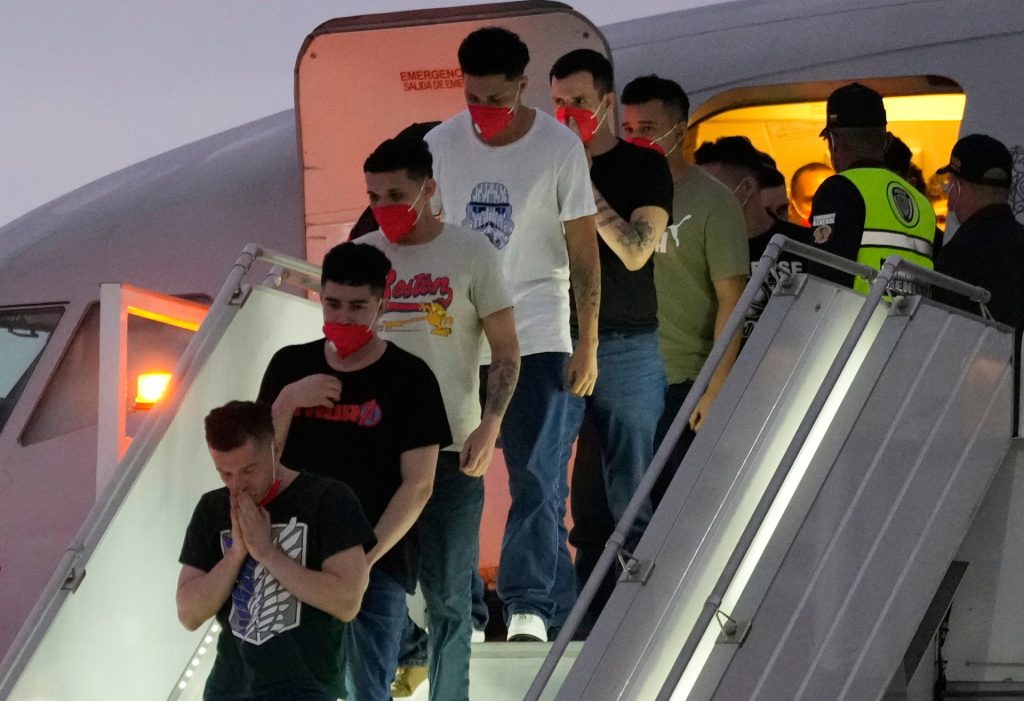
A federal appeals court has ruled that the administration of United States President Donald Trump illegally invoked a wartime law to deport Venezuelans as part of its immigration crackdown. Late on Tuesday, a majority on the Fifth Circuit Court of Appeals rejected Trump’s use of the Alien Enemies Act of 1798 to expedite deportations without due process. The decision was remarkable on several fronts. It was the first time a federal appellate court had weighed Trump’s use of the 18th-century law, but it was also a strong rebuke to Trump’s mass deportation campaign from a court with a reputation for leaning conservative. Writing for the majority on the three-person bench, Judge Leslie Southwick rejected Trump’s claim that the Venezuelan gang Tren de Aragua represented an invasion into the US. “We conclude that the findings do not support that an invasion or a predatory incursion has occurred,” Southwick wrote. “We therefore conclude that petitioners are likely to prove that the AEA [Alien Enemies Act] was improperly invoked.” The Alien Enemies Act has the power to give the government wide-ranging powers to detain and deport citizens of “hostile” foreign nations, but only in times of war or during an “invasion or predatory incursion”. Before Trump, the law had only been used three times — and exclusively during war. But Trump officials have used the law to justify the rapid deportation of Venezuelan migrants, on the basis that they constitute a criminal “invasion” across the border. Southwick, who was appointed by Republican President George W Bush, rejected that argument. Advertisement “There is no finding that this mass immigration was an armed, organized force or forces,” Southwick wrote. The panel is the highest federal court to so far rule on Trump’s attempts to use the law for deportations. The case is expected to eventually make its way to the US Supreme Court. Tuesday’s ruling, however, was limited in scope: It only applies to states under the appeals court’s jurisdiction — Texas, Louisiana and Mississippi — though it could be cited as a precedent in other appeals court circuits. Trump first invoked the Alien Enemies Act on March 15, publishing an executive order that accused the Tren de Aragua gang of “perpetrating, attempting, and threatening an invasion or predatory incursion” into the US. That same day, his administration flew two planeloads of Venezuelan migrants to El Salvador’s Terrorism Confinement Centre (CECOT), a maximum-security prison notorious for human rights abuses. That came despite a lower judge’s order blocking his use of the law while the flights were under way. Trump officials accused the Venezuelan migrants on those flights of being Tren de Aragua members, though their lawyers point out that many of them had no criminal records. To meet the standards for using the Alien Enemies Act, the Trump administration has repeatedly claimed that Tren de Aragua is controlled by Venezuelan President Nicolas Maduro, a longtime rival of the Republican leader. Trump has accused Maduro of masterminding a “narco-terrorism enterprise” in a coordinated effort to destabilise the US. But a declassified US intelligence memo has contradicted this claim, saying there is no evidence that Maduro coordinated with Tren de Aragua. On Tuesday, the US announced it had attacked a boat carrying 11 alleged Tren de Aragua members in international waters in the Caribbean, killing all on board. Trump claimed they were “narcoterrorists”. Cases related to Trump’s use of the Alien Enemies Act have twice reached the US Supreme Court, which has not yet addressed the underlying validity of the Trump administration’s actions. In April, the Supreme Court ruled that deportations under the act could proceed, but that immigrants should have “reasonable time” to contest their removals. It also decided that such challenges should be brought in the federal districts where the deportees are being held, as opposed to courts elsewhere in the country. In a second ruling, also in April, the Supreme Court blocked the deportations of a group of Venezuelan men in northern Texas. Advertisement Then, in May, the Supreme Court extended the block, faulting the Trump administration for attempting to swiftly remove detainees just one day after providing them with deportation notices. “Notice roughly 24 hours before removal, devoid of information about how to exercise due process rights to contest that removal, surely does not pass muster,” the majority opinion said. The case was ultimately sent back to the Fifth Circuit Court of Appeals. In a statement after Tuesday’s decision, Lee Gelernt, a lawyer for the American Civil Liberties Union (ACLU), called the ruling a “critically important decision reining in the administration’s view that it can simply declare an emergency without any oversight by the courts”. The ACLU represented the Venezuelan men in the case. But there was one judge who dissented from Tuesday’s decision on the Fifth Circuit Court: Andrew Oldham, a Trump appointee. Oldham argued that deportations under the Alien Enemies Act were “matters of political judgment” and that the president has the right to determine whether the appropriate conditions were met. “From the dawn of our nation until President Trump took office a second time, courts have never second-guessed the President’s invocation of that Act,” Oldham wrote. Adblock test (Why?)
Campbell’s sees tariff hit in year ahead as economic uncertainty looms

The maker of the Goldfish snack also plans to stop using artificial dyes by the second half of its 2026 fiscal year. Published On 3 Sep 20253 Sep 2025 Campbell’s Co expects sales to fall in the coming year as tariff-driven economic uncertainty weighs on the food maker. In its fourth quarter earnings report released Wednesday, the New Jersey-based company said its sales will likely remain flat or decline by as much as 2 percent in the coming year. Campbell’s, which is best known for its canned soup products, said that it expects that tariffs will account for about 4 percent of the cost of goods for the 2026 fiscal year which started August 4. The company says it plans to mitigate the cost with some price increases and other cost-saving measures as inflation weighs on how much consumers spend. “Consumers continue to be increasingly deliberate in their food choices,“ CEO Mick Beekhuizen said. The latest consumer price index report reflecting the month of July, and which came out in mid-August, showed that prices overall for food at home increased by 2.2 percent compared over the same period a year ago. “The company faces a dynamic operating and regulatory environment resulting in substantial input cost pressures, primarily driven by tariffs, which, despite significant mitigation efforts, reduce its earnings outlook for the upcoming fiscal year,” Beekhuizen said. Campbell expects annual adjusted profit per share to fall up to 18 percent to between $2.40 and $2.55, including tariffs, and below the estimates of $2.63, according to data compiled by LSEG. Food brands like Campbells and its competitors use steel in their cans, which has been subject to steep tariffs. The Can Manufacturers Institute warned earlier this year that tariffs would put a strain on food producers, especially as domestic manufacturing of the steel used in cans has fallen by 75 percent over the last eight years. “Domestic can makers and canned food producers now import nearly 80 percent of tin mill steel from trade allies,” Robert Budway, president of the Can Manufacturers Institute, said at the time. Advertisement Campbell’s Co reported net sales increased in the fourth quarter by 1 percent to $2.3bn. Prices also increased by 2 percent for the quarter, which offset a 4 percent decline in volume. Food dye cuts The maker of the Goldfish snack also plans to stop using synthetic food dyes in its products by the second half of the 2026 fiscal year. The company plans to replace them with more natural alternatives like annatto, an orange-red food condiment made from the seeds of the achiote tree, and purple carrot juice in Lance crackers and V8 Splash. It joins industry peers, including PepsiCo, Kraft-Heinz and Nestle, in replacing synthetic food dyes with natural ones in response to Health Secretary Robert F Kennedy Jr’s “Make America Healthy Again” initiative and shifting consumer preferences. On Wall Street, the company’s stock surged on the news, and as of 11:30am in New York (15:30 GMT), it was up by 4.6 percent. Adblock test (Why?)
How did US strike on Venezuelan boat come about? What it means
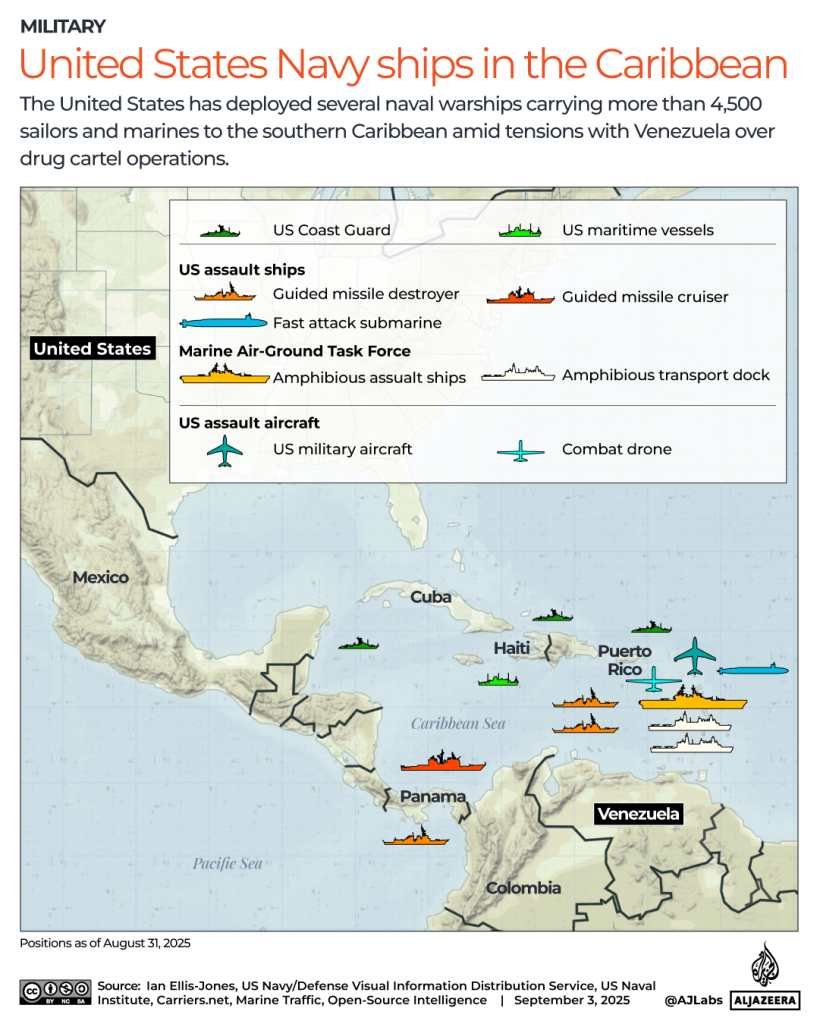
President Donald Trump has released a video showing a United States military strike on a boat in the Caribbean that he says was smuggling drugs out of Venezuela for the Tren de Aragua gang, stoking fears of a possible clash between the Venezuelan and US militaries. In a post on his social media platform, Truth Social, Trump said 11 people were killed on Tuesday. He wrote: “No US Forces were harmed in this strike. Please let this serve as notice to anybody even thinking about bringing drugs into the United States of America. BEWARE!” The strike, apparently carried out in international waters, marks an escalation in tensions between the Trump administration and Venezuelan President Nicolas Maduro, whom Trump has repeatedly accused of assisting international drug gangs. The incident is the first known attack the US has made against alleged smugglers since the Trump administration began increasing its military presence in the Caribbean last month to counter drug cartels designated as “narcoterrorist organisations”. What happened? The Trump administration dispatched warships to the southern Caribbean in August in a bid, it said, to counter threats to US national security posed by criminal organisations operating in the region. The New York Times reported that Trump had signed a secret directive ordering the Pentagon to use military force against certain Latin American drug cartels that the US considers “terrorist organisations”. On Thursday, the Reuters news agency reported that seven US warships and one nuclear-powered fast attack submarine were headed for the Caribbean. More than 4,500 sailors and Marines are on board the vessels. Advertisement Then on Tuesday, Trump announced the strike on the Venezuelan boat he said was transporting drugs. (Al Jazeera) What is Tren de Aragua and why does Trump link it to Maduro? Trump identified the people on board the Venezuelan boat as “narcoterrorists” who were “at sea in International waters transporting illegal narcotics, heading to the United States”. The Tren de Aragua is one of Venezuela’s most notorious criminal organisations with operations spreading across Latin America. Originating in the early 2000s among prison inmates in the state of Aragua, the gang initially controlled contraband and extortion networks inside jails before expanding outwards. Today, it runs a diversified criminal empire spanning drug trafficking, human smuggling, extortion, illegal mining and contract killings. The group is especially active along migration routes, exploiting vulnerable refugees and migrants through kidnapping, forced labour and sex trafficking. The Trump administration has repeatedly claimed there is a direct link between groups like Tren de Aragua and Venezuela’s government. According to Trump, Maduro controls the gang as part of a “narcoterrorism” ploy to destabilise the US. On August 7, the US Departments of State and Justice doubled their reward for information leading to the arrest of Maduro to $50m, accusing him of being “one of the largest narcotraffickers in the world”. For his part, Maduro denies any connection to the group. At least two reports from the US intelligence community also contradict the Trump administration’s claim. In May, a declassified National Intelligence Council report found that Maduro’s government “probably does not have a policy of cooperating with” Tren de Aragua. The report also said Maduro is “not directing” the gang’s operations in the US although it did concede that Venezuela offers a “permissive environment” that allows Tren de Aragua to operate. Venezuelan President Nicolás Maduro said at a news conference on September 1, 2025, in Caracas that his government has been targeted by eight military ships and 1,200 missiles, calling it the greatest threat to Venezuela for 100 years [Jesus Vargas/Getty Images] What does the US strike mean for Venezuela-US relations? The US deployment piqued concerns over spiralling tensions with Venezuela after Maduro urged millions of Venezuelans in August to join nationalist “militias” to defend Venezuela in response to Washington’s aggressive new antidrug operations in the Caribbean. In the run-up to the US strike on the Venezuelan boat this week, Maduro said on August 25: “No empire will touch the sacred soil of Venezuela.” Advertisement The Venezuelan president has long accused the US government of interfering in his country’s politics on behalf of the political opposition. In last week’s remarks, he also accused Trump of “seeking a regime change through military threat”. Trump, meanwhile, has adopted the same “maximum pressure” campaign that defined his foreign policy towards Venezuela during his first term. It included heightened sanctions on the Latin American country. In spite of this, the US energy group Chevron returned to Venezuela in July after a three-month hiatus after Trump’s decision in February to rescind a US Treasury licence that allowed the oil giant to export crude from Venezuela despite US sanctions. Trump revoked the existing licence, which was issued during President Joe Biden’s administration in 2022, over what he saw as a “failure” by Maduro to implement electoral reforms and accept Venezuelans deported from the US, forcing Chevron to pause operations and wind down its activities. But after intense lobbying, Chevron was granted a new restricted licence by the Department of the Treasury to export Venezuelan crude. That decision was considered to amount to an easing of sanctions on Venezuela’s oil sector. While the precise licence conditions remain unknown, experts said the agreement will bring benefits to Venezuela’s debt-strapped economy as Chevron is expected to send 200,000 barrels of oil per day from Venezuela to international markets. Christopher Sabatini, senior research fellow for Latin America at Chatham House, said the Trump administration is facing “competing objectives” in Venezuela. Sabatini told Al Jazeera that the Treasury’s recent move to reinstate Chevron’s (albeit restricted) licence “is a recognition, in part, of the failure of past sanctions” insofar as they ceded control of Venezuelan oil assets from Chevron to “governments opposed to US interests, … China, Russia and Iran”. He added that “by mobilising this fleet [in the Caribbean], the administration is also trying to scare Maduro into potential regime change.” The upshot, Sabatini said, is that Trump’s two-pronged policy approach “risks causing an unintended conflict with Venezuela”. How are
Israel accused of using drones to drop incendiary bombs in Gaza
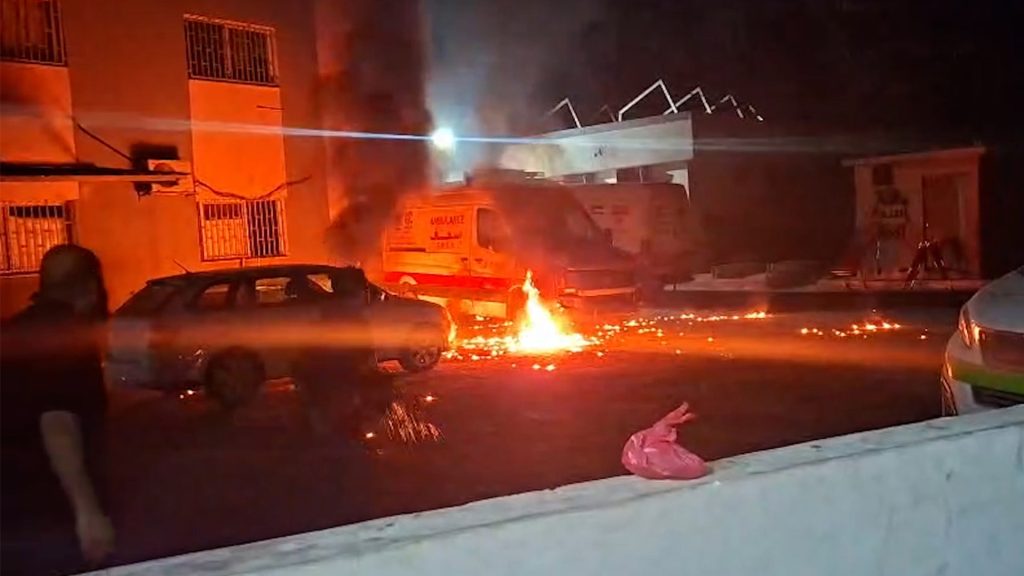
NewsFeed Israeli forces reportedly used quadcopter drones to drop incendiary bombs on ambulances parked outside a clinic in Gaza City, causing a fire. The use of incendiary weapons is prohibited in civilian-populated areas under international humanitarian law. Published On 3 Sep 20253 Sep 2025 Adblock test (Why?)
What China unveiled at its military parade
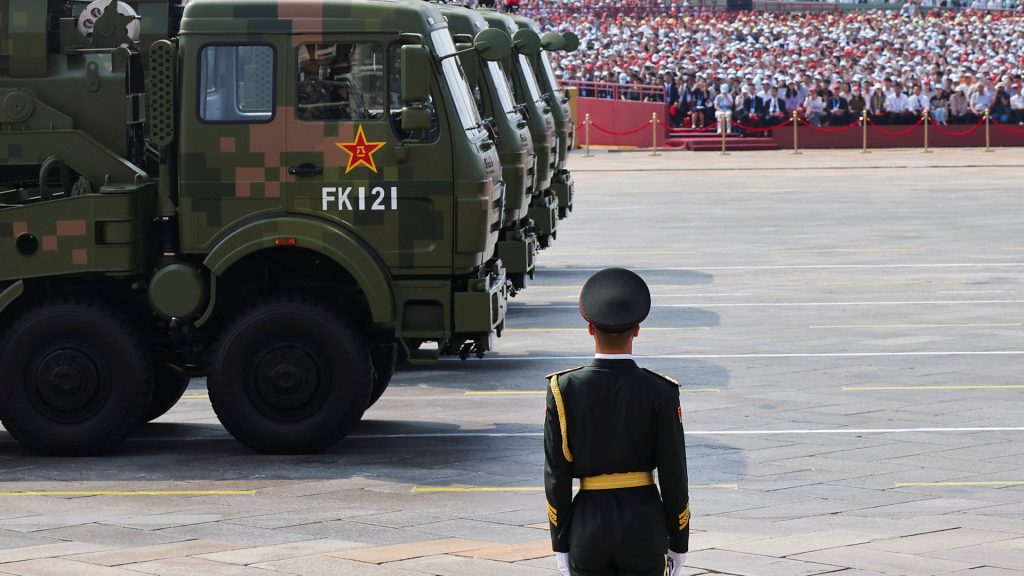
NewsFeed China showcased a new generation of weapons at a military parade in Bejing, including ‘robot wolves’, unmanned submarines and aircraft, and intercontinental ballistic missiles. Al Jazeera’s Alex Gatopoulos looks at how these all fit into Beijing’s push to build a world-class military. Published On 3 Sep 20253 Sep 2025 Adblock test (Why?)
Some 400 Indonesian school children fall ill after eating free school meals

Indonesian President Prabowo’s free meals programme hit by more mass illness as protests against government rock country. Published On 3 Sep 20253 Sep 2025 An investigation has been launched after some 400 children became ill after eating free school meals in Indonesia’s western Bengkulu province, in the worst case of mass food poisoning linked to President Prabowo Subianto’s flagship food programme to help pregnant women and children. The reports of mass illness on Wednesday came as President Prabowo arrived in Beijing, China, for events commemorating the end of World War II, and days after widespread antigovernment protests rocked cities and towns across Indonesia. Authorities will launch an investigation into the cause of the illness, Bengkulu Province ‘s Vice Governor Mian said. “We will temporarily suspend operations at this kitchen while we investigate where the weaknesses lie,” said Mian, who goes by a single name. “This is the domain of the BGN [National Nutrition Agency] investigation team and the authorities,” he said. Dadan Hindayana, chief of the National Nutrition Agency, which runs the programme, told the Reuters news agency the kitchen in question had only recently started operating, asking staff to evaluate services while waiting for results of tests on the food. Since its launch, Prabowo’s free school meals programme has been rapidly expanded to reach more than 20 million recipients, and authorities plan to reach 83 million recipients by year-end, budgeting a total cost of 171 trillion rupiah ($10.52bn) for the programme this year. The president launched the programme in January, but the initiative had already been marred by food poisoning that affected hundreds of people. Airlangga Hartarto, Indonesia’s coordinating minister for economic affairs, inspects the trial of a free lunch programme for students at a junior high school in Tangerang, on the outskirts of Jakarta, Indonesia, on February 29, 2024 [Stefanno Sulaiman/Reuters] Last month, 365 people fell ill from free school meals in Central Java. According to local media reports, laboratory results indicated that the outbreak was a result of poor sanitation. Advertisement In the latest mass illness in Bengkulu, children aged from about 4 to 12 were rushed to a local hospital complaining of stomach pain beginning last Thursday, according to a video handout from the local government. On Wednesday, Prabowo was seen attending a military parade hosted by Chinese President Xi Jinping in Beijing, to mark 80 years since Japan’s defeat at the end of World War II, according to China’s CCTV. Despite the ongoing street protests at home over his government’s handling of the economy, Prabowo decided he would travel to China, after briefly reconsidering his trip amid the mass unrest. The Jakarta Post reported on Wednesday that some 10 people are now thought to have died in protests over the weekend, with 20 people missing and 500 injured, according to reports from civic organisations and officials. In Geneva on Monday, the United Nations called for investigations into the alleged use of disproportionate force by Indonesia’s security forces against demonstrators. “We are following closely the spate of violence in Indonesia in the context of nationwide protests over parliamentary allowances, austerity measures, and alleged use of unnecessary or disproportionate force by security forces,” UN human rights office spokeswoman Ravina Shamdasani said. “We stress the importance of dialogue to address the public’s concerns,” she said in a statement. Adblock test (Why?)
US Open: Carlos Alcaraz cruises into 2025 semifinals
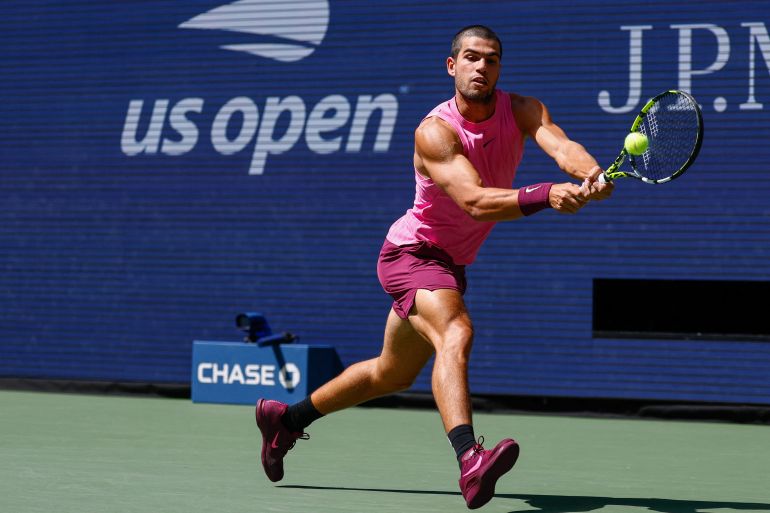
Alcaraz dominated Czech player Jiri Lehecka in the quarters, with the Spaniard yet to lose a set at this year’s event. Published On 3 Sep 20253 Sep 2025 Second seed Carlos Alcaraz has yet to drop a set at Flushing Meadows, and cruised into the US Open semifinals, demolishing Czech Jiri Lehecka 6-4, 6-2, 6-4 on Arthur Ashe Stadium. Alcaraz had the crowd in the palm of his hand on Tuesday as he fired off 28 winners and never faced a break point, putting on yet another almost pristine performance. He will next play either 24-time major winner Novak Djokovic or American fourth seed Taylor Fritz. Lehecka is one of the few players to beat Alcaraz this season, winning in the Doha quarterfinals, but was outclassed this time around and could only watch helplessly as the Spaniard’s forehand winner zipped by on match point. “If you show the opponent you’re fresh, you’re able to play two, three, more hours, to play long rallies, it’s giving him the mindset of, this is going to be really tough,” said Alcaraz. “The way that I walk between points, with attitude – I’m fresh, I’m really good physically. I think it’s really important to show the opponent that they are going to sweat a lot, and they are going to have to run a lot if he wants to beat me.” Alcaraz broke in the first game, helped on his way by a pair of Lehecka double faults, and the Spaniard got the crowd going as he triumphed in a thrilling, cat-and-mouse exchange at the net in the 10th game, sending a backhand winner streaking past the Czech. The 2022 champion kept the momentum going in the second set, converting a break point at the net in the first game, and Lehecka became visibly agitated as he went down another break with a double fault in the seventh game. Advertisement Alcaraz smiled in disbelief as he nailed a series of precise shots to set up a break point in the seventh game of the final set, but Lehecka dug in to hold. Alcaraz let out a triumphant cheer as he prevailed in a 12-shot rally on break point in the ninth game and deployed his golf swing celebration to the delight of fellow Spaniard and 2017 Masters champion Sergio Garcia, who was in attendance. “I just played a really – or almost – perfect match,” he said. “I’m just feeling great and hungry to make it.” The five-time major winner has only been broken once so far in the tournament and could retake the number one world ranking from Italy’s Jannik Sinner, although he is trying not to think about it. “If I think about the number one spot too much, then I’m going to put pressure on myself, and I don’t want to do that,” he said. Alcaraz, at just 22, is in the semifinals at a grand slam for the ninth time. Only Rafael Nadal, with 10, had more before turning 23 [Kena Betancur/AFP] Adblock test (Why?)
China’s Xi oversees massive military parade with Putin, Kim in attendance
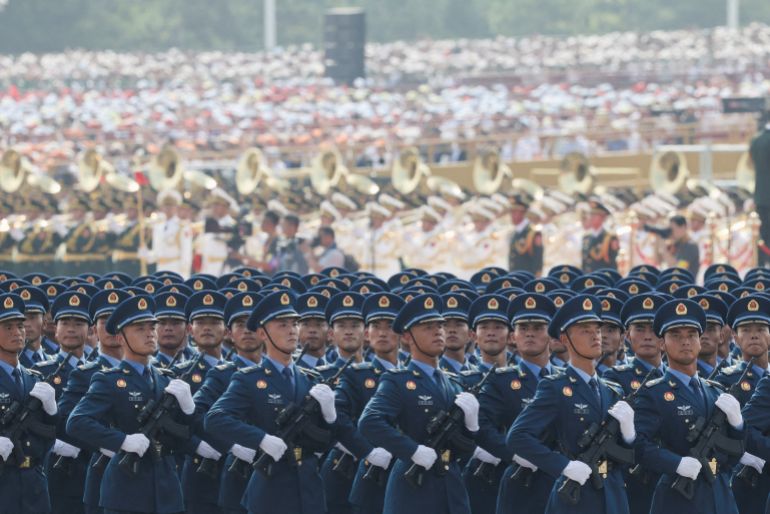
China’s full military might was on display in Beijing’s Tiananmen Square where thousands of troops marched in parade. Published On 3 Sep 20253 Sep 2025 China flexed its military muscle at a huge military parade in Beijing to mark 80 years since the end of World War II, displaying its latest generation of stealth fighters, tanks and ballistic missiles amid a highly choreographed cast of thousands. The parade through Tiananmen Square on Wednesday morning was overseen by Chinese President Xi Jinping, who is also the head of China’s military and the Chinese Communist Party. After greeting foreign leaders, including Russian President Vladimir Putin and North Korean leader Kim Jong Un, Xi moved on to welcome Chinese military veterans before taking his place at the centre of the event. Xi watched on from the Gate of Heavenly Peace before making a speech to the 10,000 assembled members of the People’s Liberation Army, Navy and Air Force, stating that China would continue to “adhere to a path of peaceful development”. “Humanity is again faced with a choice of peace or war, dialogue or confrontation, and win-win outcomes or zero-sum games,” Xi said, according to an official readout of his speech. Members of the Chinese People’s Liberation Army (PLA) Air Force march during a military parade to mark the 80th anniversary of the end of World War II, in Beijing, China, on September 3, 2025 [Maxim Shemetov/Reuters] “The Chinese people will stand firmly on the right side of history and on the side of human progress, adhere to the path of peaceful development, and join hands with the rest of the world to build a community with a shared future for humanity,” he said. Advertisement Dressed in a grey Mao suit, Xi then toured Tiananmen Square, standing in a vehicle, before the parade finally commenced down Beijing’s Chang’an Avenue, a major thoroughfare in the Chinese capital. China’s most advanced weaponry took front and centre in the parade, including clearly labelled DF-5 intercontinental missiles – capable of delivering a nuclear warhead – alongside tight formations of military personnel. “For Xi, the point is to reinforce the impression that the [People’s Republic of China, PRC] has arrived as a great power under his leadership,” said Ian Chong, a political scientist at the National University of Singapore. “Another is the array of leaders at the parade, which suggests that the PRC cannot be isolated and is unafraid of pressure and bullying, particularly from the United States,” he said. Above the parade, the air force staged a flyover, including helicopters with banners declaring, “Justice will prevail”, “Peace will prevail”, and “The people will win”. Chinese President Xi Jinping stands in a car to review the troops during a military parade to mark the 80th anniversary of the end of World War II, in Beijing, China, on September 3, 2025 [Tingshu Wang/Reuters] Adblock test (Why?)