

New Zealand’s minor gov’t party pushes to define women by biological sex
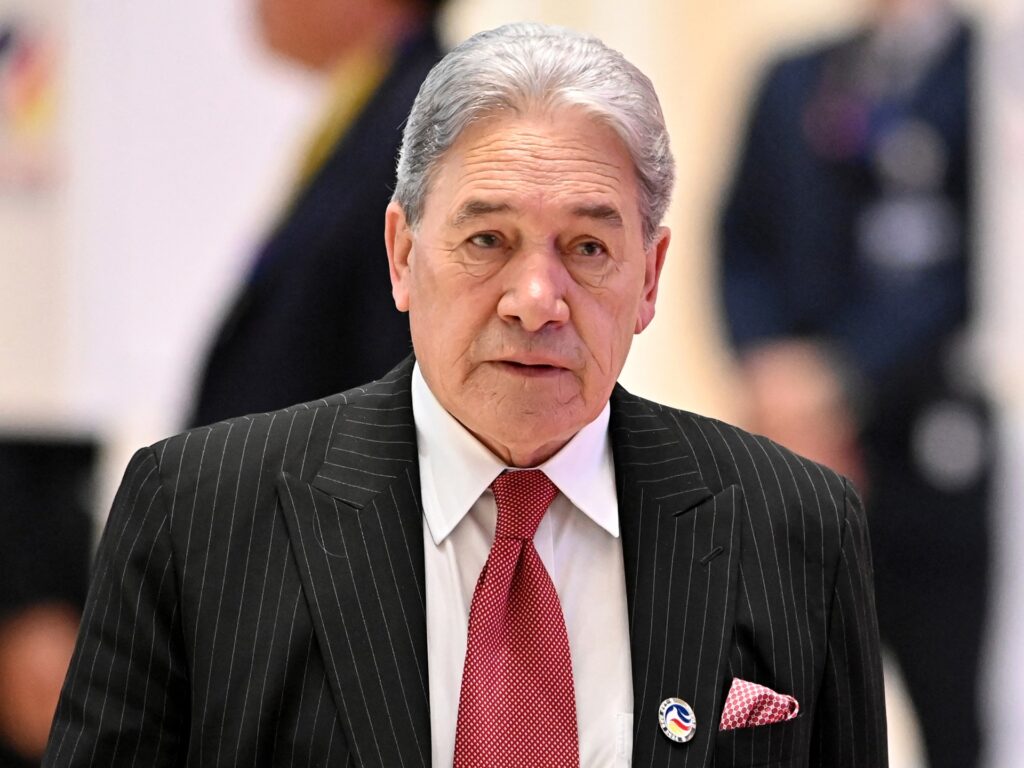
Populist New Zealand First party says bill will ensure country moves away from ‘woke ideology’ harming women. A minor party in New Zealand’s coalition government has announced proposals to legally define women by biological sex, casting the move as a return to common sense and a rejection of “woke ideology”. The bill announced by the populist New Zealand First (NZF) party on Tuesday would define a woman and a man in law as a “human biological female” and “an adult human biological male”, respectively. NZF leader Winston Peters, whose party governs in a coalition with the centre-right National Party and pro-business ACT New Zealand, said the proposed law would “reflect biological reality” and “provide legal certainty”. “This Bill would ensure our country moves away from the woke ideology that has crept in over the last few years, undermining the protection, progression, and safety of women,” Peters, who serves as the deputy prime minister and minister of foreign affairs, said in a post on X. “These definitions in law fight back against the cancerous social engineering we’ve seen being pushed in society by a woke minority,” Peters added. Advertisement “The need for legislation like this shows how far the deluded left has taken us as a society. But we are fighting back. This bill is a win for common sense.” It is not clear whether the bill, which was introduced by an individual MP instead of the government, has a realistic prospect of becoming law. NZF is the smallest of the three coalition partners in government, with 11 seats in the 123-member parliament, and most bills introduced by individual MPs ultimately do not end up on the statute books. Chris Hipkins, the leader of the main opposition New Zealand Labour Party, accused the NZF of being interested in “one headline after the next”. “They don’t really have a coherent programme and they’re certainly not focused on the things that are required to lead New Zealand forward,” Hipkins told Radio New Zealand. The proposals come less than a week after the United Kingdom’s highest court ruled that women are defined by biological sex under the country’s equality laws. The landmark decision was welcomed by conservative politicians and some feminist advocacy groups, but greeted with dismay by transgender campaigners and progressive activists, who warned it would further the marginalisation of the LGBTQ community. Adblock test (Why?)
Palestinians in distress after Israeli attack in Khan Younis

NewsFeed “Let them drop nuclear weapons on us so we can die all at once.” At least eleven Palestinians were killed in an Israeli attack on a residential building, as a result of a fire caused by the strikes. Neighbours of the victims in Khan Younis expressed their distress. Published On 22 Apr 202522 Apr 2025 Adblock test (Why?)
The Endgame

People & Power examines whether the forced transfer of Palestinians is Israel’s ultimate goal. As soon as he came to power, United States President Donald Trump echoed calls for the Palestinians’ massive displacement outside their homeland. Israel’s war on Gaza has displaced nearly two million Palestinians since October 2023. And with calls by some Israeli politicians to permanently expel Palestinians from the Strip, fear is growing of yet another forced population transfer. An Israeli minister has even called the current war the “Gaza Nakba”, referring to the forced displacement of Palestinians in 1948-49. Meanwhile, in the occupied West Bank, the Israeli army and settlers are waging a less visible but equally dangerous shadow war. People & Power delves into the history of Palestinian displacement and asks whether population transfer is Israel’s ultimate goal. Adblock test (Why?)
Israeli attacks kill 28 in Gaza, destroy bulldozers for recovering the dead

UNRWA says Gaza has become ‘a land of desperation’ as Israel continues to pound the strip and block humanitarian aid. Israeli forces have killed at least 28 Palestinians in Gaza since dawn, including 11 people who burned to death inside their home in Khan Younis, and carried out air strikes that destroyed equipment used to retrieve the dead from under rubble. Seven members of a family were also killed on Tuesday by an air raid on the home where they were sheltering in western Gaza City. Three civilians, including two girls, were killed when Israeli warplanes targeted a group of people in the Nuseirat refugee camp. Philippe Lazzarini, the commissioner-general of the United Nations agency for Palestinian refugees, UNRWA, warned that more than two million people – mostly women and children – were being collectively punished. “Gaza has become a land of desperation,” he said on X. Nearly 3,000 trucks of UNRWA supplies and humanitarian aid remained stuck outside Gaza, unable to enter while food and medicine inside the strip are quickly running out. “Hunger is spreading,” Lazzarini warned. “Humanitarian aid is being used as a bargaining chip – a weapon of war.” Advertisement The UN’s special rapporteur on the occupied Palestinian territory, Francesca Albanese, warned that withholding humanitarian aid constitutes a war crime. “This action would further aggravate conditions of life calculated to destroy the Palestinian population of Gaza.” Hamas slammed Israel’s ongoing blockade, which began on March 2. “The Gaza Strip is facing an unprecedented humanitarian catastrophe,” the group said in a statement, citing severe shortages of food, water, fuel and medicine. It added that the siege as well as daily attacks on shelters, hospitals and residential areas amount to a “premeditated crime” by the Israeli leadership. Hamas also blamed the situation on a “political, moral, and humanitarian failure” on the part of the international community and called on the UN and other institutions to pressure Israel to lift the blockade on aid. ‘Eradicating entire families’ Al Jazeera’s Tareq Abu Azzoum, reporting from Deir el-Balah in central Gaza, said: “The situation is unfolding rapidly here on the ground. What we are seeing is truly extraordinary in terms of very huge momentum of air strikes and artillery bombardments that have been seen over the course of the past 24 hours.” “What we understand is that the Israeli military has launched huge and heavy waves of air strikes with the latest targeting a group of Palestinians – three were confirmed killed in the strike, including two girls under the age of 14,” he added. “It has been quite obvious that these attacks are focused on eradicating entire families (as in Khan Younis attack) – we’re talking about four generations being wiped out – and also a more systematic escalation has been taking place on targeting heavy machinery that has been allowed to enter Gaza during the first phase of the Gaza ceasefire deal,” Abu Azzoum said. Advertisement Bulldozers used to recover the dead destroyed Gaza’s Civil Defence said Israel also targeted bulldozers used in humanitarian operations, including rubble removal and the recovery of bodies. Nine bulldozers brought into Gaza from Egypt during a six-week ceasefire that Israel ended on March 18 were destroyed in Israeli attacks on the Jabalia al-Nazlh municipality garage in northern Gaza, according to Civil Defence official Mohammed el-Mougher. “An agreement had previously been reached with the Egyptian-Qatari committee regarding the location of the bulldozers’ shelters,” he said, noting that their coordinates had been shared with Israel. “The targeting of municipal headquarters by Israeli occupation aircraft and the bombing of heavy equipment designated for rescue and rubble removal, including bulldozers and other machinery, is a criminal continuation of the war of extermination,” the group added in a statement. The Israeli army claimed heavy equipment destroyed in overnight attacks on Gaza was used “for terror purposes”. Thirty rights groups including Oxfam, Medical Aid for Palestinians and ActionAid issued a statement saying Israel has intensified its violence in Gaza and the occupied West Bank despite the UN General Assembly having demanded in September an end to Israel’s occupation of Palestinian territory within 12 months. World leaders must act urgently to “uphold their legal and moral responsibilities”, the statement said. Adblock test (Why?)
Pistons snap record playoff losing streak, win Game 2 against Knicks

Detroit Pistons end their NBA-record, 15-game postseason losing streak with a road victory against the New York Knicks in their Eastern Conference playoff series. The Detroit Pistons snapped their NBA-record 15-game playoff losing streak with a 100-94 victory over the New York Knicks to level their Eastern Conference first-round series at one game apiece. Detroit’s Cade Cunningham scored 33 points and grabbed 12 rebounds, and Dennis Schroder added 20 points off the bench, including a go-ahead three-pointer with 55.7 seconds left, as the Pistons thwarted the Knicks’ fourth quarter rally on Monday. The Pistons, in the playoffs for the first time since 2019, notched their first playoff victory since Game 4 of the 2008 Eastern Conference finals against the Boston Celtics. Two days after the Knicks authored a 21-0 scoring run to rally in Game 1, the Pistons were pushed to the finish in a fast-paced, physical encounter at Madison Square Garden. They led by as many as 15 in the third quarter, but the Knicks had cut the deficit to eight going into the final period. New York star Jalen Brunson scored 14 of his 37 points in the fourth and fed Josh Hart for a dunk that tied it at 94-94 with 1:15 to play. Advertisement But Schroder answered immediately, drilling a three-pointer that put the Pistons ahead for good. The Knicks came up empty on three straight possessions, while Schroder and Jalen Duren connected at the free throw line to seal Detroit’s win. Detroit’s Tobias Harris scored 15 points and pulled down 13 rebounds, and Duren had 12 points and 13 boards. Mikal Bridges scored 19 for the Knicks as Karl-Anthony Towns and OG Anunoby were held to 10 apiece. “We did what we were supposed to do. And that was it,” said Pistons coach JB Bickerstaff, whose team hosts Game 3 on Thursday. “To win a game on the road to get home court was what we came here for. “So we approached it with a businesslike mentality, learned from the fourth quarter the other night. But we just did what we were supposed to do.” New York Knicks guard Jalen Brunson (#11), who led all scorers with 37 points, drives towards the basket against a Pistons defender in the fourth quarter of Game 2 on April 21, 2025 [Angelina Katsanis/AP] Leonard dominates Nuggets Kawhi Leonard scored 39 points on 15-of-19 shooting as the visiting Los Angeles Clippers beat the Denver Nuggets 105-102 on Monday to level their Western Conference first-round playoff series at one win apiece. Denver’s Christian Braun and Nikola Jokic missed three-point attempts to end the game. Jokic wound up with a triple-double. James Harden added 18 points, Ivica Zubac contributed 16 points and 12 rebounds, and Norman Powell scored 13 points for Los Angeles. Leonard, 33, bounced back from a seven-turnover performance in the opener on Saturday, a 112-110 Denver win in overtime. He hit his first six shots on Monday, missed a pull-up jumper early in the second quarter and did not miss again until early in the fourth. Advertisement “Tough fight,” Leonard said postgame on TNT. “This is what the playoffs are about.” The best-of-seven series shifts to California for Game 3 on Thursday in Inglewood. Kawhi Leonard #2 of the LA Clippers drives to the basket during the game against the Denver Nuggets during Game 2 of the 2025 NBA Playoffs on April 21, 2025, at Ball Arena in Denver, Colorado, US [Garrett Ellwood/NBAE/Getty Images via AFP] Adblock test (Why?)
Palestinian activist Khalil denied release for son’s birth, wife says

Mahmoud Khalil’s wife Noor Abdalla accuses US government of trying to silence pro-Palestinian activism. Mahmoud Khalil, the pro-Palestinian activist who has been detained in the United States pending his deportation, has missed the birth of his son after being refused temporary release to attend the birth, his wife has said. Noor Abdalla said on Monday that she gave birth to the couple’s first child in New York without Khalil present after US Immigration and Customs Enforcement made the “purposeful decision” to make her family suffer. “My son and I should not be navigating his first days on earth without Mahmoud,” Abdalla, a US citizen, said in a statement. “ICE and the Trump administration have stolen these precious moments from our family in an attempt to silence Mahmoud’s support for Palestinian freedom.” “I will continue to fight every day for Mahmoud to come home to us,” Abdalla added. “I know when Mahmoud is freed, he will show our son how to be brave, thoughtful, and compassionate, just like his dad.” ICE did not immediately respond to a request for comment. Khalil, a graduate student at Columbia University who played a prominent role in last year’s campus protests against Israel’s war in Gaza, was detained by immigration authorities on March 8 as part of US President Donald Trump’s crackdown on pro-Palestinian activism. Advertisement The Trump administration is seeking to deport Khalil, who is being detained at an ICE facility in Louisiana, claiming that his advocacy has undermined US efforts to “combat anti-Semitism” and “protect Jewish students from harassment and violence”. Khalil, who is a permanent US resident, has denied engaging in anti-Semitism. An immigration judge in Louisiana earlier this month ruled that the Trump administration could proceed with deportation proceedings against Khalil, finding that the government had “established by clear and convincing evidence that he is removable”. Khalil’s lawyers have said they will appeal the decision. Adblock test (Why?)
Russia’s Putin hints at direct talks with Ukraine
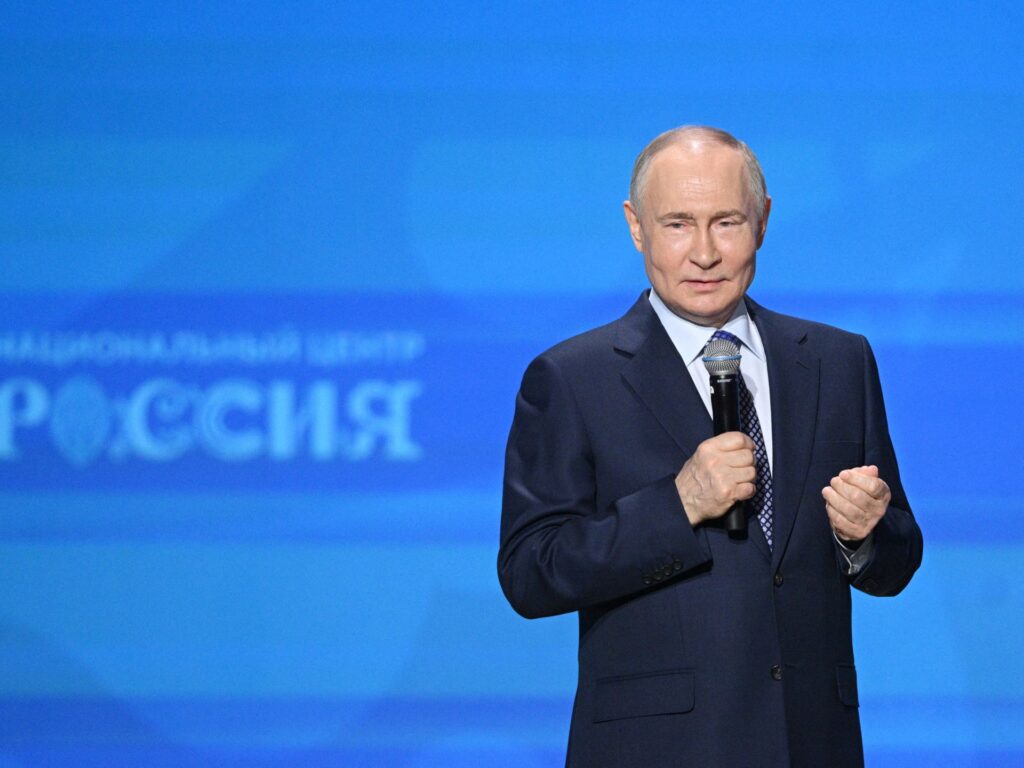
Russian president signals ‘positive’ outlook on bilateral peace talks after Ukraine proposed a 30-day ceasefire. Russia’s President Vladimir Putin has indicated that he is open to the prospect of direct talks with Ukraine. Putin told Russian state TV on Monday that he had a “positive attitude towards any peace initiatives” and that he hoped Kyiv would “feel the same way”. Moscow and Kyiv have held no bilateral talks since the immediate aftermath of Russia’s February 2022 invasion. However, the United States has been raising the pressure on them to agree to a ceasefire. Kremlin spokesman Dmitry Peskov said Putin’s comments, following the expiry of a 30-hour Easter truce – which each side accused the other of violating – meant he was open to direct talks. “When the president said that it was possible to discuss the issue of not striking civilian targets, including bilaterally, the president had in mind negotiations and discussions with the Ukrainian side,” said Peskov, quoted by Russia’s Interfax news agency. While Ukrainian President Volodymyr Zelenskyy did not respond directly to Putin’s proposal, he signalled in his nightly video address that Ukraine was “ready for any conversation” about a ceasefire that would stop attacks on civilians. Now, after Easter, the whole world can clearly see the real issue — the real reason why the hostilities continue. Russia is the source of this war. It is from Moscow that a real order must come for the Russian army to cease fire. And if there is no such firm Russian order for… pic.twitter.com/jS9cTiRQqd — Volodymyr Zelenskyy / Володимир Зеленський (@ZelenskyyUa) April 21, 2025 Advertisement On Sunday, Zelenskyy had proposed a follow-up to the truce that would “cease any strikes using long-range drones and missiles on civilian infrastructure for a period of at least 30 days”. Putin said Russia would “analyse everything and take the corresponding decisions” but questioned how it would work, as he accused Ukraine of using civilian buildings such as restaurants and universities for military purposes. Zelenskyy pressed Putin further on Monday, saying Ukraine stood by its offer – “at the very least, not to strike civilian infrastructure” – and that he expected a “clear answer” from Moscow. The possibility of direct talks comes after US President Donald Trump threatened to walk away from efforts to broker a ceasefire unless progress is made. At the same time, he continued on Monday to express hope that a deal is close and could even be reached this week. Negotiators from the US, Ukraine, United Kingdom and France are due to meet in London on Wednesday for another round of talks on ending the war, Zelenskyy said. The discussions are a follow-up to a similar meeting in Paris last week. Amid the push for an end to the fighting, in which Trump appears ready to accept many of Moscow’s demands and gains, Russia is eager to press home its military advantage on the battlefield. Ukraine’s air force reported another overnight barrage on Tuesday, with Russia launching 54 drones. Meanwhile, Russian media said the military had retaken the Gornal St Nicholas Belogorsky Monastery, one of the last positions held by Ukrainian troops in the Kursk region. Advertisement Adblock test (Why?)
Haiti is nearing ‘point of no return’ as gang violence surges: UN official
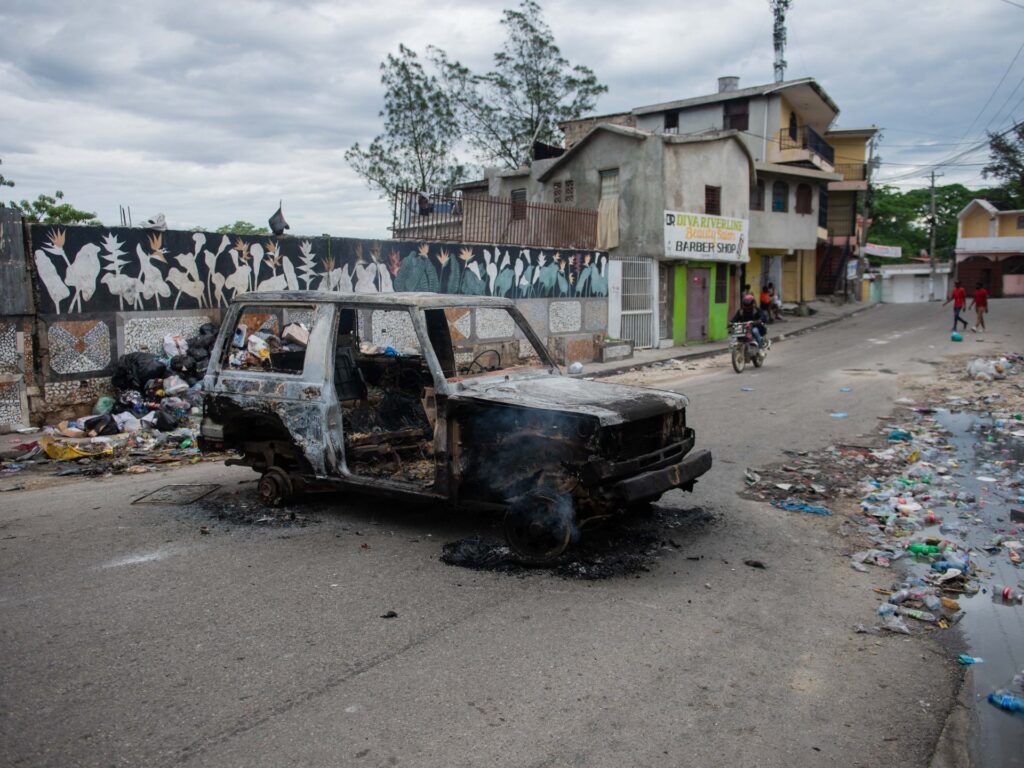
Calls for more aid, support for police amid surge in violence in the Caribbean nation since the end of last year. Haiti is approaching a “point of no return” as it struggles to respond to escalating gang violence, the top United Nations official in the country has said. Maria Isabel Salvador, the UN special representative to the Caribbean nation, delivered the warning to the UN Security Council on Monday. “As gang violence continues to spread to new areas of the country, Haitians experience growing levels of vulnerability and increasing scepticism about the ability of the state to respond to their needs,” Salvador said. “Haiti could face total chaos,” she said, adding that aid and support for the international force deployed to stem rampant gang violence was desperately needed to avoid that fate. “I urge you to remain engaged and answer the urgent needs of the country and its people,” she said. The poorest country in the Western Hemisphere, Haiti faces severe political instability, with swaths of the country under the control of rival armed gangs who carry out widespread murders, rapes and kidnappings. Advertisement Salvador cited cholera outbreaks and gender-based violence alongside a deteriorating security situation. Most recently, Salvador said, gangs seized the city of Mirebalais in central Haiti, freeing more than 500 prisoners during the assault. It was the fifth prison break in under a year and “part of a deliberate effort to entrench dominance, dismantle institutions and instil fear”, she said. Armed gangs have also been increasingly battling for control of the capital, Port-au-Prince, with violence intensifying as rival gangs attempt to establish new territories, she said. Meanwhile, a Kenyan-led force authorised by the UN has failed to push back the gangs since the deployment began in June of last year. The mission has about 1,000 police officers from six countries, short of the 2,500 originally planned. Kenya’s national security adviser, Monica Juma, told the council in a video briefing from Nairobi that the force has entered “a decisive phase of its operation” where gangs are coordinating operations and attacking people and strategic installations, and targeting the political establishment. While the Haitian police and the multinational force have launched intensive anti-gang operations and achieved some notable progress, especially in securing critical infrastructure, she said a significant gap exists. UN Secretary-General Antonio Guterres has also warned that further international support was “required immediately to allow the national police to prevent the capital slipping closer to the brink”, according to an unpublished report seen by the AFP news agency. Advertisement The report detailed the surge in violence, with the UN recording 2,660 homicides in the three months since December 2024 – a 41.3 percent increase over the previous quarter. But the report also pointed to a high civilian toll in efforts to counter the gangs. During the period, anti-gang operations resulted in 702 people killed, with 21 percent estimated to be innocent civilians, the report said. There was also an alarming increase in gender-based violence, with 347 incidents reported in the five months to February 2025, according to the UN data. Collective rape was the most common violation, accounting for 61 percent of cases. Adblock test (Why?)
Why China has warned countries against ‘appeasing’ Trump in trade deals
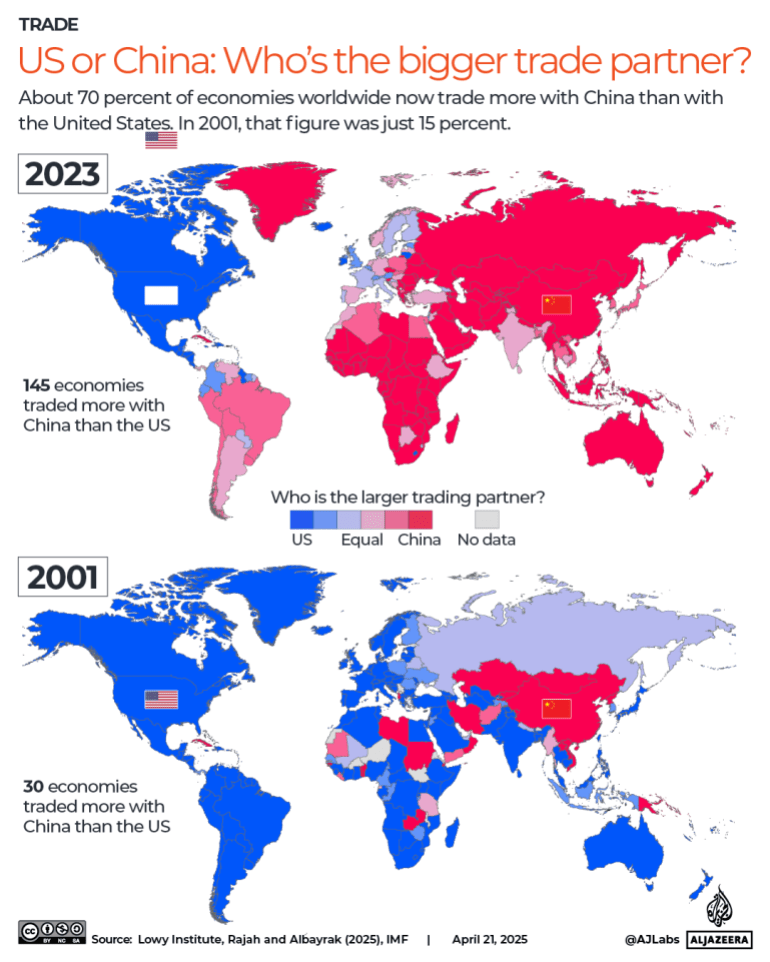
China has warned countries against striking trade deals with the United States at Beijing’s expense, ratcheting up its rhetoric in a spiralling trade war between the world’s two biggest economies. Responding to reports suggesting that US President Donald Trump’s administration is pressuring other countries to isolate China, a spokesperson for China’s Ministry of Commerce said on Monday that Beijing “will take countermeasures in a resolute and reciprocal manner” against nations that align with the US against it. The warning comes as countries prepare for talks with the US to seek exemptions from “reciprocal” tariffs that Trump imposed and then later paused on about 60 trading partners. So what’s this latest verbal spat about, how much clout does China wield in global trade and can Trump drive a wedge between other capitals and Beijing? What’s the backdrop? The Wall Street Journal recently reported that Trump was seeking to use tariff talks to push US economic partners to curb trade with China and rein in Beijing’s manufacturing dominance. Advertisement In return, these nations could secure reductions in US levies and trade barriers. The Trump administration has said it is in negotiations with more than 70 countries. On Monday, China’s Commerce Ministry hit back, warned other nations that “to seek one’s own temporary selfish interests at the expense of others’ interests is to seek the skin of a tiger”. In effect, it argued that those trying to strike deals with the US – the tiger – would be eaten up themselves eventually. The ministry also said China would in turn target all countries that fell in line with US pressure to hurt Beijing. What’s the status of US-China trade? After Trump suspended his “reciprocal tariffs” on major US trading partners on April 9, he ramped them up on China. US trade levies on most Chinese exports have climbed to 145 percent. Beijing has retaliated with duties of its own at 125 percent on US goods. Trump has long accused China of exploiting the US on trade, casting his tariffs as necessary to revive domestic manufacturing and return jobs to the US. He also wants to use tariffs to finance future tax cuts. For his part, Chinese President Xi Jinping travelled to three Southeast Asian countries last week to bolster regional ties. He called on trading partners, including Vietnam, to oppose unilateral bullying. “There are no winners in trade wars and tariff wars,” Xi said in an article published in Vietnamese media, without mentioning the US. As with other countries in Southeast Asia, Vietnam has been caught in the trade war’s crossfire. It is not only a manufacturing hub itself, but China also frequently uses it to dispatch exports to the US to avoid the tariffs imposed by the first Trump administration on Beijing in 2018. Advertisement Elsewhere, the Trump administration has begun talks with East Asian allies over the tariffs with a Japanese delegation visiting Washington, DC, last week and South Korean officials set to arrive this week. Many countries now find themselves stuck between the world’s two biggest economies – China, a large source of manufactured goods and a key trading partner, and the US, a crucial export market. How dependent is the world on Chinese exports? In a report published in January by the Lowy Institute, a Sydney-based think tank, analysts found that in 2023, about 70 percent of countries imported more from China than they did from the US. China’s rapid ascent as a trading superpower can be traced back to 2001, the year it joined the World Trade Organization (WTO) and when it started to dominate global manufacturing after years of successful protectionist industrial policies. During the 2000s, China benefitted from the relocation of international supply chains, turbocharged by substantial inflows of foreign investment, large pools of low-cost labour and an undervalued currency exchange rate. By 2023, China had become the largest trading partner for at least 60 countries, almost twice as many as for the US, which remained the largest trading partner for 33 economies. The gap between them is also widening in many countries: The Lowy Institute analysis found that in 2023, 112 economies traded more than twice as much with China as they did with the US, up from 92 in 2018 during Trump’s first trade war. Advertisement “The critical dependence China has developed around the world, especially in Asia, means that lots [of trading partners] cannot do without China,” said Alicia Garcia-Herrero, an economist at the investment bank Natixis. “From critical minerals to silicon chips, Chinese exports are almost irreplaceable.” Has world trade tipped more in China’s favour since Trump’s last trade war? In 2018, two years into his first administration, Trump imposed 15 percent tariffs on more than $125bn in Chinese goods, including footwear, smartwatches and flat-screen TVs. Since then, the US has become an even more important source of demand for non-Chinese exports, especially from Mexico and Vietnam, reflecting the impact of years of US tariffs on China. Yet if Trump’s aim in part was to hurt Beijing, his first salvoes failed. Since 2018, many more nations have deepened their trade relations with China – at the expense of the US. When China joined the WTO, more than 80 percent of countries had more two-way trade with the US than with China. That had fallen to just 30 percent by 2018, the year of Trump’s first tariffs on China, according to the Lowy Institute analysis. That trend has only solidified since then: In 2018, 139 nations traded more with China than with the US. By 2023, that number had risen to 145, and about 70 percent of the world’s economies now trade more with China than with the US – up from just 15 percent in 2001. “Trump doesn’t seem to understand how important Chinese trade flows have become,” Garcia-Herrero told Al Jazeera. “What’s more, he’s not offering much by way of carrots, like more investment, so I don’t think he’ll get what he wants.” Advertisement Can countries afford to alienate China
US stocks and dollar tumble as Trump renews attacks on Fed Chair Powell

US stocks and the dollar have dropped sharply as United States President Donald Trump’s attacks on the chief of the US central bank shake investors’ confidence in the world’s top economy. The benchmark S&P 500 fell 2.36 percent on Monday, one of the steepest one-day declines of the year. The tech-heavy Nasdaq Composite tumbled 2.55 percent, dragging the index down nearly 18 percent from its position at the start of the year. The dollar fell to a three-year low, at one point weakening to 97.923 against a basket of major currencies. US government bonds also fell as investors sold off the traditional safe-haven assets, with the yield on 10-year Treasury notes rising above 4.4 percent. Asian markets opened broadly lower on Tuesday, with Japan’s Nikkei 225, Hong Kong’s Hang Seng Index and Taiwan’s TAIEX down about 0.8 percent, 0.6 percent and 0.5 percent, respectively, as of 02:00 GMT. The steep losses came as Trump renewed his attacks on US Federal Reserve Chair Jerome Powell, branding the central bank boss a “major loser” and “Mr Too Late” on social media for not moving faster to cut interest rates. Advertisement Trump has repeatedly threatened to replace Powell, saying last week that his termination “cannot come fast enough”. On Friday, Kevin Hassett, Trump’s top economic adviser, said the administration was studying the possibility of removing Powell, whose term runs until May next year. Since announcing its most recent cut to its benchmark interest rate in December, the Federal Reserve’s policy-making committee has expressed caution about lowering rates further in the near term amid concerns that Trump’s sweeping tariffs will stoke inflation. Powell warned in a speech last week that the tariffs could leave the US economy grappling with weak growth, rising unemployment and higher inflation all at once, putting the central bank’s dual goals of maximum employment and stable prices in “tension”. “We know from experience in the United States and many other countries that politicians are tempted to ease monetary policy while they are in office because the initial effects are to increase growth and employment. Only later, perhaps when they have left office, does the higher inflation show up,” Joseph E Gagnon, a senior fellow at Peterson Institute for International Economics, told Al Jazeera. “Markets understand this and are worried that President Trump may try to undo the Fed’s longstanding protection against political interference.” Powell, who was nominated by Trump in 2017 and tapped to serve another four-year term by former US President Joe Biden, has said he would not resign if asked and insisted that he can only be removed for malfeasance. Advertisement Under a US Supreme Court ruling handed down in 1935, the executive branch is prohibited from dismissing the heads of independent federal agencies such as the Federal Reserve except for “cause”. The Trump administration, which has taken aim at numerous established norms, is seeking to overturn the 90-year-old precedent in a Supreme Court case related to its dismissal of the heads of the Merit Systems Protection Board and the National Labor Relations Board. Any move to dismiss Powell would almost certainly send shockwaves through financial markets, given the more than century-old principle that the Federal Reserve should set interest rates free from political considerations. On Monday, Austan Goolsbee, the president and chief executive officer of the Federal Reserve Bank of Chicago, warned that any effort to undermine the independence of the central bank would have negative ramifications for the economy. “When there is interference over the long run, it’s going to mean higher inflation,” Goolsbee said in an interview with CNBC, without commenting directly on Trump’s attacks on Powell. “It’s going to mean worse growth and higher unemployment.” Gagnon said the financial markets were reacting to the “greater probability of presidential interference” with the Federal Reserve. “More generally, investors will be less interested in holding investments in the United States if they believe the Fed will not be independent in the future because that means the US economy will not perform as well in the future as in the past,” he said. Advertisement Adblock test (Why?)