

Arsenal stun Real Madrid in Champions League with Declan Rice double
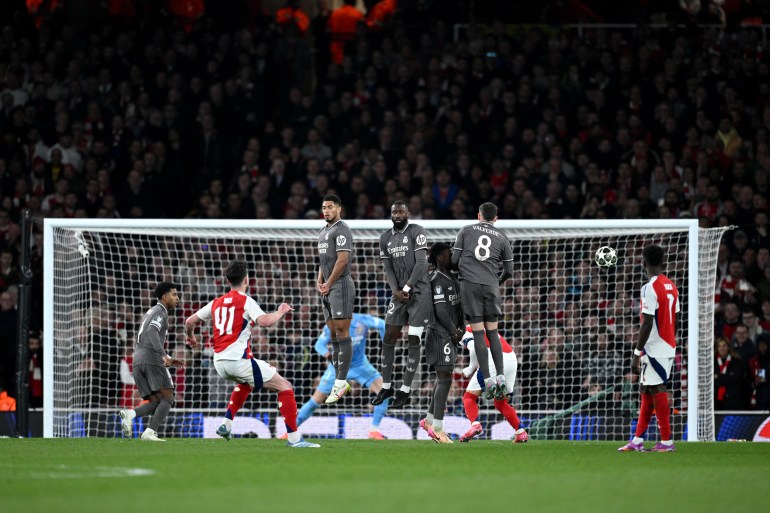
Arsenal midfielder Declan Rice nets two free kicks in shock 3-0 quarterfinal first-leg win against defending champions. Declan Rice curled home two superb free kicks to help give Arsenal a 3-0 win over defending champions Real Madrid in the first leg of the Champions League quarterfinals. Rice opened the scoring in the 58th minute on Tuesday by bending a free kick around the Madrid wall and inside the near post, leaving goalkeeper Thibaut Courtois stranded. With Madrid great Roberto Carlos looking on in the stands – the Brazilian scored a number of spectacular free kicks in his day – Rice then repeated the feat in the 70th by curling another effort into the far top corner. Mikel Merino added the third five minutes later to put Arsenal on the brink of returning to the semifinals for the first time since 2009. Declan Rice of Arsenal scores his team’s first goal from a free kick as Jude Bellingham, Antonio Ruediger, Eduardo Camavinga and Federico Valverde of Real Madrid jump in a defensive wall [Justin Setterfield/Getty Images] Only a handful of saves from Courtois prevented the scoreline from getting even bigger. Advertisement “In the second half, we knew we had to score and to score three was a real positive,” Rice told Prime Sports. “The message from the manager was that we needed to be super convinced that we could come and win this game. “As a group of players, we were really convinced that we were out there as a team fighting for each other.” It was the teams’ first meeting since 2006, when Arsenal eliminated Madrid in the round of 16. The second leg will be played on April 16 at Santiago Bernabeu Stadium. “It’s not going to hit me yet because there is another leg to go,” Rice said of his two sensational strikes. “I’m excited, I’m happy, I’m over the moon. I don’t mean to be cliched but I think this will hit me in a few years’ time – that what I did was really special.” French forward Kylian Mbappe had the best of Real’s chances but was twice denied by David Raya in the Arsenal goal. “For 68 minutes, the game was level, and then they hit two fantastic free kicks and the game changed,” Real Madrid coach Carlo Ancelotti told Prime Sport. “We did not react as we need to react and they scored another goal and now it will be very difficult but we have to try. Mentally, we went down and we had problems in the last 30 minutes of the game.” Real midfielder Jude Bellingham was more critical of last season’s double winners: “We were nowhere near it, that’s the fact. Arsenal were really good. I know two of their goals were free kicks but, to be honest, they could have had way more. We were lucky to get away with three. Advertisement “If there’s one place where crazy things can happen, it’s our house … We are still alive, we’ve still got 90 minutes of football and anything can happen at the Bernabeu.” Adblock test (Why?)
DR Congo repatriates three US citizens convicted over failed coup

Move coincides with DRC’s drive to sign minerals deal with US in exchange for security in war with Rwanda-backed rebels. Three United States citizens initially sentenced to death in the Democratic Republic of Congo (DRC) over a botched coup attempt have been repatriated after Kinshasa commuted their death sentences to life imprisonment last week. Congolese presidential spokesperson Tina Salama said on Tuesday that the three men, including the son of political exile Christian Malanga, who led the attack on the presidential palace in May last year, would all serve out their life sentences in the US. Marcel Malanga, 21, claimed he had been forced to take part by his father, who live-streamed from the palace during the coup attempt before being shot and killed by Congolese forces. Also repatriated were Tyler Thompson Jr, 21, a friend of the younger Malanga, and Benjamin Reuben Zalman-Polun, 36, who reportedly got to know the father through a gold mining company. US Department of State spokesperson Tammy Bruce confirmed the transfer on Tuesday, saying that the US condemned the armed attacks and supported DR Congo’s bid to hold the convicts accountable, but that it also sought “consistent, compassionate, humane treatment and a fair legal process”. Advertisement When the US assumes custody of prisoners convicted abroad, it typically agrees to carry out the sentence of imprisonment designated by that country. Jared Genser, a US-based international human rights attorney, said that lawyers representing the three could try to get their sentences reduced by arguing they signed their consents to the prisoner transfer treaty under duress. “But it would be very hard to prevail in such a case as there would be enormous implications for other potential transfers in the future if the US failed to abide by such agreements,” Genser said. Multibillion-dollar deal The repatriation came amid efforts by Congolese authorities to sign a minerals deal with the US in exchange for security support that will help Kinshasa fight Rwanda-backed M23 rebels in the country’s conflict-hit east. US senior adviser for Africa Massad Boulos said last week that the countries were in talks on the issue, adding that it could involve “multibillion-dollar investments”. The US has estimated that Congo has trillions of dollars in mineral wealth. Boulos, whose son is married to US President Donald Trump’s daughter, is set to visit DR Congo to discuss tensions between the country and Rwanda. News of the trio’s repatriation brought joy to the families. Miranda Thompson, stepmother of Thompson, who had flown to Africa from Utah for what his family believed was a free vacation, said the family was “excited” to have him return home. A total of 37 people were sentenced to death in the purported coup attempt, also including a Belgian, Briton and Canadian, all naturalised Congolese. Advertisement The fate of the others was not immediately clear. Family members last year said the men slept on the floor at a high-security military prison in Kinshasa, struggling with health issues and having to pay for food and hygiene products. Adblock test (Why?)
At least 66 killed in Dominican Republic nightclub roof collapse
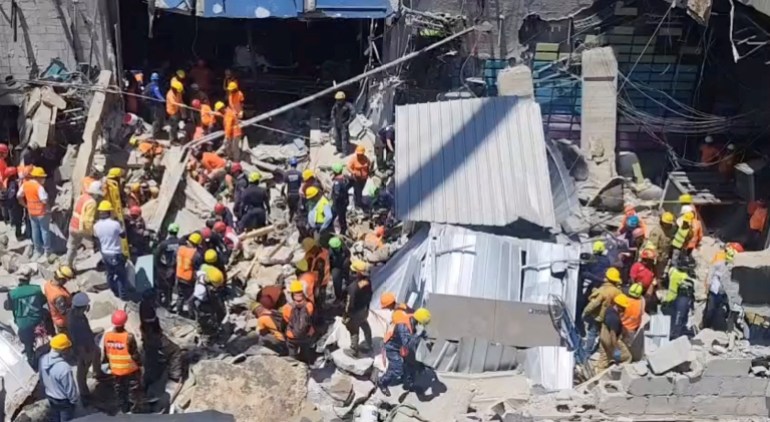
A catastrophic roof collapse at an iconic nightclub in the Dominican Republic’s capital, Santo Domingo, has left at least 66 people dead including a provincial governor and former Major League Baseball (MLB) pitcher Octavio Dotel. At least 160 other people were injured and some 400 emergency crews were still working to pull survivors from the rubble as families of the victims gathered at the site searching for their loved ones, authorities said on Tuesday. Juan Manuel Mendez, head of the Dominican Republic’s emergency operations centre, said that efforts to rescue those trapped under the debris were continuing, though the exact number of people inside the Jet Set nightclub at the time of the collapse remained unclear. Local media reported there were between 500 and 1,000 people in the club when disaster struck in the early hours of Tuesday. The roof collapse happened during a concert attended by politicians, athletes and other prominent figures. Among the victims was Nelsy Cruz, governor of the northern Monte Cristi province, President Luis Abinader said. Cruz is the sister of former baseball player Nelson Cruz, a seven-time MLB All-Star. Advertisement Former MLB pitcher Dotel died en route to a local hospital after being pulled from the debris, a spokesman for the nation’s Ministry of Sports said. The Dominican Republic’s Professional Baseball League expressed “its sorrow over the death of former pitcher Octavio Dotel” and concluded: “Peace to his soul”. Dotel, 51, debuted for the New York Mets in 1999 and played until 2013 for more than a dozen teams including the Houston Astros, Oakland A’s, New York Yankees, Chicago White Sox and Detroit Tigers. “Thinking about our people in the Dominican Republic,” Carlos Mendoza, manager of the Mets, said in a press conference. “We have a lot of the Dominican community in the baseball world.” Nearly 150 people have been taken to local hospitals for treatment, according to the government. The cause of the roof collapse remains under investigation. ‘Save lives’ Iris Pena, a woman who had attended the concert, told the Dominican channel SIN how she escaped with her son. “At one point, dirt started falling like dust into the drink on the table. I asked the security officers … whether the ground had shaken,” she said. “A stone fell and cracked the table where we were, and we got out,” Pena recounted. “The impact was so strong, as if it had been a tsunami or an earthquake.” Dozens of family members flocked to hospitals for news. “We are desperate,” Regina del Rosa, whose sister was at the concert, told SIN. “They are not giving us news; they are not telling us anything.” Rescuers work at the site of the collapsed Jet Set nightclub in Santo Domingo, Dominican Republic [Reuters] At the scene, meanwhile, helicopter images revealed a large hole where the club’s roof once was. A construction crane was helping to lift some of the heavier rubble as men in hard hats dug through the debris. Advertisement The authorities have issued a call for Dominicans to donate blood. “We are rescuing all the people we can save alive and recovering those bodies we find along the way. But we have focused on people we can rescue alive because we hear them asking for help,” Mendez said. “The main objective is to save lives,” President Abinader said as he arrived at the scene. The Instagram page of the Jet Set club said it has been in operation for more than 50 years, with shows every Monday until the early hours. On Tuesday, the club issued a statement saying it had “collaborated fully and transparently with the authorities to help the victims and clarify what happened”. The Dominican Republic, which shares the island of Hispaniola with Haiti, received more than 11 million visitors in 2024, according to its Ministry of Tourism. Tourism generates about 15 percent of gross domestic product (GDP), with visitors attracted by the country’s Caribbean beaches, music and nightlife, as well as the colonial architecture of Santo Domingo. Adblock test (Why?)
Palestinians mourn journalist burned alive in Israeli strike on Gaza tent
[unable to retrieve full-text content] Palestinians in Gaza are mourning the death of journalist Ahmad Mansour who was filmed burning alive.
‘Mediterranean Blue’: Rare diamond makes dazzling debut
[unable to retrieve full-text content] Sotheby’s unveiled a newly discovered 10.03-carat fancy vivid blue diamond at an Abu Dhabi exhibit.
Zelenskyy: Chinese soldiers fighting for Russia inside Ukraine
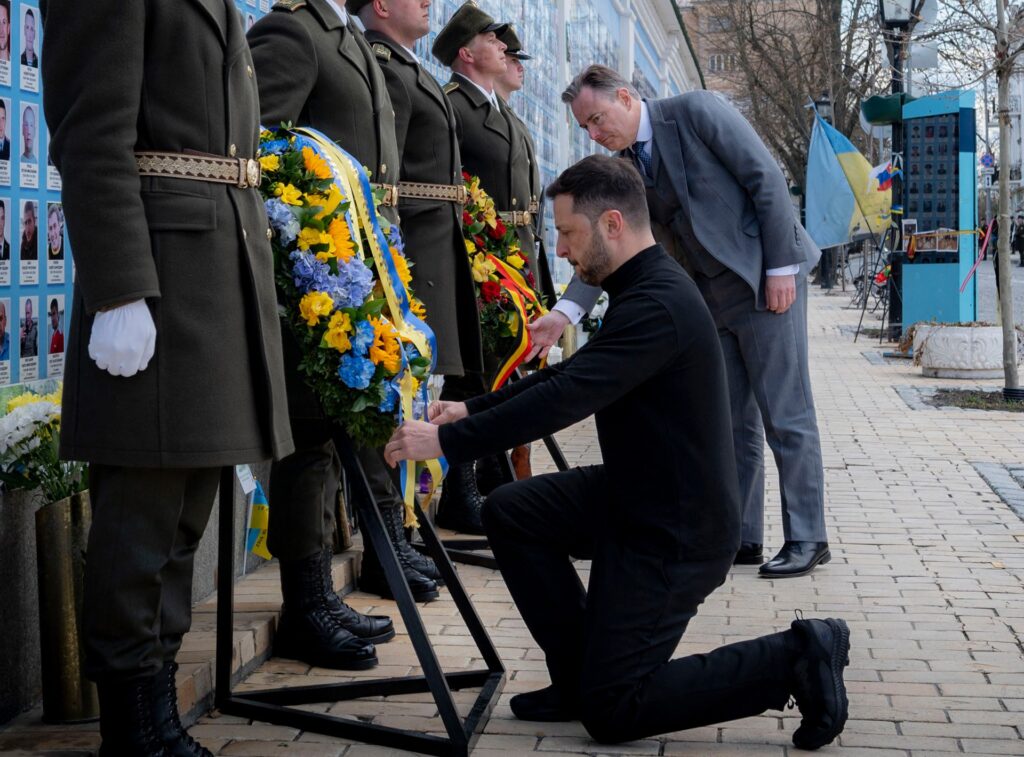
NewsFeed Ukrainian President Volodymyr Zelenskyy said his country’s military captured two Chinese soldiers fighting alongside Russian forces in the territory of Ukraine. He added that he believes there are “significantly more” and is raising the issue with Beijing. Read more Name(required) Email(required) Website Message Submit Published On 8 Apr 20258 Apr 2025 Adblock test (Why?)
Under Trump, US Justice Department ends cryptocurrency investigations
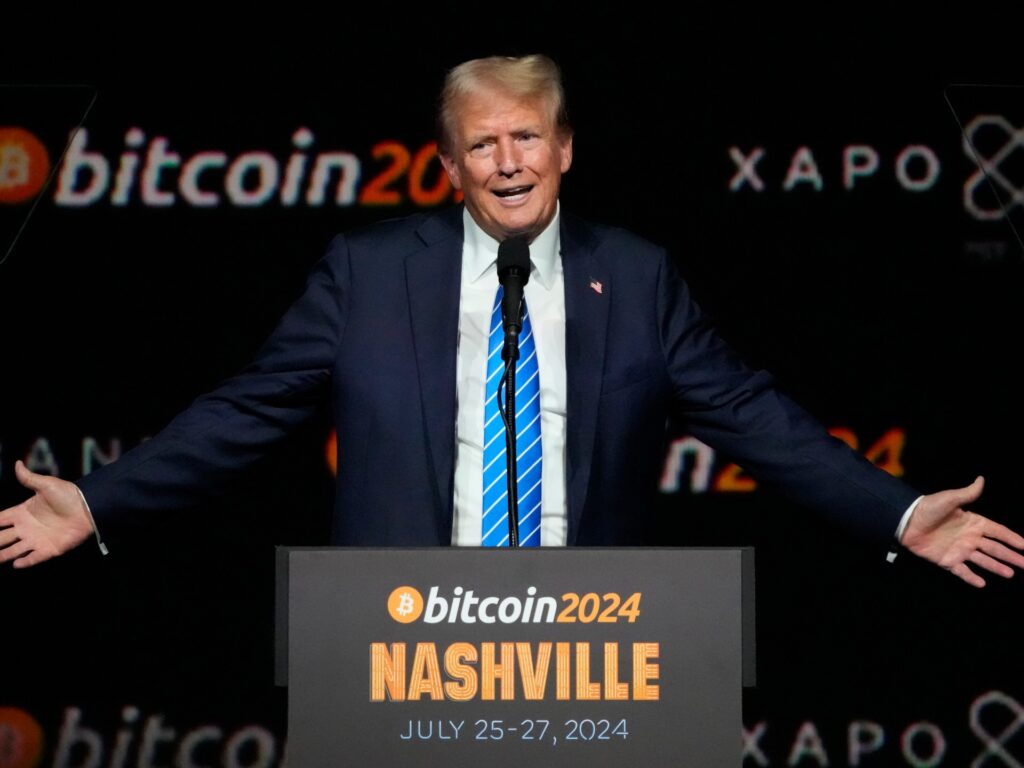
The United States Department of Justice has announced it plans to pare back its investigations into cryptocurrency fraud, instead redirecting those resources towards immigration enforcement, terrorism and drug trafficking. In a memo late on Monday, Deputy Attorney General Todd Blanche quoted President Donald Trump’s pledge to “end the regulatory weaponization” of the cryptocurrency industry. “The Department of Justice is not a digital assets regulator,” Blanche wrote. “The Justice Department will no longer pursue litigation or enforcement actions that have the effect of superimposing regulatory frameworks on digital assets.” Instead, Blanche explained that Trump regulators in other departments would enforce financial law “outside the punitive criminal justice framework”. “Prosecutors should not charge regulatory violations in cases involving digital assets,” Blanche wrote. As part of the changes, the Justice Department will immediately dismantle its National Cryptocurrency Enforcement Team (NCET), which was launched in February 2022 under the administration of former President Joe Biden. Advertisement The team was designed to pursue cases of alleged fraud and illicit finance schemes. In 2024, it announced a conviction in its first “cryptocurrency open-market manipulation case”. The suspect, Avraham Eisenberg, was found guilty of commodities fraud for artificially manipulating cryptocurrency prices. That, in turn, allowed him to amass $110m in cryptocurrency, according to prosecutors. NCET has also led high-profile investigations against cryptocurrency firms like Binance and Tornado Cash, the latter of which was accused of laundering money for North Korea. Trump has repeatedly slammed the Biden administration and has set about dismantling some of the former president’s signature policies, including NCET. In Monday’s memo, Blanche echoed Trump by blaming the “prior administration” for pursuing “a reckless strategy of regulation by prosecution”. Trump has sought to distance himself from Biden’s investigations into the largely unregulated cryptocurrency industry, instead positioning himself as a champion of digital currencies. On January 23, three days after returning to the White House for a second term, Trump issued Executive Order 14178, entitled “Strengthening American leadership in digital finance technology”. It revoked a Biden-era executive action pushing for “responsible development” of cryptocurrency and instead laid the groundwork for a “national digital asset stockpile”. In the weeks since, Trump has made good on that pledge, announcing a national strategic reserve for cryptocurrency in early March. He named five currencies to the reserve — XRP, Cardano, Solana, Bitcoin and Ethereum — giving each a brief boost in value. Advertisement Trump also released his own “meme coin” and has business interests in the cryptocurrency firm World Liberty Financial (WLF), netting him and his family billions of dollars. Critics, however, have questioned the ethics of those ventures, given Trump’s outsized role in the global economy. Calling himself the “crypto president”, Trump has nevertheless continued to make overtures to the digital currency industry. For example, he held a meeting with cryptocurrency leaders at the White House on March 7, dubbed the “first-ever White House Digital Assets Summit”. “Last year, I promised to make America the Bitcoin superpower of the world and the crypto capital of the planet, and we’re taking historic action to deliver on that promise,” Trump said at the meeting. “This will be a virtual Fort Knox for digital gold to be housed within the United States Treasury. That’s a big thing,” he added. He also drew a parallel between his legal woes and the investigations into the cryptocurrency industry. In 2023, Trump became the first president ever to be indicted on criminal charges, and in 2024, he was convicted of falsifying business documents in New York. “They weaponised government against the entire industry,” Trump said of the Biden administration’s actions probing cryptocurrency firms. “I know that feeling also, maybe better than you do. All of that will soon be over.” Under Trump’s direction, the federal government has indeed dropped several investigations into cryptocurrency businesses. Advertisement The Securities and Exchange Commission (SEC), for instance, dropped its probe into Coinbase, while the Justice Department ended its investigation of the financial company Robinhood, which had been accused of mishandling crypto assets. Monday’s memo did nevertheless say that some cryptocurrency-related investigations would remain a priority at the Justice Department. Instead, Blanche said the department would narrow its scope to focus on illegal activity that causes “financial harm to digital asset investors and consumers” and supports cartels, drug traffickers and designated “terrorist” groups. “For example, cartels and human trafficking and smuggling rings have increasingly turned to digital assets to fund their operations and launder the proceeds of their illicit businesses,” Blanche wrote. While the department would continue to pursue cartels and criminal organisations that use digital currencies, Blanche specified that his prosecutors “will not pursue actions against the platforms that these enterprises utilize to conduct their illegal activities”. Adblock test (Why?)
Tehran sceptical ahead of upcoming US-Iran nuclear talks
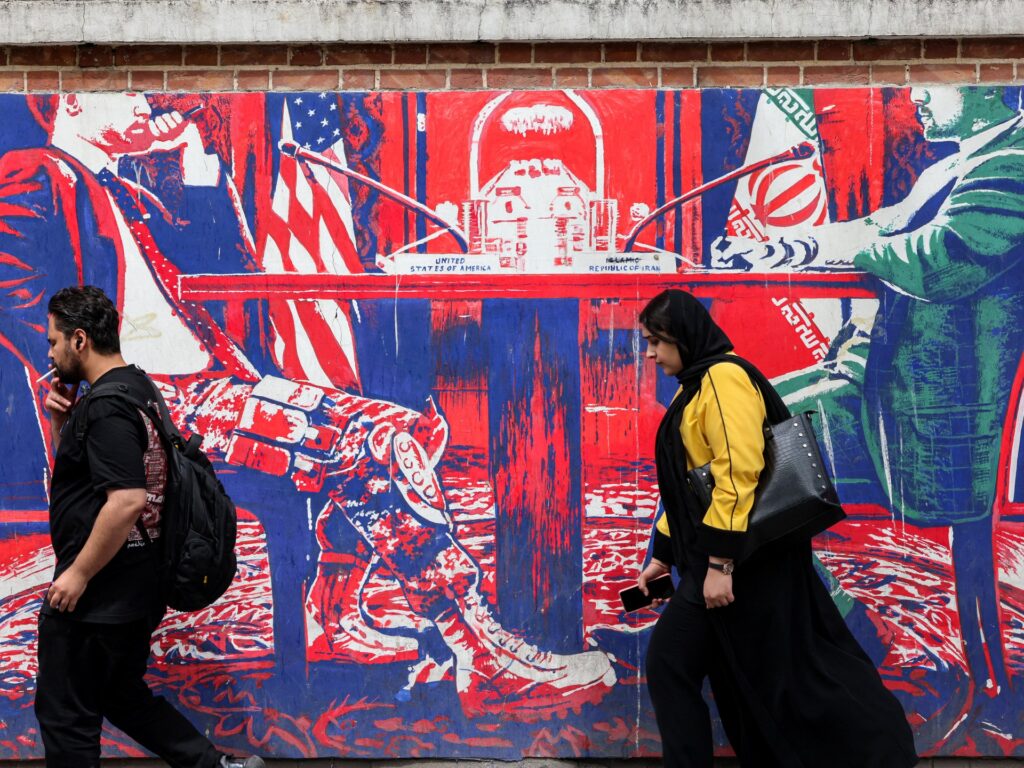
Iran is approaching talks in Oman with the United States over its nuclear programme with deep suspicions regarding Washington’s motives, following the latter’s repeated threats of military action in the lead-up to the meeting. US President Donald Trump announced this week that his administration would have “direct” talks with Tehran on Saturday. But his warning that Iran would be in “great danger” if talks failed comes after recent threats to bomb the country. While Iranian Foreign Minister Abbas Araghchi demonstrated Tehran’s willingness to engage on Tuesday, insisting amid the threats that the talks would nevertheless be “indirect”, he issued a note of warning, saying “Iran prefers diplomacy, but it knows how to defend itself”. In an opinion piece published Tuesday in the Washington Post, Araghchi alluded to “a significant wall of mistrust” and “doubts about the sincerity of intentions” exacerbated by the US’s revival of its “maximum pressure” campaign in the run-up to talks. Behind the scenes, three Iranian officials told news agency Reuters that Trump’s warnings were seen as a tactic “to box the Islamic Republic into accepting concessions in the talks Trump demands or face air strikes”. Advertisement “Trump wants a new deal: end Iran’s regional influence, dismantle its nuclear programme, and halt its missile work. These are unacceptable to Tehran. Our nuclear programme cannot be dismantled,” a senior Iranian official told the news agency. Iran’s suspicion may have been heightened by the presence of Israeli Prime Minister Benjamin Netanyahu at the White House when Trump announced Saturday’s talks. Netanyahu, who has repeatedly urged US governments to use strikes against Iran’s nuclear programme, said a diplomatic solution would be good if it was done “in a full way”, citing the complete dismantling of Libya’s atomic programme in 2003. Israel, which has engaged in tit-for-tat attacks on Iran as regional tensions mounted amid Israel’s war on Gaza, severely weakened Tehran’s Lebanese ally Hezbollah last year as it destroyed much of the group’s weapons arsenal and killed much of its leadership, including long-time chief Hassan Nasrallah. Tehran’s position in the region was weakened further by the toppling of another key partner, Syrian President Bashar al-Assad, by the country’s opposition last year. Analyst Tohid Asadi, speaking from Tehran, said that the signals from Iran and the US were at odds. “[Araghchi] said under these circumstances, in which we see pressure and threats directed from the United States, there’s no possibility for direct talks … That’s contradictory to what we heard from the US President Donald Trump, who said the two sides are getting ready for direct talks,” Asadi told Al Jazeera. Advertisement Russia and China ‘following’ talks Ahead of Saturday’s talks in Oman, the deputy foreign ministers of Russia, China and Iran met in Moscow, with the Kremlin welcoming the opening of dialogue between Washington and Tehran. Kremlin spokesman Dmitry Peskov said that Moscow “absolutely” supported the initiative. “This can only be welcomed because it can lead to de-escalation of tensions around Iran,” he said. Russia’s lower house of parliament also ratified on Tuesday a 20-year strategic partnership with Iran, a sign of the deepening military ties between the two countries. China offered pointed criticism of Washington, calling out Trump for tearing up a 2015 deal between Iran and six world powers – the US, Russia, China, France, the United Kingdom and Germany – that saw Iran receive sanctions relief in return for curbing nuclear activities. “As the country that unilaterally withdrew from the comprehensive agreement on the Iran nuclear issue and caused the current situation, the United States should demonstrate political sincerity [and]… mutual respect,” said China’s Foreign Ministry spokesman Lin Jian. Trump unilaterally withdrew from the deal in 2018, during his first presidency. Reporting from Moscow, Al Jazeera’s Yulia Shapovalova said Russia and China had agreed “to follow what is happening to the nuclear deal between Iran and the US, particularly in terms of the US rhetoric to resolve this issue by force”. Defence ‘non-negotiable’ Trump’s withdrawal from the nuclear deal was followed by an Iranian decision to stop complying with obligations under the agreement. Advertisement The result has been that Iran has built up large stocks of highly enriched uranium that leave it a short step from weapons-grade, according to the International Atomic Energy Agency. The agency said in February that Iran had an estimated 274.8 kilogrammes (606 pounds) of uranium enriched to up to 60 percent. Weapons-grade is around 90 percent. But Iran has repeatedly insisted in the past that its nuclear activities are solely for civilian purposes. Israel, which bitterly opposed the 2015 agreement, is widely believed to have an undeclared nuclear arsenal. There has been widespread speculation that Israel might attack Iranian facilities if no new agreement is reached in the upcoming US-Iran talks. “Our defence is non-negotiable. How can Tehran disarm when Israel has nuclear warheads? Who protects us if Israel or others strike?” an Iranian official asked in an interview with Reuters. Iran has withstood repeated sanctions programmes over recent decades, and Iranian military leaders have previously threatened to cut off regional oil exports – a significant proportion of the global energy supply. Adblock test (Why?)
A growing trade war? Trump says China ‘wants to make a deal’
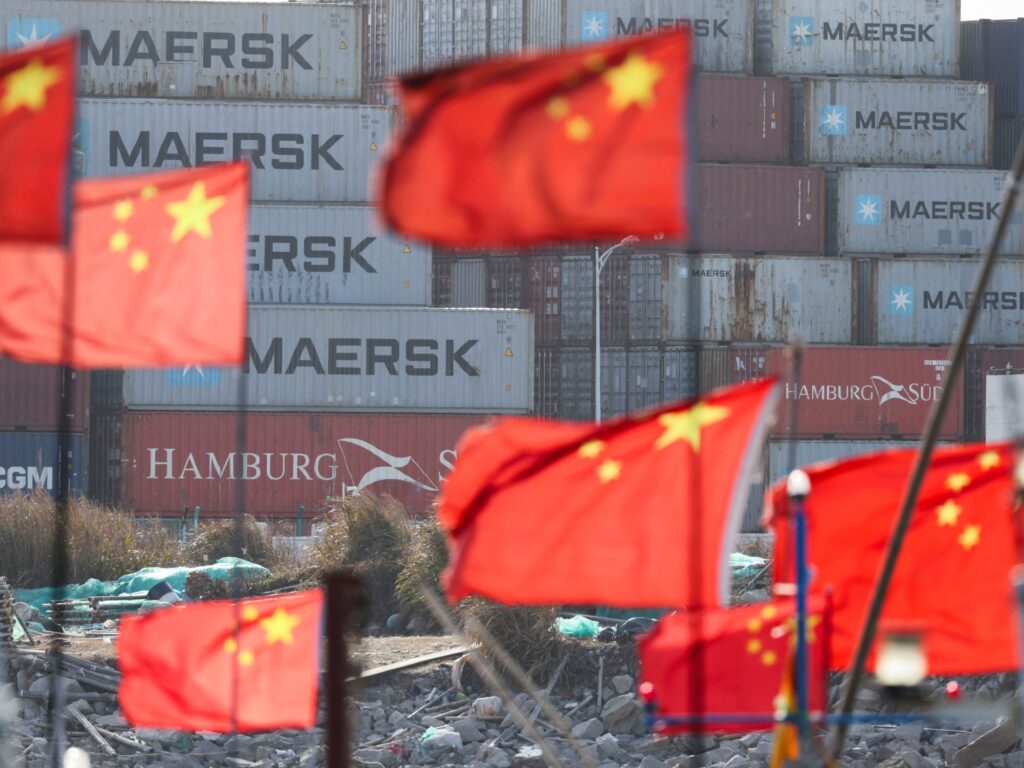
Washington, DC – With the clock ticking for additional United States tariffs to be placed on goods from China, President Donald Trump has said he is waiting for a call from Beijing to defuse a growing trade war. After a phone call with South Korea’s acting president, Han Duck-soo, on Tuesday, Trump said South Korean officials are travelling to the US for trade talks. He added that “many other countries” want to open economic negotiations with Washington. “China also wants to make a deal, badly, but they don’t know how to get it started,” the US president wrote in a social media post. “We are waiting for their call. It will happen!” However, hours later, a senior Trump aide cast doubt over Beijing’s willingness to negotiate a solution to tit-for-tat tariffs, suggesting that a breakthrough is unlikely in the coming days. “They [China] elected to announce retaliation,” US Trade Representative Jamieson Greer said at a Senate committee hearing on Tuesday. “Other countries did not. Other countries signalled that they’d like to find a path forward on reciprocity. China has not said that, and we will see where that goes.” Advertisement Trump has threatened to impose additional 50-percent tariffs on Chinese goods if China does not revoke the retaliatory levies it imposed on US products If implemented, the new US levies would be as high as 104 percent on some Chinese goods. Beijing, however, has appeared to refuse to budge, rejecting what it called “economic bullying” by Washington. “We Chinese are not troublemakers, but we will not flinch when trouble comes our way,” Chinese Foreign Ministry spokesperson Lin Jian said on Tuesday. “Intimidation, threats and blackmail are not the right way to engage with China. China will take necessary measures to firmly safeguard its legitimate and lawful rights and interests.” Lin added that, if the US is determined to engage in a trade war, “China’s response will continue to the end”. Despite the growing competition and tensions between the US and China, Washington and Beijing are major trade partners. According to US government data, the US imported $438.9bn in Chinese goods last year, making China the second largest exporter to the US after Mexico. US exports to China totalled $143.5bn in 2024. Foreign policy hawks in Washington have long called for scaling back economic ties with Beijing and reducing dependence on Chinese goods. On Tuesday, White House Press Secretary Karoline Leavitt used the friction with China as a means of illustrating Trump’s strength as president. “America does not need other countries as much as other countries need us, and President Trump knows this. He’s going to use the leverage of our markets and our country to the advantage of the people he was sworn in to represent,” Leavitt said. Advertisement “Countries like China who have chosen to retaliate and try to double down on their mistreatment of American workers are making a mistake. President Trump has a spine of steel, and he will not break.” Relations between the US and China have soured over many issues in recent years, including trade, the status of Taiwan, Beijing’s claims in the South China Sea and an ongoing US push against growing Chinese influence in the Indo-Pacific. But the ongoing tariff crisis between the two countries is part of Trump’s worldwide trade shake-up, which has not spared even the closest US allies. Trump has announced a 10-percent baseline tariff on all imports to the US, with additional levies — described as “reciprocal tariffs” — on countries with which the US has large trade deficits. On Tuesday, Greer portrayed the US as the victim of an unfair international trading system that has gutted American industries. Beyond tariffs, he slammed other countries for imposing barriers and regulations that limit US imports, including restrictions by the European Union on shellfish and by Australia on pork. Greer said “nearly 50 countries” have approached him to discuss Trump’s trade policy and “explore how to achieve reciprocity”. Trump’s tariffs, however, have rocked global markets and raised concerns about a spike in prices for US consumers. But the Trump administration has argued that the tariffs will ultimately force companies to manufacture their products in the US, reviving industries and creating jobs. Advertisement Greer said the plan will not achieve its aims “overnight”. “We must move away from an economy that’s based solely on government spending and the financial sector, and we must become an economy based on producing real goods and services that provide jobs for working class and middle class Americans in their communities,” he told senators. “This adjustment may be challenging at times. And in a moment of drastic, overdue change, I’m certain that the American people can rise to the challenges they’ve done before.” Adblock test (Why?)
Ukraine detains suspected Russian assassin
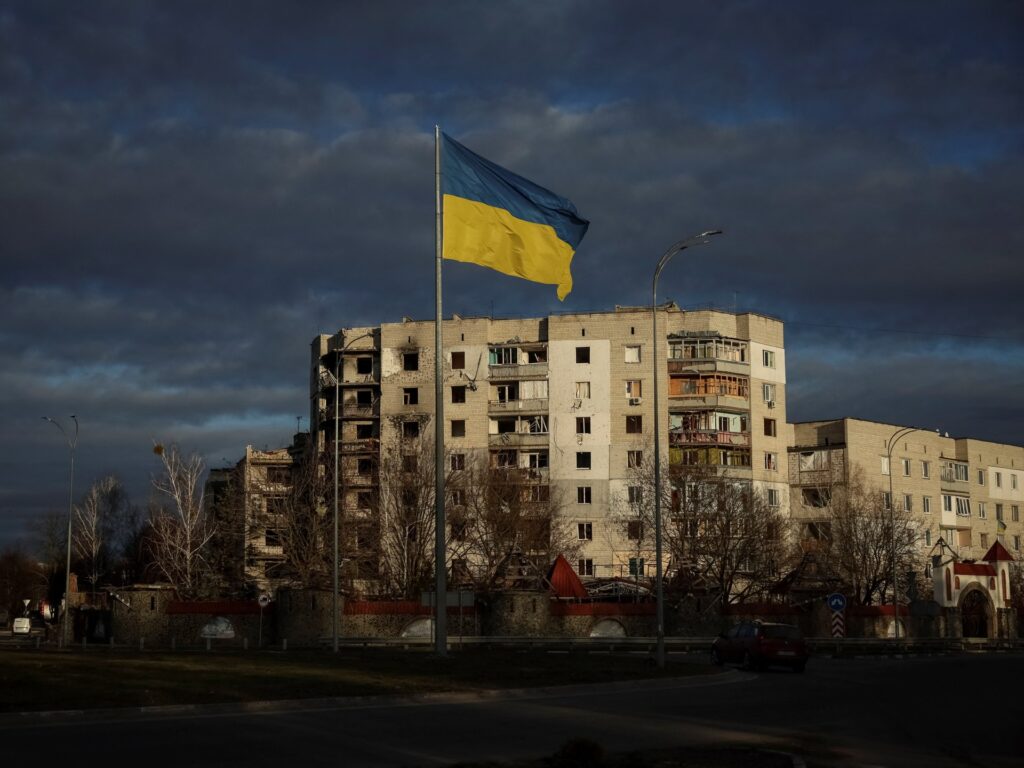
Indictment comes amid an uptick in targeted attacks on Ukrainian officials and public figures. Ukraine has arrested and indicted a man accused of assassinations and blowing up buildings on orders from Russia. The Ukrainian prosecutor general’s office said on Tuesday in a statement that the suspect is accused of murdering a Ukrainian soldier and plotting the assassination of officials. The arrest comes amid an apparent uptick in targeted attacks on Ukrainian officials and public figures, including a local lawmaker who was killed by a car bomb on Friday in the city of Dnipro. The prosecutor general’s office said under the orders of Russia’s Federal Security Service (FSB), the 56-year-old from the Crimean Peninsula, reportedly a persistent offender over many years, shot a Ukrainian soldier dead in March 2024. Prosecutors have also accused the suspect of planting an explosive under the car of Vyacheslav Zadorenko. However, the Kharkiv official spotted the bomb, “saving his own life”, they said in the statement. The suspect was also allegedly tasked with killing the head of the Kharkiv region, Oleh Synyehubov, for a reward of $50,000. Advertisement He also planted and set off explosives at strategically important buildings in the northeastern city of Kharkiv, the statement added. Russia and Ukraine have targeted one another’s officials in assassination plots since Moscow’s invasion in February 2022. Ukrainian counterintelligence investigators claimed last May to have foiled a Russian plot to assassinate President Volodymyr Zelenskyy, as well as the heads of Ukraine’s military intelligence agency and the SBU security service. Zelenskyy has said there had been numerous attempts to assassinate him since the start of the war with Russia, which has now stretched into a fourth year. The FSB did not comment on Kyiv’s claims regarding the suspect. Adblock test (Why?)