

What’s behind the widespread protests in Kenya?

Young people in Kenya reacted to the government proposal with angry demonstrations and police cracked down hard. Widespread protests in Kenya erupted this week against proposed new taxes, and police were criticised for using excessive force to break them up. Many on the streets were young, mobilised by social media. Why is the government pushing the new taxes? And why has there been such a violent reaction? Presenter: Elizabeth Puranam Guests: Stella Agara – Tax justice activist and Africa governance and security analyst Reginald Kadzutu – Finance economist at Oxford Brooks University Nicodemus Minde – Researcher with the East Africa Peace and Security Governance Program at the Institute for Security Studies Adblock test (Why?)
‘All of the rats in the Knesset’: Mass antiwar protest in Israel

An estimated 150,000 people attended the rally in one of the biggest demonstrations since Israel’s war on Gaza began. Tens of thousands of protesters waving Israeli flags and chanting slogans against Prime Minister Benjamin Netanyahu’s government rallied in Tel Aviv Saturday, demanding new elections and the return of captives held in Gaza. Large protests have occurred in the Israeli city on a weekly basis over Netanyahu’s handling of the nearly nine-month-old war in Gaza started by Hamas’s October 7 attack on southern Israel. Many protesters held signs reading “Crime Minister” and “Stop the War” as people poured into the biggest Israeli city’s main thoroughfare. “I am here because I am afraid of the future of my grandchild. There will be no future for them if we don’t go out and get rid of the horrible government,” said contractor Shai Erel, 66. “All of the rats in the Knesset … I wouldn’t let any one of them be a guard of a kindergarten.” Antigovernment protest organisation Hofshi Israel estimated more than 150,000 people attended the rally, calling it the biggest since Israel’s war on Gaza. Some demonstrators lay on the ground covered in red paint in the city’s Democracy Square to protest what they say is the death of the country’s democracy under Netanyahu. In an address to the crowd, a former head of Israel’s domestic Shin Bet security agency, Yuval Diskin, condemned Netanyahu as Israel’s “worst prime minister”. Many are frustrated with the country’s right-wing coalition, which includes Security Minister Itamar Ben-Gvir and other far-right ultranationalists, accusing it of prolonging the war in Gaza and putting the country’s security and captives at risk. Yoram, a 50-year-old tour guide who declined to give his last name, said he was attending every weekly protest as Israel needed elections “yesterday” because of Netanyahu. “I really hope the government collapses. If we go to the original date of elections in 2026, it is not going to be a democratic election.” A separate Tel Aviv rally on Saturday night drew thousands of relatives and supporters of the captives. Adblock test (Why?)
US aircraft carrier arrives in South Korea amid tensions with North Korea

USS Theodore Roosevelt to participate in joint military exercises between the United States, South Korea and Japan. A nuclear-powered United States aircraft carrier has arrived in South Korea for three-nation exercises aimed at stepping up military training, days after North Korea and Russia signed a mutual defence pact. “The US Navy’s aircraft carrier Theodore Roosevelt … arrived at the Busan Naval Base on the morning of June 22,” the South Korean Navy said in a statement. “[The aircraft carrier’s arrival] demonstrates the strong combined defence posture of the South Korea-US alliance and their firm resolve to respond to the escalating threats from North Korea,” it said on Saturday. The carrier is expected to participate in joint exercises with South Korea and Japan this month. Pyongyang has always decried similar combined drills as rehearsals for an invasion. The leaders of the three nations had agreed at a summit in August 2023 to hold annual military training drills. Earlier this month, their defence chiefs announced new exercises aimed at sharpening their combined response in various areas including air, sea and cyberspace. The arrival of the USS Theodore Roosevelt strike group comes a day after South Korea summoned the Russian ambassador to protest against deal reached between Russian President Vladimir Putin and North Korean leader Kim Jong Un this week. The pact pledges mutual defence assistance in the event of war. Putin visited North Korea for the first time in 24 years. South Korea says the agreement between the two isolated nations poses a threat to its security and warned that it could consider sending arms to Ukraine to help fight off the Russian invasion as a response. North Korean soldiers have also recently been engaged in activities such as laying more landmines, reinforcing tactical roads and adding what seemed to be antitank barriers near the border, according to the South Korean military. The two Koreas have been locked in a tit-for-tat “balloon war”, with an activist in the South confirming on Friday that he had floated more balloons carrying propaganda north. Pyongyang has already sent more than a thousand balloons carrying rubbish southwards, and Kim’s powerful sister Kim Yo Jong warned on Friday that the North is likely to retaliate. Adblock test (Why?)
Israel pounds north Gaza after attack on southern al-Mawasi ‘safe zone’
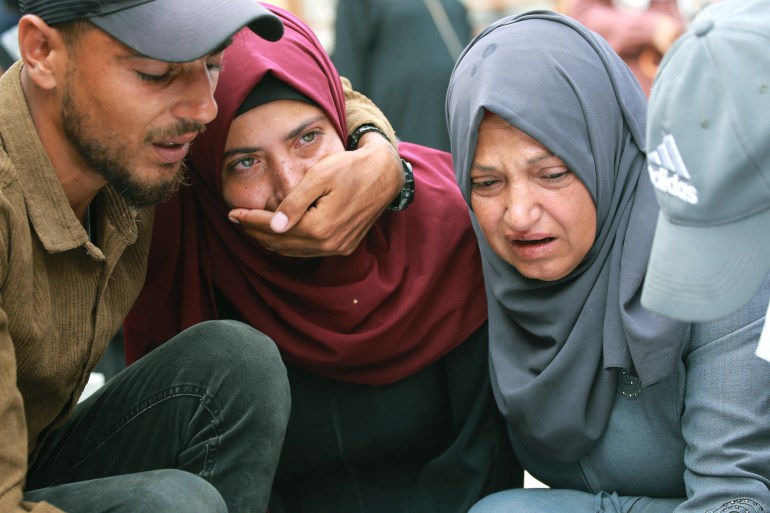
The Israeli military has launched attacks across the Gaza Strip after an assault on a tent camp in al-Mawasi in the south killed at least 25 people, according to Palestinian officials. On Saturday, at least 42 Palestinians were killed by Israeli attacks on the Shati refugee camp and the Tuffah neighbourhood in Gaza City, the head of Gaza’s Government Media Office told Al Jazeera. Reporting from Deir el-Balah, in central Gaza, Al Jazeera’s Tareq Abu Azzoum said the Israeli military targeted a residential neighbourhood in the Shati refugee camp, where displaced Palestinians from the north of the territory were told to seek refuge. “Rescuers with the help of civilians are trying to sift through the rubble to find survivors,” he said. “The casualties arriving at Al-Aqsa Hospital are surging.” Gaza’s civil defence spokesperson Mahmoud Basal said it was “very difficult” to reach victims in Shati. “Israel is reattacking areas that it had operated in, despite its previous announcement that it managed to control militarily the northern part of Gaza,” Abu Azzoum reported. Israeli attacks killed 101 Palestinians and wounded 169 in the last 24 hours, Gaza’s Ministry of Health said on Saturday, with many people under the rubble and ambulances and civil defence crews unable to reach them. This is the highest daily death toll recorded in the enclave by the ministry since June 8, when Israeli forces killed at least 274 Palestinians to free four Israeli captives in the Nuseirat refugee camp. On Friday, an Israeli attack near the International Committee of the Red Cross (ICRC) base at the al-Mawasi camp – designated by Israel as a safe zone – that Palestinian officials say killed at least 25 people and wounded 50 others, involved two strikes, The Associated Press news agency reported. Witnesses whose relatives died in one of the bombardments told AP how Israeli forces fired a second volley that killed people who came out of their tents. “We were in our tent, and they hit with a ‘sound bomb’ near the Red Cross tents, and then my husband came out at the first sound,” Mona Ashour, whose husband was killed in the attack, told AP outside Nasser Hospital in nearby Khan Younis. “Then they hit with the second one, which was a little closer to the entrance of the Red Cross,” she said. The ICRC condemned the attack on the camp and said the location of its humanitarian office, which was struck, was known to warring parties. It reported that 22 people had died and 45 were wounded. The ICRC office in Gaza, which is surrounded by hundreds of displaced civilians living in tents, was damaged by nearby shelling in Gaza. Firing so dangerously close to humanitarian structures puts the lives of civilians and humanitarians at risk. https://t.co/SVrwaQ9cNV — ICRC (@ICRC) June 21, 2024 “Firing so dangerously close to humanitarian structures, of whose locations the parties to the conflict are aware and which are clearly marked with Red Cross emblems, puts the lives of civilians and Red Cross staff at risk,” it said in a statement. “The strike damaged the structure of the ICRC office, which is surrounded by hundreds of displaced civilians living in tents, including many of our Palestinian colleagues.” A survivor of the attack told Al Jazeera that fire was “consuming” them “from every direction”. “We had just eaten and were about to sleep and take some rest, and the next we knew was the sound of resounding explosions destroying our places. We find ourselves alone not knowing what to do. We still can’t process what happened,” the survivor said. Palestinian women grieve as they bid farewell to a relative, killed the day before in a strike on the al-Mawasi camp, northwest of Rafah [Bashar Taleb/AFP] Al Jazeera’s Abu Azzoum noted that in the last 24 hours since the al-Mawasi assault, there has been an increase in Israeli attacks. “Witnesses said Israeli tanks carried out a sudden and unexpected incursion in al-Mawasi, launching a number of artillery shells towards the evacuation centres and makeshift tents,” he said on Saturday. “The entire area of al-Mawasi is an evacuation centre. It’s a very tiny strip of land where more than 100,000 Palestinians have been taking refuge. It’s the place where field hospitals have been established and it’s a centre for humanitarian organisations,” he added. The Israeli military has claimed there is “no indication” that it was responsible for Friday’s camp attack, but said it was under review. Earlier, the military said its forces were conducting “precise, intelligence-based” actions in the Rafah area. According to the Health Ministry on Saturday, more than 37,500 people have been killed and 85,900 wounded in Israel’s war on Gaza since October 7. The revised death toll in Israel from the Hamas-led attacks stands at 1,139, with dozens of people still held captive in Gaza. Adblock test (Why?)
Everyone is talking about Biden’s age

The two eldest nominees in US history are going head-to-head, in a battle to lead the world’s greatest superpower. Given how partisan the media has become, have mainstream outlets intentionally ignored issues surrounding Joe Biden’s age, and possible cognitive decline? Contributors:Rachel Leingang – Democracy reporter focused on misinformation, Guardian USJohn Nichols – National affairs correspondent, The NationAlex Shephard – Staff writer, The New RepublicPrem Thakker – Politics reporter, The Intercept On our radar: The intensity of the rhetoric and cross-border attacks between Israel and Lebanese group Hezbollah have raised fears of an all-out war. Producer Tariq Nafi has been following the messaging on both sides. Hunterbrook: hedge fund or newsroom? A new style of financial journalism has emerged and it is blurring the lines between reporting and profit-making. Meenakshi Ravi reports on Hunterbrook Media, a New York-based company known for its “investigate and trade” strategy. Featuring:William Cohan – Editorial adviser, HunterbrookKate Duguid – Capital markets correspondent, Financial TimesFelix Salmon – Chief financial correspondent, Axios Adblock test (Why?)
Palestinians grieve loved ones killed in Mawasi tent camp attack

NewsFeed An Israeli attack on a tent camp for displaced Palestinians has killed at least 25 people and wounded 50 in Gaza’s Mawasi, according to local health officials. Loved ones took many of the dead to nearby Khan Younis. Published On 21 Jun 202421 Jun 2024 Adblock test (Why?)
Can Putin’s diplomacy help him counter Western isolation?

Russian president visits North Korea and Vietnam to shore up alliances. Russia’s President Vladimir Putin wrapped up a two-nation Asia tour on a high. It was the first time in 24 years he’d set foot in North Korea – and left Pyongyang with a new defence pact to show for it. His two-day visit to Vietnam yielded several new trade agreements with the manufacturing hub. Putin’s latest state visits seem to be an attempt to bolster support amid increasing isolation over his war in Ukraine. But what do these countries stand to gain from closer ties with Moscow? And how is Washington reacting? Presenter: Laura Kyle Guests: Andrei Lankov – professor at Kookmin University and director of NK News, an online news source focused on North Korea Benjamin Young – assistant professor at the Virginia Commonwealth University; author of Guns, Guerrillas and the Great Leader: North Korea and the Third World Carlyle Thayer – professor emeritus University of New South Wales Canberra; former senior staff member at the Asia-Pacific Center for Security Studies at the US Pacific Command Adblock test (Why?)
Israel will be the ‘ultimate loser’ in war with Hezbollah, Iran says

Israel says it will soon ‘make the necessary decisions’ about confronting the Iran-allied Lebanese group. Iran says Hezbollah is capable of defending itself and Lebanon, warning Israel that it would be the “ultimate loser” in an all-out war with the Lebanese armed group. Tehran’s statement on Friday came as fears of a major Israeli offensive in Lebanon continued to mount. “Any imprudent decision by the occupying Israeli regime to save itself could plunge the region into a new war, the consequence of which would be the destruction of Lebanon’s infrastructure as well as that of the 1948 occupied territories,” Iran’s mission to the United Nations said in a social media post. “Undoubtedly, this war will have one ultimate loser, which is the Zionist regime. The Lebanese Resistance Movement, Hezbollah, has the capability to defend itself and Lebanon – perhaps the time for the self-annihilation of this illegitimate regime has come.” Israel also issued a threat to Iran-aligned Hezbollah on Friday with Foreign Minister Israel Katz saying “soon we will make the necessary decisions” about confronting the Lebanese group. “The free world must unconditionally stand with Israel in its war against the axis of evil led by Iran and extremist Islam. Our war is also your war,” Katz said. Israel cannot allow the Hezbollah terror organization to continue attacking its territory and citizens, and soon we will make the necessary decisions. The free world must unconditionally stand with Israel in its war against the axis of evil led by Iran and extremist Islam. Our… — ישראל כ”ץ Israel Katz (@Israel_katz) June 21, 2024 Hezbollah chief Hassan Nasrallah said this week that if the Israeli military goes to war in Lebanon, his group will use its rockets and drones to hit targets across the entire territory of Israel. He warned Hezbollah would wage a war with “no restraint and no rules and no ceilings”. Nasrallah also issued a threat to Cyprus, a European Union member that sits in the eastern Mediterranean west of the Lebanese and Israeli coasts. He said the group has information that Israel is conducting military exercises in Cyprus in terrain similar to southern Lebanon. Nasrallah added that Israel plans to use airports and bases in Cyprus for military purposes if its own infrastructure is targeted during a serious war. “Opening Cypriot airports and bases for the Israeli enemy to target Lebanon means the Cypriot government has become part of the war, and the resistance will deal with it as part of the war,” he said without elaborating. Cyprus said Nasrallah’s threat is not grounded in reality, stressing the country enjoys great relations with Lebanon. Still, the Hezbollah statement exacerbated concerns about an even larger regional war that could spill beyond Lebanon’s borders and pull Iran-allied groups – if not Tehran itself – as well as the United States into the conflict. Hezbollah started attacking military bases in northern Israel the day after the outbreak of the war on Gaza on October 7 in what it says is a “support front” to back Palestinian groups. Israel responded by bombing southern Lebanese villages and Hezbollah positions. While the near-daily clashes have displaced tens of thousands of people in Lebanon and Israel, they have been largely contained to the border areas. But the violence has escalated in recent weeks, especially after an Israeli air raid killed a top Hezbollah commander in southern Lebanon last week. On Friday, Hezbollah claimed several military operations against Israel, including a drone attack it said targeted Israeli forces at a coastal base on the western side of the border. The US has pushed for a diplomatic resolution to the crisis while expressing concern about Hezbollah’s attacks. “We have made quite clear we do not want to see escalation of this conflict,” Department of State spokesperson Matthew Miller told reporters on Thursday. For its part, Hezbollah has said it will continue operations against the Israeli military until Israel ends its war in Gaza, which has killed more than 37,000 Palestinians. Members of Hezbollah attend the funeral of a senior field commander [File: Mohamed Azakir/Reuters] Adblock test (Why?)
Video shows Israeli destruction of Gaza’s Rafah crossing

NewsFeed A video released by an Israeli journalist shows Gaza’s Rafah crossing burnt and destroyed, just over a month since Israel captured it. The crossing had been a vital route for aid. Published On 21 Jun 202421 Jun 2024 Adblock test (Why?)
Israel’s Nuseirat massacre and Gaza’s wounds that won’t heal

Deir el-Balah, Gaza – The two weeks that have passed since the June 8 Nuseirat massacre, when Israeli forces killed at least 274 Palestinians to free four Israeli captives, have not brought any healing to the survivors. More than 500 more Palestinians were injured in the attack, filling Deir el-Balah’s Al-Aqsa Martyrs Hospital, with every inch of the floors covered with people in pain bleeding and screaming. Many of the injured still lie at the hospital. Here are some of their stories. Raghad Raghad al-Assar, a 12-year-old girl, lay motionless with her head bandaged. She was struck in the Israeli bombardment that targeted her home during the massacre. Her father Mohammad, 46, stood near her, barely able to talk. Two of his daughters were killed in the massacre, and his wife and another daughter, Rahaf, are in critical condition in intensive care. Mohammad, who sells clothes at the Nuseirat camp market, described the sudden chaos as drones and quadcopters targeted people in the market, explosions everywhere. He huddled in his shop as he tried to call his family to check on them, to no avail. Raghad [Abdelhakim Abu Riash/Al Jazeera] “I was looking out at the street and seeing people falling and hearing them screaming and pleading … no one understood what was happening,” Mohammad said. His eyes filled with tears as he recalled a relative calling to tell him that their home had been hit and two of his daughters killed. “I didn’t understand what I was hearing. I ran out under the shelling, trying to take a shortcut, but it was too crazy. People were running, falling under the heavy shooting, right in front of me.” About two hours later, Mohammad finally got to Al-Aqsa Martyrs Hospital – and to scenes of carnage. “There was blood everywhere, victims, injured, body parts, and cries of agony… everywhere… there was nowhere to set your foot down. It was like the Day of Resurrection,” he said. Mohammad searched desperately for his family, eventually finding his injured wife and daughter. But Raghad was missing. Mohammad was frantic, relatives joining him in looking everywhere, peering at wounded people lying in corridors and checking the bodies being prepared for a hasty burial. “We finally found her past midnight. She was on the ground, unconscious. There were dead bodies and injured people everywhere. They had presumed she was dead at first. “I lost two daughters so they could free four Israeli captives. Now, I’m afraid I’m going to lose my wife and remaining daughter due to lack of medical care,” Mohammad lamented. Ahmed Ahmed Abu Hujair, 32, was going to the market for some vegetables and essentials when the world turned upside down around him. “Suddenly, quadcopters and helicopters appeared. I saw armed men disguised as vendors appearing in the market and opening fire directly at people,” Ahmed said. “The market was packed, especially at that hour. So many people were being hurt, falling, screaming.” Before Ahmed could comprehend what was happening, he was felled by five bullets to his legs. Ahmed’s legs were shattered by bullets fired directly at them [Abdelhakim Abu Riash/Al Jazeera] He lay there, bleeding, with hundreds of injured people for more than an hour before ambulances were able to enter and take them to the hospital, and explained that he was slipping in and out of consciousness because of the blood loss. It was like Black Hawk Down, Ahmed said, real life mimicking the famous 2001 war movie. But the choppers weren’t there to help Ahmed. “They were shooting directly at us, with huge bullets,” Ahmed says. “My right leg was nearly shattered from top to bottom by three bullets, and my left leg was severely wounded by two bullets.” Seven of Ahmed’s family were killed by Israeli bombs on their home in Nuseirat about two months ago – his mother, sisters, and brothers. “My father and I miraculously survived, but he still suffers,” Ahmed said. “How much more must we endure? Was this massacre truly inflicted so four people could be retrieved?” Ghazal Sixteen-year-old Ghazal al-Ghussein gazed out with unseeing eyes. Shrapnel hit her in the head as Israel bombed indiscriminately during the massacre. Her 15-year-old brother was killed, and her parents suffered head wounds and extensive burns. Her six-month-old sister has a severe eye injury, a corneal laceration. Her aunt, 48-year-old Hayat al-Ghussein, sat beside her. “I was planning to go see my sister, Ghazal’s mother, at their makeshift tent near the market,” she started. “I was just at the market to buy a few things on the way when shelling and gunfire erupted from all directions. I ran… [there were] screams everywhere, I saw children, women, many injured people. I ran, screaming, barely comprehending what was going around.” According to Hayat, the bombing and gunfire targeted the displaced persons’ tents, including the one where her sister’s family lived. “People were running out of their tents. I was shocked when I got to my sister’s tent, they were all wounded and bleeding – my sister, her husband, their children, even their baby was hit in the eye.” Ghazal lies on her cot, unseeing, while her aunt Hayat frets beside her [Abdelhakim Abu Riash/Al Jazeera] Hayat tried to reach them, but the shooting was too close and she had to run. When calm finally returned, she went back to the tent as ambulances arrived to take the injured and deceased. “My nephew bled to death; no one could save him,” she sobbed. “Ghazal can’t move, stand, speak, or hear. How does this happen to a young girl? What wrong did she commit?” Because of the enormous number of injuries, the al-Ghusseins could not stay together at Al-Aqsa Martyrs Hospital. Some family members had to be moved to the equally underequipped and overloaded European Hospital in Khan Younis. “How can this happen before the eyes of the world?” Hayat asked. Adblock test (Why?)