

Colombia names attorney general amid political unrest under Gustavo Petro

Luz Adriana Camargo Garzon will lead probes into President Petro and his son after weeks of delay in the appointment process. Colombia’s Supreme Court of Justice has chosen Luz Adriana Camargo Garzon as the country’s new attorney general, amid ongoing turmoil for the government of President Gustavo Petro. Camargo was a former judge who worked for the attorney general’s office for 12 years, starting in the 1990s. She was also a prosecutor assigned to the Supreme Court of Justice, where she investigated ties between legislators and right-wing paramilitary groups. She is set to direct several delicate investigations, including a probe into accusations of illegal financing in Petro’s 2022 presidential campaign. The attorney general’s office is also in the midst of prosecuting Petro’s eldest son Nicolas, a former provincial legislator, for alleged corruption and money laundering, as part of an investigation that began more than a year ago. “With 18 votes, Luz Adriana Camargo Garzon was elected as the country’s new attorney general,” Gerson Chaverra, the president of the Supreme Court of Justice, told journalists on Tuesday. A total of 23 judges were eligible to vote. The previous attorney general — Francisco Barbosa, a prominent Petro critic — saw his four-year term end in February. Camargo’s appointment comes amid weeks of political tensions and protests over delays in naming an official to the role. In January, Petro presented three candidates to the Supreme Court to succeed Barbosa, having pledged to fill the impending vacancy with a woman. But the voting process had stalled in the weeks since. Last month, hundreds of pro-Petro protesters surrounded the Supreme Court to demonstrate against the slowdown. The United Nations and the Inter-American Commission on Human Rights called for Barbosa’s replacement to be named swiftly, without any additional pressure on the court. On Tuesday, before Camargo was voted in, there was another shake-up in the process: Amelia Perez, long considered the frontrunner to fill the role, announced she would withdraw her candidacy. Perez’s prospects had dimmed in recent days, after her husband’s social media posts became the subject of scandal. According to publications like Semana magazine, Perez’s husband Gregorio Oviedo had used his online platforms to insult the Supreme Court and other judges, as well as blast the investigation into Petro’s son. Petro himself has been critical of the attorney general’s office for its probes into his campaign, and he has denied any wrongdoing. The first leftist president in Colombia’s modern history, Petro has also faced steep opposition from right-wing lawmakers. Prior to her appointment on Tuesday, Camargo worked for the International Commission against Impunity in Guatemala (CICIG) between 2014 and 2017, where she directed the investigations team. While in that role, she was a colleague of current Defence Minister Ivan Velasquez. Carmago also consulted with the Inter-American Commission on Human Rights in the case of three Ecuadorean journalists kidnapped and killed by a Colombian armed group. As Colombia’s new attorney general, Carmago will oversee a case alleging that the younger Petro received money from accused drug traffickers in exchange for beneficial treatment in his father’s “Total Peace” plan — a framework for ending the armed conflict that has gripped Colombia for nearly 60 years. Carmago will also manage the long-running case against right-wing former President Alvaro Uribe for witness tampering and fraud, allegedly part of a scheme to discredit accusations he had ties to paramilitary groups. Uribe has denied the accusations against him. Adblock test (Why?)
‘Should never have come to this’: What’s next as Henry steps down in Haiti?

After nearly two weeks of heightened gang violence and instability, millions of Haitians woke up to the news that Ariel Henry has pledged to resign as the country’s prime minister. The announcement came late on Monday after the United States urged him to step aside and usher in a transitional political process to stem the unrest. Haitian civil society leaders welcomed the resignation of Henry, an unelected leader who was named to his post in 2021 shortly before the assassination of President Jovenel Moise, as a long overdue step. But many are now questioning what comes next. For years, the country has been plagued by corrupt leaders, failed state institutions and violence wrought by rival armed groups, and federal elections have not been held. “First of all, we have to say that we think this is a good thing,” Rosy Auguste Ducena, a lawyer and programme director at Haiti’s National Human Rights Defense Network (RNDDH), said of the prime minister stepping down. Yet Ducena told Al Jazeera in a phone interview from Port-au-Prince on Tuesday morning that his announcement did little to stem the anxiety and fear on the ground. The West Department, which encompasses the capital city, remained “very tense” after days of gang violence, she said. “The streets continue to be empty.” Since late February, Haitian armed groups have launched attacks on police, prisons and other state institutions. The main airport in Port-au-Prince has been shut down, and residents have been afraid to leave their homes to get water, food and other supplies. “Today again, we have the impression that the West Department is holding its breath because we don’t really know what’s going to happen,” Ducena added. Transitional council The answer to that question — what happens next? — remains unclear. The leaders of Haiti’s armed groups, one of whom had said the country would face a “civil war” if Henry did not resign, have yet to comment on the prime minister’s announcement. But it appears unlikely that Henry’s promise to step down after a transitional presidential council and his replacement are chosen will be enough to get the groups to lay down their arms. Jimmy Cherizier, a former police officer known as Barbecue who leads Haiti’s powerful G9 gang alliance, said before Henry’s statement that he rejected any proposed solution led by the international community. The resignation came after a group of Caribbean nations known as CARICOM held an emergency meeting on Monday to set out the terms of Henry’s departure, which will come into effect after the “establishment of a transitional presidential council and the naming of an interim prime minister”. Jake Johnston, a Haiti expert and senior research associate at the Center for Economic and Policy Research (CEPR) in Washington, DC, said CARICOM’s announcement “is unlikely to lead to a solution to the current crisis by itself”. “After criticising Henry for relying on the support of the US and other foreign powers, an agreement pushed by those same foreign powers is likely to face legitimacy concerns from the moment it forms,” Johnston wrote on Tuesday in a post to CEPR’s website. “Though negotiations have been taking place for the better part of a week, none of the participants or discussions has been made public, leaving the vast majority of Haitians in the dark.” According to CARICOM’s statement, the transitional council will be composed of seven voting members picked from across Haitian society, including the private sector and various political factions. Two non-voting members will also be chosen, from civil society and religious groups. US Department of State spokesman Matthew Miller told reporters on Tuesday afternoon that Washington expects the members of the council to be appointed within 24 to 48 hours. “And then they will take the step to appoint an interim prime minister in the near future after that,” Miller said. But CARICOM’s statement tied participation in the process to support for a proposed international security mission to Haiti, led by Kenya and backed by the United Nations. CARICOM indicated that anyone opposed to the Kenya-led mission would be excluded from the transitional council, raising more questions about who is dictating the country’s political transition. Some Haitian civil society leaders have previously raised concerns about the prospect of a multinational force in Haiti, stressing that safeguards need to be in place to avoid crises wrought by past foreign interventions. Kenyan officials, meanwhile, have told news outlets such as Reuters and the New York Times that any police deployment from their country is on hold following Henry’s resignation. “It was US and foreign support for Henry that pushed the situation to its dire state,” said Johnston. “But rather than letting a truly Haitian-led process play out, those same foreign powers have opted for a stability pact that, it would seem, is likely to lock in an unsustainable status quo at least in the short term.” An armoured police vehicles passes people taking refuge amid gang violence in Port-au-Prince, Haiti, on March 9 [Guerinault Louis/Anadolu Agency] ‘Should never have come to this point’ Most analysts and experts agreed that it is important to understand how Haiti got to this point, in order to chart a path forward. Marlene Daut, a professor of French and African American studies at Yale University, stressed that the unelected Henry should never have had the backing of Washington, the UN and other Western powers to begin with. The prime minister was handpicked for his post shortly before President Moise was assassinated in July 2021. From the very start of his tenure, Henry faced calls to step down in favour of a representative council that would guide Haiti to elections — but he refused. He has served as Haiti’s de facto president amid the political stalemate. “It should never have come to this point,” Daut told Al Jazeera on Tuesday. “Because either the United States, the CORE Group [and] the UN believe in democracy, which is what they say — or they don’t. “And if they believe in democracy — that
Russia claims to repel major Ukrainian drone strikes

NewsFeed Ukraine launched one of its most severe attacks into Russia on Tuesday – destroying critical energy infrastructure. Meanwhile, Russia claims it is doing everything necessary to thwart new attacks – including the invasion of anti-Kremlin troops threatening to disrupt the upcoming presidential election. Published On 12 Mar 202412 Mar 2024 Adblock test (Why?)
Pirates seize control of cargo ship near Somalia, say owners

MV Abdullah was sailing from Mozambique’s capital Maputo to the United Arab Emirates when it was attacked. Pirates have seized a Bangladesh-flagged bulk carrier off the coast of Somalia and taken its 23-member crew hostage, the ship’s owners said. The MV Abdullah was sailing from Mozambique’s capital Maputo to the United Arab Emirates with a cargo of 55,000 tonnes of coal when it was attacked on Tuesday, according to Kabir Steel Re-Rolling Mills, which owns the vessel. “A group of 15-20 Somali pirates hijacked the ship,” said Meherul Karim, chief executive officer of Kabir Steel Re-Rolling Mills. Maritime security firm Ambrey confirmed that a group of armed people had taken control of the ship. The incident happened in the Indian Ocean about 600 nautical miles (1,111km) east of Somalia’s capital Mogadishu, said Ambrey. The United Kingdom Maritime Trade Operations (UKMTO) advised caution to other vessels in the area and said that it was investigating the incident. Hijackings off Somalia since December have raised concerns about a resurgence of Indian Ocean raids by opportunistic pirates, coming on top of a separate surge in attacks on shipping launched by Yemen’s Houthi rebels. The Houthis have launched many attacks in the Red Sea and Gulf of Aden targeting vessels they say are linked to Israel, the United States or the United Kingdom in response to Israel’s war on Gaza. International naval forces have been diverted north from the Gulf of Aden into the Red Sea, leading to fears that pirates will exploit the security gap. Somali pirates caused chaos in global waterways for a decade from about 2008 to 2018. Data from the Maritime Security Centre – Horn of Africa, the planning and coordination centre for the European Union’s anti-piracy operation EUNAVFOR, show there have been more than 20 hijackings or attempted hijackings of ships in the Gulf of Aden and Somali Basin since November. Adblock test (Why?)
Sudan army regains control of national TV and radio headquarters from RSF

Sudan’s military posts videos online showing its soldiers inside the headquarters in the city of Omdurman. Sudan’s army has taken control of the country’s national radio and television headquarters from the rival paramilitary Rapid Support Forces (RSF), the army said in a statement. The military posted videos online showing its soldiers inside the headquarters on Tuesday in Omdurman, a city across the Nile from Khartoum that forms part of Sudan’s wider capital, where the army has claimed recent gains after a string of military losses. There was no immediate comment from the RSF. The conflict broke out in mid-April 2023 amid tensions over a plan for transition to civilian rule. In 2021, the warring factions staged a coup that derailed a previous transition following the 2019 overthrow of longtime leader Omar al-Bashir. Al Jazeera’s Hiba Morgan, reporting from Khartoum, said the military’s takeover of the media headquarters follows weeks of gains against the RSF. “After overnight battles between the RSF and the Sudanese army, and after gains from the army here in the city of Omdurman, the army was able to retake control of the station,” said Morgan. “It shows that the army over the past few weeks has been making steady gains from the RSF, regaining territory and recapturing grounds back from the RSF in the city of Omdurman and in some other parts of the capital as well.” The war in Sudan has devastated the capital, sparked waves of ethnically driven killings in the western region of Darfur and created the world’s biggest displacement crisis. The United Nations has called for a ceasefire over the Islamic holy month of Ramadan, but the army has rejected a pause in hostilities with the RSF unless the paramilitary group vacates civilian facilities in the capital of Khartoum and elsewhere. “So fighting continues here in the capital Khartoum,” Morgan said. “We were able to see, in the past few hours, several plumes of smoke rising in various parts of the capital – and we were able to hear artillery shelling.” Adblock test (Why?)
World watches as China sets out priorities for 2024

National People’s Congress discusses future of nation amid increasingly turbulent geopolitics. China’s plans for the coming year have been set out at its National People’s Congress. The country is aiming for the same modest economic growth as it did last year, but its economy is facing several challenges, and geopolitical tensions are rising. That makes the fortunes of the planet’s second largest economy of global interest – as are its political intentions. So what’s in store for China – and the rest of the world? Presenter: Jonah Hull Guests: Einar Tangen – senior fellow at the Taihe Institute, Beijing Bert Hofman – professor at the East Asian Institute of the National University of Singapore Vicky Pryce – chief economic adviser at the Centre for Economics and Business Research, London Adblock test (Why?)
Haiti crisis explained, as prime minister steps down
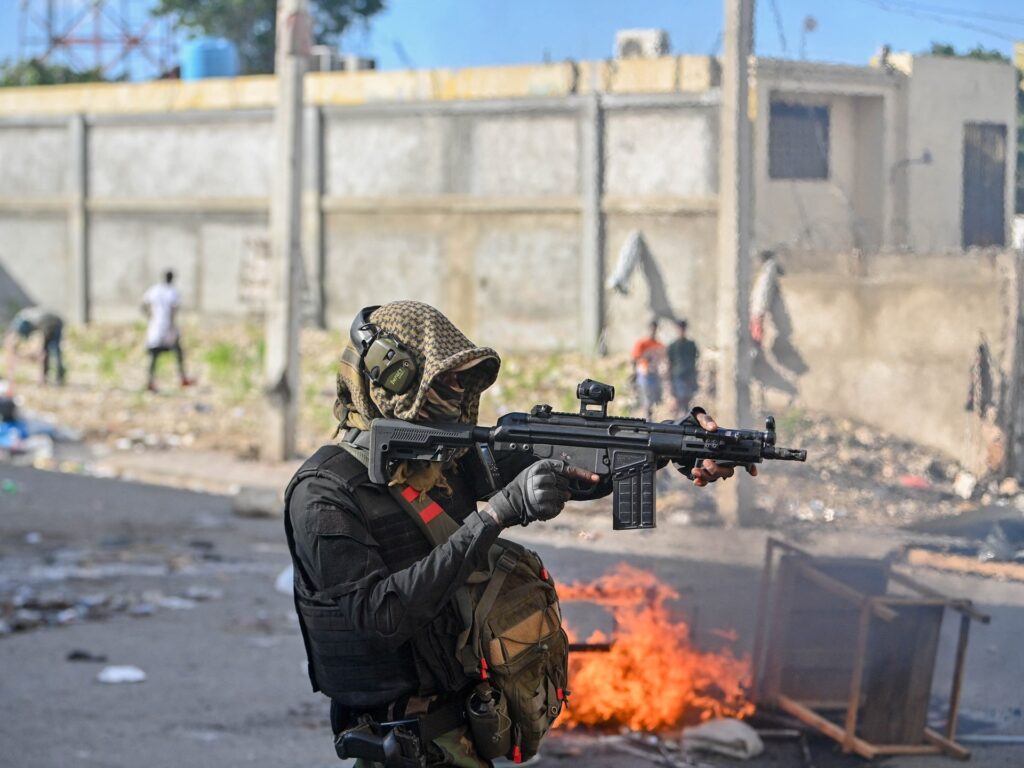
NewsFeed Haiti’s Prime Minister Ariel Henry has announced he is stepping down, after gangs threatened a civil war if he returned to the country. Here’s a quick explainer on the crisis in Haiti. Published On 12 Mar 202412 Mar 2024 Adblock test (Why?)
UK Conservatives’ top donor Frank Hester spoke of hating ‘all Black women’
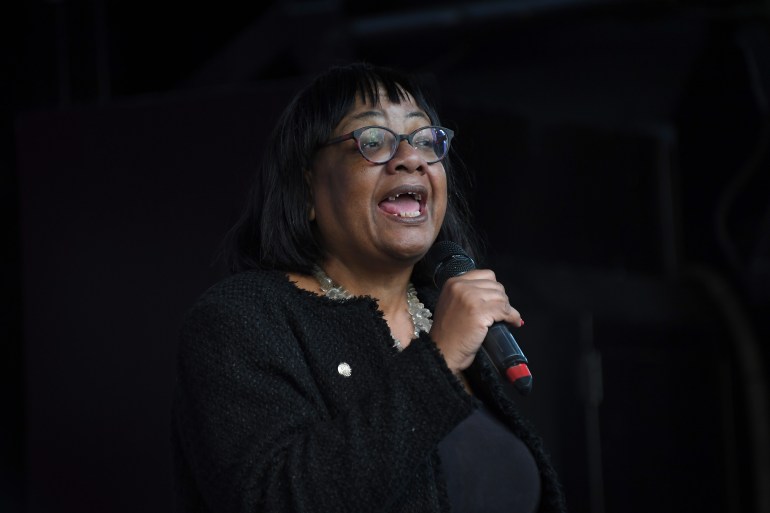
Opposition Labour Party blasts Frank Hester over remarks about Diane Abbott, who calls the comments ‘frightening’. The biggest donor to Britain’s governing Conservative Party has come under fire after he reportedly said looking at the country’s longest serving Black lawmaker made him “want to hate all Black women” and she “should be shot”. Frank Hester has given 10 million pounds ($12.8m) to Prime Minister Rishi Sunak’s party in the past year, and the publication of his comments from 2019 prompted the opposition Labour Party to urge the Conservatives to return the donation. The Guardian newspaper quoted Hester as referring to Diane Abbott, who became the first Black woman to be elected to the Parliament of the United Kingdom when she won a seat in 1987. “It’s like trying not to be racist, but you see Diane Abbott on the TV, and you’re just like, I hate, you just want to hate all Black women because she’s there, and I don’t hate all Black women at all, but I think she should be shot,” he was quoted as saying. Hester said in a statement that he “accepts that he was rude about Diane Abbott in a private meeting several years ago but his criticism had nothing to do with her gender nor colour of skin”. He said he abhors racism and had tried to apologise to Abbott. “Mr Hester has made clear that while he was rude, his criticism had nothing to do with her gender nor the colour of her skin. He has since apologised,” a Conservative Party spokesperson said. Then-Shadow Home Secretary Diane Abbott addresses anti-Brexit voters in London on October 19, 2019 [File: Alberto Pezzali/AP Photo] “The comments about Diane Abbott are just abhorrent,” Labour leader Keir Starmer told ITV on Tuesday. “This apology this morning that is pretending that what was said wasn’t racist or anything to do with the fact she’s a woman, I don’t buy that I’m afraid, and I think that it’s time the Tory Party called it out and returned the money.” Abbott, 70, sits as an independent after being kicked out of the Labour Party caucus for comments that suggested Jewish and Irish people do not experience racism “all their lives”. Abbott issued a statement Tuesday saying Hester’s remarks were alarming for a public figure who is a visible presence in the community because she doesn’t have a car and regularly walks or takes the bus. “It is frightening,” Abbott said. “I am a single woman, and that makes me vulnerable anyway. But to hear someone talking like this is worrying.” Hester’s comments are likely to revive scrutiny of the Conservative Party and how it handles allegations of racism. Former party chairperson Lee Anderson was suspended after he refused to apologise for saying London’s first Muslim mayor, Sadiq Khan, was under the control of “Islamists”. Senior Conservative lawmakers said Anderson’s comments were wrong but declined to say why or whether they were Islamophobic. Graham Stuart, a minister in Sunak’s government, was asked by reporters about Hester’s comments on Tuesday morning. He said they were unacceptable but refused to call them racist, telling Times Radio he did not like to “sit in judgement”. He said the party noted that Hester had said the comments made “half a decade ago” were not racist, and he told Sky News the party could not “cancel” people based on previous remarks. Anneliese Dodds, chairperson of the Labour Party, said it was vital that the party returns the donation. “Rishi Sunak has claimed that ‘words matter’ and he must know that holding on to that money would suggest the Conservatives condone these disturbing comments,” she said in a statement. “Sunak must return every penny.” Adblock test (Why?)
Jim Crow 2.0: As US elections near, new efforts to suppress Black votes.
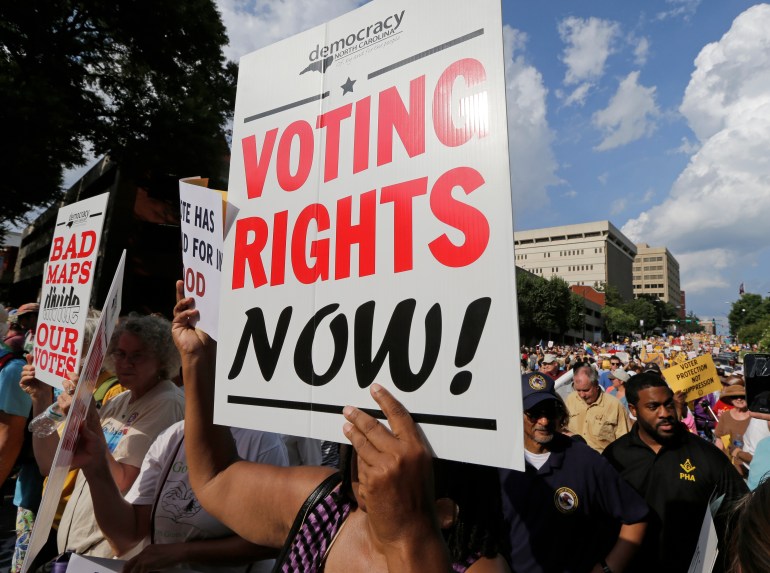
In the days and months leading up to today’s presidential primary in Georgia, activists have been on the ground in African American neighborhoods across the state working to prevent a rollback of voter rights that they say harkens back to the Jim Crow era. After record voter turnout flipped the state from deep red to barely blue in the 2020 presidential elections, Georgia has become the epicentre of a GOP campaign to effectively deny African Americans’ access to the ballot box in the American South. Georgia’s Republican legislators passed a melange of laws in 2021 intended to restrict voting in the state, strengthening voter identification requirements for absentee balloting, reducing the availability of drop boxes, and expanding the legislature’s authority in elections. Mirroring arguments made by GOP operatives nationwide, Republicans in Georgia contend that the measures are necessary to combat voter fraud. But Democrats and voting rights experts have countered that there is no statistical evidence of widespread voter fraud anywhere in the country, and that the reforms target African Americans who overwhelmingly support Democratic candidates and can therefore determine the outcome of elections when they turn out in large numbers, as was the case in Georgia in the 2020 presidential election. Cliff Albright, co-founder of Black Voters Matter and executive director of the Black Voters Matter Fund, said that Republican lawmakers across a wide swath of the former Confederacy have been redrawing the borders of election districts to favour their own party (often called “gerrymandering”), purging voters from the rolls and rewriting laws to effectively disenfranchise African Americans. Alabama’s House of Representatives last week approved legislation that would make it a felony for anyone in the state to receive help in filling out an absentee ballot from anyone who has not been designated by elections officials or is not a relative, or co-inhabitant. Under the proposal, anyone convicted of the crime could be sentenced to as many as 20 years in prison, on par with sentencing guidelines for manslaughter and statutory rape. And the Republican-controlled Mississippi legislature has repeatedly refused to repeal a Draconian provision in the state constitution, written in 1890, that disenfranchises anyone convicted of a catalogue of crimes that includes, car theft, robbery, perjury and receiving stolen goods. A woman holds a voting rights sign as demonstrators march through the streets of Winston-Salem, NC [File/Chuck Burton/AP Photo] White backlash Legal scholars and advocates have said that this wave of voter suppression is not isolated, but rather part of a broader white backlash that is animated, in large measure, by growing economic woes, and the feeling that people of colour – African Americans especially – are gaining ground and may soon surpass whites in terms of social status and economic prosperity. In this way, many academics have said, renewed efforts to suppress the Black vote are related to the mostly white rioters who stormed the US Capitol on January 6th, 2021 in an effort to overturn the presidential election, and the litany of young, white gunmen who have waged racially motivated attacks in recent years on African American parishioners and shoppers. A peer-reviewed study published by the Brennan Center for Justice in 2022 found that the US is amid “an unprecedented wave of anti-voter legislation introduced and passed across the country.” Continuing the report’s author wrote, “In 2021, at least one bill with a provision restricting access to voting was introduced in the legislature of every state except Vermont. By early May of this year, nearly 400 restrictive bills had been introduced in legislatures nationwide,” representing a nearly seven-fold increase over 2020. “There is a true backlash towards Black and brown folks” Melanie Campbell, president and CEO of the National Coalition on Black Civic Participation told Al Jazeera. “That makes it [this election year] very different … It’s a very toxic environment.” ‘Gaza will hurt if they don’t change course.’ Campbell and Albright said that their organisations have mounted massive “ground games” to offset the campaign of voter suppression, going door to door to educate and register voters, staffing phone banks, sending text messages and even touring Black neighbourhoods in the South by bus to shine a spotlight on the wide range of material deficits on the ground. Scholars have said that suppressing the African American vote, however, is not a bug but a feature of US democracy, dating back to the era known as Jim Crow. Mobs who set upon African American neighbourhoods in Atlanta in 1906, for example, did so as part of a campaign strategy devised by a gubernatorial candidate. The Atlanta riot was, in fact, informed by one in Wilmington, North Carolina eight years earlier when Democratic party operatives organised a coup to overthrow a populist political party that enjoyed broad support from Black male voters. Similarly, the GOP’s efforts today are motivated by political gain, Albright said, although he acknowledged that the Democratic party’s leadership can at times be its own worst enemy. Speaking of Black activists working to turn out the Black vote, he told Al Jazeera: “We get almost zero resources [from the Democratic National Committee]. They’ve got their favourite groups and white, male consultants. And Black groups end up contracting the same white consultants.” Moreover, he said that the GOP’s efforts to suppress the Black vote is only a part of the Democrats’ problems. “Young people don’t have much confidence with [Biden].” And noting the 100,000 Michigan voters who chose the “uncommitted” option in last month’s primary to protest Biden’s failure to stop Israel’s siege and blockade of the Gaza Strip and, increasingly, the West Bank, Campbell said of the Biden campaign: “Gaza will hurt if they don’t change course … Biden could lose the election.” Adblock test (Why?)
Prayers at Al-Aqsa Mosque after first day of Ramadan

NewsFeed Crowds of Palestinian worshippers were allowed in to pray at Al-Aqsa Mosque in occupied East Jerusalem, after the first day of Ramadan fasting. On the previous night Israeli forces beat back groups of people trying to access the site. Published On 12 Mar 202412 Mar 2024 Adblock test (Why?)