

Trump breezes by Haley in South Carolina primary with eyes on Biden rematch
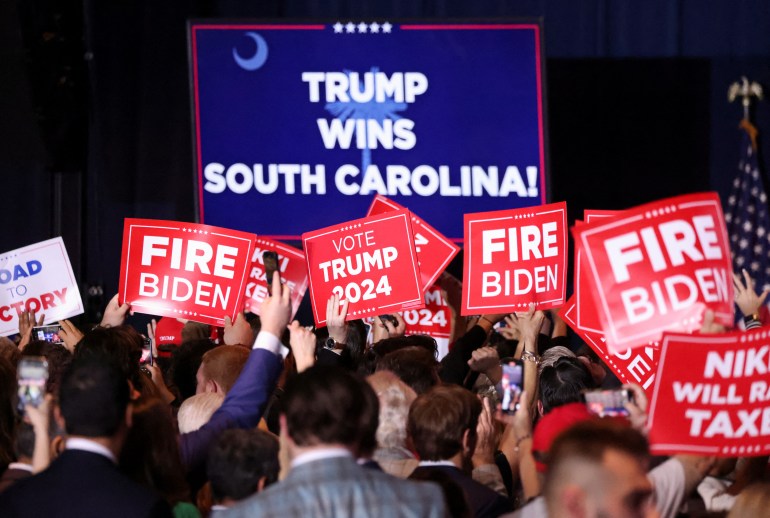
Former United States President Donald Trump has secured another decisive victory in the Republican Party’s 2024 presidential primaries, defeating former United Nations Ambassador Nikki Haley in her home state of South Carolina. The Associated Press and other US media outlets swiftly declared Trump the winner of the state’s GOP primary shortly after the polls closed on Saturday evening. The final results have not yet been released, but Trump was leading 59.7 percent to 39.7 percent with about half of the expected vote counted, according to Edison Research. Speaking to supporters at an election night party in the state capital of Columbia, the ex-president turned his attention to November’s general election and promised that if he is re-elected, the US would be “respected like never before”. “There’s never been a spirit like this,” Trump said. “I have never seen the Republican Party so unified as it is right now.” The former president has maintained a strong grip over the Republican caucus despite facing a slew of civil and criminal cases against him, sweeping every state contest so far. Trump supporters hold signs as they attend his primary night party in Columbia, South Carolina, on February 24 [Alyssa Pointer/Reuters] Trump’s victory in South Carolina also makes it increasingly likely that he will face a rematch against his Democratic rival, President Joe Biden, in November. Al Jazeera’s Shihab Rattansi, reporting from South Carolina on Saturday, noted that Trump did not even mention Haley’s name during his victory speech. “That is going to be the policy going forward,” Rattansi said. “This is all about Biden.” But Haley, who served as South Carolina’s governor from 2011 to 2017, has pledged to continue her campaign at least through the Super Tuesday contests on March 5. That’s the day 15 US states and a territory hold their primaries. “I said earlier this week that, no matter what happens in South Carolina, I would continue to run for president,” Haley said in a speech to supporters in the city of Charleston after her loss. “I’m a woman of my word.” Her commitment to continuing drew chants of “Nikki! Nikki!” from the crowd. “I’m not giving up this fight when a majority of Americans disapprove of both Donald Trump and Joe Biden,” Haley added. “South Carolina has spoken; we’re the fourth state to do so. In the next 10 days, another 21 states and territories will speak. They have the right to a real choice, not a Soviet-style election with only one candidate. And I have a duty to give them that choice.” Haley speaks on stage in Charleston, South Carolina, on February 24 [Brian Snyder/Reuters] Haley said she plans to head to Michigan on Sunday, just days ahead of that state’s Republican primary on February 27. Then, her campaign will turn its attention to Super Tuesday states, which include Minnesota, Vermont and Colorado. But the former UN ambassador has no real path to winning the Republican Party nomination – and the party has largely hitched its wagon to Trump. Even in her home state, Haley struggled to rally high-profile political endorsements. Only one Republican representative from South Carolina, Ralph Norman, backed her over Trump. Trump, meanwhile, celebrated his South Carolina victory with a row of his backers, including both of South Carolina’s senators – Tim Scott and Lindsey Graham – as well as the state’s governor. He had arrived in South Carolina shortly after delivering a speech at the Conservative Political Action Conference (CPAC) in Maryland, the largest annual gathering for conservatives in the country. Many of his remarks there were focused on Biden. In his 90-minute speech, Trump accused the president of overseeing the country’s decline. He added that, if he beats Biden in November, it will represent a “judgement day” for the US and his “ultimate and absolute revenge”. For his part, Biden has warned that the former Republican president likewise poses a threat to the country. Last month, Biden characterised Trump and his followers as dangerous outliers. The Democratic president asked his party, independents and “mainstream Republicans” who cherish US democracy to back him. “Democracy is on the ballot. Your freedom is on the ballot,” Biden said. Trump faces four separate criminal indictments, including two related to his efforts to overturn the results of the 2020 presidential election – a contest he lost to Biden. His first criminal trial – on charges of falsifying business documents in connection to hush-money payments – is scheduled to begin on March 25 in New York City. Trump has denied wrongdoing in all the cases and said they are part of a politically motivated witch hunt. Adblock test (Why?)
US, UK bomb Houthi sites in Yemen amid surge in Red Sea ship attacks

US and UK forces hit 18 Houthi targets including underground weapons and missile storage facilities, officials say. The United States and the United Kingdom have bombed more than a dozen Houthi sites in Yemen, officials said, as the rebel group stepped up its attacks on ships in the Red Sea in protest against Israel’s war on Gaza. In a joint statement on Saturday, the US and UK said the military action against 18 Houthi targets in Yemen included attacks on underground weapons and missile storage facilities, air defence systems, radars and a helicopter. The operation marked the fourth time that the US and UK militaries have carried out joint attacks against the Houthis since January 12. The US has also been carrying out almost daily raids to take out Houthi targets, including incoming missiles, rockets and drones targeting commercial and other Navy vessels. The raids, however, have so far failed to halt the Houthis’ attacks, which have upset global trade and raised shipping rates. US Defence Secretary Lloyd Austin said the latest strikes were meant “to further disrupt and degrade the capabilities of the Iranian-backed Houthi militia”. “We will continue to make clear to the Houthis that they will bear the consequences if they do not stop their illegal attacks, which harm Middle Eastern economies, cause environmental damage and disrupt the delivery of humanitarian aid to Yemen and other countries,” Austin said. The attacks were supported by Australia, Bahrain, Canada, Denmark, the Netherlands and New Zealand. The Houthis denounced the “US-British aggression” and pledged to keep up its military operations. “The Yemeni Armed Forces affirm that they will confront the US-British escalation with more qualitative military operations against all hostile targets in the Red and Arabian Seas in defense of our country, our people and our nation,” the group said in a statement. The Houthis have launched at least 57 attacks on commercial and military ships in the Red Sea and the Gulf of Aden since November 19, and the pace has picked up in recent days. A spokesman for the Houthis claimed an attack on MV Torm Thor, a US-flagged, owned and operated chemical and oil tanker, on Saturday, saying the group targeted the vessel using a “number of appropriate naval missiles”. The US Central Command confirmed the attack, saying its forces downed an antiship ballistic missile launched from Houthi-held areas in Yemen towards the Gulf of Aden, adding that the missile was likely targeting MV Torm Thor. The tanker was not damaged and there were no injuries, it said. Earlier this week, the Houthis also claimed responsibility for an attack on a UK-owned cargo ship and a drone assault on a US destroyer, and said they targeted Israel’s port and resort city of Eilat with ballistic missiles and drones. No ships have been sunk nor crew killed during the Houthi campaign. However, there are concerns about the fate of the UK-registered Rubymar cargo vessel, which was struck on February 18 and its crew evacuated. The US military has said the Rubymar was carrying more than 41,000 tonnes of fertiliser when it was hit, which could spill into the Red Sea and cause an environmental disaster. The turmoil from Israel’s war on Gaza has also spilled over to into other parts of the Middle East. Apart from the Houthi attacks on vital shipping lanes, Lebanon’s Iran-backed Hezbollah group has traded fire with Israel along the Israel-Lebanon border and pro-Iran Iraqi militia have attacked bases that host US forces. Adblock test (Why?)
UK Conservatives suspend MP who said ‘Islamists’ control London’s mayor

Lee Anderson will now sit as an independent lawmaker in parliament after his remarks prompted a flood of criticism. The UK’s Conservative Party has suspended one of its lawmakers, Lee Anderson, after he said the mayor of London, Sadiq Khan, was under the control of “Islamists”. Khan, the first Muslim to be mayor of London and a member of the opposition Labour Party, is a frequent target of Conservative criticism for his handling of policing in the UK’s capital, including regular pro-Palestinian marches. On Wednesday hundreds of pro-Palestinian protesters gathered outside parliament, during a chaotic vote over whether to call for a ceasefire in Gaza and the exact language to use. The speaker of the lower house of parliament, Lindsay Hoyle, said he broke with the usual parliamentary procedure for the vote because of previous threats of violence some lawmakers had received due to their views on the conflict. Pro-Israeli voices in the UK, such as Anderson, have attempted to portray the pro-Palestinian movement as dangerous, despite the majority of British respondents in several polls supporting an end to Israel’s attack on Gaza. Speaking on Friday to the television channel GB News, Anderson said, “I don’t actually believe these Islamists have got control of our country. But what I do believe is they’ve got control of Khan and they’ve got control of London. He’s actually given our capital city to his mates.” His remarks prompted a flood of criticism from across the political spectrum, with Labour Party chairwoman Anneliese Dodds calling them “unambiguously racist and Islamophobic”. Conservative business minister Nus Ghani, senior backbencher Sajid Javid and Tory peer Gavin Barwell were among senior Tory figures to join the complaints, with Barwell calling the comments a “despicable slur”. The Muslim Council of Britain said they were “disgusting” and extremist. Khan – who regularly speaks of the importance of fighting anti-Semitism, misogyny and homophobia – told reporters that he regarded Anderson’s comments as racist and Islamophobic and that they would “pour fuel on the fire of anti-Muslim hatred”. Amid growing criticism of Anderson’s remarks on Saturday, the Conservative Party said it had decided he could no longer represent them in Parliament. “Following his refusal to apologise for comments made yesterday, the Chief Whip has suspended the Conservative whip from Lee Anderson MP,” a spokesperson for Simon Hart, the government minister in charge of party discipline, said. Anderson, a former Conservative Party vice chairman, did not immediately respond to a request for comment. He will now sit as an independent lawmaker in parliament. A survey conducted from February 16-18 by Savanta showed that 29 percent of Britons believed the Conservatives had a problem with Islamophobia, the most of any major political party. Sayeeda Warsi, a Conservative member of the House of Lords and a former co-chairwoman of the party, has previously said that the Tories were “institutionally Islamophobic“. Anderson’s comments come as incidents of Islamophobia have spiked dramatically across the UK. A monitoring group said Thursday that anti-Muslim hate incidents in the UK more than tripled following the outbreak of the war between Israel and Hamas in October. Since then Tell MAMA recorded 2,010 such cases, the largest recorded number of cases in a four-month period, a statement from the organisation said, which was set up to monitor and report such incidents. The latest figures were up from 600 incidents over the same period in 2022-2023, a rise of 335 percent. “We are deeply concerned about the impacts that the Israel and Gaza war are having on hate crimes and on social cohesion in the UK,” Tell MAMA director Iman Atta said. “This rise in anti-Muslim hate is unacceptable and we hope that political leaders speak out to send a clear message that anti-Muslim hate, like anti-Semitism, is unacceptable in our country.” Adblock test (Why?)
What has Russia achieved during two years of war in Ukraine?

The bloodiest conflict in Europe since World War II moves into its third year. The cost of the Russia-Ukraine war is already enormous: tens of thousands of soldiers killed on both sides; thousands of civilians dead; and millions of Ukrainians forced from their bombed-out towns and cities. Yet there is little sign of an end in sight. Russian President Vladimir Putin remains defiant – saying there will be no peace until his country’s goals are met. Meanwhile, Ukraine is again appealing for more donations to replace dwindling supplies of ammunition. The European Union agreed to a new package worth $54bn earlier this month. But the United States Congress cannot agree upon their support package. It is election year in the US and Republicans are arguing over whether to extend the military lifeline to Ukraine – a delay that could put more pressure on NATO. So, is the Russia-Ukraine war one that can be won? Who is benefiting? And where might Putin set his sights next? Presenter: Laura Kyle Guests: Pavel Felgenhauer – Moscow-based defence analyst and former columnist for Novaya Gazeta Stefan Wolff – Professor of international security at the University of Birmingham Hanna Shelest – Security Studies Program director at Ukrainian Prism, non-governmental analytical centre Adblock test (Why?)
Dahomey doc on Europe’s looted African art wins Berlin film festival

Dahomey, a documentary by Franco-Senegalese director Mati Diop probing the thorny issues surrounding Europe’s return of looted antiquities to Africa, has won the Berlin International Film Festival’s top prize. Kenyan-Mexican Oscar winner Lupita Nyong’o announced the seven-member panel’s choice for the Golden Bear award at a gala ceremony in the German capital Saturday. Diop said the prize “not only honours me but the entire visible and invisible community that the film represents”. Al Jazeera’s Dominic Kane, reporting from Berlin, said the documentary “confronts an issue that has been the forefront of many people’s minds, not just in the film world but also across Europe. “DDahomeyconcentrates on the Benin bronzes and the struggle to return those bronzes. The whole principle of restitution, that is what the director Mati Diop referred to in accepting the prize, the Golden Bear at this festival,” Kane said. South Korean arthouse favourite Hong Sang-soo captured the runner-up Grand Jury Prize for, A Traveller’s Needs, his third collaboration with French screen legend Isabelle Huppert. Mati Diop celebrates with Berlinale Artistic Director Carlo Chatrian, right, and Head of Programming Mark Peranson backstage during the awards ceremony in Berlin [Nadja Wohlleben/Pool/AFP] Hong, a frequent guest at the festival, thanked the jury, joking, “I don’t know what you saw in this film.” French auteur Bruno Dumont accepted the third-place Jury Prize for, The Empire, an intergalactic battle of good and evil set in a French fishing village. Dominican filmmaker Nelson Carlo de los Santos Arias won best director for, Pepe, his enigmatic docudrama conjuring the ghost of a hippopotamus owned by the late Colombian drug baron Pablo Escobar. Marvel movie star Sebastian Stan picked up the best performance Silver Bear for his appearance in the US satire, A Different Man. Stan plays an actor with neurofibromatosis, a genetic disease causing disfiguring tumours, who is cured with a groundbreaking medical treatment. The Romanian American star called it “a story that’s not only about acceptance, identity and self-truth but about disfigurement and disability – a subject matter that’s been long overlooked by our own bias”. ‘Collusion’ The United Kingdom’s Emily Watson clinched the best supporting performance Silver Bear for her turn as a cruel mother superior in, Small Things Like These. The film, starring Cillian Murphy, is about one of modern Ireland’s biggest scandals: the Magdalene laundries network of Roman Catholic penitentiary workhouses for “fallen women”. She paid tribute to the “thousands and thousands of young women whose lives were devastated by the collusion between the Catholic church and the state in Ireland”. German writer-director Matthias Glasner took the Silver Bear for best screenplay for his semi-autobiographical tragicomedy, Dying. The three-hour tour de force features some of the country’s top actors depicting a dysfunctional family. The Silver Bear for outstanding artistic contribution went to cinematographer Martin Gschlacht for the chilling Austrian historical horror movie, The Devil’s Bath. It tells the tale of depressed women in the 18th century who murdered in order to be executed. A separate Berlinale Documentary Award went to a Palestinian-Israeli activist collective for, No Other Land, about Palestinians displaced by Israeli troops and settlers in the occupied West Bank. “In accepting the prize, the two men most involved in this film – one Israeli, one Palestinian – both spoke about the need for a ceasefire immediately, and that is a thought picked up by many other people – some recipients of awards, [and] some people presenting awards,” Kane said. Cu Li Never Cries, by Vietnamese filmmaker Pham Ngoc Lan won the best first feature prize. The film tells the story of a woman who returns to Vietnam from Germany with the ashes of her estranged husband. Best short film went to, An Odd Turn, by Argentina’s Francisco Lezama about a museum security guard who predicts a surge in the dollar’s value with a pendulum. The Berlinale, as the festival is known, ranks with Cannes and Venice among Europe’s top cinema showcases. Last year, another documentary took home the Golden Bear, France’s, On the Adamant, about a floating day-care centre for people with psychiatric problems. Adblock test (Why?)
‘Our bodies know the pain’: Why Norway’s reindeer herders want Gaza peace

Fosen Peninsula, Norway – A herd of reindeer running through thick, white snow sounds a bit like thunder. It is a spectacle that has been replayed for at least the past 10,000 years on eastern Norway’s Fosen Peninsula and one that Maja Kristine Jama, who comes from a family of reindeer herders, is deeply familiar with. Like most Sami reindeer herders, Jama knows every inch of this terrain without any need for a map. Instead of going to kindergarten like most other children in Norway, she was raised living outdoors alongside the migrating reindeer. Reindeer husbandry in Norway is a sustainable activity that is carried out in accordance with the traditional practices of Sami culture. Reindeer also play an important role in the Arctic’s ecosystem and have long been a symbol of the region “Reindeer herding defines me,” Jama says. “We are so connected to nature, we have respect for it. We say that you don’t live off the land, you live within it. But we see our lands being destroyed.” Europe’s oldest and last remaining Indigenous people are under grave threat as a result of borders, land seizures, construction projects dedicated to the extraction of natural resources and systematic discrimination. Yet, that creeping sense of suffocation has made the Sami reach out to another set of Indigenous people nearly 4,000km (2,500 miles) away, whose fight for survival they identify with: the Palestinians in the Gaza Strip and the occupied West Bank. Their own struggle for Indigenous rights and self-determination has turned the Sami into vocal advocates for the Palestinian cause. “There is an instant urge to stand up for people who are being displaced from their homes,” Ella Marie Haetta Isaksen, a Sami activist and artist widely known for her singing, tells Al Jazeera. ‘We say you don’t live off the land, you live within it,’ reindeer herder Maja Kristine Jama says [Courtesy of Norske Samers Riksforbund/Anne Henriette Nilut] Isaksen had just finished taking part in several months of demonstrations in Oslo for the rights of her own people when Israel launched its war on Gaza in October. As the death toll mounted, anger about Gaza quickly spread through Norway generally and the Sami community in particular. Scores of Norwegians posted images of themselves holding “Stop bombing Palestine” placards on social media while mass demonstrations called for an immediate ceasefire after Nordic countries, with the exception of Norway, abstained from a United Nations General Assembly ceasefire vote on October 27. For the Sami, it was a pivotal moment of two causes tangling into one. The community launched a series of regular protests in Oslo against the war in Gaza, and those rallies continue to take place. In front of the Norwegian Parliament on a cold October day, surrounded by hundreds of Palestinian and Sami flags, Isaksen held a mic and performed the “joik”, a traditional Sami song performed without instruments. Her lilting sounds brought the noisy demonstrators to a standstill, carrying a prayer that she hoped would somehow reach the besieged children of Gaza. “I’m physically so far away from them, but I just want to grab them, hold them and take them out of this nightmare,” Isaksen says. “Without trying to compare situations, Indigenous peoples all over the world have stood up for the Palestinian people because our bodies know the pain of being displaced from our homes and forced out of our own lands,” Isaksen says. Ella Marie Isaksen at Sami demonstrations in Oslo in October 2023 [Courtesy of Rasmus Berg] A long struggle For more than 9,000 years, the Sami lived a free, nomadic existence spanning modern-day Norway, Sweden, Finland and Russia. That began to change in the ninth century when outsiders from Southern Scandinavia encroached into Sapmi, the name given to the broad, untamed lands of the Sami. Christian invaders established a church in the 13th century in Finnmark in northern Sapmi territory in what is now northern Norway. Sweden’s break from Denmark, which had also ruled Norway, in 1542 launched an era of land disputes, conflict and coercion of the Sami that lingers today. A Swedish census that has been preserved from 1591 notes how one Sami community, moving across borders that hadn’t existed for their ancestors, simultaneously paid taxes to Sweden, Denmark and Russia. The creation of Europe’s longest unbroken border in 1751 – between Norway and Sweden – was particularly disastrous for the Sami, restricting them permanently within one country, splitting families apart and forcing their reindeer away from migratory routes. As has been the case for the Palestinians, the imposition of such borders has had a direct impact on the Sami’s fragile existence, says Aslat Holmberg, president of the Sami Council, a nongovernmental organisation promoting the rights of the Sami people across the Nordics and western Russia. He comes from an area on the border between Finland and Norway. “I don’t like to divide the Sami with borders, but we are people now living in four countries,” Holmberg says. Although Sami groups maintain a bond, they believe the borders imposed on them were one of many colonial acts that tore them apart. A ban on speaking their own language under forced assimilation policies, which officially ended in the 1960s in Norway, almost erased their cultural ties. Holmberg warns that Sami languages are now “endangered”. A Sami woman on a Sami farm in Solheim, Troms og Finnmark in Norway [File: Jorge Castellanos/SOPA Images/LightRocket via Getty Images] He isn’t exaggerating. There are no historical records showing population figures for the Sami through history. Today, however, they are estimated at 80,000. About half that number live in Norway, where just three Sami languages remain in use. There are only 20 remaining speakers of one of them – the Ume language used in Sweden and Norway. In all, there are nine surviving Sami languages, which are related to languages such as Estonian and Finnish. Preservation of these languages is fraught with difficulties. In Finland, 80 percent of Sami youth live outside traditional Sami territory, where
US warns of ‘disaster’ amid oil slick in Red Sea from ship hit by Houthis

US military says Iran-aligned group is being reckless with attacks on shipping in the Red Sea off Yemen’s shores. The United States military has warned of an “environmental disaster” after an attack by Yemen’s Houthi rebels on a cargo ship caused an oil slick in the Red Sea. The Iran-aligned group hit the United Kingdom-owned, Belize-flagged bulk carrier Rubymar on February 18 with multiple missiles. It was sailing through the Bab al-Mandeb Strait which connects the Red Sea and the Gulf of Aden, on its way to Bulgaria after leaving Khor Fakkan in the United Arab Emirates. Extensive damage prompted the crew, all of whom are safe, to abandon the ship. US Central Command (CENTCOM) confirmed on Saturday that the ship was now “anchored but slowly taking on water”, which it said has caused a 29-kilometre (18-mile) oil slick. The vessel was transporting more than 41,000 tonnes of fertiliser when attacked, the military said, “which could spill into the Red Sea and worsen this environmental disaster”. “The Houthis continue to demonstrate disregard for the regional impact of their indiscriminate attacks, threatening the fishing industry, coastal communities, and imports of food supplies,” it added. On Feb. 18 between 9:30 p.m. and 10:40 p.m., Iran-backed Houthi terrorists attacked the M/V Rubymar, a Belize-flagged, UK-owned bulk carrier. The ship is anchored but slowly taking on water. The unprovoked and reckless attack by Iran-backed Houthi terrorists caused significant… pic.twitter.com/bU6j850wwG — U.S. Central Command (@CENTCOM) February 24, 2024 US broadcaster CNN cited an unnamed US official as saying the threat of more Houthi attacks in the Red Sea, combined with the condition of the water, makes it very difficult to safely get to the ship and attempt to tow it to a port. US officials are not sure what kind of substance is causing the slick, the report said. The group has been disrupting trade through the Red Sea, promising that its attacks will continue until Israel ends its war on Gaza, which has killed more than 29,600 Palestinians, mostly children and women. Backed by several other allied Western governments, the US and the United Kingdom have been bombing governorates across Yemen in response to the Houthi strikes. The military confrontation has now turned into a daily occurrence. The US military also confirmed multiple new “self-defence strikes” on Houthi-controlled positions in Yemen. It said it destroyed seven mobile antiship cruise missiles that were prepared for launch towards the Red Sea. “These actions will protect freedom of navigation and make international waters safer and more secure for US Navy and merchant vessels,” CENTCOM said. The Houthis, who control Yemen’s most populous regions, earlier this week struck what they said was an Israeli cargo ship, the MSC Silver, in the Gulf of Aden near the entrance to the Red Sea. Houthi military spokesperson Yahya Saree said the group had also used drones to target a number of US warships in the Red Sea and Arabian Sea as well as sites in the southern Israeli resort town of Eilat. US media cited US officials as confirming earlier this week that the Houthis had hit an MQ-9 attack drone near Yemen, the second time they have shot down a US military drone since the start of the Gaza war. Houthi leader Abdulmalik al-Houthi on Thursday said they have introduced “submarine weapons” in their attacks. This confirms a previous US military report that the group is deploying underwater drones. A Houthi spokesperson has said the group has recruited and trained more than 200,000 new fighters since the start of the Gaza war. Adblock test (Why?)
Navalny widow says Russia’s Putin torturing him even in death, demands body

Yulia Navalnaya accuses Russian president of mocking Christianity as officials refuse to hand over remains to family. Yulia Navalnaya, the widow of opposition leader Alexey Navalny, has demanded that Russian authorities hand over his body for burial as she accused President Vladimir Putin of mocking Orthodox Christian values and “torturing” his corpse. “Give us the body of my husband,” Navalnaya said in a video released on Saturday, adding that she wanted to give him a traditional Orthodox funeral. “You tortured him alive, and now you keep torturing him dead. You mock the remains of the dead,” she said in a message to Putin. Navalny, a prominent opponent of Putin, died last week in a remote maximum-security Arctic penal colony where he was serving a 19-year sentence on extremism charges. The authorities claim that he died of natural causes. They have refused to hand over his remains to the family even nine days later. Navalny’s mother, Lyudmila Navalnaya, has said investigators were pressuring her to bury her son in “secret” at a private ceremony without mourners. An official told her that she should agree to their demands because Navalny’s body was already decomposing, she said. Navalny’s aides said the authorities had threatened to bury him in the prison colony where he died unless his family agreed to their conditions. “They want to take me to the far end of the cemetery to a fresh grave and say: ‘Here lies your son’,” his mother said in a video posted on YouTube on Thursday. “I’m not agreeing to that.” ‘How low will you sink?’ “No true Christian could ever do what Putin is now doing with the body of Alexey,” his widow said in the video, as she questioned Putin’s often-professed Christian faith. “What will you do with his corpse? How low will you sink to mock the man you murdered?”, she asked and said, “We already knew that Putin’s faith was fake. But now we see it more clearly than ever before.” The Russian leader is frequently pictured in church, dunking himself in ice water to celebrate the Epiphany and visiting holy sites in Russia. He has promoted what he has called “traditional values” without which, he once said, “society degrades”, and has touted his closeness to Russia’s Orthodox Church. Kremlin spokesperson Dmitry Peskov has denounced allegations – even from world leaders – that Putin was involved in Navalny’s death, calling them “absolutely unfounded, insolent accusations about the head of the Russian state”. Musician Nadya Tolokonnikova, who became widely known after spending nearly two years in prison for taking part in a 2012 protest with her band Pussy Riot inside Moscow’s Christ the Savior Cathedral, released a video in which she accused Putin of hypocrisy. “We were imprisoned for allegedly trampling on traditional values. But no one tramples on traditional Russian values more than you, Putin, your officials and your priests who pray for all the murder that you do, year after year, day after day,” said Tolokonnikova, who lives abroad. “Putin, have a conscience, give his mother the body of her son.” Tolokonnikova was one of several cultural icons who have released videos calling on Russian authorities to return Navalny’s body to his family. Critics say that the authorities fear a funeral could turn into a large-scale public show of support for the opposition leader. The funeral arrangements for Yevgeny Prigozhin, a Putin ally-turned-rival and founder of the Wagner mercenary group who died last August, were surrounded in secrecy and his body was buried on the outskirts of Saint Petersburg away from the glare of the media. While Russian media have given little space to the news of Navalny’s death, people flocked to the streets of cities across the country to pay tribute to the opposition leader. Police arrested at least 400 people in the first 24 hours since the news of his death, according to protest monitoring group OVD-Info. Adblock test (Why?)
US says new Israeli settlements ‘inconsistent’ with international law

The US and its allies have historically done little to pressure Israel to halt or roll back settlement expansion. The United States has said that new Israeli settlements in the occupied Palestinian territories are illegal, effectively reversing a policy by the administration of former President Donald Trump. US Secretary of State Antony Blinken said an announcement by Israeli Finance Minister Bezalel Smotrich that more than 3,300 new Israeli settlements are to be built in the occupied West Bank was “disappointing”. “It has been a longstanding policy of both Democratic and Republican administrations that new settlements are counterproductive to achieving enduring peace. They are also inconsistent with international law,” Blinken said at a news conference late on Friday in Buenos Aires. “Our administration maintains firm opposition to settlement expansion. In our judgement it only weakens, not strengthens Israel’s security,” he added, without making any mention of tangible consequences Israel could face for settlement expansion. This negates the so-called Pompeo Doctrine, which referred to an announcement in November 2019 by then-Secretary of State Mike Pompeo that Washington supports Israeli settlements in the West Bank, Golan Heights and East Jerusalem as legal. The majority of the global community views these settlements as illegal and an extension of Israeli occupation. White House national security spokesperson John Kirby told reporters that Blinken’s position “has been consistent over a range of Republican and Democratic administrations”. “If there’s an administration that is being inconsistent, it was the previous one,” Kirby said. The Pompeo Doctrine itself had overturned a legal position held by the US Department of State since 1978 when the administration of former President Jimmy Carter had evaluated Israeli settlements to be in violation of international law. Germany has also condemned the latest Israeli plans to construct thousands of new settler homes in the occupied West Bank. “You know our position on settlement construction. It is contrary to international law and this also applies when new construction projects are carried out,” deputy foreign ministry spokeswoman Kathrin Deschauer told a news conference in Berlin. New settlements Israel’s Smotrich had announced the new settlement plans were a supposed response to what he called a “terrorist” attack on Thursday, when three Palestinians opened fire near a checkpoint between Jerusalem and the occupied West Bank city of Ma’ale Adumim, killing one Israeli and wounding several others. Smotrich now plans to build 2,350 new housing units on Palestinian land in Ma’ale Adumim, 300 in Kedar and 694 in Efrat, with backing from Prime Minister Benjamin Netanyahu, Defence Minister Yoav Gallant and Strategic Affairs Minister Ron Dermer. Palestinian Prime Minister Mohammad Shtayyeh on Saturday called the announcement a “blatant challenge to the international community” and an obstacle to establishing an independent Palestinian state. Israeli settlement watchdog Peace Now said that “Israel’s 2024 budget shows an addition of over $100m to settlements”. “In 2024, coalition funds for settlements will amount to over $203m [instead of the originally allocated $76m in the government decision from May 2023],” it added. Ministers in the most far-right administration in the history of Israel have also called for increased curbs on Palestinians, including heavy restrictions on movement, after the attack. Over decades, Israel has advanced plans to build new illegal settlements regardless of any attacks. The US and its allies have historically done little to pressure Israel to halt or roll back settlement expansion. Raids across Palestinian territories occupied by Israel had become an almost daily occurrence even before the war on Gaza started on October 7, and they have only significantly intensified since, growing deadlier as well. In the Gaza Strip, more than 29,500 Palestinians have been killed by Israeli attacks since the start of the war, most of them children and women. Adblock test (Why?)
Western leaders visit Ukraine to show solidarity as war enters third year

Visit comes as Kyiv is on the defensive amid flagging Western aid and Russian territorial gains. Western leaders including the European Commission’s Ursula von der Leyen and Canada’s Justin Trudeau have arrived in Ukraine to show solidarity with Kyiv as it enters the third year of its war with Russia. Von der Leyen, Trudeau, Italian Prime Minister Giorgia Meloni, and Belgium Prime Minister Alexander De Croo arrived in the country on Saturday on an overnight train from neighbouring Poland. Meloni, whose country is chairing the G7 this year, is scheduled to host a video conference on Saturday between leaders from the group of major economies and Ukrainian President Volodymyr Zelenskyy, with new sanctions against Russia and joint arms purchases for Ukraine among the likely topics of discussion. “More than ever, we stand firmly by Ukraine. Financially, economically, militarily, morally. Until the country is finally free,” von der Leyen said in a post on X. Trudeau said that Ukrainians were fighting for “our collective future”. “They are fighting to remind the world that democracy is both important enough to die for and strong enough to win,” he said in a statement before arriving in Kyiv. “As the war continues, that is what is at stake. And that is why Canada has stood with Ukraine since day one.” The Western leaders’ visit comes as Ukraine marks the second anniversary of Moscow’s invasion on the defensive amid flagging Western aid and Russian territorial gains. Kyiv’s fortunes have suffered in recent weeks amid shortages of military supplies, with Russia this month capturing the eastern town of Avdiivka in its biggest victory on the battlefield in months. United States President Joe Biden has blamed Republicans in Congress for holding up a $61bn package of military funding, casting the support as crucial to Kyiv’s efforts to repel Moscow. Biden on Friday announced further sanctions against Russia, pledging to keep up pressure on Russian President Vladimir Putin’s “war machine”. On Friday, Ukrainian foreign minister Dmytro Kuleba delivered a rebuke to sceptics who doubt Kyiv’s ability to defeat Moscow, insisting that “Ukraine will win the war” and victory would come “sooner rather than later” with international support. Zelenskyy earlier this week told diplomats in an emotional address that he remained “convinced that victory awaits us”. While neither Ukraine nor Russia has provided official estimates of the number of people killed and injured in the war, both sides claim to have inflicted heavy losses. The New York Times in August cited US officials who estimated that about 70,000 Ukrainian troops had been killed and a further 100,000-120,000 wounded. In December, leaked US intelligence suggested that about 315,000 Russian troops had been killed or injured. Adblock test (Why?)