

Qatar condemns ‘double standards’ at ICJ hearing on Israeli occupation

Qatar tells the International Court of Justice (ICJ) that it rejects the “double standards” when international law applies to some but not to others during a hearing on Israel’s occupation of the Palestinian territories. “Some children are deemed worthy of protection while others are killed in their thousands,” senior Qatari diplomat Mutlaq al-Qahtani said on Friday in The Hague. “Qatar rejects such double standards. International law must be upheld in all circumstances. It must be applied to all, and there must be accountability”. Al-Qahtani added that Israel had implemented an “apartheid regime” to maintain the “domination of Jewish Israelis over Palestinians”. He also said the occupation is “illegal” due to it violating the Palestinian people’s right to self-determination. The court has the “clear mandate and indeed the responsibility to remedy this unacceptable situation. The credibility of the international legal order depends on your opinion, and the stakes cannot be higher.” Qatar, the United States and Egypt are currently mediating negotiations for a ceasefire between Israel and Hamas to stop the current war, which is taking a devastating toll on Palestinian civilians in the Gaza Strip. Over the past week, the ICJ has been hearing the opinion of more than 50 countries on the legal implications of Israel’s occupation ahead of the court issuing a nonbinding opinion. The 15-judge panel has been asked to review Israel’s “occupation, settlement and annexation, … including measures aimed at altering the demographic composition, character and status of the Holy City of Jerusalem, and from its adoption of related discriminatory legislation and measures”. But Qatar echoed similar statements from several countries in calling out Israel’s policy as a breach of international law, including South Africa, which also referred to the occupation as “apartheid”. Representatives from several other countries, including Pakistan, Norway, Indonesia and the United Kingdom, spoke at Friday’s hearing. Pakistani Minister for Law and Justice Ahmed Irfan Aslam said that while Israel had tried to make its occupation of the Palestinian territories irreversible, history has shown that change is possible, referring to the withdrawal of French settlers from Algeria in 1962. He added that a two-state solution “must be the basis for peace”. Norway’s representative said developments on the ground “give reason to ask whether the occupation is turning into a de facto annexation”, which is prohibited under international law. Indonesian Foreign Minister Retno Marsudi, who said she left the G20 meeting in Brazil to address the ICJ personally, stated: “I stand before you to defend justice against a blatant violation of international humanitarian law that is being committed by Israel.” Marsudi added that Israel’s “unlawful occupation” should not be normalised or recognised, all actions that stop the Palestinian people’s right to self-determination “shall be unlawful” and it is clear that its “apartheid regime” is in breach of international law. The British representative was the only person to divert from what other countries had said on Friday and instead aligned with the US, who called on the court to reject issuing an advisory opinion. The representative said that while Israel’s occupation is illegal, it is a “bilateral dispute”, and issuing an opinion would affect the security framework led by the United Nations Security Council. The hearings are, in part, a push by Palestinian officials to get international legal institutions to investigate Israel’s occupation, especially in light of the current war on Gaza. During the past four months and after Hamas’s October 7 attacks in southern Israel, which killed 1,139 Israelis, Israel has conducted a military campaign in Gaza, which has resulted in the deaths of more than 29,000 Palestinians. In the occupied West Bank, settler violence has increased, and world leaders have issued sanctions to try to penalise and curb the attacks. Israel, which is not attending the hearing, has said the court proceedings could be harmful to achieving some kind of negotiated settlement. Adblock test (Why?)
Five drown as migrant boat capsizes during rescue operation off Malta

Eight other people were injured and 21 were rescued by Malta’s armed forces. Five people have died and eight others were injured after the boat they were in capsized during a rescue operation by armed forces from Malta off the Mediterranean island. The armed forces deputy commander Colonel Edric Zahra told reporters that the incident happened at about midday (around 11:00 GMT) on Friday when the eight-metre (26-foot) migrant boat was 6.5km (four miles) south of Malta. “The boat capsized suddenly while the rescue operation was under way,” he said. “Eight are receiving medical care in hospital and unfortunately five were brought ashore dead,” he said, adding that the deceased included four men and one woman. Among the injured were two people who swallowed a considerable amount of seawater and fuel. Some 21 migrants were rescued and taken to a migrant centre. The passengers are believed to have set sail from Libya, but they hail from Egypt, Eritrea, Ghana and Syria. Search operations were continuing offshore to ensure no other passengers remained in the sea. The armed forces said they had been alerted earlier on Friday to a boat carrying several migrants close to fish farms off Zonqor on Malta’s southern coast. A surveillance plane confirmed the location and a patrol boat was dispatched to the area. A photograph released by the armed forces showed the patrol boat nearing the migrant vessel, with some on board wearing what looked like red life jackets. “These migrant boats are usually heavily loaded with people. The chances are that when people move about, the boat loses balance,” Zahra said, adding that “the migrants ended up in the water.” He said there had been no collision, but the boat capsized “due to instability” as the passengers moved around. The armed forces later sent more boats to try to help, and a police investigation was launched. Malta rescued 380 migrants at sea in 2023 – its lowest annual total in years and just 10 percent of the number of irregular migrants who reached the island in 2019. The country has also stepped up its relocation and repatriation efforts in recent years, relocating 159 irregular migrants and deporting roughly 1,700 others in 2023. Most people who attempt the Central Mediterranean crossing from North Africa to Europe land in Italy, which recorded just under 160,000 arrivals last year. Mediterranean sea crossings from North Africa to Italy or Malta are among the most dangerous migration routes in the world. Last year almost 2,500 migrants died or went missing on those routes, the International Organization for Migration says. Adblock test (Why?)
Palestinian Authority says Israeli post-war Gaza plan ‘destined to fail’

The Palestinian Authority has sharply criticised a “day after” plan for Gaza presented by Israeli Prime Minister Benjamin Netanyahu, calling it “destined to fail”. “If the world wants security and stability in the region, it must end the Israeli occupation of Palestinian territories and recognise the independent Palestinian state with Jerusalem as its capital,” Nabil Abu Rudeineh, the spokesperson for Palestinian President Mahmoud Abbas, was quoted as saying on Friday by the Palestinian state news agency Wafa. Netanyahu’s plan is his first official proposal for what comes after the war in Gaza – in which Israel has killed more than 29,000 Palestinians. According to the document, presented to members of Israel’s security cabinet on Thursday, Israel would maintain security and military control over all land west of Jordan, including the occupied West Bank and Gaza – territories where the Palestinians want to create their independent state. In the long-term goals listed, Netanayhu also rejected the “unilateral recognition” of a Palestinian state. He said a settlement with the Palestinians will only be achieved through direct negotiations between the two sides – but it did not name who the Palestinian party would be. In response, Abu Rudeineh rejected any effort to separate governance in Gaza from the West Bank. “Gaza will only be part of the independent Palestinian state … Any plans to the contrary are destined to fail,” he said. “Israel will not succeed in attempts to alter the geographic and demographic reality in the Gaza Strip.” “Netanyahu’s proposed plans aim to perpetuate Israel’s occupation of Palestinian territories and prevent the establishment of a Palestinian state,” Abu Rudeineh added. Gaza to be run by ‘local officials’ The war in Gaza has revived international calls – including from Israel’s main backer, the United States – for the so-called two-state solution as the ultimate goal for resolving the decades-long Israel-Palestinian conflict. However, many senior Israeli politicians oppose the creation of a Palestinian state. While on Gaza, Netanyahu’s plan emphasised that the war would continue until Israel had achieved all of its announced goals: the dismantlement of military capabilities and infrastructure operated by Hamas and Islamic Jihad; the return of all captives taken on October 7; and the removal of all security threats originating from Gaza. The enclave will then be run by “local officials” who are not tied to “countries or entities that support terrorism”. Commenting on the plan, Al Jazeera’s senior political analyst Marwan Bishara said that the identity of these officials was unknown. “We don’t know who they are, he [Netanyahu] doesn’t know either … I don’t think they exist. There were attempts in the 1970s and 1980s to create such entities among the Palestinians and it failed in no time,” he said. It is also unclear whether representatives of the Palestinian Authority (PA) will be involved in controlling Gaza. Reporting from occupied east Jerusalem, Al Jazeera’s Hamdah Salhut highlighted that, in his draft plan, Netanyahu did not mention the PA’s role. “He [Netanyahu] didn’t say this officially in his plan but used broader terminology probably to reach a consensus among his right-wing government,” she said. “Remember the Israeli prime minister is under immense pressure from the Americans who want to see a revitalised PA to take over once the war is over. But Netanyahu has been quiet defiant to come in and take over Gaza,” Salhut added. The Israeli prime minister’s plan also outlined demilitarisation and deradicalisation as goals to be achieved in the medium term in Gaza. It does not elaborate on when that intermediary stage would begin or how long it would last, but says that the “the Israeli army will maintain indefinitely the freedom to intervene in Gaza to prevent the resurgence of terror activity”. It also proposes that Israel have a presence on the Gaza-Egypt border in the south of the enclave and says that Israel should cooperate with Egypt and the US in that area to prevent smuggling attempts, including at the Rafah crossing. [embedded content] Plans for UNRWA’s closure Lastly, Netanyahu’s plan also says that the UN relief agency for Palestinian refugees, UNRWA, would be shut. Israel has long tried to eliminate the UN agency, which enshrines the right of Palestinian refugees to return home. Israel has recently made claims that UNRWA has links to Hamas, a claim that the body has fiercely denied, and that US intelligence assessments have cast doubt on, according to reports. Tamara Alrifai, UNRWA’s director of external relations and communications told Al Jazeera that attempts to get rid of UNRWA should be seen alongside efforts to remove the future prospect of a Palestinian state, highlighting Netanyahu’s display of a map of Israel that included the occupied West Bank, Gaza, and occupied East Jerusalem during an address at the UN General Assembly in September. “A map which includes and encompasses all the Palestinian territories where UNRWA works. I don’t find this a coincidence,” she said. According to Al Jazeera’s Bishara, this plan is not official and is one that Netanyahu is floating to the cabinet, in order to leak it to the media and to do a number of other things. “Firstly there is that approach towards his own base. He’s telling his radicals in the government and public that he remains steadfast … Secondly, I think it is quite stupid to be honest, because we know the Israelis have tried this [plan to take control of Gaza in some form or the other] before and it never worked,” Bishara said. “Lastly, it [the plan] is so sadist. We are in the midst of the fifth month of genocide against the Palestinian people. Still, the Israeli prime minister insists they will maintain control … that kind of sadism is unprecedented.” Adblock test (Why?)
Mexico’s teachers seek relief from pandemic-era spike in school robberies

Guadalajara, Mexico – In Maria Soto’s classroom, nearly half of the fourth-graders have not yet learned how to read. The rest are at least a year behind. For these kids, the pandemic era continues, even if no one wears a mask anymore. But as Soto sees it, the problem lies not just in learning delays accumulated during months of remote education. It stems equally from an ongoing trend of classroom crime. The Eduardo O’Gorman elementary school, in Guadalajara’s impoverished Chulavista neighbourhood, has been the victim of near-constant robberies since 2020, Soto said. The latest occurred this past October. Bit by bit, furniture, electrical equipment and plumbing infrastructure — down to the toilets and sinks in the bathrooms — have disappeared from the campus, which features a pair of skeletal two-storey buildings linked by a square patch of asphalt, decorated with hopscotch squares. The school has become a buffet for local criminals who resell stolen goods, at the expense of the community’s children. Many of the thefts occurred in broad daylight, with multiple witnesses and security camera footage as evidence. But police investigations have not yielded any answers or any change, Soto said. “They stole everything little by little, the cables, the windows, the sinks,” she explained. “The neighbours had to have seen who was doing it, but no one admitted that they saw anything.” What is happening at O’Gorman elementary is part of a nationwide trend. In the year after the COVID-19 pandemic began, the National Union of Educational Workers (SNTE), Mexico’s largest teachers’ union, estimated that 40 to 50 percent of the nation’s schools had faced robbery or vandalism. Teachers and education advocates like Soto say that heightened risk has yet to subside. And they fear that the continued threat of theft will exacerbate the education setbacks wrought by the pandemic. “We couldn’t return to school for two years, so we did online class, and now 35 percent of the kids can’t read,” Soto said. The COVID-19 pandemic has resulted in educational setbacks, including lower reading scores [File: Gustavo Graf/Reuters] Fernando Ruíz, an investigator at Mexicanos Primero, a non-profit involved in improving the Mexican public education system, told Al Jazeera that school robberies continued throughout 2023 at high levels, affecting 11,000 of the schools his organisation worked with last fall. The damage can end up shuttering educational facilities indefinitely, he added. “There are schools that remain pretty much abandoned.” Ruíz and other advocates suspect the number of schools affected is likely much higher. But the Mexican government has not collected data on the subject since 2022. In a press conference in July 2023, Daniel Covarrubias Lopez, the SNTE’s secretary general, remarked on the frequency of school robberies by saying, “This is our daily bread.” For Soto — a short teacher with tall, block heels whose firm, measured tone lays bare her decades of experience — the constant repairs and replacements required at her school have left classrooms with few resources. Midway through the pandemic, the school was able to gather money from state government grants, allowing it to make the minimum necessary repairs. “When we were able to raise money, the first thing we did was replace the electricity, so workmen could come do construction,” Soto said. “But the next day, the new cables were gone.” Because the school could not afford further fixes, students continued online classes well after the risk of COVID-19 abated in the community. In-person classes only resumed in 2022, thanks to further government assistance and a private donation. Nearly four years after the start of the ordeal, the school is still struggling to keep afloat. Some days, students are turned away at the school gate because the water tank has malfunctioned, rendering the bathrooms unusable. The school does not have the funds to repair the issue. “We started just telling the kids to hold it in,” Soto said. Every time she leaves for a weekend or holiday break, Soto fears she will return to a school in tatters. “One time [in April 2023], I opened the door to my classroom, and it had been completely vandalised as well,” Soto said. “On the wall there was a message addressed to me, and I realised the person who did it had likely been my former student.” Advocates say schools are struggling to replace stolen items amid an ongoing wave of thefts [File: Daniel Becerril/Reuters] While drug lords like Joaquín “El Chapo” Guzmán and his four sons, Los Chapitos, have gained a kind of celebrity status in Mexico, the everyday reality of organised crime intersects more often with poverty than with riches and fame. The most recent government statistics, from 2022, indicate that 43.5 percent of the Mexican population grapples with poverty. Slightly more than 7 percent — or 9.1 million people — face extreme poverty. Those numbers were even higher during the pandemic. Extreme poverty touched nearly 11 million people in 2020 alone, as businesses shuttered and residents self-isolated to reduce infection. In low-income urban areas, the economic drought that characterised the pandemic years lingers. Advocates like Ruíz say already-vulnerable public schools are paying the price. “What we’ve seen is the formation of groups dedicated to stealing electrical wiring. They’ve found the weak spots,” Ruíz said. “The minute [the schools] replace something, they come and take it again.” Ruíz explained that the schools best able to recover from theft are the rare examples of community cooperation: institutions where parents, teachers and local officials all pitch in. But most schools struggle to keep parents engaged, much less local officials. Ruíz added that law enforcement likewise devotes little time to the schools’ protection and upkeep. “Most schools make police reports just to receive government aid if it is available,” Ruíz said. The police “almost never actually follow up with the cases”. Teachers and education advocates are hoping school thefts will subside as the economy recovers [File: Jose Luis Gonzalez/Reuters] Even some of the schools that face only one or two robberies are left in precarious financial situations.
Crisis in eastern DR Congo

NewsFeed Heavy fighting between Congolese armed forces and the M23 rebel group have forced thousands of civilians to flee their homes in east Democratic Republic of the Congo. Al Jazeera’s Catherine Soi explains what’s caused the crisis. Published On 23 Feb 202423 Feb 2024 Adblock test (Why?)
The latest industry upset with the use of AI: Fashion

New York City, USA – Last week, the fashion world descended on New York City for New York Fashion Week (NYFW). The bi-annual event celebrated the best in the industry and showcased the hottest trends for the season. NYFW is a massive money maker for the city and the fashion industry at large. On average, the event brings in a staggering $600m annually. But regardless of the stark economic and cultural value the event brings, it is overshadowed by the same existential threat hitting sectors like media and tech – artificial intelligence eroding existing jobs and limiting work opportunities in the future. Behind the glitz and glamour lies the same fears that in large part led to the Writers Guild and Screen Actors Guild strikes this past year – protection over one’s likeness. “When your body is your business, having your image manipulated or sold off without your permission is a violation of your rights,” Sara Ziff, founder and executive director of the Model Alliance, said in a statement. Yve Edmond is a model based in New York City. She says that because of the new era of AI-driven modelling, there is a lot of room for exploitation. “There are some people in the industry that had their body scanned or photos that have been collected of them over the years have gone on to create their virtual self, yet they have no ownership. They have no claim to that at all,” Edmond told Al Jazeera. She’s worried that this could undermine work opportunities for models in the near future. “As models, our image, our measurements, our posture, our body shape is our brand. In many cases, somebody takes ownership of that brand without our knowledge and without our compensation. We’re literally competing against ourselves in the market” Edmond added. Edmond is among the many models eager for reform and is pushing for the Fashion Workers Act in New York State. Among other larger changes, it would provide new safeguards that would protect models from clients who may try to use their image without their permission. The act would require models to give clear written consent for any digital replica of their respective likeness. It would also require clients to outline how they intend to use their image. The mind behind the legislation is The Model Alliance. “We introduced the Fashion Workers Act to create basic labour protections for models and content creators working in an industry that infamously operates without oversight. The misuse of generative AI presents a new challenge, and we cannot allow it to go unregulated,” Ziff, of The Model Alliance, said. The bill authored by state Senator Brad Hoylman-Sigal would change how the fashion industry works in one of the single most iconic fashion cities in the world, rivalling only cities like Paris and Milan. Models argue this would also protect them from signing onto unfair contracts when the alternative is no work at all. “You don’t want to end up in a world where the model feels like they are forced to give their consent or they won’t get paid,” model Sinead Bovell told Al Jazeera. If passed, it would be a state-level law, but it helps set the stage for a more global push. Models say AI takes advantage of all of the sacrifices of real human models [File: Peter K Afriyie/AP Photo] Existential threat As the use of AI spreads across sectors ranging from media to customer service, business leaders argue that it will help improve workflow and help workers’ jobs get easier with the help of new tools. Yet that has not been reflected in the data. According to a November survey from Resume Builder, roughly one-third of business leaders say AI will lead to layoffs this year alone. Those are some of the concerns flaring up in global fashion as AI poses an existential threat by undermining work opportunities around the globe, especially for communities of colour. Models like Bovell have fought for more inclusivity in fashion and voiced this concern. “You’re going to have companies that take advantage of all of the sacrifices of real human models, and instead just kind of generate diverse identities, on the front end,” Bovell said. “You might have a brand profiting off of the marginalised identities of communities without actually having to pay them,” Bovell added. That’s exactly what happened with Levi Strauss last year. The brand launched a partnership with Dutch company LaLaLand.ai which allows for customised AI-generated models. In a release, the company said: “Lalaland.ai uses advanced artificial intelligence to enable fashion brands and retailers to create hyper-realistic models of every body type, age, size and skin tone. With these body-inclusive avatars, the company aims to create a more inclusive, personal and sustainable shopping experience for fashion brands, retailers and customers.” The move was met with public backlash and critics referred to it as problematic and racist. The clothing company later updated its statement. “We are not scaling back our plans for live photo shoots, the use of live models, or our commitment to working with diverse models. Authentic storytelling has always been part of how we’ve connected with our fans, and human models and collaborators are core to that experience.” Some companies are taking models out of the picture completely. In the last year, both Vogue Brasil and Vogue Singapore included AI-generated models on their respective covers in place of human models. Companies like Deep Agency created AI-generated models to model clothes. Danny Postma, who made the tool, said in a post on the social media platform now known as X that it will help marketers and social media influencers. In response to his thread, there was substantial public backlash among the applause. Critics said the concept was deeply unethical and undermined work both for models and those involved in the process, like photographers. Others accused the company of a cash grab and also referred to the move as dystopian. One user called Postma out saying: “I’m sure you also
What Black History Month means for those on the front lines of activism

What does Black History Month mean for those on the front lines of activism and organising? From the struggles of the civil rights movement to the present day, African Americans have been pivotal in advocating for justice and equality in the face of systemic racism. Throughout history, they have confronted racial inequality, police brutality and the erasure of Black culture. In celebration of Black History Month, this episode spotlights the work of three Black activists who are shaping their communities through poetry, education and grassroots organising. What challenges do they face, and how are they contributing to the ongoing struggle for equality and the resilience of Black communities? Presenter: Anelise Borges Guests:Ericka Hart – host, Hoodrat to Headwrap podcastAbbas Muntaqim – co-host, Hella Black podcastAja Monet – poet Adblock test (Why?)
Odysseus completes first US moon landing in 50 years: How did it unfold?
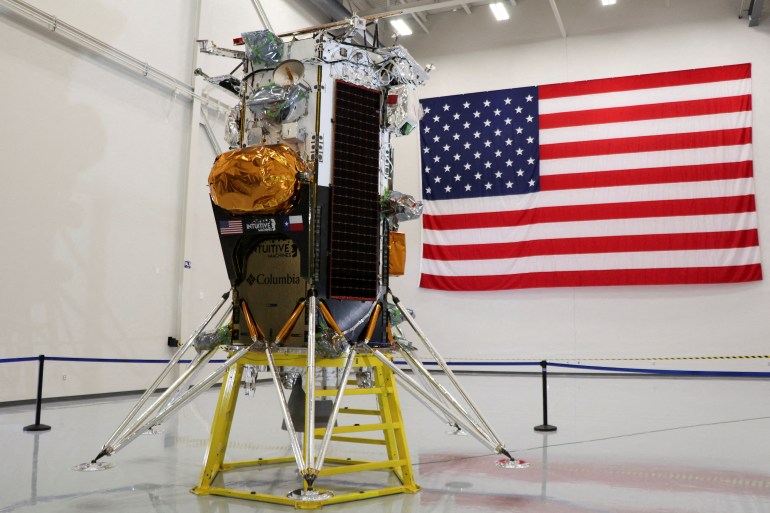
The Odysseus lunar lander has made the first United States landing on the moon in more than 50 years, in what has been described as similar to a “cargo mission”. The moment marks the first successful landing of a commercial spacecraft on the moon, following an unsuccessful US lunar lander mission last month. Here is what we know about the moon landing and Odysseus: What’s the Odysseus moon lander? Odysseus is the first craft launched from the US to land on the moon’s surface since the Apollo 17 in 1972. Odysseus, also known as “Odie”, is a type of lunar lander designed by Intuitive Machines, a commercial lunar missions group which has the goal of delivering small “payloads” to the surface of the moon. For this mission, during which the environment at one of the moon’s poles will be investigated, NASA paid Intuitive Machines $118m under a programme known as Commercial Lunar Payload Services (CLPS). According to EVONA, a space industry recruiter, “a payload is the part of a spacecraft that is responsible for achieving the mission’s primary objectives … [they] can be scientific instruments, communication equipment, or any other specialised equipment that is needed for the mission”. This model of lunar lander is called a Nova-C. Intuitive Machines reportedly described it as roughly the size of a British telephone booth with legs attached. According to NASA, it’s a hexagonal cylinder with dimensions of 4.0 metres tall and 1.57 metres wide. The lander is equipped with five NASA payloads and one commercial one – a total of 100kg. NASA’s cargo comprises exploration and other equipment. “The NASA payloads will focus on demonstrating communication, navigation and precision landing technologies, and gathering scientific data about rocket plume and lunar surface interactions, as well as space weather and lunar surface interactions affecting radio astronomy,” the space agency said in a statement. The Nova-C lunar lander designed by aerospace company Intuitive Machines is displayed at the company’s headquarters in Houston [File: Evan Garcia/Reuters] According to Joel Kearns, the deputy associate administrator for exploration in NASA’s Science Mission Directorate, this is similar to a cargo mission. “NASA pays a company to take our equipment, our science, to the moon all the way down to the surface and get our data back,” Kearns told Al Jazeera. “But this is the company’s mission, they go off and make their lander, they buy a rocket, they design their mission, they get all their communications set up, we are just a paying cargo customer, just as if we were shipping a parcel to somebody’s house,” he added. Art and technology are also on board. Among the items is a box from American artist Jeff Koons which contains 125 small stainless steel balls to represent the moon’s different phases through a month. The artwork is associated with individuals who have made important accomplishments in history. “In this way, Koons honours some of the greatest achievements of the past to inspire future generations,” Intuitive Machines said. We’ve landed! Congratulations to Intuitive Machines & SpaceX for their astounding achievement of realizing this historic private mission to the Moon! I’m so honored to have my Moon Phases artworks be part of the Odysseus mission! @Int_Machines @SpaceX @NASA #jeffkoons #moonphase pic.twitter.com/yQq80zgdck — Jeff Koons (@JeffKoons) February 23, 2024 At what time was the moon landing? Odysseus landed at 6:23pm EST (23:23GMT) on Thursday. It was launched by SpaceX from NASA’s Kennedy Space Center in Florida, on February 15, using a Falcon 9 rocket launcher. Falcon 9 propelled the lander into Earth’s orbit, reaching speeds of more than 40,000km per hour. Once the rocket depleted its fuel 48 minutes about 223km (139 miles) above the Earth, it separated from Odie, leaving the lunar lander to navigate independently through space. The lander used an on board stellar map to establish its orientation in space, aligning its solar panels with the sun’s rays to recharge its batteries. If its mission doesn’t face any setbacks, the hexagonal solar-powered lander will spend seven days operating on the moon, working until the sun sets each lunar day. When the lunar night sets in, the lander will enter sleep mode. Your order was delivered… to the Moon! 📦@Int_Machines‘ uncrewed lunar lander landed at 6:23pm ET (2323 UTC), bringing NASA science to the Moon’s surface. These instruments will prepare us for future human exploration of the Moon under #Artemis. pic.twitter.com/sS0poiWxrU — NASA (@NASA) February 22, 2024 How did the moon landing unfold? After a journey of roughly 400,000km (250,000 miles), the lander began a 73-minute descent down to the surface of the moon on Thursday. Intuitive Machines CEO Stephen Altemus said at the start of the mission that the spacecraft had about an 80 percent chance of success. During the mission, controllers faced a potentially mission-halting technical issue. In the few hours before the landing, the craft’s laser navigation system failed, according to The Associated Press. The Intuitive Machines’ flight control team had to rely on an experimental NASA laser system that was on board instead – the Navigation Doppler Lidar. The lander had to make an extra lap around the moon to allow time for the last-minute switch. “We put the Navigation Doppler Lidar … as a tech demo and as a test, we weren’t planning to use it for the actual mission … but now we are. So, basically, it is the primary system to help provide the velocity and altitude information,” NASA’s Space Tech mission directorate deputy associate administrator Prasun Desai said. “We put the [Navigation Doppler Lidar for Precise Velocity and Range Sensing] as a tech demo and as a test, we weren’t planning to use it… for the actual mission… but now we are. So, basically, it is the primary system to help provide the velocity and altitude information.” —… pic.twitter.com/yLl4YuhBTC — NASA Technology (@NASA_Technology) February 22, 2024 Following the successful landing by Odysseus, however, initially there was no signal from the moon lander. As the minutes passed, there were initial concerns about the lander’s status
Hungary, Sweden sign fighter jet deal before NATO membership vote

Hungary, the last NATO country to approve Sweden’s membership bid, will hold a parliamentary vote on Monday. Hungary has signed a deal to buy four fighter jets from Sweden, as Budapest finally prepares to approve Stockholm’s bid to join NATO after nearly two years of delays. “We not only keep our air defence capability but will increase it,” Hungary’s Prime Minister Viktor Orban said in a news conference alongside Swedish Prime Minister Ulf Kristersson on Friday of the agreement to buy four Saab JAS Gripen fighter jets. This “means our commitment to NATO will strengthen and so will our participation in NATO’s joint operations,” Orban added. Hungary will also expand a related logistics contract. It currently leases Gripen aircraft under a contract signed in 2001. Kristersson welcomed the deal and said that “the conversation has been constructive, and we have agreed to move forward in fields of common interests”. “We do not agree on everything, but we do agree that we should work more actively together when we have common ground,” he added. Swedish Prime Minister Ulf Kristersson in Budapest, Hungary, February 23, 2024 [Bernadett Szabo/Reuters] Hungary, the final country to approve Sweden’s bid to join the transatlantic military alliance, will hold a vote in parliament on Monday after Turkey’s ratification last month. The delay in ratifying Sweden’s NATO application soured Budapest’s relations with the United States and raised concerns among its allies. Sweden sought to join the military alliance in 2022 along with Finland following Russia’s invasion of Ukraine. Finland became the 31st member of the alliance last April, which doubled the length of NATO’s border with Russia. It also strengthened the defences of three small Baltic countries that joined the bloc after the collapse of the Soviet Union more than three decades ago. Earlier Friday, Orban told state radio that “some pending [bilateral] military and arms issues” had to be resolved before the vote. “We are pro-peace, and the Swedes are pro-war in the Russian-Ukrainian conflict,” Orban said. adding the “clear differences in values” could be bridged. Sweden, which has a long coastline on the Baltic Sea, could become a vital logistics hub for NATO in Northern Europe if it manages to join the bloc. Military non-alignment had once been a point of pride for Swedes, with a clear majority against NATO membership, which changed once the Ukraine war started. Sweden has already regularly participated in NATO exercises in the region. Orban, who had maintained close economic ties with Russia, had repeatedly delayed Sweden’s ratification citing grievances over Stockholm’s criticism of the rule of law and the state of democracy in Hungary. The Hungarian leader, who has also refused to send weapons to Ukraine and slammed Western sanctions against Russia, urged for a ceasefire earlier on Friday. He said a truce was the only solution as “Russia cannot be forced on its knees in the military sense … This conflict [in Ukraine] has no solution on the battleground”. Adblock test (Why?)
Hundreds of mourners attend funeral for marathon star Kiptum in Kenya

The 24-year-old set the world record in Chicago in October before his death in a car accident this month. Marathon world record holder Kelvin Kiptum, whose dreams of breaking the race’s two-hour barrier were ended by a fatal car crash this month, has been remembered for his talent and humility at a funeral in western Kenya. The service on Friday in his hometown, the Rift Valley village of Chepkorio, was attended by hundreds of mourners, including political and sporting dignitaries like President William Ruto and World Athletics President Sebastian Coe. The 24-year-old Kiptum had run only three international marathons, but each was among the fastest seven ever recorded. He set the world record in Chicago in October in two hours and 35 seconds, shaving 34 seconds off his compatriot Eliud Kipchoge’s mark. Anglican Bishop Paul Korir, who presided over the service, emphasised Kiptum’s humility and ties to the local community, where he had worked as a livestock herder and trained as an electrician before becoming a professional runner. “He dined with the high and mighty, and at the same time, he came to play pool at Chepkorio,” Korir said. His sudden death has left Kenya and the wider athletics community reeling. “He was a real superstar whose path was on a spectacular upward trajectory,” said Jack Tuwei, president of Athletics Kenya. “All indications were he was going to beat the two-hour barrier.” “Fare thee well champ,” was the front-page headline of Kenya’s leading Daily Nation newspaper on Friday. A woman mourns after viewing Kiptum’s body [Reuters] Mourners, including 1,500-metre record holder Faith Kipyegon, started arriving for the funeral at dawn, some wearing black T-shirts with a picture of Kiptum on the front. They viewed the body, laid out in a half-open coffin on a red carpet as a choir sang religious songs. Four giant screens streamed the service for the many villagers gathered outside the venue. Kiptum will be buried later on Friday in a family plot near the city of Eldoret, where the government is now building a house for his wife and two children. His widow, Asenath Cheruto, said she and Kiptum, who had a traditional marriage in 2017, had planned to hold a “colourful wedding ceremony” in April. “You have been the best husband and father to our children,” she said, breaking down into sobs. Kiptum had hoped to break two hours at a marathon in Rotterdam in April and was also expected to make his Olympic debut in Paris this year in what could have been his first head-to-head match-up with Kipchoge. He and his coach Gervais Hakizimana, a 36-year-old Rwandan, were killed when the runner lost control of the vehicle he was driving. Adblock test (Why?)