

Israel’s unrelenting war on Gaza healthcare requires urgent action

In late December, South Africa filed a landmark case at the International Court of Justice alleging that Israel has committed multiple “genocidal acts” against Palestinians in Gaza, including an “assault on Gaza’s healthcare system, which renders life unsustainable”. Destruction of a healthcare system is indeed an act of genocide – especially in a besieged territory where over two million displaced, desperate, starving people are facing relentless, indiscriminate bombardment and sniper fire. Once the health system is destroyed, injuries cannot be treated, primary care cannot be delivered, and famine cannot be managed – in other words, life cannot be sustained. While the ICJ will likely take some years to issue a final verdict on the case against Israel, it should be clear to anyone paying any attention to the situation of healthcare in Gaza that the Strip is on a scandalous pathway to complete ethnic cleansing. Since October 7, Israeli forces have been blocking the entry of essential medical supplies and medicines to the Strip, bombing hospitals and other medical facilities, killing and kidnapping healthcare staff, and targeting ambulances. Even Gaza’s sole paediatric cancer ward has been attacked and destroyed by the Israeli military. It is difficult to see these sustained, deliberate attacks on healthcare in Gaza as anything other than an ethnic cleansing strategy aimed at creating a major health crisis that would kill thousands of Palestinians and deem the territory uninhabitable for the survivors. Since the beginning of its latest war on Gaza, Israel conducted more than 400 attacks on healthcare facilities in the Strip, including on every single one of its hospitals, leaving the majority non-functional. As of February 13, only 11 out of 36 hospitals in Gaza are partially functioning – five in the north and six in the south. According to the WHO, hospital bed capacity across all of Gaza has now been reduced from 3,500 to just 1,400. In many cases, the Israeli authorities tried to justify these attacks by claiming, without providing any independent, conclusive evidence, that hospitals are being used by Hamas, or that there are “Hamas command centres” under them. At this point in the conflict, the few partially functioning hospitals are only able to deliver desperately needed trauma care and there is no treatment for other critical primary care needs, such as chronic illnesses. In addition to attacks on health facilities, we know of 374 health workers that have already been killed, some in targeted assassinations. By late December, the number of health workers killed in Gaza had already exceeded the total number of all health worker deaths recorded across all other conflicts globally last year, and in any single year since 2016. Many health workers have also been kidnapped, including Dr Muhammad Abu Salmiya, the director of Gaza’s largest hospital, al-Shifa, who remains missing. Ambulances have also faced attacks in Gaza, with about 120 of them completely destroyed. There have been many incidents in which ambulances have been prevented from reaching critically injured patients. In one case, an Al Jazeera journalist injured from Israeli bombardment bled to death after the ambulance trying to reach him came under fire. In another, Israeli forces bombed the Palestine Red Crescent ambulance trying to rescue a six-year-old child trapped in a car with the dead bodies of her family members, killing the two paramedics onboard. Later, it was revealed that Israeli forces also killed the child they tried to rescue. Antenatal and maternity care across the territory – care that is crucial for the long-term survival of the Palestinian population in Gaza – is also extremely limited. It is estimated that 183 women give birth in Gaza every day, but access to care for a safe pregnancy is dependent on reaching a facility still able to deliver antenatal care. Few women are able to do so and those facilities that still offer care for pregnant women are hugely overcrowded and subject to conditions described as catastrophic – lacking basic hygiene necessities, fuel, water, anaesthetics, drugs, blood products, and other supplies. With no fully functioning maternal hospitals, many women are forced to give birth in one of the few healthcare facilities that are still partly operational. However these are not geared for maternal care, and the risk of complications is very high for all mothers and babies. In November 2023, al-Hilo Hospital, which was serving as a designated maternity hospital after the collapse of all other specialist facilities, was shelled by Israeli forces. A Palestinian doctor then reported that “[f]ear is the common condition of every pregnant woman” in Gaza. The looming famine in Gaza – caused by the near complete siege imposed on the territory by Israel since the beginning of the war – is also posing a threat to pregnant women. Today, half of all pregnant women in Gaza are suffering from anaemia and at least 50,000 pregnant women are facing extreme hunger, affecting not just the current generation of people living in Gaza, but the next. There are reports of an increased number of miscarriages, too. Health workers in Gaza are working under immense stress and hardship, having to carry out amputations, c-sections and other procedures without anaesthesia, electricity, and most basic medical supplies. UN experts have framed the war on the Gaza health system as one that has resulted in the complete obliteration of healthcare infrastructure. Presented with evidence for all this and more, on January 26, the ICJ issued a preliminary ruling in the genocide case against Israel, explaining that it has seen sufficient evidence of dispute for the case to proceed, and ordering Israel to take action to prevent acts of genocide in Gaza and provide humanitarian aid to Palestinians. And yet, despite the ICJ’s provisional order, Israel’s military assault on the health system has continued unabated. In fact, the attacks on remaining healthcare facilities in Gaza intensified significantly in the past few weeks. On January 27, just one day after the ICJ announced its provisional orders, Doctors Without Borders (Medecins Sans Frontieres, or MSF) announced that “amid
Turkey rescuers battle to save workers trapped in landslide-hit gold mine

Disaster highlights country’s poor safety record, as previous calls to shut down Copler mine went unheeded. Turkey is under pressure to shut down a gold mine buried by a massive landslide, as hundreds of rescuers battle to save at least nine trapped workers. The Union of Chambers of Turkish Engineers and Architects said on Wednesday that the government should close the Copler mine in the eastern town of Ilic “immediately”. The union said its past warnings about a looming disaster had gone unheeded. “All those responsible for the disaster should be held accountable before the judiciary,” it said in a statement. “All environmental impact reports should be cancelled and the plant should be closed immediately.” Rescuers were deployed to search through cyanide-saturated soil to save the workers, trapped when 10 million cubic metres of sludge rolled over their open pit on Tuesday. Interior Minister Ali Yerlikaya said on Wednesday that some 1,700 search and rescue personnel, including police and military teams, mine rescuers and volunteers, were deployed to find the mine workers. Of the nine missing, five people were believed to be in a container hut, three in a vehicle and one in a truck, he said at the disaster site. Relatives of missing miners arrive after a landslide hit a gold mine operated by Anagold Mining in the Ilic district of Erzincan province, Turkey, January 14, 2024 [Ugur Yildirim via Getty Images] An investigation has been launched and the authorities said on Wednesday that four people, including the pit’s field manager, had been arrested. The mine is run by private company Anagold, which has been extracting gold in the region since 2010. Eighty percent of Anagold is owned by SSR Mining, which is based in Denver in the United States, and Turkey-based Lidya Madencilik and Calik Holding. The mine produced 56,768 ounces (1,609kg) of gold in the third quarter of last year and is SSR’s second-largest producing gold mine. Cyanide Rescuers have been searching through a cyanide-laced field in the area, located in Turkey’s mountainous Erzincan province, to find the workers. Environmentalists fear that cyanide and sulphuric acid used in the gold extraction process could spread into the Euphrates River, which runs from Turkey to neighbouring Syria and Iraq. The Ministry of Environment, Urbanisation and Climate Change said in a statement that a stream leading to the Euphrates was closed to prevent water pollution. Erzincan Governor Hamza Aydogdu said there was no leakage into the waterway. But the Ilic Nature and Environment Platform, a local pressure group, said the stream had already mixed with the Euphrates. “Don’t seal off [the stream], seal off the mine,” the group said. Poor safety record The mine was closed down in 2020 following a cyanide leak caused by a burst pipe into the river. It reopened two years later after the company was fined and a cleanup operation was completed. A Turkish court then fined the company 16.5 million Turkish lire ($537,000 at the current exchange rate). But local efforts to shut it down failed. Turkey has a poor mine safety record. In 2022, an explosion at the Amasra coal mine on the Black Sea coast killed 41 workers. The country’s worst mining disaster took place in 2014 at a coal mine in Soma, western Turkey, where 301 people were killed. In the wake of those incidents, engineers warned that safety risks were frequently ignored and inspections not adequately carried out. Adblock test (Why?)
Paint and tears: Northwest Syria commemorates 2023 earthquakes

Jindires, northwest Syria – On the night of February 5, people across northwest Syria stayed up all night, till 4:30am, before they could close their eyes and sleep, reassured that the anniversary of last year’s earthquakes had passed without somehow triggering another devastating quake. The caution was not based on a scientific warning but rather a fear that the disaster that killed and injured thousands of people and continues to displace tens of thousands more would somehow recur. From the north of Aleppo province to western and southern Idlib, the effects of the earthquakes are still visible in cracked buildings and camps filled with tents of the people who lost their homes amid war, poverty and declining humanitarian aid. Only the rubble has been cleared from the streets. Jindires, one year on Early in the morning on February 6, people began to gather in a gallery on the outskirts of Jindires, one of the worst-hit areas, among them were many members of the White Helmets, otherwise known as Syria Civil Defence, who had worked tirelessly to rescue people from the earthquakes’ destruction. Syria Civil Defence Director Raed al-Saleh speaks on the first anniversary of the earthquakes [Ali Haj Suleiman/Al Jazeera] They were there to mark the first anniversary of the earthquakes with a public event and exhibition. They spoke to the press about what the earthquakes did to an area whose infrastructure was already decimated by years of war and where a severe shortage of emergency equipment had hampered the emergency response. “There was a lack of machinery, and there were no international teams or immediate aid to help us respond to the disaster,” White Helmets media official Hamid Qatini told Al Jazeera. Even though they deployed all their available equipment, they still did not have enough to cover the widespread destruction, Qatini added. The long delay in getting any aid into northwest Syria caused even more hardship to an already traumatised population. Images of loss As soon as Fatima Hamoudi entered the exhibition, her tears began to flow. The 50-year-old woman lost her son, Muhammad, his wife and his daughter during the earthquakes. His five-year-old son, also named Muhammad, was the only survivor. A painting depicts the suffering of the people of northern Syria due to the earthquakes [Ali Haj Suleiman/Al Jazeera] “I knew that I had lost him as soon as I heard about the earthquake,” said Hamoudi, who had been in Turkey at the time and had talked to her son on the phone the previous evening. As soon as she heard about the quake, she tried in vain to communicate with the family. “He was under the rubble for a whole day,” Hamoudi said, noting that she was unable to say goodbye to him and that it took six months for her to return to Syria, where she lives today, to take care of her grandson. Hamoudi toured the exhibition, looking sadly at the images of the destruction. Next to paintings representing the work of the White Helmets stood the painter, Gulstan Bouzou, who said her paintings express gratitude. “I tried to add hope in my drawings,” she said. She had been in nearby Afrin city when the quakes hit, and over the past months, she has used her art to help those affected and has taught drawing and music to children orphaned in the disaster. Visitors view a map and documents about the disaster during the exhibition [Ali Haj Suleiman/Al Jazeera] “We’re still working on starting other educational projects during the coming months,” Bouzou said. “I want to revive hope and tell survivors that overcoming disaster is possible.” Murals on destroyed walls About an hour’s drive away from Jindires, in Maland, west of Idlib, there are also artistic commemorations of what hit the region a year ago. But here, the colours are splashed onto the damaged walls that remain standing, perhaps as a message of hope. “The earthquake left a huge trauma,” graffiti artist Salam al-Hamed told Al Jazeera. “We haven’t forgotten what happened yet.” Over the past few days, al-Hamed and her fellow painters in the Brush of Hope group visited several of the worst-affected cities and towns in the countryside of Idlib province. They painted murals depicting the disaster and the White Helmets rescuing people trapped under the rubble. A mural shows the White Helmets rescuing a girl from under the rubble after the 2023 quakes in northwestern Syria [Ali Haj Suleiman/Al Jazeera] “Our drawings were related to the suffering and pain of people, especially those who were stuck under the rubble and were praying for life but were buried and dead while waiting for help,” al-Hamed said, referring to more than 4,500 people killed by the earthquakes. “Other murals are about resilience, patience and loss.” Destruction, death and damage are things the people of the northwest, the last area in Syria controlled by opposition forces, are accustomed to after 13 years of war and continuous bombing by government forces and their ally Russia. But the earthquakes were nothing like any other disaster experienced in Syria’s modern history, leaving shock and fear so deep that it remains with them today. [embedded content] Adblock test (Why?)
Iran condemns ‘terrorist’ attack on gas pipelines

The explosions took place on the south-north gas pipeline, reportedly cutting off gas supply to industries and offices. An Iranian government official has blamed “terrorism and sabotage” for twin explosions on gas pipelines overnight. While there are few details about the blasts, one occurred on the mainline gas route running from Iran’s central Chaharmahal and Bakhtiari province north to major gas fields in the Caspian Sea, state media reported on Wednesday. The other explosion was reported in the southern province of Fars. The blasts come amid raised tension as Israel’s war in Gaza threatens to spill over across the region. While Tehran has not specified who it suspects, it has linked other such incidents to Israel over the years. “This terrorist act of sabotage occurred at 1am (21:30 GMT) on Wednesday morning in the network of national gas transmission pipelines in two regions of the country,” oil minister Javad Owji told state TV. Starting in Asaluyeh, a hub for Iran’s offshore South Pars gas field, the first pipeline runs 1,270 kilometres (790 miles) to the Chaharmahal and Bakhtiari province. Authorities denied reports that the incident caused gas cuts to industries and offices. “We hope the pipeline will be repaired and will become operational as soon as possible,” Saeed Aghili, the manager of Iran’s gas network control centre, told Iranian state television. Usual suspect In the past, Arab separatists in southwestern Iran have claimed attacks against oil pipelines. But attacks on such infrastructure are rare elsewhere. However, in recent years, tensions have risen as Iran faces an economy hobbled by international sanctions over its nuclear programme. Tehran has also faced rare mass civil unrest, most recently in 2022, over the death of Mahsa Amini following her non-compliance with hijab rules. But Iran has generally blamed agents of Israel for similar acts of alleged sabotage in the past. Israel has carried out attacks in Iran, but has predominantly targeted its nuclear programme. The war on Gaza has worsened relations between the two countries. Iranian-linked groups, like Yemen’s Houthis and Lebanon’s Hezbollah, have launched attacks on Israel and shipping in the Red Sea in what they say is intended as defence of Palestinians. On Tuesday, the head of the United Nations’ nuclear watchdog warned that Iran is “not entirely transparent” regarding its atomic programme. Adblock test (Why?)
Spanish folk festival participants burn Israeli flag

NewsFeed An Israeli flag was burned by people taking part in this carnival in the north of Spain, where the government has been openly critical of Israel’s war on Gaza. Published On 14 Feb 202414 Feb 2024 Adblock test (Why?)
Ukraine claims critical strike on Russian warship

The attack came as Ukraine’s new military chief toured the front lines. Ukraine reported its forces have critically damaged a large Russian warship off occupied Crimea, landing a new blow on its foe’s Black Sea fleet. Ukraine’s armed forces said on Wednesday that the attack with naval drones had “destroyed” the Tsezar Kunikov landing ship. The strike came as Kyiv’s new military chief toured the front lines, describing the situation as “complex”. The military said via the Telegram messaging app that it had acted in concert with defence ministry intelligence to target the ship, which was in Ukrainian territorial waters near Alupka as it was hit. The Ukrainska Pravda media outlet published videos showing a column of smoke over the sea off the southern coast of Crimea, and helicopters flying over the water. Ukraine has mounted a series of attacks on Russia’s Black Sea Fleet in recent months. Pushing its ships out of the sea’s western waters would help free up a key export route. In February, Ukrainian forces used sea drones to attack and destroy a Russian warship. Cruise missiles struck a large Russian landing warship in December. There was no immediate comment from Russia on the latest attack. Cross-border attacks On land, the pair continues to swap cross-border air strikes. Russia launched several missile attacks on the town of Selydove in the eastern Donetsk region overnight, killing three people, injuring a dozen, and damaging a hospital and several apartments, Ukrainian officials said. Donetsk Governor Vadym Filashkin said on the Telegram messaging app that 100 patients were evacuated after a wing of the town’s hospital was damaged. Several apartments in a five-storey residential building were destroyed, he added, injuring at least four people, including two children. Russian state agency RIA reported that Moscow’s air defence systems destroyed nine Ukraine-launched drones over the Belgorod and Voronezh regions, as well as over the Black Sea. Russia and Ukraine both deny targeting civilians in their attacks on each other’s territories. ‘Complex’ The use of air strikes has grown as the front line has become largely bogged down in recent months. Nevertheless, fierce fighting continues in the country’s east. Visiting the area, newly appointed Ukrainian military chief Oleksandr Syrskyii described the situation as “extremely complex and stressful”. Syrskyii, who was accompanied by Defence Minister Rustem Umerov, said in a social media statement that the Russian occupiers had “a numerical advantage in personnel”. Adblock test (Why?)
Why is France revoking birthright citizenship in Mayotte?

France has announced a controversial plan to amend the constitution to restrict citizenship to people born to immigrants in the overseas territory of Mayotte in a move aimed at curbing immigration to the Indian Ocean islands. The move has been welcomed by the far-right but opposed by socialists who say birthright citizenship rule is “non-negotiable”. Leftist leaders fear the constitutional amendment will open Pandora’s box as the far right will try to emulate it in mainland France. The announcement comes less than three weeks after France’s highest court scrapped large parts of a new immigration law designed to toughen access to welfare benefits for foreigners and curb immigration – a hot potato in the country. Here is more about Mayotte – an archipelago between Madagascar and the African mainland – and why the change has triggered controversy. What has France announced? French Interior Minister Gerald Darmanin on Sunday announced that children of immigrants born in Mayotte, comprising of two islands, would no longer automatically become French citizens. The decision comes after weeks of protests in Mayotte, which has seen the deterioration of living conditions blamed on immigration from impoverished Comoro islands. “It will no longer be possible to become French if you are not the child of a French parent,” Darmanin said. France currently grants citizenship through both parentage and birthplace. The latest proposal would cause further political tensions in France in the wake of the adoption of a new immigration law. But the French interior minister assured that the “radical measure” would be “limited to the Mayotte archipelago”. Where is Mayotte? Mayotte is one of the five overseas departments of France located in the Indian Ocean, off the East African coast comprising of two islands. The others in the surrounding archipelago sought independence, becoming the Comoros Islands. The Muslim-majority overseas territory, which voted to stay part of France in 1974, became a full-fledged French department in 2011. What are French overseas territories? France administers 12 territories outside of Europe, known as French overseas territories. These territories exist under various statuses as part of the French state and are largely remnants of the French colonial empire. The French overseas territories, which are divided into three categories: overseas departments, overseas communities, and special territories, are collectively home to more than 2.6 million people. The territories, collectively known as overseas France, are subject to France’s constitution and the local administration cannot devise their own laws and regulations. Why is France planning to revoke birthplace citizenship in Mayotte? Sunday’s decision by the French interior minister came in a bid to curb immigration in Mayotte, which has seen gang violence amid declining living standards. Darmanin said the reform was the idea of French President Emmanuel Macron. Mayotte residents say the arrival of immigrants has put health, housing and education services under pressure. In the capital Mamoudzou, several hundred protesters greeted Darmanin and his entourage with boos and shouts of “Mayotte is angry” amid the lack of basic amenities including water shortage. Darmanin said the measure would reduce “the attractiveness” of the archipelago for prospective immigrants. According to France’s National Institute of Statistics and Economic Studies (INSEE), the 375sq km (145sq miles) island is home to around 310,000 people, but officials say this figure is seriously underestimated. More than 40 percent of the islanders survive on less than 160 euros ($172) per month, says INSEE. Residence permits issued to foreigners in Mayotte are only valid for the island and cannot be used to travel to mainland France. The scrapping of that system is one of the key demands of the protesters. Darmanin said the authorities would abolish the measure as part of the reform, which some protesters welcomed. What are the reactions to France’s announcement? Boris Vallaud, head of the Socialists in the National Assembly, said they would oppose the revision of the constitution. “Birthright citizenship is not negotiable,” he told a local broadcaster. The decision was also denounced by Manon Aubry of the far-left France Unbowed (LFI) party. President Macron’s administration was “attacking the very concept of nationality, the foundation of the Republic”, she wrote on X. French advocacy group SOS Racisme also denounced what it called “a particularly spectacular calling into question of the principle of equality”. Centrist MP Aurelien Tache told local media that “if this provision is enacted and if Marine Le Pen then comes to power, it will be the end of birthright citizenship in France”. But Eric Ciotti, leader of the right-wing Republicans party, welcomed Darmanin’s proposed reform – but complained it did not go far enough. The measure should be applied across the whole of French territory, he said. Sebastien Chenu, spokesman for Le Pen’s far-right National Rally took a similar line. Le Pen’s niece, Marion Marechal of the far-right Reconquete party, also welcomed the announcement. Has France had tensions with other overseas territories? Macron has proven unpopular throughout France’s overseas territories. In the last presidential election, majorities of voters throughout the overseas territories voted for far-right candidate Marina Le Pen over Macron. Le Pen won 41 percent of the vote. This distrust in the system stems from the discriminatory treatment of the territories as compared to mainland France. After Macron was elected in 2017, a social movement sprung up in French Guiana in protest of inadequate public service in the region. The president responded saying he is no Santa Claus. During his election campaign, he also incorrectly called French Guiana an island. Later, Macron’s government shut down France O, a television channel featuring programming from overseas departments. French departments Martinique and neighbouring Guadeloupe also saw street demonstrations and unrest following mandatory vaccination rules for health workers. Adblock test (Why?)
Exploited, abused, trapped: The lives of Italy’s South Asian rose sellers
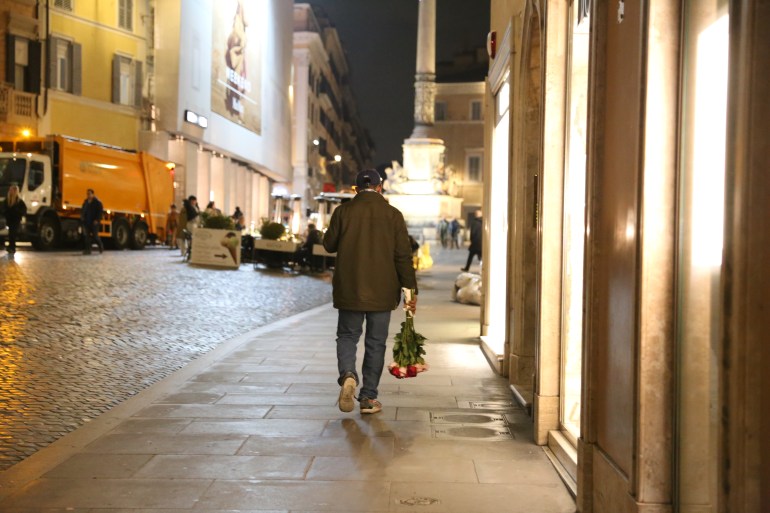
Names marked with an asterisk have been changed to protect identities. After a night of selling roses in Tuscany, Mohammed* was cycling along a seaside road when someone in a passing car hit him on the back with a pole. He fell to the ground. It was August 2013 and Mohammed was 22. He believes it was intentional and likely a racist attack. “I was already broken,” he said. “But after that, I was in pieces.” He suffered emotionally and still has back pain from the assault today. He had arrived in Italy a few months earlier following a harrowing seven-month journey via land and sea. He had no documents or money and owed 9,000 euros ($9,700) to the Bangladeshi agents who had arranged his trip. Mohammed says he was guided by multiple people along the way. When he arrived in Tuscany, he was approached by men from his country who, he says, put him to work selling roses in busy city centres so he could pay for room and board at a house with nine other foreign workers. “I didn’t like bothering people while they were eating to ask them if they wanted to buy a rose from me,” said Mohammed. “But I had no choice.” Street rose sellers in Italy work long hours and are often trapped in a vicious cycle of debt and despair [Agostino Petroni/Al Jazeera] Rose sellers are a common sight in Italy’s largest and most romantic cities, such as Rome, Milan or Turin. South Asian men wield bunches of red roses and approach hordes of tourists every night. During high season, you may see about 20 rose sellers a night spread across the city centre – and dozens more on Valentine’s Day weekend. But hidden behind the universal symbol of love is a bleak story of hardship, labour exploitation and human trafficking. On a given night, rose sellers of all ages can walk miles on end, weathering rejection, police scrutiny and even violence to sell a few flowers. “They are a pain in the ass,” said a Welsh tourist on a February night, at the top of the Spanish steps in Rome. Despite their familiar presence and the dangers they encounter, there are almost no official records or data about these street vendors. In recent years, several attacks on rose sellers in various parts of the country have been reported in local news outlets; they are often carried out by young Italian men. In November, a 50-year-old Bangladeshi rose seller described as a “well-known face” in Ivrea, Turin, was brutally beaten by a group of three men. Another Bangladeshi seller was randomly pushed into the Naviglio canal in Milan by two men in 2020. A year earlier, two young men in Nettuno reportedly beat and robbed a seller whose origin was unknown. It is unclear what consequences – if any – the perpetrators ultimately faced in each case. “They are visible to everybody but there is no data. There is nothing,” said Marina Mazzini, who conducted one of the only case studies on rose vendors in Italy for the United Nations Interregional Crime and Justice Research Institute (UNICRI). For this article, as well as Mohammed, Al Jazeera interviewed two other rose sellers, three former vendors and four NGOs who have supported dozens of rose vendors with their documentation. Fear, uncertainty and thankless work South Asians who end up selling roses in Italy are predominantly from Bangladesh. Nearly all have crippling debts and rely on members of their communities to help them start life in a new country. Mohammed says he was hosted in Tuscany by a man of Bangladeshi origin and another from Pakistan. On the first day Mohammed was to sell roses, his hosts gave him 30 euros ($32) and told him to go to a local flower vendor to buy them. The hosts were always in contact with the flower shops to track how many roses each seller bought, Mohammed said. He says he spent at least 12 hours a night traversing the city’s restaurants, bars, monuments and other tourist hot spots until all the flowers were sold before returning to his hosts’ home, where he would sleep with five others in the same room. A rose vendor makes a sale in Fontana di Trevi, one of Rome’s busiest tourist destinations [Agostino Petroni/Al Jazeera] There is no going rate for a red rose. Vendors may ask for a few euros and accept between two and five ($2.16 to $5.40) depending on each sale. If he made 120 euros ($129) from selling 200 roses on a good night, he would have to give 60 euros ($65) to the flower seller and 50 euros ($54) back to his hosts for room, board and the promise of a good lawyer to get his paperwork in order, Mohammed said. The 10 euros ($11) left were usually spent on cigarettes and a coffee. Soon, he had trouble sleeping, and started suffering from panic attacks and nightmares about his journey – part of which he says was spent on a ship with 200 other people making their way from Egypt to Sicily. If local police poked around when he was working, Mohammed was transferred to a different area. In between selling flowers, he worked at a Bangladeshi grocery store in Genova, where he says his work was never compensated, sold artichokes at a Milan market and sold roses again in southern Italy, while toiling intermittently as a gardener, dishwasher and chef’s assistant. After about seven years, Mohammed was granted asylum in 2018 as a victim of human trafficking with the help of a local NGO, Comunità Progetto Sud. Mohammed believes his countrymen let him down. “A Moroccan helped me to learn Italian and Italians helped me get documents,” Mohammed said. “I have only been exploited by my own people.” “To the young people who are now coming to Italy, I tell them not to trust their own people,” he added. Recognising exploitation Uddin Md Mofiz, 55, who
Russia-Ukraine war: List of key events, day 722

As the war enters its 722nd day, these are the main developments. Here is the situation on Wednesday, February 14, 2024. Fighting At least 10 people were killed in Russian drone and shelling attacks across eastern, central and northern parts of Ukraine, including three who were at a market in the northeastern region of Kharkiv. A missile and drone attack on the central Ukrainian city of Dnipro damaged a power plant, forcing authorities to close schools and evacuate a hospital. Ukraine’s Air Force said it shot down 16 of 23 drones. The UN’s educational, scientific and cultural organisation UNESCO said Russia’s invasion of Ukraine has caused damage estimated at about $3.5bn to the country’s heritage and cultural sites, with some 5,000 destroyed. Politics and diplomacy Mike Johnson, the Republican Speaker of the United States House of Representatives, blocked war aid for Ukraine, ignoring President Joe Biden’s plea that passing the bill was vital to stand up to “Russian dictator” Vladimir Putin. Johnson, who is close to presidential candidate Donald Trump, told reporters he had no intention even of allowing a vote on the bill, which had been passed in the Senate. Russia added Estonian Prime Minister Kaja Kallas and two of the country’s top officials to its wanted list over the “destruction” of Soviet-era war memorials and alleged hostility towards Russia, hours after intelligence services in the Baltic state warned that Russia was gearing up for a war against NATO in the coming decade. Kallas is one of Ukraine’s most vocal supporters. US Secretary of State Antony Blinken said he had spoken this week of Paul Whelan, a former Marine jailed in Russia on espionage charges, as he promised sustained efforts to free Whelan as well as journalist Evan Gershkovich who has been detained pending trial on spying charges. The men and the US government have rejected the spying claims. The US classified Whelan and Gershkovich as “wrongfully detained”. A Russian military appeal court overturned a fine to jail left-wing academic Boris Kagarlitsky for five years after he criticised Moscow’s war in Ukraine, his lawyer said. Weapons Global defence spending jumped by 9 percent to a record $2.2 trillion last year, the London-based think tank the International Institute for Strategic Studies (IISS) said in its annual report The Military Balance, and was likely to rise further in 2024. The report said Russia had lost some 3,000 main battle tanks during the fighting in Ukraine, or roughly as many as it had in its active inventory before it began its full-scale invasion two years ago. It is now refitting older tanks for use, it added. Adblock test (Why?)
Is Israel in breach of the ICJ’s order?

The UN’s top court ordered Israel to prevent destruction in Gaza. Israel’s war has laid waste to the Gaza Strip. Eighty-five percent of the population has been displaced. Much of the vital infrastructure is so badly damaged that experts say it will take decades to rebuild. An order by the International Court of Justice (ICJ) states Israel must take action to prevent acts of genocide and must ensure the delivery of aid to civilians in Gaza. But the military has largely ignored the ruling and, if anything, has intensified its bombing campaign. What can be done to force Israel to comply? Presenter: Hashem Ahelbarra Guests: Ahmed Abofoul – legal researcher and advocacy officer at Al-Haq, an independent Palestinian rights organisation based in Ramallah Kate Mackintosh – executive director of the University of California, Los Angeles Law Promise Institute Europe Mohammed Abu-Nimer – professor at the School of International Service in International Peace and Conflict Resolution at American University in Washington, DC Adblock test (Why?)