

El Salvador votes with Nayib Bukele poised for second presidential term

The country is voting in both presidential and legislative polls; incumbent Bukele faces virtually no competition. Voters in El Salvador are casting their ballots in presidential and legislative elections that are largely about the tradeoff between security and democracy. With soaring approval ratings and virtually no competition, President Nayib Bukele is almost certainly headed for a second term. For the first time since civil war ended in 1992, the Central American country will vote under a state of emergency imposed for Bukele’s gang crackdown that slashed homicide rates but drew criticism for human rights violations. Bukele, who polls as Latin America’s most popular leader, is also expected to expand his hold over the Legislative Assembly of El Salvador in Sunday’s elections. An estimated 69.9 percent of voters approve of his re-election bid, despite questions about its constitutionality: Before Bukele, presidents in El Salvador had historically been limited to one term. With little need to campaign for himself, Bukele focused on promoting his Nuevas Ideas party, which holds 56 seats in the 84-member assembly. The overall number of seats has been reduced to 60 under a reform he led, which critics say will make it much harder for smaller parties to get enough votes to get in. In 2022, the legislature also approved a law allowing Salvadorans to vote abroad. Under that reform, all foreign ballots – which tend to favour Bukele – will count towards the department of San Salvador, which has the most undecided seats, according to the Washington Office on Latin America, an NGO promoting human rights. Alternating in power for some three decades, the conservative Nationalist Republican Alliance (ARENA) and leftist Farabundo Marti National Liberation Front (FMLN) were discredited for corruption and inefficacy. Their presidential candidates have been polling in the low single digits. ‘Unwaveringly loyal’ Bukele, who often spars with foreign leaders and foes on social media, came to power in 2019, trouncing El Salvador’s traditional parties with a vow to eliminate gang violence and rejuvenate the stagnant economy. He has campaigned on the success of his draconian security strategy that saw authorities suspend civil liberties to arrest thousands of suspected gang members without charge. The detentions led to a collapse in nationwide murder rates and transformed the poor Central American nation that was once among the world’s most dangerous. “I would vote for Bukele because of the work he has done so far,” Juan Carlos Rosales, 44, a systems engineer in the capital San Salvador told the Reuters news agency. “The improvement in security is palpable.” Still, despite Bukele’s solid base, some analysts question how long voters will back his strongman approach, particularly as more people feel its sting. Under his rule, El Salvador has one of the highest incarceration rates in the world, with an estimated two percent of its adult population behind bars. Bukele has credited his “mano dura” or “iron fist” tactics for causing that number to tumble to just 7.8 homicides out of every 100,000 people — the lowest in Central America. Rights groups have warned El Salvador’s democracy is under attack. Bukele has largely dismissed those concerns, at one point changing his profile on X, to say: “World’s coolest dictator”. His biggest challenge is the state of the economy, Central America’s slowest growing during his time in power. More than a quarter of Salvadorans live in poverty. The International Monetary Fund, which is negotiating a $1.3bn bailout with El Salvador, in late 2023 described the country’s fiscal situation as “fragile”. In a post on X this week, Bukele pledged to bring about changes. “There is still a huge amount to do,” he said, “but, step by step, we will resolve entire decades of looting and neglect.” Adblock test (Why?)
World Aquatics Championships in Qatar

The World Aquatics Championships in Doha features the highest number of athletes and countries in the event’s history, swimming’s governing body World Aquatics said. The event, which started on Friday, hosts more than 2,600 athletes from 201 countries competing across 75 medal events in six aquatic sports, with qualification spots for the 2024 Olympic Games in Paris up for grabs. “We are humbled that more athletes and more countries than ever before have opted to compete in these championships,” said Khaleel Al Jabir, the event’s director general. The championships continue until February 18 in different venues around the Qatari capital. Adblock test (Why?)
EU: Postponed Senegal election opens ‘period of uncertainty’

The postponement of Senegal’s presidential election opens a “period of uncertainty”, the European Union has said, and the United States called for a swift new date for free polls ahead of opposition protests expected in the capital, Dakar. “The European Union … calls on all actors to work … for the staging of a transparent, inclusive and credible election as soon as possible,” EU spokesperson Nabila Massrali said in a statement on Sunday. On Saturday, Senegal’s President Macky Sall indefinitely postponed the election scheduled for February 25. In a televised address to the nation, Sall announced he had cancelled the relevant electoral law, citing a dispute over the candidate list. He said he signed a decree abolishing a November 2023 measure that had set the original election date, but did not give a new date. Last month, Senegal’s Constitutional Council excluded some prominent opposition members from the list of candidates. France, the former colonial power in the country, called for a vote “as soon as possible”, saying that Senegal should end “uncertainty”. “We call on authorities to end the uncertainty about the electoral calendar so the vote can be held as soon as possible, under the rules of Senegalese democracy,” the French foreign ministry said in a statement. Opposition presidential candidates said they would launch their campaigns in defiance of the postponement. Senegal has traditionally been seen as a rare example of democratic stability in West Africa, which has been hit by a series of coups in recent years including in Mali, Niger and Burkina Faso. Police fire tear gas at protest Meanwhile, Senegal police fired teargas at hundreds of opposition supporters in the capital Dakar on Sunday, the first such clashes after Sall announced the election’s postponement, an AFP journalist saw. Gendarmes fired tear gas to disperse men and women of all ages, waving Senegalese flags or wearing the jersey of the national football team, who had converged in the early afternoon at a roundabout on one of the capital’s main roads at the call of a number of opposition candidates. The police then pursued the fleeing protesters into surrounding neighbourhoods, with some members of the crowd throwing rocks back at the police. Al Jazeera’s Nicolas Haque reporting on the outskirts of Dakar says all 19 candidates of the opposition in the cancelled election have asked their supporters to gather in the area. “There’s a sense that the security forces does not want any gathering of sorts. But for the members of the opposition, until the decree is published on government papers, then the decree is not in place. The decree I’m alluding to, is the decree by Sall that the elections are cancelled; they are angry at this decision,” Haque said. “Some of the opposition figures that I spoke to said it’s a ploy for him to cling onto power, others describe it as a constitutional coup. A motorcyclist on the road shouted: ‘We’re going to burn everything down’. From every protester that we spoke to, they feel angry at that decision; they feel robbed from their ability to express themselves in this election cancelled by Sall.” Around 200 protesters blocked traffic on a main thoroughfare in Dakar with a makeshift barricade of burning tyres, Reuters reported. The crowds retreated into side streets after riot police fired tear gas and started making arrests. The police did not immediately reply to a request for comment. Further protests are planned outside parliament on Monday. Senegalese riot police lobs tear gas at supporters of opposition presidential candidate Daouda Ndiaye, in Dakar, Senegal [Stefan Kleinowitz/AP Photo] ‘Inclusive and credible elections’ The US Department of State noted Senegal’s “strong tradition of democracy and peaceful transitions of power” and urged “all participants in [the] electoral process to engage peacefully to swiftly set a new date and the conditions for a timely, free and fair election”. Senegalese politicians must “prioritise dialogue and collaboration for transparent, inclusive and credible elections”, the Economic Community of West African States (ECOWAS) bloc said in a statement that called on authorities to “expedite the various processes to set a new date for the elections”. Opponents suspect that the president’s camp fear the defeat of his anointed successor, Prime Minister Amadou Ba. Senegal cannot “indulge in a fresh crisis” after deadly political violence in March 2021 and June 2023, Sall said on Saturday as he announced a “national dialogue” to organise “a free, transparent and inclusive election”. The country’s electoral code states that at least 80 days must pass between the announcement of a new presidential vote and polling day – theoretically putting the soonest possible new date in late April at the earliest. Sall’s presidential term is supposed to end on April 2. Analysts say the crisis is putting one of Africa’s most stable democracies to the test at a time when the region is struggling with the recent surge in coups. Senegal has been embroiled in political tensions as a result of deadly clashes involving opposition supporters and the disqualification of two opposition leaders ahead of the crucial vote. Adblock test (Why?)
Afraa, ‘miracle baby’ of Syria’s earthquake, is turning one

Jandaris, Syria – It was a party, a celebration of life for so many children and young people who survived one of the worst natural disasters in decades. The big white tent was decked out in balloons and streamers, with colourful games marked out on the floor and all manner of hula hoops changing hands. Among the people being celebrated at the World Vision party was little Afraa, the baby who was born as her mother died under the debris of the massive earthquakes that struck northwestern Syria and southern Turkey on February 6 last year, killing 4,500 people in Syria and some 50,000 in Turkey. She turns one on Tuesday. “Since I was a child, people would say ‘Hope is born from suffering,’” Khalil Shami al-Suwadi, Afraa’s uncle by marriage, said. “On the day of the earthquake, seeing Afraa born beneath the rubble of her home made me realise how true that was,” he added. Afraa looks up at her cooing uncle, Khalil, in the family’s tent in March 2023 [Ali Haj Suleiman/Al Jazeera] An entire family wiped out Jandaris, in the countryside of Aleppo, was one of the areas most affected by the earthquake, with more than 510 people killed and at least 810 injured, according to the Syria Civil Defence, also known as the White Helmets. The day of Afraa’s birth was when her parents and four brothers were killed when their house in Jandaris collapsed in the earthquake. After being rescued from the rubble and taken to hospital for treatment, she was named Aya by the medical staff. Later, her aunt, Hala, who was the sister of Afraa’s 26-year-old father Abdullah, and uncle, Khalil, changed her name to Afraa to honour her late mother. She lives with her aunt and uncle and her six new siblings. Eleven-year-old Mal al-Sham is the eldest, and the youngest is Ataa, another little girl who was born two days after Afraa and is also turning one soon. Baby Afraa, in the pink cap, on Khalil’s lap, with her cousin Ataa. Around them are her cousin Shami, left, and her cousins Mariam, second from right, and Doaa, right [Ali Haj Suleiman/Al Jazeera] In March last year, Hala told Al Jazeera over the phone, “I would have never given up Afraa. She’s my niece, my blood. Many people wanted to adopt her, but we would not have it. We will take care of her just like our own children.” She is still nursed by her aunt, alongside her cousin Ataa, and has recovered from the rib fractures and bruising she suffered under the rubble last year. Not only that, she has also taken her first steps and is babbling away. “When she took her first step, I was immensely happy. But I remembered her parents and how they would have been over the moon if they were with us,” said al-Suwadi. ‘Baba’ and ‘Mama’ “My heart has eight compartments for my wife and my seven children [including Afraa],” said al-Suwadi. “She is a trust left to us by her parents, may they rest in peace.” There is an exceptionally strong bond between Afraa and her cousin Doaa, seen here carrying her [Ali Haj Suleiman/Al Jazeera] Afraa has started saying a few words and has called out “Mama” and “Baba” her aunt, Hala, and uncle, Khalil. “It wasn’t the first time I’ve heard the word ‘Baba’, but for some reason, when Afraa said it, I felt a strange, indescribable sensation,” al-Suwadi added. Because she spends all day with her big cousins, Afraa is also constantly trying to talk to them, making demands and telling stories that nobody is sure they understand completely. The children play, argue, and sleep together, and there is an especially strong bond between her and her eight-year-old cousin, Doaa. “I love all my siblings, but Afraa is my favourite,” Doaa confided. “I love playing with her and being close to her,” she said, adding that it goes both ways, with Afraa preferring to be with Doaa at all times, including playtime and bedtime. Doaa holds Afraa in her arms outside the family tent in March 2023 [Ali Haj Suleiman/Al Jazeera] “When she cries, my mom will hold her. But it doesn’t work, she keeps crying. But when I pick her up, she stops crying immediately,” Doaa said. The al-Suwadis are hopeful and looking forward to the future with their seven children, but sometimes that sunny outlook is clouded over by the occasional aftershocks that remind him of what happened a year ago. “What happened to us in Jandaris was a disaster in every sense of the word, and I pray that it never happens again,” he added. But for an afternoon, in that lively, decorated tent, children and their carers were able to get together and talk about their experiences, celebrate being there together, and marvel at how much the nearly-one-year-old Afraa had grown. Malik Abdulghani, a World Vision education programme officer, told Al Jazeera: “Having Afraa with us for this event, which is near her birthday and the anniversary of the earthquake, symbolises that in the heart of every hardship, there is hope.” [embedded content] Adblock test (Why?)
How have Red Sea attacks by Yemen’s Houthi fighters affected companies?
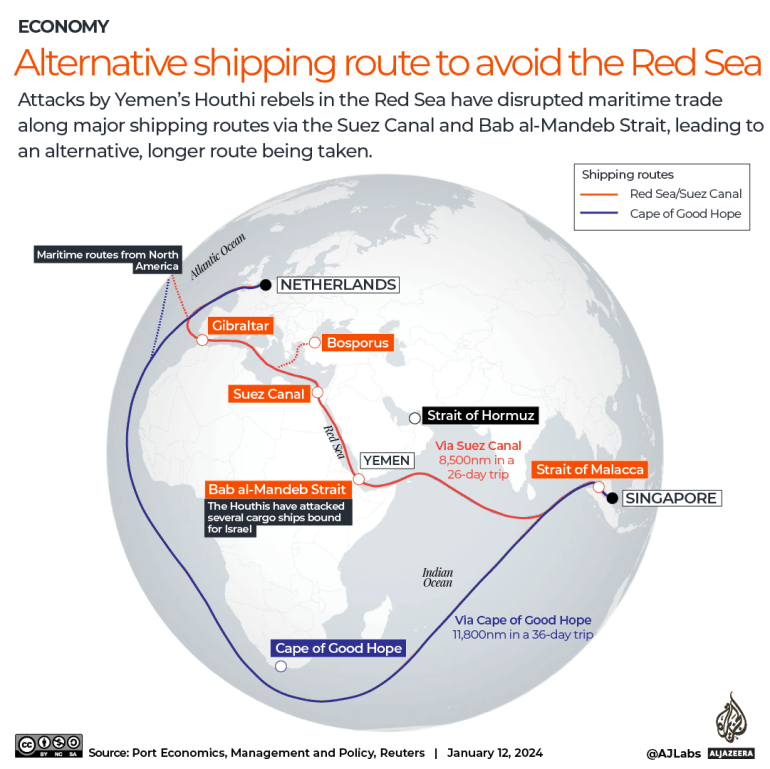
The strikes have forced ships to change route, causing major disruptions in companies’ chains of production. Attacks on vessels by Yemen’s Houthi rebels in the Red Sea have disrupted international trade on the shortest shipping route between Europe and Asia. The strikes, which came in solidarity with Palestinians facing Israeli bombardments in Gaza, are targeting a route that accounts for about 15 percent of the world’s shipping traffic, forcing several shipping companies to reroute their vessels. The Houthi assaults have pushed several commercial vessels passing through the Suez Canal and the Bab al-Mandeb Strait to take an alternative and much longer route around South Africa’s Cape of Good Hope, causing major changes and delays. Here’s a look at the impact the Houthi raids had on major companies: Autos Geely: China’s second-largest automaker by sales said on December 22 that its electric vehicle (EV) sales would likely be impacted by a delay in deliveries. Michelin: Four factories in Spain owned by the French tyre maker halted output on January 20-21 due to raw materials delivery delays. Suzuki: The company’s Hungary production plant restarted manufacturing on January 22 as planned following a halt the previous week due to delays in the arrival of Japanese-made engines. It said shipping routes were changed to pass around Africa, which could affect pricing. Tesla: The US-based electric vehicle maker will suspend most car production at its factory near Berlin from January 29 to February 11 due to a lack of components caused by shifts in transport routes. Volvo: The Swedish automaker said on January 12 that it would halt production at its Belgian plant for three days due to delays. Energy BP: The oil major on December 18 said it had temporarily paused all transits through the Red Sea. Equinor: The company said on December 18 that it had rerouted vessels that had been heading towards the Red Sea. Edison: The energy group’s CEO said on January 25 that it was starting to experience a slowdown in liquefied natural gas (LNG) supplies from Qatar. Qatar Energy: The world’s second-largest exporter of LNG has stopped sending tankers via the Red Sea although production continues, a senior source with direct knowledge of the matter told the Reuters news agency on January 15. Shell: The British oil major suspended all shipments through the Red Sea indefinitely, the Wall Street Journal reported on January 16. Valero Energy: The US refiner said on January 25 that the Red Sea attacks have led to a rise in freight rates for crude oil. Logistics DHL: The German logistics company, which does not operate ships but uses them to transport containers, on January 8 advised customers to take a close look at how they manage inventories. FedEx: The US parcel delivery giant said on January 14 that it hadn’t seen much of a shift to air freight due to disruptions in the Red Sea. Retailers Adidas: CEO Bjorn Gulden said on February 1 that shipping disruptions in the Red Sea were negative for gross margins, adding that “exploding” freight rates were driving up costs and shipping delays were causing some delivery issues. Danone: The French food group said in December that most of its shipments had been diverted, increasing transit times. Should the situation last beyond 2-3 months, Danone will activate mitigation plans, including using alternate routes, its spokesperson said. Ikea: The furniture retailer is sticking to planned price cuts despite increased costs, and has sufficient stocks to absorb any supply chain shocks, it said on January 15. Marks & Spencer: The British retailer’s CEO said on January 11 that the company is expecting some slight delay in clothing and home deliveries due to the disruption to shipping. Next: The British clothing retailer’s CEO on January 4 said sales growth would likely be moderated if disruptions continued through 2024. Pepco: The Poundland owner warned on January 18 that its supply could be impacted in the coming months if the disruptions continue. Primark: Associated British Foods’ finance director said on January 23 that Primark is coping with disruptions by adjusting timings and stock flow. Sainsbury’s: “We’re making sure that we plan the sequencing of product from Asia Pacific so that we get products in the right order,” the company’s CEO said, adding that long-term contracts with shippers “mitigate any cost impact as far as possible”. Target: The US retailer is experiencing some disruptions of shipments from India and Pakistan, a source familiar with the matter said on January 12, calling the effect “minor” overall. Tractor Supply: Deliveries for the US retailer have been delayed anywhere from two to 20-plus days, the company’s chief supply chain operator said on January 12. Williams-Sonoma: The Pottery Barn owner is rerouting shipments and has been working on contingency plans, its CEO told CNBC on January 24. Others BHP Group: The Australian mining giant on January 25 said the disruptions were forcing some of its freight service providers to take alternative routes, such as Africa’s Cape of Good Hope. Electrolux: The Swedish home appliance maker has set up a task force to find alternative routes or identify priority deliveries to try to avoid disruptions. On February 2, its CEO said that costs related to the developments in the Red Sea were manageable. “If the situation is prolonged, I am more worried about higher costs than about risk of having to pause production,” he added. Essity: The maker of brands such as Libresse and TENA said it was staying in contact with impacted suppliers to ensure the continued flow of goods. On January 25, its CEO said that it saw a negative impact on its freight costs, but he could not specify what that impact would amount to. Evonik: The speciality chemicals maker said it was being hit by “short notice routing changes and delays”, and was trying to mitigate the impact by ordering earlier and switching to air freight where possible. Gechem GmbH & Co KG: The German chemicals maker said it had lowered production of dishwasher and toilet
Iraq says US bombing killed civilians and intensified regional conflict

NewsFeed The US has warned of more strikes after bombing 85 alleged Iran-linked targets in Iraq and Syria in retaliation for an attack that killed American soldiers in Jordan amid Israel’s war on Gaza. Iraq says civilians are among the dead. Published On 4 Feb 20244 Feb 2024 Adblock test (Why?)
Russia says dozens killed in Ukraine shelling of bakery in Lysychansk

Russia says at least 28 people were killed after Ukrainian forces shelled a bakery in Lysychansk city. Russia says at least 28 people have been killed after Ukrainian forces shelled a bakery in the city of Lysychansk in the occupied eastern region of Luhansk, with the Ministry of Civil Defence, Emergencies and Disaster Relief saying at least one child was among the deceased. Russian Ministry of Foreign Affairs spokesperson Maria Zakharova said on Sunday that “dozens of civilians” were inside the building when Ukraine hit it using the US-supplied High Mobility Artillery Rocket System (HIMARS). The Emergencies Ministry had released a video late on Saturday of first responders finding dead bodies and taking away bloodied people on stretchers out of the ruins of the one-storey building that appeared to be destroyed. The building appeared to have housed a restaurant named Adriatic, which local authorities said was known to offer fresh bread during the weekends, attracting many Russians. Foreign Ministry’s Zakharova also said Moscow expects “quick and unconditional condemnation” from international organisations. Ukraine has not officially commented on the incident. Almost two years into the war, the front in eastern Ukraine where Luhansk is located has barely moved in months, but battles continue to rage, with both sides launching deadly attacks during the winter. Lysychansk had a population of about 110,000 before Moscow’s offensive. The city fell to Russian forces after a deadly battle in 2022. Adblock test (Why?)
We, Jewish students, must not be silent on the genocide in Gaza

On December 5, 2023, I joined fellow Jewish university students outside the United States Congress to protest against a resolution conflating criticism of Israel with anti-Semitism. Our calls to reject the resolution were not heard. Two weeks earlier, a hearing was held where our concerns were yet again ignored; only pro-Israeli witnesses were called to testify. To us, progressive Jews, it appears elected officials who proudly stood by former President Donald Trump after he refused to condemn neo-Nazis and dined with anti-Semites value our voices only when they can tokenise a select few to fulfil their political goals. Conflating anti-Semitism with criticism of a modern apartheid state is dangerous historical revisionism. It ignores the fact that since the conception of Zionism, there has always existed strong and diverse Jewish opposition to it. For decades, progressive Jewish movements have held Zionism to be a dangerous form of nationalism, with some Holocaust survivors openly denouncing Zionist policies. Like countless other Jews, I was brought up to believe in extending solidarity, combating oppression and supremacy, and standing up for the sanctity of human life. The Torah states that all people are made B’tselem Elohim (in the image of God), making each life sacred. The Talmud teaches that saving a single life is to save the whole world, commanding Jews everywhere to fight against the loss of life anywhere. These teachings drive the love I have for my faith and culture … and the heartbreak I feel whenever I see the destruction Zionism has wrought. The Israeli army has killed more than 27,000 Palestinians since October 7, including more than 11,000 children. Of the tens of thousands of bombs dropped on Gaza – one of the most densely populated areas in the world – nearly half were “unguided”. Israel has killed Palestinians indiscriminately in illegal attacks on hospitals, United Nations-run school shelters, ambulances, and civilian evacuation routes. Entire neighbourhoods in areas such as Gaza City, with a higher population density than New York City, have been flattened. The Israeli government claims it is fighting to destroy Hamas. Yet, Israeli authorities have long supported strengthening Hamas, facilitating payments to the group and dismissing intelligence reports on a planned attack on southern Israel. By now, it is more than clear that this is not a fight against Hamas, but rather a genocide in the making. Israel is starving millions of civilians, illegally depriving them of food, water, and medical supplies. It is systematically destroying Gaza’s healthcare system, denying the wounded and the sick even the most basic services in an attempt to make survival impossible for millions of Palestinians. Israeli officials openly call for Palestinian civilians’ fates to be “more painful than death” and appeal for the complete destruction of Gaza. The Israeli army has even killed its own people taken hostage by Hamas in a clear indication that there are no “rules of engagement” for Israeli soldiers when it comes to civilians. Israel has sought to obliterate every aspect of the Palestinian nation, including its knowledge and culture. More than 390 educational institutions have been destroyed in Gaza, along with every single university; thousands of students and teachers have been killed. Had this happened in any other country, our universities would have been instantly up in arms, but they remain completely silent about the destruction of Palestine’s education system and the ongoing genocide. Worse still, many universities across the US continue to invest in industries that bolster Israeli military brutality. University presidents often claim to have the safety and best interest of Jewish students, while suppressing condemnations of Israeli violence. But attacking free speech and doxing students does not fight anti-Semitism on campus because there is nothing anti-Semitic about opposing genocide. What is more, university administrations have consistently made it clear that they do not care much about the safety of students with pro-Palestinian attitudes, even if they are Jewish. Just earlier this month, members of the Students for Justice in Palestine (SJP) and Jewish Voice for Peace (JVP) groups were attacked with what is believed to be an Israeli-made chemical-based weapon while they were peacefully rallying for a ceasefire on campus at Columbia University. At least eight students have since been hospitalised. The university administration chose to blame the victims for what happened, saying their protest was “unsanctioned and violated university policies”. Columbia is one of the many universities fuelling the dangerous, ahistorical conflation of Judaism and Zionism, having banned its chapters of SJP and JVP. These smears and hypocrisy are nothing new. As a student in Washington, DC, I have watched political pundits slander pro-Palestine marches as “breeding grounds” for campus anti-Semitism while claiming the November 14 March for Israel was an event rejecting anti-Semitism. Many of my Palestinian and Arab peers – who have always stood in solidarity with the Jewish community – are continually threatened, harassed, and branded “terrorists” for supporting a humanitarian ceasefire and mourning their loved ones. As a Jewish woman, I have felt nothing but kindness and safety at each Palestinian-led protest I have attended. At the March for Israel, I would not have felt the same, alongside chants of “No Ceasefire!” and featured speakers, like Christian Zionist televangelist John Hagee, who believes “God sent Hitler”. While disagreement will always exist within our community, Zionist nationalism is not the standard, with Jewish Americans now shutting down freeways, occupying offices of elected officials, and chaining themselves to White House gates to demand a ceasefire. In the face of unspeakable violence, Palestinians continue to show resilience and selflessness, and the world owes them solidarity. Proclaiming that the actions of the Israeli government do not represent us is not enough; the grief and rage we feel at the ongoing violence must motivate us to act. In 1965, civil rights activist Rabbi Abraham Joshua Heschel wrote about the Selma-to-Montgomery March he attended: “Even without words, our march was worship. I felt my legs were praying.” Today, almost 60 years later, we must also embrace protest as a form of prayer because
Facebook turns 20: How the social media giant grew to 3 billion users

In 2004, as broadband was replacing dial-up internet and mobile phones with colour screens were gaining popularity, on February 4, a social network, named “TheFacebook”, was launched by 19-year-old Mark Zuckerberg and his college roommates at Harvard University. Facebook was named after the physical student directory distributed at universities at the start of the academic year, commonly known as a “face book”. Within a few years, the platform exploded in popularity, becoming the world’s largest social media network, with more than three billion monthly active users today. Major milestones The idea behind Facebook was an offshoot of one of Zuckerberg’s previous projects called Facemash, a “hot-or-not” website used to rate female Harvard students’ faces side-by-side. To obtain the photos used on the site, Zuckerberg hacked into the university’s security system and copied student ID images without their permission. This prompted the university to shut down the platform within days of its launch and led to disciplinary action against Zuckerberg. Yet, just a few months later, Zuckerberg and his roommates launched a new networking site that enabled Harvard students to connect with their peers using their “.edu” email address. Screenshot of thefacebook.com captured by the Internet Archive on February 12, 2004 The social network was a big hit and soon spread to other college campuses across the United States. Within its first year, the platform grew to one million users, and in August 2005, it was renamed “facebook.com”. By the end of 2006, anyone above the age of 13 with internet access could join. The number of users jumped from 12 million in 2006 to 50 million in 2007, which doubled to 100 million by the end of 2008. Facebook Chief Executive Mark Zuckerberg remotely rings the Nasdaq’s opening bell in Menlo Park, California, on May 18, 2012 [Reuters] In 2012, the year Facebook reached one billion users, it went public, valued at $104bn. Facebook made its initial public offering (IPO) at $38 a share and raised $16bn. The platform’s market share has since grown nearly 12 times, to about $474 at the closing on Friday. On October 29, 2021, Zuckerberg announced the rebranding of Facebook, Inc to Meta Platforms, Inc. The company owns and operates Facebook, Instagram, Threads, and WhatsApp, among other products and services. With three billion active monthly users, Facebook remains the world’s most popular social media platform, accounting for more than half of the world’s internet users and more than one-third of the world’s population. To put 3.03 billion users in perspective, that is more than the population of India (1.4 billion), China (1.4 billion), and Bangladesh (173 million) combined. In 2023, Facebook’s biggest audiences included: India (385.6 million), followed by the US (188.6 million), Indonesia (136.3 million), Brazil (111.7 million) and Mexico (94.8 million). Who uses Facebook the most? According to Datareportal, an online reference library, among Facebook’s global users, individuals aged 65 and above (5.6 percent) outnumber those aged 13-17 (4.8 percent). Debra Aho Williamson, an analyst with Insider Intelligence who has followed Facebook since its early days, notes that the site’s younger users have been dwindling. “Young people often shape the future of communication. I mean, that’s basically how Facebook took off – young people gravitated toward it. And we see that happening with pretty much every social platform that has come on the scene since Facebook,” Williamson told The Associated Press news agency. Facebook’s largest audience group, with just below a third (29.9 percent) of all users, is 25-34 years. Issues with data privacy and user safety Facebook has encountered numerous data privacy and user safety issues over the course of its 20-year existence. One of the most notable issues occurred in 2018 when it was revealed that a British consulting firm Cambridge Analytica used 87 million Facebook users’ personal information without permission in early 2014 to build profiles of individual voters in the US to target them with personalised political advertisements. Zuckerberg attended his first congressional hearings at Capitol Hill, Washington, DC where he was questioned about his data privacy practices. The Meta boss agreed to pay fines and said he would enhance privacy regulations on the platform. The global citizens’ movement Avaaz install life-sized Zuckerberg cutout figures wearing ‘fix fakebook’ T-shirts in a protest action in front of the Capitol Hill in Washington, US, April 10, 2018 [Carolyn Kaster / AP Photo] On January 31, 2024, Zuckerburg, along with CEOs of TikTok, X and other social media platforms, were asked to testify before the US Senate Judiciary Committee. In a rare show of unity, Republican and Democratic senators grilled the CEOs about how social media companies have not done enough to curb the damage their platforms do to the health and wellbeing of children and teenagers. Zuckerberg apologised to the parents of the victims. “I’m sorry for everything you have all been through. No one should go through the things that your families have suffered,” he said, adding that Meta continues to invest and work on “industry-wide efforts” to protect children. Child health advocates say that social media companies have failed repeatedly to protect minors. Zuckerberg looks at X Corp’s CEO Linda Yaccarino and TikTok’s CEO Shou Zi Chew as they raise their hands to be sworn in during the Senate Judiciary Committee hearing on online child sexual exploitation at the US Capitol in Washington, DC [File: Evelyn Hockstein/Reuters] What lies ahead for Meta? Despite government scrutiny, and a dwindling younger audience, Meta on Thursday reported a revenue of $40.1bn and a profit of $14bn for the fourth quarter of last year – far surpassing analysts’ forecasts. Meta, like many other tech giants, has been investing heavily in boosting its computing power to support its ambitious artificial intelligence (AI) plans. According to Reuters, Meta is gearing up to unleash its own AI chips, referred to internally as “Artemis”, later this year to be used in energy-hungry generative AI products it plans to integrate into Facebook, Instagram and WhatsApp. Adblock test (Why?)
Namibia’s President Hage Geingob dies aged 82

The African leader announced last month that he had begun treatment for cancer. Namibian President Hage Geingob has died at the age of 82, his office has said, less than three weeks after it was announced he would undergo treatment for cancer. Geingob died on Sunday at Lady Pohamba Hospital in the capital Windhoek with his wife and his children at his side, acting president Nangolo Mbumba said in a statement posted on Geingob’s official Facebook page. “The Namibian nation has lost a distinguished servant of the people, a liberation struggle icon, the chief architect of our constitution and the pillar of the Namibian house,” Mbumba said. “At this moment of deepest sorrow, I appeal to the nation to remain calm and collected while the Government attends to all necessary state arrangements, preparations and other protocols. Further announcements in this regard will be made.” Geingob’s office announced last month that he had begun treatment following the discovery of “cancerous cells” during a routine colonoscopy and gastroscopy. The announcement did not provide details of the African leader’s diagnosis or prognosis but said he would continue to carry out his presidential duties. Geingob’s office later announced that he would travel to the United States for medical care and would return to Namibia on February 2. Geingob, who also served a 12-year stint as prime minister, had a history of health problems that preceded his election as Namibia’s third president in 2014. In 2013, the anti-apartheid activist-turned-politician underwent brain surgery, and the following year he revealed that he had survived prostate cancer. Last year, Geingob announced he had undergone aortic surgery in neighbouring South Africa. Namibia, a former German colony that gained independence from South Africa in 1990, is scheduled to hold presidential and parliamentary elections in November. Geingob was ineligible to run for reelection as Namibia’s constitution limits the president to a maximum of two terms in office. The ruling SWAPO Party’s presidential candidate, Nandi-Ndaitwah, would be the country’s first female head of state if elected. Adblock test (Why?)