

How escalating Red Sea crisis poses billions of dollars of risk for India
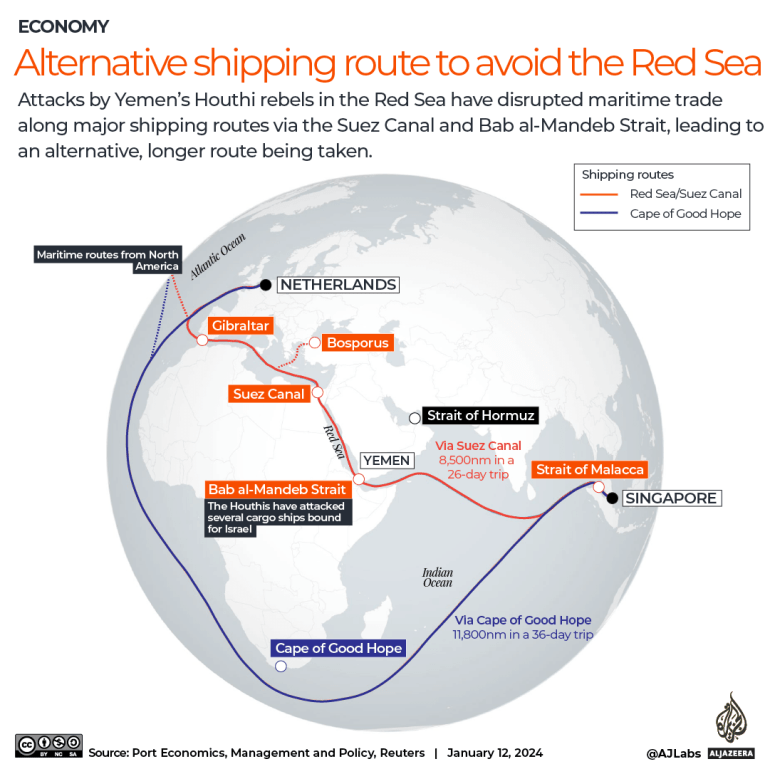
New Delhi, India – Demand for India’s Basmati, the long-grain aromatic rice, from traditional buyers in the Middle East, the US and Europe has dropped as it has become costly. The reason is the escalating tensions in the Red Sea, the shortest and most efficient trade route for ships moving from Asia to Europe. Attacks by Iranian-backed Houthis from Yemen on commercial vessels passing through the Red Sea have forced shippers to avoid one of the world’s most crucial trade routes. The alternative longer route around the Cape of Good Hope on the southern tip of Africa has added more than 3,500 nautical miles (6,500km) to the journey and close to a half-month of sailing time to each trip, significantly increasing shipping costs. Exporting Basmati from India has become a challenge for shippers as freight costs have shot up as high as five times with an increase in insurance premiums, shortage of containers and longer transit time, said, Vijay Kumar Setia, director of Chaman Lal Setia Exports Ltd and former president of the All India Rice Exporters’ of India. Part of the inventory is lying at various ports or processing units, while some stock is now being sold in the domestic market, resulting in a fall in prices by about 8 percent in the local market. India, the world’s biggest rice exporter, ships over 4.5 million tonnes of basmati rice out of the country annually. About 35 percent of about 7.5 million tonnes of production is shipped to Europe, North America, North Africa and the Middle East through the Red Sea. “Buyers are hesitant to take at higher prices,” said Setia. “Some exports are going on, but business isn’t that smooth. We are losing profits because of higher logistic costs.” Like Basmati, chaos in the Red Sea is disrupting shipments of produce from tea to spices and grapes to buffalo meats from India, resulting in losses to exporters. Similarly, imports of fertilisers, sunflower oil, machinery components and electronic goods to India are getting delayed, raising the risk of higher costs to consumers. This has raised concern that the unrest will lead to supply-chain snarls and contraction of trade, and halt a slowdown in food inflation. India is heavily reliant on the Red Sea route through the Suez Canal for its trade with Europe, North America, North Africa and the Middle East. These regions accounted for about 50 percent of India’s exports of 18 trillion rupees ($217bn) and about 30 percent of imports of 17 trillion rupees ($205bn) in the year ended March 2023, according to CRISIL Ratings. Shipments are currently getting delayed by 21-28 days. The crisis could cost the country more than $30bn in exports for the fiscal year ending March, hitting $451bn of exports a year ago by around 6.8 percent, said Sachin Chaturvedi, director-general of the Research and Information System for Developing Countries, a New Delhi-based think tank. Official estimates of the impact on trade in India will be known when the government releases export and import data around mid-February for January. Houthi rebels have been carrying out missile and drone attacks on cargo ships in the Red Sea since November, actions they say are in response to Israel’s war on Gaza. Retaliatory strikes to aid the safe movement of ships by a US-led coalition haven’t stopped the Houthi assaults. Shipping costs rise To avoid risk, the shipping industry has temporarily suspended Suez Canal transit. The average number of tankers and cargo ships transiting through the Suez Canal had fallen about 46 percent over two months till January 28, while the voyages around Cape of Good Hope have risen 32 percent, according to the International Monetary Fund PortWatch data. Meanwhile, shipping prices have increased. According to Drewry’s World Container Index, the average price of transporting a 40-feet (12-metre) container on a cargo ship rose 161 percent to $3,964 on January 25 from $1,521 on December 14. The chaos has brought concern for India. Around half a dozen ships heading toward India or with Indian crews on board have been attacked – allegedly by Houthis or hijacked by armed pirates. In response, India has increased its maritime presence in the Arabian Sea by deploying about a dozen warships. But the fear is so high that about 25 percent of the outbound shipments transiting through the Red Sea have been held back and roughly 95 percent of cargo ships from India have been rerouted through Cape of Good Hope, said Ajay Sahai, director-general of the Federation of Indian Export Organisations, set up by India’s Ministry of Commerce and Industry. Imports more expensive, exports hurt Russia has emerged as one of the largest suppliers of crude oil to India [File: AP Photo] However, there is no disruption in oil flows even as the Red Sea is one of the key routes for oil shipments for India which imports 80 percent of its crude oil needs. Russia emerged as one of the biggest crude suppliers to India in 2023, accounting for more than one-third of its imports. Unlike other sectors, there is no diversion of Russian vessels carrying crude oil bound for India through the Red Sea, as per S&P Global. But the supply of sunflower oil has become tight for India, the world’s biggest importer of the vegetable oil. As most of the vessels from Russia and Ukraine are being rerouted through Cape of Good Hope, freight costs have increased by 35 percent and transit time increased by 15 days, said Sandeep Bajoria, CEO of Sunvin Group, a vegetable oil brokerage. Part of the higher costs has been passed to consumers, he said. Similarly, shipments of fertilisers have been delayed and logistics costs have risen, minister of chemicals and fertilisers, Mansukh Mandaviya, told reporters, adding India will have no shortage of fertilisers critical for the country’s food security as there are adequate reserves. But the crisis is hurting buffalo meat export. India is one of the major buffalo meat suppliers to the international market. About 60 percent of the
Kataib Hezbollah announces halt of attacks on US forces

Iraqi-based group seeking to de-escalate as Washington mulls response to deadly Jordan strike. Iran-backed Kataib Hezbollah has announced the suspension of hostile operations against US troops, as Washington ponders its response to a deadly drone attack that left three of its soldiers dead. The group’s attempt to de-escalate late on Tuesday, which it said was motivated by a desire not to “embarrass” the Iraqi government, was met with some scepticism in the US. The Pentagon alleges that there have been three further attacks since the attack in Jordan on January 28. However, the White House has indicated that it is pondering a “tiered response” to Sunday’s attack. Speaking yesterday in Washington, Biden tied the attacks to Iran. “I do hold them responsible in the sense that they’re supplying the weapons to the people who did it,” he said. However, he specified he did not want “a wider war” in the region. However, Al Jazeera correspondent Patty Culhane, reporting from Washington, said that Republican hawks were calling for strikes inside Iran. “For months, this administration has been saying the biggest concern they have is that this will lead to a wider war, and it seems fairly clear that striking inside of Iran would make it more likely rather than less,” she said. Powerful element Kataib Hezbollah is the most powerful element in a group called the Islamic Resistance in Iraq, which has claimed more than 150 attacks on US forces in Iraq and Syria since 7 October. The US has so far responded to that campaign by conducting air raids and imposing sanctions against Iran-backed groups in Iraq, particularly Kataib Hezbollah. In its statement on Tuesday, Kataib Hezbollah’s Secretary-General Abu Hussein al-Hamidawi noted that many of its allies, in particular Iran, “often object to the pressure and escalation against the American occupation forces in Iraq and Syria”. Al Jazeera’s Mahmoud Abdelwahed said the statement aimed to “alleviate or reduce the burden, the pressure that the government in Iraq has been facing since … the beginning of these attacks”. The Iraqi government, he said, has been engaged in talks with US military officials to find mechanisms guaranteeing the withdrawal of US and coalition troops from the country. Hawks apply pressure In the face of Biden’s caution over the US response to the attack in Jordan, hawkish members of the Republican Party have gone into overdrive as they appeal for more direct military action against Iran. Senator Lindsey Graham called on the Biden administration to “strike targets of significance inside Iran, not only as reprisal for the killing of our forces but as deterrence against future aggression”. Roger Wicker, the top Republican on the Senate Armed Services Committee called for “striking directly against Iranian targets and its leadership”. Adblock test (Why?)
Hate crime tracker Hindutva Watch blocked in India ahead of national vote

New Delhi, India – The website of Hindutva Watch, a United States-based independent research project that documents hate crimes against religious minorities in India, is no longer accessible in India, days after government officials warned its founder that they might block it. The website of India Hate Lab, another initiative dedicated to exclusively tracking hate speech in the country, can also no longer be accessed in India even though both platforms are available outside the country. “We received communication from MEITY (Ministry of Electronics and Information Technology) under the IT Act last week regarding the potential blocking of India Hate Lab and Hindutva Watch,” Raqib Hameed Naik, the founder of both projects, told Al Jazeera, referring to India’s Information Technology (IT) Act. On January 29, Naik was informed by users in India that both websites had become inaccessible on multiple servers, he said. “Currently, I am exploring legal options,” Naik added. The government issued notices for blocking the websites under section 69A of the controversial IT Act, which empowers authorities to prevent the public from accessing information citing the “interest of sovereignty, integrity, and security” of India. The Supreme Court of India in 2022 had struck down another section of the IT Act that allowed the government to prosecute people for sending “offensive” messages online – multiple governments, across political parties, had used that section to arrest everyday civilian critics, from a cartoonist to a chemistry teacher. Al Jazeera reached out to India’s IT ministry for comments but has not yet received a response. Naik, a Kashmiri journalist living in the US since 2020, launched the Hindutva Watch website in April 2021. He is joined by 12 volunteers, spread across five countries, who work through different time zones to keep up with the documentation of rising hate crimes in India. Since its launch, Hindutva Watch has grown into a rare database that documents hate speech and violence against India’s religious minorities, which have escalated everywhere from major cities to smaller towns, yet often receive little mainstream press coverage in the country or outside it. The project has been documenting two to four hate events daily, nearly double the number of reported incidents from a year ago. Its critics, however, accuse Hindutva Watch, Naik and their coverage of being driven by a bias against Indian Prime Minister Narendra Modi’s Bharatiya Janata Party (BJP) and its political ideology, called Hindutva. Indian PM Narendra Modi, right, meets Elon Musk, chief of X, in New York on June 20, 2023 [Narendra Modi Youtube Channel via AP] Censorship fears The blocking of the websites comes two weeks after X – formerly known as Twitter – withheld the account of Hindutva Watch in India on January 16, following the government’s order under the IT Act. The X account of India Hate Lab was still accessible in India as of Wednesday morning. “While shocking, it’s not surprising, considering Prime Minister Modi regime’s history of suppressing free press & critical voices,” Naik wrote on X on January 16, reacting to the ban. “The suppression of our account in India only fuels our determination to continue our work undeterred.” Critics of the government have pointed to a growing climate of censorship involving X accounts in India since the platform was taken over by billionaire Elon Musk in November 2022. Last year, the company also withheld the accounts of US-based human rights groups – the Indian American Muslim Council and Hindus for Human Rights in India – in response to legal demands by the Modi government. “Not only is the Indian state rewriting history, the government does not want information, or any kind of documentation, of violence against minority groups,” said Suchitra Vijayan, an author and founder of The Polis Project, a New York-based research and media organisation. Describing Hindutva Watch as an “institution”, Vijayan said the group of volunteers had effectively used social media to highlight rights abuses against minorities in India. “The Indian government is literally going after anybody still thinking, writing and documenting,” she noted. The blocking of Hindutva Watch’s website in India is a part of a larger pattern, including “the absolute destruction of media in Kashmir,” she said, referring to a crackdown on independent news outlets and journalists in the region, which is claimed by both India and Pakistan and that both partly control. “A story of David versus Goliath,” she added. India’s ranking in the 2023 World Press Freedom Index slipped to 161 out of 180 countries, from 150 in 2022, as per the annual report by global media watchdog Reporters Without Borders (RSF). In 2014, when Modi came to power, India stood at 140. “In any democracy, this kind of violence against minorities should be 24/7 news. But it has been completely wiped out [in India],” Vijayan said. “Even an act of documenting [it] is seen as a threat.” Supporters of India’s ruling BJP light firecrackers as they celebrate winning elections in three states in Srinagar, Indian-administered Kashmir [File: Mukhtar Khan/AP] Run-up to election In a September 2023 report, Hindutva Watch and India Hate Lab jointly analysed more than 255 documented incidents of hate speech aimed at Muslims and noted that 80 percent of the events took place in states governed by Modi’s BJP. About 70 percent of the incidents took place in states scheduled to hold elections in 2023 and 2024, the report added. The majority of the hate speech events mentioned conspiracy theories as well as calls for violence and socioeconomic boycotts against Muslims. India is headed towards a national election, likely to be held in April-May 2024. “There is a huge concern in the way that hate speeches will be used to incite people in the run-up to the elections,” said Geeta Seshu, an editor at Free Speech Collective, a media watchdog. Rather than obstructing the work of such projects, she added, the government should “see them as allies and not adversaries”. “Is the government trying to shield people that are committing illegal acts against the Constitution?” asked Seshu.
Myanmar’s NUG says anti-coup forces ‘edging closer’ to defeating generals

Myanmar’s anti-coup forces say they are moving closer to victory over the generals who seized power in a coup three years ago, energised by the successes of a major offensive that began at the end of October. Speaking from an undisclosed location inside Myanmar at an online forum, NUG Acting President Duwa Lashi La said anti-coup forces had made “stunning gains” since the start of Operation 1027, which was launched late last year by an alliance of ethnic armed groups and resistance fighters. “After three years, the Spring Revolution is stronger than ever,” Duwa Lashi La said on Tuesday. “With each passing day, we are edging closer to victory. The criminal military will never crush the will of the people.” The NUG includes elected politicians who were removed in the February 2021 coup and established the so-called Peoples’ Defence Force (PDF) of civilians, after the military responded with brutal force against peaceful protests against its power grab. Duwa Lashi La added that the military was facing an increasing rate of desertion that was a “deep humiliation for the junta”. As anti-coup forces advance in multiple areas of the country taking control of military outposts and several towns, the generals are facing their biggest challenge since they overthrew the elected government of Aung San Suu Kyi triggering a mass opposition movement. The military has claimed those fighting against them are “terrorists”, while reports of military abuses, losses and desertions are “fake news” designed to “discredit” the military. At least 4,468 civilians have been killed since the coup and nearly 20,000 people are being held in detention on political grounds, according to the local monitoring group the Assistance Association for Political Prisoners. The United Nations and human rights groups have accused the generals of serious human rights abuses, including crimes against humanity in their crackdown on the opposition. UN High Commissioner for Human Rights Volker Turk said the country’s human rights crisis was now in “free fall” with the military “routinely” targeting civilians, medical facilities and schools. The world, he added, was paying “insufficient attention” to the situation. “Amid all of the crises around the world, it is important no one is forgotten,” Turk said in a statement on Tuesday. “The people of Myanmar have been suffering for too long. As the military has suffered setback after setback on the battlefield, they have lashed out, launching waves of indiscriminate aerial bombardments and artillery strikes.” Entire villagers have been burned to the ground and attacks from the air, where the military has overwhelming superiority, have intensified. ‘Where dictatorship ends’ On Wednesday, Amnesty International and Human Rights Watch were among those calling on the international community to take additional steps to end the military’s access to jet fuel. “Concerned governments should be doing more to curb the junta’s capacity to commit appalling laws of war violations,” Elaine Pearson, the Asia director at Human Rights Watch, said in a statement. “United Nations member countries should urge the UN Security Council to impose an arms embargo on Myanmar including sanctions on jet fuel that facilitates unlawful air attacks on civilians.” Amnesty said an analysis of shipping satellite, trade and customs data from 2023 suggested there had been “significant changes” in the way in which aviation fuel was entering Myanmar over the past year after the European Union, United Kingdom, United States and others implemented sanctions. The military was engaged in multiple sales and using intermediaries as well as storage units, including in Vietnam, to obscure the fuel’s origin and destination, it added. “After the international community took action on this deadly supply chain, the Myanmar military is ripping a page out of the sanctions evasion playbook to continue importing jet fuel,” Montse Ferrer, Amnesty’s deputy regional director for research, said in a statement. “Air strikes have killed or injured hundreds of civilians across Myanmar in 2023, and left many feeling nowhere is safe. The best way to stop the Myanmar military from carrying out lethal air strikes is to stop all jet fuel imports into the country.” Calls are also growing for the international community to make more effort to hold the military leadership accountable for its abuses. “Since the February 1, 2021 coup, the junta military has been killing unarmed civilians, razing down villages, destroying religious structures, and arresting activists, journalists, and politicians with impunity. After Operation 1027, it has continued targeting and killing innocent civilians and displacing whole communities across Myanmar,” John Quinley III, the director at Fortify Rights, said in a statement urging the international community to take “concrete action” to hold the generals to account. Quinley said member states of the International Criminal Court (ICC) should request the court to investigate the military’s alleged crimes in Myanmar. Although the country is not part of the ICC, the NUG lodged a declaration with the court in 2021 accepting its jurisdiction. “Without adequate intervention by the international community, the well-oiled killing machine that is the Myanmar junta will continue unabated,” he said. The NUG’s Duwa Lashi La also called for accountability as well as for governments to recognise the NUG. Any attempt at negotiations by the military should also be treated with caution, he added. “The military has no place in our politics,” said Duwa Lashi La. “It must be made permanently subservient to a civilian government. Now is where the dictatorship ends.” Adblock test (Why?)
Pakistan ex-PM Imran Khan, wife sentenced to 14 years in state gifts case

Verdict comes a day after another court convicted Khan for leaking state secrets and gave him a 10-year prison sentence. Islamabad, Pakistan – Pakistan’s former Prime Minister Imran Khan and his wife Bushra Bibi have been sentenced to 14 years in jail in a case related to illegal selling of state gifts. An accountability court – which deals with corruption cases – in Rawalpindi on Wednesday also ruled that the couple would be ineligible to contest for a public office for 10 years while also slapping a fine of 757 million rupees ($2.7m). The sentencing came a day after Khan was given a 10-year prison term for revealing state secrets. It was not immediately clear if the sentences were to run consecutively or concurrently. Khan was handed a three-year prison sentence in August for selling gifts worth more than 140 million rupees ($501,000) he received when he was the prime minister from 2018 to April 2022. Though he secured bail, he remained in jail facing trial in other cases. The convictions against arguably Pakistan’s most popular politician came a week before the general elections to be held on February 8. Khan’s Pakistan Tehreek-e-Insaf (PTI) has already been stripped of its election symbol, with most of its candidates contesting as independents. PTI official Syed Zulfiqar Bukhari said the sentencing against Khan was “yet another sad day in Pakistan’s judicial history” and questioned its legitimacy. “Judiciary is being dismantled. A flawed decision meant to be suspended by the higher court, as witnesses clearly seemed compromised,” he told Al Jazeera. “Star witnesses were changed… with no cross questioning allowed, no final argument concluded, and the decision pops up like a predetermined process in play. This ridiculous decision will be challenged in superior courts.” Adblock test (Why?)
‘Slank U’: Indonesian presidential candidates try to harness power of music

Medan, Indonesia – On a blisteringly hot and thundery day in the city of Medan, fans peeled off their T-shirts and hoisted each other up onto shoulders to get a better view of one of Indonesia’s most famous rock bands. “Don’t forget to spread the virus of peace across Indonesia” Slank’s frontman and lead vocalist, Akhadi Wira Satriaji, better known as Kaka, screamed to the thousands of people who had come down to Istana Maimun, the palace of the Sultanate of Deli, to rock out with their favourite band. The crowd, known as “Slankers”, roared their approval and grabbed selfies with their idol, as Kaka crouched near the edge of the stage, shaking hands and bumping fists with thrilled fans. But while the atmosphere was electric, Slank had not come to Medan on Indonesia’s western island of Sumatra, just to put on a good show. In Indonesia, there is a tradition of presidential and vice presidential candidates enlisting popular musicians in their campaigns in an attempt to boost their electability. “Political elites and political parties have actually been using artists to gain support or votes for a long time,” said Hikmawan “Indra” Saefullah, who played guitar in the Indonesian indie band Alone at Last from 2002 to 2013 and is a lecturer in Indonesian Studies at the University of New England. Slank frontman Kaka preached a message of “peace” at the concert [Al Jazeera] “Whether it is effective or not is rather difficult to measure unless you want to wait until the election results come out. Even then, it is difficult to know for sure whether a candidate’s victory was the result of votes from a supporting artist’s fans or not. Because voting is secret. So who knows?” The Slank gig was organised in conjunction with a visit to the city by presidential hopeful and former governor of Central Java, Ganjar Pranowo, and his running mate Mahfud MD, the former coordinating minister for politics, legal and security affairs. A natural fit To some supporters, the concert was the perfect mix of music and politics. Johnny and Dian, both construction workers, told Al Jazeera that they were lifelong Slankers and fervent supporters of Ganjar. “We like their songs because they are easy to listen to and understand, and they appeal to young people,” 30-year-old Johnny said. “Slank also often come to Medan to perform and we also go to see them.” Dian, also 30, added that he liked Slank because they “sing from the heart” and that he would vote for Ganjar and his party, the Indonesian Democratic Party of Struggle (PDI-P), because Slank supported them. For Dian, the band and the candidates are a natural fit. He noted Slank was interested in social justice, while the PDI-P, a secular-nationalist party, had traditionally been affiliated with the interests and rights of workers across Indonesia. “Ganjar will work for the people and will make changes for the Indonesian populace. He supports grassroots workers more than other candidates,” Dian said. University student Lufti (back centre) holds a flag with the Slank logo as he poses with his friends. He said he would not vote for Ganjar even though the band had endorsed him [Al Jazeera] Slank was founded in 1983 by a group of then-teenagers in Jakarta and takes its name from the term “slange’an” which means “free men” in Betawi, the language of the Betawi ethnic group in the capital. Slank has also long been known for the political nature of many of its songs and lent its support to current Indonesian President Joko Widodo, popularly known as Jokowi, when he ran for the presidency in 2014 and 2019 on a PDI-P ticket. Now that Ganjar is the PDI-P presidential candidate (Jokowi has served the maximum two terms in office), Slank is also backing him ahead of the presidential election on February 14. “They want to build a perception among the public that they will be left behind or ‘not cool’ if they don’t support the PDI-P and Ganjar [by saying], ‘See, Slank support him, why wouldn’t everyone else?’” lecturer Saefullah said of the alliance. Also in the crowd at the concert were market-sellers 34-year-old Ratna and 28-year-old Lisa who said that they had come to the event to support Ganjar who they praised for being “an intellectual candidate”. Among his election promises, Ganjar has said will improve Indonesians’ work life, including raising salaries, paying off farmers’ debts and eliminating the corruption and nepotism that have long plagued the job market in Indonesia. Most of the Slank fans were there to see the band and Ganjar made only a brief appearance [Al Jazeera] He has also pledged to distribute social assistance more evenly and widely across the archipelago of 278 million people. “The cost of living is rising in Indonesia and essentials are becoming more expensive,” Ratna said. “Rice and cooking oil are more expensive now while salaries are still low. We want salaries to be reasonable, which is why we support Ganjar.” No guarantees However, not everyone in the crowd was convinced. Mulia, a 20-year-old communications student at the State Islamic University of North Sumatra, told Al Jazeera that he had come to the concert to see Slank but that he had yet to decide who to vote for. “Maybe I will choose Ganjar. It seems like he is close to young people and he might do more for the youth of Indonesia if he is elected,” he said. “It depends how I feel when I see him. If I like him, then I’ll vote for him.” Ganjar, himself, made only a brief appearance at the concert. Ganjar Pranowo took his campaign to Medan over the weekend as Indonesia prepares to go to the polls on February 14 [Binsar Bakkara/AP] Given a traditional Sumatran welcome dance, he made his way through the crowd, a flower garland around his neck, greeting supporters who screamed and grasped his hands while taking selfies on their phones. But, while Ganjar stood alongside Kaka and
Russia-Ukraine war: List of key events, day 707

As the war enters its 707th day, these are the main developments. Here is the situation on Wednesday, January 31, 2024. Fighting Four people in two villages in Ukraine’s northern Sumy region near the Russian border were killed in Russian shelling, while a woman died in a new assault on the devastated eastern Ukrainian town of Avdiivka, according to local officials. Three people were also reported injured after Russian drones hit Kharkiv, Ukraine’s second-largest city, according to local officials. The attack also started a fire and caused damage to apartment blocks and infrastructure. Ukraine’s Air Force said Russia launched a total of 35 attack drones and two guided missiles targeting energy and military infrastructure near the front line and other Ukrainian regions, with air defence systems destroying 15 of the 35 drones. Russia said it brought down 11 drones launched by Ukraine over Crimea, which it occupied and annexed in 2014 in a move that was not recognised internationally. Ukraine’s military said it hit a Russian air defence radar station on the peninsula. Russian news agencies said several alleged Ukraine-launched drones were also shot down over Belgorod, Bryansk, Kaluga and Tula – all regions in Russia. Kyrylo Budanov, the head of Ukraine’s military intelligence agency GUR, said he expected Russia’s offensive on the eastern front to fizzle out by early spring. In recent months, Russia has stepped up its attacks in the area, attempting to encircle towns such as Avdiivka. Budanov said they had only achieved “a few advances across some fields”. The Ukrainian government submitted an amended version of its controversial military mobilisation bill to parliament, including a new provision that would allow certain people to serve in the armed forces despite being convicted of a crime. The bill aims to lower the age of conscription to 25 from 27. Andriy Yusov, a spokesperson for Ukraine’s military intelligence, said Russia showed “no readiness” to return the bodies of 65 Ukrainian prisoners of war Moscow claims were killed in the crash of a military transport plane last week. Ukraine said it temporarily disrupted communications for military units in a cyberattack that knocked out a server used by Russia’s Defence Ministry. Politics and diplomacy Writing on the website of the journal Foreign Affairs, the director of the United States’s Central Intelligence Agency (CIA), Bill Burns, said Ukraine was likely to face a tough year fighting Russia in 2024, and that a US move to cut off aid to Kyiv would be an “own goal of historic proportions”. A huge assistance package for Ukraine is currently held up in Congress because some Republicans want to link it to changes in US border policies. Russian opposition politician Vladimir Kara-Murza wrote in a letter to his lawyer that he was in four months of solitary confinement after being transferred to a new Siberian penal colony. In the letter, published by his wife, he said the move was punishment for not standing up when a guard commanded him to “rise”, which he said the authorities had deemed a “malicious violation”. Kara-Murza, a critic of President Vladimir Putin and his invasion of Ukraine, was jailed for 25 years last April after being found guilty of treason. Russian investigators charged two 17-year-olds with carrying out sabotage for Ukraine after they set fire to a rail-side equipment box in Moscow. The two have been remanded in custody and face as long as 20 years in prison if found guilty. Weapons Russia’s Defence Minister Sergei Shoigu said that Russia had more than doubled production of air defence missiles and aimed to further increase production but that there were “questions” over engine and launcher production that needed to be addressed, Ukraine is expected to receive its first batch of the Ground-Launched Small Diameter Bomb (GLSDB), a new long-range precision bomb developed by Boeing, as soon as Wednesday, according to Politico. The new bomb can travel about 145km (90 miles) and will give Ukraine “a deeper strike capability they haven’t had”, a US official told the magazine. Adblock test (Why?)
Malaysia prepares for ‘hands-on’ king as Johor Sultan takes the throne
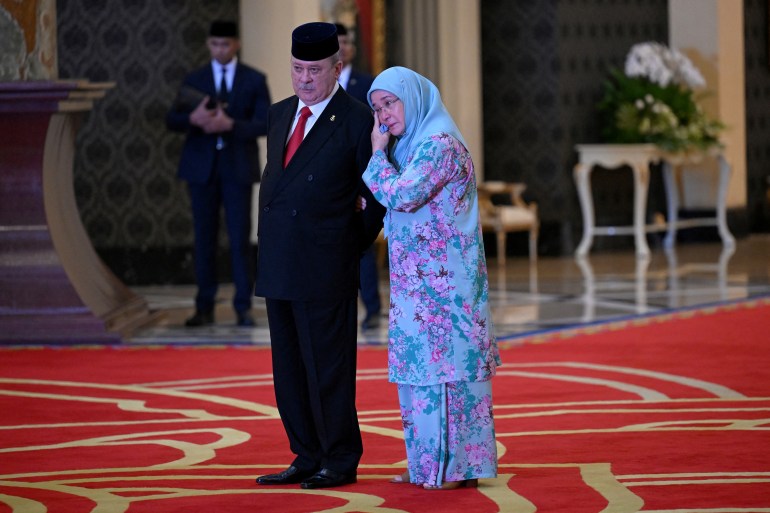
Kuala Lumpur, Malaysia – The last time a Sultan from the state of Johor was on the throne of Malaysia in the late 1980s, the country was embroiled in a constitutional crisis as then-Prime Minister Mahathir Mohamad sought to clip the wings of the judiciary. Now, as the current Johor Sultan becomes king, Malaysia is facing a corruption crackdown which has ensnared some of the most prominent political personalities of the Mahathir era, speculation of a pardon for disgraced former Prime Minister Najib Razak and continued political manoeuvring as part of a realignment that began in 2018. “It is very likely that at some point, he will be called upon to adjudicate as to which side would have a more solid command of parliament,” Malaysian political analyst Oh Ei Sun told Al Jazeera. “It could happen any time.” Sultan Ibrahim Sultan Iskandar, 65, will be installed as the 17th Yang di-Pertuan Agong in a ceremony in Kuala Lumpur on Wednesday, which will be broadcast live on state television. He will serve for five years as part of Malaysia’s unique system of rotational monarchy under which the country’s nine hereditary rulers take turns to be the Yang Di-Pertuan Agong, or He Who is Made Lord. While the king is a constitutional monarch who acts as the head of state and commander of the armed forces, the upheaval that followed the historic election in 2018 – when the once-dominant United Malays National Organisation (UMNO) was defeated for the first time since independence – has seen the monarch playing a more prominent role in the country’s politics. The Sultan of Johor after he was chosen as the next king last year. He is with his sister, Tunku Azizah Aminah Maimunah Iskandariah, who was Malaysia’s queen until January 30 [Mohd Rasfan/Pool via Reuters] At the time of that defeat, King Muhammad V from the northeastern state of Kelantan, was on the throne, and helped ensure a smooth transfer of power. When the then-49-year-old chose to resign, his successor, King Sultan Abdullah Sultan Ahmad Shah from the central state of Pahang, used the monarch’s discretionary powers to name the country’s prime ministers in 2020 and 2021, and after the election in 2022 when no single party won a parliamentary majority. He also agreed to then-Prime Minister Muhyiddin Yassin’s request for a state of emergency, which suspended parliament in January 2021 as the COVID-19 pandemic raged. As Sultan Ibrahim is installed, Malaysia is in a period of relative calm, with Prime Minister Anwar Ibrahim at the head of a so-called “unity” government that includes his one-time rivals in UMNO as well as representatives from the Borneo states of Sabah and Sarawak. Still, some politicians continue to jockey for power amid deep cleavages in Malaysian society, while a corruption crackdown has ensnared Daim Zainuddin, the once powerful right-hand man to Mahathir, Malaysia’s longest-serving prime minister. There is nervousness too about disgraced former Prime Minister Najib Razak who is nearly 18 months into a 12-year sentence for corruption in relation to the multibillion-dollar scandal at state fund 1MDB. Speculation has grown that Najib, who has applied for a full pardon, might be released despite multiple ongoing court cases over the scandal. Some say Najib’s release would help address some of the country’s political divisions because he remains popular among some ethnic Malays, who make up more than half the population and have increasingly voted for conservative religious and nationalist parties. But analysts say such a move risks alienating those who want to see reform, and undermining Malaysia’s international reputation. Minister in the Prime Minister’s Department (Federal Territories) Zaliha Mustafa said the Pardons Board met at the palace on Monday in the last official engagement for the outgoing king. She did not elaborate on what was discussed. “Wait for an official statement by (the) Pardons Board,” she said, according to the Star, a Malaysian newspaper. ‘Not shy’ Malaysia’s royal houses remain potent symbols of identity for many Malays and Sultans are the guardians of Islam in their own states. Malays in Malaysia are always Muslim. Sultan Ibrahim has previously spoken out against the “Arabisation” of Malay culture and stressed the need for moderation in a country where there are large populations of ethnic Chinese and Indians, most of whom are not Muslim. Independent analyst Asrul Hadi Abdullah Sani says once he moves into the palace, the new king “will not be shy” about offering his views to Anwar if he is unhappy. The two men appear to have a close working relationship and share similar concerns, notably over the need to tackle corruption and boost the economy and investment. This month, Singapore and Malaysia reached a preliminary agreement to establish a Singapore-Johor special economic zone and improve connectivity across the border, one of the busiest in the world. “Unlike other state rulers who have been mostly ceremonial, the sultan has always had a hands-on approach to state matters and a working relationship with the chief minister,” Asrul Hadi said referring to the leader of the Johor state government. “He is expecting a similar relationship with the federal government but there will likely be pushback from the administration, especially on policy matters.” Sultan Ibrahim has already triggered controversy in an interview with Singapore’s Straits Times newspaper that was published in December. Under a story headlined “No ‘puppet king’”, the Sultan said there was a need to tackle corruption, for “checks and balances” on the government and to control the “machinations of self-serving politicians” in a swipe at the political manoeuvring that has rocked the country over the past few years. “He will not want to be caught in the games which the politicians are playing,” said Ong Kian Ming, the director of the philosophy, politics and economics programme at Taylor’s University in Kuala Lumpur as well as a former member of parliament and deputy trade minister. “He wants political stability so that a strong economic agenda can be put in place and implemented.” Married with six children, Sultan Ibrahim is one
South Korea beat Saudi Arabia on penalties to reach Asian Cup last eight

South Korea beat Saudi Arabia 4-2 in a penalty shootout to advance to the Asian Cup quarter-finals after a thrilling last-16 tie ended 1-1 in extra time at Education City Stadium in Qatar on Tuesday. After South Korea’s Cho Gue-sung equalised in second-half added time to cancel Abdullah Radif’s opener, Sami Al-Najei and Abdulrahman Ghareeb had their penalties saved to send South Korea through to the last eight, where they will play Australia. In a goalless first half, Saudi Arabia hit the crossbar twice from a corner while Son Heung-min was the only South Korean player to test the keeper with two tame efforts on goal. However, Saudi Arabia took the lead in the first minute after the restart when halftime substitute Abdullah Radif made an instant impact, stealing in behind the defence and finding the far corner of the net from skipper Salem Al-Dawsari’s pass. With Saudi Arabia having one foot in the quarterfinals, South Korea finally breached the Saudi defence in the ninth minute of added time when their pressure paid off and Cho Gue-sung headed home from close range to force extra time. South Korea then converted all their spot kicks to advance. But they will have only two days to recover, with their quarterfinal clash against 2015 champions Australia taking place on Friday. Adblock test (Why?)
‘Frog being boiled’: US troop deaths in Jordan incite Republican Iran hawks

Republican lawmakers in the United States have amplified their calls for President Joe Biden to take decisive action against Iran, after a drone attack killed three US troops along the Jordan-Syria border. But foreign policy experts and advocates fear the political pressure may send the US down an increasingly dangerous path towards direct confrontation with Iran. “I think it’s really scary how far the rhetoric has come and what that means for the decisions that policymakers will make,” said Jamal Abdi, the president of the National Iranian American Council (NIAC). “It really does feel like the frog being boiled in the water situation,” he said, referring to the allegory of an amphibian unaware it is being cooked in slowly warming water. For his part, Biden has promised the US will “hold all those responsible to account at a time and in a manner [of] our choosing”. On Tuesday, he told reporters he had decided how to proceed, without providing further information. Speaking to reporters on Monday, White House National Security spokesman John Kirby maintained the US is not seeking direct confrontation with Iran. He also did not link Iran directly to the attack. Nevertheless, Kirby said the US would respond appropriately to the “Iran-backed group” responsible for the deaths. Department of Defense spokesperson Sabrina Singh, meanwhile, told reporters the attack “has the footprints” of the Iran-aligned Kataib Hezbollah group — but that the agency’s assessment remained ongoing. “We don’t seek a war with Iran. We don’t seek to widen this conflict,” Singh said. “We have said and we will continue to call out the fact that Iran does fund and equip these groups and provide them the capabilities that they use to attack our service members, whether it be Iraq, Syria or Jordan.” On Tuesday, Kataib Hezbollah released a statement saying it had suspended its attacks against the US. Pentagon spokesman Pat Ryder also reiterated the administration’s stance on Tuesday, saying that the US had repeatedly “called on the Iranian proxy groups to stop their attacks. They have not, and so, we will respond in a time and manner of our choosing.” ‘Devastating military retaliation’ US military bases have faced more than 160 attacks since Israel’s war in Gaza began on October 7, but the drone attack on Sunday marked the first time US personnel have been killed. That fact has kicked hawkish members of the Republican Party into overdrive, as they appeal for more direct military action against Iran. Senator Lindsey Graham, for instance, called on the Biden administration to “strike targets of significance inside Iran, not only as reprisal for the killing of our forces but as deterrence against future aggression”. Senator Tom Cotton likewise pushed for “devastating military retaliation against Iran’s terrorist forces, both in Iran and across the Middle East”. Other right-wing figures have also chimed in, including Roger Wicker, the top Republican on the Senate Armed Services Committee, who called for “striking directly against Iranian targets and its leadership”. Stephen Miles, the president of Win Without War, a group that advocates for progressive US foreign policy, described the reaction as the equivalent of a knee-jerk. He quipped that some Republicans call for bombing Iran when they “think they lose their keys”. He considers the latest Republican appeals as adding fuel to an already hazardous situation. The Biden administration, he explained, already pursues a strategy of retaliatory strikes on groups that receive support from Iran in Iraq and Syria, as well as the Houthis in Yemen. That, in turn, could ratchet tensions over the Gaza conflict into a regional war. “I think, a lot of times, people think of these situations as big ‘set piece’ wars where the US makes the decision to intervene, and we pre-position all these troops and all these assets and go to war,” Miles told Al Jazeera. “The far more likely path … is that these kinds of tit-for-tat retaliatory strikes have the potential to really grow far beyond that.” “It doesn’t matter if folks in Washington or Tehran might not want a broader regional war,” he added. “These things can take on take on a life of their own.” Trita Parsi, the executive vice president of the Quincy Institute, a think tank, said the Republicans calling for direct retaliation against Iran have fallen into two camps: Some “truly want war”, while others are simply attacking Biden’s perceived vulnerability during an election year. For the latter camp, a hawkish approach can pay dividends regardless of whether Biden acts. “They can push Biden to take military action, which I think they understand is not going to work out well,” he said. “Or Biden will not strike Iran, and then they will attack him for being weak. So they see this as a win-win from a political standpoint.” Looming presidential election The death of US troops has already brought Biden’s Iran policy to the fore of the 2024 presidential race. Republican presidential frontrunner and former President Donald Trump has seized on the moment, saying the attack “would never have happened” if he were in the White House. He has described his approach as “peace through strength”. But critics have pointed out that the Trump administration’s decision to assassinate Iranian General Qassem Soleimani in Iraq on January 3, 2020, brought the two countries to the brink of war. Since then, US bases in the Middle East have been regularly targeted, sometimes in explicit retaliation for the assassination. Republican presidential candidate Nikki Haley has also called for “surgical strikes” on Iranian assets and officials outside of Iran. “There is this message being trotted out in an election year that somehow Trump was really tough on Iran, and that was beneficial, and Biden has been weak,” said the National Iranian American Council’s Abdi, whose group has long pushed for diplomatic solutions to the tense relations between the US and Iran. Abdi added that some Republicans have already sought to connect the attack with Biden’s wider Iran policy, which has largely resembled Trump’s, despite pledges to