

Israel, genocide and whether the ICJ matters
[unable to retrieve full-text content] International Court of Justice orders Israel to avoid genocidal acts, provide humanitarian aid — but will it be enough?
Iran denies involvement in drone attack that killed 3 US troops in Jordan

Tehran says it has ‘no connection’ to attack on logistics support base near Jordan-Syria border. Iran has denied involvement in a drone attack in Jordan that killed three US military personnel and injured dozens of others, state media has reported. US President Joe Biden and UK Foreign Secretary David Cameron have blamed Iran-backed groups for Sunday’s attack near the border with Syria. “As we have clearly stated before, the resistance groups in the region are responding [to] the war crimes and genocide of the child-killing Zionist regime and… they do not take orders from the Islamic Republic of Iran,” Iranian Ministry of Foreign Affairs spokesman Nasser Kanaani was quoted saying by IRNA on Monday. “These groups decide and act based on their own principles and priorities as well as the interests of their country and people.” Kanaani said claims of Iranian involvement were motivated by “specific political goals to reverse the realities of the region” and were “influenced by third parties, including the child-killing Zionist regime”. Iran’s mission to the United Nations also said in a statement carried by IRNA that Tehran had “no connection and had nothing to do” with the attack, which it blamed on “conflict between US forces and resistance groups in the region”. The Islamic Resistance in Iraq, an umbrella organisation of Iran-backed armed groups, has claimed responsibility for the attack. The drone strike on Tower 22, a logistics support base, marked the first loss of American life by enemy fire since the start of the war in Gaza. Biden, who has staunchly backed Israel’s war in Gaza, condemned the “despicable and wholly unjust attack” and has vowed to hold all those responsible “to account at a time and in a manner [of] our choosing”. Washington has accused Iranian-backed groups of carrying out dozens of attacks on US military installations in Iraq and Syria since the start of the war. Adblock test (Why?)
Australia’s pro-Palestinian activists to continue targeting Israeli ships
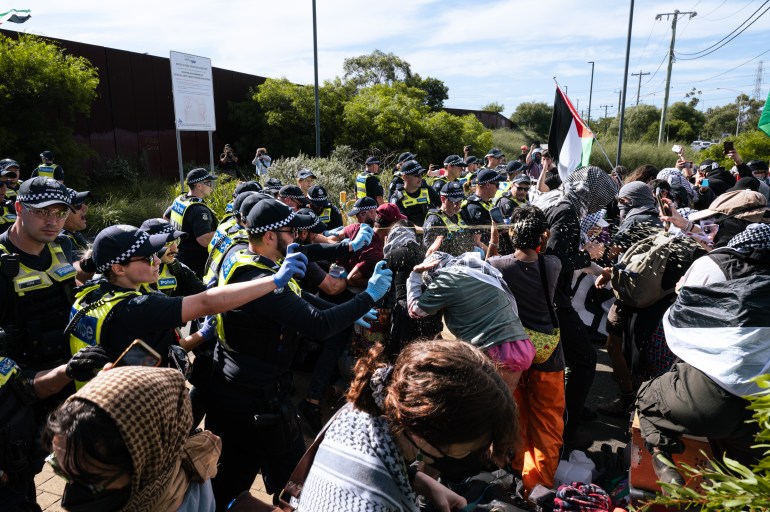
Melbourne, Australia – Ports have emerged as the centre of pro-Palestine rallies in Australia as protesters target Israeli ships, and vessels alleged to have links with the country. Last week, dozens of people attempted to stop the ZIM Ganges container ship from reaching the Port of Melbourne, with police eventually deploying pepper spray to break up the blockade against a backdrop of shipping containers and cranes, the familiar symbols of a global industrialised world. Dozens were arrested after the picket blocked access to the wharf and forced the Victorian International Container Terminal (VICT) to close. Voluntary legal observers (MALS) who were accompanying the protesters say they were met by about 200 police, some of whom were on horseback. Tasnim Mahmoud Sammak of the community organisation Free Palestine Melbourne was at the blockade, which lasted for four days. “I have family in Gaza and they have nowhere to go in the bombarded prison it has become,” she said. Sofia Sabbagh, a prolific Melbourne-based Palestinian artist, was also there for the final showdown. “They circled us forming lines, intimidating us,” she told Al Jazeera, saying the group complied with a request to move on to avoid arrest. The legal observers say the crowd was not threatening and people were just chanting. “Once we were on public property, police pushed us away from our medical supplies and gear, pulling one person out of a wheelchair and pushing over a lot of other people, pepper spraying over 20 people,” Sabbagh added. “I was traumatised seeing a person being dragged out of their wheelchair.” Victoria Police said the use of pepper spray was in response to the “dynamic nature” of the blockade and the threat of “aggressive” protesters. After the dozen or so arrests, the exhausted enclave of activists descended onto Sandridge Beach. There, Declan Furber Gillick, a representative from the revolutionary group the Black People’s Union gave an impassioned final speech calling for the continued disruption of the military-industrial complex through the use of “peaceful, people-powered, revolutionary tactics” before the group disbanded and went home. The blockade was established at the port on the afternoon of January 19, a few hours before the ZIM Ganges, which sails under the Portuguese flag, was scheduled to dock in Melbourne, Australia’s second-biggest city. Police deployed pepper spray against the people blockading the port [Leo Mace/Al Jazeera] ZIM shipping was founded in 1945 as part of Israel’s quest for statehood, initially helping Holocaust survivors travel to the new state of Israel. Currently Israel’s 10th-largest shipping company, ZIM has drawn protests since Chief Executive Eli Glickman promised to fulfil all of Israel’s needs after the Hamas attacks on southern Israel on October 7 and Israel’s declaration of war on Gaza. Port Melbourne handles about 8,850 containers a day and is Australia’s largest commercial port. The protests had “effectively halted operations” for almost four days, VICT said in a press release after the police ended the picket. Tradition of radical action The ragtag gang of activists worked in shifts, blocking six consecutive shifts of port workers from entering the terminal and forcing the ZIM Ganges to anchor in the bay until it was finally able to enter the port at about midnight on January 21. The blockade was originally organised by a group called Unionists for Palestine (U4P) but, as the days went by, attracted wider interest. By January 20, it had become a broad coalition of Palestinian, First Nations and antiwar groups. U4P member Fiona Healey said the picket was aimed at disrupting the company’s supply chain as it continued to “support and supply an apartheid regime”. This was reiterated by fellow community organiser John Smith. “We targeted the port of Melbourne in solidarity with Palestinians call to disrupt all companies complicit with the ongoing genocide in Gaza – and that includes ZIM shipping,” Smith said. Maritime Union Australia (MUA) members, such as dock workers, were advised not to cross the picket due to health and safety concerns. Many dock workers, who would have been escorted onto the terminal by police, refused to cross the picket line. An online fundraiser raised more than 25,000 Australian dollars ($16,469) for the workers, who were initially not paid for the days they did not work, but the money was redirected to Gaza relief efforts after the union secured pay for the dock workers. Ben Hjorth from U4P told Al Jazeera that the movement was linked to a broader “anti-war” cause within the Australian trade union movement. ZIM’s chief executive promised the company would do all it could to support Israel after the war on Gaza began [Briana Charles/Al Jazeera] He referenced Nelson Mandela’s 1990 speech in Melbourne, thanking Australian workers for leading the world in boycotting ships to apartheid-era South Africa. Hjorth cited those radical but successful MUA industrial actions as a source of inspiration, adding: “Sometimes you have to break the law to change it.” VICT Chief Executive Bruno Porchietto told Australian media outlet Channel 7 that the four-day picket had probably cost the port about “50,000 containers”, and Victoria “millions of dollars”. But the state’s treasurer, Tim Pallas, downplayed the blockade’s financial impact, saying the brief protest would only “minimally affect” the economy in the long run. As the ZIM Ganges finally came into the dock, some protesters were following it online through the vesselfinder.com tracking site. They say the ship disabled its GPS tracking as it came into port, noting the two tug boats accompanying it did not, leaving a gap where the ZIM Ganges was. “This is highly unusual behaviour,” said U4P’s Hjorth. Under Australian maritime law, ships can only disable their GPS tracking for safety and security reasons. Since the protests, other ships have been able to dock in Melbourne without disruption. But the threat of action remains. Hjorth said the group aims to disrupt Israeli supply chains until there is a “permanent ceasefire in Gaza and an end to the occupation”. On Monday, the ZIM Ganges was due to arrive in Sydney, where protesters held
China’s property giant Evergrande ordered to liquidate as debt talks fail

Hong Kong court orders developer to wind up after finding company has no viable restructuring plan. China’s troubled real-estate giant the Evergrande Group has been ordered to liquidate, a move likely to deal a new blow to confidence in the world’s second-largest economy. A Hong Kong court made the ruling on Monday after the company failed to convince a judge it had a workable plan to restructure some $300bn in debts. “It would be a situation where the court says enough is enough,” Judge Linda Chan said. “I consider that it is appropriate for the court to make a winding up order against the company, and I so order.” The ruling follows 18 months of legal wrangling after creditor Top Shine, in 2022, filed a petition to wind up the developer in a bid to recoup its losses. Evergrande, the world’s most indebted developer, had been granted a brief reprieve in December after arguing it needed time to refine its restructuring plan. Chan said the court had in December “made it very clear it expected to see a fully formulated and viable proposal”. Evergrande’s lawyer Jose-Antonio Maurellet defended the revised plan and denied that the developer had acted in bad faith. Evergrande’s default on repayments to international investors in 2021, after Beijing began cracking down on excessive borrowing for real estate, sent shockwaves through China’s property sector, which accounts for an estimated 15-30 percent of the economy. More than 50 Chinese real-estate developers have defaulted or missed payments during the past three years, according to credit ratings agency Standard and Poor’s (S&P). Hong Kong-listed shares in Evergrande plunged by more than 20 percent following the ruling on Monday, before the city’s stock exchange halted trading in the stock. The move is the latest in a series of warning signs for China’s $18 trillion economy, whose post-COVID recovery is facing challenges ranging from crackdowns on private industry to a declining population and an exodus of foreign capital. China’s official gross domestic product (GDP) growth of 5.2 percent last year was the worst performance in decades, excluding the COVID-19 pandemic. After Monday’s ruling in Hong Kong, the fate of Evergrande’s asset sheet is uncertain. While China signed an agreement with Hong Kong to recognise insolvency and restructuring proceedings in the Chinese cities of Shenzhen, Shanghai and Xiamen, it is unclear whether mainland courts would sanction liquidators seizing the developer’s assets in the country. Hong Kong’s common law system, adopted during the British colonial era, is distinct from China’s Communist Party-controlled courts. Chinese mainland courts have so far only recognised one liquidation order granted in Hong Kong. In 2022, a Shenzhen court ordered the recognition of liquidators for paper manufacturing firm Samson Paper. Adblock test (Why?)
North Korea’s Kim ‘guided’ submarine-launched cruise missile test: KCNA

Second test of weapon in days as North Korea accelerates efforts to modernise its navy. North Korean state media say the country’s leader, Kim Jong Un, oversaw the launch of two submarine-launched cruise missiles (SLCM), the second test of the weapon within days. The newly-developed Pulhwasal-3-31 missiles “flew in the sky above the East Sea … to hit the island target”, the KCNA news agency reported on Monday, adding that Kim “guided” the launch. It shared photos of Kim at an undisclosed location pointing at a missile in the sky and laughing with members of the military. In other images, huge clouds of white smoke obscured the actual launch platform. South Korea’s military announced on Sunday that multiple missiles had been launched from waters near the North Korean port of Sinpo, where Pyongyang operates a shipyard that manufactures naval assets including submarines. It did not go into further detail. The Pulhwasal-3-31 is a new generation of nuclear-capable cruise missile that Pyongyang first tested last Wednesday, as it seeks to enhance the weapons capability of the country’s navy. The testing of cruise missiles, which are jet-propelled and fly at lower altitudes, is not banned under United Nations sanctions imposed over North Korea’s nuclear weapons programme that outlaw ballistic missile testing. KCNA said the SLCMs were in the air for 7,421 seconds and 7,445 seconds – approximately two hours – but did not say how far they flew. North Korea’s exact sea-based launch capabilities remain unclear, and previous tests have been carried out from older vessels, including from a submerged platform, rather than an actual submarine. Kim expressed “great satisfaction” over Sunday’s test, according to KCNA, noting North Korea’s determination to build a “powerful naval force”. The North Korean leader separately inspected “the building of a nuclear submarine” and discussed issues related to the construction of other new warships, the report added without giving details. “They will focus on improving naval power in the East Sea and test weapons systems that can be mounted on submarines, with the first attempt being this strategic cruise missile,” Yang Moo-jin, president of the University of North Korean Studies told the AFP news agency. “In the future, it will lead to the development of submarine-launched ballistic missiles and nuclear-powered submarines, which will have a much higher impact than SLCMs,” he added. North Korean leader Kim Jong Un chatting with military officials at the submarine-launched cruise missile test [KCNA via Reuters] Proven SLBM capability would take North Korea’s arsenal to a new level, allowing deployment far beyond the Korean Peninsula and a second-strike capability in the event of an attack. Choi Il, a retired South Korean Navy submarine captain, said once a nuclear-tipped SLCM becomes operational, it will pose a “new threat” to South Korea. “North Korea will be equipped with a two-track nuclear attack means, with the capabilities of mass destruction of a SLBM and precision strike of a SLCM,” he said. In recent months, North Korea has tested a variety of weapons, including ballistic missile systems under development and an underwater drone. Last September, Kim launched the country’s first nuclear attack submarine, which analysts said was probably designed to carry ballistic and cruise missiles and appeared to be modified from an existing diesel-powered submarine. KCNA said the submarine marked the beginning of a new chapter for North Korea’s navy. Adblock test (Why?)
UK says it thwarted Houthis’ drone attack in the Red Sea

UK says Houthis attacked British military vessel in the Red Sea resulting in no damage and no injuries. A UK vessel shot down a Houthi drone in the Red Sea, the United Kingdom’s Ministry of Defence has said, as tensions in the Middle East soar amid the ongoing war in Gaza. “Yesterday HMS Diamond successfully repelled a drone attack from the Iranian-backed Houthis in the Red Sea,” read a statement from the ministry published on Sunday on X. “Diamond destroyed a drone targeting her, with no injuries or damage sustained to Diamond or her crew,” it added. There was no immediate comment from the Houthis. The Yemen-based group previously pledged to target Israel-linked vessels in the region as part of an effort to pressure the country’s government to end its bombardment of Gaza and allow more humanitarian aid supplies into the coastal Palestinian enclave. Gaza has been under heavy bombardment by Israeli forces since October 7, when Hamas fighters stormed communities in southern Israel, killing at least 1,139 people and taking about 240 others captive, according to Israeli officials. At least 26,400 people in Gaza have been killed in the Israeli assault since, according to Palestinian authorities in the territory. Houthi attacks in the Red Sea have caused major disruption to global commerce as the area is a key artery for maritime trade. Some of the world’s largest shipping companies have suspended operations in the region, instead sending their cargo vessels on a longer route around the Cape of Good Hope in South Africa, slowing trade between Asia and Europe. In response to the Houthi strikes on dozens of commercial vessels, the UK and United States launched multiple air raids targeting Houthi military positions, including missile depots and launcher sites, in Yemen. The US also re-designated the Houthis as a “terrorist” organisation. US President Joe Biden had delisted the group in 2021. The Houthis responded to the strikes by expanding the threat to any US and UK-linked vessels in the region. The Houthi have seized large swathes of northern Yemen since launching an offensive against the government in 2014. The war forced internationally recognised Yemeni President Abd-Rabbu Mansour Hadi and his cabinet to relocate to the southern port city of Aden, while it also triggered a brutal air bombing campaign led by Saudi Arabia. A truce has been in place since April 2022 as talks progressed between the Houthis and Riyadh over a permanent ceasefire. Adblock test (Why?)
Why is Benjamin Netanyahu lashing out at Egypt, Jordan and Qatar?

The Israeli prime minister has criticised regional players since start of the war on Gaza. Since the start of Israel’s war on Gaza in early October, its relations with countries in the region have come under increasing strain. Israel has accused Egypt of blocking aid deliveries to Gaza and criticised Qatar’s role in mediating the release of Israeli captives. Israel also says it might not renew a long-standing water agreement with Jordan because Amman has denounced its military offensive in Gaza. Is Benjamin Netanyahu criticising Cairo, Doha and Amman for political gain, as he faces calls to step down as Israel’s prime minister? And how will his condemnation of these countries affect ongoing negotiations towards a ceasefire? Presenter: Nastasya Tay Guests: H A Hellyer – Senior associate fellow of the Royal United Services Institute for Defence and Security Studies Sultan Barakat – Professor of public policy at Hamad Bin Khalifa University in Doha, Qatar Akiva Eldar – Israeli political analyst, journalist and author Adblock test (Why?)
Why, as a Palestinian American journalist, I had to leave the news industry

I was listening to a lecture at my local mosque when it suddenly felt like the imam was speaking directly to me. He was interpreting a few verses from the Quran. As he approached the sixth verse in the chapter and began to explain its meaning, my heart began to beat fast. “O believers, if an evildoer brings you any news, verify it so you do not harm people unknowingly, becoming regretful for what you have done,” he translated. I felt validated. God is telling us to fact-check. To avoid spreading rumours or misinformation. To question the source of information and to minimise harm. This was a command that I was following on an almost daily basis. I struggled to see how I was making a difference sometimes as a journalist, but in that moment, my faith reassured me that my efforts, no matter how small, were seen and rewarded by God Himself. I had read the Quran a few times in Arabic, but I was delving into the English translation for the first time. I was getting closer to my religion and God as I grew further away from my career. I constantly reminded myself that my purpose in journalism is to share factual and important information and to put my best work forward. I hoped one day I would be a correspondent for a US media outlet and get sent to the Middle East to report instead of one of the white journalists I usually saw on television. This was a lofty goal for someone who grew up in Dearborn, Michigan, the city with one of the largest Arab populations in the United States. Despite being surrounded by people like me, I felt isolated when I chose to study journalism, as the majority of my peers had gone into engineering and medicine. I lived in a city where there was a deep mistrust of the news media because of years of inaccurate or faulty coverage of the Middle East and Muslim and Arab communities in the US. Most of the time, we would only see ourselves in the news portrayed in a negative light or accused of “terrorism”. The Arab families I grew up with did not tune into local news because the news did not serve them. Most families moved to Dearborn to be near fresh pita and packed mosques, where you can take your time learning English because you can get by with just your mother tongue. My dad moved our family to Dearborn in 2000, and after the 9/11 attacks, it became a permanent stay. A man who lived in multiple countries and couldn’t sit still in one place, all of a sudden held his family closer and refused to move. He mentally built thick gates around the city that were rarely ever crossed. I was only two years old, so I can’t tell you about any immediate effects of 9/11 that I experienced. But I can tell you that I grew up in a household that never travelled unless it was to Jordan and Palestine. While some families went up to Mackinac Island during the summers, I never set foot there until I was 21. As a family, we visited the two closest Great Lakes, but never made the two-and-a-half-hour journey to Lake Michigan because it was passing through too many white Republican counties where my dad didn’t feel he could protect us against any possible hate speech or discrimination, especially since my mother and I wear hijabs. I grew up angry at my community for being so insular, but I later understood the decisions my parents’ generation made. Their fears were partly fuelled by US media coverage of the invasion of Afghanistan and Iraq and other post-9/11 policies like the demonisation of Muslims under the guise of “anti-terrorism” operations. I wanted to become a journalist to correct the narrative. I wanted to accurately tell stories and hold people in power accountable. I was taught in college that journalism can change policies, expose government secrets and lies and absolve the wrongfully convicted. It drew me in. I wanted to redirect that power to myself and the communities I belong to who had been vilified by the news industry and the government for decades. I fell in love with storytelling and reported for the campus paper while studying, and interned at multiple outlets in Michigan. I even had an opportunity to spend two weeks interning at the New York Times. My mom was sharing my stories on social media, my dad was reading my bylines and asking further reporting questions, and my brothers and sister would call me with “exclusive tips” about incidents that happened in the halls of their school. I saved hard copies of all my stories printed in newspapers. In 2021, I landed my first full-time job after college at a local paper in Texas where I was the only Muslim and only Palestinian in the newsroom. I pumped out about 400 stories in a year on breaking news and trending topics. Among them was one story that I hesitated to pitch, and later regretted ever writing. It was a news piece covering a local protest against an evangelical church raising money for Israel. I took my own photos of the event, interviewed multiple protesters, most of whom were Palestinian, and included as much context as I could while staying concise. The story went through multiple editors in the newsroom before it was published. Usually, I got to look at the edits that were made, but this time I saw them after publication. Instead of highlighting protesters’ concerns and informing readers of the conditions of Palestinians living under Israeli occupation, the article mischaracterised the demonstration as just “another protest” that happens every year at this event. Several paragraphs were cut and the headline was changed to a more attractive line that called the fundraiser for another country just an “annual event”. The article quoted the church’s founder and the keynote speaker for the
Three US service members killed in Jordan drone attack, Biden says

DEVELOPING STORYDEVELOPING STORY, The US military says three killed, at least 25 others injured in the attack on US forces in northeastern Jordan. Three US service members have been killed and “many” others wounded during an unmanned aerial drone attack on US forces stationed in northeastern Jordan near the Syrian border, President Joe Biden has said, blaming Iran-backed groups for the attack. The United States military said in a statement that at least 25 people were injured. “While we are still gathering the facts of this attack, we know it was carried out by radical Iran-backed militant groups operating in Syria and Iraq,” Biden said in a statement on Sunday. Biden said the US “will hold all those responsible to account at a time and in a manner [of] our choosing.” At least 34 personnel were being evaluated for possible traumatic brain injury, a US official told Reuters, speaking on condition of anonymity. Two different officials said some wounded US forces were medically evacuated from the base for further treatment. Jordanian state television quoted Muhannad Mubaidin, a spokesperson for Jordan’s government, as saying the attack happened outside of the kingdom across the border in Syria. The Islamic Resistance in Iraq, an umbrella group of hardline Iran-backed militant groups, claimed attacks on three bases, including one on the Jordan-Syria border. The deaths are the first fatalities of US troops in the Middle East since Israel’s war on Gaza began on October 7. The attack comes amid soaring tensions in the region, where Israel continues its war on Gaza in response to an attack by the Palestinian group Hamas in southern Israel that killed at least 1,139 people, according to Israeli authorities. Israel’s subsequent assault on Gaza has killed more than 26,400 people, according to Palestinian officials in the besieged territory. ‘We are now in a regional war’ Fears have grown about the possibility of a regional conflagration amid attacks from Yemen’s Houthi rebels on Red Sea shipping and near-daily rounds of cross-border fire between Israel and the Lebanese armed group Hezbollah. In recent weeks, Iran-backed armed groups have intensified their attacks on US military bases in Iraq and neighbouring Syria in response to the Israeli military campaign in the Gaza Strip. Reporting from Tehran, Al Jazeera’s Resul Serdar said there have been more than 100 attacks on US bases in the Middle East since Israel launched its assault on Gaza. “Iran’s position so far … has been quite clear. They say that these attacks are not conducted and planned by Iran. They say that Iran has allies across the region. However, these allies also make decisions based on their own decisions,” he said. “Iranians do not want a regional escalation. The Iranian officials know a direct military confrontation with Israel also means a war with the US which could be a deadly one for Iran. “So, Iran so far has avoided direct military confrontation with Israel and it has instead asked its allies to act. Iran’s response has been through its allies like Yemen’s Houthis, Hezbollah in southern Lebanon and many other groups in Syria and Iraq.” But Colin Clark, senior research fellow at the Soufan Group told Al Jazeera that these attacks have proved that “we are now in a regional war.” “There is no denying that. US troops have been killed and the US will respond forcefully whether that is in Iran proper or against the Iranian proxies in the various countries where they operate,” he said. “Iran can choose to distance itself as much as it wants but it funds, trains and equips these groups….The Biden administration will be under immense pressure to show the US is not going to sit back and watch its troops being killed by these Iranian-backed groups,” he added. “The question now becomes what shape this response will take.” Adblock test (Why?)
Israeli forces kill two brothers along Gaza evacuation route

NewsFeed Two brothers were shot dead in front of their family on an evacuation route in Gaza as they were heeding Israeli instructions to flee their home in Khan Younis. The parents say they thought a white flag would keep them safe. Published On 28 Jan 202428 Jan 2024 Adblock test (Why?)