

Will Israel obey the ruling of the UN’s top court?

The International Court of Justice (ICJ) has ordered Israel to prevent acts of genocide in Gaza. The United Nation’s top court has ordered Israel to take measures to prevent genocide in Gaza and allow in humanitarian aid. The International Court of Justice (ICJ) issued the ruling on Friday in a case filed by South Africa. Judges voted overwhelmingly in favour of six emergency measures that included asking Israel to punish those inciting genocide. So, how will this ruling impact Israel’s war on Gaza? And how might other countries pressure Israel to comply? Presenter: Nastasya Tay Guests: Nimer Sultany – Reader in public law at SOAS, the University of London; and editor-in-chief of The Palestine Yearbook of International Law Geoffrey Robertson – Human rights barrister and the founder of Doughty Street Chambers Chris Gunness – Former spokesperson for UNRWA and founder of the Myanmar Accountability Project Adblock test (Why?)
Why Lula has failed to address the Yanomami genocide

In December 2022, Brazilian media published photos of malnourished Yanomami children which shocked the nation. The Indigenous peoples of the Amazon had long lived off of hunting, farming, and gathering food and resources from the bountiful rainforest. But the encroachment on their lands by the Brazilian state, corporations, illegal loggers, and illegal miners has now doomed them to starvation and disease. Soon after taking office in January 2023, President Luiz Inacio Lula da Silva rushed to address the crisis. He visited the Yanomami community in the northern Roraima state and declared that a “genocide” was happening against the Indigenous people, blaming it on his predecessor, Jair Bolsonaro. He vowed to take action and put an end to the suffering of the indigenous people. Today, a year after Lula made his promise, the Yanomami are yet to see a radical change in their lives. Despite the measures the Lula government undertook, expelling thousands of illegal miners, the crisis in Roraima state has persisted. Many illegal miners have returned and the Indigenous people continue to suffer from diseases and malnutrition. In an audio message to the press, Indigenous leader Dario Kopenawa from the Hutukara Yanomami Association (HAY) said, “We have seen many operations to root out the miners from Yanomami land and also on the humanitarian and sanitarian crisis. However, precariousness still lies in the Yanomami territory.” Indeed, the Lula government’s efforts have not improved the situation much because the roots of the crisis go much deeper than the disastrous policies of Bolsonaro’s presidency. Addressing it would necessitate radical action. A history of victimisation Like other countries in the Americas, Brazil was founded against the backdrop of a genocidal campaign led by the European settlers against the Indigenous population. Successive Brazilian rulers and governments have oppressed and dispossessed the Indigenous communities throughout the past two centuries. One of the worst episodes of violence in recent history took place during the Brazilian military dictatorship (1964 – 1985). Indigenous peoples were subjected to forced labour, torture and acts of extermination at the hands of the state which sought to take over their lands to build federal highways and exploit its resources. The dictatorship forces and big landowners introduced the smallpox virus into communities and distributed sugar laced with poison, killing many. Army aeroplanes dropped napalm on villages, devastating whole communities. Although these atrocities stopped after the end of the dictatorship, the marginalisation and dispossession of the Indigenous peoples of Brazil continued into the democratic era. During his first two terms in office in the 2000s, Lula, too, was known to pursue policies which harmed the rights of the Indigenous people of Brazil. Case in point: the Belo Monte Dam on the Xingu River in the Amazon. Lula played a key role in pushing through the project, which was completed under his successor, Dilma Rousseff, also a member of the Workers’ Party (PT). The dam flooded some 500 square kilometres (193sq miles), displacing more than 20,000 people, destroying the livelihoods of fisherfolk, devastating Indigenous communities and creating a deforestation hotspot in the Amazon rainforest. Lula’s environmental wreckage did not stop at Belo Monte. In 2009, he decided to grant land rights to squatters on Amazon land, basically legalising land grabs and giving an amnesty to people responsible for deforestation and encroachment on Indigenous territories. He also had friendly relations with the big agribusiness sector, another enemy of Indigenous rights. He gave the meat industry – known as a major driving force of deforestation – access to cheap loans, allowing it to expand meat production and export exponentially, growing its appetite for cleared land. Bolsonaro’s policies – although widely condemned by the PT – were merely an extension of the decades-old Brazilian state policy of complete disregard for Indigenous people’s rights and wellbeing. A crisis decades in the making Bolsonaro’s open disdain for the Indigenous communities encouraged further encroachment on their land. Illegal loggers and miners tied to organised crime flooded the Amazon, terrorising Indigenous communities, including the Yanomami. They killed Indigenous activists and rangers trying to protect the forest, prevented people from hunting and growing food, poisoned the water resources with mercury and other harmful substances, spread diseases such as COVID-19 and malaria and even prevented healthcare workers from reaching the communities. This devastated the Yanomami people, who hold one of the largest Indigenous territories in the country, with almost 10 million hectares. It is estimated that 28,000 Indigenous people reside there, so the following numbers paint a disturbing picture. Undernourishment, famine, pneumonia and mercury poisoning killed 570 Yanomami children between 2018 and early 2023. Just in 2022, at least 99 Yanomami children aged five and below died. In January 2023, the Health Ministry reported that almost 10 percent of registered malaria cases in the country were found in Yanomami communities, although they represent just 0.013 percent of the Brazilian population. While Bolsonaro’s actions undoubtedly made the situation much worse for the Yanomami and other Indigenous groups, he was by no means solely to blame for this disastrous state of affairs. The systematic disregard of Indigenous rights had long had deadly consequences for Indigenous communities. For example, within a year of the construction work on the Belo Monte Dam commencing, the number of seriously underweight Indigenous children jumped by 53 percent; within the first two years, the cases of intestinal parasites increased by 244 percent. Indeed, the present crisis with the Yanomami people also did not happen overnight. Lula has tried to manage it by cracking down on illegal mining, launching a special task force to tackle the issue. Many people suspected of criminal activities were arrested and their mining equipment and aeroplanes were destroyed or confiscated as seen. Emergency healthcare units were also dispatched to the Yanomami territories, as well as supplies of medicine and food. In May 2023, the Health Ministry announced that in the first four months of the public health emergency for Yanomami territories Lula had announced, 67 of the 122 registered deaths of Yanomami people were children and teenagers; most of them had succumbed to curable diseases, such as
Venezuela court disqualifies leading opposition presidential candidate

Maria Corina Machado had declared victory in the Venezuelan opposition’s presidential primary last October. Venezuela’s Supreme Justice Tribunal has upheld a ban which prevents presidential candidate Maria Corina Machado from holding office, upending the opposition’s plans for elections planned for later this year. Machado, a former lawmaker, won the opposition’s independently run presidential primary last October with more than 90 percent of the votes, potentially putting her in a prime position to challenge longtime socialist leader Nicolas Maduro at the elections. Her victory came despite the government announcing a 15-year ban on her running for office just days after she formally entered the race in June. After the court issued its ruling on Friday, Machado posted on social media that her campaign’s “fight to conquer democracy through free and fair elections” is not over. “Maduro and his criminal system chose the worst path for them: fraudulent elections. That’s not going to happen. Let no one doubt it, this is to the end,” the 56-year-old wrote on X. El régimen decidió acabar con el Acuerdo de Barbados. Lo que NO se acaba es nuestra lucha por la conquista de la democracia a través de elecciones libres y limpias. Maduro y su sistema criminal escogieron el peor camino para ellos: unas elecciones fraudulentas. Eso no va a… — María Corina Machado (@MariaCorinaYA) January 26, 2024 The court’s decision came hours after three of Machado’s allies were detained on accusations of conspiracy, amid growing tensions between Maduro’s government and the political opposition. Attorney General Tarek Saab accused Guillermo Lopez, Luis Camacaro and Juan Freites, who belong to Machado’s Vente Venezuela party, of forming part of a group of at least 11 people who he said tried to rob a military weapons arsenal last year before a planned assault on a pro-Maduro state governor. Saab said on state television that the three were “criminals”. In a post on X, the Vente Venezuela party said that Camacaro and Freites had also appeared in court in Caracas on Thursday without private legal representation or contact with their families permitted, calling it an “illegal and arbitrary” procedure. It did not mention Lopez. US-Venezuela relations The court said it also upheld findings that Machado supported US sanctions, had been involved in corruption, and had lost money for Venezuela’s foreign assets, including United States-based oil refiner Citgo and chemicals company Monomeros, which operates in Colombia. The US has conditioned a continuation of sanctions relief for Venezuela, granted in October on the back of an electoral deal signed in Barbados, on Maduro freeing political prisoners and “wrongfully detained” Americans. While the Maduro government released five prisoners, including prominent opposition members, it reiterated that those with disqualifications will not be able to run in the 2024 race. On Thursday, Maduro said the Barbados agreement was “mortally wounded” after government authorities claimed to have foiled numerous plots to assassinate him. Currently, the upheld ban on Machado could set relations back between the US and Venezuela. “The regime decided to finish off the agreement in Barbados. What it didn’t finish was our fight to see democracy win via free and fair elections,” Machado said in a message via X. Maduro, the protege of former President Hugo Chavez, has been in power since 2013. While he has not formally announced his re-election bid, he is widely expected to seek a third six-year term in 2024. A victory would put him on track to stay in office until 2030, far exceeding the 11 years that Chavez held power. Adblock test (Why?)
Cold, rainy weather making war-wracked Gaza ‘completely uninhabitable’

Relentless Israeli attacks against infrastructure in Gaza and cold weather are making the Palestinian enclave “completely uninhabitable”, the United Nations human rights office (OHCHR) has warned. “I fear that many more civilians will die,” Ajith Sunghay, the head of the OHCHR for the Occupied Palestinian Territory, said on Friday. “The continued attacks on specially protected facilities, such as hospitals, will kill civilians, and there will be a further, massive impact on access to health care, safety and security in general of Palestinians.” Sunghay said his office was also “very worried about the impact of the rainy, cold weather” which was “entirely predictable” at this time of the year. He said the weather “risks making an already unsanitary situation completely uninhabitable for the people. Most have no warm clothes or blankets”. Most Palestinians in the Gaza Strip have been internally displaced by Israeli attacks, and many are crammed into overcrowded shelters where they are threatened by the worsening weather, diseases and an acute shortages of food, water and medicine. Sunghay said it would be “disastrous” if the bombardment or the street-to-street fight taking place in Khan Younis moved further south to Rafah, where some 1.3 million people are now massed in the town bordering Egypt in an attempt to evade the Israeli assault. Meanwhile, Georgios Petropoulos, the director of the UN Office for Humanitarian Affairs in Gaza, told Al Jazeera the months-long war has left 2.2 million people at risk of starvation in the Strip. “Everyone in Gaza needs aid now and the war must stop,” he said. Adblock test (Why?)
Has the war on Gaza hurt Israel’s economy?
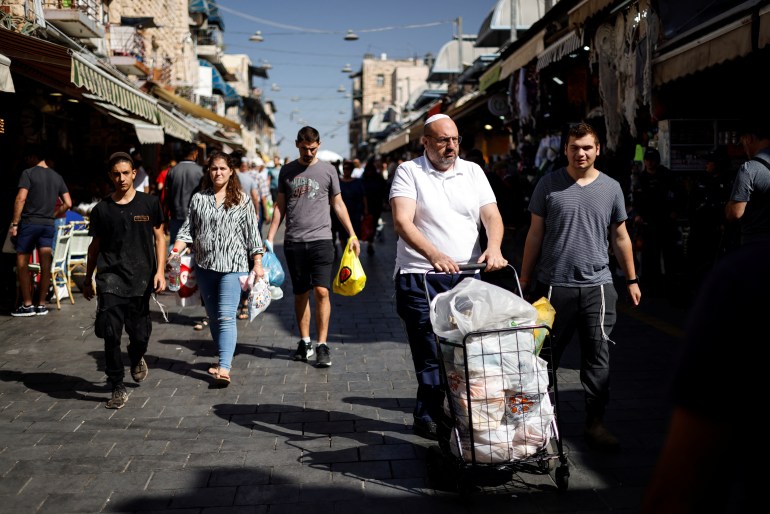
Israel’s war on Gaza, now well into its fourth month, has taken a toll on its own economy with many industries pausing business even as a few continue to get new investments. Since October, Israel’s government has subsidised the salaries of reportedly 360,000 mobilised reservists deployed to Gaza – many of whom are high-tech industry workers in finance, artificial intelligence, pharmaceuticals and agriculture. In November, the Bank of Israel put the war’s “gross effects” on Israel at 198 billion shekels ($53bn) and pared back its estimates for economic growth to 2 percent per year for 2023 and 2024, down from 2.3 percent and 2.8 percent. In December, Israel’s Finance Ministry said that the war will likely cost Israel approximately $13.8bn this year if its high-intensity phase concludes during the first quarter of 2024. In the midst of that, experts are watching to see how business is doing on the ground. One of the industries that have continued to do well is the high-tech sector, its fastest-growing area for several years, which today accounts for close to 20 percent of the country’s gross domestic product (GDP) and 14 percent of jobs. Since the Israeli start-up scene exploded in the 1990s, Israel has established itself as the largest tech centre in the world, second only to Silicon Valley. More than 500 multinational corporations – from Google to Apple, IBM to Meta, and Microsoft to Intel Corp – operate in Israel. And while there are concerns if companies would continue investing in a nation at war, for the moment at least, there’s no evidence to say that’s a real threat. Show of support Israel’s economy is expected to shrink on account of the war [File: Amir Cohen/Reuters] Within one week of October 7, more than 220 venture capital firms, including Bain Capital Ventures, 8VC, Bessemer Venture Partners, and GGV Capital, signed a public statement to express solidarity with Israel and called on investors worldwide to continue to support its tech ecosystem. From December 17-20, dozens of senior executives from US-based venture capital, tech and private equity firms took part in the Israel Tech Mission, entailing meetings in Jerusalem and Tel Aviv between these executives and top Israeli government officials. Essentially, it was a high-profile delegation showing the Israeli tech sector support amid this war. Ron Miasnik is an investor for Bain Capital Ventures who co-organised the Israel Tech Mission with David Siegel, the CEO of Meetup.com. “We are longtime investors in the Israeli startup ecosystem, and have made it a priority to visit the region and meet with teams there to continue to support stability and economic prosperity in the area,” Miasnik told Al Jazeera. “In the long term, we believe in the resilience of the Israeli startup ecosystem and are committed to not only continuing but deepening our focus on the area,” he added. Hillel Fuld, a tech columnist and startup adviser based in Beit Shemesh, Israel, pointed out that in December, US chipmaker Intel Corp confirmed its plans to build a $25bn chipmaking factory in southern Israel – a development hailed by Netanyahu as the “largest investment ever” in Israeli history. With a $3.2bn grant from the Israeli government, Intel’s planned investment is a big boost to Israel’s tech sector amid this war. In the final quarter of last year, Israeli startups managed to raise $1.5bn and “out of those deals, high-risk ‘seed’ funding was $220m in 31 rounds”, Fuld said. Palo Alto Networks, a Santa Clara, California-headquartered multinational cybersecurity company founded by American-Israeli entrepreneur Nir Zuk, has a history of acquisitions in Israel. On October 29, it acquired Dig Security for roughly $300m, then it acquired Talon Cyber Security for $615m. But the picture is slightly mixed, said Benjamin Bental, a principal researcher and economics policy programme chair at the Jerusalem-based Taub Center for Social Policy Studies. “When one looks at the number of players, one sees a decline. When one looks at the sums invested, one sees basically stability, meaning that those who stay invest more,” he said. Israeli officials face the challenge of needing to restore confidence and a sense of security – which will not prove easy – to boost investments. “Beyond a clear military and political outcome both in the Gaza Strip and along the Lebanese border, and a repatriation of the hostages, this requires a clear and goal-oriented economic policy. It is not yet clear how this will eventually be addressed,” Bental told Al Jazeera. Tens of thousands of people have been displaced in the last few weeks on both sides of the Israel-Lebanon border as Israeli troops and Hezbollah fighters have fired missiles at each other. Tourism nosedives Number of tourists in Israel has shrunk since the start of the war [File: Ammar Awad/Reuters] Perhaps the sector of the Israeli economy that has suffered the most amid this war is tourism which accounted for 2.6 percent of GDP before the pandemic in 2019, before falling to 1.1 percent in 2021. Both foreign and domestic tourism in Israel have flatlined since the start of the war. Across Israel, restaurants and stores remain empty. Soon after Hamas’s incursion into southern Israel and the eruption of the war on Gaza, a long list of airlines cancelled or suspended the majority of their flights to Tel Aviv, and many tourists cancelled their plans to visit Israel. Nonetheless, some major airlines such as Lufthansa and some of its subsidiaries, including Swiss International Air Lines and Austrian Airlines, resumed their flights to Israel earlier this month. Prior to Operation Al Aqsa Flood, visitors to Israel numbered above 300,000 each month. In November, that figure reportedly sank to 39,000. “War is not only tragic, it’s also expensive. The impact on tourism, for example, is a very real one and there is no ignoring it,” Fuld told Al Jazeera. Hard-hit construction industry Construction has come to a standstill since the start of the war [File: Ronen Zvulun/Reuters] Construction, accounting for 14 percent of Israel’s GDP, has taken a huge hit since
ICJ ruling in Gaza genocide case renews calls to end Israel arms transfers

Rights advocates and legal experts have welcomed the International Court of Justice’s (ICJ) decision ordering Israel to take “all measures within its power” to prevent acts that could amount to genocide against Palestinians in the Gaza Strip. While it stopped short of explicitly demanding a ceasefire, the top court of the United Nations on Friday acknowledged there is a plausible risk of genocide in the bombarded Palestinian enclave and refused to dismiss the case brought by South Africa. “It’s a huge defeat for Israel — one of the biggest defeats … in the past 75 years,” said Raed Jarrar, advocacy director at Democracy for the Arab World Now (DAWN), a think tank in Washington, DC. But the ruling “goes beyond Israel” alone, Jarrar told Al Jazeera, as it highlights countries’ legal and political obligations to take action to prevent the alleged genocide unfolding in Gaza. The ICJ’s decision in The Hague also spurred renewed calls to suspend weapons transfers to the Israeli government, which advocates say amount to complicity and violate international law. That includes arms shipments from the United States, Israel’s foremost backer. “It’s a watershed moment where the United States government is put on notice that they cannot continue their blank-cheque policies with Israel,” Jarrar said. “The US can’t and should not continue its arms transfers with Israel now.” Not a ‘goodwill gesture’ The US provides at least $3.8bn in military aid to Israel annually. For years, rights advocates and a growing number of US lawmakers have called on Washington to condition that assistance on Israel’s human rights record and international law. However, US President Joe Biden has rejected those efforts while bolstering assistance to the Israeli government. After Israel began the Gaza war on October 7, following an attack by Hamas that killed more than 1,100 people in southern Israel, the Biden administration sent a request to Congress to approve a $14bn foreign aid package for Israel, the bulk of which would be military assistance. The US government also twice bypassed Congress to provide thousands of artillery shells to the country as it continued to bombard Gaza. Israeli attacks have killed more than 26,000 Palestinians to date and decimated the coastal territory. Yet, despite reports and investigations that showed US weapons were used in Israeli bombings that killed Palestinian civilians in Gaza, attempts to pressure Washington to end the transfers or determine whether the arms are being deployed in rights abuses have failed. “We have been telling the Biden administration that this is not just a goodwill gesture” to end the transfer of weapons to Israel, said DAWN’s Jarrar, explaining that Washington has obligations under international and US law. “This is something that they have to think about very seriously because the United States as a government is implicated in these war crimes, and US officials are also implicated,” Jarrar said. “They have to take today’s order [from the ICJ] very seriously.” International treaties Rights groups have called on all UN member-states to suspend their transfers of weapons that “can be used to commit violations of international humanitarian and human rights law” in Gaza. Among other countries, Canada and the United Kingdom faced growing pressure on Friday following the ICJ’s decision. Both nations are state parties to the Arms Trade Treaty, a UN pact that seeks to regulate the flow of weapons globally and prevent them from being used in violations of international law and human rights. It prohibits parties from greenlighting arms transfers “if [they have] knowledge at the time of authorization that the arms or items would be used in the commission of genocide, crimes against humanity, grave breaches of the Geneva Conventions of 1949, attacks directed against civilian objects or civilians protected as such, or other war crimes”. The UK has licensed more than 474 million pounds ($602m) worth of military exports to Israel since 2015, according to Human Rights Watch (HRW), and it “provides approximately 15% of the components in the F-35 stealth bomber aircraft currently being used in Gaza”. Pressed on UK arms exports to Israel in November, Defence Secretary Grant Shapps said the country’s “defence exports to Israel are relatively small — just 42 million pounds [$53m] last year”. The weapons also “go through a very strict criteria before anything is exported”, Shapps said, according to a parliamentary transcript. But on Friday, Yasmine Ahmed, the UK director at HRW, said the ICJ’s provisional order should push the UK government to “halt arms exports to Israel with immediate effect”. “There is NO question,” she wrote on social media. “The Court found a plausible risk of genocide & the UK has an obligation to prevent genocide & not be complicit.” There is NO question. In light of the provisional measures judgment @CIJ_ICJ, the 🇬🇧 must halt arms exports to Israel with immediate effect @David_Cameron @KemiBadenoch The Court found a plausible risk of genocide & the UK has an obligation to prevent genocide & not be complicit — Yasmine Ahmed (@YasmineAhmed001) January 26, 2024 That obligation stems from the UN’s 1948 Convention on the Prevention and Punishment of the Crime of Genocide — commonly known as the Genocide Convention. The US, the UK and Canada are among 153 countries that are parties to the treaty. It confirms “that genocide, whether committed in time of peace or in time of war, is a crime under international law which they undertake to prevent and to punish”. South Africa invoked this “obligation to prevent genocide” when it brought its case to the ICJ, and the court on Friday recognised that it had standing under the Genocide Convention. The treaty also states that “complicity in genocide” is punishable. “If you’re supplying arms to a country where you know the arms may be used for criminal purposes, then you may become complicit in those crimes,” said Geoffrey Nice, a UK lawyer who led the prosecution of Slobodan Milosevic at the International Criminal Tribunal for the former Yugoslavia. “And it’s very hard not to become complicit after a certain stage of
Brutality of oppression: Ai Weiwei speaks on Gaza, China and New York City

“Power is afraid of art and poets,” writes Ai Weiwei in Zodiac: A Graphic Memoir. He would know. The renowned artist is a notorious rankler of the powers that be, particularly in his native China, where Communist Party leadership came to fear him to such a ferocious degree that he has endured prison, torture and now exile. “Why does power fear the arts,” I ask him. “Every form of power solidifies its foundation on absolute conditions, emphasising uniformity in thoughts, pathways, speech, and behavioural patterns,” he responds. “This uniformity serves as the fundamental prerequisite for the assertion of power. “Contrarily, art and poetry inherently defy the pre-established restrictions of human existence, venturing into uncharted territories. They are, in essence, endeavours to construct a novel reality, constituting a potent and destructive challenge to authoritarianism.” Zodiac is the latest of many such challenges posed by Ai over the decades. Rich with metaphor, philosophical musings, and rebellious wisdom, the book is “comic” in the classical sense – a work of komikos in which mirth and myth, commentary and critique are all combined, and tragedy is never too far off. In it, Ai relates a lifetime of creative struggle against power and repression, from his childhood during the politically fraught period following China’s Cultural Revolution to his early forays abroad as a student in New York City during the 1980s, on through his illustrious artistic career and the violent reaction it inspired. Unwilling to cede to self-censorship, Ai has endured the destruction of his Beijing studios by Chinese authorities, imprisonment – and his eventual need to flee the country once and for all. Now he is facing censorship once again, this time in the form of a London show cancelled last November after he tweeted criticism of United States-Israel relations in the early days of Israel’s war on Gaza. I interviewed Ai via email in the weeks leading up to the release of Zodiac (January 30, 2024) in a discussion that spanned his many years of living under political peril, the intentions behind censorship and oppression, and the importance of artistic expression. Dissident Chinese artist and activist Ai Weiwei at his exhibition, ‘Making Sense’, at the Design Museum, in London, April 4, 2023 [Kin Cheung/AP] Born into a ‘system of oppression’ Ai’s memoir opens with a scene from his childhood in China’s remote Xinjiang province, where his family was forced to live in an underground burrow due to the persecution and exile of his father – celebrated poet Ai Qing – in the wake of the country’s Great Leap Forward. Mao Zedong’s campaign intended to turbocharge the process of industrialisation in agrarian China, but its consequence was famine and a severe crackdown on intellectuals who were perceived as oppositional to Mao’s vision. In Zodiac, Ai describes how his family eked out their subterranean banishment as part of a “strange commune” where he took part in a competition to see who could catch the most mice. Ai won, accumulating a collection of their tails. “The experience of growing up in an intensely politicised environment within the household of an intellectual subject to prolonged suppression and oppression was not different from the lives of others during that period in terms of material life,” he told me of this period. “During those times, everyone shared a common experience of living under the pervasive fear of politics.” Sixty years later, Ai opens Zodiac with a scene between father and son in which the former warns the latter to avoid reading. When I asked about it, he explained, “From my early years, I encountered discrimination and witnessed an unjust society, leading me to recognise that political oppression doesn’t emanate solely from those in power; rather, it permeates everyone’s ideology. In such oppressive circumstances, individuals willingly conform to the violence inherent in society, becoming conscious participants in the system of oppression. This type of society leaves victims with nowhere to hide, exposing them to harm on all fronts.” After two decades of living in an Orwellian social structure, Ai decided enough was enough. “Personally, the most discernible impact of the Cultural Revolution on me was the decision to leave China and move to the US. At that time, I perceived China as an abnormal and unsafe society,” he said. “In hindsight, at the post-Cultural Revolution time, China underwent changes, transitioning from an intensely politicised society under proletarian authoritarianism to a politically authoritarian yet simultaneously materialistic and capitalistic society in terms of lifestyle.” What was it like, I ask, to leave such circumstances? “The United States in the 1980s felt like an entirely different planet to me,” Ai responded. “Everything there, both in the realms of materiality and spirituality, severed any semblance of connection. Every new experience unfolded as an entirely novel world. While, to some extent, I attained the pinnacle of freedom, from an alternate viewpoint, I found myself subjected to the most stringent constraints.” Ai Weiwei poses in front of his sculpture,’Template’, during a media preview of Documenta 12 on June 13, 2007 in Kassel, Germany [Johannes Simon/Getty Images] A young art student abroad Ai spent more than a decade in the US, studying in Philadelphia and San Francisco before ending up in New York. There he struck up a friendship with poet Allen Ginsberg and discovered that the country he had come to was no stranger to brutality. When police were caught on film indiscriminately attacking protesters, community members and journalists while attempting to dismantle homeless encampments during the 1988 Tompkins Square Park incident, Ai happened to be there, taking photos, as he somewhat relentlessly photographed his time in the US. Then, after 12 years, he decided to move on. “It seemed to me that I had already obtained all things possible to me during my time there, and the prospect of discovering more unique experiences appeared elusive. Continuing my stay in the US would feel like a squandering of time. At that time, my father in China was ill, so it was a compelling motive to
Packed Tanzania protests offer hope but reforms remain a distant dream

Dar-es-Salaam, Tanzania – As thousands of supporters carrying placards stating their demands marched through Dar-es-Salaam on Wednesday, opposition party Chadema deputy chairperson Tunde Lissu declared to reporters that the rallies were the beginning of a mission to get a new constitution and get the electoral commission truly independent. Deemed the biggest public demonstrations since President Samia Suluhu Hassan lifted the ban a year ago, they served as a platform for the opposition to dispute a raft of contentious electoral reforms set to be debated in parliament next month. “We have been asking for these constitutional reforms for 30 years, now we’ll demand them on the road,” said Lissu. “If it’s not possible to get a new constitution over dialogue, it will be obtained in the streets.” But even as the rallies were deemed successful by onlookers, the big question in Tanzanian politics is how far the government will go to heed Chadema’s demands. Since taking office in March 2021 with the stated goal of implementing democratic reforms, Hassan has kept observers guessing on what would be her next move. Her predecessor John Magufuli was different: nicknamed The Bulldozer for his dictatorial tendencies, he governed ruthlessly. He muzzled the media and banned rallies and public gatherings, forcing opposition politicians like Lissu into exile and others into hiding. Between 2015 when he came into power and 2021 when he died in office, Magufuli also shunned the West and was infamously a COVID-19 denier and vaccine sceptic. Hassan overturned the ban on rallies and public gatherings in 2023, paving the way for Lissu to return from exile. She also reinstated members of the ruling Chama Cha Mapinduzi who had been expelled from the party. But during her tenure, there have also been accusations of stifling dissent: Chadema leader Freeman Mbowe was imprisoned for seven months on “terrorism” charges after being arrested during a night-time police raid a day before the party was to hold a forum pressing for constitutional reforms. Dissent and determination Even on the eve of the rallies, there was uncertainty about whether they would take place at all. Two weeks ago, when Chadema announced plans for the rallies, the Dar-es-Salaam regional commissioner declared that government officials and the army would be holding a sanitation exercise in the city streets on the same day. The official’s statement was quickly interpreted as aiming to obstruct the rallies from taking place. The police also issued a statement threatening to intervene if the rallies were not peaceful. But some analysts say Chadema was determined to go ahead, regardless of whatever challenges security agencies would pose. “I don’t think we credit them enough for putting not just their money but their bodies where their mouth is,” said columnist and commentator Elsie Eyakuze. The authorities’ decision to let the rallies take place is part of the healing process from the Magufuli era in which there was no room for dissent, she added. Rights activist and political commentator Baruani Mshale agreed, saying Chadema deserves credit for being bold enough to go ahead with the rallies, and not Hassan and her government for not blocking them. “I sensed the determination from Chadema’s side that come what may, they will hold the rallies. The only surprising thing was the cooperation that the police granted them,” he told Al Jazeera. A season of demands Thirty years ago, when Tanzania decided to move from one-party rule to a multiparty democracy, calls for amendment of the existing constitution, forged in 1977, began. They bubbled to the surface again after Magufuli’s election in 2015 as opposition supporters cried foul, saying the vote had been rigged by the machinery of state working in tandem with the governing party. The government has proposed to change the composition of the committee that selects commissioners to the electoral body and that appointment of the chairperson and vice chairperson of the electoral commission be made by the president. But opponents of the bill say the choices of the president, who doubles as chairperson of the governing party, ought to be vetted by an independent committee. They also want the scope of the bill which currently focuses on presidential, parliamentary, and ward executive elections to be widened to accommodate elections for chairpersons of streets, villages, and hamlets which are currently administered by the Ministry for Regional Administration and Local Government and not the electoral commission. Chadema in particular has gone a step further in demanding for the bills to be drafted afresh. “If you look at the size of weakness in these bills, you realise … the only way to fix these bills is by withdrawing them from the parliament and be rewritten after being preceded by the amendment of the 1977 constitution,” John Mnyika, the party’s secretary-general, said after submitting an analysis to the parliamentary committee. The party also has other demands, including the revival of a bill for a new constitution, regardless of what happens in parliament next month. For many Tanzanians, there remains a degree of uncertainty about what grounds the government will concede before the 2026 election, especially as opposition talks with the governing party failed to yield its desired results for more than a year. And that could see Tanzania enter into a season of sustained protests, experts say. “The fact that most of their recommendations have been ignored shows that all these talks and well-meaning promises from Samia are meaningless,” said Thabit Jacob, a political commentator and postdoctoral researcher at Lund University, Sweden. “The rallies give them a chance to talk about the urgency of the situation as backroom talks have proved ineffective.” Some believe the president needs more time to deliver, arguing that she represents the progressive element of the governing party and a different order from her predecessors. And there is increasing talk about the opposition needing to temper its demands, seeing as a compromise between both sides seems unlikely in the coming months. “Let’s be politically mature,” Eyakuze said. “It’s very easy to destroy a system overnight, but building a democracy takes
Palestinians slam suspension of UNRWA funding by some Western nations

Top Palestinian officials and Hamas have criticised the decision by some Western countries to suspend funding to the United Nations relief agency for Palestinians and called for an immediate reversal of the move that entails “great” risk. The UN Relief and Works Agency for Palestine Refugees in the Near East (UNRWA) earlier said it had opened an investigation into some employees that Israel alleges were involved in the October 7 attacks that triggered the current conflict. On Saturday, Palestine Liberation Organization (PLO) Secretary-General Hussein al-Sheikh said the countries’ decision “entails great political and humanitarian relief risks”. “At this particular time and in light of the continuing aggression against the Palestinian people, we need the maximum support for this international organization and not stopping support and assistance to it,” he wrote on X, urging the countries to “immediately reverse their decision”. We call on the countries that announced the cessation of their support for #UNRWA to immediately reverse their decision, which entails great political and humanitarian relief risks, as at this particular time and in light of the continuing aggression against the Palestinian… https://t.co/mxIam0zmZs — حسين الشيخ Hussein AlSheikh (@HusseinSheikhpl) January 27, 2024 Italy, Australia, Canada and the United States said they would halt funding to the agency, while European Union foreign policy chief Josep Borrell said the 27-member bloc would “assess further steps and draw lessons based on the result of the full and comprehensive investigation”. The United Kingdom and Finland also joined the growing list of countries to pause financial aid to the UN agency, whose facilities where displaced Palestinians sought shelter have been repeatedly attacked in Israeli airstrikes. Hamas on Saturday slammed Israeli “threats” against the agency, after Israel accused several UNRWA staff of involvement in Hamas’s October 7 attacks in southern Israel that the authorities there say killed about 1,140 people. “We ask the UN and the international organisations to not cave in to the threats and blackmail” from Israel, Hamas’s press office said in a post on Telegram. On Friday, UNRWA said it had fired several employees and that it had opened an investigation into the allegations. “The Israeli authorities have provided UNRWA with information about the alleged involvement of several UNRWA employees in the horrific attacks on Israel on October 7,” said UNRWA Commissioner-General Philippe Lazzarini. “To protect the agency’s ability to deliver humanitarian assistance, I have taken the decision to immediately terminate the contracts of these staff members and launch an investigation in order to establish the truth without delay.” UNRWA was founded in the wake of the creation of the state of Israel in 1948 to provide hundreds of thousands of Palestinian refugees who were forcibly displaced with education, healthcare, social services and jobs. It started operations in 1950. The cash-strapped agency today supports nearly six million Palestinians in Gaza, the occupied West Bank, as well as in neighbouring Jordan, Syria and Lebanon. Aid freeze Britain on Saturday said it had joined the US in “temporarily pausing” future financial aid for UNRWA, which is funded almost entirely by voluntary contributions from UN member countries. “The UK is appalled by allegations that UNRWA staff were involved in the 7 October attack against Israel, a heinous act of terrorism that the UK Government has repeatedly condemned,” the Foreign and Commonwealth Office said in a statement. Italy’s Foreign Minister Antonio Tajani said on Saturday that his country was joining its allies and cutting its support for the agency. “Allied countries have taken a similar decision. We are committed to providing humanitarian aid to the Palestinian population while protecting Israel’s security,” he posted on X. Australia’s Foreign Minister Penny Wong said she was “deeply concerned” by the allegations against UNRWA. “We are speaking with partners and will temporarily pause disbursement of recent funding,” she wrote on X. “We welcome UNRWA’s immediate response, including terminating contracts and launching an investigation, as well as its recent announcement of a full investigation into allegations against the organization,” she added. Israel praised the countries for halting their support to the UN agency, saying it wants to completely stop its operations after the war on Gaza has ended. Commending the US government for its decision to cease funding to @UNRWA after it was revealed that some of its employees were involved in the heinous massacre on #October7. We have been warning for years: @UNRWA perpetuates the refugee issue, obstructs peace, and serves as a… — ישראל כ”ץ Israel Katz (@Israel_katz) January 27, 2024 Foreign Minister Israel Katz said Israel “aims to promoting a policy ensuring that UNRWA will not be a part of the day after, addressing other contributing factors”. “We will work to garner bipartisan support in the US, the European Union, and other nations globally for this policy aimed at halting UNRWA’s activities in Gaza,” he said. Independent investigation Canada’s International Development Minister Ahmed Hussen on Friday announced that Ottawa had “temporarily paused any additional funding to UNRWA while it undertakes a thorough investigation into these allegations”. “Canada is taking these reports extremely seriously and is engaging closely with UNRWA and other donors on this issue,” he wrote on X. “Should the allegations prove to be accurate, Canada expects UNRWA to immediately act against those determined to have been involved in Hamas’s terrorist attacks.” The US halted funding to UNRWA on Friday because of the allegations against 12 employees who “may have been involved” in the Hamas attack. Lazzarini did not disclose the number of employees nor the nature of their alleged involvement, but said “any UNRWA employee who was involved in acts of terror” would be held accountable, including through criminal prosecution. UN chief Antonio Guterres has pledged to conduct an “urgent and comprehensive independent review of UNRWA”. At least 26,257 people have been killed and 64,797 wounded in Israeli attacks on Gaza since October 7. Adblock test (Why?)
How Israel is responding to the ICJ ruling

The ICJ’s order to Israel to stop acts of genocide marks a watershed in the Gaza war. Part 1: What does the ICJ ruling mean for Israel? Judgement day at the International Court of Justice. The court has ruled the people of Gaza must be protected from genocidal acts carried out by Israel. Richard Gizbert is joined by producer Tariq Nafi to discuss the impact this ruling could have on how the media discuss the war in Gaza. Part 2: Mohammed el-Kurd on Palestinian resistance Writer and journalist Mohammed el-Kurd in a video essay on Palestinian resistance and the Western media’s warped coverage of Palestine. Contributor:Mohammed el-Kurd – Writer and journalist Part 3: India: Temple opening or election campaign kickoff? A long-anticipated – and deeply contentious – consecration of a Hindu temple in India this past week featured Prime Minister Narendra Modi front and centre. The country’s mainstream media enthusiastically played along, giving Modi valuable airtime in what is an election year. Contributors:Apoorvanand – Professor, Delhi UniversitySeema Chishti – Editor, The WirePamela Philipose – Author, Media’s Shifting TerrainSreemoy Talukdar – Deputy executive editor, Firstpost Adblock test (Why?)