

How doctors in Gaza persevere amid Israel attacks

“No doctor wakes up in the morning and says: ‘I’m going to amputate a child’s leg without anaesthesia.’” “You don’t want to watch children suffer,” Dr Amber Alayyan with Doctors Without Borders, known by its French initials MSF, tells Al Jazeera. The measured cadences of the voice of the charity’s deputy programme manager for Palestine suggests just how inconceivable it is for her, as a doctor and a mother, to cause pain to a patient and to a child. Yet it is the moral conflict her colleagues in Gaza face daily, minute by minute, as they try to treat unprecedented numbers of injured people flooding into the Gaza Strip’s barely functioning hospitals. Your natural instinct is to take care of people… to protect people. … You’ve been trained over and over and over and over for years. by Dr Amber Alayyan As doctors in Gaza are forced to make split-second decisions on who to save and who to let die, on whose pain to relieve and whose they do not have time to, it is that innate instinct and their Hippocratic oath that is assailed by decisions they never thought they’d have to make. Burdened with personal losses and struggling to operate under unrelenting Israeli bombardments, this is the story of how medical workers are fighting to keep Gaza’s healthcare system going. How Gaza’s healthcare system has been destroyed It is nearing midnight in Gaza and Mohamed S Ziara, a Palestinian doctor, is on a WhatsApp call to Al Jazeera. His tone is soft and unaffected by the rumbling explosions and pop of gunfire that can be heard in the background. The plastic surgeon is working 12- to 14-hour shifts, six days a week at the European Gaza Hospital (EGH) in Khan Younis, where he treats up to 15 cases a day. Ziara describes the healthcare situation as “catastrophic”. “It doesn’t match anything I’ve seen before, even with previous escalations and war,” says Ziara, who has worked during Israel’s assaults on Gaza since 2014. He has been posting about Israeli attacks near the EGH and the conditions inside on his Instagram account. The widespread damage caused by Israeli attacks since October 7, following Hamas’s surprise attacks on Israel, has led to a shortage of medical staff and supplies and an urgent need for fuel, electricity and water. According to the World Health Organization (WHO), only 15 of Gaza’s 36 hospitals are partially functional – nine in the south and six in the north. From October 7 to November 24, there were 74 Israeli assaults on health facilities with 30 hospitals attacked in Gaza, according to Insecurity Insight, a humanitarian association that collates data on threats facing people in dangerous environments. Northern Gaza, including Gaza City, has borne the brunt of attacks on the healthcare sector, but as the war has progressed, previously designated safe areas south of Wadi Gaza have come under Israeli fire. The map below summarises the Israeli attacks on Gaza’s healthcare sector during the first seven weeks of the war. The hospitals that have been attacked most often include: al-Shifa Hospital – attacked 12 times al-Quds Hospital – attacked nine times Indonesian Hospital – attacked nine times Nasser Hospital – attacked three times Insecurity Insight documented at least 26 other hospitals from across the Gaza Strip that were attacked by Israeli forces over the same period. These repeated attacks came during an Israeli order on October 13 that instructed all 22 hospitals in northern Gaza to evacuate to the south within 24 hours. The WHO described the order as “impossible to carry out” and “a death sentence for the sick and injured”. Israel’s raid on al-Shifa Hospital One of the first hospitals to come under fire was al-Shifa Hospital, Gaza’s largest medical facility, located in the Remal neighbourhood in Gaza City, where Ziara worked before EGH. “I remember that I was watching TV, and the spokesman of the [Israeli] army was asked twice about the possibility of bombing the hospital, and he replied that everything is possible,” Ziara says. Israeli soldiers flanked al-Shifa Hospital on three sides on November 15 and then stormed the complex after Israeli accusations that it was serving as a Hamas command centre. “We have never seen any military action or military activity inside the hospital,” Ziara says, adding that he thought the threat to the hospital was merely propaganda from the Israeli army. “We never thought that they would reach the hospital and that we’d evacuate patients and the injured.” Several doctors, including Norwegian Mads Gilbert, who has worked in Gaza for several years, have said they had not seen any evidence of military activity at the hospital during the war. After the storming of al-Shifa Hospital, a number of United Nations missions were carried out in cooperation with the Palestine Red Crescent Society (PRCS) to evacuate patients and healthcare workers. The same exercise has been attempted more recently at hospitals in Deir el-Balah in central Gaza and Khan Younis in the south – namely Al-Aqsa, Nasser and EGH – due to ongoing hostilities nearby. Ziara says he witnessed drone attacks on al-Shifa Hospital. “They were shooting at people. They injured many. They shot a missile at the hospital garden and killed about four people staying there who had evacuated or were refugees,” he says. This satellite image shows al-Shifa Hospital and the surrounding neighbourhood in Gaza City on November 11, 2023 [Maxar Technologies via AP] Healthcare attacks and ‘war crimes’ Assaults such as those seen on al-Shifa Hospital have raised questions about the legality of attacks on healthcare facilities. International humanitarian law, based on the Geneva Conventions, stipulates that hospitals are considered “civilian objects” and receive de facto protection. Despite that prohibition, Israel has continued to target healthcare structures and workers. “The UN has been very clear that hospitals, civilians and healthcare workers should be protected, and we continue to call for their protection. They’re not a target,” Dominic Allen, the UN Population Fund’s representative for Palestine, tells Al Jazeera. Human Rights
Israel reportedly pushing deal for captive release without ending war

A US envoy is visiting Egypt, Qatar to try to broker the deal as pressure rises on Tel Aviv to bring captives home. Israel is reported to have readied a proposal for a two-month truce that aims to secure the release of captives held by Hamas but without ending the war in Gaza. US and Israeli press reported late on Monday that Tel Aviv is optimistic that it could conclude a deal with the help of the US. The plan comes against a backdrop of intensified combat in southern Gaza as well as increasing pressure on the Israeli government to find a deal to bring the captives home. US website Axios quoted Israeli officials as saying that the proposal has been presented by Tel Aviv to Hamas through Qatari and Egyptian mediators. It includes a two-month truce during which all Israeli detainees in Gaza will be released. Israel’s Channel 13 reported that the principles of the deal consist of three to four stages of captive release. Meanwhile, the Israeli military would withdraw from some areas of the enclave, but without ending the war. Reports suggest that the US is pushing the plan with regional partners. The White House’s Middle East coordinator, Brett McGurk, is now in Cairo to discuss the deal, with plans to continue to Qatar. Phases Reporting from East Jerusalem, Al Jazeera’s Stefanie Dekker said that the proposal included plans to release captives in phases, starting with women and those over 60. A second phase would see a handover of female soldiers and men deemed as non-soldiers by Hamas. The third phase would include male soldiers and bodies remaining inside Gaza. Meanwhile, Israeli soldiers could be redeployed away from some urban areas to allow Palestinians to return home. “Of course, the question is what do they have to return to,” said Dekker. Families of captives and supporters shout slogans as they protest to call for the release of captives taken during the deadly October 7 attack by the Palestinian armed group Hamas, in Tel Aviv, Israel, January 6, 2024 [Alexandre Meneghini/Reuters] In Israel, the families of the captives have been applying increasing pressure on Israeli Prime Minister Benjamin Netanyahu to agree a deal. Amid the ongoing bombardment of Gaza, they worry that time is running out to bring their relatives home alive. On Monday, dozens of relatives stormed a parliamentary committee meeting, demanding that the government seek a deal to win their loved ones’ release. Stuttering A weeklong truce in November saw the release of around 100 of the 240 or so captives taken by Hamas on October 7. Efforts to put another pause or even ceasefire in place have been stuttering since. But Israel is facing mounting impatience as it ignores calls to scale back its onslaught. The EU on Monday gave Tel Aviv’s Foreign Minister Israel Katz short shrift as he pitched the construction of an artificial island in the Mediterranean near the Gaza coast as a hub for the enclave’s commercial relations with the rest of the world. But facing political pressure and demands from hardline coalition partners, Netanyahu has repeatedly vowed to press ahead with the offensive until Hamas is crushed. The reports of the truce negotiations come amid an intensification of fighting in southern Gaza, with the hundreds of civilian casualties adding to the death toll in the enclave, which local authorities now say tops 25,000. The Palestine Red Crescent Society said early on Tuesday that its headquarters in Khan Younis had been shelled. Writing on X, the NGO said that the shelling coincided with “intense gunfire from Israeli drones, resulting in injuries among internally displaced individuals who sought safety on our premises”. UN agencies and aid groups have sounded the alarm about the growing threat of disease and famine in Gaza, where 1.7 million people are estimated to have been displaced from their homes. That makes a cessation of fighting ever more urgent, and there will be hope that alongside the pressure from the families, recent troop losses could give added momentum to efforts towards dialling down the conflict. On Tuesday, the Israeli military reported it lost at least 21 soldiers in one of the deadliest attacks on its troops since the war began three months ago. Adblock test (Why?)
US and UK carry out new attacks against Yemen’s Houthis

NewsFeed The US and UK militaries say they have conducted new air attacks against Houthi weapon sites in Yemen, as the group continues to target Red Sea shipping in protest over Israel’s war in Gaza. Published On 23 Jan 202423 Jan 2024 Adblock test (Why?)
Israel, Gaza, Germany and the genocide in Namibia
[unable to retrieve full-text content] Germany joins Israel to deny the war in Gaza constitutes genocide against the Palestinians, but Namibia disagrees.
Race to find dozens trapped in southwest China landslide

Rescuers have been racing to find dozens of people trapped after a landslide struck a remote and mountainous part of southwestern China, killing at least 12. The predawn landslide buried 18 homes when it hit Zhenxiong county, in Yunnan province, on Monday. More than 24 hours after the disaster, state news agency Xinhua reported that rescue workers were in a “race against time” on Tuesday to find those still missing, after a night of subzero temperatures. Yunnan is among several provinces in China currently experiencing bitterly cold temperatures, according to the National Meteorological Centre. “Search and rescue efforts persisted through the night,” firefighter Li Shenglong told Xinhua. Two hundred emergency workers, including soldiers, were dispatched to the scene – a rural area surrounded by towering peaks dusted with snow – along with dozens of fire engines and other equipment. The area is covered in thick snow and rescuers were “using all kinds of tools to search for survivors” amid the debris, Xinhua reported. Wu Junyao, the director of the natural resources and planning bureau of Zhaotong, which includes the affected villages, said the disaster “resulted from a collapse in the steep cliff area atop the slope”. Chinese President Xi Jinping has ordered “all-out” rescue efforts. Landslides are common in Yunnan, a far-flung region where steep mountain ranges abut the Himalayan plateau. China has experienced a string of natural disasters in recent months, some following extreme weather events such as sudden, heavy downpours. Rainstorms last September in the southern region of Guangxi triggered a mountain landslide that killed at least seven people, according to media reports. In August, heavy rains sparked a similar disaster near the northern city of Xi’an, killing more than 20 people. Adblock test (Why?)
Pakistan ex-PM’s party loses election symbol. Will it hurt its prospects?

Electoral symbols play an important role in a democratic process. As Pakistan gears up for general elections due next month, posters with party symbols can be seen plastered on utility poles and roadside walls across cities and towns. Political parties have kicked off campaigning, plastering walls with propaganda posters but the symbol of what many believe is the country’s most popular party, the Pakistan Tehreek-e-Insaf (PTI), seems to be missing, thanks to an unprecedented crackdown on the PTI and its jailed leader, former Prime Minister Imran Khan. Khan’s party has been barred from using the party symbol in the elections scheduled for February 8. PTI members and supporters say the blocking of its symbol, a cricket bat, is a ploy by the military-backed caretaker government to ensure the party’s defeat. Meanwhile, the leader of the Pakistan Peoples Party (PPP), Bilawal Bhutto-Zardari, has also alleged that seven of his party’s national and provincial assembly candidates have being assigned the wrong electoral symbols in the eastern Punjab province. Bhutto claimed the Election Commission of Pakistan (ECP) acted under pressure from former Prime Minister Nawaz Sharif, who has been accused of cutting a deal with the country’s military that controls most levers of power from behind the scenes. Sharif, who returned to Pakistan in October after several years of self-imposed exile, has rejected the allegations. So why are party symbols important, and will the ban on the PTI symbol harm the party? Why did PTI lose its bat? The ECP on December 22 omitted PTI’s bat symbol on the technical grounds that the party had not held intra-party elections – required under law. This rendered the party ineligible for having a symbol for the 2024 elections. An intra-party election conducted by the PTI on June 8, 2022 was not recognised by the ECP on the grounds that it was not “just and fair”. The ECP also passed similar orders against 13 marginal political parties. Critics and supporters of PTI have deemed it a deliberate attempt to curtail the party’s success in the elections. “The cricket bat was unjustly revoked through an illegal order,” PTI lawyer Syed Ali Zafar said. An attempt by the PTI to get the ban overturned failed as Pakistan’s Supreme Court last week upheld the election commission’s decision, which is significant to the PTI because it is reminiscent of Khan’s success as a former cricketer. Khan, who was the national team captain when the country won its only World Cup trophy in 1992, leveraged his successful sporting career to gather popular support as a politician. Supporters of Imran Khan install a giant bat symbol along a roadside in Karachi in May 2013 [File: Athar Hussain/Reuters] Arif Rafiq, president of Vizier Consulting, a New York-based political risk advisory company, said the decision to block PTI symbol is “politically motivated”. “They are part of a pattern of the Pakistani state using administrative measures, along with coercion, to deny PTI a pathway toward electoral victory,” he said, referring to the high popularity of Khan. Nadia Malik, Head of Geo Television’s election cell, says that intra-party elections are a farce in Pakistan but the ECP did not hold other parties accountable, letting them scot-free. “Losing a symbol is not something new in Pakistan but PTI can not even choose a different symbol for all their candidates,” as the deadline for that has passed, Malik told Al Jazeera. The ECP has defended its decision saying the elections will be further delayed if the process of changing symbols continues. To counter the confusion that this can create, the party’s social media team is working on a portal that allows voters to search for names and symbols of PTI’s candidates, Malik added. “PTI is really good at social outreach in that way.” But one in every two Pakistanis does not own a smartphone, making it difficult for the PTI to reach out to voters. “The end result of the ECP’s decision, and the Supreme Court’s ludicrous affirmation of it, is the disenfranchisement of millions of voters and the liquidation of the country’s largest party in the run-up to the polls,” Asad Rahim Khan, a constitutional expert, said. “Flaws in intra-party elections don’t merit such a disproportionate punishment anywhere in the actual law. Even otherwise, Pakistan’s Constitution and clearly developed jurisprudence favour political parties and their right to contest.” PTI Social Media Team has created a portal to search for candidate name & symbol. See video below showing a search for “NA1” & the results with candidate name & symbol. We are just waiting for data for each candidate before we go LIVE! #ChallengeAccepted #PrimeMinisterImranKhan pic.twitter.com/BhI4bOfIfJ — PTI (@PTIofficial) January 14, 2024 The story behind the PTI bat The slanted cricket bat symbol has a ubiquitous association with Khan’s party. However, the bat was not the party’s first symbol. Malik from Geo TV said that the party’s first symbol was a lamp. Before the 2013 elections, PTI wanted to use a double-balance scale as its electoral symbol, since it is the symbol of justice and “Insaf” roughly translates from Urdu to justice. However, the scales were the symbol of the Jamaat-e-Islami party in the 1970 general election. The legal battle for the symbol between the two parties ultimately tipped in Jamaat-e-Islami’s favour due to its historical claim on the scales. After the 1977 general election, the military government of General Zia-ul-Haq deleted several electoral symbols from the approved list of symbols, the scales being one of them. These were restored by the ECP in 2010. Why are electoral symbols significant? The symbols that look like mere minimalist line work hold high stakes in Pakistan. Malik, the journalist from GEO, pointed out that around 40 percent of Pakistan’s population is uneducated and voters who can not read rely on symbols to identify the party they want to choose on the ballot. “Even those people who can read names are not always as involved in campaigning, but they know their party’s symbol,” she said. She added that parties’ electoral campaigning
China races to find landslide survivors in sub-zero temperatures
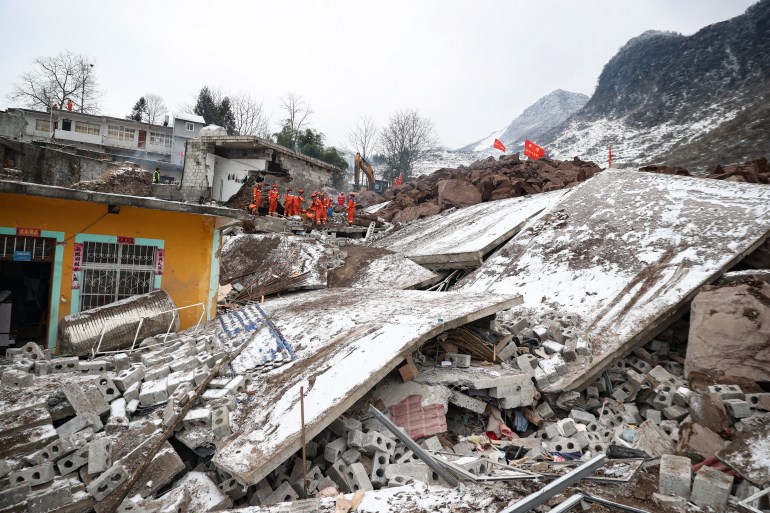
At least nine people have been confirmed dead in the pre-dawn disaster in southwestern Yunnan, with dozens still missing. Rescuers in China have stepped up efforts to find dozens of people who were buried in a landslide in southwestern Yunnan. The landslide struck two villages in mountainous Zhengxiong County in the early hours of Monday morning when many people were asleep, burying 18 homes and at least 47 people. At least nine people had been found dead, according to state broadcaster CCTV, while two were pulled from the rubble and taken to hospital. “The mountain just collapsed, dozens were buried,” a witness, named Gu, told state-owned television. He said four of his relatives were among those beneath the rubble. “They were all sleeping in their homes,” he said. State news agency Xinhua said rescue workers were in a “race against time” to find those missing after a night of sub-zero temperatures. Chinese President Xi Jinping has ordered “all-out” rescue efforts. The agency quoted Wu Junyao, the director of the natural resources and planning bureau of Zhaotong, which includes the affected villages, as saying the disaster “resulted from a collapse in the steep cliff area atop the slope”. Hundreds of rescue workers including soldiers have been sent to the area, which is known for its steep rugged mountains that are covered with snow in winter. The two affected villages were built towards the foot of the mountains and more than 500 residents were evacuated after the disaster. State media showed rescuers climbing over concrete blocks and collapsed roofs dusted with snow to find survivors. Luo Dongmei was sleeping when the landslide struck. “I was asleep, but my brother knocked on the door and woke me up. They said there was a landslide and the bed was shaking, so they rushed upstairs and woke us up,” 35-year-old Luo told the Associated Press news agency. Luo, her husband and their three children were evacuated to a school along with many other residents. Luo said she had been unable to contact her sister and aunt, who lived closer to the site of the landslide. “The only thing I can do is to wait,” she said. Rescuers search through the remains of village houses to try and find survivors [AFP] Yunnan is among several provinces in China currently experiencing bitterly cold temperatures, according to the National Meteorological Centre. Last week, rescuers evacuated tourists from a remote skiing area in northwestern China where dozens of avalanches triggered by heavy snow had trapped more than 1,000 people for a week. The avalanches blocked roads, stranding both tourists and residents in a village in the Xinjiang region, close to China’s border with Mongolia, Russia and Kazakhstan. There was no immediate official explanation for what might have caused Monday’s landslide. Zhengxiong County lies about 2,250km (1,400 miles) southwest of Beijing, with altitudes ranging as high as 2,400 metres (7,900 feet). Landslides, often caused by rain or unsafe construction work, are not uncommon in China. At least 70 people were killed in landslides last year, including more than 50 at an open pit mine in the Inner Mongolia region. Adblock test (Why?)
UK’s upper house votes to delay plan to deport asylum seekers to Rwanda

House of Lords defies Rishi Sunak by voting to delay ratification of treaty with Kigali. The United Kingdom’s upper house of parliament has voted to delay Prime Minister Rishi Sunak’s controversial plan to deport some asylum seekers to Rwanda. The vote by the unelected House of Lords on Monday came despite Sunak urging its members to back his plan, which he has characterised as the will of the people. The upper house voted 214 to 171 to delay the ratification of a related treaty London signed with Kigali until the government can demonstrate that Rwanda is a safe country for asylum seekers to be sent to. The chamber does not have the power to block the so-called Safety of Rwanda (Asylum and Immigration) Bill indefinitely, but could delay the legislation for up to a year. The move comes after the more powerful House of Commons on Wednesday narrowly passed the bill after some Conservative MPs threatened to vote against the government on the grounds the legislation was not robust enough to survive legal challenges. Sunak has made the controversial immigration plan a key plank of his bid to return to power in an expected general election this year that the centre-left Labour Party is strongly tipped to win. Sunak introduced the legislation after the UK Supreme Court last year ruled that the safety of asylum seekers deported to Rwanda could not be guaranteed. The bill would make it harder for courts to challenge the Rwanda policy by allowing the government to set aside certain provisions of human rights law and asking the House of Commons to declare by majority vote that the African country is safe for asylum seekers. Sunak has said he wants deportations to begin within months to meet his pledge to “stop the boats” carrying asylum seekers across the English Channel. Former Prime Minister Boris Johnson first announced the Rwanda plan in 2022 to deny people arriving by “irregular means” the opportunity to apply for asylum in the UK. The first Rwanda-bound flight from the UK was halted in June of that year after a last-minute intervention by the European Court of Human Rights (ECHR), which ruled that one of the asylum seekers on board was at “real risk of irreversible harm” in the East African nation. Adblock test (Why?)
Qatar storm to the knock-out stage with perfect record

Hosts Qatar stormed to the knock-out stage of the AFC Asian Cup 2023 with a 1-0 win against China. AFC Asian Cup hosts Qatar finished their group stage in style on Monday with a spectacular volley from Hassan Al-Haydos for a 1-0 win over China, which is on the brink of elimination from the tournament. The deadlock at the Khalifa International Stadium was broken midway through the second half with an unforgettable strike. Akram Afif’s corner was immediately met outside the area by Al-Haydos, who confidently volleyed into the top corner. Both players had just been introduced as substitutes. Qatar, who had already secured its spot in the knockout stage, topped Group A with nine points and advanced with Tajikistan, who beat last-place Lebanon 2-1 to take second place with four points. China finished with just two points and failed to score in any of their three games. They have never won the Asian Cup and must now wait for other results but have only the faintest of chances of squeezing into the next round as one of the four best-performing third-place teams in the six groups. 🔝 Record-breaker💪 Captain on the field🔥 Scores, creates, and dazzles The historic Hassan Al-Haydos 🇶🇦😍#AsianCup2023 pic.twitter.com/EDbso57vg2 — Qatar Football Association (@QFA_EN) January 22, 2024 Qatar may have lost all three games on home soil at the 2022 World Cup but have been perfect in the Asian Cup, advancing to the round of 16 by winning all three games without conceding a goal. Already certain of the top spot heading into the match, defending champions Qatar made nine changes from the previous game, handing the initiative to China who created better chances in the first half. Wei Shihao had three opportunities to score his team’s first goal. After just seven minutes, he side-footed wide from just inside the area and later, his low shot from close range was saved by Qatar’s Saad Al Sheeb. Wei went close again right before the break with a header that just cleared the bar. After Al-Haydos’s superb goal in the 66th, China had the ball in the net with three minutes remaining but Jiang Shenglong’s shot was ruled out as the ball had gone out of play in the buildup. A full mark in the group stage 🇶🇦✔️#AlAnnabi #AsianCup2023 pic.twitter.com/Ve2rGQa0DV — Qatar Football Association (@QFA_EN) January 22, 2024 In the group’s other fixture, Tajikistan rallied to beat Lebanon and advance to the knockout stage for the first time. “We made history today and this is the biggest thing for the Tajikistan people,” coach Petar Segrt said. “It was difficult but we kept fighting and we did it.” Lebanon took the lead early in the second half with a curling shot from Bassel Jradi but were reduced to 10 men after 54 minutes because of a foul by Kassem El Zein. Tajikistan had two goals ruled out for offside but finally scored with 10 minutes remaining. Parvizdzhon Umarbaev scored, then Nuriddin Khamrokulov headed home a winning goal in the second minute of second-half stoppage time. Adblock test (Why?)
Fashion giant H&M pulls ad after claims it sexualised under-age girls

Swedish brand apologises after ad campaign in Australia sparks backlash online. H&M, the Swedish fashion giant, has pulled an advertisement for school clothing after complaints it sexualised underage girls. The advertising campaign launched in Australia featured two young girls in school uniform with the caption, “Make those heads turn in H&M’s Back to School fashion”. “We have removed this ad,” an H&M spokesperson said on Monday. “We are deeply sorry for the offence this has caused and we are looking into how we present campaigns going forward.” The move comes after social media users accused the clothing brand of sexualising young girls. “The little girls’ parents generally prefer heads don’t ‘turn’ when others see their daughters walking to school, on a bus or in class,” Melinda Tankard Reist, an Australian writer known for campaigning against pornography, said in a post on X. “Why would you want to fuel the idea that little girls should draw attention to their looks, bodies and ‘style’? Perhaps have a word to your marketing team and come up with something that doesn’t draw attention to pre-pubescent girls already struggling to thrive in a culture that values ‘lookism’ as an aspirational goal?” The backlash is the latest in a series of controversies involving fashion brands’ advertising campaigns. Last month, Zara dropped a campaign featuring a model standing among rubble and mannequins wrapped in shrouds after social media users claimed it was insensitive to victims of the war in Gaza. Paris-based luxury fashion brand Balenciaga last year apologised for running adverts that featured children holding teddy bears wearing bondage-style attire and a printout of a Supreme Court decision that upheld laws against child pornography. Adblock test (Why?)