

Celebrating a child’s birthday in Gaza with no cake, candles or friends

NewsFeed Palestinian journalist Mohammed Asad has celebrated his daughter’s 6th birthday in Gaza amid the rubble of homes destroyed by Israel’s war. Dana’s birthday wish is to return to school. Published On 21 Jan 202421 Jan 2024 Adblock test (Why?)
Anti-government protesters demand new elections in Israel amid Gaza war

NewsFeed ‘The threat is no longer from Hamas, but from (Israel’s) criminal cabinet.’ Thousands of outraged Israelis, including relatives of soldiers and captives, are calling for new elections, saying they’ve lost all faith in their government for how it has relentlessly pursued war on Gaza. Published On 21 Jan 202421 Jan 2024 Adblock test (Why?)
Paul Lynch: Is Prophet Song a mirror of modern-day fascism?

The Booker Prize-winning author dissects his tale of global conflicts and tyranny. In a world where literature often mirrors the pulsating heart of society, Paul Lynch’s Prophet Song stands out as a beacon of emotional and narrative depth. This masterpiece delves into the complexities of human experience, weaving a story that resonates deeply with the themes of tyranny and resilience. Set against a backdrop that parallels global conflicts, Lynch portrays the struggles of a mother in a totalitarian regime, drawing parallels with real-world events. We dissect how his novel is a poignant exploration of human spirit under oppression as Booker Prize winner, Paul Lynch talks to Al Jazeera. Adblock test (Why?)
US base attacked in Iraq hours after Iran vows revenge for Damascus attack

Iran-backed armed groups have targeted US troops in Iraq hours after Tehran vowed revenge and blamed Israel for a deadly attack on a building housing its elite forces in the Syrian capital Damascus, driving fears of wide regional conflict. The attack caused one Iraqi and possible American casualties, the US Central Command (CENTCOM) said on Saturday, and came hours after Tehran vowed to take revenge against Israel for its strike targeting the Iranian Revolutionary Guards Corps (IRGC) in Syria. “Multiple ballistic missiles and rockets were launched by Iranian-backed militants in western Iraq targeting al-Assad Airbase,” CENTCOM said on X. Most of the projectiles were intercepted by the base’s air defence systems, but “others impacted on the base”, the statement said. Iranian-backed Militants Attack Al-Assad Airbase, Iraq At approximately 6:30 p.m. (Baghdad time) time Jan. 20, multiple ballistic missiles and rockets were launched by Iranian-backed militants in Western Iraq targeting al-Assad Airbase. Most of the missiles were intercepted by… pic.twitter.com/rYaNrRdRtu — U.S. Central Command (@CENTCOM) January 20, 2024 Attacks on US forces in Iraq and Syria have increased since the October 7 Israeli military offensive, which has been militarily backed by Washington. Since launching its offensive on the Gaza Strip, Israel has expanded its attacks targeting Iran-linked armed groups in Syria and Lebanon. Yemen’s Houthis, who form part of Tehran-backed groups known as the “axis of resistance”, have launched attacks towards Israel and targeted Israel-linked ships in the Red Sea in solidarity with Palestinians in Gaza disrupting one of the busiest maritime routes. Houthis demand Israel end its war on Gaza and allow humanitarian aid into the besieged territory in desperate need of food, medicines and other essential items. Jordan’s Foreign Minister Ayman Safadi has warned of the dangers of escalation in Israel’s war on Gaza. “If Israel continues to ramp up its attacks on other fronts and if it drags the West in, we’ll be looking at a very, very serious escalation of the conflict,” he told Al Jazeera. Missiles elsewhere risk wider war The stepped-up Israeli and US attacks targeting Iran-linked groups have the potential to trigger a regional conflict, pitting Iran and its allies against Israel and the US. An Israeli drone strike in south Lebanon reportedly killed a member of Hezbollah, who was travelling in a car, according to two security sources. Another unidentified person travelling in the same car was also killed. Meanwhile, the US said it had targeted a missile that the Houthis were aiming into the Red Sea. The US military has in the last week launched a number of strikes at the Houthis. According to Hassan Ahmadian, a professor at the University of Tehran, Israel is widening the conflict due to its inability to achieve its military goals in Gaza. “Israelis have upped the ante of what they were doing beforehand,” Ahmadian told Al Jazeera, adding that Israeli Prime Minister Benjamin Netanyahu has been vocal about calls for an escalation. Israel is also ramping up its attacks to stave off attacks by Iran and allies in the region, however many of these groups are part of the “axis of resistance” and are doing so in their own national interests, he said. Israeli strike targets Iran in Syria On Saturday, Iran’s President Ebrahim Raisi said his country would retaliate against the attack in Damascus which killed five members of the IRGC. Tehran blamed Israel for the latest attack targeting its forces in Syria – a close ally of Iran. “The Islamic Republic will not leave the Zionist regime’s crimes unanswered,” Raisi said, according to state broadcaster IRIB. There was no comment from Israel, but it has killed IRGC members in several similar strikes since October 7. They were targeted in a building in Damascus which was flattened by “precision-targeted Israeli missiles”, according to a security source close to Syria’s government. Portraits of the IRGC members on Iranian state media referred to three of them with an honorific used for generals, suggesting they were senior commanders, while the two others were a major and someone holding a lower rank. An unspecified number of Syrian troops were also killed. Foreign Minister Hossein Amirabdollahian said on the X: “The activities of Iran’s military advisers in the fight against terrorism and securing the region will continue with full strength.” Iran and its military allies in Syria have entrenched themselves in several parts of the country. In December, an Israeli air strike killed two IRGC members, and another on December 25 killed a senior adviser to the IRGC. Adblock test (Why?)
In India’s Ayodhya, the Ram temple means ‘land is costlier than gold’

Ayodhya, India: Ram Surat Verma regrets his decision to sell his land in 2019. A farmer in Takpura village in the Ayodhya district of the north Indian state of Uttar Pradesh, about 155km (96 miles) from Lucknow, the state capital, he received 25 million rupees ($300,000) when he sold his 1.55 acre (0.6 hectares) patch of land to a local property dealer four years ago. The 65-year-old believes that he could have gotten at least 10 times that amount had he delayed his decision to now. “Land is costlier than the gold here, with prices surging since the verdict for building a Ram temple was announced by the Supreme Court in 2019. I made the mistake of selling my land before the judgement. Had I delayed the land deal, it could have fetched me a far better price than what I had received then,” Verma told Al Jazeera. Verma, whose land holding is 7km (4.3 miles) from the temple, is yet to decide on selling his remaining 4.65 acres (1.88 hectares) of land. “The property brokers and customers are making a beeline outside my house every day, offering me lucrative prices for the land but I will not repeat the same mistake again. A delay would certainly fetch me a higher price,” he said. Verma is not alone in adopting a wait-and-watch policy on selling his land. Several thousand farmers and landholders in the Ayodhya district and its neighbouring areas are doing the same, expecting exponential prices for their land which is in massive demand mainly to build commercial properties there. The boom in real estate began after India’s apex court in its verdict on November 9, 2019, ruled in favour of the construction of a temple to the Hindu god Ram at the 2.77-acre (1.12-hectare) disputed site in Ayodhya. The court also allocated a separate 5 acres (2 hectares) of land to Muslims near Ayodhya to build a mosque. The verdict turbocharged the political and religious movement that for decades had been campaigning to build a temple at a spot that many Hindus believe was the birthplace of Ram. But it also opened new business avenues for entrepreneurs who began to tap investment opportunities in Ayodhya in anticipation of the millions of tourists expected to visit the temple after its inauguration on Monday, by Prime Minister Narendra Modi. Vinay Kumar Verma, 33, a property dealer in Ayodhya, told Al Jazeera that his phone has not stopped ringing for the past six months, with people inquiring about the availability of land for building hotels. “Earlier, I used to receive one to two calls every month asking for land for commercial use. But now I am getting eight to nine calls per day for this,” he said. Some of those calls are from people in other states who are interested in building hotels and guest houses to cash in on the huge influx of pilgrims that are expected to visit the holy city, pushing up prices from 16 million rupees ($190,000) per acre of land in 2019 to about 64 million rupees ($770,000) now. “And still, people are ready to pay more, expecting huge returns after investing in commercial properties like hotels and guest houses,” Verma said. “The land here is even costlier by four to five times than that in the state capital, Lucknow.” Vinay Kumar Verma, a property dealer in Ayodhya, said he has been inundated with calls from potential buyers seeking commercial land [Gurvinder Singh/Al Jazeera] The days leading up to the January 22 consecration of the temple have seen an explosion in demand for hotel rooms from visiting tourists and pilgrims – buttressing the business logic of real estate firms looking to build more hotels in Ayodhya. Most hotels are booked out and have hiked up rates for rooms even when they are available after the temple launch. Jitendra Pandey, 41, who has been a real estate agent in Ayodhya for the past 12 years, said he has never witnessed such an increase in land prices. “The prices of commercial property have increased by four to five times because of the deep pockets of buyers who are willing to pay any price for the land. Even the prices of residential property have gone up by 2.5 times. The commercial rates are high because outsiders are not interested to settle here but want to make much of the business opportunity,” he told Al Jazeera. Farmers, he said, are the main beneficiaries because they are not only getting exorbitant prices for the land but some buyers are also connecting directly with them in order to avoid real estate agents commissions. Real-estate majors have jumped in too. Mumbai-based House of Abhinandan Lodha (HOABL) has acquired 25 acres (10 hectares) of land and plans to invest 12 billion rupees ($1.4m) in Ayodhya to develop a seven-star mixed-use enclave that would host luxurious facilities for buyers including a swimming pool, gym and banquet halls, among other amenities. Bollywood superstar Amitabh Bachchan has booked a piece of land of about 10,000sq feet (929sq metres) in this upcoming project for 145 million rupees ($17.43m), according to local media reports. HOABL did not respond to Al Jazeera’s request for information about the new project. The city is also witnessing a wave of modernising with star hotels like the Park Inn by the Radisson Group, as well as malls and showrooms of multinational companies that have set up their outlets in recent weeks, including Tata Group’s high-end jewellery store Tanishq which opened its showroom in the city in December. A new township Realising the potential of Ayodhya on its way to becoming the spiritual hub for millions of Hindus globally, the state government has since 2020 acquired 1,407 acres (569 hectares) of land to build Navya Ayodhya, or the new township of Ayodhya, on the outskirts of the city. Om Prakash Pandey, an executive engineer with the Uttar Pradesh Housing and Development Board, told Al Jazeera that the total township would be spread across 1,857
Palestinian-American teen one of hundreds killed by Israelis in West Bank

They are using US tax dollars to ‘kill our own children’, says father after Israeli soldiers and settlers opened fire, killing his 17-year-old son. Palestinian-American Tawfiq Ajaq, 17, is one of 369 people killed by Israeli troops and settlers in the occupied West Bank since October, including 95 children. Speaking at his son’s funeral on Saturday, Tawfiq’s father, Hafez Ajaq, implored Americans to “see with their own eyes” the ongoing violence in the occupied West Bank. “They are using our tax dollars in the US to support the weapons to kill our own children,” Hafez Ajaq said. “How many fathers and mothers have to say goodbye to their children? How many more? “They are killer machines,” Tawfiq’s father said of Israeli forces at the funeral. Born and raised in Gretna, Louisiana, near New Orleans, Tawfiq Ajaq’s parents brought him and his four siblings to the village of al-Mazra’a Asharqiya last year so they could reconnect with Palestinian culture. Tawfiq Hafez Tawfiq Ajaq, 17, a U.S. citizen, was killed yesterday as an Israeli settler and Israeli forces opened fire on his car in the occupied West Bank. It remains unclear whether the settler or a soldier fired the bullet that struck him in the head. https://t.co/KNXxMRoeqj pic.twitter.com/nYEULLlWCM — Defense for Children (@DCIPalestine) January 20, 2024 On Saturday, crowds of Palestinians filled village streets, following men who held aloft a stretcher with the teen’s body, wrapped in a Palestinian flag and covered in flowers. Another vigil held at the Masjid Omar mosque in Harvey, New Orleans was standing room only, according to the New Orleans news outlet NOLA.com. Circumstances unclear Ajaq’s relative, Joe Abdel Qaki, said Tawfiq and a friend were having a barbecue in a village field when he was shot, once in the head and once in the chest. Abdel Qaki said he arrived at the field shortly after the shooting and helped transport Tawfiq to an ambulance. He said Israeli forces briefly detained him and other Palestinians at the scene, asking for their identification cards before the men could get to Tawfiq. He said Tawfiq died in the ambulance on the way to the hospital. “Tawfiq is an American child who was chased and shot at by an Israeli settler, then Israeli forces pulled up and continued shooting,” Miranda Cleland, an advocacy officer with Defense for Children Palestine, said in a post on X. “This is not the first time Defense for Children Palestine hasn’t been able to confirm whether a settler or soldier killed a child. One aids and abets the other,” Cleland said. The United States Office of Palestinian Affairs called for an “urgent investigation” into Ajaq’s death in a post on X. Devastated to hear about the killing of a 17 year old U.S. citizen, Tawfic Abdel Jabbar. We call for an urgent investigation to determine the circumstances of his death. — U.S. Office of Palestinian Affairs (@USPalAffairs) January 20, 2024 Various English spellings of the teen’s name have been used in reports. In its daily update for Friday, the United Nations humanitarian agency OCHA reported a “17-year-old Palestinian child was shot and killed” near al-Mazra’a Asharqiya village in Ramallah where Tawfiq Ajaq lived. “At the time of the incident, Israeli forces and settlers shot live ammunition towards a group of Palestinians who were reportedly throwing stones at Israeli vehicles driving on Road 60 near the village,” OCHA said. “It is not yet clear whether the boy was shot by Israeli forces or settlers,” OCHA said. According to OCHA’s latest figures, of 358 Palestinians killed in the occupied West Bank since October 7, “348 were killed by Israeli forces, eight by Israeli settlers, and two by either Israeli forces or settlers”. Israeli police said they received a report on Friday regarding a “firearm discharge, ostensibly involving an off-duty law enforcement officer, a soldier and a civilian”. Police did not identify who fired the shot, though it said the shooting targeted people “purportedly engaged in rock-throwing activities along Highway 60″, the main north-south thoroughfare in the occupied West Bank. The ongoing violence in the occupied West Bank comes as the death toll from Israel’s war on Gaza approaches 25,000, with thousands more missing under the rubble. Adblock test (Why?)
Israel’s war on Gaza: List of key events, day 107

EXPLAINER The Israeli army killed at least 165 people in the past 24 hours as Netanyahu doubles down on his refusal of a Palestinian state. Here’s how things stand on Sunday, January 21, 2024: Latest developments A video verified by Al Jazeera showed a fire broke out in Gaza’s Jabalia refugee camp after an overnight Israeli attack in the area. Thousands of people rallied in central Tel Aviv on Saturday, demanding the return of Hamas captives and elections to replace Netanyahu’s government. The Council on American-Islamic Relations (CAIR) is urging an investigation into allegations by pro-Palestine students at Columbia University in New York that they were sprayed with a noxious “chemical agent” during their protest on Friday. Tess Ingram, a communication specialist for UNICEF, called on the world to bring an immediate end to the “warped version of normal” in Gaza in a video statement posted on X on Saturday. Israeli forces dropped leaflets in southern Gaza on Saturday, suggesting benefits for those who provide information to Israel on captives taken by Hamas on October 7. Human impact and fighting In the past 24 hours, the Israeli army has been accused of committing several massacres against Palestinian families in the Gaza Strip, killing at least 165 people, according to the Gaza Ministry of Health. Israeli shelling east of the Jabalia refugee camp in Gaza on Saturday killed four Palestinians and injured 21 others, according to the Palestine Red Crescent Society. Syrian state media SANA said Israel attacked a building in Damascus on Saturday. Israel has not claimed responsibility for the attack or offered any comment. Iran’s President Ebrahim Raisi promised to hit back at Israel following the air raid on Syria after it killed five members of the country’s Islamic Revolutionary Guard Corps, according to state broadcaster IRIB on Saturday. The United States military personnel targeted in an attack on Iraq’s Ain al-Assad airbase on Saturday suffered “minor” injuries, the Reuters news agency reported, quoting an unnamed US official. A member of Iraq’s security forces was also wounded in the attack. Diplomacy Israeli Prime Minister Benjamin Netanyahu reiterated his opposition to the independent Palestinian state, rebuffing the Biden administration’s stand on the issue. “Full Israeli security control … is contrary to a Palestinian State,” he posted on X, formerly Twitter. UN Secretary-General Antonio Guterres reiterated on Sunday that “the denial of the right to statehood for the Palestinian people” is “unacceptable”. “The right of the Palestinian people to build their own state must be recognized by all,” he posted on X. On Saturday, the US Office of Palestinian Affairs called for an “urgent investigation” into the killing of 17-year-old Palestinian-American Tawfiq Ajaq in the occupied West Bank. San Francisco Mayor London Breed declined to veto a resolution by city officials calling for an extended ceasefire in Gaza, saying the measure would leave her city “angrier, more divided and less safe”. Breed explained that her veto would send the issue back to the board of supervisors, in whom she has “no confidence”. At a foreign policy conference on Saturday, British Shadow Foreign Secretary David Lammy faced interruptions from pro-Palestinian protesters during a speech and briefly left the podium, saying he wanted “change through power, not through protest”. Saudi Arabia’s Prince Faisal bin Farhan Al Saud says the kingdom is “very worried” about a “difficult and dangerous time in the region” amid Red Sea tensions, Reuters reported, citing a CNN interview that will be aired on Sunday. Adblock test (Why?)
Russian lawmakers to debate seizing property of those who ‘discredit’ army

A bill to be voted on next week aims to confiscate assets of Russians spreading ‘deliberately false’ information amid Ukraine war. Russia’s parliament will consider a law allowing for the confiscation of money, valuables and other property from those deemed to spread “deliberately false information” about Moscow’s military actions, a senior lawmaker has said. Vyacheslav Volodin, speaker of the State Duma, wrote in a Telegram post on Saturday that a bill has been developed in an attempt to punish “scoundrels” who “pour mud” on Russia and its soldiers participating in the war in Ukraine, which is approaching its two-year mark. He said the bill will be submitted to the Duma, which is Russia’s lower house of parliament, on Monday. The proposed measure would apply to those publicly inciting “extremist activities” or calling for the introduction of sanctions against Russia, the speaker explained. It would also be applicable to those “discrediting” the armed forces, a criminal offence under a law adopted as part of Moscow’s crackdown on dissent after it sent troops into Ukraine in February 2022. Those found guilty also face being stripped of any honorary titles. “Everyone who tries to destroy Russia, betrays it, must suffer the deserved punishment and compensate for the damage inflicted on the country, at the cost of their property,” Volodin said. The existing law against “discrediting” the Russian military, which covers offences such as “justifying terrorism” and spreading “fake news” about the armed forces, is regularly used to silence critics of Russian President Vladimir Putin. Existing laws Multiple activists, bloggers and general Russian citizens have received long jail terms under the existing law. Popular writer Dmitry Glukhovsky was handed an eight-year jail term in absentia after a Moscow court found him guilty in August of deliberately spreading false information about Russia’s armed forces. One of the country’s bestselling novelists, known under the pen name Boris Akunin, was charged under the law and added to the Russian register of “extremists and terrorists”. In November, a court in St Petersburg jailed Sasha Skochilenko, an artist and musician, for seven years for swapping supermarket price tags with antiwar messages. The month before, Russian blogger Aleksandr Nozdrinov received an 8.5-year term for posting photos of destroyed buildings in Kyiv, along with a caption implying that Russian troops were responsible. Meanwhile, attacks on the ground continue. On Saturday, Russian forces shelled the southern Ukrainian town of Huliaipole, local governor Yuriy Malashko wrote on Telegram. Earlier, regional Ukrainian officials reported that one person was killed when Russian forces shelled the southern Kherson region overnight. In southern Russia, close to the Ukrainian border, an exploding drone hit a gas pipeline on the outskirts of the city of Belgorod, regional governor Vyacheslav Gladkov reported on Telegram, blaming Ukraine for the attack. The European Union said it will drastically increase ammunition production this year in response to Ukraine’s growing pleas for support. It also aimed to impose a new round of sanctions on Russia next month to mark the second anniversary of Moscow’s invasion, adding to its previous 12 rounds of sanctions. Adblock test (Why?)
‘Refuse to fight’: Jewish, Arab activists call for peace in Israel’s Haifa

Peace activists have taken part in a protest in Israel’s third-largest city, Haifa, demanding a ceasefire in the war on Gaza and the exchange of captives and prisoners between Hamas and Israel. “This is the first time we are seeing this protest happen in the north,” said Al Jazeera’s Stefanie Dekker, reporting from Haifa on Saturday. “It’s a protest with Israeli Jews and Palestinian Israelis, and it is significant because of the two coming together. “The message here is to end the war and that they can only live peacefully side by side with a political solution for the Palestinians,” she said. Omri Evron, a member of the Communist Party of Israel, who helped organise the anti-war protest, spoke to Al Jazeera about the message the protesters were hoping to convey. “The killing of thousands and thousands of Palestinians, the vast majority of whom are innocent civilians, is not only reprehensible, it does not serve the security of the people of Israel. It does not bring us security, it only ensures the next massacre, the next cycle of violence,” he said. “Currently, they [the protestors] are chanting “refuse to kill, refuse to fight, refuse to murder” – this is our call.” Evron admitted there were difficulties in organising a protest of this kind. “It has been difficult, not because there aren’t Jews and Arabs who want to come together who believe in a joint future of peace and equality and national liberation of both people in two states,” he explained. “It has been difficult because the government and the police in particular have done everything in their power to prevent us from coming together, to prevent us from voicing a lawful and peaceful voice. We had to appeal to the Supreme Court of Justice just to allow us to come together and demonstrate.” Al Jazeera’s Dekker said the protesters were not allowed to march, and officials said the protest could not be held at night. But several hundred people were finally able to gather for two hours during the day. Adblock test (Why?)
Tens of thousands protest in Germany against the far-right
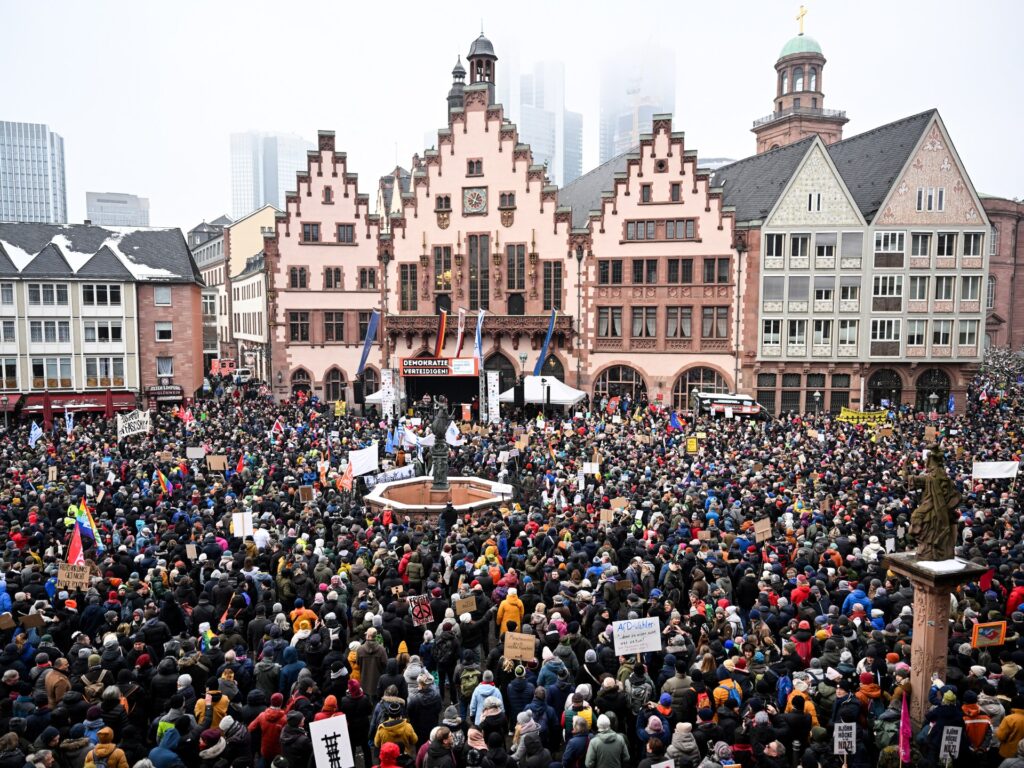
Public outcry followed revelations that the far-right Alternative for Germany (AfD) party had discussed plans to mass deport immigrants. Tens of thousands of people have gathered across Germany to protest against a far-right political party and its stance against migrants. People protested in several cities and small towns on Saturday, with some mocking the Alternative for Germany (AfD) party with signs saying “Facism is not an alternative”, German media reported. The protests come following an outcry after it was revealed that AfD members held a meeting with far-right activists and discussed plans to mass deport foreigners. Police said some 35,000 people joined a call under the banner “Defend democracy – Frankfurt against the AfD”, marching in the financial heart of Germany. A similar number, some carrying posters like “Nazis out”, turned up in the northern city of Hanover. Protests were also held in cities including Braunschweig, Erfurt and Kassel and many smaller towns, mirroring mobilisation every day over the past week. Some 50,000 people demonstrated in Hamburg, Germany’s second-largest city, on Friday, police said. In all, demonstrations have been called in about 100 locations across Germany from Friday through the weekend, including in Berlin on Sunday. Politicians, churches, and Bundesliga coaches have urged people to stand up against the AfD. On January 10, a report by investigative outlet Correctiv, revealed that AfD members had discussed the expulsion of immigrants and “non-assimilated citizens” at a meeting with other far-right activists. Among the participants at the talks was Martin Sellner, a leader of Austria’s Identitarian Movement, which subscribes to the “great replacement” conspiracy theory that claims there is a plot by non-white migrants to replace Europe’s “native” white population. ‘An attack against our democracy’ News of the far-right gathering sent shockwaves across Germany at a time when the AfD is polling second in nationwide surveys, just months before three major regional elections in eastern Germany where their support is strongest. The anti-immigration party confirmed the presence of its members at the meeting, but has denied taking on the “remigration” project championed by Sellner. Co-leader Alice Weidel parted ways with one of her advisers who participated in the talks. But leading politicians, including Chancellor Olaf Scholz, who joined a demonstration last weekend, said any plan to expel immigrants or citizens alike amounted to “an attack against our democracy, and in turn, on all of us”. He urged “all to take a stand – for cohesion, for tolerance, for our democratic Germany”. Members of the country’s business industry also voiced their concerns. “If everything is true as reported, then that is absolutely disgusting,” said Siemens Energy’s supervisory board chairman Joe Kaeser in an interview with Reuters published on Saturday, Kaeser’s comments come after leaders of German companies, including chip manufacturer Infineon and chemicals maker Evonik voiced their concerns earlier this week. Highlighting lessons from Germany’s history, Kaeser warned of the damage to Germany’s image around the world and called on German businesses to publicly warn of the consequences. Adblock test (Why?)