

Ukraine’s Zelenskyy urges Western allies to step up pressure on Russia

The Ukrainian leader says Western hesitation in backing Kyiv is costing time and lives and could prolong the fighting for years. Ukrainian President Volodymyr Zelenskyy has urged the West to tighten sanctions against Russian President Vladimir Putin and step up its support for Kyiv to ensure that Moscow does not succeed in its war. Western hesitation in supporting Ukraine and fears of an escalation in the war with Russia are costing time and lives and could prolong the fighting by years, Zelenskyy said on Tuesday in an emotional speech at the World Economic Forum in Davos, Switzerland. With the West’s once-staunch wartime support for Kyiv now wavering amid political wrangling in Washington and Brussels, Zelenskyy said Europeans need to understand that Putin’s plans go beyond the war in Ukraine. “In fact, Putin embodies war. … He will not change. … We must change. We all must change to the extent that the madness that resides in this man’s head or any other aggressor’s head will not prevail,” the president said. Nearly two years after Russia launched its full-scale invasion, Zelenskyy said he strongly opposes freezing the conflict along its current lines. “Putin is a predator who is not satisfied with frozen products,” he said. He said sanctions on Moscow need to be enforced properly and the lack of sanctions on Russia’s nuclear sector are an illustration of the West’s weakness. European Union and NATO leaders echoed Zelenskyy’s concerns, telling the forum the West could not let up supplying Ukraine with weapons and money if it wants Kyiv to prevail. “Ukrainians need predictable financing throughout 2024 and beyond. They need a sufficient and sustained supply of weapons to defend Ukraine and regain its rightful territory,” European Commission chief Ursula von der Leyen advised. NATO Secretary-General Jens Stoltenberg, also speaking at Davos, said support for Ukraine was not charity but an investment in the alliance’s own security. “We just have to stand by Ukraine. At some stage, Russia will understand that they are paying too high a price and sit down and agree to some kind of just peace – but we need to stand by Ukraine,” he stated. The forum is being held as Kyiv’s troops are going onto a more defensive footing after a major counteroffensive last year was unable to break through Russian defensive lines in Ukraine’s occupied south and east. Speaking hours after the Ukrainian president, Putin insisted his forces have the upper hand. “Not only has their counteroffensive failed, but the initiative is entirely in the hands of the Russian armed forces,” the Russian leader said in televised remarks. “If this continues, Ukraine’s statehood could be dealt an irreparable, very serious blow,” he added. Putin also shot down the possibility of peace talks with Ukraine, saying the country had advanced “prohibitive formulas for the peace process”. Kyiv is now focused on trying to secure Western assistance held up in the United States Congress and Brussels as it reforms its conscription effort to replenish manpower and addresses artillery shortages at the front. In a question-and-answer session after his speech, Zelenskyy said he had received “positive signals” about the unlocking of financial support from the EU. He said he hoped that the US would approve further aid within weeks. To drive home his point about the need to support Kyiv, he asked rhetorically what other European nation could provide a combat-ready army that could hold back Russian forces. “If anyone thinks this is only about Ukraine, they’re fundamentally mistaken. Possible directions and even timeline of a new Russian aggression beyond Ukraine become more and more obvious.” Zelenskyy met senior officials on the sidelines of the forum, including US Secretary of State Antony Blinken, US National Security Adviser Jake Sullivan, Stoltenberg and international investors, such as executives from JPMorgan Chase. Adblock test (Why?)
Trump attends New York court for defamation trial
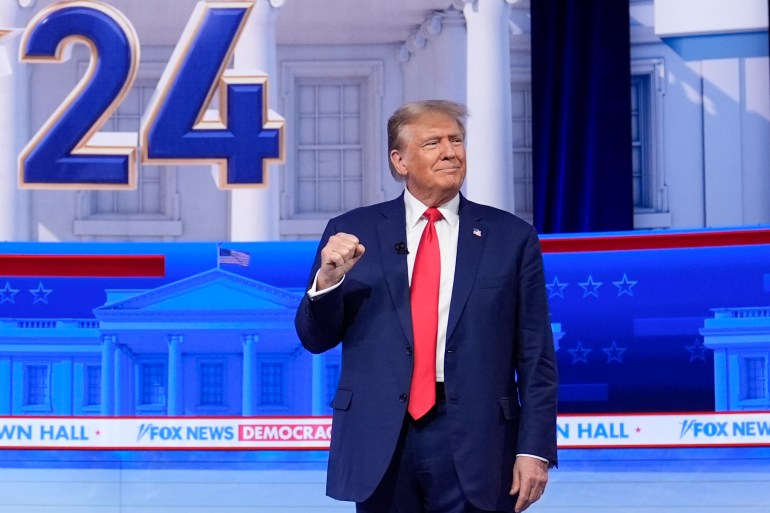
Writer E Jean Carroll is accusing the former US president of defaming her in 2019 by denying he had attacked her in a department store dressing room. Former US President Donald Trump has arrived in a New York courtroom to defend himself for a second time against charges that he defamed writer E Jean Carroll after she accused him of rape. Trump, who has said he wants to testify at the civil trial, sat two tables behind Carroll, who is accusing him of defaming her in 2019 by denying he had attacked her in a Bergdorf Goodman department store dressing room in Manhattan. Carroll, 80, is seeking at least $10m in damages. US District Judge Lewis Kaplan, who is overseeing the case, told prospective jurors on Tuesday that they would only have to consider how much Trump should pay Carroll in damages, not whether the alleged assault took place or whether Trump lied about it. He added that the trial is expected to last three to five days. Former President Donald Trump arrives for a Fox News Channel town hall in Des Moines, Iowa, the US [Carolyn Kaster/AP] Trump has cast himself as the victim of political persecution and said Kaplan should dismiss the case. “Judge Kaplan should put this whole corrupt, Crooked Joe Biden-directed Election Interference attack on me immediately to rest,” he said on social media. “He should do it for america.” Trump has so far pleaded not guilty in four criminal cases that could potentially land him in prison before the November presidential election, including two that accuse him of trying to overturn the results of the 2020 election. He is also the defendant in at least two other civil cases. But Trump has already lost one defamation case against Carroll. In May last year, a jury ordered Trump to pay the former Elle columnist $5m for having sexually abused her during the encounter and defaming her. Trump has said that he did not know Carroll and that she made up the encounter to sell her memoir. He is also appealing the $5m award. Kaplan, who also presided over that case, said he has barred Trump from arguing that he did not defame or sexually assault Carroll or that she made up her account. In recent weeks, Trump has ramped up his attacks on Carroll, including saying she did not know the decade of their encounter. He also called Kaplan “terrible, biased, irrationally angry”. Trump may face an uphill fight to escape significant additional damages because of Kaplan’s pre-trial rulings. These include banning Trump from suggesting he did not rape Carroll, as New York’s penal law defines the term, because the first jury did not find that Trump committed rape. Kaplan has ruled that because Trump used his fingers in the assault, Carroll’s rape claim was “substantially true.” Trump also cannot discuss DNA evidence or Carroll’s sexual activities, or suggest that Democrats are bankrolling her case. Carroll is a Democrat. And as happened at the first trial, jurors will be able to see the 2005 video from Access Hollywood video where Trump graphically described the ability of famous people like himself to have sexual relations with beautiful women. Trump did not retract his comments when asked about them in a 2022 deposition. Kaplan has said the video could offer “useful insight into Mr. Trump’s state of mind” toward Carroll. Trump lawyer Alina Habba on Sunday assured Kaplan that he was “well aware” of the court’s rulings “and the strict confines placed on his testimony”. Adblock test (Why?)
Polish truckers agree to suspend border protest until March

Truck drivers had blocked border since November, demanding restrictions be reintroduced for Ukrainian hauliers. Polish truckers have agreed to suspend a protest that had blocked some border crossings with Ukraine since November, the infrastructure minister says. The hauliers confirmed the suspension until March but warned they would return to the border if their demands are not met. “We’ve signed an agreement. The outcome of the agreement will be the discontinuation of protests at road border crossings in three towns: Korczowa, Hrebenne, Dorohusk,” Infrastructure Minister Dariusz Klimczak said on Tuesday. He said that while drivers have agreed to stop protesting for nearly two months, talks were still ongoing. Truckers are demanding that the European Union reinstate a system for Ukrainian companies requiring a permit to operate in the bloc. The truckers also want empty trucks from the EU to be excluded from an electronic queueing system in Ukraine. The bloc waived the permit system after Russia mounted a full-scale invasion of Ukraine in February 2022, but Polish hauliers said the move created unfair competition from Ukraine and took a toll on their earnings. Their protests created kilometres-long lines of trucks at the border as they tried to cross from Poland to Ukraine. Protest co-organiser Rafal Mekler confirmed the agreement to suspend the border protest. “The government is undertaking several commitments within the specific timeframe that are intended to fulfil the protest demands,” he said on X, formerly Twitter. “If we don’t manage to reach a solution, we will return to the border. … This is not capitulation but a strategic pause.” The agreement, which Mekler posted on X, sets out several actions the government committed to, including launching talks with the European Commission towards securing financial support for Polish hauliers. Another one of the organisers in Dorohusk, Edyta Ozygala, also warned that the action could be renewed at any time. “If the effects are unsatisfactory, we will come back,” she said. Ukrainian trucks are parked near the Poland-Ukraine border near the Polish village of Korczowa in November 2023 [File: Yan Dobronosov/Reuters] Ukraine says the protests have caused the country economic losses and affected its war efforts. It said cross-border transportation has increased because of the war and because its main export and import routes across the Black Sea have been blocked. “The key reason for the growth in the number of transportations by Ukrainian hauliers is the response to the consequences of the Russian armed aggression,” Ukrainian Deputy Prime Minister Oleksandr Kubrakov said on social media on Monday. “Transportations of fuel, humanitarian and military cargo take up about 20% of total traffic.” The main points of the agreement include monitoring of solutions worked out jointly by Poland and Ukraine to ease the situation of EU-registered drivers in Ukraine, talks with the EU on its agreement with Ukraine and talks with the European Commission on financial support for Polish haulage companies. The deal will provide more road checks to stop Ukrainian truckers from providing services not offered under the EU-Ukraine agreement. Adblock test (Why?)
Israel’s new $15bn war budget: What’s it for and what gets cut?

Waging war is a costly business for any state – and raising the funds required to fight one can be laden with political controversy. But when that state’s cabinet is volatile, mistrustful and deeply divided, then the stakes can be higher still. Indeed, the 37th government of Israel has rarely enjoyed much harmony since it took office about a year ago. Three months into its war on Gaza, it was clear the funds assigned to the war efforts were not enough despite an emergency injection in December of nearly 30 billion shekels ($7.85bn), mostly funded through increased borrowing. On Monday, Netanyahu’s cabinet approved an increased budget for 2024, which allocates an additional 55 billion shekels ($15bn) for the war as well as increased funding for other departments despite fraught deliberations that caused the education minister, Yoav Kisch, to storm out in a rage when proposals to cut funding to his department were put forward. In the end, after an all-night meeting, Kisch’s concern was allayed when Prime Minister Benjamin Netanyahu announced an increase in the education budget as well as the health budget. Why did Israel’s budget need to be amended? The Israeli cabinet first met on Sunday to augment the two-year budget for 2023 and 2024, originally amounting to $270bn, which it had approved in May. Netanyahu, who has become a deeply unpopular figure in Israeli society, began by stating the government’s budget aims. “What is required now is, first of all, to cover the expenses of the war and to allow us to conduct the war in the coming year and complete it, including eliminating Hamas, returning our hostages and restoring security and the sense of security in both the north and the south so that the residents can return there,” he told his cabinet. It’s one thing to make bold wartime declarations but quite another to pay for them, not least in the face of shocking statistics. Israel’s war on Gaza – which has killed more than 24,000 Palestinians, with thousands more lost under the rubble and presumed dead, and has injured tens of thousands more – has cost the country about $269m each day since it began on October 7. The Bank of Israel estimated that war-related costs for 2023 to 2025 could amount to $55.6bn. This makes troubling reading for a country that, feeling the financial pinch that often comes with waging a war, posted a budget deficit of 4.2 percent of its gross domestic product (GDP) in 2023, compared with a 0.6 percent surplus the year before. As a result of this new budget, the deficit for 2024 has widened to 6.6 percent of Israel’s GDP. What is in the amended budget? The new, 582-billion-shekel ($155bn) budget for 2024 has been reached by cutting funding for government departments by an average of 3 percent and increasing spending by $18.6bn. After the cabinet agreed on the budget, Netanyahu hailed the “increases to … the internal security budget, but most importantly, the defence budget, which is simply essential for victory and for our future”. The fractious Israeli coalition government – which includes the political parties Likud, United Torah Judaism, Shas, Religious Zionism Party, Otzma Yehudit, Noam and National Unity – is the most right-wing in the country’s history. However, National Unity, led by Netanyahu rival Benny Gantz, voted against Monday’s financial plan after its bid to push for more cuts, including from the $2.15bn pot given over to so-called coalition funding in 2022, was rejected. These funds include money to fund the ongoing construction of Israeli settlements in Palestinian territories, which, despite being illegal under international law, continue to expand. Yossi Mekelberg, an associate fellow with the Middle East and North Africa Programme at London’s Chatham House, told Al Jazeera that the coalition funding deal struck between Netanyahu and the ultra-Orthodox members of his government is still much-wanted by ministers. “They still want the coalition agreement that allocates money to their causes,” Mekelberg said. In the end, this fund saw only a small cut of $663.5m. The additional money will buy military hardware for starters as well as pay Israel’s 360,000 army reservists . Also included are funds to support the more than 100,000 Israelis evacuated from communities bordering Gaza and neighbouring Lebanon, where Israeli forces are clashing with Hezbollah, the Lebanese resistance group. “We changed the priorities so that every reservist and every fighter and his family knows that there is a government that stands behind him and fully takes care of him,” Finance Minister Bezalel Smotrich said after the budget was approved. As a country at war, safeguarding Israel’s internal security was a crucial consideration too. The far-right national security minister, Itamar Ben-Gvir, who himself lives in an illegal settlement in Hebron in the occupied West Bank, had previously threatened to withdraw his support from any budget that stripped money away from his ministry. Ben-Gvir is leader of the Otzma Yehudit, or Jewish Power, party, which espouses anti-Palestinian policies. His department duly received an extra $534m in the new budget. Could Israel run out of money for its war? Funds probably will not dry up in the short term. Whatever the pressures on Israel’s finances as a result of its war on Gaza and raids on the West Bank, the Israeli state can likely rely on unwavering United States military and financial support. In November, the US House of Representatives greenlit legislation to provide $14.5bn of military aid to Israel in addition to the $3.8bn given to the country each year. It has yet to pass the Senate. Israel’s new budget also faces legislative scrutiny. It will now be referred to the Knesset, where three votes are required for it to become law. In the longer term, and despite current strains on the country’s finances, Mekelberg said the “Israeli economy can recover – and recover relatively quickly” but only if Israel finds a way to end the war. This will require real leadership, he added. With the war on Gaza now more than
UK takes centre stage in Red Sea action, targeting Yemen’s Houthis

As an ally of Ukraine, the United Kingdom has been an outspoken opponent of Russian aggression and moved first to provide Ukraine with tanks and long-range missiles. As a participant in the multinational naval force working to neutralise the threat from Yemen-based Houthis to international shipping, it has raised its own military profile on the world stage. “We’ve acted at the forefront of global responses to maintain regional stability,” UK Defence Secretary Grant Shapps said in a speech to Lancaster House on Monday. In October, after the Palestinian group Hamas attacked Israel, the UK was among the first countries to send a Royal Navy task group, marines and surveillance planes off Israel. Last December, after Yemen-based Houthis attacked international shipping in support of Hamas, the UK joined the US to lead the multinational Operation Prosperity Guardian in the Red Sea. On Friday, that force struck Houthi military sites after the Houthis targeted HMS Diamond and US Navy vessels with 21 drones and missiles. The UK used four RAF Typhoon FGR4s to drop Paveway IV guided bombs on two facilities, a site at Bani used to launch reconnaissance and attack drones, and the airfield at Abbs, used to launch cruise missiles and drones. “Early indications are that the Houthis’ ability to threaten merchant shipping has taken a blow,” said the Ministry of Defence in a statement. The UK has been raising its military profile globally and its defence budget at home. Shapps said defence spending, already at 50 billion pounds ($63bn) this year, would rise to 2.5 percent of gross domestic product (GDP) as soon as possible, and he called on other NATO allies to follow suit. The justification for the Red Sea action has been to protect global trade. Some 15 percent of the world’s marine traffic passes through the Bab al-Mandeb Strait, which separates the Indian Ocean from the Reds Sea. From there it reaches Europe through the Suez Canal. Among the most affected are container ships, bringing manufactured products from China to the European market. When Moller-Maersk, the world’s largest operator of container ships, said it was diverting its vessels around Africa on January 5, it prompted other shippers to do the same. The diversion adds about 10 days shipping time, increases costs and could inflate prices. Maersk made its decision after Houthis attacked the Maersk Hangzhou on January 2. Oil tankers have been the other large category of ships affected, since they use Suez to bring Middle Eastern oil to European refineries. One-third of the world’s oil is moved by Greek-owned ships. “Greek tanker businesses have been monitoring the situation in the Red Sea for some time now – well before the most recent events,” an adviser to a Greek tanker operator told Al Jazeera, preferring to remain anonymous. “Incidents that were widely reported off Yemen in the last quarter of 2022 alerted everyone to the need to adopt a prudential stance.” Not everyone in Europe has seen a similar need for the use of force. “There’s a wider question about the extent to which this was legal self-defence under Article 51 of the UN Charter,” international relations professor at Panteion University in Athens Angelos Syrigos told Al Jazeera. “Nothing … shall impair the inherent right of individual or collective self-defence if an armed attack occurs against a Member of the United Nations,” the article says. “Italy is hiding behind the need for parliamentary approval [of military force],” said Syrigos. “France and Spain are saying, ‘We don’t want to solve this through force because that risks escalation,’” he said. “It is a huge problem, it is a consequence of other [war] outbreaks. I would not like to open a third front of war at this time,” Italian defence minister Guido Crosetto told Reuters, in a reference to current conflicts in Ukraine and Gaza. Crosetto has also called on Ukraine to open negotiations with Russia. The risk of escalation is certainly present. Both Hamas and the Houthis are armed by Iran. A third Iran proxy, Lebanon-based Hezbollah, has also threatened to attack Israel. And there is the risk of Iranian direct involvement. On January 11, Iran seized an oil-filled tanker in retaliation for the confiscation by US authorities of a sanctioned Iranian oil cargo last year. An escalation could be a significant military challenge. The Israeli army is still fighting Hamas after more than three months of bombing and commando operations. Hezbollah is said to possess 150,000 rockets. And the Houthis may still have powerful weapons. They attacked a US-owned ship three days after the punitive attacks by the US and UK. The London-based International Institute of Strategic Studies believed Iran had provided the Houthis with Sayyad and Quds 800km (500-mile) range missiles as well as 500km (300-mile) range missiles with 300kg (660-pound) warheads. “Although the Houthis have linked their campaign against shipping to the ongoing fighting between Israel and Hamas, the weapons were being provided by Iran well before the Israeli–Hamas conflict erupted in October 2023,” wrote the IISS’s Fabian Hinz in an IISS blog. “That suggests a strong, long-term Iranian focus on strengthening Houthi anti-ship capabilities and a potential attempt to export Iran’s model of naval coercion from the Persian Gulf and the Strait of Hormuz to the geopolitically important Red Sea and Bab el-Mandeb Strait.” The UK has nonetheless determined that an advance defence is the best deterrent against possible future hostilities by other actors. “The era of the peace dividend is over,” said Shapps, referring to the post-Cold War years. “In five years time, we could be looking at multiple theatres involving Russia, China, Iran and North Korea.” “Ask yourselves – looking at today’s conflicts across the world – is it more likely that the number grows, or reduces? I suspect we all know the answer – it’s likely to grow.” The UK is about to field 36,000 soldiers overseas – its highest number of land forces in 40 years. There may be other reasons, too, why the British government is putting itself
Remembering Refaat Alareer, in the words of his student

Gaza City – I first met Dr Refaat in 2015 in Gaza City. He was a guest speaker at The English Club to discuss the book he edited, Gaza Writes Back: Short Stories from Young Writers in Gaza. It was a collection of short stories by 15 young writers, and a couple by Dr Refaat, that delved into the experience of growing up in Gaza and the writers’ experiences during the 2008-2009 Israeli assault on the enclave. We were all aspiring writers of a sort, we ranged from 13 to 17 years old, and I think most of us underestimated what being an English major could be like. We thought we were learning everything we needed to learn right there in the English Club. Then we met Dr Refaat. He was so impressive, the hall was completely quiet – we were all absorbing his speech, his mannerisms; we were moved by his story. Steering his own course Dr Refaat told us his story of rebellion, how he decided to major in English when his father wanted him to study medicine. He was determined to steer away from the sciences, though, so he told us he intentionally failed in his chemistry and physics exams to convince his father that he needed to move to the literary stream. “I had to make my father proud, but I hated math!” he explained to an amused audience. [embedded content] His father wasn’t happy with this but later, Dr Refaat ranked second in all of Palestine on his high school exams. And he went on to major in English. The discussion went on for a while and by the end, I think we were all aware that we should not have underestimated English as a major. Four years later, I was finally done with high school and had to pick a university. I decided to go with the “strict” Islamic University instead of other colleges in Gaza. He was teaching there and I wanted to hear him talk about literature again. I was warned by some upperclassmen about going into the English programme at the Islamic University. “Dr Refaat is tough and not friendly, but he is intellectually stimulating,” they said, concluding with “You have to decide.” They were right, Dr Refaat as a teacher was tough but fair and his rules were clear: “If you want to feed your nerdy side, you have to be willing to give every minute to pass my course. Otherwise, take it with another lecturer.” I think he must have gotten a sense of satisfaction when he was offering a course that no other lecturers were offering. Maybe he enjoyed torturing his students, but it’s probably more that he wanted to make sure that they learned everything properly, it was in their best interests. A photo of Refaat Alareer is displayed at a protest for a ceasefire and a free Palestine at Breslauf Square in Cologne, Germany, on December 9, 2023 [Ying Tang/NurPhoto via Getty Images] “Literature provokes more questions than answers,” he would say. “I won’t give you answers, you have to do that for yourself.” Another Dr Refaat In 2022, I was accepted into a writing workshop that Dr Refaat was teaching, needless to say, I was happy. And in that class, there was a whole other Dr Refaat – unlike the formal man behind the university podium, he was open and friendly with all his students. He taught us everything he knew about literature, writing and translation. And so we shifted that term between a formal Dr Refaat teaching Shakespeare and the friendly one in the writing training. It’s magical how a loaded, two-hour class feels like a minute when the lecturer is teaching that way. It was August 2022 when I got paid for a job for the first time. I brought Dr Refaat a pizza, his favourite, to thank him for teaching me the skills I needed. Without Dr Refaat, I would still be scribbling, not daring to share a word I wrote. I wouldn’t know how a pun works, what a metaphor is or how to be a loyal translator. On January 1, 2023, my first story was published and Dr Refaat was the first one I sent it to, worried because I knew he was hard to please. He “liked” the link but didn’t say anything, I so wanted to hear his opinion. Two months later, he commented on an article I had translated and said: “I liked your Hamlet story too.” That made my day. A last chance When I became a senior last year, I managed to do a course with him in the summer semester, and it was worth the juggling I had to do to manage to attend. What I didn’t know back then was that it would be the last time he would teach me. On December 7, my literary father figure, my role model, Dr Refaat was martyred in the “safety” of his home. On December 7, the world lost a great educator, a free soul, a remarkable storyteller, a powerful man and a father. Dr Refaat lived his way. Dr Refaat taught me everything I know. Your heart lives inside our hearts. You will always be remembered. You shall never be forgotten. [embedded content] Adblock test (Why?)
What we know about Iran’s strikes on northern Iraq

NewsFeed Iran’s strikes on what it called “enemy sites” in Iraq and Syria come at a time of heightened fears that Israel’s war on Gaza could spill over to a wider regional conflict. Published On 16 Jan 202416 Jan 2024 Adblock test (Why?)
Italian football club Roma sack manager Jose Mourinho

Mourinho was sacked two days after a 3-1 loss at AC Milan left the club in ninth place in Serie A. Jose Mourinho is leaving Roma “with immediate effect”, the club has announced – ending an at times successful but also turbulent stay in the Italian capital for the veteran coach. The move came two days after a 3-1 loss at AC Milan left Roma in ninth place in Serie A and at risk of missing the Champions League for a sixth straight season. Roma were also eliminated by Lazio in an Italian Cup derby last week. Mourinho was in his third season at Roma and his contract was due to expire in June. He led the Giallorossi to the UEFA Conference League title in his first season and Roma were Europa League finalists last season. But Mourinho was also given a series of bans for his protests and tirades against referees – which was clearly not appreciated by Roma’s American owners. Mourinho was banned by UEFA from four European games for verbally abusing the Europa League final referee in a stadium garage after Roma lost to Sevilla. He was also suspended for the game at Milan on Sunday due to protests. “AS Roma can confirm that Jose Mourinho and his coaching staff will leave the club with immediate effect,” the club said in a statement on Tuesday. “We would like to thank Jose on behalf of all of us at AS Roma for his passion and efforts since his arrival at the club,” said owners Dan and Ryan Friedkin. “We will always have great memories of his tenure at Roma, but we believe that an immediate change is in the best interests of the club.” Roma added that updates on the coaching staff “will follow imminently.” Former Roma captain Daniele De Rossi is being mentioned as a possible caretaker, while there have been reports that ownership is trying to hire Antonio Conte for next season. Adblock test (Why?)
Northern Iraq hit by Iranian missile strikes

NewsFeed Northern Iraq has been hit by missiles launched by Iran’s military, which says it was targeting “espionage centres” linked to Israel and other “anti-Iranian” groups in the Kurdish region. Officials there say that civilian areas were hit and that at least four civilians were killed. Published On 16 Jan 202416 Jan 2024 Adblock test (Why?)
Israel’s war on Gaza: List of key events, day 102

EXPLAINER Gaza suffers its seventh communications blackout since October 7 amid relentless Israeli strikes in the Palestinian enclave. Here’s how things stand on Tuesday, January 16, 2024: Latest updates and human impact Iran’s Islamic Revolutionary Guard Corps have claimed responsibility for five ballistic missiles that struck the city of Erbil in the semi-autonomous Kurdish region of Iraq. The attack occurred late on Monday night, killing at least four people and injuring another six, according to the Kurdistan government’s security council. Israeli attacks killed at least 25 people in Gaza on Monday night, including 11 Palestinians from two families in Miraj, in the north of Rafah, reported Palestinian news agency Wafa. At least 24,100 Palestinians have been killed in Gaza since October 7, and 60,834 others have been injured, according to Gaza’s Ministry of Health. Hamas appeared to show the bodies of two Israeli hostages in a video released on Monday, claiming that they were killed by Israeli air strikes. In the seventh communications blackout since October 7, telecommunication services in Gaza remained shut down for the third consecutive day on Monday, according to the United Nations Office for the Coordination of Humanitarian Affairs (UN OCHA). Diplomacy In a post to X on Tuesday, United Nations Secretary-General Antonio Guterres called for sexual violence claims against Hamas to “be rigorously investigated and prosecuted”. Iran’s Foreign Minister Hossein Amirabdollahian described the United States and United Kingdom’s military strikes on Houthi targets as a “strategic mistake” in a phone call on Monday with Guterres, according to the state-run Islamic Republic News Agency (IRNA). On Tuesday, Prime Minister Masrour Barzani of Iraq’s semi-autonomous Kurdish region called on Iraq’s federal government to take a “principled position” following Iran’s “cowardly attack” on the city of Erbil. He also said the strike was a “flagrant violation of Iraq’s and the Kurdistan region’s sovereignty”. Israel’s cabinet on Monday passed an amended 2024 state budget, adding $15bn for war, said the finance ministry and Prime Minister’s Office. West Bank raids and violence The Israeli army says it has redeployed an elite unit from Gaza to the occupied West Bank, where it says the situation is “spiralling”, reported Al Jazeera correspondent, Hamdah Salhut, on Tuesday. Dozens of Israeli settlers attacked Palestinian vehicles at dawn in the town of Sinjil, north of Ramallah after midnight on Monday, reported Wafa. On Monday, Israeli soldiers raided the home of Ahmed and Mohammed Zeidat, whom they accuse of carrying out a car ramming and stabbing attack in Raanana, near Tel Aviv, killing one person and injuring at least 14 others, according to Al Jazeera correspondent, Ayman Nobani. Adblock test (Why?)