

India’s Sakshi Malik quits over election of new wrestling federation chief
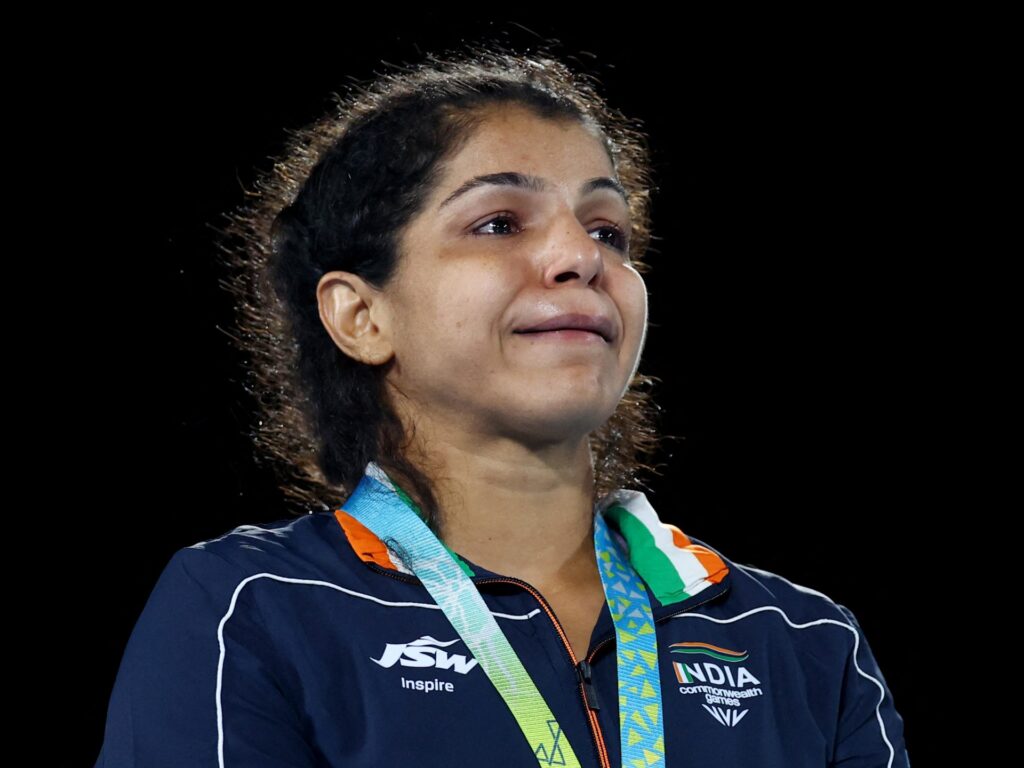
Top wrestler quits the sport after Indian wrestling body replaces the powerful president accused of sexual abuse with his close ally. A top Indian wrestler has announced she will quit the sport in protest after the country’s wrestling federation replaced a president accused of sexually abusing female athletes with his close ally. Sakshi Malik, an acclaimed wrestler who won a bronze medal at the 2016 Rio Olympics and led protests against Brij Bhushan Singh, the former chief of the Wrestling Federation of India (WFI), announced her retirement on Thursday. “We slept for 40 days on the roads and a lot of people from several parts of the country came to support us,” Malik, 31, told a news conference in New Delhi, referring to the protests earlier this year. “If Brij Bhushan Singh’s business partner and a close aide is elected as the president of WFI, I quit wrestling”, she said before leaving the conference with tears in her eyes. VIDEO | “We gathered a lot of courage for this fight against the WFI President (Brij Bhushan Sharan Singh). But today, his right hand (referring to Sanjay Singh) has been elected as the new WFI President. We had demanded a woman be made the president, but that has not been… pic.twitter.com/UMwOMRnnNI — Press Trust of India (@PTI_News) December 21, 2023 Malik became an outspoken voice over harassment and discrimination faced by female athletes in India, a plight underscored by charges filed against Singh in June accusing him of sexually harassing six female wrestlers, including a minor, during his time leading the WFI. Singh, who is also a six-time parliamentarian and member of Prime Minister Narendra Modi’s ruling Bharatiya Janata Party (BJP), denied any wrongdoing, dramatically stating then that he will hang himself if the accusations are proven to be true. Asked about Malik’s decision to quit, 66-year-old Singh on Thursday said, “I have nothing to do with it.” Singh was stripped of his administrative duties in January, and the government promised to investigate the accusations. But Malik and other athletes renewed their protests in April after the government refused to disclose the findings of a panel looking into the incidents. In recent months, Singh actively campaigned for Sanjay Singh to replace him and predicted his victory to the local press. On Thursday, the WFI voted to replace Brij Bhushan Singh with Sanjay Singh, who defeated Anita Sheoran, another contender for the presidency who had won a gold medal in the 2010 Commonwealth Games and had supported the campaign by the athletes to bring attention to the allegations of abuse. “It’s a very big victory of truth over lies,” Sanjay Singh told members of the media after securing 40 out of the 47 votes by the federation’s member institutions. He told reporters that he was committed to supporting wrestlers, but did not comment on Malik’s announcement. The United World Wrestling (UWW), the global wrestling body which suspended the Indian federation in August over the wrestlers’ protest, is yet to comment on the election. Adblock test (Why?)
Could Israel’s war on Gaza cause a wider conflict?
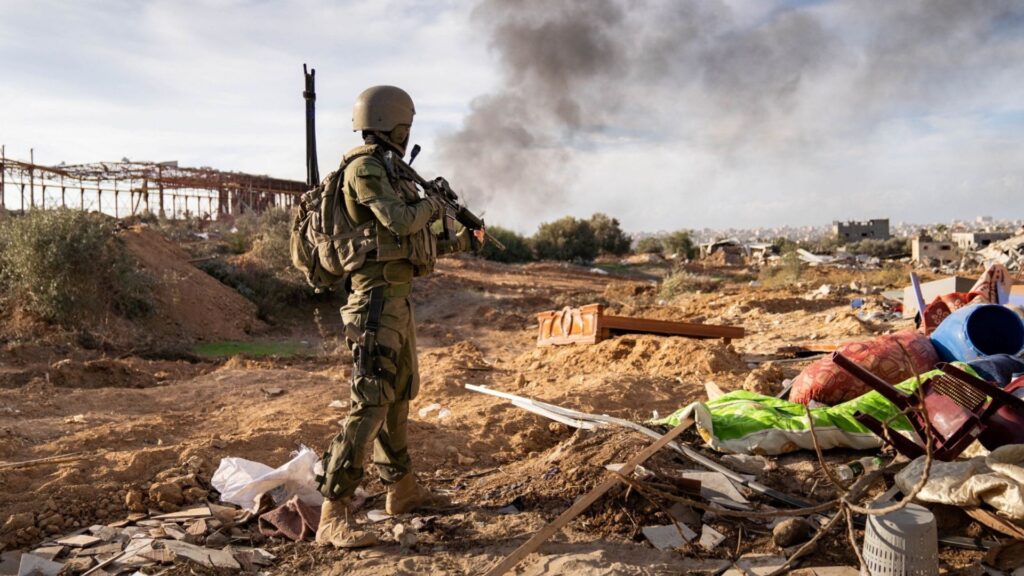
Regional tensions are rising over the US-backed war. More than 20,000 Palestinians killed in Gaza by Israel, armed and backed by the United States and European allies. More fighting nearby too: Hezbollah in Lebanon and the Houthis in Yemen among the groups involved. Could Israel’s war trigger a wider conflict? Presenter: Dareen Abughaida Guests: Omar Rahman – fellow at the Middle East Council on Global Affairs. He focuses on Palestine, Middle East geopolitics and American foreign policy in the region. Miko Peled – human rights activist and author of The General’s Son: Journey of an Israeli in Palestine, which is based on his experiences as the son of a former military governor of the Gaza Strip Elijah Magnier – military and political analyst who, as a former war correspondent, has covered more than 35 years of conflict in the Middle East and North Africa Adblock test (Why?)
Angola to leave OPEC over disagreement on oil production quotas

Oil minister says the country ‘gains nothing’ from remaining in the group after disagreements emerge over production cuts. Angola says it will leave the Organization of the Petroleum Exporting Countries (OPEC) over a disagreement regarding production quotas, a move that will bring the group down to 12 members. Speaking on public television on Thursday, Diamantino Azevedo, minister for mineral resources, petroleum and gas, said Angola, which produces about 1.1 million barrels of oil a day, is leaving OPEC because it was not serving the country’s interests. “We feel that … Angola currently gains nothing by remaining in the organisation and, in defence of its interests, decided to leave,” Azevedo was quoted as saying in a statement issued by the president’s office. Angola, which first joined OPEC in 2007, has struggled to meet production quotas over the past several years. The country is joining others, such as Qatar and Ecuador, that have left OPEC in the past decade. Questions about potential production cuts sought by leading oil producers such as Saudi Arabia have been a source of recent debate within the group. Without Angola, OPEC countries will produce about 27 million barrels of oil per day, about 27 percent of the global supply. But while Angola was a relatively small player in OPEC, the country’s departure has raised larger questions about the future of the organisation. Crude prices dropped by more than 1.5 percent after the announcement. “From an oil market supply perspective, the impact is minimal as oil production in Angola was on a downward trend and higher production would first require higher investments,” said Giovanni Staunovo, a commodity analyst with UBS. “However, prices still fell on concern of the unity of OPEC+ as a group, but there is no indication that more heavyweights within the alliance intend to follow the path of Angola.” Oil and gas make up about 90 percent of Angola’s exports and are a crucial economic lifeline for the country. Last month, Azevedo’s office protested against an OPEC decision to reduce its production quota for 2024, concerned that it would damage Angola’s ability to increase its output capacity. OPEC and its allies in OPEC+ have agreed to cut production to prop up oil prices. Angola’s production capacity peaked in 2008 at 2 million barrels per day but has dropped since due to ageing infrastructure. Adblock test (Why?)
Israel’s war on Gaza deadliest in modern history for journalists, CPJ says
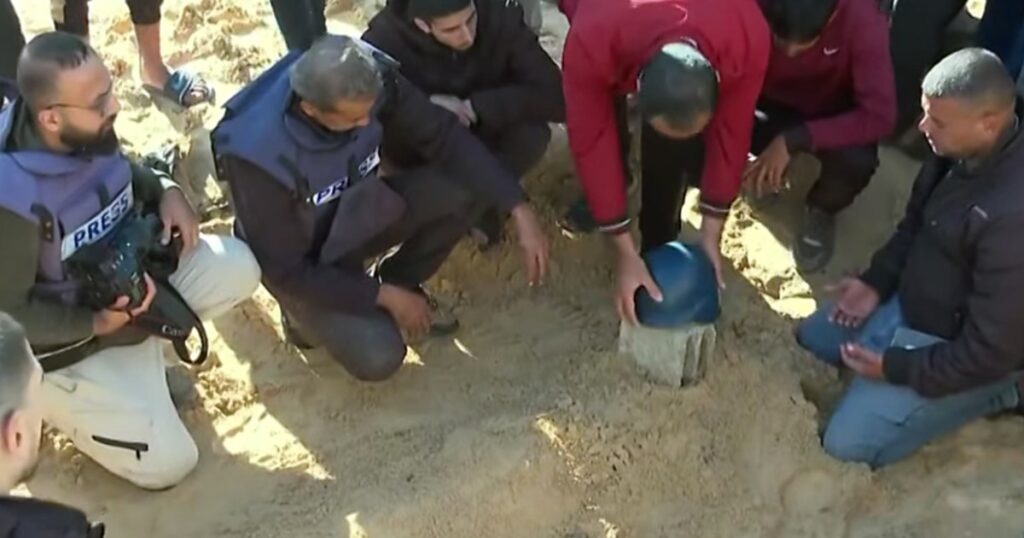
The Committee to Protect Journalists says concentration of reporters killed in Gaza ‘unparalleled’ in the group’s history. As Israeli forces pound the Gaza Strip, journalists are being killed at a rate with no parallel in modern history, a press freedom watchdog says. The Committee to Protect Journalists (CPJ) said on Thursday that 68 media workers have been killed in the 10 weeks of fighting – 61 of them Palestinian, four Israeli and three Lebanese. Among them is Al Jazeera cameraman Samer Abudaqa, who was killed in an Israeli drone strike last week while reporting from a school in Khan Younis. “More journalists have been killed in the first 10 weeks of the Israel-Gaza war than have ever been killed in a single country over an entire year,” the CPJ said in a statement. “More than half the deaths – 37 – occurred during the first month of the war, making it the deadliest single month ever documented by CPJ since it began recording journalist fatalities in 1992,” it added. The statement came as Palestinian reporters in Gaza continue to work under brutal conditions, facing constant bombardment, displacement and possible targeting by Israeli forces. The report drew attention to what CPJ called “an apparent pattern of targeting of journalists and their families by the Israeli military”, noting that it had recorded at least one instance in which a journalist was killed while wearing clearly marked press insignia with no fighting in the surrounding area. “The concentration of journalists killed in the Israel-Gaza war is unparalleled in CPJ’s history and underscores how grave the situation is for press on the ground,” CPJ President Jodie Ginsberg said. “Local Palestinian journalists continue to report from Gaza while living in fear for their lives.” The concentration of journalists killed in Gaza outpaces that of other conflict zones, such as Ukraine, Iraq, Syria and Afghanistan, it said. The CPJ said Iraq was the only country to approach the current death toll in Gaza when in 2006, 56 journalists were killed in the wake of the United States invasion of the Gulf country three years earlier. Another Al Jazeera journalist, Wael Dahdouh, lost his wife, son, daughter and grandson in an Israeli bombing last month and was wounded in the attack that killed Abudaqa. Al Jazeera has said it will refer Abudaqa’s killing to the International Criminal Court (ICC), stating that the strike took place within a context of “recurrent attacks on the Network’s crews working and operating in the occupied Palestinian territories and instances of incitement against them”. Adblock test (Why?)
EU top court rules FIFA, UEFA unlawfully blocked Super League plans
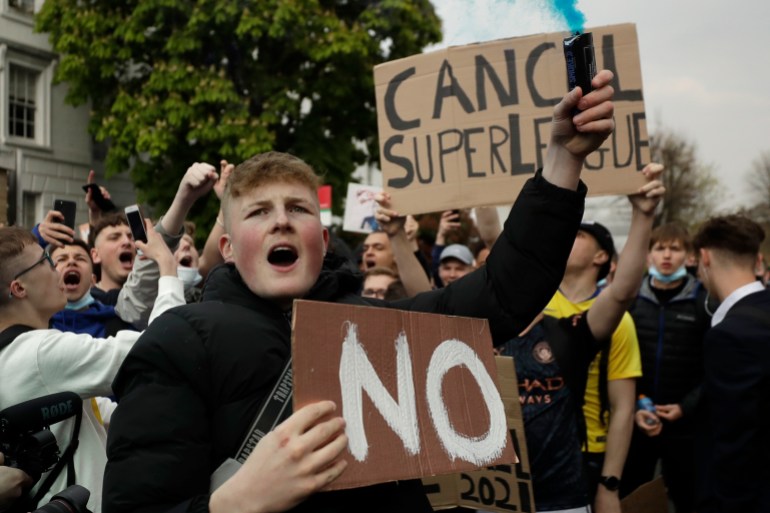
The two football governing bodies contravened law by stopping the formation of league, the European Court of Justice says. The European Union’s top court has ruled that UEFA and FIFA broke EU law in blocking the formation of a rival Super League competition. Thursday’s ruling by the European Court of Justice (ECJ) marks a serious legal setback for UEFA (Union of European Football Associations) and for football’s world governing body, FIFA. The court found that the two sporting bodies threatening to ban future Super League clubs and players from taking part in their competitions was illegal. “FIFA and UEFA rules making any new interclub football project subject to their prior approval, such as the Super League, and prohibiting clubs and players from playing in those competitions, are unlawful,” it said. In early 2021, 12 of Europe’s biggest clubs announced they had signed up to the planned Super League, triggering a furious backlash from fans and a stark warning from UEFA that clubs and players who took part would be barred from competitions like the World Cup. Chelsea fans protest in London against the club’s then decision to be included in a new European Super League [File: Matt Dunham/AP] Within 48 hours, nine of the 12 rebel clubs – including six from the English Premier League – backed down and the project collapsed, leaving promoters A22 Sports Management to launch a legal challenge through the Spanish courts, which referred the question to the ECJ. In response to the Super League threat, UEFA launched a major reform of the Champions League starting in 2024, with 36 teams involved instead of 32. The clubs will play in a single league competition, which will replace the current group stage, guaranteeing at least eight matches for each team. European clubs, leagues reject Super League Though the Super League organisers welcomed the ECJ’s ruling, major leagues and clubs moved quickly to support the status quo. Manchester United were one of the first to say they remained committed to playing in competitions run by UEFA, as did German champions Bayern Munich. “Our position has not changed. We remain fully committed to participation in UEFA competitions, and to positive cooperation with UEFA, the Premier League, and fellow clubs through the ECA on the continued development of the European game,” United said. Manchester City, Liverpool, Arsenal, Chelsea and Tottenham Hotspur were the other five Premier League clubs involved before pulling out. Bayern Munich said they were committed to UEFA competitions, saying the door for the Super League “remains closed” for the German champions. “The Bundesliga is the foundation of FC Bayern, just as all national leagues are the foundation of other European football clubs,” Bayern CEO Jan Christian Dreesen said. “It is therefore our duty and our deep conviction to strengthen them, not to weaken them. We are also committed to the European club competitions under the umbrella of UEFA.” The European Club Association (ECA), which represents nearly 500 clubs across the continent, said the football world had “moved on from the Super League years ago”. “Through ECA, clubs today are already at the heart of decision-making in relation to the competitions they participate in,” it said. “Most importantly, football is a social contract, not a legal contract.” France’s Ligue de Football Professionnel (LFP) said it “unequivocally supports” competitions organised by UEFA. The Italian Football Federation (FIGC) reiterated its intention to protect the national championships, “for the defence of the broader and more general principle of sporting merit and the respect of international calendars”. “The FIGC believes that the Super League is not a project compatible with these conditions and will always act in pursuing the general interests of Italian football,” it added. Adblock test (Why?)
What explains the dramatic rise in armed attacks in Pakistan?
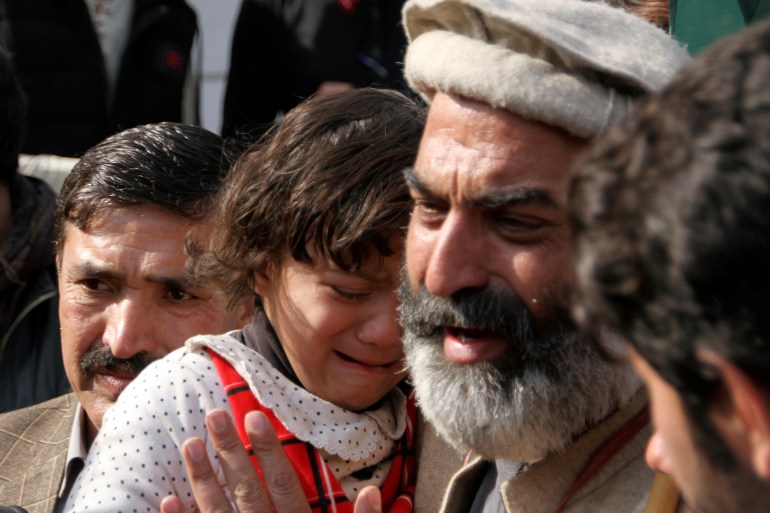
Islamabad, Pakistan – A recent deadly suicide attack on a military post in northwest Pakistan has raised fears of the return of armed rebellion in the country’s tribal regions that have seen a dramatic rise in armed attacks this year. A little-known group, Tehreek-e-Jihad Pakistan (TJP), claimed the December 12 bombing in Dera Ismail Khan district of Khyber Pakhtunkhwa province, which borders Afghanistan. At least 23 soldiers were killed and another 34 injured in the car bomb attack. The attacks by the TJP have brought back memories of the series of deadly attacks carried out by armed groups led by the Pakistan Taliban, known by the acronym TTP, in late 2000. But why have attacks on security forces increased and how are the Pakistani government and the military planning to handle it? What explains the surge in the attacks? The first 11 months of the year witnessed 664 attacks of varying nature and size across the country, an increase of 67 percent from the corresponding duration in 2022, according to the Pakistan Institute for Conflict and Security Studies (PICSS), an Islamabad-based research organisation. But the bulk of the attacks have targeted two provinces – Khyber Pakhtunkhwa in the northwest and Balochistan in the southwest. Almost 93 percent of the total attacks took place in these two provinces, with Khyber Pakhtunkhwa the worst affected province, witnessing 416 attacks since November 2022 when the TTP walked out of the ceasefire with the government. Pakistan Taliban’s ideology is aligned with the Taliban in Afghanistan, which currently rules the war-torn country. However, the groups have different goals and they operate independently. Family members of the victims of a suicide bombing in Peshawar weep as they take part in a march on February 1 denouncing armed attacks. [Muhammad Sajjad/AP Photo] In January, at least 100 people, mostly policemen, were killed in the worst attack of the year, when a suicide bomber blew himself up in a mosque in Peshawar, the capital of Khyber Pakhtunkhwa. The attack was claimed by a TTP splinter group, Jamaat-ul-Ahrar. The genesis for the spike in the violence, analysts say, could be traced back to the unilateral decision by the Pakistan Taliban to end the ceasefire last year. The armed group has asserted that its attacks were in response to the renewed military operations in the region. Among their main demands include the release of its members and the reversal of the merger of the tribal region with the Khyber Pakhtunkhwa province. A stricter imposition of their interpretation of Islamic laws is also one of the demands. The Pakistani army has conducted multiple operations to eliminate the group since 2002 but struggled to achieve its goal as fighters have used the porous border to find safe haven in Afghanistan. Since its founding in 2007, the TTP has targeted both civilians as well as law enforcement personnel, resulting in thousands of deaths. Their deadliest attack came in December 2014, when they targeted the Army Public School (APS) in Peshawar, killing more than 130 students. The TTP also claimed responsibility for shooting Malala Yousafzai in 2012. Yousafzai went on to win the Noble Prize for Peace in 2015 and is currently a globally renowned girls’ education activist. The most disconcerting aspect of TJP lies in its implementation of suicide attacks. by Abdul Sayed, a Sweden-based researcher The group remains banned in Pakistan and has been designated a “terrorist” group by the United States. Formed to unify like-minded groups in the region, the TTP stepped up attacks in response to Pakistani military operations launched to flush out foreign fighters fleeing the US invasion of Afghanistan in 2001. In response to the APS attack, the Pakistani military launched a large-scale military operation, titled Zarb-e-Azb, against the armed groups. While the Pakistani army claimed it was able to achieve its objective, the military operation was harshly criticised by the local population as well as human rights organisations. The military was accused of adopting scorched earth tactics and carrying out enforced disappearances of individuals accused of having links with the TTP. Many of those arrested were tried in a military court, which is considered contrary to international law. Which groups have sought to claim responsibility for the recent attacks? With the return of the Taliban government in Afghanistan in August 2021, which has had historical links with the Pakistani security establishment, it was believed that managing the TTP would become easier. A month after the Taliban took over Kabul, it helped facilitate the meeting between the Pakistani military with the TTP for both sides to engage in a ceasefire talk, a decision endorsed and pushed by Imran Khan, Pakistan’s then-prime minister. Subsequently, over the next few months, a tentative ceasefire led to the release of senior TTP leaders imprisoned by Pakistan. It also facilitated the resettlement of hundreds of TTP fighters and their families back to Pakistan. Some of their leaders had been released as part of peace deals with previous Pakistani governments. However, low-scale skirmishes between the two sides continued well into 2022, with both sides accusing each other of violating the agreement. The January 31 suicide blast targeting a mosque inside a police facility was one of the deadliest attacks on Pakistani security forces in recent years. [Muhammad Zubair/AP Photo] Despite repeated meetings, in Pakistan and Afghanistan, the growing distrust between the two sides increased. The removal of Khan as prime minister in April 2022, followed by the retirement of army chief General Qamar Javed Bajwa in November 2022, did not help the cause. The TTP announced a unilateral end to the ceasefire days after Bajwa retired. The emergence of an obscure TJP, believed to be affiliated with the TTP, has further raised concerns among policymakers. TJP has been behind at least seven major attacks this year, including the latest one in Dera Ismail Khan. The group targeted a Pakistani Air Force airbase in Mianwali city in November and in another attack this year in Zhob city of Balochistan it killed at least 14 army personnel. According
UN calls for probe as Israeli army accused of killing unarmed Palestinians
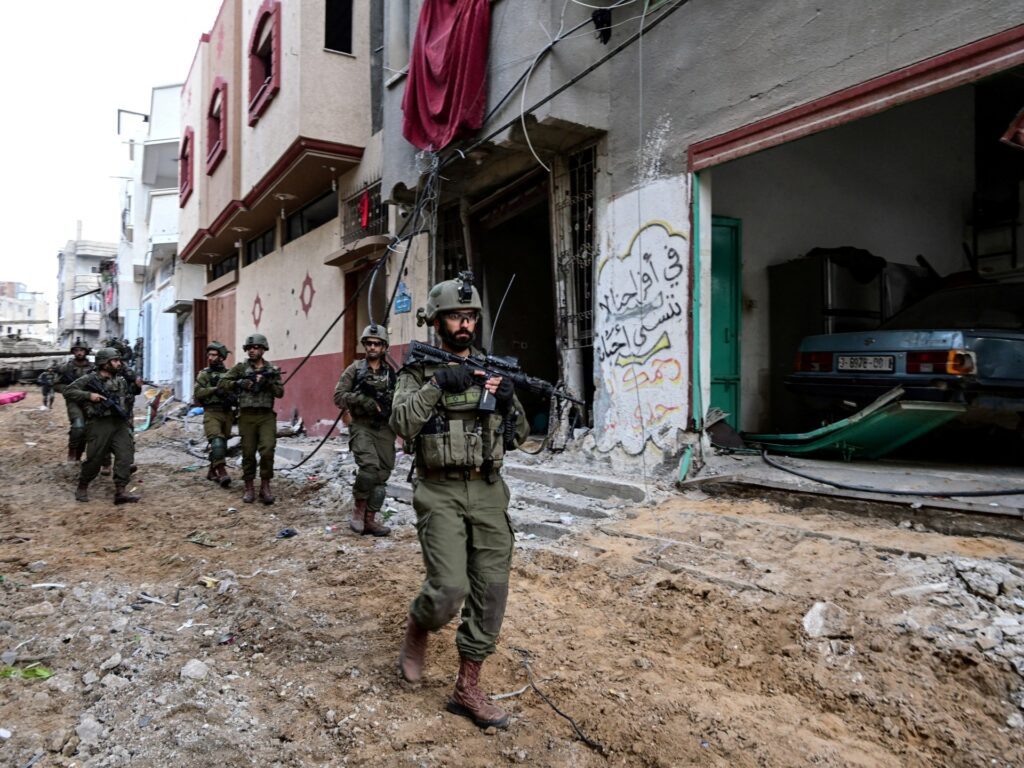
UN rights office calls for investigation into ‘possible war crime’ amid reports Israeli forces allegedly ‘executed’ 11 Palestinian men in Gaza. The United Nations human rights office has called for an independent inquiry into allegations that Israeli forces “summarily executed” at least 11 Palestinian men in Gaza in what it called “a possible war crime”. “The Israeli authorities must immediately institute an independent, thorough and effective investigation into these allegations, and if found to be substantiated, those responsible must be brought to justice and measures implemented to prevent any such serious violations from recurring,” said the Office of the UN High Commissioner for Human Rights (OHCHR) in a statement on Wednesday. Disturbing information on summary killings of at least 11 unarmed Palestinian men in front of their family members in Al Remal neighbourhood.#Gaza #opt #IHL #humanrightshttps://t.co/Gf0GdyDPAZ — UN Human Rights OPT (@OHCHR_Palestine) December 20, 2023 Al Jazeera spoke to several witnesses to Tuesday’s raid during which Israeli troops allegedly surrounded and stormed a residential building, going floor to floor to separate the men from the women and children, and then shooting dead 11 of the men in front of their family members. The men were in their 20s and 30s, survivors said. “They saw us, men and their wives and children. My brother-in-law tried to speak and explain all in the house are civilians, but they shot him dead,” one survivor told Al Jazeera of the attack on families who were sheltering in al-Adwa building in Gaza City’s Remal neighbourhood. The soldiers “forced their way into every home, killed the men and detained the women and children. We do not know their whereabouts. They did the same on every floor. All women were rounded up in one room. By the time they reached us on the sixth floor, they started shooting all men,” a woman said, adding that her father-in-law and son were shot and killed instantly. Survivors also said that the Israeli soldiers also attacked the women and children after ordering them into a room in the residential block also known as Annan building. “The Israeli soldiers rounded up all the women in one room, then fired three mortar shells on us, then kept shooting their machine guns at us,” a wounded woman said. “I was hit with a bullet in my hand, my daughter in her head, my younger daughter was killed and my son is blind. My husband was executed in cold blood. All my other daughters suffered severe injuries, broken bones and flesh torn open. We were all hit by bullets or shrapnel,” she added. Analyst Tamer Qarmout, an assistant professor at the Doha Institute for Graduate Studies, welcomed the UN call for an investigation into the “unlawful killings”, telling Al Jazeera that the key issue is how such probes are going to be conducted. None of the entities that could investigate alleged Israeli crimes against Palestinians is currently allowed into the Gaza Strip, Qarmout noted. Other witnesses recalled that the men were forced to strip before being shot, and one man said that “even young boys were not spared. They were all battered and bludgeoned. They suffered broken bones and are in hospital.” There has been no comment from the Israeli military on the attack. Adblock test (Why?)
Greece to join US-led coalition to protect Red Sea shipping from Houthis
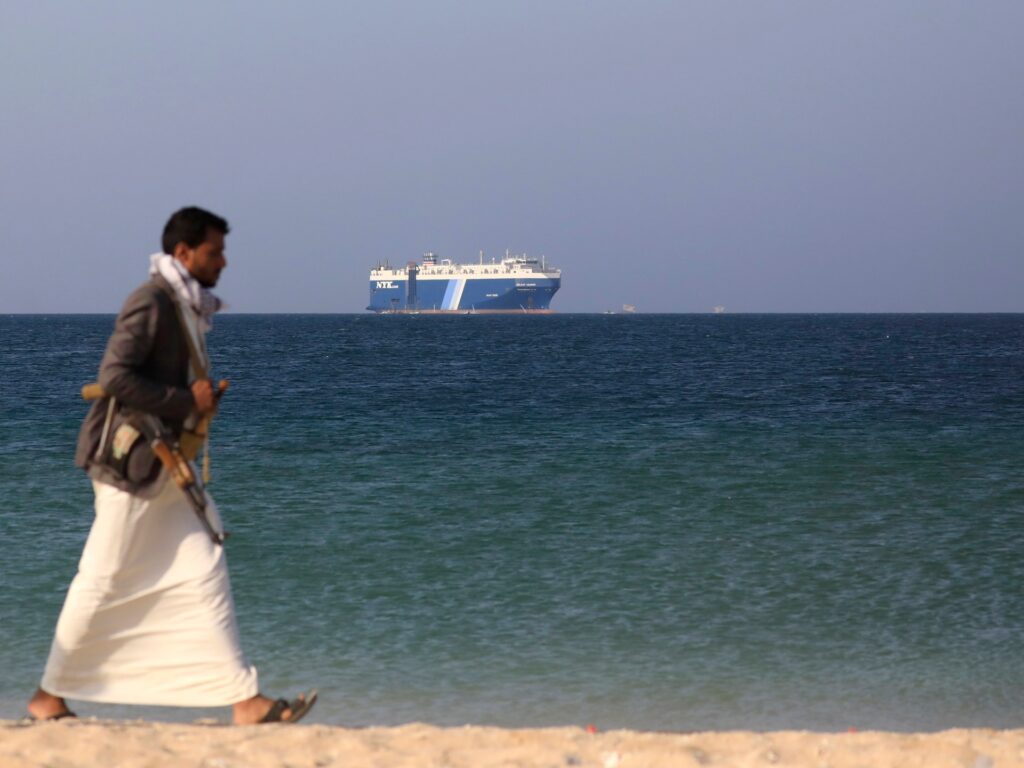
The maritime alliance wants to counter threats that the Yemeni rebel group says are a response to Israeli ‘crimes’ in Gaza. Greece will send a warship to support a United States-led naval coalition in the Red Sea, becoming the latest country to join the alliance to counter threats from Yemen’s Houthis. Defence Minister Nikos Dendias announced the move in a televised address on Thursday, saying Greece, as a major shipping nation, has a “fundamental interest” in addressing the “massive threat” to maritime transport. The naval task force, announced by the US on Tuesday, initially listed 10 member nations to help patrol the waters to deter the Iran-aligned Houthis, who have attacked more than a dozen vessels they claim were linked to Israel amid the war on Gaza. The Houthis say they will halt their attacks only if Israel’s “crimes in Gaza stop”. The original members of the Red Sea task force – called Operation Prosperity Guardian – include the United Kingdom, Bahrain, Canada, France, Italy, Netherlands, Norway, Seychelles and Spain. Since then, Denmark has also joined the alliance, according to the Reuters news agency. Meanwhile, the European Union member states have agreed to contribute through the European Naval Force. Australia stopped short of committing its warships to the alliance but said on Thursday it would send 11 military personnel to support the mission. ‘Will not stand idly by’ Despite the Western show of force, the Houthis have promised to continue their attacks on vessels travelling to or from Israel for as long as the Gaza war goes on, saying operations will not cease even if the US mobilises “the entire world”. On Wednesday, Houthi leader Abdel-Malik al-Houthi warned the group would not hesitate to strike US warships if Washington targeted it. “We will not stand idly by if the Americans are tempted to escalate further and commit foolishness by targeting our country or waging war against it,” al-Houthi said in a televised speech. “Any American targeting of our country will be targeted by us, and we will make American battleships, interests, and navigation a target for our missiles, drones, and military operations,” he added. In recent months, Houthi drone attacks and attempted hijackings have pushed more than a dozen shipping firms to suspend operations in the Red Sea, through which 12 percent of all global trade passes. On Thursday, the foreign minister of Egypt, which has not formally joined the maritime coalition, said countries on the Red Sea have a responsibility to protect the contentious waters and that Cairo would do its part to ensure “freedom of navigation”. “We continue to cooperate with many of our partners to provide suitable conditions for the freedom of navigation in the Red Sea,” said Sameh Shoukry at a news conference. Adblock test (Why?)
Israel continues deadly attacks on Gaza amid hopes for another truce
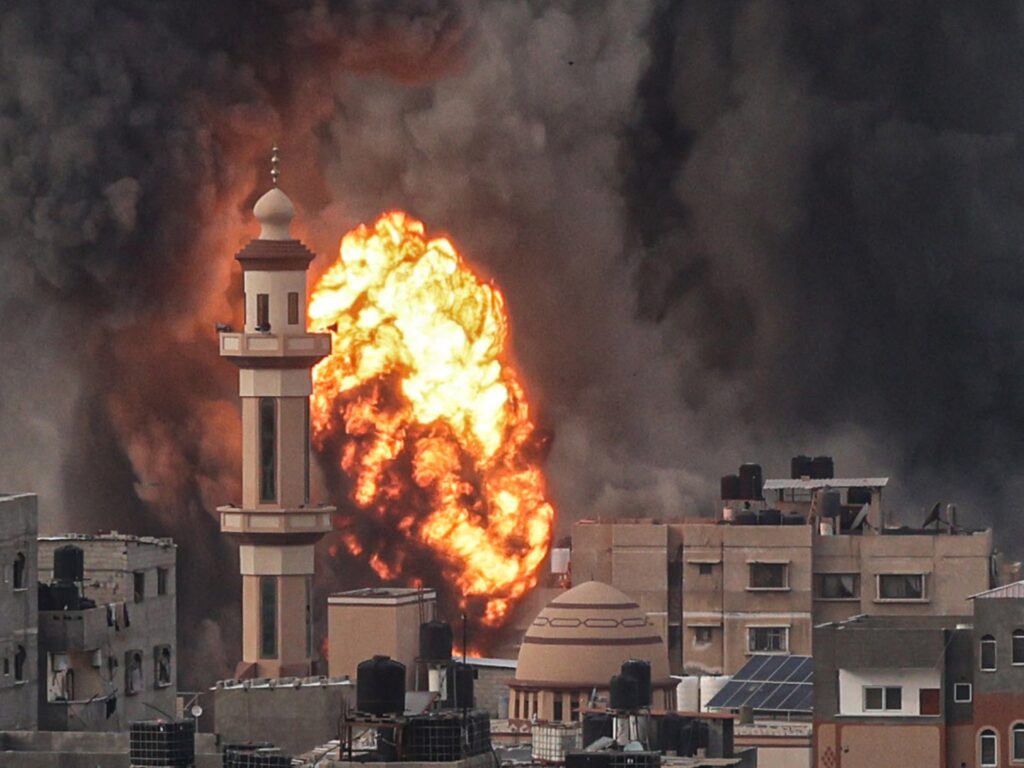
Israel bombarded towns across Gaza with air strikes on Wednesday, killing dozens of Palestinians, as talks over securing another truce and captive-prisoner exchange with Hamas continue. At least 46 people were killed and more than 100 wounded after Israel bombarded the urban Jabalia refugee camp near Gaza City, according to Munir al-Bursh, a senior Palestinian health ministry official. In southern Gaza, several women and children were among those brought into Nasser hospital in the city of Khan Younis after the strikes. Gaza’s health ministry also said at least 12 people were killed and dozens were wounded in a series of air strikes in Rafah, near the border with Egypt. “Twelve martyrs and dozens of wounded, including women and children, were recovered from under the rubble when a house and a mosque were targeted hundreds of metres from Kuwaiti hospital,” the ministry said in a statement. The Israeli military also ordered the immediate evacuation of an area covering some 20 percent of central and southern Khan Younis city, which before Israel’s invasion was home to more than 111,000 people and now includes 32 shelters housing more than 141,000 people displaced from northern Gaza by the war. Israel’s notification of the forced relocation was announced online on Wednesday, according to the United Nations Office for the Coordination of Humanitarian Affairs (UN OCHA), with Palestinians instructed to move to the already overcrowded neighbourhoods in Rafah, further south. Meanwhile, Hamas’s top leader Ismail Haniyeh travelled to Cairo on Wednesday for talks on the war in Gaza, part of a flurry of diplomacy amid hopes of securing another truce and captive-swap deal with Israel. Both sides have recently relaunched indirect talks, mediated by Egypt, Qatar and the United States. More than 20,000 Palestinians have been killed since Israel began its war on Gaza on October 7. Thousands more lie buried under the rubble of Gaza, the UN estimates. Adblock test (Why?)
Led by ‘plumes of smoke’: How Gaza’s first responders navigate a blackout
Deir el-Balah, Gaza Strip – When Youssef Abdullah’s home in the central Gaza Nuseirat refugee camp was hit by an Israeli air strike, killing 17 members of his family on Saturday morning, no one could call the emergency services. Israeli forces had cut off phone and internet services for the fifth time. The attack was “sudden”, he told Al Jazeera. Two of his children – six-year-old Mohammed and eight-year-old Omar – were among the dead. He, himself, was badly injured. Taking a break from his hospital bed, Youssef Abdullah, 35, was clearly still in shock when he spoke to Al Jazeera outside the busy gates of Al-Aqsa Martyrs Hospital, one of the few remaining operational facilities in the Gaza Strip. He was struggling to cover up his broken spirit as he limped on one leg across the courtyard, dressed in clothes still covered in debris. Only seven members of Abdullah’s family survived an air strike on his home, in which two of his young children were killed [Atiyah Darwish/Al Jazeera] Apart from head wounds, Abdullah suffered broken ribs, a broken knee and burns on his arm. “I remember the first thing I saw when I managed to lift my head up, was my wife’s face. Half of it was badly scraped and covered in blood, but she survived,” Abdullah told Al Jazeera. “I hugged her and started frantically calling out for my children.” Most of his family members killed were women and children, he said. Among them were his mother, sister and nieces, as well as his father and brother. Only seven members of his family survived. His cousin, Bassam al-Hafy, lives just a few houses down from him in the Nuseirat camp. Al-Hafy said a neighbour rushed over to inform him of the attack that struck Abdullah’s home so he could “get help”. “There was no way for us to contact medics or a hospital, so I immediately jumped on my bicycle and headed to the nearest hospital, al-Awda Hospital, to call for help,” al-Hafy told Al Jazeera. Bassam al-Hafy says he used his bicycle to rush to the nearest hospital to call for help when his cousin’s home was destroyed in an Israeli air strike, killing 17 members of the family [Atiyah Darwish/Al Jazeera] Earlier this week, Paltel, the main Palestinian telecommunications company, announced it would begin a “gradual restoration” of telecom services in the central and southern areas of Gaza. On at least five occasions now, communications blackouts have effectively cut off Gaza’s residents from the outside world – and from one another. With each blackout, Gaza’s government media office has warned that Palestinians who are subjected to attacks are unable to contact civil defence teams amid heavy bombardment. No one could reach many of those “martyred and wounded”, it said last week. According to Abdullah, the phone and internet blackout definitely “doubled the number of martyrs” in his family. “My brother-in-law was alive, but died because medics arrived 45 minutes later,” he said. This is not uncommon, civil defence workers say. The blackouts, which rights groups have warned are being used to cover potential Israeli war crimes, have repeatedly prevented medics, first responders and firefighters from reaching areas that have been targeted. “Two weeks ago there was an attack in Bureij. By the time we arrived, it was a whole hour later, and people waiting at the scene reacted negatively towards us,” Hatem Abu Taqeyeh, a volunteer medic with the Palestinian Red Crescent Society (PRCS), told Al Jazeera. “They scolded us, asked us why we were so late. But in reality, we simply had no idea this had happened,” the 30-year-old said. Sounds of explosions in areas further away are “not even heard”, which adds to their “stress and anxiety” every time the enclave plunges into digital darkness, Abu Taqeyeh said. Many ‘do not make it’ During the first blackout, shortly after Israel launched its latest war on the Strip, Abu Taqeyeh said civil defence teams would conduct what is known as “field checks”, which means driving around neighbourhoods in case they are needed. But doing this has become increasingly difficult for several reasons. After more than two months of aerial bombardment and ground invasion, Gaza’s roads have become hard to navigate by foot, let alone by car. It has also become increasingly dangerous to move around amid intensified bombing. The lack of fuel to operate vehicles means field inspections have become less and less frequent, Abu Taqeyeh added. The Palestinian Red Crescent says it has repeatedly lost contact with its teams operating on the ground in Gaza [Atiyah Darwish/Al Jazeera] Israel has blocked the entry of much-needed fuel since it imposed a total siege on the already blockaded enclave at the start of the war, and has only allowed a very small amount of aid in through the Rafah border crossing. “With the lack of fuel … we would only go to a location knowing 100 percent that it had just come under attack,” Abu Taqeyeh said. “Otherwise, we stay put.” Abdulrahman Basheer, another volunteer medic with the PRCS, said teams cannot coordinate with any international body without internet or phone lines. The PRCS has repeatedly said it has lost contact with its teams operating on the ground in Gaza amid these blackouts. Other groups, including Doctors without Borders (Medecins Sans Frontieres, or MSF), Amnesty International and several United Nations bodies have also reported being abruptly cut off from their teams in Gaza during network outages. To work around this, Basheer said members of his team station themselves at the hospital in case injured people start arriving in vehicles other than ambulances. “They usually come in private cars, in tuk-tuks … or on donkey carts,” Basheer told Al Jazeera. With no access to the internet and without phone lines, even the national emergency services hotline is inaccessible, Abdulrahman Basheer said [Atiyah Darwish/Al Jazeera] Volunteers then ask those coming into the emergency unit about the location and nature of the attack they had just escaped, and