

‘Nonsense’: Putin rejects Biden claim that Russia plans to attack NATO
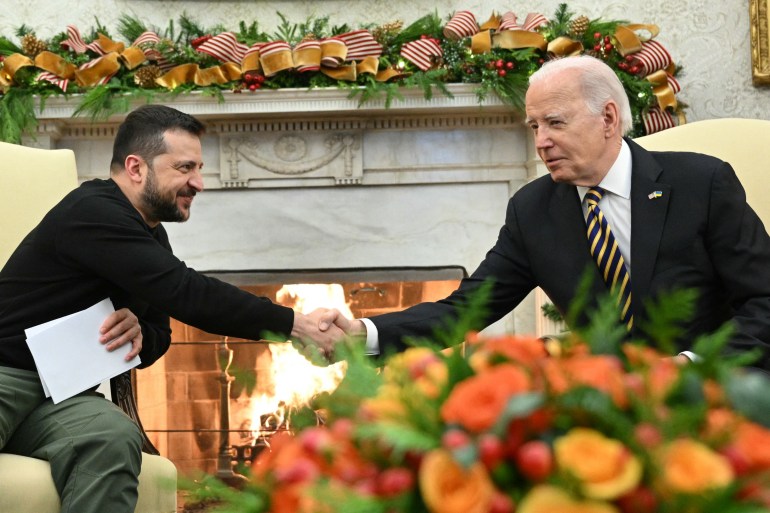
The Russian president says Moscow has ‘no interest … to fight with NATO countries’. The Russian president has dismissed the United States’s claims that Moscow could attack a NATO country in the future as “complete nonsense”, saying such a conflict would run counter to his country’s interests. Vladimir Putin made the statement in an interview with Russian state TV on Sunday, weeks after US President Joe Biden warned that if Putin achieved victory in Ukraine, he might be emboldened to attack a NATO ally, sparking a third world war. “It is complete nonsense – and I think President Biden understands that,” Putin told state television channel Rossiya. “Russia has no reason, no interest – no geopolitical interest, neither economic, political nor military – to fight with NATO countries.” Putin added that Biden may be trying to stoke such fears to justify his “erroneous policy” in the region. US-Russia relations have sunk to their lowest level in decades since Moscow invaded neighbouring Ukraine in February 2022. Throughout the 22-month war, the US has provided Ukraine with $111bn in weapons, equipment, and other aid, helping the Ukrainians fend off Russia’s advance and regain some territory. Biden favours sending even more support to war-torn Ukraine, which is running short on supplies as it grinds to a bloody winter stalemate. He has asked US Congress to approve $61.4bn in support for Ukraine as part of a larger $110bn package that includes more funds for Israel and other issues. However, there is waning appetite in the Congress for the lingering war. Some Republican lawmakers have blocked the aid package, demanding the White House first take action on border security. Biden on December 12 said right-wing lawmakers’ refusal to approve the package also risked handing President Putin a “Christmas gift” of victory. “Putin is banking on the United States failing to deliver for Ukraine,” Biden said during a news conference with Ukraine’s President Volodymyr Zelenskyy. “We must … prove him wrong.” Presidents Zelenskyy, left, and Biden shake hands in the White House, Washington, DC, December 12 [Mandel Ngan/AFP] Tensions with Finland While Putin dismissed the prospect of a direct NATO feud, he did address tensions with neighbouring Finland since it joined the alliance. Finland, which became a NATO member in April, on Friday shut down its entire eastern border with Russia, which it accuses of orchestrating a migrant crisis on its border. Putin said he would respond to the deteriorating ties by opening up a military zone in its northwest. “They [the West] dragged Finland into NATO. Did we have any disputes with them? All disputes, including territorial ones in the mid-20th century, have long been solved,” Putin said. “There were no problems there. Now there will be [problems] because we will create the Leningrad military district and concentrate a certain amount of military units there.” Adblock test (Why?)
France condemns killing of its worker in Israeli strike in Gaza’s Rafah

The killing comes as French top diplomat Catherine Colonna in Israel to appeal for truce and lasting peace. The French Ministry for Europe and Foreign Affairs has condemned the Israeli bombing of a residential building in Rafah that killed one of its staff in a region previously declared a safe zone. “France condemns this bombing of a residential building which caused the death of many other civilians. We demand that all light be shed by the Israeli authorities on the circumstances of this bombing, as quickly as possible,” the Foreign Ministry said in a statement on Sunday. The house was hit on Wednesday evening, killing the employee and 10 others who had been sheltering with colleagues and their family members in the residential location. The employee had been working with the French government in Gaza since 2002, and some of his family members had already been evacuated from Gaza, the ministry said, offering condolences. The ministry statement is released at a time when external pressure on Israel is increasing due to its “indiscriminate” bombing raids in Gaza. More than 80 percent of the nearly 19,000 Palestinians killed are said to be civilians. French Foreign Minister Catherine Colonna on Sunday pressed for an “immediate and durable” truce in the Gaza war, adding Paris is “deeply concerned” over the situation in the war-ravaged Palestinian territory. “Too many civilians are being killed,” Colonna said during remarks in Tel Aviv with her Israeli counterpart Eli Cohen, as Israel presses on with its offensive after the October 7 attacks that has sent tensions spiralling across the region. The foreign minister also condemned the October 7 attack by Hamas and plans to meet with the families of the Israeli captives held in the Gaza Strip. At least 1,140 people, most of them civilians, were killed in the Hamas attack and 240 were taken captive. Dozens of them were released in exchange for Palestinian prisoners as part of a truce deal late last month. Colonna also plans to pursue an agreement with her Palestinian counterpart Riyad al-Maliki in the occupied West Bank during her trip. Shortly before her arrival in Israel, Colonna condemned increasing attacks by Israeli settlers on Palestinians in the occupied West Bank. “Since October 7, unfortunately, some settlers, driven by their ideological blindness… have committed crimes” against Palestinians, she said, adding that “these settlers must be punished”. More than 290 Palestinians have been killed by Israeli forces or settlers in the West Bank since October 7, according to the territory’s Ministry of Health. Adblock test (Why?)
A tale of two Rumis – of the East and of the West

Jalaluddin Mohammad Rumi’s spiritual poems and perpetual wisdom have transcended time and cultures. Seven hundred and fifty years after his death, the celebrated Persian thinker remains a best-selling poet in the West, revered as an Islamic dervish in the East, while his sagacious thoughts rule the internet. When he died on December 17, 1273, aged 66, the streets of Konya, in present-day Turkey, were filled with mourners from multiple creeds and nations, reflective of the cosmopolitan society that lived in 13th century Anatolia – it was a time when the cross-cultural exchange of ideas and arts prospered. At his funeral, his followers, who also included Jews, Christians, and Zoroastrians, each recited from their own scriptures. This year too, on Sunday, the man posthumously known by his nisbah (a name indicating one’s origins) Rumi, will be honoured by his followers on Sheb-i Arus – meaning wedding night in both Persian and Turkish. And it would be in the spirit of the Persian poet’s call: “Our death is our wedding with eternity.” From the British capital, London, to California in the United States, to Konya, his murids or devotees, will gather in whirls of motion and emotion, remembering his own elegiac eulogy: “When you see my corpse is being carried,Don’t cry for my leaving,I’m not leaving,I’m arriving at eternal love.” – Rumi (translated by Muhammad Ali Mojaradi) Mevlana Rumi’s tomb in Konya is a point of pilgrimage for millions of devotees and tourists each year [Creative Commons] Who is Rumi in the east? Rumi is believed to have been born in the early thirteenth century in Balkh (now in Afghanistan), though some say his place of birth was in Central Asia. At the time of his birth (1207), the Persianate Empire spanned from India in the east and as far west as Greece, with many staking a claim to the man who would become more popularly known as Rumi, reflecting the region where he would settle – the Sultanate of Rum, also known as Anatolia. In the eastern world, Rumi’s name is often preceded by the honorific title Mevlana or Maulana (meaning our master), showing just how respected he is as an Islamic scholar and Sufi saint. To state his name without this title in some circles would receive tut-tutting and be considered disrespectful. “Like any historical figure who spans cultures, he has taken on a life of his own,” explained Muhammad Ali Mojaradi, a Persian scholar based in Kuwait. He said people tend to project their own understanding and bias when engaging with historical texts, including Rumi’s. “I have heard that Rumi is a staunchly orthodox Sunni Muslim, others say he is a closeted Zoroastrian, or a deviant Sufi, or someone who is too enlightened to subscribe to a religion. Some consider him a Tajik, a Khurasani, others a Persian, or Iranian, some are adamant that he is Turkish. These are more indicative of our biases than the real Rumi.” During his life, his identity was intrinsically linked to his faith. “I am the servant of the Quran, for as long as I have a soul.I am the dust on the road of Muhammad, the Chosen One.If someone interprets my words in any other way,That person I deplore, and I deplore his words.” – Rumi (translated by Muhammad Ali Mojaradi) Rumi was an Islamic scholar, following in a long line, and taught Sharia or Islamic law. He would also practise Tasawwuf, more popularly known as Sufism in the West. It is a way of understanding and drawing closer to God through the purification of the inner self, reflecting and remembering God through meditative chants, songs and sometimes even dance. Other thinkers and poets of his time included Ibn Arabi, the Andalusian philosopher and Fariddudin Attar, the Persian author of the Mantiq-ut-Tayr (Conference of the Birds). Islam’s openness to discussion and debate at this time would allow the poetry and arts to thrive, influencing the works of other Persian poets like Hafez and Omar Khayyam. Whirling dervishes perform outside the Byzantine-era Hagia Sophia mosque in Istanbul, Turkey, this year to mark the 750th anniversary of the death of Mevlana Rumi [Khalil Hamra/AP Photo] What did Rumi become known for? After completing his theological education in Syria’s Aleppo, Rumi went to Konya where he met a wandering dervish, named Shams-i-Tabriz, who left a lasting impact on the Islamic scholar. Barka Blue, founder of a spiritual arts movement, the Rumi Centre, in California, said Tabriz would transform Rumi, and lead to his “spiritual awakening”. Rumi penned his magnum opus, the Masnavi, a 50,000-line poem, written in rhyming couplets and quatrains about a lifelong yearning in search of God. It would become the most famed of his works. Other notable works include Fihi Ma Fihi and Divan-i Shams-i Tabrizi – a collection of poems written in honour of his spiritual mentor. “It [Masnavi] was actually called the ‘Quran in Persian’, indicating that it is the pinnacle of expression in that language but also that it is an exposition of the Quran in the Persian tongue,” Blue, the acclaimed rapper and poet, told Al Jazeera. As Rumi says in the introduction, “this is the root of the root of the root of the way [faith],” added Blue, author of The Art of Remembrance. To fully understand and appreciate the depths of Rumi’s words, “a firm grasp of the Islamic tradition in general and Sufism in particular” is needed, Blue said. “His words are undoubtedly a beautiful entry point to this tradition [of Islam].” Rumi himself would advise readers of the Masnavi to make ritual ablution and be in a state of cleanliness as one would upon reading the Quran or praying the five daily prayers. The intention when reading it was to connect with the Creator. Who is Rumi in the West? The first-known English translation of some of Rumi’s work was published in 1772 by a British judge and linguist William Jones in Calcutta — now Kolkata — then the base of the British
UK teen Alex Batty arrives home after going missing on holiday in 2017

Teen told investigators he spent six years living a nomadic lifestyle in Spain, Morocco and France. A British teenager who went missing for six years before turning up in France has arrived back in the United Kingdom, police have said. Alex Batty never returned home after travelling to Spain in 2017 with his mother and grandfather for what was supposed to be a two-week family holiday. The then 11-year-old boy’s disappearance sparked unsuccessful appeals for information about his whereabouts – until he turned up last week walking along a road late at night in southern France. “It gives me great pleasure to say Alex has now made his safe return back to the UK after six years,” Matt Boyle of Greater Manchester Police told reporters on Saturday. Boyle said police are yet to fully establish the circumstances surrounding his disappearance and whether a criminal investigation is warranted. Boyle said that officers, who are seeking to locate his mother Melanie Batty, would speak to the teen “at a pace that feels comfortable to him”. Batty, now 17, will return to his maternal grandmother, Susan Caruana, whom a British court entrusted with his custody before he vanished. Caruana requested that the family be granted space to process the news. “I cannot begin to express my relief and happiness that Alex has been found safe and well,” she said in a statement issued through British police. “The main thing is that he’s safe, after what would be an overwhelming experience for anyone, not least a child.” Batty told French officials he spent the past six years living a nomadic lifestyle with his mother and grandfather in Spain, Morocco and France as part of a “spiritual community”. He said the family grew their own food, meditated and contemplated esoteric subjects such as reincarnation. A doctor who examined Batty said the teen was healthy and did not appear to have suffered any abuse. French prosecutor Antoine Leroy told reporters on Friday that Batty had decided to leave his family after his mother said she wished to move to Finland, where she is “likely” to be now. Adblock test (Why?)
Smell that: The rise of India’s ittar industry

Kannauj, India — Gopal Kumar pulled apart the bulb of a flower and pointed to where the roots of the petals had turned a little black inside. This is when the marigolds smell the best and are ready for picking, he said. He picked a pink rose next and sniffed. “You can only find this smell in Kannauj,” he said. Kumar has been growing flowers outside Kannauj – a sleepy town nestled on the fertile plains of the Ganges in northern India – for 50 years. His flowers are used in the making of ittars, natural perfumes produced by distilling flowers, herbs, plants or spices over a base oil, which takes on the scent of the raw material. Once a sophisticated kingdom in northern India, Kannauj is famed for its production of ittars using an ancient method called deg-bhakpa. This is a slow, laborious process of hydrodistillation devoid of all modern equipment that has survived in hundreds of small-scale distilleries across Kannauj and in surrounding cities. Despite a long heritage of fragrance and scent, economic liberalisation of the late 1980s led to a period of decline in India’s ittar industry as cheap, alcohol-based perfumes were introduced from the West. Until the 1990s, there were 700 distilleries in Kannauj, but their numbers dropped to 150 to 200 by the mid-2000s. Trying to compete on price, some manufacturers started using alcohol as the base rather than more expensive sandalwood oil, degrading the quality and purity of the products. Post-liberalisation, rather than selling directly to consumers, the vast majority of ittars and essential oils produced in India were exported to other businesses – either as an input into perfumery and cosmetic industries in the West or to the tobacco industry. Rosewater is an ingredient in chewing tobacco. But in the past few years, several young, predominantly female Indian entrepreneurs have spotted a gap in the market between these indigenous artisanal skills and India’s thriving consumer culture, and a new set of homegrown brands has emerged. A new wave of fragrance Boond Fragrances is one such company, established in May 2021 during the pandemic by a sister and brother, Krati and Varun Tandon, to help preserve and raise awareness of the perfume-making traditions of Kannuaj and to support local artisans. “Our father was a perfume trader and at-home perfumer,” Krati Tandon explained at her family home in Kannuaj. ”We grew up around perfumers and perfumeries in Kannauj, and you really absorb what’s happening. But we also saw over the years how some perfumeries started shutting down, and some are worried about their futures.” The duo wanted to make ittars accessible. “The idea was really for us to bring it to customers – people like us who, if we knew something like this existed, would appreciate it,” Krati said. Divrina Dhingra, author of The Perfume Project: Journeys Through Indian Fragrance, agrees. “Ittars have a marketing problem actually. In many ways they are stuck in the past,” she said. “But it is also an awareness problem. I don’t know if many people know this industry still exists, the way in which it exists, what it does, what is actually available.” Gopal Kumar grows flowers in Kannauj that are used to make ittars [Eileen McDougall/Al Jazeera] The initial response to Boond, Krati said, has been overwhelming with more than 10,000 orders dispatched in the 12 months up to October, a sizeable number for the young business. Sales rise in winter, the Indian wedding season and the time when Christmas orders come from abroad. The company said it expects sales to double in the next two years but declined to share its revenue numbers. “Recently, people have again started realising what synthetic perfume is and what real perfume is,” Krati said. “Particularly post-COVID, there has been a transformation back towards the real thing.” As per market research firm Technavio, the Indian perfumery industry will increase by about 15 percent compounded annually for the next five years. While market trends are currently dominated by trade between businesses, the number of Indian firms selling their own fragrances directly to consumers is increasing. Indian beauty writer Aparna Gupta said there’s been “a discernible shift, a renaissance if you will, in the domestic market’s attitude towards these traditional fragrances”, which are predominantly marketed on Instagram, and demand for them has gained “considerable momentum”. She credited brands like Boond that are concentrating on traditional, time-tested ittar scents for playing “a pivotal role” in this resurgence. “They are not just selling ittars; they are reintroducing a forgotten art form to a generation that is eager to reconnect with its heritage,” she said. Then there are other new brands like Kastoor and Naso Profumi that are targeting “younger consumers by blending traditional elements with modern nuances” – for instance, Kastoor’s Mahal with its unique blend of patchouli and lotus, Gupta said. A tradition of scent The flowers used used to make ittar are put in water and sealed inside a large copper vat called a deg [Eileen McDougall/Al Jazeera] It is unclear exactly how long ittars and essential oils – made when vapours of ingredients are extracted but no base oil is used – have been produced through hydrodistillation in India. However, recently distillation stills excavated from the cities of the Indus Valley indicate a culture of scent in some form dating back to about 3,000 BC. Around Kannuaj, many locals attribute the discovery of ittars to the Mughal queen Nur Jahan, who lived in the 16th and 17th centuries CE. However, Sanskrit texts indicate that the area was already a centre of fragrance before Mughal times. Historians believe the practice was invigorated with new ingredients and distillation methods further developed by the Mughal court. Production is highly seasonal, and February in Kannuaj is the season of Damask rose. The warming winter sun was high in the sky by the time a motorbike arrived at the distillery of Prem and Company, a jute sack tied to its rear. Dinesh, the distiller, immediately weighed, inspected and
Analysis: Why Israel will continue its deadly push into Gaza city centres
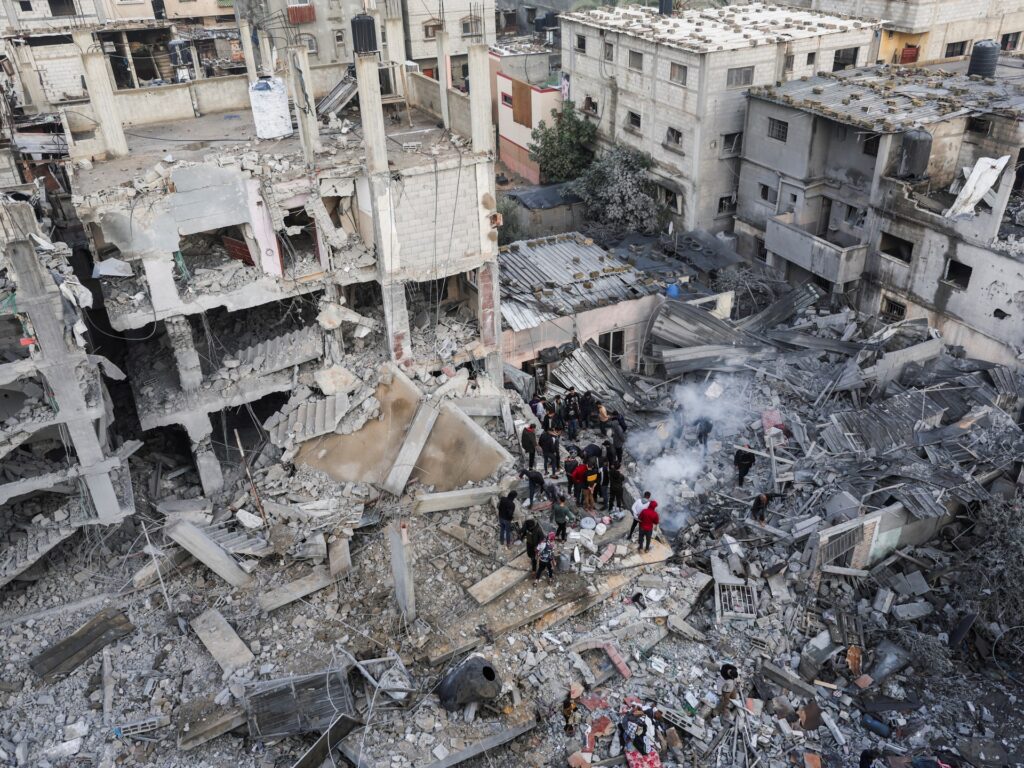
Dramatic news reports, claims and videos have emerged from both sides involved in the Gaza fighting throughout the past week. The week started with the Israeli army releasing several videos of Palestinians stripped to their underwear being marched through urban ruins. Israel’s PR machine disregarded the Palestinian outcry that followed. Israel staunchly asserted that the men were Hamas fighters and that their alleged mass surrenders signified that the end of the Palestinian group was close, even as many Palestinians and independent observers insisted that the men were civilians who had been treated against the laws of war by being publicly humiliated. For its part, Hamas stuck to its usual practice of pushing its cause through video releases – skilfully edited to enhance the desired effects – purporting to confirm its constant and numerous successes against Israeli invaders, mostly showing hits scored against armoured vehicles. Then came the news that stunned Israel and put a big question mark on its official line of Hamas being on the verge of collapse. First, nine soldiers were killed in a single operation in the Shujaiya neighbourhood of Gaza City on Tuesday. That shock was followed by another one on Friday, with the Israeli army admitting that it killed three Israeli captives, having mistaken them for enemies – even though they held white flags. So what is really happening on the ground in Gaza? Nothing we did not predict weeks ago: The war has entered a difficult, unpredictable and bloody phase of full-scale urban warfare where gains are small and slow, and losses can be huge. Combat in narrow and cramped streets of old cities is known to be one of the most difficult ways to fight a war. Classic military theory calls for defended cities to be surrounded and blockaded by units just strong enough to prevent the defenders from breaking out, while the main force continues advancing and taking territory. But the fight in Gaza is not about conquering fields and beaches – Israel’s proclaimed goal is to destroy Hamas. To do that, the first step is to control the ground where the enemy operates: the cities. Many aspects of warcraft are as ancient as the human urge to fight wars: attack and conquer versus defend and remain free. But the ways of achieving those goals have changed with technology and, at certain times, the means available to soldiers favour one aspect over another. In the old days, cities needed strong walls to defend themselves, but in the last 100 years, weapons have advanced at a rapid rate, causing a change in tactics. Successful resistance against enemy attacks no longer depends on huge, expensive static bastions. Nowadays, small but potent man-portable weapons whose destructive power is hugely disproportionate to their size, such as anti-tank rocket launchers, grenade throwers, small mortars, assault rifles and many others, allow the defenders to turn each house and every street into a formidable defensive position. From the 1940s to this day, almost all attempts to conquer cities held by determined defenders have ended in failure. The few victories attackers achieved were so costly that they often ended the offensive capabilities of those armies pushing into cities. In their own ways, Stalingrad, Warsaw, Berlin, Dien Bien Phu, Vukovar, Sarajevo, Grozny and Fallujah – some successfully defended, others eventually succumbing to attacks – all confirmed the military wisdom that urban warfare should be avoided whenever possible. Israel could not avoid urban warfare in Gaza. To have a chance of destroying Hamas, it has to deny it its operating ground, the three biggest urban agglomerations in the strip: Gaza City, Khan Younis and Rafah. In the first phase of its ground operation, the Israeli army advanced across open ground, through farmland and villages that do not lend themselves to mounting a major defence, only harassing attacks to slow down and dent the invaders. Hamas acted in classic guerrilla fashion, launching some hit-and-run attacks without wasting any effort to stop the Israelis then and there. The second phase started with Israeli forces reaching the suburbs, first of Gaza City and then, after the temporary ceasefire expired, of Khan Younis. Treading slowly and carefully in expectation of a concentrated Hamas response, the Israeli military completed the encirclement of those two urban areas. It would be naive to assume that Israel’s generals hoped that by isolating the two biggest built-up areas in the Gaza Strip, they would seriously impair the ability of the Qassam Brigades, Hamas’s armed wing, to fight back. In reality, the encirclement of the two city centres is not a classic one where troops within the blockade cannot be reinforced nor receive any supplies. Hamas still has an unknown but probably major part of its tunnel network intact and can move in and out. They have some difficulties in doing so but Hamas fighters are not locked in. Aware of the menace that tunnels present but also of the grave hazard of taking the fight into them, Israel has tried several approaches. It has destroyed as many tunnel entrances as it has found, mostly in the areas under its control, but many others that remain keep the danger acute. After several attempts to send troops underground that ended in disaster, with troops falling casualty to Hamas booby traps, the high command abandoned that approach. It then reportedly mulled the idea of filling tunnels with seawater, claiming that the test-flooding was successful but it has not yet decided to mount a full-scale deluge operation. This week’s Israeli actions on the ground strongly suggest that the Israeli army leadership realises that the only way towards achieving its proclaimed goal of annihilating Hamas is by taking, holding and controlling the ground throughout the currently surrounded centres of Gaza City and Khan Younis. That in itself would not guarantee victory but could create conditions to squeeze Hamas fighters into tunnels, after which Israeli forces could block and destroy all entrances. Flushing Hamas out would probably take weeks of heavy urban warfare with many more
Al Jazeera to refer journalist Samer Abudaqa’s killing to ICC
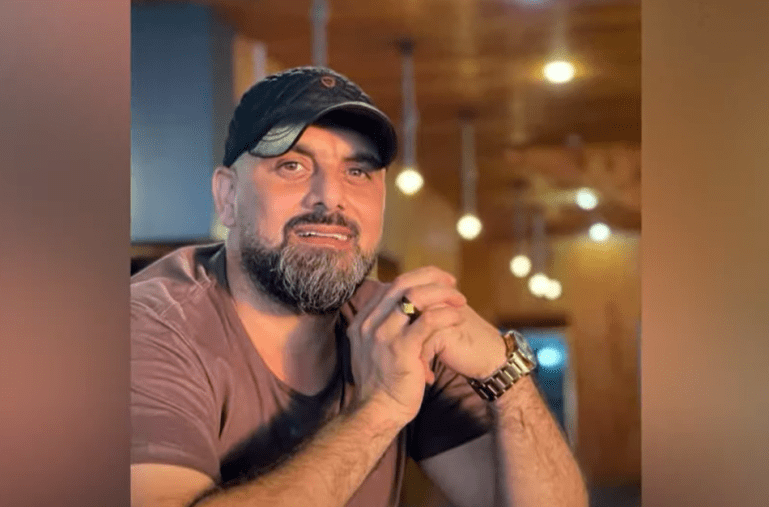
The Al Jazeera Arabic cameraman was killed by a drone attack while reporting on the bombing of a school in southern Gaza Strip. The Al Jazeera Media Network says it will refer the killing of its cameraman Samer Abudaqa in Gaza to the International Criminal Court (ICC). In a statement on Saturday, the Qatar-based network said it has instructed its legal team to “urgently” refer the case of what it called “the assassination” of Al Jazeera Arabic cameraman Samer Abudaqa to the court in The Hague. Abudaqa was killed by a drone attack on Friday while reporting on an earlier bombing of a school used as a shelter for displaced people in Khan Younis in the southern Gaza Strip. Samer Abudaqa [Screengrab/Al Jazeera] “Al Jazeera Media Network reiterates its denunciation and condemnation of the assassination crime of its colleague, Samer Abudaqa, who devoted 19 years with the Network to covering the ongoing conflict in the occupied Palestinian territories,” said the network’s statement. “In addition to the assassination of Abudaqa by the Israeli occupation forces in the Gaza Strip, the legal file will also encompass recurrent attacks on the Network’s crews working and operating in the occupied Palestinian territories and instances of incitement against them.” Targeting journalists is a war crime under Article 8 of the Rome Statute. The media network said it has set up a working group comprising its international legal team and international legal experts to submit a file to the court’s prosecutor. Al Jazeera Arabic correspondent Wael Dahdouh – who lost his wife, son, daughter and grandson in a previous Israeli bombing – was wounded in the same attack on Friday. He was hit by shrapnel on his upper arm and managed to reach the Nasser Hospital where he was treated for minor injuries. But rescue teams were unable to immediately reach Abudaqa and others at the site as they needed approval from Israeli forces to bulldoze through the debris to get to the location. By the time rescuers arrived five hours after the attack, Abudaqa had bled to death. The 45-year-old was laid to rest in southern Gaza on Saturday, with dozens of mourners, including journalists, paying their respects. “We are carrying this human message, we are carrying this noble message,” Dahdouh said in his eulogy as mourners around him wept. “We will continue to do our duty with professionalism and transparency.” Al Jazeera had previously submitted a formal request to the ICC to investigate and prosecute those responsible for shooting a veteran television reporter Shireen Abu Akleh in May 2022 while covering an Israeli military raid on the Jenin refugee camp in the occupied West Bank. Evidence provided in the request, filed in December 2022, includes a comprehensive six-month investigation by the network, gathering witness accounts and video footage, among other material. The ICC has acknowledged its receipt, yet no further steps have been taken. The Committee to Protect Journalists (CPJ) says the ongoing conflict in Gaza is the deadliest for journalists ever recorded, with at least 64 reporters and media workers killed in 10 weeks of the enclave’s bombing. The CPJ has also called on the international authorities to “conduct an independent investigation into the attack to hold the perpetrators to account”. Adblock test (Why?)
Israel’s Netanyahu hints new deal under way to release Gaza hostages
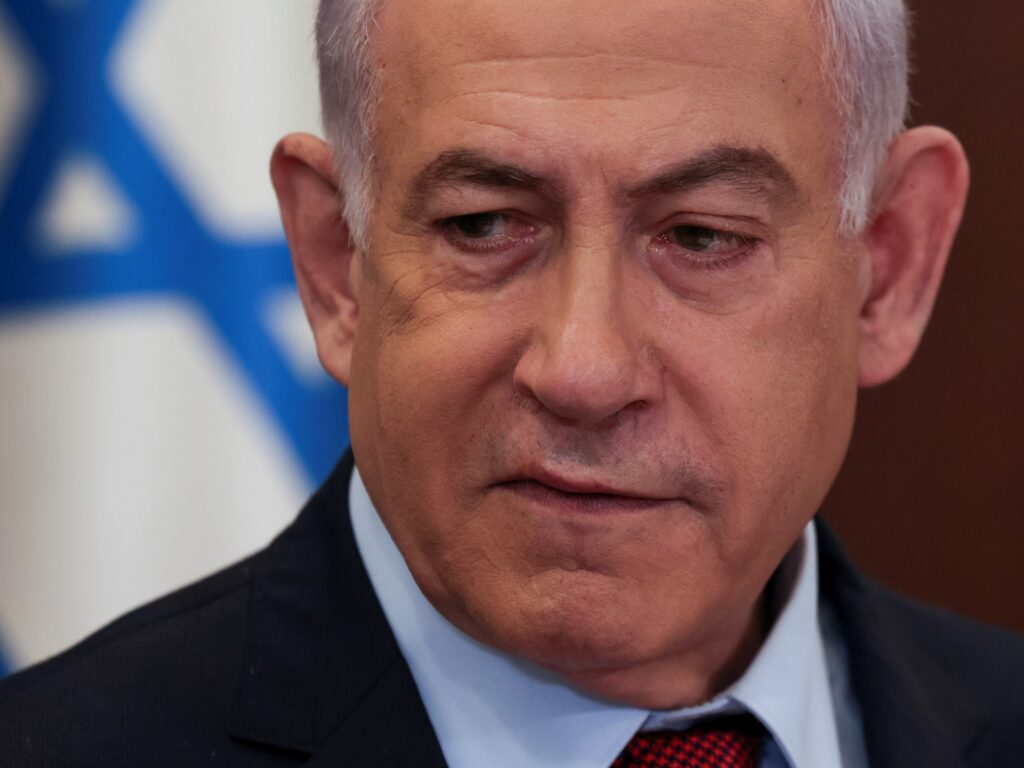
The Israeli leader’s comments came after Qatar confirmed talks are on for a possible new truce. Israeli Prime Minister Benjamin Netanyahu has made comments, suggesting that new negotiations were under way to recover hostages held by Hamas. In a televised press conference on Saturday, Netanyahu called the conflict an “existential war” that must be fought until victory, despite pressure and costs, and said Gaza would be demilitarised and under Israeli security control. His statements came a day after Israeli forces mistakenly killed three of more than 100 captives. Netanyahu said Israel’s offensive in Gaza had helped clinch a partial hostage-release deal in November and promised to maintain intense military pressure on Hamas. “The instruction I am giving the negotiating team is predicated on this pressure, without which we have nothing,” he said. Netanyahu’s comments came after the chief of Mossad, the Israeli intelligence agency, met the prime minister of Qatar, a country mediating between Israel and Hamas, and whose efforts resulted in a seven-day truce and exchange of hostages last month. Earlier on Saturday, Qatar confirmed that talks were under way for a possible new truce. Netanyahu sidestepped a question about the meeting reportedly held in Europe, but confirmed he had given instructions to the negotiating team. “We have serious criticisms of Qatar … but right now we are trying to complete the recovery of our hostages,” he said. A Hamas statement later said the group “affirms its position not to open any negotiations to exchange prisoners unless the aggression against our people stops once and for all”. “The movement communicated this position to all mediators,” it added. On Friday, Israeli forces admitted to mistakenly killing three Hamas-held hostages, all in their 20s, in the Shijaiyah area of Gaza City, where the troops are engaged in fierce fighting with Hamas. Israel continues to pound Gaza, killing nearly 19,000 Palestinians since October 7. Thousands more are feared buried under rubble. Israel says at least 1,147 people were killed in the Hamas attack on its soil two months ago. The 10-week war has flattened much of northern Gaza and displaced 85 percent of the territory’s population of 2.3 million from their homes. Adblock test (Why?)
At least 61 asylum seekers drown after shipwreck off Libya: IOM

DEVELOPING STORYDEVELOPING STORY, International Organization for Migration’s Libya office quotes survivors as saying the boat was carrying about 86 people. At least 61 refugees and migrants, including women and children, have drowned following a “tragic” shipwreck off Libya, the International Organization for Migration (IOM) says. The organisation’s Libya office early on Sunday quoted survivors as saying the boat was carrying around 86 people. A “large number of migrants” are believed to have died because of high waves which swamped their vessel after it left from Zuwara, on Libya’s northwest coast, the IOM’s Libya office said in a statement. Libya and Tunisia are principal departure points for migrants risking dangerous sea voyages in hopes of reaching Europe, via Italy. In the latest incident, most of the victims – who included women and children – were from Nigeria, Gambia and other African countries, the IOM office said, adding that nearly 25 people were rescued and transferred to a Libyan detention centre. An IOM team “provided medical support” and the survivors are all in good condition, the organisation said. Flavio Di Giacomo, an IOM spokesperson, wrote on X, formerly Twitter, that more than 2,250 people died this year on the central Mediterranean migrant route, a “dramatic figure which demonstrates that unfortunately not enough is being done to save lives at sea”. On June 14 this year, the Adriana, a fishing boat loaded with 750 people en route from Libya to Italy, went down in international waters off southwest Greece. According to survivors, the ship was carrying mainly Syrians, Pakistanis and Egyptians. Only 104 survived and 82 bodies were recovered. More than 153,000 migrants arrived in Italy this year from Tunisia and Libya, according to the United Nations refugee agency. Adblock test (Why?)
Israeli captives mistakenly killed in Gaza held white flag, official says
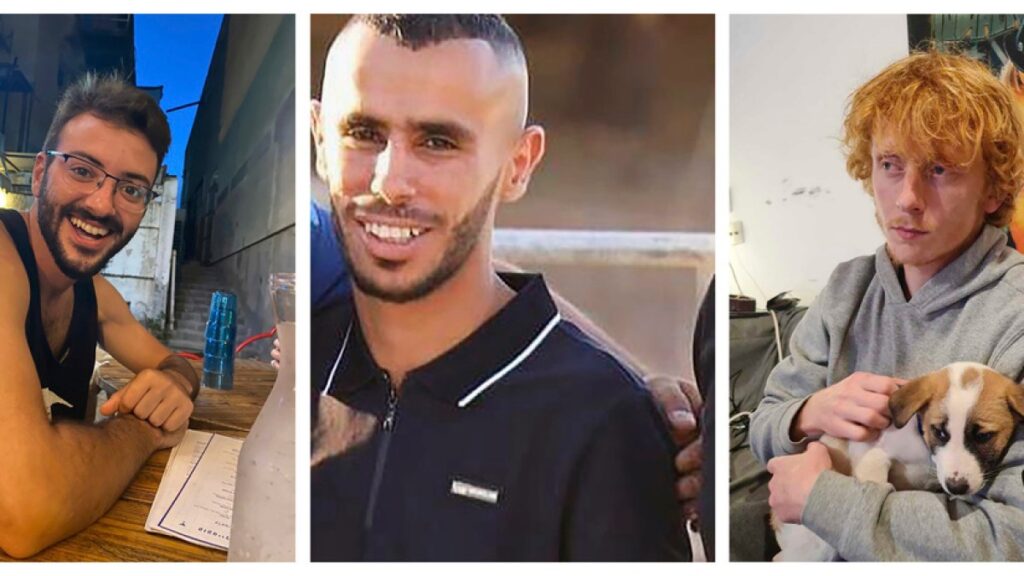
Rules of engagement breached in incident that resulted in death of three hostages, all in their 20s. Three Israeli hostages killed mistakenly in Gaza by Israeli forces were shirtless and one of them was holding up a white flag, according to an initial inquiry into the incident, a military official has said. The incident took place in an area of intense combat where Hamas fighters operate in civilian attire and use deception tactics, the Israeli official said on Saturday. A soldier saw the hostages emerging tens of metres from Israeli forces in the area of Shujayea, the official added. “They’re all without shirts and they have a stick with a white cloth on it. The soldier feels threatened and opens fire. He declares that they’re terrorists, they [forces] open fire, two are killed immediately,” said the military official. The third captive was wounded and retreated into a nearby building where he called for help in Hebrew. “Immediately the battalion commander issues a ceasefire order, but again there’s another burst of fire towards the third figure and he also dies,” said the official. “This was against our rules of engagement.” Mourning and anger The military on Friday identified the three as Yotam Haim, 28, and Alon Shamriz, 26, abducted from Kibbutz Kfar Aza, and Samer Talalka, 25, abducted from nearby Kibbutz Nir Am, by Hamas. About 300 people turned out to mourn Talalka at his funeral on Saturday in his hometown of Hura, in southern Israel, The Associated Press news agency reported. “We had so many hopes, expectations, that he would come back to us,” his cousin, Alaa Talalka told Israel’s public broadcaster Kan. “We’re not going to start pointing fingers, who is guilty and who is not. It is just not the time,” Talalka said. “The families are thinking only of how to bring the hostages back alive. This is the time to ask for the war to end.” They were among about 240 people taken captive during Hamas’s October 7 attacks in Israel, which killed about 1,200 people, mostly civilians, according to Israeli figures. Promising to destroy Hamas and bring back the hostages, Israel launched a massive military offensive against the Palestinian group that has left much of the Gaza Strip in ruins. The territory’s Hamas-run government says the war has killed at least 18,800 people, mostly women and children. Israeli Prime Minister Benjamin Netanyahu described the killing of hostages as an “unbearable tragedy”. Hundreds of people are expected to gather on Saturday in Tel Aviv to call on Netanyahu’s government to secure the release of 129 hostages still held in Gaza. Several returned home during a pause in hostilities which saw the release of captives in exchange for Palestinian prisoners held in Israel jails. Adblock test (Why?)