

Manipur: Three shot dead in Thoubal, curfew reimposed in valley districts

After the attack, the enraged locals set three four-wheelers on fire.
Delhi NCR: Stage III of GRAP revoked as air quality improves, BS III, IV vehicles allowed to ply

The commission has asked agencies to keep strict vigil and especially intensify measures under Stage-I and II of GRAP in order to obviate the implementation of Stage-III of GITAP actions.
‘Rahul Gandhi is an ordinary Congress worker, dont…’: Digvijay Singh’s brother

Former Congress MP Lakshman Singh has said Rahul Gandhi is an ordinary party worker and parliamentarian and he should not be highlighted so much.
Centre declares gangster Goldy Brar as terrorist under anti-terror law UAPA

The Canada-based terrorist had also claimed responsibility for the murder of Punjabi singer Sidhu Moose Wala in 2022.
Analysis: Is the Israeli army as militarily successful as it claims?
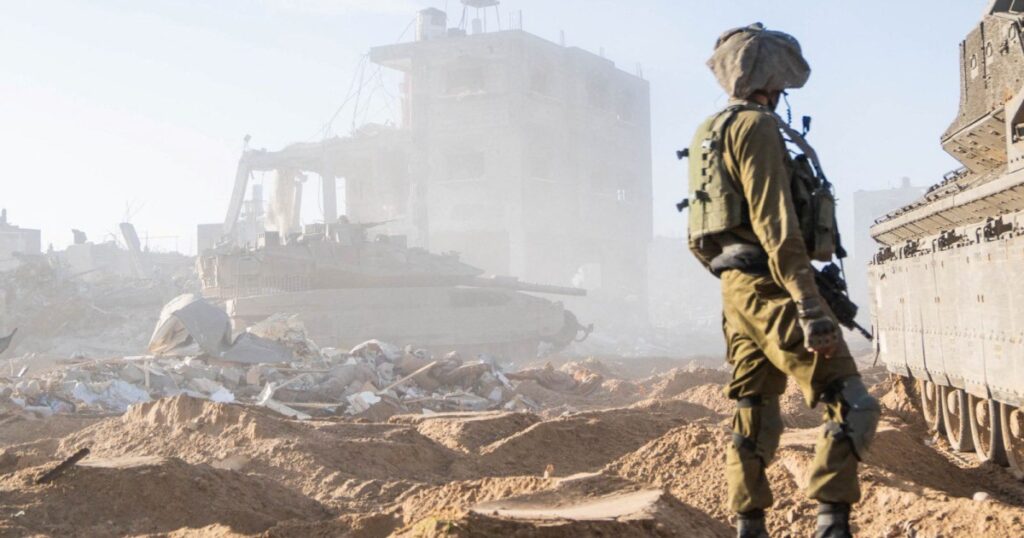
Coordinated, focused, deadly and brutal, the Hamas attacks of October 7 were a shock to Israeli society. The country’s defence, intelligence and security organisations – sources of national pride – were caught unawares and unprepared. They acted slowly and inadequately, with the whole establishment humiliated. The first military reaction was in line with the Israeli military doctrine of powerful attacks against previously designated targets. It took a few days for everyone to get their act together, create the emergency unity government (that mostly unified belligerent right-wingers) and proclaim a huge mobilisation of 360,000 reservists. Three weeks later, amid continuous indiscriminate bombardment, the Israeli army crossed into Gaza. Then, in more than two months of ground combat, the army cut Gaza in three, surrounding Gaza City and isolating Khan Younis. Most Palestinians fled to the south, where they now crowd Rafah in unbearable conditions. Israel maintains that although it has not yet defeated Hamas, it is close to its proclaimed goal, claiming to have “eliminated” 8,500 fighters. The Israeli military’s showing, however, has been very uneven across many aspects of the armed and diplomatic response. Military performance: Not a failure, but far from success In purely military terms, Israel has achieved a degree of success. It has conducted complex military operations in urban terrain, certainly the deadliest form of warfare, by advancing steadily – yet too cautiously and slowly. The centres of Gaza City and Khan Younis are surrounded on the ground, but the military has so far failed to neutralise Hamas fighting units. In an extremely challenging battle environment, the Israeli army successfully integrated many different units of various backgrounds, training and experience – including a plethora of specialised units that report directly to the General Staff outside of the normal territorial or brigade chain of command. Those complex arrangements demand the presence of higher officers on the front lines to coordinate and avoid potential confusion. Among the 172 Israeli soldiers killed so far, the proportion of senior non-commissioned officers is unusually high, but the number of officers who died in battle is staggering, with no less than four full colonels among the dead. Hamas’s losses are certainly lower than Israel claims. A prudent estimate would put it at 3,500 fighters to date – 20 percent of its front line complement. This would mean a ratio of 20 Hamas fighters killed for each Israeli soldier. In classic warfare, any general would happily accept that proportion as a certain victory. However, not in this war. Hamas fighters are ideologically and religiously motivated, and conditioned to disregard death; the fallen are seen as martyrs, which strengthens the cause. In contrast, Israeli society, which is heavily militarised – almost everyone, except the ultra-religious, serves in the military – has a lower tolerance for the losses of its people. Israelis do not see the tangible results of their sons’, husbands’ and brothers’ deaths. The attitude towards losses is probably best demonstrated by the fact that the Golani Brigade, one of the army’s oldest and most decorated units, was pulled from fighting after 72 of its soldiers died in combat. Finally, Israeli forces who claimed their overwhelming military (and moral) superiority, proved to lack either the capabilities or the willingness to decisively destroy the Hamas tunnel network. Despite demonstrating the mastery of technology to flood tunnels with seawater, the Israelis have yet to deploy that tactic. Liberation of captives: Abject failure Besides destroying Hamas, the other main proclaimed goal of the Israeli incursion into Gaza was to liberate the remaining captives. Not only has this aim not been achieved, but Israel managed to kill three captives who tried to give themselves up. Military technology: Very good, but non-decisive performance In many aspects of military technology, the Israeli military is known as a world leader. Most of its hardware and software perform to the army’s own high expectations, which will certainly boost its post-war exports and help, at least, to partially offset the staggering cost of war. New weapons and systems have been successfully integrated with old ones. The Israeli-built Eitan armoured fighting vehicle was rushed into action a year before its planned introduction into combat units without issue. New products, like the Iron Sting smart mortar, and small, simple and cheap reconnaissance quadcopter drones, have proved valuable in reducing losses in urban fighting. Existing products have demonstrated their versatility and become widespread: small body cameras and gun cams are now deployed on all teams; dogs with live cameras have expanded the possibilities of reconnaissance inside buildings suspected of being booby-trapped. Another undoubted Israeli military success is managing to keep its combat data link communications secret, encrypted in real time – there has been no hint of compromise by Hamas. The already-proven Iron Dome antimissile system has continued to be reliable. Just a few weapons have had issues, such as the much-touted Trophy armoured vehicle active protection system, which proved of mixed or no value in close-quarter combat. Initial overreliance on it cost the Israeli army some casualties in the first phases of the battle. But the Israeli army’s learning curve has been steep and, like in the case of the Merkava tank’s lack of protection from above, remedial action has been applied quickly and successfully. Despite the military’s operational success, none of its technology proved to be a real game changer. Public relations: A disaster despite all efforts The notorious overwhelming Israeli propaganda machinery has tried very hard to sell its official line but with limited success. Calling Hamas “terrorists” caught on in much of the Western world – not as much for the rest of the planet. Attempts to equate Hamas with ISIL (ISIS), an effort aimed particularly at the Arab and Islamic world and reinforced by Israeli military spokesperson Lieutenant Colonel Avichay Adraee to the Arab world, appear to have failed miserably. But Israel’s biggest failure was the attempt to make the world believe the claim that “Israel is committed to minimising civilian harm and abiding by international law”. Even Israelis themselves
Nobel laureate Muhammad Yunus convicted in Bangladesh labour law case

The microfinance pioneer is accused by PM Sheikh Hasina of ‘sucking blood’ from the poor, but supporters say charges politically motivated. Nobel laureate Muhammad Yunus has been convicted of violating Bangladesh’s labour laws in a case decried by his supporters as politically motivated. “Professor Yunus and three of his Grameen Telecom colleagues were convicted under labour laws and sentenced to six months in simple imprisonment,” lead prosecutor Khurshid Alam Khan told the AFP news agency on Monday. He added that all four were immediately granted bail pending appeals. Yunus, 83, is credited with lifting millions out of poverty with his pioneering microfinance bank but has earned the enmity of longtime Prime Minister Sheikh Hasina, who has accused him of “sucking blood” from the poor. Hasina has made several scathing verbal attacks against the internationally respected 2006 Nobel Peace Prize winner, who was once seen as a political rival. Yunus and three colleagues from Grameen Telecom, one of the firms he founded, were accused of violating labour laws when they failed to create a workers’ welfare fund in the company. All four deny the charges. “This verdict is unprecedented,” Abdullah Al Mamun, a lawyer for Yunus, told AFP. “We did not get justice.” Yunus is facing more than 100 other charges over labour law violations and alleged corruption. He told reporters after one of the hearings last month that he had not profited from any of the more than 50 social business firms he had set up in Bangladesh. “They were not for my personal benefit,” Yunus said. Another of his lawyers, Khaja Tanvir, told AFP that the case was “meritless, false and ill-motivated”. “The sole aim of the case is to harass and humiliate him in front of the world,” he said. ‘Travesty of justice’ Irene Khan, former chief of Amnesty International now working as a United Nations special rapporteur who was present at Monday’s verdict, told AFP the conviction was “a travesty of justice”. “A social activist and Nobel laureate who brought honour and pride to the country is being persecuted on frivolous grounds,” she said. In August, 160 global figures, including former US President Barack Obama and ex-UN Secretary-General Ban Ki-moon, published a joint letter denouncing the “continuous judicial harassment” of Yunus. The signatories, including more than 100 of his fellow Nobel laureates, said they feared for “his safety and freedom”. Critics accuse Bangladeshi courts of rubber-stamping decisions made by Hasina’s government, which is all but certain to win another term in power next week at elections boycotted by the opposition. Her administration has been increasingly firm in its crackdown on political dissent, and Yunus’s popularity among the Bangladeshi public has for years earmarked him as a potential rival. Amnesty accused the government of “weaponising labour laws” when Yunus went to trial in September and called for an immediate end to his “harassment”. Criminal proceedings against Yunus were “a form of political retaliation for his work and dissent”, it said. Adblock test (Why?)
US sinks Houthi boats in the Red Sea: How did the fight unfold?
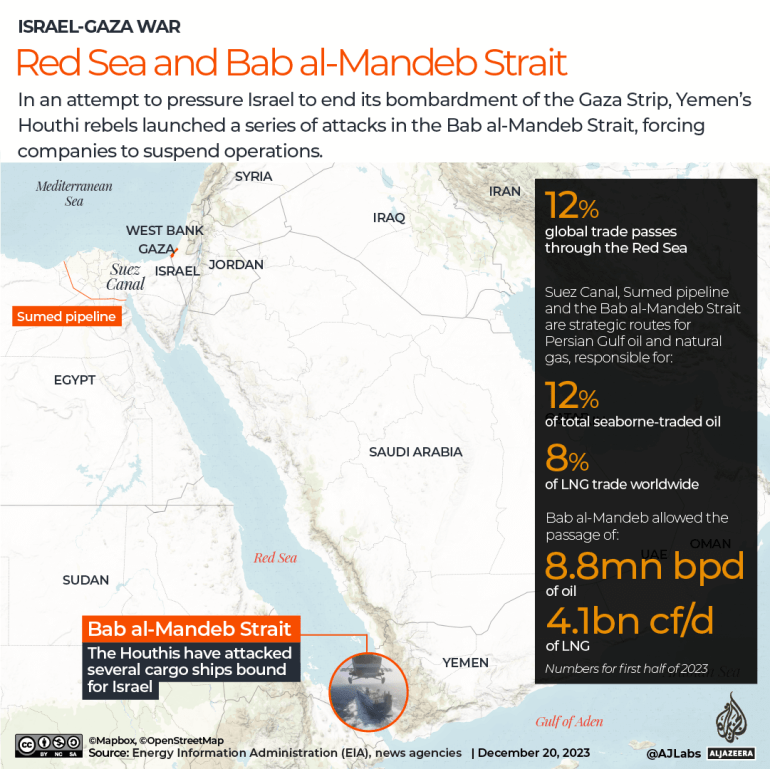
The US military said that it sunk three Houthi vessels in the Red Sea in a statement on Sunday, and killed 10 fighters of the Yemeni armed group after a clash in the middle of one of the world’s most important trade waterways. The escalation follows weeks of Houthi attacks on ships passing through the sea, ostensibly in a bid to pressure Israel to stop its devastating war on Gaza that has killed more than 21,000 Palestinians in the besieged strip. US destroyers have teamed up with a few other nations to try and stop the Houthi attacks in the Red Sea under Operation Prosperity Guardian — though several of its partners have distanced themselves from the initiative. The Red Sea clash on Monday was the first major direct military engagement between the US military and Houthi fighters. Here is what we know about how it all unfolded: What happened on Sunday? On Sunday at 6:30am Yemen time (03:30 GMT), the Denmark-owned and Singapore-flagged container ship Maersk Hangzhou issued a second distress call in a day, reporting being attacked by four “Houthi small boats”, the US Central Command (CENTCOM) posted on X. CENTCOM added that the Houthis tried to board the Maersk vessel that was sailing through the Southern Red Sea. In response to this distress call, helicopters from two warships, the USS Eisenhower and USS Gravely, flew towards the Maersk ship. CENTCOM said the crew of the USS Gravely destroyer first shot down two antiship ballistic missiles fired at the Maersk vessel. Why did the US sink Houthi boats? Four small boats then attacked the same cargo ship with small arms fire and Houthi fighters tried to board the vessel, the US Navy said. The US Navy said it then warned the fighters to stay away from the ship, at which point, the helicopters came under fire. The helicopters fired back, sinking three of the boats. Houthi crew members in the boats were killed. The fourth boat escaped the area and US personnel and equipment did not bear harm, CENTCOM added. “We’re going to act in self-defence going forward,” a White House official said. A spokesman for the Houthis confirmed that ten of their fighters were “dead and missing” after their boats were attacked. Iranian-backed Houthi small boats attack merchant vessel and U.S. Navy helicopters in Southern Red Sea On Dec. 31 at 6:30am (Sanaa time) the container ship MAERSK HANGZHOU issued a second distress call in less than 24 hours reporting being under attack by four Iranian-backed… pic.twitter.com/pj8NAzjbVF — U.S. Central Command (@CENTCOM) December 31, 2023 How have Maersk and other shipping firms reacted? Maersk announced on Sunday that it was pausing all sailing through the Red Sea for the next 48 hours. On December 27, it had scheduled several dozen container vessels to travel via the Suez Canal and the Red Sea in the coming days and weeks. Together with German shipping company Hapag-Lloyd, Maersk operates almost a quarter of the world’s shipping fleet. Other shipping firms have also responded to the escalating maritime conflict. Firms including CH Robinson, Evergreen, HMM, Ocean Network Express, Wallenius Wilhelmsen and Yang Ming Marine Transport are planning to avoid the Red Sea and increase the number of ships rerouting around Africa’s Cape of Good Hope rather than the Suez Canal. This new route is longer and costlier. Evergreen has also temporarily stopped accepting Israeli cargo. While these attacks have had a “fairly limited” impact on the oil market so far, experts postulate that prices could rise if the situation continues. Why are the Houthis attacking ships in the Red Sea? The Iran-backed Houthis began launching drones and missiles towards the southern parts of Israel in October soon after the war broke out on October 7. However, the drones were intercepted or fell short. In a change of tactic, the group started attacking ships in the Red Sea that they claimed were linked to Israel. Their attacks have disrupted many ships for making their way into Israel. On December 19, US Defense Secretary Lloyd Austin announced the establishment of a multinational maritime protection force to counter the Houthis. Despite this, the Houthis have said they will not back down unless Israel ceases its war on Gaza. Despite a multinational coalition agreeing to support the US cause, only the United Kingdom has directly contributed warships, leaving Washington to effectively “act alone” against the Houthis, reports Al Jazeera’s Resul Serdar from Djibouti on the edge of the Red Sea. Serdar added that the US has “not been able to deter the Houthis” so far, with the group waging attacks even more frequently. He added that the latest clash marked a serious escalation because the US not only sunk Houthi boats but also killed Houthi fighters. Such confrontations are sparking fears of a regional escalation of the war that could pull Yemen into the conflict. Adblock test (Why?)
Vouchers, border security, abortion: The issues you heard about in 2023 will continue to be hotly debated in 2024

After nearly a year’s worth of legislative sessions, several issues are poised to dominate Texas politics this year. Here’s a look at how things ended on several fronts last year — and where they’re headed next.
Israel’s war on Gaza: List of key events, day 87

EXPLAINER Israel rejects South Africa’s ICJ claim and the world protests on New Year’s Eve – here are the latest updates. Here’s how things stand on Monday, January 1, 2024: Latest updates Israel has rejected South Africa’s recent case filed in the International Court of Justice against Israel. The Israeli government voted on Sunday to postpone municipal elections, originally scheduled for January 30, to February 27, according to local media. A total of 688 candidates for 144 cities and towns are currently serving in army reserves. Israel’s Finance Minister Bezalel Smotrich reiterated his call for the “voluntary migration” of Palestinians from Gaza. “They want to leave. They have been living in a ghetto for 75 years and are in need,” said Smotrich. Shipping giant Maersk announced a temporary halt in operations through the Red Sea on Sunday following a missile attack on a vessel by Yemen’s Houthi rebels. Human impact and fighting: The Government Media Office in Gaza says it recorded 1,825 Israeli “massacres” in the strip in the past 85 days. Israeli attacks resulted in 28,822 people killed or missing, including 9,100 children, the Government Media Office added. Hamas’s military wing, the Qassam Brigades, has said it has fired at least 20 rockets towards Israel. This comes as Israel says it’s going to prolong its war on Gaza, reported Al Jazeera’s Laura Khan from East Jerusalem. Turkey’s Ministry of Health posted on X on Sunday that it received 292 wounded and sick from Gaza for treatment. The Israeli attacks in Gaza continue. The Palestinian Red Crescent Society says that several people have been killed and injured during Israeli shelling in the Beach Street area of Khan Younis, south Gaza. At least 68 Palestinians were killed in new Israeli air strikes in Gaza on Sunday. Former Palestinian Minister of Awqaf and Religious Affairs Yousef Salameh was killed in an Israeli air strike that targeted his home in central Gaza on Sunday, according to Palestinian news agency Wafa. Israeli warplanes have also targeted civilians in the eastern Gaza district of Zeitoun, Wafa reported. Israeli attacks have also affected civilians in the Maghazi and Nuseirat refugee camps in Gaza, reported Wafa. New Year’s Eve protests: Residents of Ramallah took to the streets on New Year’s Eve to demonstrate in solidarity with the Palestinians in Gaza, Al Jazeera’s Imran Khan reported from Ramallah in the occupied West Bank. Protest actions for Palestine on New Year’s Eve were also held in communities around the world, including Pakistan, Turkey and Iraq. The UN refugee agency, UNRWA, said that the year 2023 brought devastation and tragedy to Palestinian refugees on Sunday. The UN’s World Food Program reiterated its call for a long-term ceasefire and unhindered humanitarian aid access in the beleaguered Gaza strip in an X post on Saturday. As we count down to a new year, there is a different kind of countdown in #Gaza. We are racing against time to avert a complete collapse of even the most basic services and starvation for millions. Only a long-term ceasefire and unhindered humanitarian access can end this. pic.twitter.com/AU7EPHTAyn — World Food Programme (@WFP) December 30, 2023 Raids in the West Bank Israeli forces have continued to raid areas in the occupied West Bank including el-Bireh city in the south of Qalqilya; Biet Iba west of Nablus; Beit Ummar north of Hebron and Barta’a in Jenin. Wafa reports that Israeli forces injured a young Palestinian man with live bullets and detained a man in his 60s, along with his son, during an Israeli military raid on the town of Bani Naim, east of Hebron. Israeli settlers attacked Palestinian shepherds in Masafer Yatta area, south of Hebron, Wafa reports. Wafa also reported that Israeli occupation forces on Sunday evening detained two teenagers — Nasr Jihad Mansour, 17, and Mohammad Rizq Mansour, 16 — from the town of Deir Istiya, northwest of Salfit, which is in the central West Bank. Adblock test (Why?)
Kenyan farmers battle toxic legacy of locust plague three years on

Garissa, Kenya – In January 2020, one of the biggest locust plagues to hit the Horn of Africa in 70 years landed in Garissa, a remote town in northeastern Kenya near the Somali border. The region is honeycombed with small-scale croplands growing mostly maize and an array of produce – tomatoes, watermelons, bananas, lemons – belonging to farmers such as Mohammed Adan. As millions of locusts descended, devouring all living flora in sight, Adan and his fellow farmers were horrified. This region is no stranger to locusts––the United Nations Food and Agriculture Organization (FAO) even has a designated Desert Locust Control Committee (DLCC) to mitigate periodic damage from locusts. Still, mayhem ensued during the plague. The FAO spearheaded a “Desert Locust” campaign with a budget of more than $230m, in partnership with the World Bank and World Food Programme. Together, they aided Kenya’s Ministry of Agriculture in spraying a cocktail of pesticides across 100,000 hectares (250,000 acres) of land, home to 26,650 households. Adan, responsible for a family of 11, was relieved to receive such support, as were his neighbours. After a rushed, impromptu workshop hosted by a government agricultural extension officer, where they learned how to mix the pesticides with water to fill knapsack sprayers, the farmers set off to save what was left of their crops. But the farmers say they were not briefed on what kind of chemicals they were given, nor provided with any protective gear. Amidst the frenzy, Adan sloshed some of the concoction across his torso. He did not think much of it at the time. It was hours before he rinsed himself off with water, and weeks before he started feeling really sick with abdominal pain, nausea, and an inability to pass urine. Thus began a long journey of being shuttled in and out of hospitals. Now, three years later, he is facing the possibility of a sixth surgery. “It’s hard to calculate how much the damages came to,” 28-year-old Abubakar Mohammed (Abu), one of Adan’s sons, tells Al Jazeera. “A lot of it can’t be [quantified].” Mohammed Adan in his grove of mangoes at his Garissa farm. Despite selling most of his camels to cover his medical bills for six surgeries, he is not sure that his health will ever be the same after chemical poisoning from pesticides [Kang-chun Cheng/Al Jazeera] Bureaucratic aftermath The Ministry of Agriculture has denied issuing pesticides to farmers; Ben Gachuri, a communications officer in Garissa told Al Jazeera by telephone that it was “impossible that farmers could have been instructed to spray [pesticides] themselves” and that in the “three years since the final spraying, no one has ever come forward with complaints about suffering effects from the pesticides”. FAO representatives declined to publicly release reports about documented user errors and exact pesticide makeup information, or their procurement procedure. The East Africa regional office emailed a statement downplaying FAO’s role in selecting products – authorised or not. They also denied the possibility that untrained community members were involved, insisting that only “well-trained/properly equipped teams undertake controls, not communities or farmers”. In March 2023, the DLCC hosted a meeting in Nairobi to tout its success in salvaging northern Kenya’s food security. The meeting, according to Christian Pantenius, a former FAO staff member who attended, failed to address multiple errors internally admitted by the FAO as part of their 2020 spraying campaign in Kenya and Ethiopia. “I was so, so disappointed,” Pantenius, who worked as an independent consultant coordinating the campaign, told Al Jazeera. “It was a massive missed opportunity.” Farmers in Garissa, Kenya stand on the banks of the Tana River, which they pipe water from for their crops [Kang-chun Cheng/Al Jazeera] Of the 193,600 litres (51,000 gallons) of pesticides the FAO procured for the Kenyan government, 155,600 litres were organophosphates such as fenitrothion and chlorpyrifos. These chemicals have been banned for use on food or feed crops across most Western countries for their proven neurological toxicity to humans and ecological devastation. Still, the FAO procured and distributed them to untrained community members against the advice of its own independent advisory body, the Locust Pesticide Referee Group (LPRG). In a 2021 report, the LPRG expressed uneasiness about FAO’s choice of outdated chemicals: “In view of increasing concerns about the use of synthetic insecticides and the absence of new products evaluated for locust control, emphasis should be given to the least toxic compounds already evaluated in relation to human health and environmental impact.” “If countries decide to use pesticides that are not supported by the FAO, such as carbofuran, they are within their rights. The FAO will just not use them in campaigns it runs itself,” said James Everts, an ecotoxicologist with the LPRG, in an email interview with Al Jazeera. “A compound like fipronil – banned in the UK, approved in the US, Australia, Belgium, and the Netherlands – is extremely effective against locusts. However, large-scale, long-term observations have shown that there is a long-term threat to ecological key organisms.” The FAO’s East Africa office dismissed these concerns from its own advisory body and has insisted all pesticides were procured through official channels and are technically legal, according to Kenya’s Pesticide Control Board listing. An internal report dated September 2020 that Al Jazeera obtained from sources at the Ministry of Agriculture showed that the FAO did not conduct required environmental and social impact assessments as per Kenya’s environmental laws. The report condemned the lack of communication with communities on the ground regarding when the pesticides were sprayed. In northern Kenya’s Samburu County, fenitrothion – banned in New Zealand in 2016 – was found to be used by “non-trained personnel” wielding motorised and knapsack sprayers. The rate of application was also dangerously high: 34 litres per hectare, far more than the recommended rate of 1 litre per hectare. Spraying had also been done on a rainy day, spiking risks of chemical run-off. High honeybee mortality was observed shortly afterwards. Mohammed Adan has scars from multiple surgeries in the attempt