

Can the US-led maritime force stop Yemen’s Houthi attacks during Gaza war?
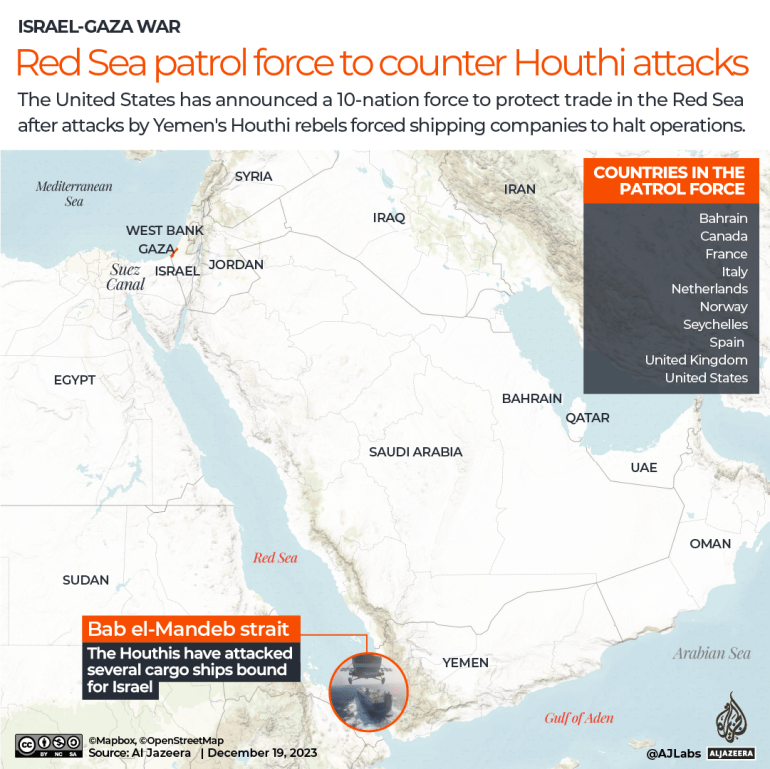
The United States has announced the establishment of a new multinational maritime security force in response to attacks on ships launched by Iran-aligned Houthi rebels in Yemen. The initiative is aimed at ensuring ships can pass through busy waterways near Yemen safely as the Houthis have been targeting vessels in protest of Israel’s war on Gaza, which has killed more than 19,000 Palestinians. But what will the task force do, how will it work and how effective could it be? What is the new force? US Defense Secretary Lloyd Austin announced the establishment of a 10-country force on Tuesday in Bahrain. In addition to the Arab nation, the United Kingdom, Canada, France, Italy, the Netherlands, Norway, the Seychelles and Spain have agreed to join Washington in the new mission. Some of the countries are expected to conduct joint patrols in the southern parts of the Red Sea, the Bab al-Mandab Strait and the Gulf of Aden while others will support the force by providing intelligence. The mission will be coordinated by Combined Task Force 153 (CTF 153), an existing force under a US-led joint effort established in April 2022 with the aim of improving maritime security in the area. The existing framework has 39 member nations, and there are reports that other countries could join or have already agreed to join the newly formed 10-member maritime effort but don’t want it publicised. The Houthis have promised to stand up to any US-led efforts and only stop their attacks once Israel stops its war in Gaza. They have signalled they are open to talks, but diplomacy has so far failed to stop their attacks. For its part, Iran has warned Washington that its joint maritime effort will face “extraordinary problems”. [embedded content] How disruptive are the Houthi attacks? The Houthi group, also known as Ansarallah, started its operations against Israel by launching missiles and drones on the southern parts of Israel, including the port and tourist city of Eilat, in October soon after the war started. Most of the projectiles were intercepted by Israeli and US defences or fell short due to the roughly 2,000km (1,240-mile) distance between the two countries. So the Houthis changed tactics, instead focusing on ships near their shores. They have since been firing missiles and launching attack drones at commercial ships that they claim are linked to Israel and seized a vessel last month that they are still holding in a Yemeni port. Their attacks have stopped many ships from making their way to Israel. At least 12 shipping companies have suspended transit through the Red Sea due to these safety concerns. They include some of the largest in the world: Denmark’s AP Moller-Maersk, Germany’s Hapag-Lloyd, the Italian-Swiss Mediterranean Shipping Company and France’s CMA CGM. Is a new oil crisis brewing? Markets, including the oil and gas market, have increasingly reacted to the attacks, especially considering the volume of cargo being redirected. For instance, Maersk and Hapag-Lloyd together operate almost a quarter of the world’s shipping fleet. Bab al-Mandab, the narrow waterway that separates Eritrea and Djibouti on the Horn of Africa from Yemen on the Arabian Peninsula, is where 10 percent of the world’s seaborne crude oil travels. More than 17,000 ships pass through it each year. It is less than 20km (12 miles) wide, far narrower than the more than 200km (124 miles) of the northern parts of the Red Sea. The direct impact on oil prices has been relatively limited so far, but experts have warned that things could significantly escalate if the attacks continue and security remains an issue. Insurance premiums and prices of oil and gas products are expected to rise if the conflict is not resolved. How will the task force provide protection to ships? Some of the member nations of the task force have warships in the Red Sea. Two US navy destroyers, the USS Carney and USS Mason, are sailing through the Bab al-Mandab Strait. The idea is for the warships to serve as a deterrent to Houthi attacks and to stop them when possible. The naval ships won’t necessarily escort commercial vessels through the Red Sea but will be on standby to respond to attacks. Will the task force be able to stop Houthi attacks? It’s complicated. Houthi fighters landed a helicopter on a ship last month to capture it. The presence of task force military vessels nearby could make a repeat of such a move harder. The task force’s warships could also strike down incoming missiles from Yemen, just as they have intercepted rockets headed towards Israel. But even Israel’s much-touted Iron Dome missile defence system doesn’t have a 100 percent track record of stopping incoming rockets. So far, the US has not fired back at Yemen. At this point, the markets appear unconvinced that the task force will be able to protect shipments through the Red Sea. On Tuesday, Maersk said it was rerouting its ships around Africa to avoid sending them through the Bab al-Mandab Strait. [embedded content] Adblock test (Why?)
‘We have a duty’: US doctor says ceasefire an ‘ethical imperative’ in Gaza

Of all the doctors and medical personnel killed in Gaza this year, Dr Osaid Alser estimates he knew half personally. Alser, a researcher and resident at the Texas Tech University Health Sciences Center in the United States, grew up in Gaza City, Palestine’s largest city. He started his medical career there, starting as a student and eventually becoming a teacher himself. But since the start of the war in Gaza on October 7, Alser has watched as Israeli bombs have rained down on his hometown and military forces have stormed into medical centres. The result has been the near collapse of Gaza’s healthcare system. Only 11 hospitals — a third of those in the enclave — remain operational, with dwindling amounts of fuel and medical supplies. Faced with the death and destruction in Gaza, Alser felt compelled to speak up. “We have a duty to say: Stop the war and ceasefire now,” he told Al Jazeera. To him, calling for a ceasefire was an ethical imperative, not a political statement. But not all healthcare providers feel the same way. Many feel an obligation to avoid commenting on conflicts, as part of a tradition that views medical workers as above the fray. However, the intensity of the war — and its particular toll on Gaza’s health system — have spurred some to ask: When do medical professionals have a responsibility to speak out? Palestinians inspect the damage following an Israeli raid at the Kamal Adwan Hospital in the northern Gaza Strip [Fadi Alwhidifa/Reuters] Debating ‘medical neutrality’ The debate erupted last month with a meeting of the American Medical Association (AMA), the largest professional organisation for physicians in the US. Its House of Delegates, which sets the organisation’s policies, declined to debate a resolution that would have called for a ceasefire in Gaza. According to the publication MedPage Today, some of the delegates felt the resolution would force them to decide whether the conflict in Gaza was a “’just war’ or ‘unjust war’”. That, they said, was not their role. The concept of so-called “medical neutrality” stretches back to a history of civilian involvement in battlefield medical care, with some volunteer nurses tending to the sick and wounded on both sides of a conflict. International law has since developed to protect the roles healthcare workers have in warfare, making it a war crime to intentionally attack medical personnel. But “medical neutrality” does not necessarily mean impartiality. And some medical ethicists point out that the scale of the Gaza conflict has raised dire questions. “The concern that a lot of people are having is that this is not business as usual,” Harold Braswell, an associate professor of healthcare ethics at Saint Louis University, told Al Jazeera. “Israel has dropped an enormous amount of bombs on a highly condensed civilian area in a very, very short period of time. And that has created a very, very urgent situation.” A unique circumstance Gaza, a narrow strip only 11km (7 miles) wide and 40km (25 miles) long, is home to 2.3 million people. Palestinian health authorities estimate that at least 19,453 people have been killed, two-thirds of them women and children. A further 1.9 million have been displaced, with tens of thousands living in the streets of Rafah after Israel ordered civilians to flee south. Humanitarian organisations have warned of healthcare workers being killed, as bombs drop on hospitals and ambulance convoys. Alser, the doctor in Texas, has taken it upon himself to sketch out the scale of the impact. He and his brother, also a doctor, launched an initiative last month to track the number of healthcare workers killed. So far, they have documented 278 killed since the start of the war. That includes 104 physicians, 87 nurses and 87 others working in various medical roles. “That includes a lot of my friends, my mentors, even my own medical students that I taught back in 2017, who went on to become doctors and have been killed,” Alser said. 6.12.2023 Update: IOF murdered 278 healthcare workers and kidnapped 41 just in the past 60 days.#NotATarget #Palestine #Gaza #Gaza_Genocide #WarCrimes #CeasefireNOW #WestBank #freedom #freepalestine #Palestine_Genocide #Gaza_Holocaust pic.twitter.com/kykaAaK6SX — Healthcare Workers Watch – Palestine (@HCWWatch) December 7, 2023 “We’ve been documenting the names of course, because they’re not just numbers, and we’re posting their stories from people we know and trust on the ground.” In addition, Israel has detained more than 40 health workers, including Dr Muhammad Abu Salmiya — the director of Gaza’s largest hospital, al-Shifa — and Alser’s former student, Dr Saleh Eleiwa. The rising numbers left Alser feeling no choice but to speak out. “I just felt like we absolutely have to talk about this,” he said. “So that’s really the motivation: Seeing our colleagues, friends, family being killed — doctors, professionals who just work in medicine [and] go home after they work for many, many hours and they get killed.” Rising calls for a ceasefire Alser is not alone. The American Public Health Association (APHA), the largest professional body for public health workers in the US, issued an appeal last month for an immediate ceasefire, amid pressure from its members. Healthcare labour unions and advocacy groups have likewise called for a ceasefire. And more than 100 faculty members at public health and medical schools signed a letter this month urging the US government to support a ceasefire. US President Joe Biden has thus far avoided pressing for a ceasefire, citing Israel’s right to “defend itself” after the Hamas attack on October 7. But members of the medical community are divided over how much pressure to place on Israel and whether its acts of war have reached a threshold that demands a unified ethical stance. Much of that division has centred on whether the attacks on healthcare centres in Gaza amount to war crimes. In a widely circulated opinion piece published in the Journal of the American Medical Association, Dr Matthew Wynia argued that health professionals do indeed have a responsibility to speak out
Why 141 India opposition MPs suspended from parliament?
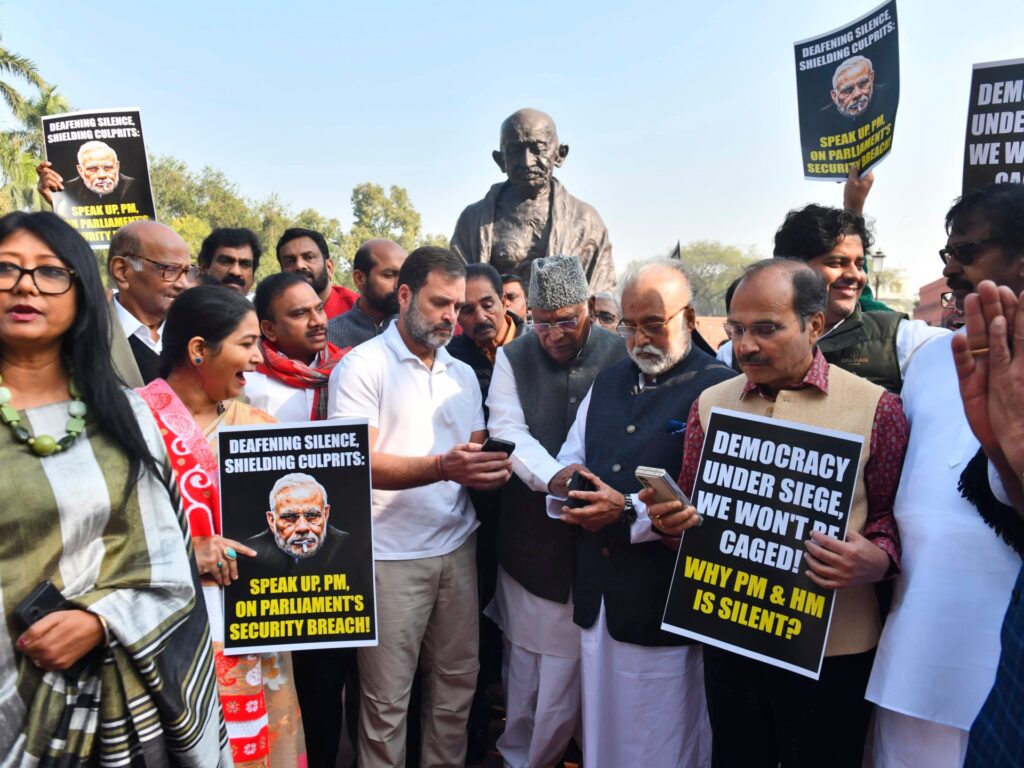
Forty-nine Indian opposition lawmakers, who have been demanding a debate on a December 13 parliament security breach, were suspended from the legislature on Tuesday for allegedly disrupting House proceedings. Tuesday’s government action came a day after 78 opposition members of parliament were suspended from the remainder of the crucial Winter Session of the parliament. In total 141 lawmakers – 95 from the lower house (Lok Sabha) and 46 from the upper chamber (Rajya Sabha) – have been suspended since December 14. The opposition has dubbed the government move a “mockery of democracy”, as important legislation will be passed without any debate undermining parliamentary democracy. The opposition has been demanding a debate on the security breach on December 13, when two men had jumped into the chamber of the lower house from the visitors’ gallery and opened gas canisters. Their visitor’s pass was provided by a legislator from the governing Bharatiya Janata Party (BJP). “A complete purge is being executed so that draconian Bills are passed without any meaningful debate, and so that the BJP MP who facilitated the entry of the two intruders into the Lok Sabha on December 13th goes scot-free,” Congress Member of Parliament Jairam Ramesh posted on X, formerly known as Twitter. Prime Minister Narendra Modi has promised to investigate the matter but rebuked the opposition for demanding the debate. Here is what to know: Why did India suspend 141 lawmakers? Presiding officers of the upper and lower house suspended the opposition lawmakers for disrupting proceedings after the legislators demanded a discussion and a statement from Home Minister Amit Shah regarding last week’s security breach during which two men opened gas canisters inside the lower house chamber while a man and woman opened smoke canisters outside the parliament in the capital New Delhi. Police filed charges against five individuals in connection with the breach that has triggered a political row, with the opposition accusing the government of failing to provide security on the 22nd anniversary of a deadly attack on the parliament. The speaker of the lower house, Om Birla, has said that security is his responsibility and is conducting a review. He has blamed the MPs for breaking the rules of the House. The federal home ministry is also investigating the breach. Political analysts have questioned the suspensions. “MPs have all the right to seek answers and hold the government accountable to the parliament,” academic and author, Apoorvanand, told Al Jazeera. He said that the government justified the move saying that the opposition was suspended for creating a ruckus and being unruly, hindering the functioning of the parliament. The government plans to introduce contentious bills to replace the existing criminal laws in parliament without two-thirds of the opposition members present in the House. Apoorvanand, the academic, said that the prime minister’s refusal to interact with the opposition undermines democracy which is “the dialogue between majority and minority”. Was the move politically motivated? The suspension essentially emptied the parliament of the opposition, with analysts saying the mass suspensions are unprecedented and in line with Modi’s authoritarian style of functioning. Critics have said the current government has misused investigating agencies and other institutions to target opposition leaders. “Is it only the opposition that is involved in corrupt practices?” Apoorvanand asked. “There have been numerous cases where [investigation agencies] ED [Enforcement Directorate] or CBI [Central Bureau of Investigation] start an investigation against certain politicians who then join the BJP and the investigation stops.” A firebrand opposition legislator Mahua Moitra, who is known for her sharp questions in parliament, was expelled over an allegation of misconduct. She has deemed her expulsion politically motivated. She has approached the country’s top court against her removal. Main opposition leader Rahul Gandhi’s parliamentary membership was cancelled after he was convicted in a defamation case by a local court in Gujarat state – Modi’s home state. Gandhi returned to the parliament after his conviction was overturned by the Supreme Court in August. The governing party has justified the government’s actions saying the opposition is corrupt and power hungry. The lawmakers are gone, how will the parliament function? Parliamentary processes can carry on, following the suspension of the opposition lawmakers, as the quorum of 10 percent will be met by the governing party and its allies with an overwhelming majority. While bills are typically passed following a discussion in parliament, they have been passed without any discussion numerous times in the past. “Using the power of numbers to throttle all other voices is contrary to democratic principles,” academic Apoorvand said. What did the Indian government say? Modi, in an interview with a Hindi-language newspaper, said what had happened was very serious and there should be a detailed investigation into it, but “there was no need to debate this”. What has the opposition said? Opposition lawmakers reacted by saying the government was being dictatorial. They continue to protest “against the murder of democracy and violation of the dignity of Parliament” through silent demonstrations, Mallikarjun Kharge, president of the main opposition Congress party, on Tuesday posted on X. Took part in a protest along with INDIA MPs at New Parliament gate against historic suspension of almost all the Opposition MPs from both houses–Lok Sabha and Rajya Sabha. pic.twitter.com/Fo4W9FaVzM — Samirul Islam (@Samirul65556476) December 19, 2023 “First, intruders attacked Parliament. Then Modi govt is attacking parliament & democracy,” Kharge, on Monday, said on X. “With an opposition-less parliament, the Modi govt can now bulldoze important pending legislations, crush any dissent, without any debate.” First, intruders attacked Parliament.Then Modi Govt attacking Parliament & Democracy All Democratic norms are being thrown into the dustbin by an autocratic Modi Govt by suspending 47 MPs. We have two simple and genuine demands – 1. The Union Home Minister should make a… — Mallikarjun Kharge (@kharge) December 18, 2023 Rajya Sabha member Manoj Jha also condemned the government, deeming the suspension a badge of honour. “Congratulations to Modi ji on an opposition-mukt [opposition-less] Parliament,” Jha said. Adblock test (Why?)
INDIA bloc meeting: Seat-sharing to be decided soon, exercise to start at state-level

While the TMC insisted during the fourth meeting of the INDIA parties here on Tuesday that the seat-sharing should be finalised by December 31, the Congress asserted it could be sealed by the second week of January after all issues are ironed out smoothly.
Trump edges Biden again in new 2024 poll, builds support with younger voters
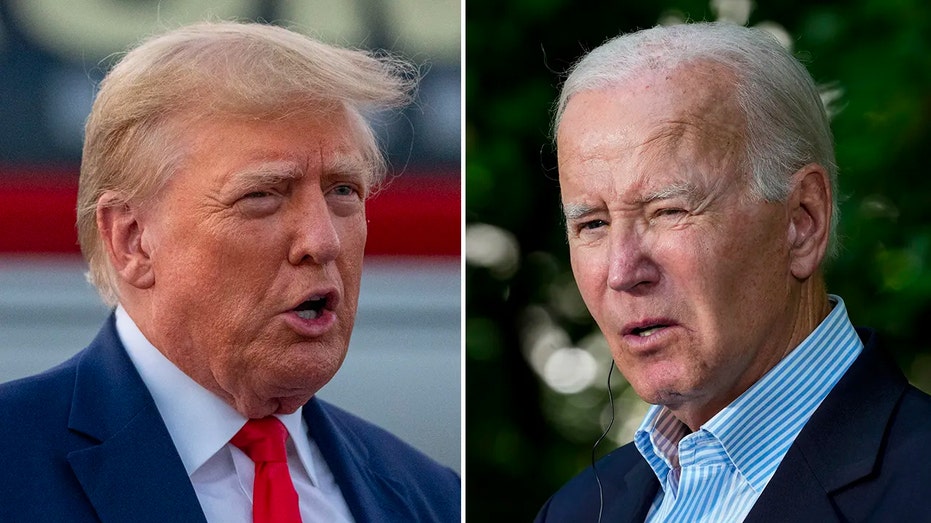
A new national survey by the New York Times and Siena College is the latest to indicate former President Trump edging President Biden in an increasingly likely 2024 general election rematch. Additionally, the survey suggests that the president is losing support among younger Americans – a key constituency for Democrats – due to his handling of the Israel-Palestinian war in Gaza. According to the poll, which was released on Tuesday, Trump edges Biden 46%-44% among registered voters nationwide. However, in a very early look at next November’s presidential election, Biden holds a razor-thin 47%-45% margin over Trump among those likely to vote in the 2024 contest. BIDEN APPROVAL SINKS TO NEW ALL-TIME LOW IN NATIONAL POLL The 81-year-old Biden once held the upper hand over the 77-year-old Trump in 2024 rematch surveys, but Trump began enjoying an advantage over his successor in the White House in most polls starting in October. The poll indicates that nearly three-quarters of voters ages 18-29 – a key part of the Democratic base that helped boost Biden to over then-President Trump in the 2020 election – disapprove of the way Biden is handling the conflict in Gaza. HEAD HERE TO CHECK OUT THE LATEST FOX NEWS POLLING Younger voters questioned in the survey say they would back Trump 49%-43% over the president. That is a dramatic switch from June, when a previous Siena College poll for the New York Times pointed to Biden holding a 10-point lead. Among registered voters overall, by a 46%-38% margin, they said Trump would do a better job than Biden handling the Israel-Palestinian fighting. The new survey also indicates Biden’s approval rating slipping to 37% support among registered voters. The president stood at 34% approval in a Monmouth University poll released on Monday, an all-time low in Monmouth polling since Biden took over the White House nearly three years ago. Biden stood at 37% approval – an all-time low – in a Wall Street Journal survey released earlier this month. However, a new Fox News national poll released on Sunday indicated Biden’s approval rating at 43%. The approval rating is a key indicator of a president’s performance, clout and popularity and is a closely watched metric, especially when an incumbent in the White House seeks a second term. Get the latest updates from the 2024 campaign trail, exclusive interviews and more at our Fox News Digital election hub.
Biden admin hit with legal challenge over gas appliance crackdown
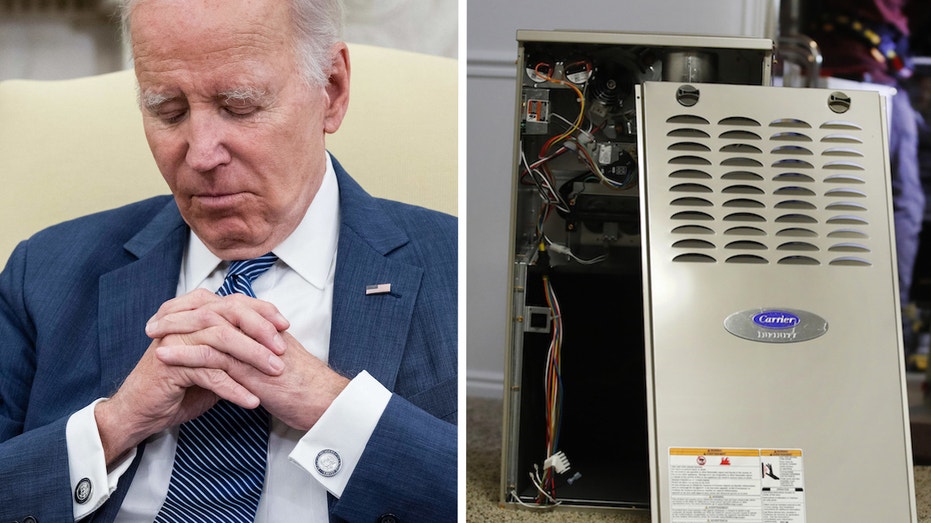
The natural gas industry is challenging the Biden administration over its regulations targeting traditional gas-powered residential furnaces, which a rulemaking energy groups says will impact more than half of all U.S. households. Led by the American Gas Association (AGA), whose members provide natural gas to more than 74 million customers nationwide, several trade associations and one manufacturer filed the legal challenge late Monday against the Department of Energy (DOE) over the regulations, which were finalized in late September. The groups argued the agency’s action effectively bans the sale of a large swath of furnaces enjoyed by consumers. “AGA has attempted to work with the Department of Energy to address the rule’s profound impacts on consumers and homeowners with a solutions-oriented approach to energy conservation that protects consumers and ensures continued availability of low-cost, low-emission natural gas furnaces,” AGA President and CEO Karen Harbert said in a statement. “Unfortunately, our 114 pages of comments have been summarily ignored.” “This ruling from DOE will push American families with natural gas heat into a corner — when their furnace goes out, they’ll be forced to choose between retrofitting for electric with the increased month-to-month utility bills that entails or engaging in a costly and time-consuming renovation to retrofit their home for a completely different type of natural gas furnace,” she continued. BIDEN INVOKES WARTIME POWERS TO FUND ELECTRIC HEATERS AS HE CRACKS DOWN ON GAS APPLIANCES Harbert added that as a result of the regulations, families and businesses will be “saddled with increased costs with little environmental gain.” The DOE’s finalized regulations, which are slated to go into effect in 2028, specifically require furnaces to achieve an annual fuel utilization efficiency (AFUE) of 95%, meaning manufacturers would only be allowed to sell furnaces that convert at least 95% of fuel into heat within six years. The current market standard AFUE for a residential furnace is 80%. EXPERTS WARN BIDEN ADMIN’S WATER HEATER CRACKDOWN WILL HIKE PRICES, REDUCE CONSUMER CHOICE Because of the stringent AFUE requirements, the regulations would largely take non-condensing gas furnaces — which are generally less efficient, but cheaper — off the market. However, consumers who replace their non-condensing furnace with a condensing furnace after the rule is implemented face hefty installation costs. Overall, AGA has estimated the DOE regulations would remove up to 60% of current residential furnaces off the market. Additionally, AGA said on Monday that the regulations impact 55% of American households and would lead to higher costs for 30% of senior households, 27% of small businesses and 26% of low-income households. DOE Secretary Jennifer Granholm has defended the regulations, and a slew of other Biden administration actions targeting popular home appliances, by arguing they will lead to more efficient appliances, lower costs and reduced carbon emissions. “At the direction of Congress, DOE is continuing to review and finalize energy standards for household appliances, such as residential furnaces, to lower costs for working families by reducing energy use and slashing harmful pollutants in homes across the nation,” she said after finalizing the furnace regulations on Sept. 29. According to the DOE, altogether, its past and planned appliance regulations will save Americans $570 billion and reduce greenhouse gas emissions by more than 2.4 billion metric tons over the next 30 years.
Hawaii Gov. Green proposes $425M recovery budget for Maui after devastating wildfires

Hawaii Gov. Josh Green on Monday said he was requesting $425 million from lawmakers during the next fiscal year to help Maui recover from August’s wildfires — and millions more to reduce the risk of wildfires statewide. The proposed budget is Green’s first since a fast-moving wildfire killed at least 100 people and destroyed Maui’s historic town of Lahaina on Aug. 8. “We took to heart our need to care for those who lost everything on Maui. We’re going to make them whole. We’re going to help them survive,” Green said at a news conference. HAWAII GOV JOSH GREEN SAYS ‘VERY REAL’ GLOBAL WARMING CAUSED CONDITIONS FOR DEADLY WILDFIRE The blaze displaced about 12,000 people, half of whom are still living in hotels due to a severe housing shortage on the island. Wildfires have long been relatively rare in Hawaii, which is better known for a lush landscape of rainforests and waterfalls. But climate change has increased the frequency and intensity of droughts, raising the risk of wildfires on the islands. The federal government is covering the expenses for much of Lahaina’s clean-up and emergency housing. Green said that while it will cost more than $5 billion to recover from the fire, the state’s share will be about $500 million. The governor’s proposals are for the fiscal year beginning July 1. Lawmakers will consider the proposals when they draft the state’s budget during the legislative session set to start on Jan. 17. The proposals include: 1. $200 million for anticipated Maui insurance claim payments 2. $186 million for other recovery costs as they arise 3. $10 million for fire and emergency response equipment for the state’s Department of Land and Natural Resources, which is responsible for state forests, with $7.4 million to go to the same department for fire response and prevention efforts 4. 20 positions to work on firebreaks, fire assessments and wildfire matters at the Hawaii Emergency Management Agency 5. $33 million, mostly from federal funds, to repair and rebuild state highways in Lahaina In addition to fire response, Green proposed spending $22 million on housing for older adults in Honolulu, $10 million for Hawaii Public Housing Authority building improvements and $30 million in tax breaks for families with children in preschool. LAHAINA RESIDENTS PETITION HAWAII GOV. JOSH GREEN TO DELAY TOURISM REOPENING The governor said he didn’t dip into the state’s $1.5 billion rainy day fund. He said this fund, plus at least $500 million surplus expected at the end of the fiscal year, will give the state a cushion. This gives the state a higher credit rating and allows it to float bonds at lower interest rates, Green said. The tax revenue outlook for Hawaii hasn’t been as bleak as initially feared — even though after the fire, tourism dropped sharply on Maui, which is one of the state’s biggest hubs for visitors. Carl Bonham, the executive director of the University of Hawaii Economic Research Organization, said last week the state has had several months of strong tax revenue growth lately, in large part due to income taxes. Excise tax and transient accommodations tax revenue — both of which are heavily influenced by the number of travelers to the state — have been weak as expected, he said. The state Council on Revenues, which predicts tax revenue for the governor and Legislature, is scheduled to meet on Jan. 8 to update its forecast.
Unveiling Australia’s Marvels: A Tailored Adventure for You

Embark on your Australian adventure seamlessly – explore tailored Australia tour packages from India with a Diplomat Visa.
Your one stop social media solution: The best and cheapest SMM PANEL support through Marketerum

You should use Marketerum’s SMM PANEL as your primary resource for all social media-related tasks.
Over 500 elected officials have endorsed DeSantis as presidential battle heats up ahead of Iowa caucuses
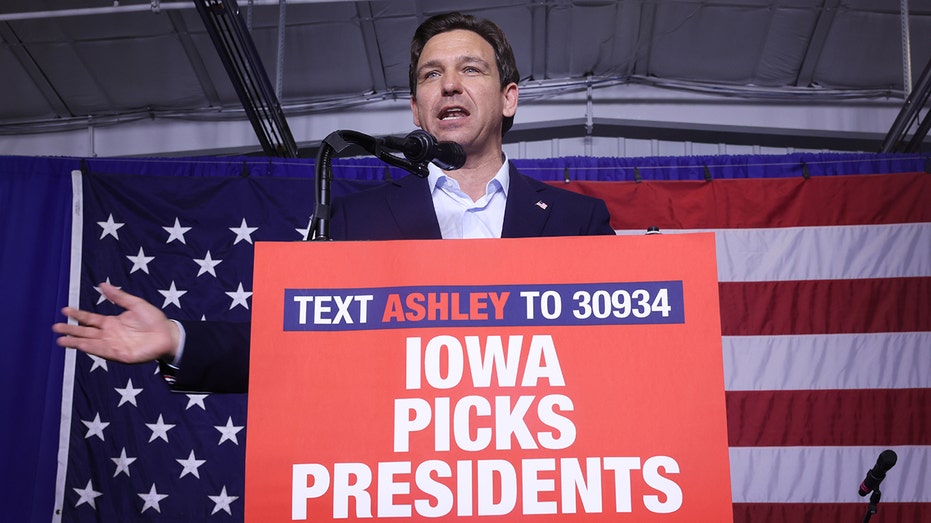
FIRST ON FOX: Florida Gov. Ron DeSantis’s presidential campaign has now received the endorsements of over 500 elected officials across the United States as the governor campaigns this week in Iowa with several of those supporters including GOP Rep. Chip Roy. As of Tuesday, the DeSantis campaign tells Fox News Digital that 543 current and former elected officials at the federal, state, and local levels have endorsed him for president as part of a list that shows the “significant strength of his momentum in early states.” The DeSantis campaign published a map on its website outlining where all the more than 500 endorsements from elected officials came from which includes 97 elected officials in Iowa, 63 in New Hampshire, and 68 in South Carolina. Rep. Roy, who will be joining DeSantis on the campaign trail in Iowa this week, told Fox News Digital he is looking forward to “barnstorming Iowa with Ron and Casey this week as they put in the hard work needed to win the Iowa Caucus.” WATCH: DESANTIS’ TOP MOMENTS ON ISRAEL, IMMIGRATION, TRUMP AND HALEY AT CNN TOWN HALL: ‘AN EASY ANSWER’ “I fully endorse Ron Desantis because it’s time for a new generation of leadership, and he is the candidate who will deliver for Americans,” Roy said. “Reining in reckless spending, securing our border, and ending the weaponization of government once and for all. In addition to Roy, DeSantis was joined by GOP Congressman Thomas Massie of Kentucky in Iowa for an event on Saturday and Oklahoma’s Republican Gov. Kevin Stitt is hitting the campaign trail for the Florida governor at events in Iowa on Wednesday and Thursday. DESANTIS ARGUES TRUMP ‘WILL SAY IT’S STOLEN, NO MATTER WHAT’ IF FORMER PRESIDENT LOSES IN IOWA OR NH “Iowans will hear directly from these national leaders who’ve seen first-hand Ron DeSantis fight the tough battles against the left and deliver big wins for conservatives,” DeSantis communications director Andrew Romeo told Fox News Digital. “They’ll make sure there is no doubt in the minds of Iowans that Ron DeSantis will deliver on his promises to stop the invasion at our southern border, restore our economy, and revive America.” DeSantis, who recently earned the coveted endorsements of Iowa Gov. Kim Reynolds and evangelical leader Bob Vander Plaats, currently sits at 20% in Iowa, according to the Real Clear Politics average. Former President Donald Trump’s polling average is 52% and former ambassador Nikki Haley is at 15.8% rounding out the top 3.